
Diamond price is calculated on a price-per-carat basis, not a flat per-stone price — a base rate for the stone's carat weight, color, clarity, and cut combination is multiplied by the carat weight, then adjusted up or down for shape, certification, fluorescence, and current market conditions. There's no single public "diamond price calculator" tool the trade relies on; instead, dealers work from benchmark price lists and apply a percentage discount or premium against them based on the specific stone in front of them.
That's the short version, and it's also where most explanations of diamond pricing stop — which is a problem for buyers trying to actually reason about what a quote should look like. This guide goes further: how the price-per-carat model works and why it isn't linear, how each of the 4Cs moves price independently, why those four factors interact multiplicatively rather than adding up, what a Rapaport-style market price list actually is and how dealers use it, why lab-grown and natural diamonds have diverged so sharply in price, how shape and certification each shift the number, and a walkthrough showing how an experienced buyer mentally builds up a price estimate before ever seeing an invoice. This is written for jewelers, designers, and manufacturers sourcing loose stones and finished pieces at wholesale — not for a retail shopper pricing a single ring.
The Price-Per-Carat Model: Why Diamonds Aren't Priced Like Other Goods
Most physical goods are priced per unit — a pound of gold, a yard of fabric, a gallon of fuel — with the price scaling in a straightforward, linear way as quantity increases. Diamonds are priced per carat too, but the price-per-carat number itself is not constant across sizes. A 1.00-carat diamond of a given color and clarity does not cost twice as much as a 0.50-carat diamond of the same color and clarity — it typically costs considerably more than twice as much, because the price-per-carat rate itself climbs as carat weight climbs.
Two forces drive this. First, larger rough is exponentially rarer than smaller rough — the distribution of rough diamond sizes coming out of the ground or a growth chamber skews heavily toward smaller material, so a cutter has meaningfully fewer options for producing a large, clean polished stone than a small one. Second, and just as important in practice, buyer demand is not evenly distributed across carat weights either. Certain carat points carry outsized psychological weight for end consumers — a "half carat," a "three-quarter carat," a "full carat," a "carat and a half," a "two carat" — because these are the numbers people search for, ask jewelers about by name, and use to benchmark against what a friend or family member has. That demand concentration at round numbers is sometimes called "magic size" pricing in the trade, and it means the price-per-carat rate doesn't rise smoothly with weight — it steps up disproportionately right around and just above those benchmark points.
Magic Size Breakpoints and Why They Matter
The practical effect shows up clearly at certain carat weights. A stone just under a psychological threshold — say 0.47 or 0.90 carats — will often price meaningfully lower per carat than a stone just over that threshold at otherwise identical quality, even though the physical difference in size is barely visible to the eye. The table below illustrates the pattern qualitatively — these are relative indicators of where the price-per-carat curve tends to step up, not fixed multipliers or real quoted rates, since actual pricing moves with quality, shape, and market conditions at any given time.
| Carat Range | Price-Per-Carat Behavior | Why |
|---|---|---|
| Under 0.30 ct | Lowest relative price-per-carat tier | Melee and small accent range; high supply, comparatively low individual-stone demand |
| 0.30–0.49 ct | Gradual step up approaching 0.50 | Approaching the "half carat" benchmark |
| 0.50 ct | Noticeable step up vs. 0.45–0.49 ct | First major magic size; strong standalone demand as a named size |
| 0.70–0.75 ct | Secondary step up | Common "just under a carat visually" target for buyers stretching budget |
| 0.90–0.99 ct | Sharp step up approaching 1.00 ct | Rough scarcity increases and demand concentrates just below the carat mark |
| 1.00 ct | Largest single step in the common range | The most recognized benchmark size in the market; rough yield drops sharply here too |
| 1.50 ct | Step up vs. 1.30–1.49 ct | Secondary named benchmark ("carat and a half") |
| 2.00 ct and up | Step up, and increasingly volatile stone-to-stone above this point | Rough this size and clean is materially scarcer; each stone starts pricing more individually |
This is also why two stones that look nearly identical to the naked eye — a 0.96-carat and a 1.02-carat round of the same color and clarity — can carry a noticeably different total price, even though the size difference is imperceptible without a scale. A buyer who understands magic size pricing will sometimes deliberately look at stones just under a benchmark weight, since the visual difference is negligible but the price gap is not.
How Each of the 4Cs Moves Price Independently
Before getting into how these factors combine, it's worth walking through what each one does on its own. The 4Cs — carat, color, clarity, and cut — are the universal grading vocabulary of the trade, and each one has a distinct, largely independent effect on price before they start interacting with each other.
Carat Weight
Covered above: price-per-carat rises with weight, and rises non-linearly at magic size breakpoints. Carat weight is also the factor every other adjustment gets multiplied against, which is why it has outsized leverage over total price compared to the other three Cs individually.
Color Grade (D to Z)
Color grading runs from D (colorless) to Z (light, noticeably tinted for a standard round brilliant), with the price curve generally sloping downward — sometimes gently, sometimes sharply at specific letter transitions — as color moves from D toward Z, since less body color generally reads as more desirable in a standard white diamond. The relationship isn't perfectly smooth: some adjacent letter grades price close together, while other transitions (particularly around the boundary between "colorless" and "near colorless" ranges, and again further down the scale) carry a more noticeable jump. Readers wanting the full scale breakdown can see our diamond color chart guide and diamond color scale guide for how each letter grade is actually defined.
Clarity Grade (FL to I3)
Clarity runs from Flawless (FL) down through Internally Flawless, the VVS and VS ranges, SI, and finally I1–I3, based on the visibility and location of internal and surface characteristics. As with color, price generally declines moving down the scale, but the curve is not uniform — the jump from an eye-clean SI grade down into I1 territory, where inclusions can become visible without magnification, is typically far more consequential to price than the jump between adjacent VVS or VS sub-grades, which are often visually indistinguishable even to a trained eye without a loupe. Our diamond clarity chart guide and VVS clarity guide cover this scale and the eye-clean threshold in more depth.
Cut Grade
Cut grade measures how well a stone's proportions, symmetry, and polish translate incoming light into brilliance, fire, and scintillation — and it's the one C that's substantially a function of workmanship rather than raw material quality alone. Two rough crystals of identical size and clarity potential can be cut to very different outcomes: a cutter who prioritizes maximum weight retention over ideal proportions will produce a heavier but duller stone, while a cutter who cuts for an Excellent or Ideal grade sacrifices some carat weight for superior light performance. Because of that tradeoff, cut grade doesn't move price as steeply per grade step as color or clarity do in most of the range, but it has an outsized effect on how the stone actually looks — a well-cut stone at a lower color or clarity grade frequently faces up brighter and more attractive than a poorly cut stone with technically "better" numbers on paper. Our round brilliant cut guide goes deeper on how cut grading actually works for the most common shape.
Why the 4Cs Multiply Instead of Add
This is the concept that trips up most people trying to reason about diamond pricing from first principles, and it's the single most important mechanic to understand. The 4Cs don't stack additively — you can't take a "base price" and subtract a fixed dollar amount for each grade the stone falls short on any given C. Instead, each factor acts as a multiplier against a base per-carat rate, and because carat weight is itself one of those multipliers, the dollar impact of any single quality factor scales up or down with the size of the stone.
Concretely: the same clarity flaw costs more in absolute terms on a large stone than on a small one, for two compounding reasons. First, a flaw is more visible — and therefore more value-damaging — on a larger stone simply because there's more surface area and a larger table to view it through, and because larger stones are more often examined closely by an end buyer or under magnification, where a small stone's flaws are more likely to escape casual notice. Second, and more mechanically, the same percentage discount for a clarity grade gets applied against a much larger base price on a bigger stone, so the same "grade penalty" translates into a bigger absolute dollar swing.
An Illustrative Walkthrough (Hypothetical Numbers Only)
The numbers below are purely illustrative — invented for the sake of explaining the mechanic, not a real market quote or anything resembling current wholesale rates. Imagine, hypothetically, a base rate of $100 per carat for a baseline color/clarity/cut combination in a small size range, and that same base rate rises to a hypothetical $400 per carat once carat weight crosses into a larger size tier (reflecting the magic-size and scarcity effects covered earlier). Now apply a hypothetical clarity discount of 20% for a specific inclusion:
- Small stone, illustrative example: 0.30 ct × $100/ct base = $30, minus a 20% clarity discount = roughly $24 total — a swing of about $6 for that flaw.
- Large stone, illustrative example: 2.00 ct × $400/ct base = $800, minus the same 20% clarity discount = roughly $640 total — a swing of about $160 for the identical percentage flaw.
Same clarity characteristic, same percentage discount, wildly different absolute dollar impact — because carat weight and the per-carat base rate both multiply into the final number rather than sitting alongside it as a flat addition. This is why an experienced buyer evaluating a large stone scrutinizes clarity and color far more carefully than they would on a small melee-range stone of the same grade: the financial stakes of a grading judgment call scale with size, even when the grade itself reads identically on paper.
Rapaport and Market Price Lists: The Industry's Benchmark Reference
Individual dealers don't price every stone from scratch. The trade relies on published benchmark price lists — the best-known and most widely referenced being the Rapaport Price List — that set out baseline price-per-carat figures across a matrix of shape, carat-weight range, color grade, and clarity grade for polished diamonds. These lists are updated on a regular cadence to reflect shifting market conditions, and they function as a shared reference point rather than a fixed retail price: two dealers looking at the same stone will both be working from the same baseline number, even though the price either one actually quotes will differ from that baseline.
In practice, dealers apply a percentage discount or, less commonly, a premium against the relevant benchmark cell, based on factors the list itself doesn't capture — the specific stone's cut quality and light performance beyond the basic grade, fluorescence, polish and symmetry ratings, current supply for that exact combination of specs, a particular dealer's inventory position and how quickly they need to move a given stone, and overall market sentiment at that moment. That discount percentage is itself a live, negotiated, and market-driven number that shifts with supply and demand — it isn't fixed, and it varies by dealer, by category, and by market cycle. The list provides a common language and a shared starting point for the trade; it does not set a final transaction price on its own, and no two dealers' actual sell prices for a given stone are guaranteed to match even when they're both discounting off the same benchmark row.
It's worth being precise about what this means for a buyer evaluating a quote: a price described as "list minus X%" only means something if both parties agree on which list, which date's edition of it, and which exact cell of shape/size/color/clarity it refers to. A meaningful discount comparison requires apples-to-apples specs — a quote on a 1.00 ct stone can't be sanity-checked against a benchmark row for 0.90–0.99 ct, even though the two sizes look almost identical to the eye, because they sit in different pricing tiers entirely.
Natural vs. Lab-Grown: The Widening Price Gap
Natural and lab-grown diamonds are chemically, optically, and physically the same material — both are crystalline carbon, both are graded on the identical 4Cs system, and neither can be distinguished from the other by eye. Their pricing, however, has diverged substantially, and that gap has been widening as lab-grown production scales up. Lab-grown diamonds trade at a steep discount to natural diamonds of comparable size and quality, and that discount has grown deeper over recent years rather than stabilizing, as CVD growing capacity has expanded globally and manufacturing efficiency has continued to improve — a supply-side dynamic that doesn't apply to natural rough, which is a finite, geologically constrained resource that isn't scaling up in the same way.
This is a market-wide, industry-level trend, not a figure specific to any one supplier's pricing or margin — the relative gap moves with overall lab-grown production volume and natural rough supply, and it's continued to widen as more growing capacity has come online across the industry.
| Factor | Natural Diamonds | Lab-Grown (CVD) Diamonds |
|---|---|---|
| Supply dynamic | Finite, geologically constrained; new major deposits are rare | Scalable with growing capacity; production has expanded significantly |
| Relative price-per-carat tier | Higher, and has generally held or appreciated over time in the higher end of the market | Substantially lower per carat at equivalent 4Cs grades, with the gap widening as production scales |
| Price trajectory over recent years | Relatively more stable at the high end | Trending downward per carat as manufacturing efficiency and volume both increase |
| Grading and certification | Same 4Cs system; graded by IGI, GIA, GCAL and other labs | Same 4Cs system; graded by IGI, GIA, GCAL and other labs, with clear lab-grown disclosure on the report |
| Physical/optical properties | Identical crystalline carbon structure to lab-grown | Identical crystalline carbon structure to natural |
For buyers weighing the two categories against wholesale margin targets and end-customer price points, our lab-grown diamonds wholesale guide and what is a lab-grown diamond guide go further into how CVD production works and how the category has evolved.
How Shape Affects Price
Shape is one of the more counterintuitive levers in diamond pricing, because the shape that commands the highest price-per-carat premium isn't necessarily the one that's hardest to produce from a given piece of rough — it's a function of both rough-yield efficiency and demand, and those two forces don't always point the same direction.
The round brilliant is the standard-bearer: it commands a per-carat premium over most fancy shapes, driven by a combination of near-universal consumer demand (it remains the most requested shape for engagement rings by a wide margin) and its light-performance profile, which is well understood and highly optimized after roughly a century of refinement to its faceting arrangement. Interestingly, round brilliants are also comparatively inefficient in terms of rough yield — a round shape leaves more waste on the cutting-room floor than an angular fancy shape like a princess or emerald cut, which can be planned to hug more of an octahedral crystal's natural geometry. In other words, the round commands its premium primarily through demand and finishing standardization, not because it's cheaper to produce from raw material — if anything, the opposite is true on the yield side.
Antique and vintage-style cuts — old European cut, old mine cut, and similar historical faceting styles — complicate the picture further. These cuts are, by modern standards, less rough-efficient than a contemporary round brilliant or most modern fancy shapes, and they don't optimize for maximum brilliance under today's lighting the way a modern cut does. Yet they can price at a premium in certain market segments precisely because supply is comparatively low (fewer cutters specialize in the technique, and genuine antique stones themselves are a finite, non-reproducible category) while a dedicated buyer segment specifically seeks out their distinctive light behavior and period-correct aesthetic. This is a case where scarcity and specialty demand override the general rule that yield efficiency drives price down — a useful reminder that "how much rough it takes to make this shape" is only one input into price, not the whole story. Readers curious about this category specifically can see our guides on the old European cut and old mine cut.
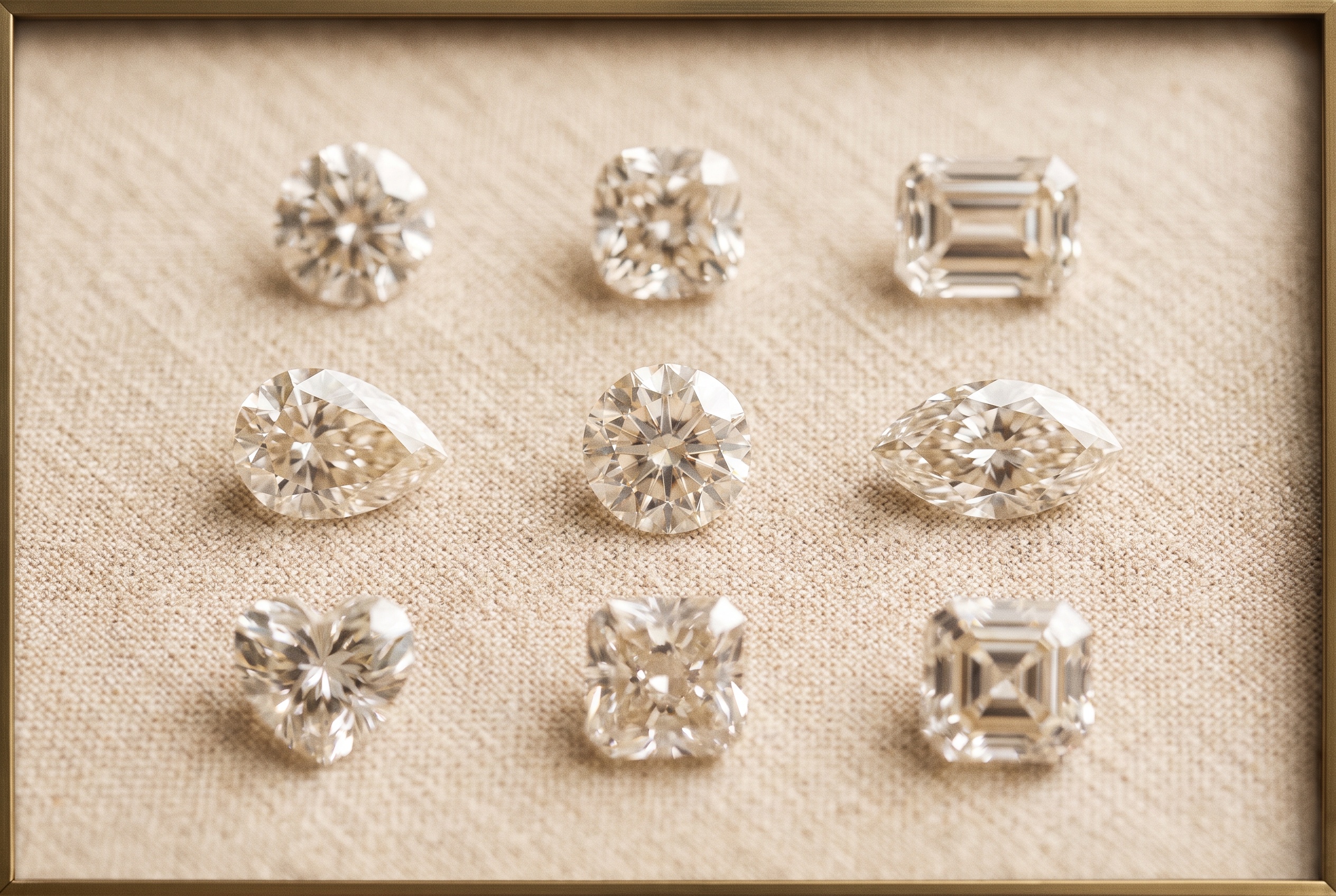
Fancy shapes outside the antique category — oval, pear, marquise, cushion, emerald, and others — generally sit at a per-carat discount to round brilliants of comparable color, clarity, and carat weight, though the gap between any two shapes shifts with fashion cycles; oval and cushion in particular have seen demand (and pricing) climb over recent years as consumer taste has shifted toward them.
How Certification Affects Price
A certified stone from a reputable, internationally recognized lab — GIA, IGI, or GCAL being the most widely trusted names in the trade — commands a premium over an uncertified stone of claimed-equivalent quality, and that premium exists for a straightforward reason: certification removes buyer risk. Without independent, third-party grading, a buyer is relying entirely on the seller's own representation of a stone's color, clarity, cut, and carat weight — claims that can't be independently verified after the fact, and that carry no recourse if they turn out to be inflated. A certificate from a reputable lab converts those claims into a documented, reproducible, third-party-verified standard that any buyer down the chain — including an end consumer buying from a retail jeweler — can trust without needing to personally evaluate the stone under magnification.
That trust has a real, quantifiable price effect: two stones that are physically identical, one certified and one not, will not command the same price, because the certified stone carries verified information and the uncertified one carries a discount that reflects the buyer's added risk and due-diligence burden. This effect compounds with stone value — the higher the carat weight and quality (and therefore the total dollar value at stake), the more a buyer stands to lose from a misrepresented grade, so the certification premium tends to matter proportionally more as stone size and quality increase, following the same multiplicative logic covered earlier in this guide. For loose stones purchased at wholesale specifically to be resold with confidence to an end customer, certification isn't optional in any practical sense — it's the mechanism that makes the rest of the supply chain function without every buyer re-grading every stone by hand.
Building a Price Estimate: A Walkthrough Example
Here's how an experienced trade buyer mentally works through a price estimate when evaluating a stone — again, using illustrative reasoning steps and no real dollar figures, since actual pricing depends on live market conditions, the specific stone, and the terms of the transaction.
- Start with shape and size. Identify the shape (round vs. fancy vs. antique) and which carat-weight tier the stone falls into, noting whether it sits just above or just below a magic-size breakpoint — this sets the base per-carat reference range before anything else is considered.
- Layer in color and clarity. Move along the color scale and clarity scale from that base reference, applying the appropriate adjustment for where the stone actually sits — recognizing that the further down either scale, the steeper certain grade-to-grade transitions can be, particularly around the eye-clean clarity threshold and the colorless/near-colorless color boundary.
- Factor in cut quality. Adjust for how well the stone is actually cut relative to its shape's ideal proportions — a well-cut stone with strong light performance holds value better than a poorly proportioned stone with identical color and clarity numbers on paper.
- Apply the natural vs. lab-grown adjustment. If the stone is lab-grown, apply the substantial discount that reflects current market conditions for CVD material relative to natural — a discount that has been trending wider, not narrower, as production scales industry-wide.
- Check certification. Confirm the stone carries a report from a reputable lab (IGI, GIA, or GCAL) and factor in the premium a certified stone commands over an uncertified one — or, if uncertified, apply a discount to account for the added buyer risk.
- Sanity-check against the market benchmark. Compare the resulting estimate against the relevant cell of a current market price reference, adjusted by a realistic discount or premium percentage for that shape/size/quality combination given current supply and demand — this is where a working knowledge of where the market sits at that moment, rather than a static table, does most of the real work.
- Multiply through, not add through. At every step above, remember that each adjustment is a multiplier against the running per-carat rate, not a flat subtraction — which is why the same grading decision matters more in absolute dollar terms on a larger or higher-quality stone than on a smaller one.
None of these steps produce an exact number without live market data and the physical stone in hand — grading is itself partly a matter of trained judgment, especially at borderline grade calls, and market benchmarks shift regularly. But walking through this sequence is how a buyer builds a defensible, reasoned estimate rather than guessing at a single number, and it's the same underlying logic whether the buyer is pricing a single center stone or evaluating a larger parcel.
Sourcing Certified, Fairly Priced Stones at Wholesale
Understanding how diamond pricing works is most useful when it's paired with a sourcing relationship that gives a buyer confidence in what they're actually paying for. Guru Diam supplies certified loose diamonds — natural and CVD lab-grown — with IGI, GIA, and GCAL certification all available, so trade buyers aren't left reconciling grading claims from multiple uncertified sources. The catalog spans standard round brilliants alongside antique and other fancy shapes, giving buyers access to the shape-driven pricing dynamics covered above from a single vendor rather than needing separate relationships for standard and specialty cuts.
For jewelers and designers who want to compare quality tiers and price points directly, the certified diamonds category is organized for that kind of side-by-side evaluation, and the matching pairs category is built specifically for buyers sourcing symmetric stones for earrings or other paired settings, where matching color and clarity across two stones adds its own layer to the pricing conversation. Buyers working outside the standard white-diamond range can browse fancy color loose diamonds. In-stock loose stones ship same day — before 6pm EST from the New York office and before 4pm PST from Los Angeles — so a buyer who's worked through a price estimate and is ready to move doesn't lose momentum waiting on fulfillment. For buyers building a finished piece around a center stone, the custom jewelry team handles engagement rings and other designs in-house, with cutting, setting, and polishing all handled internally rather than farmed out piecemeal. Trade accounts — Guru Diam works with 2,000+ active customer accounts — can review current terms at the wholesale hub or apply through trade partner; consolidating sourcing across certified natural, CVD lab-grown, standard shapes, antique cuts, fancy colors, and finished jewelry with one vendor means one shipment and one relationship to manage instead of several.
Frequently Asked Questions
Is there an actual online diamond price calculator you can use?
Not in the sense of a single authoritative public tool that returns a real wholesale price — the trade instead works from benchmark price lists (most notably the Rapaport Price List) combined with a negotiated discount or premium percentage that varies by dealer, stone, and market conditions. Some retail-facing estimator tools exist, but they approximate consumer pricing off public averages rather than reflecting actual wholesale trade pricing.
Why does price per carat go up so much between similar carat weights, like 0.90 and 1.00?
Because carat weight isn't priced linearly — certain "magic size" benchmarks (0.50, 0.70–0.75, 0.90–1.00, 1.50, 2.00 carats) carry disproportionate demand since buyers search for and recognize these round numbers specifically, and rough diamond scarcity also increases sharply at larger sizes. A stone just above a benchmark can price noticeably higher per carat than one just below it, even when the visual size difference is negligible.
Why does a flaw cost more on a bigger diamond than on a small one?
Because the 4Cs multiply against each other rather than adding up — a clarity or color adjustment is applied as a percentage against the stone's total per-carat value, so the same percentage discount produces a much larger absolute dollar swing on a large, high-value stone than on a small one. Flaws are also more visually noticeable on larger stones, compounding the effect.
How much cheaper are lab-grown diamonds than natural diamonds?
Lab-grown (CVD) diamonds trade at a substantial discount to natural diamonds of comparable size and quality, and that gap has been widening industry-wide as lab-grown production capacity has scaled up in recent years. The exact discount at any given moment depends on current market conditions and the specific stone's specs, but the general direction has been a continuing widening of the gap rather than a narrowing.
Does a diamond certificate actually change the price?
Yes — a certificate from a reputable lab like GIA, IGI, or GCAL commands a premium over an uncertified stone of claimed-equivalent quality, because certification independently verifies the stone's grading and removes the risk a buyer otherwise takes on trusting an unverified seller claim. That premium generally matters more, in absolute terms, on higher-value stones.
Why is a round diamond usually more expensive per carat than a fancy shape?
Round brilliants command a premium mainly due to consistently high consumer demand and a highly refined, standardized cutting approach — not because they're cheaper to produce from rough material. In fact, round cutting is comparatively less rough-efficient than many angular fancy shapes, so the round's price premium is a demand-driven effect layered on top of, not a result of, production cost.