
The diamond color scale grades a white diamond's absence of color, running from D (completely colorless) to Z (a noticeable light yellow or brown tint), with M-through-Z stones sometimes crossing into the fancy-color category once tint becomes strong enough to read as a color in its own right. Most diamonds sold for jewelry fall in the D-to-K range, and the difference between adjacent letter grades is often invisible to an untrained eye — which is exactly why understanding what each grade actually looks like, rather than assuming "higher letter always means visibly worse," matters more than the alphabet itself.
"What color are diamonds" is a question with a less obvious answer than most buyers expect: truly colorless diamonds are actually rarer than diamonds with some detectable tint, and the grading system exists specifically because that tint — even in tiny amounts invisible face-up — affects value. This guide walks through how the color scale works, what drives price at each grade, how color interacts with cut and setting metal, and how to choose a grade that looks great without overpaying for a distinction you won't actually see.
How the D-to-Z Diamond Color Scale Works
GIA introduced the D-to-Z scale in the 1950s specifically because earlier grading systems (including letter grades that started at A) had become inconsistent and were being used loosely by different sellers to mean different things. Starting at D avoided any confusion with those older systems and let GIA define a new, consistent standard from scratch. Diamonds are graded by comparing them, table-down, against a set of master stones under controlled lighting — a process that removes the variability of grading by eye alone under normal light.
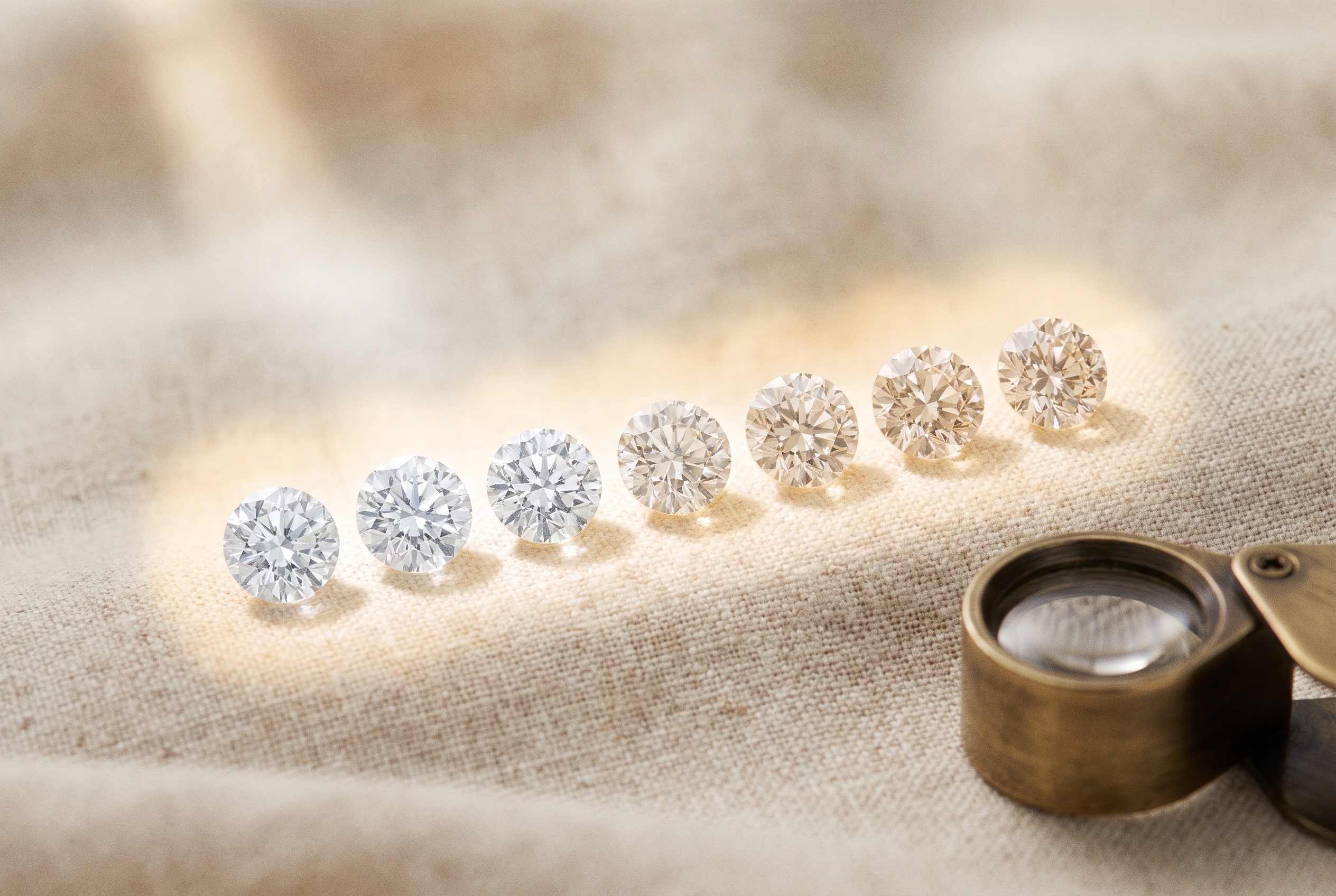
The scale groups into ranges that behave similarly in practice:
- D–F (Colorless) — no detectable color even to a trained grader under controlled conditions. The rarest and most expensive tier.
- G–J (Near Colorless) — color is essentially undetectable face-up to the naked eye, especially once mounted, though very faint traces may be visible to a trained eye under specific lighting when compared side by side with a colorless stone.
- K–M (Faint) — a warm tint becomes noticeable, particularly in larger stones or under certain lighting; some buyers prefer this warmth, especially in yellow-gold settings.
- N–R (Very Light) and S–Z (Light) — tint is visible to the naked eye without comparison, and pricing generally drops relative to near-colorless grades, though heavily tinted stones toward Z can start to command fancy-color-adjacent interest if the color is even and attractive.
Why Colorless Diamonds Are Rare
Diamond forms from carbon under extreme heat and pressure, and trace elements present during that process are what introduce color. Nitrogen is the most common culprit in yellow-tinted diamonds — even a tiny amount of nitrogen absorbed into the crystal structure during formation is enough to shift a diamond's color away from truly colorless. A diamond that formed with essentially no trace nitrogen, or with nitrogen distributed in a way that doesn't affect color, is the exception rather than the rule — which is why D, E, and F graded diamonds trade at a meaningful premium over G–J stones of otherwise identical quality.
This dynamic holds for lab-grown CVD diamonds as well: color in a CVD stone is also driven by trace elements and growth conditions during the crystal-growing process, and lab-grown diamonds are graded on the exact same D-to-Z scale as natural diamonds by IGI, GIA, and GCAL — a colorless grade means the same thing regardless of whether the diamond grew in the earth or in a lab.
Diamond Color Scale Comparison Table
| Grade Range | Category | Visible Tint Face-Up? | Typical Buyer Profile |
|---|---|---|---|
| D–F | Colorless | None, even under close comparison | Buyers prioritizing maximum whiteness, especially in platinum or white gold settings, larger center stones |
| G–J | Near Colorless | Effectively none to the naked eye once mounted | Most common range for center stones — strong value-to-appearance ratio |
| K–M | Faint | Slight warmth, more visible at larger carat weights | Buyers wanting warmth, yellow-gold settings, budget-focused larger stones |
| N–R | Very Light | Visible tint without comparison | Rarely chosen for center stones; occasionally used where warmth is the intended look |
| S–Z | Light | Clearly visible tint | Uncommon for standard white-diamond jewelry; borders on fancy-color territory at the deep end |
How Color Interacts With Carat Size
Color tint becomes easier to see as a diamond gets larger, because there's simply more material for light to travel through and more surface area for the eye to scan. A G-color 0.50ct diamond and a G-color 3.00ct diamond carry the same grade, but the tint in the 3-carat stone is more likely to register to an untrained eye than the same grade in the half-carat stone. This is one of the most common reasons buyers "trade up" in color grade as carat weight increases — a buyer comfortable with I or J color at 0.75ct might specifically request G or better once shopping in the 2-carat-plus range, precisely because size amplifies what would otherwise be an invisible difference.
How Color Interacts With Cut and Setting Metal
Two other factors change how noticeable a given color grade actually looks in a finished piece:
- Cut quality. A well-cut diamond returns more white light back to the eye, which can visually mask faint tint — a well-proportioned near-colorless stone often appears whiter than a poorly cut colorless stone, because excess light leakage and dead zones in a badly cut diamond draw attention away from color and toward the cut problem itself. This is part of why cut is frequently prioritized over color when the two compete for budget.
- Setting metal. Yellow and rose gold settings reflect warm tones back into the stone, which can make faint tint far less noticeable — or even complementary — while platinum and white gold settings do the opposite, making even slight warmth in a diamond more apparent by contrast. A K-color diamond in a yellow-gold bezel can look completely intentional; the same diamond in a platinum prong setting will read as visibly tinted.
Color Grading for Fancy Shapes vs. Round Brilliant
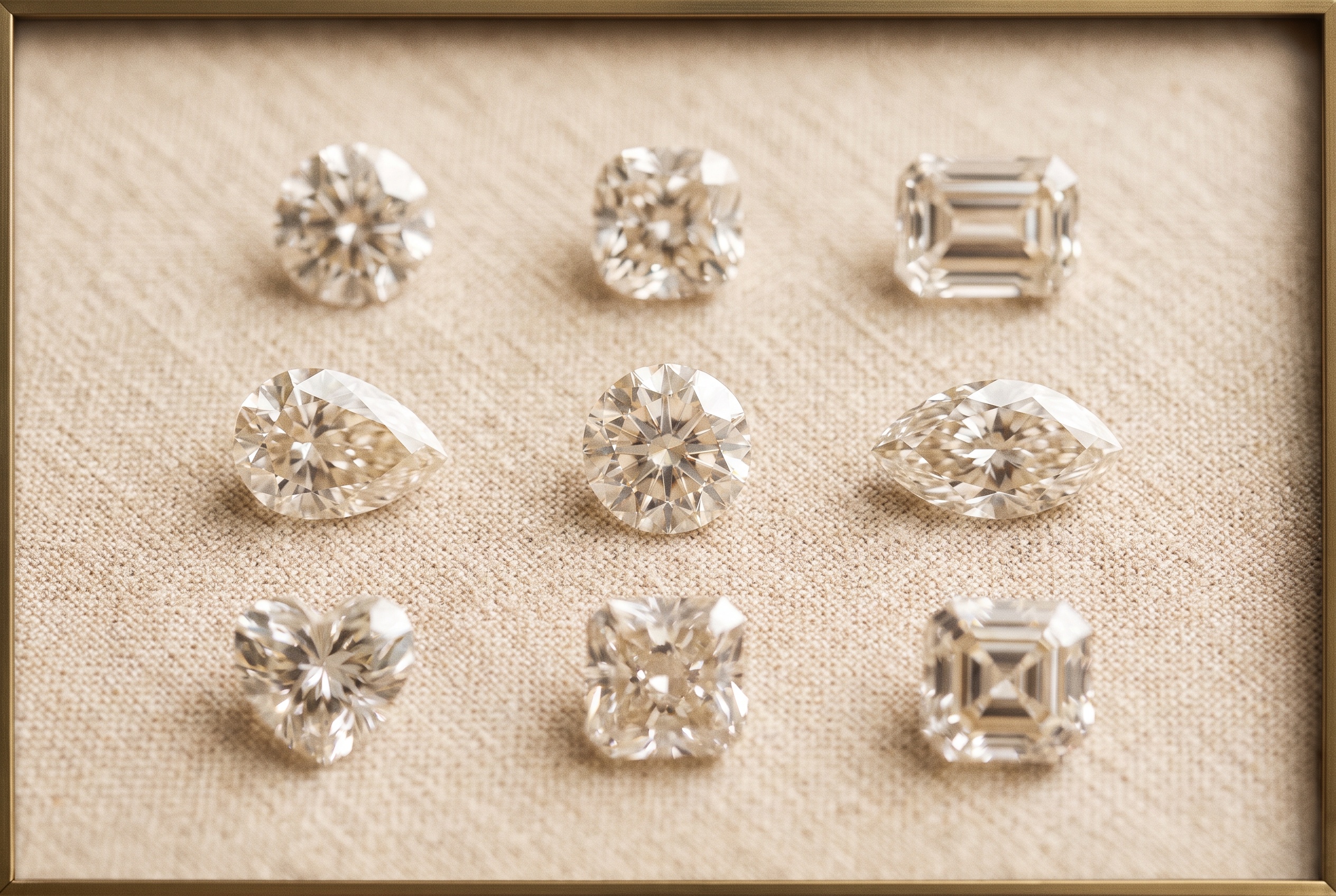
Certain fancy shapes concentrate or dilute the appearance of color differently than a round brilliant does. Step cuts like emerald and Asscher — with large, open facets and fewer light-return points — tend to show color more readily than a round brilliant of the same grade, because there's less internal light bouncing to mask tint in the open table. Cushion, radiant, and princess cuts sit somewhere in between. This is a common reason buyers choosing a step-cut center stone are advised to move up a grade or two in color compared to what they'd choose for a round brilliant, to land on a comparable face-up appearance.
Fluorescence: A Related but Separate Factor
Fluorescence — a diamond's tendency to emit a soft glow (most commonly blue) under UV light — is graded separately from color, but the two interact in ways worth understanding. In some lower-color diamonds (roughly I to M range), strong blue fluorescence can actually counteract yellow tint under UV-heavy lighting like daylight, making the stone appear whiter than its grade alone would suggest. In colorless-to-near-colorless diamonds (D–F), strong fluorescence occasionally has the opposite effect, giving the stone a slightly hazy or oily look to a trained eye in strong UV conditions, though this is rare and usually only relevant at very high fluorescence intensities. Fluorescence isn't inherently good or bad — it's a separate variable worth understanding on its own certificate line rather than folding into color judgments.
How Diamonds Are Actually Color-Graded
Color grading happens under tightly controlled conditions specifically because human perception of color is unreliable under normal lighting. Graders view a diamond unmounted, table-down (so the pavilion, where color is most concentrated and easiest to detect, faces up), against a stark white, non-reflective background, under standardized daylight-equivalent lighting. The stone is compared directly against a set of master stones — physical diamonds of known, verified grade that anchor the scale — rather than judged in isolation from memory. This comparative method is what keeps grading consistent across thousands of stones and multiple graders, since color perception can shift noticeably depending on ambient light, the color of surrounding materials, and even what a grader looked at moments before.
This is also why jewelry-store lighting is a poor place to judge a diamond's true color grade: warm incandescent lighting, colored countertops or fabric, and mounting the stone face-up in a colored metal setting all change how tint reads to the eye. A diamond that looks perfectly white under a jeweler's spotlight can show noticeably more tint when pulled out and viewed against a neutral background — which is part of why relying on the certificate's graded letter, rather than in-store visual impression alone, is the more reliable way to compare diamonds across different sellers or lighting setups.
Common Misconceptions About Diamond Color
A few assumptions trip up buyers repeatedly:
- "Whiter is always better." Not necessarily — plenty of buyers specifically want warmth, especially with yellow or rose gold, vintage-inspired designs, or antique cut styles where a touch of warmth reads as more authentic to the era being referenced. Colorless isn't a universal goal; it's a preference.
- "A one-letter difference is always visible." Within the near-colorless range especially, adjacent grades (say, H vs. I) are frequently indistinguishable to the naked eye, particularly at smaller carat weights or once mounted. The visual jump becomes more apparent across a wider gap (D vs. K, for instance) than between neighbors.
- "Color grade and clarity grade measure similar things." They don't — color measures body tint, while clarity measures internal and surface characteristics (inclusions and blemishes) unrelated to color. A diamond can be flawless in clarity and still carry a low color grade, or vice versa; the two are independent axes on a certificate, not points on the same scale.
- "Fluorescence always hurts a diamond's color." As covered above, fluorescence's effect depends heavily on the diamond's underlying color grade and the fluorescence's strength — it can help, hurt, or make no visible difference at all, and shouldn't be treated as an automatic red flag.
Grading Consistency: Why the Certifying Lab Matters
Color grading involves comparing a diamond against master stones under controlled conditions, and labs differ somewhat in strictness. IGI, GIA, and GCAL are the three labs most consistently trusted in the trade, and while all three grade against the same D-to-Z framework, buyers sourcing at volume often develop a sense for how a given lab's grading tends to run relative to the others on borderline stones. This is one of the reasons certification flexibility — being able to source the same diamond graded by IGI, GIA, or GCAL depending on a buyer's preference — is a meaningful sourcing consideration rather than a formality.
Natural Fancy Color Diamonds: A Different Scale Entirely
It's worth being clear that the D-to-Z color scale applies specifically to white (colorless-to-tinted) diamonds. Diamonds with strong, saturated body color — vivid yellows, pinks, blues, greens — are graded on a completely separate fancy-color scale (Faint through Fancy Vivid) that measures hue, tone, and saturation rather than absence of color. A Z-grade white diamond with heavy yellow tint is not the same thing as a Fancy Vivid Yellow diamond; the latter is prized specifically for its color intensity and priced on entirely different criteria. Guru Diam sources fancy color diamonds — loose stones in yellow, pink, blue, and green, plus fancy color melee in both round and fancy calibrated shapes — as a distinct catalog from the standard D-to-Z white diamond range.
Color Matching for Melee and Side Stones
Color considerations shift again when sourcing melee rather than a single center stone. Melee — small diamonds typically 0.8mm to 9.0mm used in pavé, halo, and side-stone settings — isn't graded and certified stone-by-stone the way a center diamond is; it's sourced and quality-checked as calibrated parcel goods against a consistent color and clarity baseline, commonly DEF+/VS+ for white melee. The priority for melee color isn't matching a specific letter grade so much as consistency across the parcel: a halo or pavé setting with even slightly mismatched color across its stones reads as visually inconsistent in a way a single off-grade center stone wouldn't, since the eye naturally compares side-by-side stones under the same light. A well-matched DEF+ melee parcel around a G-color center stone will generally read as a cohesive, evenly white piece, even though the melee wasn't individually certified to the center stone's exact letter grade.
Reading Color on a Certificate: What to Check Beyond the Letter Grade
The color line on a grading report is usually a single letter, but a few adjacent fields are worth cross-referencing before buying, especially at volume:
- Fluorescence intensity and color — None, Faint, Medium, Strong, or Very Strong, plus the fluorescence color (almost always blue, occasionally other colors on rare stones). Cross-check this against the color grade using the interaction described above rather than reading it in isolation.
- Comments section — some reports note if a diamond's color is affected by an unusual characteristic, or if the stone was graded with any qualifying note. Worth a read on any stone at the edges of the near-colorless range.
- Certifying lab — since IGI, GIA, and GCAL each grade against the same D-to-Z framework but can differ slightly in strictness on borderline calls, buyers comparing multiple stones across different sellers benefit from noting which lab graded each one, particularly for stones sitting right at a grade boundary (a stone graded H by one lab might grade toward the I/H line on another).
For buyers building recurring orders rather than sourcing one stone at a time, requesting real certificates rather than a written description, and spot-checking a sample against them, is standard practice — the same way any wholesale buyer verifies a supplier's stated grade against independent documentation before scaling an order.
Choosing the Right Color Grade for Your Budget
For most buyers, the practical decision comes down to a handful of questions: What setting metal is this going into? What carat range? Is the priority maximum whiteness or maximum value? A reasonable starting framework:
- Platinum or white gold, under 1.5ct: G–H color is the common sweet spot — no visible tint face-up, meaningfully better value than D–F.
- Platinum or white gold, 2ct and up: consider moving to F–G, since size amplifies visible tint.
- Yellow or rose gold, any carat weight: I–J color (or even K in warmer settings) often looks intentional rather than compromised, and frees up budget for a better cut or clarity grade.
- Step-cut shapes (emerald, Asscher): move up a grade or two from what you'd choose in round brilliant, since open facets show tint more readily.
Ultimately, color grade is the 4C most vulnerable to overspending on a difference nobody will see. A D-color diamond and a G-color diamond mounted side by side in the same ring, at the same carat weight, are indistinguishable to almost every observer outside a jeweler's loupe and a comparison stone — the premium for D–F sits mostly in rarity and certificate prestige rather than visible appearance. Buyers who understand this tend to allocate more of their budget toward cut quality and clarity characteristics that are actually visible face-up, and treat color as a threshold to clear (no visible tint for the intended setting and size) rather than a grade to maximize.
For sourcing at scale, Guru Diam carries certified loose diamonds across the full D-to-Z range with IGI, GIA, and GCAL certification available, in CVD lab-grown and natural stock, alongside natural fancy color diamonds in yellow, pink, blue, and green. Pairing this guide with our round brilliant cut guide covers two of the three most-asked-about 4Cs categories in one reference.
Frequently Asked Questions
What is the diamond color scale?
The diamond color scale is GIA's D-to-Z grading system that measures a white diamond's absence of body color, with D being completely colorless and Z showing a noticeable light yellow or brown tint. It's one of the traditional 4Cs used to evaluate and price diamonds.
What color are most diamonds?
Most diamonds used in fine jewelry fall in the near-colorless G–J range or the colorless D–F range. Truly colorless diamonds (D–F) are comparatively rare because trace elements like nitrogen, absorbed during a diamond's formation, tend to introduce at least faint color.
Is G or H color diamond good?
Yes — G and H color diamonds sit in the near-colorless range and show no detectable tint face-up to the naked eye, especially once mounted. They're one of the most commonly chosen ranges for center stones because they offer a strong balance of appearance and value relative to the D–F colorless range.
Does diamond color grade work the same for lab-grown diamonds?
Yes. Lab-grown CVD diamonds are graded on the identical D-to-Z color scale used for natural diamonds, by the same major labs — IGI, GIA, and GCAL. A G-color lab-grown diamond and a G-color natural diamond show the same absence of visible tint face-up.
Does color grade matter more or less than cut?
Cut is generally considered to have a bigger visible impact on how a diamond looks, since a well-cut diamond returns more light and can visually mask faint color, while a poorly cut diamond looks lifeless regardless of its color grade. Most buyers get better visual results prioritizing cut quality first and choosing a near-colorless (rather than colorless) grade to free up budget.
What is the difference between diamond color grade and fancy color diamonds?
The D-to-Z scale measures the absence of color in white diamonds — lower grades simply mean more visible tint. Fancy color diamonds (vivid yellows, pinks, blues, greens) are graded on an entirely separate scale measuring hue, tone, and saturation, and are valued for having strong, intentional color rather than for lacking it.
Guru Diam is a trade-only wholesale diamond supplier with locations in New York and Los Angeles, sourcing certified loose diamonds across the full color range — CVD lab-grown and natural — plus natural fancy color stones and finished jewelry. Browse graded inventory in the certified diamonds category, explore fancy color loose diamonds, or source calibrated pairs through matching pairs. Trade accounts can review current terms at the wholesale hub or apply through trade partner.