
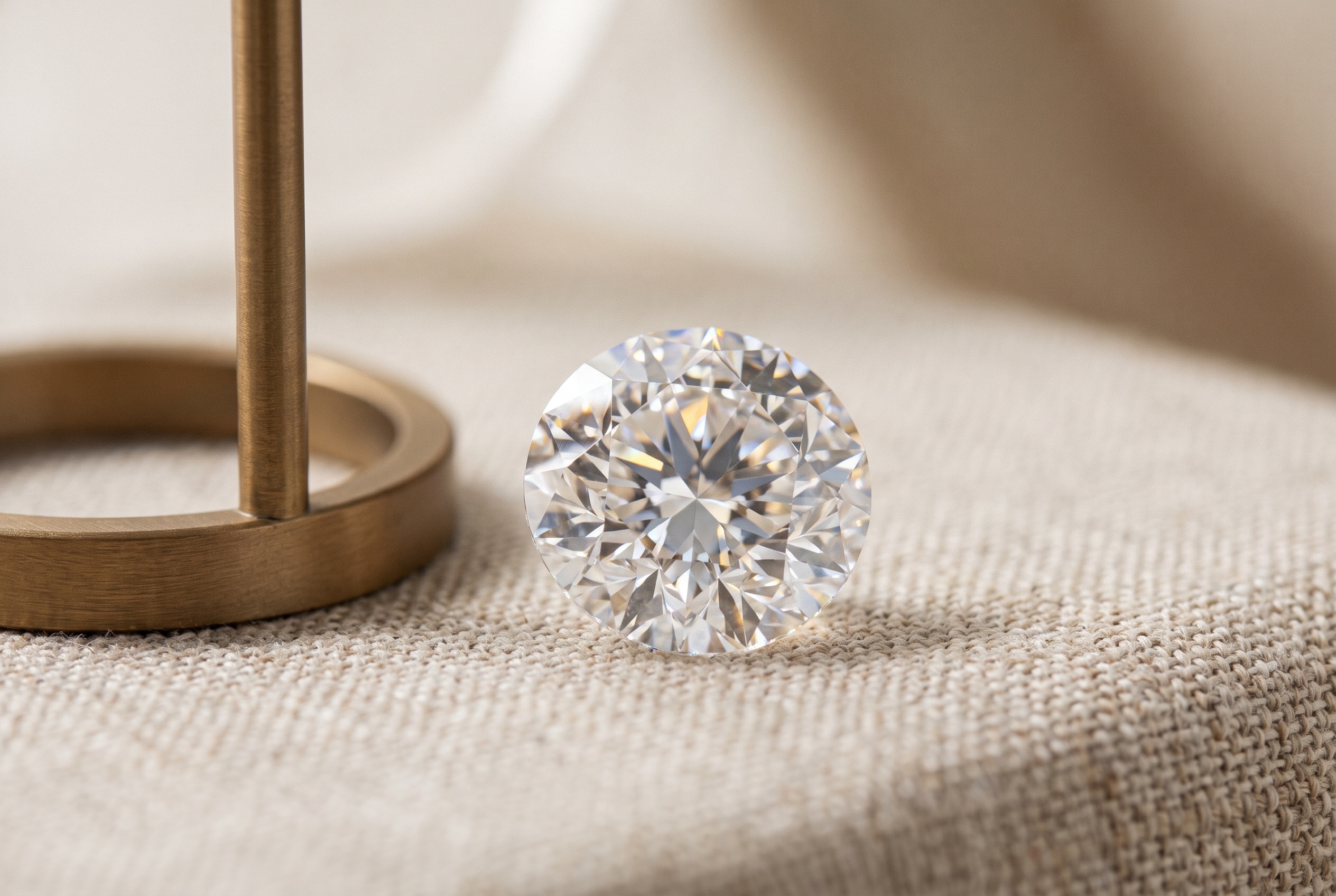
A round brilliant diamond is a diamond cut into a circular outline with 57 or 58 facets — a table, 8 star facets, 8 kite facets, 16 upper-girdle facets, 16 lower-girdle facets, 8 pavilion facets, and often a small culet facet — arranged specifically to maximize the return of light back to the viewer's eye. It is the most popular diamond shape in the world, accounting for roughly two-thirds of all diamonds sold, because its facet geometry produces more brilliance, fire, and scintillation per carat than any other cut.
But "round brilliant" describes a facet pattern, not a guarantee of quality. Two round brilliant diamonds can carry the same carat weight, color, and clarity grade and still look completely different face-up — one alive with light, the other flat and glassy — because of how precisely the cut itself was executed. This guide breaks down the anatomy of the round brilliant cut, how cut grade is actually measured, what separates a diamond that performs from one that doesn't, and how to apply all of that whether you're sourcing loose stones or buying a finished piece.
What Is a Round Brilliant Cut Diamond?
The modern round brilliant cut traces back to 1919, when mathematician and diamond cutter Marcel Tolkowsky published a set of angle and proportion calculations designed to optimize a round diamond's brilliance and fire. Tolkowsky's "ideal cut" theory — refined many times since by GIA, AGS, and individual cutting houses — is still the mathematical foundation every round brilliant is cut against today.
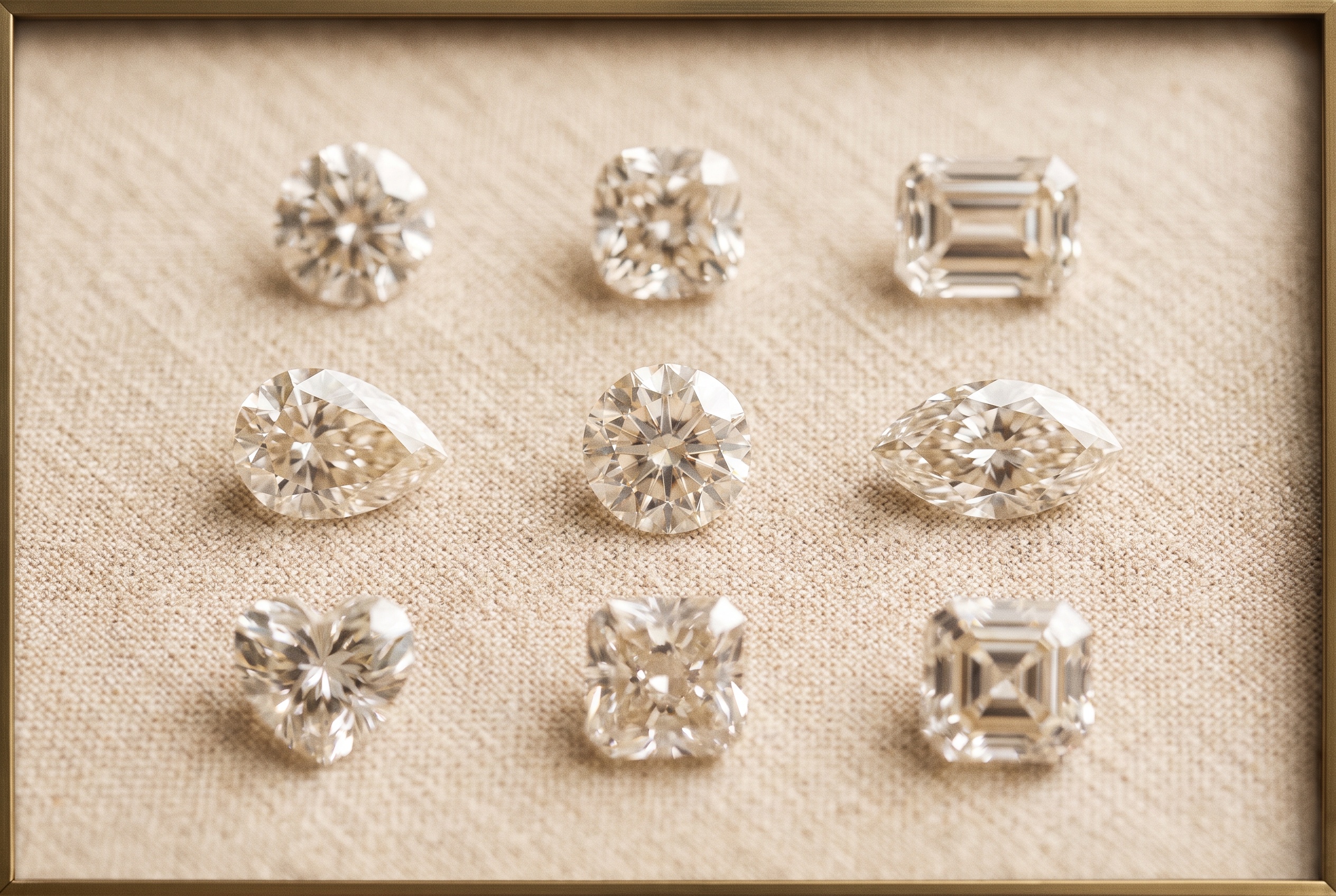
What makes the round brilliant distinct from other shapes (oval, cushion, emerald, pear) isn't the outline — it's the facet count and arrangement. A standard round brilliant has 57 facets (or 58, if it includes a culet — a tiny flat facet at the very bottom point that prevents chipping). Every one of those facets is cut at a specific angle relative to the others, and that relationship between angles is what determines whether light entering the stone bounces back out through the top (brilliance) or leaks out the bottom or sides (a "dark" or "washed out" diamond).
The Anatomy of a Round Brilliant: Crown, Pavilion, and Girdle
Every round brilliant diamond breaks down into three structural zones:
- Crown — the upper portion above the girdle, including the flat top facet (the table) and the sloped facets around it. The crown's job is to disperse white light into its spectral colors, producing fire.
- Girdle — the thin band that marks the widest point of the diamond, where crown meets pavilion. Girdle thickness affects durability (too thin chips easily, too thick adds invisible weight without adding visible size) and is graded from Extremely Thin to Extremely Thick.
- Pavilion — the lower, cone-shaped portion below the girdle. The pavilion's angles determine whether light entering through the crown reflects back up and out through the table (brilliance) or escapes out the bottom, which is what causes a visible dark zone at the center of a poorly cut stone.
The relationship between crown angle and pavilion angle is the single biggest driver of light performance in a round brilliant. GIA's cut grading system, and most independent cut-grade systems, are built around measuring exactly this relationship along with table size, depth percentage, and facet symmetry.
Table Percentage, Depth Percentage, and Why They Matter
Two measurements show up on every certified round brilliant's grading report and matter more than most buyers realize:
- Table percentage — the width of the flat top facet relative to the diamond's total width. An ideal-range table sits roughly between 54% and 62%. Too large a table lets light escape straight back out without bouncing, reducing fire; too small can make the stone look small for its carat weight.
- Depth percentage — the diamond's total height (table to culet) relative to its width. Ideal-range depth sits roughly between 59% and 62.5%. A diamond cut too deep concentrates weight below the girdle where it doesn't add face-up size — buyers sometimes call this a "nailhead" cut, referring to the dark, flat-looking center it produces. A diamond cut too shallow ("fisheye") shows a washed-out, glassy ring around the culet where light leaks straight through.
Neither number alone tells the whole story — table and depth interact with crown and pavilion angle — but a round brilliant sitting well outside both ranges is very unlikely to earn an Excellent or Ideal cut grade regardless of its other proportions.
Cut Grade: What Excellent, Very Good, Good, Fair, and Poor Actually Mean
GIA grades cut on a five-tier scale for standard round brilliants: Excellent, Very Good, Good, Fair, and Poor. The grade is a composite of proportions (table, depth, crown and pavilion angle, girdle thickness, culet size), plus finish — polish and symmetry, each graded separately on the same five-tier scale.
A round brilliant needs all three — proportions, polish, and symmetry — performing well together to earn a top grade. A diamond can have textbook proportions and still lose points on symmetry if facets are misaligned, or lose points on polish if the cutting process left surface marks visible under magnification.
| Cut Grade | Typical Table % | Typical Depth % | Light Performance | Best For |
|---|---|---|---|---|
| Excellent / Ideal | 54–58% | 59–62.5% | Maximum brilliance, fire, and scintillation; no visible dark zones face-up | Center stones, solitaires, anything worn close-up |
| Very Good | 58–60% | 58–63% | Excellent light return with only marginal difference from Excellent to the trained eye | Budget-conscious center stones; strong value-to-performance ratio |
| Good | 53–66% | 56–65% | Solid brilliance but noticeably less life than Excellent/Very Good under close inspection | Side stones, melee, accent diamonds where face-up performance matters less |
| Fair | Outside ideal ranges on multiple measurements | Outside ideal ranges | Visible dead zones or dullness even to an untrained eye | Not recommended for center stones |
| Poor | Significantly outside ideal ranges | Significantly outside ideal ranges | Noticeably dark, glassy, or lifeless | Not recommended for any prominent setting |
Brilliance, Fire, and Scintillation — the Three Kinds of Sparkle
"Sparkle" is really three separate optical effects, and a well-cut round brilliant is engineered to produce all three:
- Brilliance — the white light reflecting back out of the diamond. This is the overall brightness of the stone.
- Fire — white light split into spectral colors (the flashes of red, blue, green you see when a diamond catches light at certain angles). Fire comes primarily from the crown angle and facet arrangement dispersing light like a prism.
- Scintillation — the pattern of light and dark flashes you see as the diamond, the light source, or the viewer moves. Scintillation is a function of facet count and symmetry — it's why a well-cut round brilliant seems to "wink" as it moves under a chandelier or in daylight.
A diamond can be graded high on the color and clarity scale and still underperform on all three of these if the cut proportions are off — which is why cut is frequently called the most important of the traditional 4Cs for how a diamond actually looks in person.
Hearts and Arrows: The Visual Proof of a Precisely Cut Round Brilliant
Hearts and arrows is an optical phenomenon visible in exceptionally well-cut, well-aligned round brilliants: viewed face-up through a special viewer, the facets form eight perfectly symmetrical arrows; viewed face-down, they form eight perfectly symmetrical hearts. It only appears when facet alignment and symmetry are precise to a degree well beyond a standard Excellent cut grade — it's essentially a visual confirmation of superior symmetry, not a separate grading category on a standard GIA report.
Not every Excellent-cut round brilliant will show hearts and arrows, and the absence of the pattern doesn't mean a diamond performs poorly — but its presence is a reliable signal of exceptional cutting precision, which is why some buyers specifically request hearts-and-arrows stones for center diamonds.
Round Brilliant vs. Other Shapes: Why Round Costs More Per Carat
Round brilliants are typically the most expensive shape per carat, all else equal. There are two reasons:
- Rough-diamond yield. Cutting a round brilliant from a rough diamond crystal (which is naturally closer to octahedral) sacrifices more of the original rough than cutting a shape like princess, cushion, or radiant, which can be cut closer to the rough's natural form. Less finished carat weight per unit of rough means higher cost per carat.
- Demand. Round brilliant is the most requested shape for engagement rings and solitaires, and that steady demand keeps per-carat pricing higher relative to fancy shapes.
Fancy shapes like oval, pear, and marquise also tend to look larger face-up per carat than a round brilliant of the same weight, because their elongated outlines spread the same weight across more visible surface area. Buyers optimizing strictly for face-up size per dollar often end up in a fancy shape; buyers optimizing for maximum light performance per carat typically stay with round.
Carat Weight and Face-Up Size in Round Brilliants
Because depth percentage concentrates weight below the girdle, two round brilliants of identical carat weight can have noticeably different visible diameters. A diamond cut too deep will measure smaller in millimeter diameter than a well-proportioned stone of the same weight, because the extra weight is hidden in the pavilion where it isn't visible face-up. This is one of the most common ways buyers end up disappointed by a diamond that's technically the carat weight they ordered but looks smaller than expected in the setting — checking the millimeter diameter against standard round brilliant size charts, not just the carat weight, is the more reliable way to judge visible size.
Lab-Grown vs. Natural Round Brilliants: Cut Quality Is Identical Either Way
Cut grade, proportions, and light-performance grading apply exactly the same way to lab-grown and natural round brilliants — a CVD lab-grown diamond and a mined diamond cut to the same proportions produce the same brilliance, fire, and scintillation, because cut quality is a function of the physical cutting, not the diamond's origin. The 4Cs grading criteria themselves don't distinguish between the two; IGI, GIA, and GCAL all grade lab-grown round brilliants against the same cut, color, clarity, and carat standards used for natural stones, simply noting the growth method on the certificate.
What does change between lab-grown and natural is price per carat — lab-grown round brilliants are typically available at a meaningful discount to natural diamonds of comparable grade, which has made round brilliant one of the fastest-growing categories in lab-grown demand specifically because buyers can access higher cut and clarity grades at the same budget.
Common Cut Problems to Watch For
Most round brilliant cut problems trace back to the cutter prioritizing carat retention over light performance — squeezing extra weight out of a piece of rough at the expense of proportions. A few patterns to recognize:
- Nailhead effect — caused by a pavilion cut too deep. Light entering the crown reflects too many times inside the stone and gets absorbed rather than returning to the eye, leaving a dark, flat-looking patch at the center of the table. It's most visible when the diamond is viewed straight on under diffuse light.
- Fisheye effect — the opposite problem, caused by a pavilion cut too shallow. Light passes almost straight through the stone instead of reflecting, producing a washed-out, glassy ring visible around the culet — sometimes described as looking like the stone has a hole in the middle.
- Bow-tie effect — more commonly discussed with elongated fancy shapes (oval, marquise, pear) than round brilliants, but worth knowing as a related phenomenon: a dark, bow-tie-shaped shadow across the center of the stone caused by facets not reflecting light evenly. It's essentially absent in a well-cut round brilliant because the facet pattern is radially symmetrical.
- Uneven girdle — a girdle that varies significantly in thickness around the diamond's circumference (rather than being consistent) can create optical distortion and is also a durability risk at its thinnest points.
None of these problems are visible on a certificate's headline cut grade alone — they show up in the underlying proportion, polish, and symmetry data, which is exactly why buyers sourcing center stones at any volume benefit from checking the full report rather than the summary grade.
Round Brilliant Melee vs. Center Stones: Different Priorities
Cut standards get applied differently depending on whether a round brilliant is being sourced as a center stone or as melee for pavé, halo, and accent work. A center stone is the focal point of a piece and typically warrants the strictest cut, polish, and symmetry standards a budget allows, since it's the diamond a client will examine most closely. Melee, by contrast, is sourced and QC'd as calibrated parcel goods against a consistent color and clarity baseline (commonly DEF+/VS+) rather than certified individually — the cutting standard still matters for overall sparkle across a pavé or halo setting, but the buying process is closer to matching a parcel to a spec than evaluating one stone's certificate in isolation. Buyers building out a full piece — a halo ring with a round brilliant center and round brilliant melee surround, for instance — are effectively managing both processes at once: certificate-level scrutiny on the center stone, calibrated-parcel matching on the melee.
Buying a Round Brilliant: What to Actually Check on a Certificate
When evaluating a graded round brilliant, the cut-specific fields worth checking beyond the headline cut grade are:
- Table % and depth % — confirm they fall in or near the Excellent/Very Good ranges above.
- Polish and symmetry grades — both should ideally match or come close to the overall cut grade; a mismatch (Excellent cut grade with Good symmetry) is worth asking about.
- Girdle thickness — Thin to Slightly Thick is the durable, weight-efficient range; Extremely Thin girdles chip more easily, Extremely Thick girdles hide weight without adding visible size.
- Culet — should be None or Very Small on a well-cut round brilliant; a large culet can create a visible dark spot at the center.
For buyers sourcing loose round brilliants at scale — jewelers building inventory, designers sourcing center stones for custom work — verifying these fields against a real, independent lab report (IGI, GIA, or GCAL) rather than relying on a supplier's own description is the standard practice, since cut grade in particular has enough nuance that it benefits from an independent set of eyes.
Sourcing Round Brilliants: Loose Stones vs. Finished Pieces
Round brilliant is available both as loose certified center stones and as calibrated melee for pavé and accent work. Guru Diam carries round brilliant in both tiers — loose, certified center stones at 0.30ct and above (IGI, GIA, and GCAL certification all available), and round brilliant melee from 0.8mm to 9.0mm for pavé, halo, and side-stone work — across both CVD lab-grown and natural inventory, alongside the antique and fancy cut shapes that make up the rest of the catalog. Same-day shipping is available on in-stock round brilliant inventory from both the New York and Los Angeles locations, and custom engagement rings built around a round brilliant center stone are finished in 4–6 days.
For jewelers and designers comparing round brilliant against antique cuts like old mine or old European for a specific piece, it's worth reading through our guide to old mine cut diamonds alongside this one — the two cuts sit at opposite ends of the light-performance spectrum (round brilliant optimized for maximum sparkle, old mine optimized for a warmer, softer candlelight glow), and the right choice depends entirely on the look a client wants.
Frequently Asked Questions
What is a round brilliant cut diamond?
A round brilliant cut diamond is a diamond with a circular outline cut into 57 or 58 facets — arranged across the crown, girdle, and pavilion — specifically designed to maximize brilliance, fire, and scintillation. It is the most popular and most researched diamond cut in the world.
How many facets does a round brilliant diamond have?
A standard round brilliant has 57 facets, or 58 if it includes a culet facet at the very bottom point. This includes the table, 8 star facets, 8 kite (bezel) facets, 16 upper-girdle facets, 16 lower-girdle facets, and 8 pavilion facets.
What is the best cut grade for a round brilliant diamond?
GIA's Excellent (or Ideal, in other grading systems) is the top cut grade, reflecting the closest adherence to optimal table percentage, depth percentage, and crown/pavilion angles. Very Good is a close second, offering strong light performance at a typically lower price point, and is a common choice for buyers balancing brilliance against budget.
Why are round brilliant diamonds more expensive per carat than other shapes?
Round brilliants require cutting away more of the original rough diamond crystal than fancy shapes like cushion, princess, or radiant, resulting in lower yield per rough stone. Combined with round being the most consistently in-demand shape, this keeps round brilliant pricing higher per carat than most fancy shapes at equivalent quality.
Does cut grade work the same way for lab-grown round brilliant diamonds?
Yes. Cut grading criteria — proportions, polish, and symmetry — are identical for lab-grown and natural round brilliants, since cut quality depends on how the stone was cut, not how the rough diamond formed. IGI, GIA, and GCAL all grade lab-grown round brilliants against the same standards used for natural diamonds.
What is hearts and arrows in a round brilliant diamond?
Hearts and arrows is a viewing-tool phenomenon visible only in round brilliants with exceptionally precise facet alignment and symmetry — arrows appear face-up, hearts appear face-down. It's a strong visual indicator of superior cutting precision beyond a standard Excellent cut grade, though its absence doesn't necessarily mean a diamond performs poorly.
Guru Diam is a trade-only wholesale diamond supplier with locations in New York and Los Angeles, carrying certified loose diamonds, CVD lab-grown and natural stones, and finished jewelry across every standard, antique, and exotic diamond shape. Browse certified round brilliant inventory in the certified diamonds category, source calibrated pairs through matching pairs, or build a custom piece through custom jewelry. Trade accounts can review current inventory and terms at the wholesale hub or apply through trade partner.