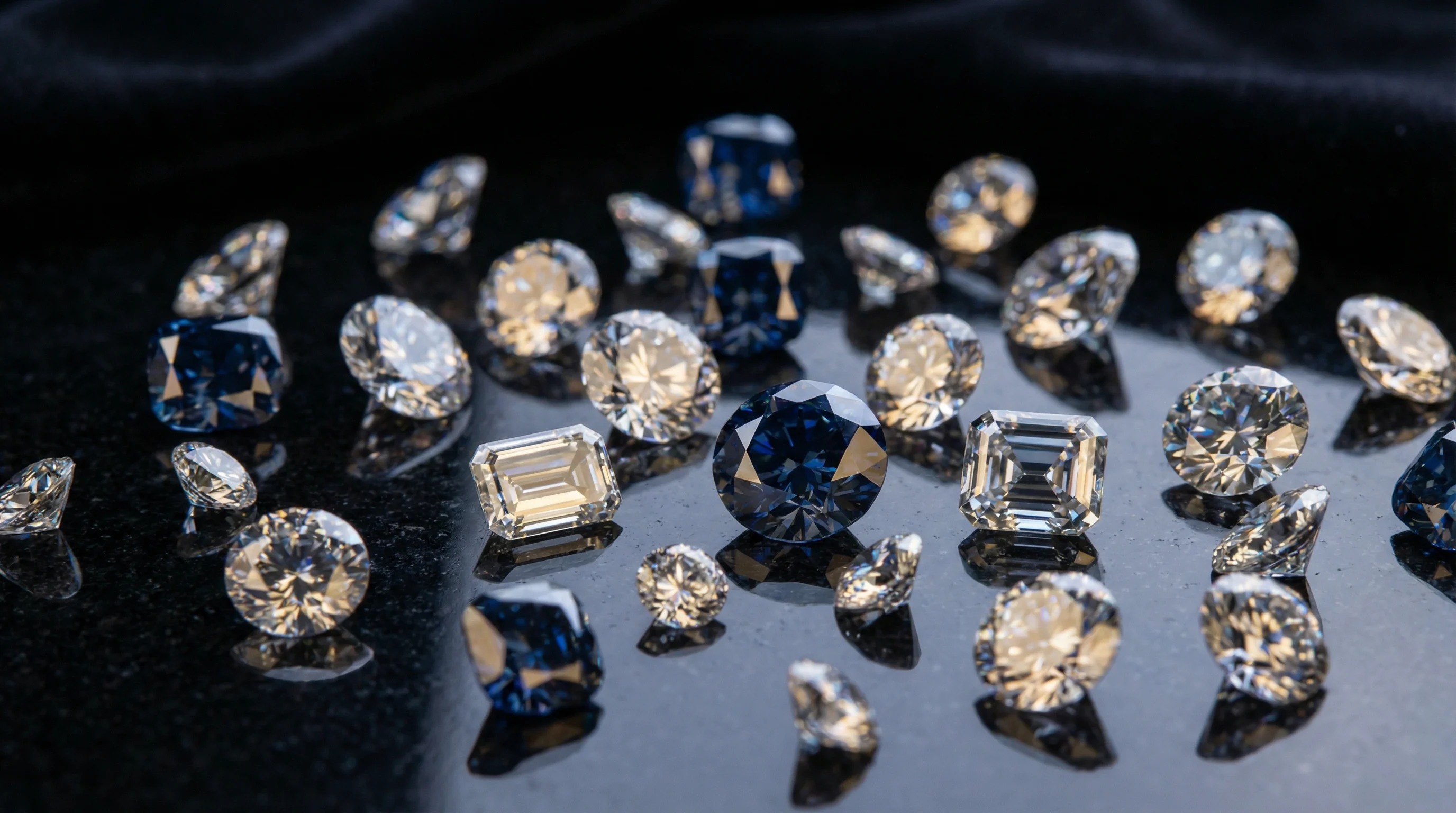
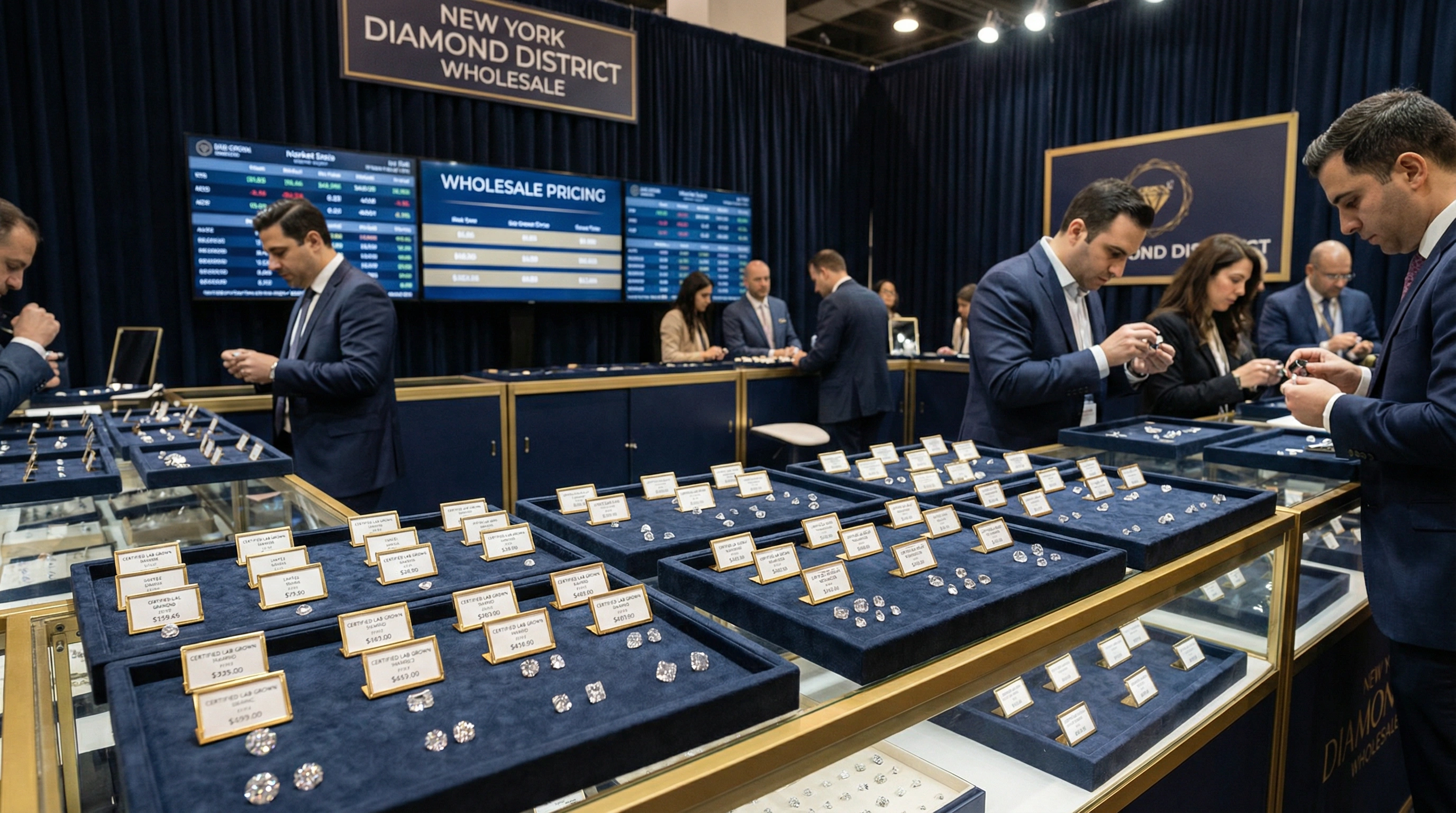
Your complete reference guide to lab-grown diamonds — written for
retailers, jewelers, and designers.
SECTION 01
The 4Cs of Lab-Grown Diamonds: A Trade Buyer's Guide
Every diamond tells its story through four measurable qualities:
Carat Weight, Color,
Clarity, and Cut — known industry-wide
as the 4Cs. Introduced by GIA founder Robert M. Shipley
in the 1940s, the 4Cs replaced vague descriptions like "without flaws"
with a precise, universal grading language that the entire diamond trade
relies on today. Whether you're sourcing a 0.50 ct melee parcel or a
5.00 ct statement stone, understanding how each C influences value —
especially in lab-grown diamonds — is the difference between stocking
smart and stocking blind.
At Guru Diam, every diamond in our 11,000+ inventory is independently
certified by IGI or GIA, so the grades
you see are the grades you get. This guide breaks down each C with the
practical detail trade buyers actually need.
Carat Weight
What Carat Really Means
Carat is a unit of weight, not size. One carat
equals 200 milligrams (0.2 grams), and it has been the standard measure
for gemstones since the 1500s. Two diamonds with identical carat weights
can look noticeably different on the finger depending on how they are
cut — a well-proportioned 0.95 ct round brilliant can face up larger
than a poorly cut 1.00 ct stone that hides weight in its pavilion depth.
Common Carat Ranges and Face-Up Appearance
For round brilliant diamonds — the most requested shape — here's what
each weight looks like in approximate diameter:
Carat Weight
Approx. Diameter (Round)
Price Tier
Best For
0.25 ct
~4.0 mm
Entry
Accent stones, halo melee, fashion earrings
0.50 ct
~5.1 mm
Value
Petite engagement rings, pendants, stackable bands
0.75 ct
~5.8 mm
Mid-Value
Popular engagement ring size, stud earrings
1.00 ct
~6.5 mm
Premium
Classic engagement rings — the most requested solitaire weight
Diamond pricing is not linear. The industry uses tiered
pricing brackets, and the per-carat price jumps sharply at
psychologically significant weights known as
magic sizes:
0.50 ct, 1.00 ct, 1.50 ct, and 2.00 ct. A 0.99 ct
diamond can cost 10–20% less than a visually identical 1.00 ct stone of
the same quality — simply because buyer demand spikes at those round
numbers. Similarly, a 2.00 ct diamond doesn't cost twice what a 1.00 ct
costs; expect three to four times the price at equivalent grades.
Lab-Grown Advantage: Carat for Carat
Because lab-grown diamonds are produced on demand rather than mined from
finite geological deposits, the scarcity premium that inflates natural
diamond prices at magic sizes is significantly reduced. Your customers
can comfortably move up a full carat bracket — from 1.00 ct to 1.50 ct
or from 1.50 ct to 2.00 ct — without the budget shock that comes with
natural stones.
Trade Buyer Tip: Stock "shy" sizes (0.90–0.99 ct,
1.40–1.49 ct) alongside the magic weights. Customers who need to stay on
budget will appreciate the option, and your margins stay healthy because
per-carat cost is substantially lower. The face-up difference is
virtually invisible.
Retailer Selling Notes
In engagement rings, 1.00–1.50 ct remains the
bread-and-butter range. In fashion jewelry — pendants, tennis bracelets,
earrings — 0.25–0.75 ct stones move the fastest. For
designers creating statement pieces,
2.00–3.00 ct lab-grown rounds and fancy shapes are
where the lab-grown value proposition truly shines.
Color
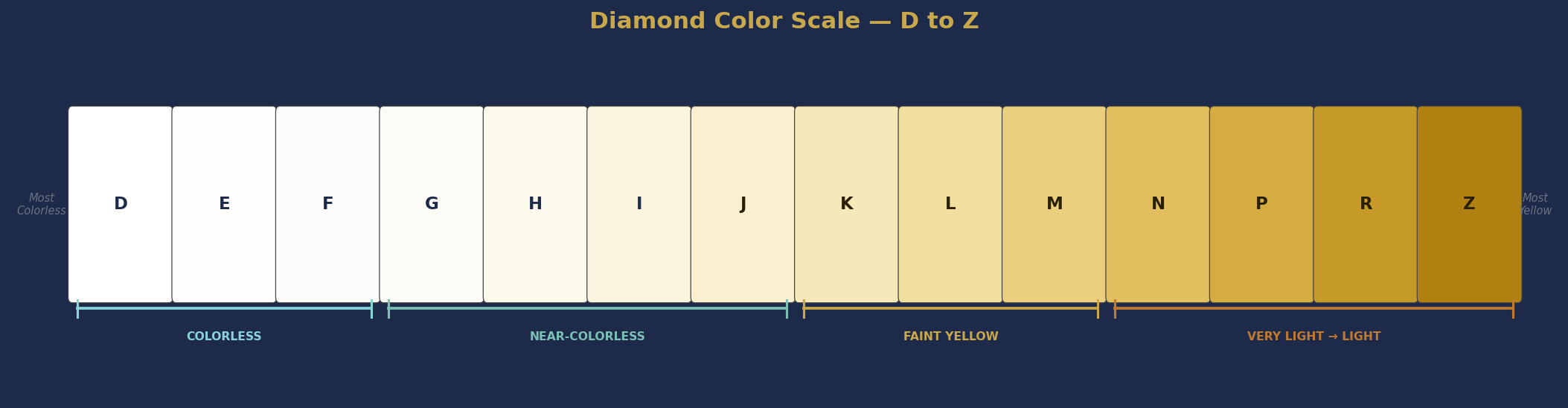
The GIA D–Z color scale — D is perfectly colorless, Z shows warm yellow
tint
The D-to-Z Scale
Diamond color is graded on the GIA D-to-Z scale,
introduced in 1953, which measures the absence of color.
D is perfectly colorless; as you move toward Z,
diamonds show increasing warmth — a faint yellow or brown tint caused by
trace nitrogen. The scale is divided into meaningful ranges for buying
decisions:
Colorless (D–F): No detectable body color face-up. D
and E are indistinguishable to the untrained eye; F shows a trace
visible only to a gemologist under controlled conditions.
Near-Colorless (G–J): Slight warmth detectable
side-by-side against a D–F stone, but face-up these grades appear
white — especially once set. G and H are the industry sweet spot.
Faint (K–M): A soft warm tint visible to the eye. Can
look beautiful in yellow gold or rose gold settings, but less
desirable in white metal.
What Matters for Lab-Grown Diamonds
Because the CVD and HPHT growth processes allow tight control over
conditions,
the vast majority of lab-grown diamonds grade between D and H. You'll find far more colorless and near-colorless stones than you
would in a comparable parcel of natural rough. This means your customers
can access D–F color at a fraction of the natural price — a powerful
selling point.
Beyond the D-to-Z scale, lab-grown technology also produces stunning
fancy colored diamonds — vivid yellows, pinks, and
blues — through controlled introduction of trace elements during growth.
See our Fancy Color collection for the full range.
Color Grade
Description
Lab-Grown Availability
Best For
Price Premium
D–E
Exceptional colorless
High
Platinum & white gold bridal, investment-grade
Highest
F
Colorless (trace detected by experts only)
High
Premium bridal, halo settings
High
G–H
Near-colorless — faces up white
Very High
Best value for bridal; ideal in any metal
Moderate
I–J
Near-colorless — slight warmth in larger stones
Moderate
Budget-friendly bridal, yellow/rose gold settings
Lower
K–M
Faint yellow or brown tint
Limited
Warm-tone designs, vintage aesthetic
Lowest
Trade Buyer Tip: For most retail customers,
G–H color delivers the best balance of appearance and
value. In a white gold or platinum setting, G and H are visually
indistinguishable from D–F. Reserve D–E stock for clients who
specifically request "the best" or for stones over 2.00 ct, where color
becomes more perceptible.
Clarity
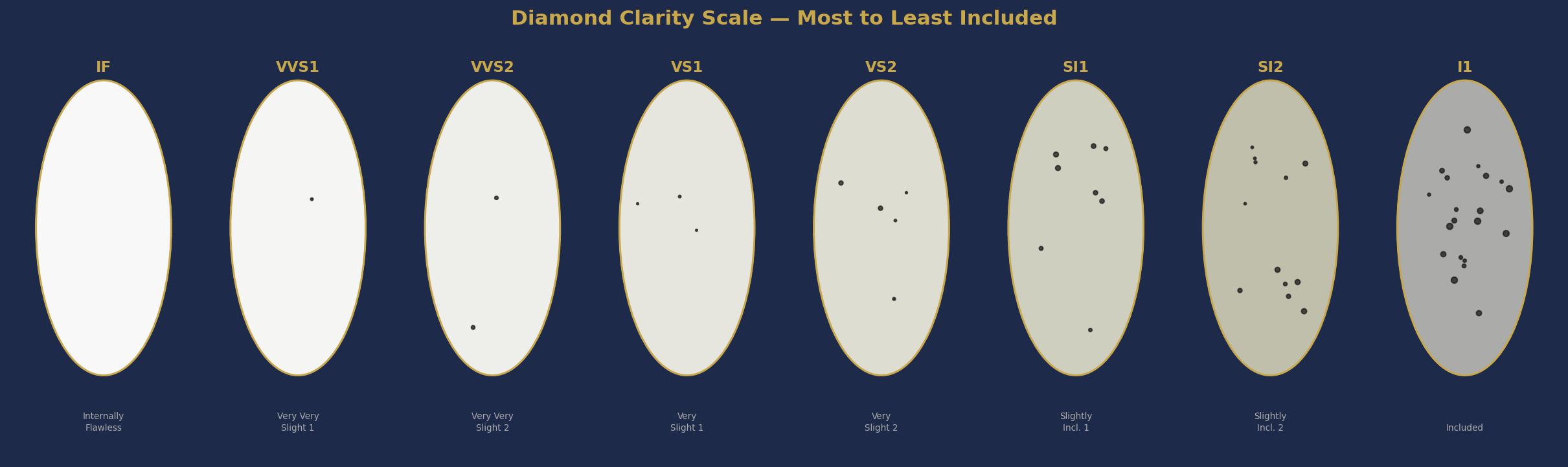
IF through I1 — dots represent inclusions visible under 10×
magnification
The Clarity Scale Explained
Clarity measures a diamond's internal
inclusions (crystals, feathers, clouds) and surface
blemishes (scratches, nicks), evaluated under
10x magnification by trained graders. The GIA/IGI
clarity scale, from highest to lowest:
IF (Internally Flawless): No inclusions visible at
10x. Extremely rare, even in lab-grown.
VVS1 – VVS2 (Very, Very Slightly Included): Minute
inclusions difficult for a skilled grader to see at 10x. Invisible to
the naked eye.
VS1 – VS2 (Very Slightly Included): Minor inclusions
visible with effort at 10x. Almost always eye-clean. This is the sweet
spot.
SI1 – SI2 (Slightly Included): Noticeable inclusions
at 10x. SI1 is often still eye-clean; SI2 may have inclusions visible
without magnification, especially in larger stones.
Why Lab-Grown Diamonds Cluster in VS–VVS
Lab-grown diamonds are crystallized in carefully controlled environments
— whether by CVD (Chemical Vapor Deposition) or HPHT (High Pressure High
Temperature). Without the geological turbulence that natural diamonds
endure, the resulting crystals tend to be
purer and more consistent. You'll find a higher
proportion of lab-grown diamonds in the
VVS to VS range compared to natural parcels, where SI
and I grades are more common. CVD diamonds, in particular, avoid the
metallic inclusions sometimes found in HPHT stones, contributing to
their cleaner appearance.
Eye-Clean vs. Certified Grade
An "eye-clean" diamond shows no inclusions to the
unaided eye at a normal viewing distance (about 6–12 inches). Most
VS2 and higher grades are eye-clean, and many
SI1 stones are too — but it depends on the type, size,
and position of the inclusions. Always inspect each stone rather than
relying on grade alone. A VS2 with a dark crystal directly under the
table might look worse than an SI1 with a white feather near the girdle.
Clarity Grade
Visible to Naked Eye?
IGI/GIA Availability (Lab-Grown)
Retail Price Index
IF
No
Limited
$$$$
VVS1
No
Good
$$$
VVS2
No
Very Good
$$$
VS1
No
Excellent — high availability
$$
VS2
Rarely
Excellent — highest availability
$$
SI1
Sometimes
Good
$
SI2
Often
Moderate
$
Trade Buyer Tip:VS1–VS2 is the
clarity sweet spot for retail. Your customers get a guaranteed eye-clean
diamond at a price point well below VVS, and the visual difference is
zero. For budget-conscious buyers, hand-pick SI1 stones
where the inclusion type and position don't affect face-up beauty — this
is where expert curation from your wholesaler makes the biggest
difference.
Cut
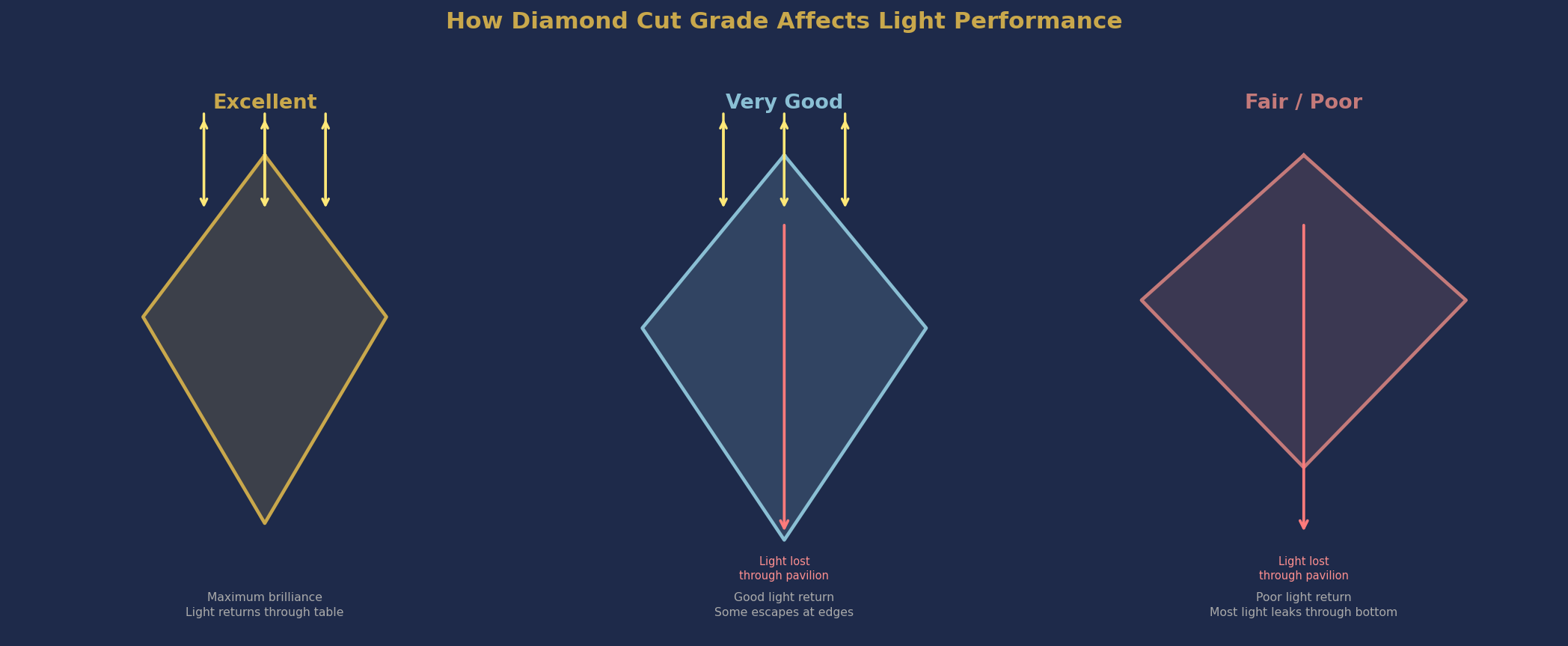
Excellent cut maximises brilliance; poor cut allows light to escape
through the pavilion
Why Cut Is the Most Important C
Of all four Cs,
cut has the greatest influence on a diamond's beauty. A
perfectly colorless, flawless diamond will look lifeless if it's poorly
cut. Cut determines how light enters, bounces between facets, and
returns to the viewer's eye — producing three optical effects:
Brilliance: The total white light reflected from the
diamond.
Fire: The dispersion of light into spectral colors.
Scintillation: The pattern of bright and dark flashes
when the diamond moves.
GIA introduced its formal Cut Grading System for round brilliant
diamonds in 2006, and both GIA and IGI now assign cut grades on a scale
from Excellent down to Poor. These
grades evaluate proportions, symmetry, and polish together.
Cut Grades at a Glance
Cut Grade
Light Performance
Recommended For
Notes
Excellent / Ideal
Maximum brilliance, fire, and scintillation
All jewelry — always the best choice
Worth the premium every time. Reflects nearly all entering light.
Very Good
Strong light return with minor deviations
Budget-conscious bridal, fashion jewelry
Close to Excellent at a lower price; differences subtle to most
eyes.
Good
Adequate light return; some light leakage
Price-driven purchases, accent stones
Visible loss of brilliance side-by-side with Excellent.
Fair / Poor
Significant light leakage; dull appearance
Not recommended for retail
Avoid stocking. Undermines customer confidence in lab-grown
quality.
Cut Styles: Brilliant, Step, and Mixed
Beyond the cut grade, diamonds come in different cut
styles that affect their optical character:
Brilliant cut (Round, Oval, Cushion, Pear):
Triangular and kite-shaped facets maximize sparkle. The round
brilliant — with 57 or 58 facets — remains the most popular and is the
only shape with a formal GIA cut grade.
Step cut (Emerald, Asscher, Baguette): Rectangular
facets create a "hall of mirrors" effect — understated elegance with
broad flashes of light. Clarity is more important here because
inclusions are easier to see.
Mixed cut (Princess, Radiant): Combines
brilliant-style facets on the crown with step-cut elements on the
pavilion, blending sparkle with geometric clean lines.
Why Guru Diam Focuses on Precision-Cut CVD Diamonds
CVD-grown diamond rough is exceptionally consistent in crystal
structure, which allows cutters to optimize for ideal proportions
without the compromises that irregular natural rough demands. At Guru
Diam, we prioritize
Excellent and Ideal cut grades across our inventory
because we know your customers buy sparkle first and everything else
second. Our sourcing relationships with precision CVD manufacturers mean
you get stones cut for beauty, not just carat weight retention.
Trade Buyer Tip: Never compromise on cut to save money
on carat, color, or clarity. An Excellent-cut G/VS2 will outsell a
Good-cut D/VVS1 every single time at the retail counter — because the
first thing your customer sees is sparkle. Educate your sales team:
cut is the C that closes the sale.
4Cs Quick Reference for Trade Buyers
Use this at-a-glance table when reviewing parcels or advising retail
customers:
The C
What It Measures
Lab-Grown Sweet Spot
Best Value Strategy
Carat
Weight (1 ct = 200 mg)
1.00–1.50 ct for bridal; 0.25–0.75 ct for fashion
Stock "shy" sizes just below magic weights (0.90–0.99, 1.40–1.49)
Color
Absence of body color (D–Z scale)
G–H (near-colorless, faces up white)
Reserve D–F for 2 ct+ or "best quality" clients
Clarity
Internal inclusions and surface blemishes
VS1–VS2 (eye-clean, excellent availability)
Hand-pick SI1 for budget buyers; avoid SI2 in stones over 1 ct
The 4Cs grading framework was created by GIA in the
1940s and formalized with the D-to-Z Color Scale in 1953 and the Cut
Grading System in 2006. (Source:
GIA 4Cs)
Prices jump 10–20% at "magic sizes" (0.50, 1.00, 1.50, 2.00 ct) due to
psychological demand and Rapaport pricing tiers. (Source:
USA Jewels Diamond Pricing Guide)
CVD lab-grown diamonds are classified as Type IIa —
the purest diamond type with no detectable nitrogen. Fewer than 2% of
natural diamonds achieve this standard. (Source:
Goldstock Jewelers CVD Diamond Guide)
IGI was the first major grading laboratory to extend full 4Cs grading
to lab-grown diamonds, establishing the certification standard the
wholesale market relies on today. (Source:
Grown Brilliance 4Cs Guide)
Find Your Next Diamond
Now that you understand how each C drives value, put that knowledge to
work. Browse Guru Diam's live inventory of
11,000+ IGI & GIA certified lab-grown diamonds —
filterable by carat, color, clarity, cut, shape, and price. Every stone
ships same-day from our New York office.
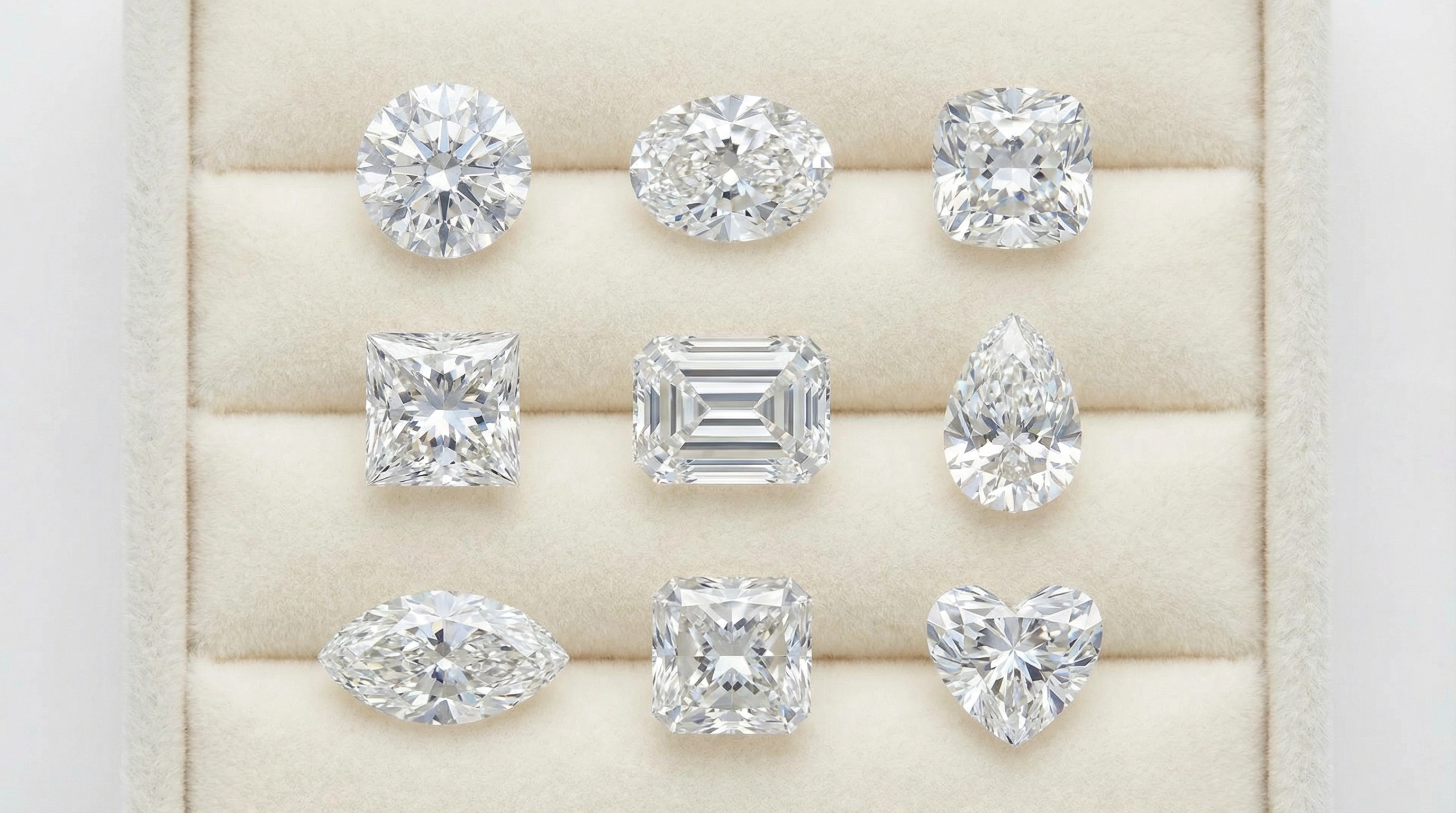
A diamond's shape is the first thing a customer notices — before carat
weight, before color, before price. It defines the personality of a
piece, determines which settings work, and drives purchasing decisions
at the retail counter. For trade buyers sourcing lab-grown diamonds,
understanding the full spectrum of available shapes is the difference
between a standard inventory and a curated collection that commands
higher margins.
This guide covers 20 distinct shapes available through
Guru Diam: nine classic shapes that anchor any retailer's inventory, and
eleven antique and rare cuts that represent Guru Diam's specialty —
shapes that virtually no other wholesaler stocks in lab-grown form.
Quick-Reference Shape Comparison Table
Shape
Cut Style
Facets
Ideal L/W Ratio
Best For
Demand Level
Round Brilliant
Brilliant
57–58
1.00
Engagement rings, studs, pendants
High
Oval
Modified Brilliant
57–58
1.30–1.50
Engagement rings, halos
High
Cushion
Modified Brilliant
58
1.00–1.20
Engagement rings, vintage settings
High
Princess (Square)
Brilliant
57–76
1.00–1.05
Engagement rings, channel-set bands
High
Emerald
Step
57
1.30–1.50
Engagement rings, three-stone settings
High
Radiant
Brilliant
70
1.00–1.35
Engagement rings, mixed-metal settings
Medium
Pear (Teardrop)
Modified Brilliant
57–58
1.45–1.75
Pendants, drop earrings, rings
Medium
Marquise
Brilliant
58
1.75–2.25
Engagement rings, earrings
Medium
Heart
Modified Brilliant
56–58
0.90–1.10
Pendants, romantic gifts
Medium
Old Mine Cut
Antique Brilliant
58
1.00–1.05
Vintage engagement rings
Niche
Old European Cut
Antique Brilliant
58
1.00
Vintage solitaires
Niche
Rose Cut
Rose
3–24
1.00 (varies)
Low-profile rings, stacking bands
Niche
Portuguese Cut
Complex Brilliant
161–200
1.00 (varies)
Statement rings, collector pieces
Specialty
Hexagon Cut
Step or Brilliant
~31 (step)
1.00–1.20+
Modern rings, Art Deco designs
Niche
Coffin Cut
Step or Brilliant
Varies
1.40–1.70
Bold statement rings
Specialty
Kite Cut
Step or Brilliant
Varies
1.20–1.60
Geometric jewelry, modern rings
Specialty
Lozenge (Diamond)
Step
Varies
1.30–1.60
Art Deco rings, pendants
Specialty
Padma Cut
Modified Brilliant
80
1.00
Luxury rings, collector pieces
Specialty
Dutch Marquise
Antique Brilliant
~58
1.60–1.70
Vintage rings, custom designs
Specialty
Criss Cut
Criss-Cross Step
77
1.30–1.50
Statement rings, luxury pendants
Specialty
Part 1: Classic & Contemporary Shapes
These nine shapes form the foundation of the global diamond market.
Every retailer needs consistent access to them in a range of sizes and
qualities. In lab-grown form, they let trade buyers stock deeper
inventories at lower cost-per-carat, enabling competitive retail pricing
and faster turnover.
1. Round Brilliant
The Round Brilliant accounts for roughly 60% of all
diamonds sold. Perfected by Marcel Tolkowsky in 1919, its 57–58 facets
are mathematically engineered for maximum light return. Perfectly
circular with a symmetrical cone-shaped pavilion, it delivers unmatched
brilliance, fire, and scintillation. L/W ratio is always ~1.00. Best for
engagement rings, studs, tennis bracelets, and pendants — the universal
shape for buyers who want maximum sparkle. In lab-grown form, rounds
deliver identical optical performance at 50–70% less than mined
equivalents.
Trade Buyer Tip: Stock across the full size spectrum
(0.50–3.00 ct). In lab-grown, customers increasingly trade up in size —
having 2.00 ct+ rounds readily available is a competitive advantage.
2. Oval
Created by Lazare Kaplan in the 1960s, the
Oval combines round-brilliant sparkle with an elongated
silhouette that flatters the finger and appears larger per carat. Its
57–58 facets produce strong fire; a faint "bow-tie" shadow is common but
minimized in well-cut stones. Ideal L/W ratio is 1.35–1.50. Now the
second most requested engagement ring shape, ovals appeal to trend-aware
buyers seeking modern elegance. Lab-grown production allows tighter
proportion control, reducing the bow-tie effect.
Trade Buyer Tip: Ovals are the hottest bridal shape
right now. Stock elongated ratios (1.35–1.50) — that is what
social-media-driven customers request most.
3. Cushion
The Cushion Cut features a square or rectangular
outline with softly rounded corners, descending from the Old Mine Cut.
Available as Cushion Brilliant (chunky light flashes)
or Cushion Modified ("crushed ice" sparkle), it has 58
facets and produces broad, romantic light. L/W ratio runs 1.00–1.05 for
square, 1.10–1.20 for elongated. Consistently a top-three engagement
ring shape, it suits vintage-inspired and halo settings. Lab-grown
cushions are available in both variants at competitive pricing.
4. Princess (Square)
The Princess Cut is a square brilliant developed in the
1960s–70s. Its sharp, geometric corners and 57–76 facets (depending on
chevron patterns) deliver brilliance comparable to a round in a
contemporary silhouette. L/W ratio should be 1.00–1.05 for a true
square. Best for solitaire engagement rings and channel-set bands, it
appeals to buyers who want maximum sparkle in a modern, angular form.
The princess retains less rough during cutting, which translates to
lower per-carat costs in lab-grown production — an excellent value
proposition for retailers.
5. Emerald
The Emerald Cut is a step-cut rectangle with beveled
corners, adapted for diamonds during the Art Deco era. Its 57 parallel
facets create a "hall of mirrors" effect that emphasizes clarity over
sparkle — higher clarity grades (VS2+) are recommended. Ideal L/W ratio
is 1.40. Best for buyers who prize understated sophistication. Lab-grown
pricing makes stocking VS1 and VVS grades practical for this
clarity-demanding shape.
Trade Buyer Tip: Emerald cuts require VS2+ clarity to
present well. Lab-grown makes premium clarity grades affordable.
Position these as a sophisticated alternative to rounds.
6. Radiant
Created by Henry Grossbard in 1977, the Radiant merges
the emerald silhouette with round-brilliant sparkle. Its 70 facets and
beveled corners produce dazzling fire in a rectangular or square
outline. L/W ratio is 1.00–1.05 (square) or 1.20–1.35 (rectangular).
Ideal for buyers who love the emerald shape but want more brilliance.
Its faceting masks color and inclusions effectively, meaning G–H color
and VS2 clarity present beautifully.
7. Pear (Teardrop)
The Pear Shape is a hybrid of the round and marquise,
first created by Lodewyk van Berquem in 1458. Its 57–58 facets form an
asymmetric teardrop with one pointed and one rounded end. L/W ratio of
1.50–1.70 is preferred. Versatile across jewelry categories — pendants,
drop earrings, and engagement rings. The pointed tip is vulnerable to
chipping; lab-grown stones can be replaced cost-effectively, lowering
warranty risk for retailers.
8. Marquise
Tracing to 18th-century France, the Marquise was
reportedly commissioned by King Louis XV to resemble the lips of the
Marquise de Pompadour. Its 58 facets in a boat-shaped outline appear
15–20% larger than a round of equivalent weight. Ideal L/W ratio is
2.00. Symmetry is critical — both points must align precisely.
Experiencing renewed interest as vintage shapes trend upward. Lab-grown
production achieves tighter symmetry tolerances than many mined stones.
9. Heart
The Heart Shape is a modified brilliant requiring
exceptional cutting skill to achieve symmetrical lobes and a
well-defined cleft. Essentially a pear shape with a notch cut into the
rounded end, its 56–58 facets form the ultimate romantic symbol in
diamond form. L/W ratio of 1.00 produces the most balanced silhouette.
Best in 1.00 ct+ sizes where the shape is clearly visible. Ideal for
pendants, anniversary gifts, and sentimental buyers who value emotional
symbolism. Retail demand spikes seasonally around Valentine's Day and
anniversaries. Lab-grown production offsets the significant rough waste
this cut demands, making heart shapes more accessible at retail.
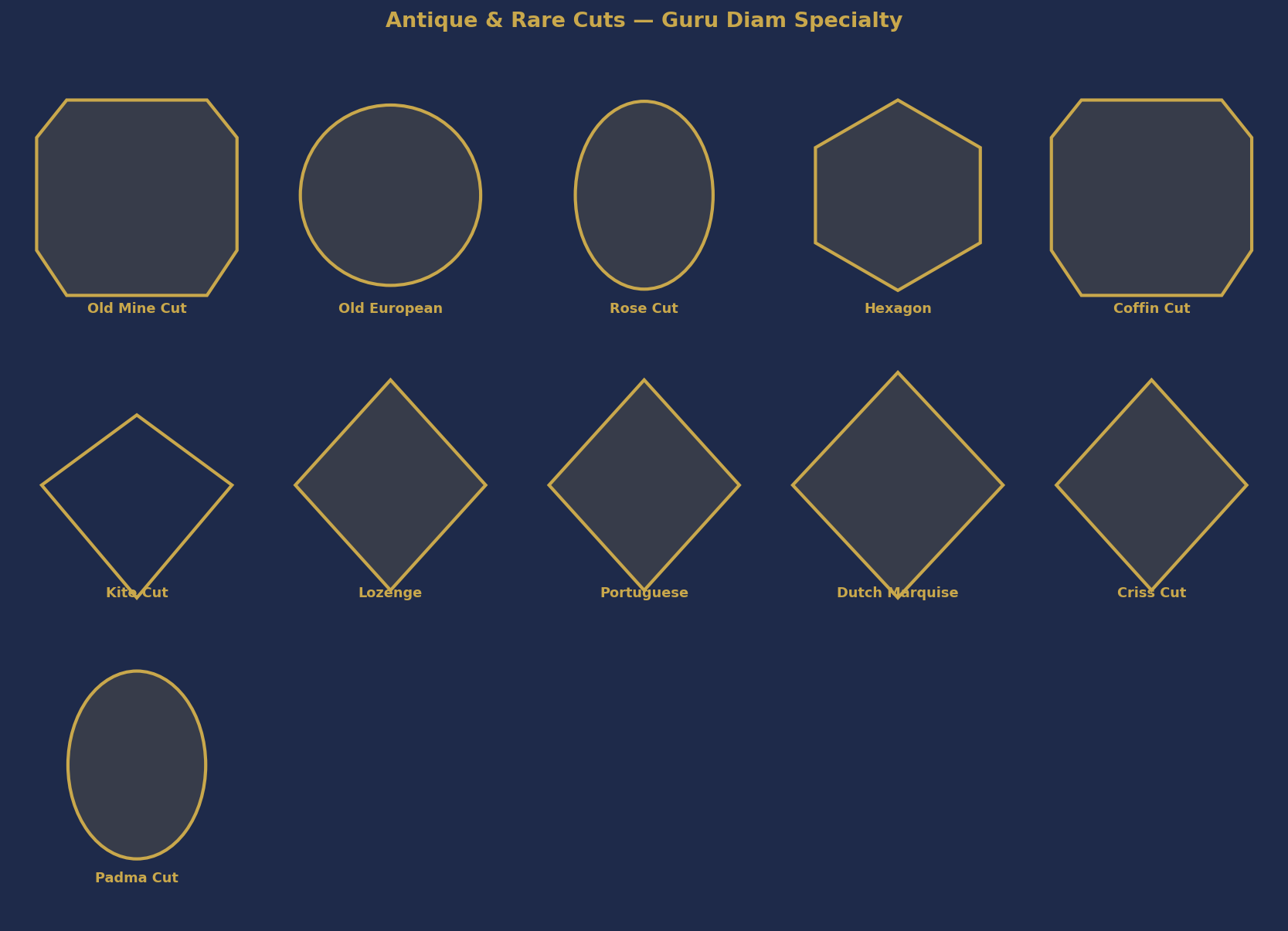
Guru Diam's exclusive rare cut inventory — in-house crafted, available
wholesale from NYC
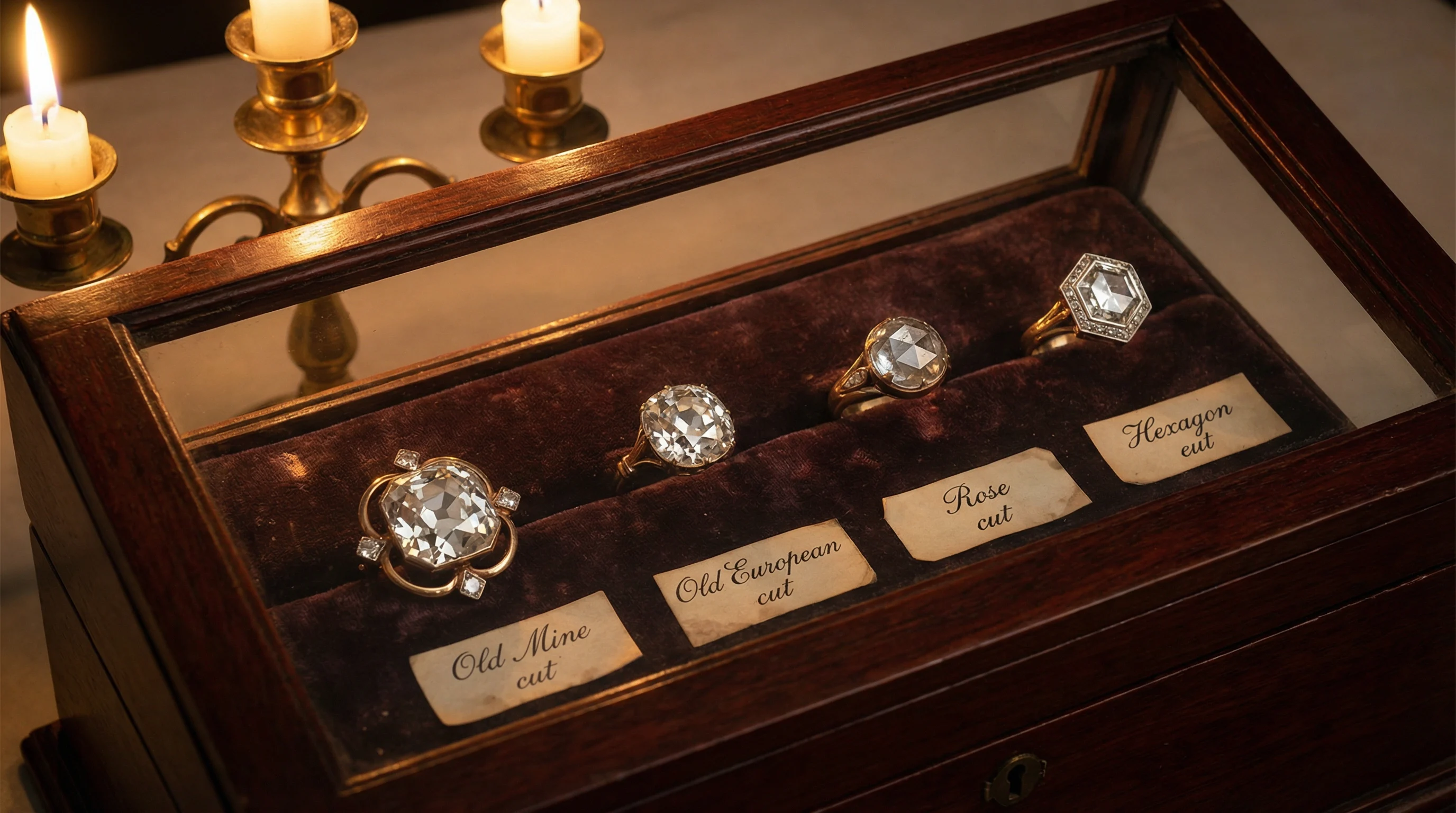
Part 2: Antique & Rare Cuts — Guru Diam's Specialty
Demand for antique and rare cuts is accelerating. Social media, the
vintage jewelry revival, and a generation of buyers who prize
individuality have made non-standard shapes a growth category for
independent jewelers and custom designers. The challenge has always been
sourcing: antique cuts in mined diamonds are scarce, inconsistent, and
expensive. Lab-grown production delivers these shapes with precision and
repeatable quality — but only if your supplier carries them.
This is where Guru Diam stands apart. With 30+ shapes
in stock, including the 11 rare cuts below, Guru Diam offers the
broadest selection of specialty lab-grown shapes in the wholesale
market.
1. Old Mine Cut
The Old Mine Cut is the predecessor of the modern
cushion, hand-cut during the 18th–19th centuries. It features a
cushion-shaped outline with a high crown, small table, deep pavilion,
and visible open culet — producing broad, romantic light flashes. Its 58
facets create a "chunky" sparkle optimized for candlelight. L/W ratio:
1.00–1.05. Best for vintage engagement rings and period reproductions.
Authentic old mine cuts are rare and expensive; lab-grown versions
deliver the same optical warmth at a fraction of the cost.
Trade Buyer Tip: Old Mine Cuts are rising. Younger
buyers discover them on social media and want the antique look without
antique pricing. Stock 0.75–2.00 ct to meet engagement ring demand.
2. Old European Cut
The Old European Cut (OEC) is the direct ancestor of
the modern round brilliant, popular from the 1890s through the 1930s
during the Art Nouveau and Edwardian eras. Its 58 facets in a round
outline feature a small table (≤53%), high crown (≥40°), and visible
open culet. The result is softer, warmer sparkle with pronounced fire
and a distinctive "bullseye" pattern when viewed face-up — less "disco
ball" than a modern brilliant, more like firelight. L/W ratio: ~1.00.
Best for vintage solitaires, Art Nouveau reproductions, and
heirloom-style pieces. Guru Diam works with cutters trained in antique
faceting patterns to deliver authentic optical performance in every
stone.
3. Rose Cut
One of the oldest diamond cuts, the Rose Cut dates to
the 1500s. Named for its resemblance to an opening rosebud, it features
a flat base and domed crown with 3–24 triangular facets and no pavilion.
It produces a soft, translucent "candlelit" glow rather than fiery
brilliance, and sits very low in settings. Ideal for stacking bands,
bezel-set earrings, and bohemian designs. Lab-grown rose cuts are
extremely cost-effective for multi-stone layouts.
Trade Buyer Tip: Rose cuts are a designer favorite for
stacking rings and cluster settings. Stock smaller sizes (0.25–1.00 ct)
alongside larger feature stones.
4. Portuguese Cut
The Portuguese Cut features 161–200 facets — nearly
three times a standard round brilliant. Originally developed for colored
gemstones like topaz and amethyst, its concentric facet rings, high
crown, small table, and deep pavilion create an almost three-dimensional
glow with extraordinary depth and fire. Available primarily in round and
oval outlines. L/W ratio: ~1.00 (round). The complex faceting requires
master-level cutting and significant rough waste. A true statement cut
for luxury collectors and connoisseurs who appreciate cutting artistry.
Few suppliers stock them at all; Guru Diam maintains ready inventory so
retailers can offer this extraordinary cut without prohibitive custom
fees or long delays.
5. Hexagon Cut
The Hexagon Cut is a six-sided geometric diamond rooted
in 1920s Art Deco aesthetics. Step-cut versions (~31 facets) produce a
sleek "hall of mirrors" effect; brilliant-cut versions offer more
sparkle. Appears larger than rounds of equivalent carat weight. L/W
ratio: ~1.00 (symmetrical) or 1.20+ (elongated). Rapidly growing demand
among indie jewelers. Guru Diam stocks both step-cut and brilliant-cut
variants.
Trade Buyer Tip: Hexagons are emerging fast with
younger buyers and indie designers. Step-cut versions are most
sought-after. Stock elongated forms for rings and symmetrical forms for
earring pairs.
6. Coffin Cut
The Coffin Cut is an elongated hexagonal shape with
tapered ends — bold, architectural, and unapologetically unconventional.
Available in step-cut and brilliant-cut variations. L/W ratio:
1.40–1.70. Appeals to the alternative bridal, Gothic, and avant-garde
jewelry market. Virtually impossible to find in mined diamonds;
lab-grown production makes it available on demand. Almost no other
wholesaler carries it.
7. Kite Cut
The Kite Cut is a four-sided shape with one sharp point
and one wider, tapered end. Its angular silhouette creates dramatic
light patterns and works in both horizontal and vertical orientations.
L/W ratio: 1.20–1.60. Favored by minimalist and geometric jewelry
designers for modern engagement rings and dramatic earrings. Guru Diam
fills the sourcing gap for designers who cannot find kite cuts through
traditional wholesale channels.
8. Lozenge (Diamond) Cut
The Lozenge Cut — from the original French word for
"rhombus" — has four equal sides and pointed corners, forming the
classic playing-card diamond shape. A quintessential Art Deco step cut
that embodies the geometric elegance of the 1920s and 1930s, its
trapezoidal facets create a sophisticated hall-of-mirrors effect
emphasizing clarity and architectural beauty. Differs from the emerald
cut (rectangular) and Asscher (square with beveled corners) in its true
rhombus silhouette. L/W ratio: 1.30–1.60. Ideal for Art Deco designs,
pendants, and multi-stone arrangements. The pointed corners require
careful setting but reward with a striking geometric presence. One of
the rarest shapes in any wholesale inventory — stocking it signals depth
of selection that retailers and designers cannot find elsewhere.
9. Padma Cut
The Padma Cut draws its name from the Sanskrit word for
lotus. Its 80 facets are arranged in concentric petal-like layers that
mimic a blooming lotus flower, producing a gentle, meditative brilliance
— softer and more diffused than a standard round. L/W ratio: ~1.00.
Rooted in Indian heritage and Mughal artistic tradition, the Padma cut
resonates powerfully in the South Asian bridal market. Guru Diam is
among the first wholesalers to stock it.
Trade Buyer Tip: The Padma cut is a sleeper hit for
retailers serving South Asian communities. Its lotus symbolism carries
deep cultural significance — a compelling story for bridal sales.
10. Dutch Marquise
The Dutch Marquise is an antique variation of the
classic marquise, rooted in the hand-cutting traditions of European —
particularly Dutch and Belgian — diamond craftsmen. It features a
broader center, shorter proportions, and vintage-style faceting that
follows the philosophy of Old Mine and Old European cuts, emphasizing
depth and fire over sharp brilliance. Its hexagonal outline has six
straight edges rather than the curved sides of a modern marquise, with
~58 facets producing deep, characterful warmth. L/W ratio: 1.60–1.70
(shorter and broader than a modern marquise's 1.75–2.25). Subtle
asymmetries are part of its character, not flaws. Authentic antique
examples are nearly nonexistent on the market; lab-grown production
makes this shape reproducible with the vintage proportions that define
its appeal.
11. Criss Cut
The Criss Cut was created by Christopher Slowinski in
1998 — born from a cutting accident on an emerald-cut diamond. Its 77
facets cross diagonally rather than running parallel, producing
dramatically more brilliance than a standard step cut while maintaining
the emerald silhouette. L/W ratio: 1.30–1.50. The criss-cross pattern
creates a mesmerizing internal display visible to the naked eye.
Lab-grown production makes this ultra-exclusive cut accessible at
wholesale.
Trade Buyer Tip: The Criss Cut is a secret weapon for
closing sales. Keep one in your showcase alongside standard emerald cuts
— the side-by-side comparison sells itself.
Build a Collection No One Else Can Offer
From bestselling round brilliants to ultra-rare Padma cuts and Dutch
Marquises, Guru Diam gives trade buyers access to the widest range of
lab-grown diamond shapes in the wholesale market. Our 30+ shapes —
including antique and rare cuts that virtually no other supplier carries
— are in stock and ready to ship from NYC and LA.
Ready to see what's available? Browse our full
inventory of rare and exotic shapes, or contact our trade team to
request specific stones for your next collection.
Browse Rare & Exotic Shapes Inventory
Request a Custom Shape Selection
Schedule a Virtual Viewing
SECTION 03
How to Read Your Diamond Certificate
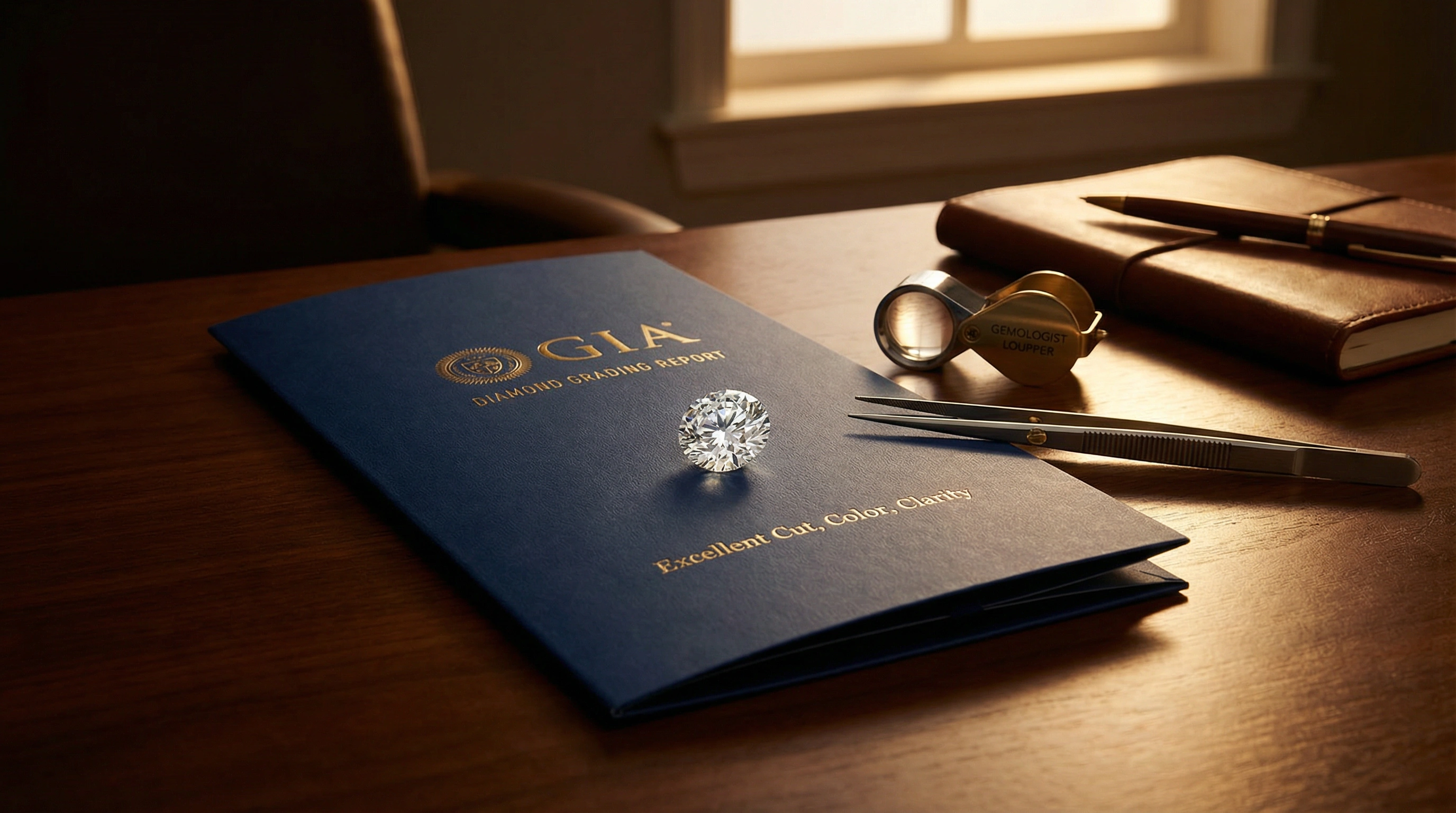
Every lab-grown diamond in Guru Diam's inventory ships with an
independent grading report from
IGI (International Gemological Institute) or
GIA (Gemological Institute of America). This guide
walks you through every field on those certificates so you can read them
with confidence — and help your customers do the same.
Section 1: Why Diamond Certificates Matter
A diamond grading report — commonly called a "certificate" — is an
unbiased document issued by an independent gemological laboratory. It
records the diamond's physical characteristics and quality grades. It
does not assign monetary value; it strictly certifies
what the diamond is.
IGI and GIA are the two most trusted
grading labs in the world. GIA created the modern 4Cs grading system and
is the gold standard in gemological science. IGI is the most widely used
lab for lab-grown diamond certification globally. A report from either
lab gives trade buyers and consumers reliable, defensible quality data.
Lab-grown diamonds are chemically and optically identical to mined
diamonds — they pass standard diamond testers. Independent certification
provides objective proof of quality, confirms the stone is
laboratory-grown, and discloses any post-growth treatments. For
retailers, the certificate is your defensible quality claim, your
protection in supplier disputes, and your customer's source of
confidence.
Trade Buyer Tip: Always confirm the laser inscription
on the diamond's girdle matches the report number before accepting
inventory. A 10x loupe is all you need.
Section 2: The Certificate Header
The top section of any certificate contains the identifying information
that links the report to a specific diamond.
Report Number — A unique ID registered in the lab's
global database. Used for online verification. Usually laser-inscribed
on the diamond's girdle.
Laser Inscription — Microscopic text on the girdle.
IGI inscribes the report number. GIA inscribes "Laboratory-Grown" plus
the assessment number.
Shape and Cutting Style — The diamond's outline and
facet pattern (e.g., "Round Brilliant" or "Cushion Modified
Brilliant").
Measurements — Length × Width × Depth in millimeters.
Determines face-up size and setting fit. A deeper stone may appear
smaller face-up despite higher carat weight.
Date of Analysis — When the lab examined the diamond.
Existing reports remain valid indefinitely.
Section 3: The 4Cs on the Certificate
Carat Weight
Weight recorded to the nearest hundredth of a carat (e.g., 1.04 ct). One
carat equals 0.2 grams. Carat measures weight, not size — two diamonds
of the same weight can face up differently depending on cut proportions.
Color Grade
Graded on the D-to-Z scale: D is colorless, Z shows
noticeable tint. Most lab-grown diamonds fall D to J. IGI reports show a
specific letter grade. GIA reports issued after October 2025 fold color
into the Premium/Standard classification (see Section 7).
Clarity Grade
Rates the visibility of inclusions and blemishes under 10x
magnification:
FL / IF — Flawless / Internally Flawless
VVS1 / VVS2 — Very, Very Slightly Included
VS1 / VS2 — Very Slightly Included
SI1 / SI2 — Slightly Included
I1 / I2 / I3 — Included (visible to naked eye)
Cut Grade
Evaluates how well facets interact with light, graded from
Excellent to Poor. Both labs grade cut
for rounds. IGI also grades fancy shapes; GIA does not. Excellent cut
means maximum brilliance, fire, and scintillation.
Trade Buyer Tip: For your best-selling rounds,
prioritize Excellent cut, Excellent polish, and Excellent symmetry — the
"triple excellent" (3EX) combination. It is the easiest quality story to
tell on the sales floor.
Section 4: Additional Quality Grades
Polish — Rates surface smoothness after cutting
(Excellent to Poor). Microscopic imperfections like scratches or burn
marks lower the grade.
Symmetry — Rates facet alignment, shape precision,
and placement (Excellent to Poor). Strong symmetry ensures even light
distribution.
Fluorescence — Describes UV light reaction: None,
Faint, Medium, Strong, or Very Strong. None to Faint is preferred for
D–F stones. Strong fluorescence can cause haziness in some diamonds —
always verify visually.
Trade Buyer Tip: Fluorescence in lab-grown diamonds is
less common than in natural stones, but when present, always check the
stone visually. A diamond with Strong fluorescence that faces up clean
is not a problem.
Section 5: The Proportions Diagram
Most certificates include a proportions diagram — a
profile silhouette with key measurements labeled as percentages:
Table % — Width of the flat top facet relative to
diamond width
Depth % — Total height relative to width
Crown Angle — Angle of upper facets relative to the
girdle
Pavilion Angle — Angle of lower facets relative to
the girdle
Girdle Thickness — Described in words (Thin, Medium,
Slightly Thick, etc.)
For an Excellent cut round brilliant, look for: Table 54%–58%, Depth
59%–62.5%, Crown Angle 34°–35.5°, Pavilion Angle 40.6°–41°. These
proportions control how light enters and exits the stone. A
well-proportioned diamond bounces light back through the top; a poorly
proportioned one leaks light and appears dull.
Section 6: The Clarity Plot
IGI reports include a clarity plot — two circle
diagrams showing the crown (top) and pavilion (bottom) views. Symbols
indicate inclusion type, location, and approximate size. Red marks
internal inclusions; green marks surface blemishes.
Common Inclusion Symbols
Pinpoint (red dot) — Tiny trapped crystal. Usually
harmless.
Crystal (red shape) — Embedded mineral. Can be white,
dark, or colored.
Feather (red squiggly line) — Small internal
fracture. Impact depends on size and position.
Cloud (red dotted circle) — Cluster of pinpoints
creating a hazy area. Minor clouds are harmless; large, dense clouds
can affect transparency.
The plot is two-dimensional — it does not capture depth or real-life
visibility. Always compare the plot to the actual stone under
magnification.
Trade Buyer Tip: Watch for comments like "cloud is not
shown" or "additional pinpoints are not shown." These notes signal the
plot does not capture every feature. Request high-resolution images when
buying sight-unseen.
Section 7: Lab-Grown–Specific Fields
Every lab-grown certificate prominently states
"Laboratory Grown" in the report title. Both IGI and
GIA identify the growth method —
CVD (Chemical Vapor Deposition) or
HPHT (High Pressure High Temperature) — and disclose
any post-growth treatments in the comments section.
IGI vs. GIA Reporting Format
IGI uses the traditional 4Cs with specific letter/number grades,
includes a clarity plot, and offers printed and digital reports. GIA
historically applied a similar approach, but effective
October 1, 2025, replaced traditional grading with a
two-tier system.
GIA's October 2025 Premium / Standard System
Under the updated system, D-to-Z lab-grown diamonds are classified as
Premium or Standard. Diamonds below
minimum criteria receive no GIA assessment.
Premium requires: D color, VVS or higher clarity,
Excellent polish and symmetry, Excellent cut (rounds).
Standard requires at minimum: E–J color, VS clarity,
Very Good polish, Very Good symmetry (Good for fancy shapes), Very Good
cut (rounds).
Each stone is laser-inscribed with "Laboratory-Grown" and its GIA
assessment number. The fee is US$15 per carat (minimum $15).
Trade Buyer Tip: New GIA lab-grown reports no longer
show traditional letter grades. If customers ask for "D VVS2" on a GIA
report, explain the two-tier system. For itemized 4Cs grading, look to
IGI-certified inventory.
Section 8: How to Verify a Certificate Online
Verify an IGI Report
Locate the report number on your IGI certificate.
Visit IGI's official verification page at igi.org.
Enter the report number and submit.
Compare every returned field to the physical certificate. They should
match exactly.
Verify a GIA Report
Locate the report number on your GIA certificate or assessment
document.
Visit GIA's Report Check page at gia.edu.
Enter the report number.
Confirm the returned data matches your certificate and the girdle
inscription.
Guru Diam Inventory Verification
Every diamond in Guru Diam's online inventory includes its certificate
number and a direct link to the lab's verification page. You can verify
any stone's grading report before placing an order.
Red Flags for Fake Certificates
Report number returns no results on the lab's official website
Grades on the physical certificate do not match the online database
Girdle inscription does not match the report number
Certificate lacks security features (holograms, watermarks, QR codes)
Issuing lab is unfamiliar or not recognized in the trade
Trade Buyer Tip: Make online verification part of your
receiving process. It takes 30 seconds per stone and eliminates any risk
of accepting a mismatched or fraudulent certificate.
Section 9: Quick Reference — Certificate Field Table
Field
Where on Report
What It Means
Why It Matters
Report Number
Top of certificate
Unique ID in the lab's global database
Verify authenticity online; match to girdle inscription
Laser Inscription
Listed on certificate; on diamond's girdle
Microscopic text linking stone to report
Physical proof this certificate belongs to this diamond
Assess whether inclusions affect beauty or durability
Origin Disclosure
Report title and comments
"Laboratory Grown" statement
Legal compliance and consumer transparency
Growth Method
Comments section
CVD or HPHT
Creation process; may indicate post-growth treatment
Comments
Bottom of report
Treatments, extra inclusions, inscriptions
Catch-all for anything not in standard fields — always read
Start Buying with Confidence
Now that you know how to read every line on an IGI or GIA diamond
certificate, put that knowledge to work. Browse Guru Diam's full
inventory of certified lab-grown diamonds — every stone comes with its
grading report and a direct verification link.
Ready to order? Contact Guru Diam's trade team in New
York or Los Angeles to discuss pricing, custom assortments, or bulk
orders.
SECTION 04
Lab Grown Diamond Price Guide 2026
Lab grown diamond prices have shifted dramatically over the past five
years. This guide breaks down the factors that drive pricing, traces the
market from 2021 through early 2026, and provides wholesale reference
ranges so retailers and jewelers can price with confidence.
Disclaimer: All prices listed are approximate wholesale
reference ranges for round brilliant, CVD-grown, VS2 clarity, Excellent
cut, IGI-certified lab grown diamonds unless otherwise noted. Actual
pricing depends on specific 4Cs, certification, and real-time market
conditions. Login to gurudiam.com for
live pricing on 11,000+ certified stones.
Section 1: How Lab Grown Diamond Prices Work
The 4 Factors That Most Affect Price
Lab grown diamonds are graded and priced using the same 4Cs framework as
mined diamonds — carat weight, color, clarity, and cut.
Of these, carat weight has the single largest impact on price, followed
by color grade, clarity grade, and cut quality. A one-grade shift in
color (for example, F to G) can change wholesale cost by 5–15%, while
jumping a full carat weight bracket (0.99ct to 1.00ct) can move the
price per carat by 10–20%.
Why Lab Grown Prices Differ from Natural Diamond Prices
Natural diamond pricing reflects geological scarcity and a controlled
supply chain. Lab grown pricing reflects manufacturing cost, energy
inputs, and technology efficiency — which improve year over year. As of
early 2026, lab grown diamonds are approximately
80–85% less expensive than comparable natural diamonds
of the same grade.
Why Prices Change
Four forces shape lab grown diamond pricing over time:
Supply volume: As production capacity grows —
particularly from large-scale facilities in India and China —
wholesale prices face downward pressure.
Consumer demand: Lab grown diamonds now account for
roughly 42% of all diamond jewelry sold and nearly 48% of engagement
rings, driving steady demand growth.
Technology improvements: Advances in CVD and HPHT
reactor efficiency reduce the cost per carat of rough production.
Input costs: Energy prices, rough diamond costs (HPHT
rough reached approximately $10/ct floor in 2025), and tariffs all
affect the wholesale floor.
Section 2: Price Trends 2021–2026
Year-by-Year: How the Market Moved
The lab grown diamond market has undergone one of the fastest pricing
corrections in the jewelry industry's history. Here is how average
1-carat round retail prices evolved:
2021 — Peak pricing. A 1-carat IGI-certified round lab
grown diamond retailed for approximately $2,800. Post-pandemic demand
was surging, and natural diamond prices also spiked, making the
lab-to-natural gap appear modest and fueling adoption.
2022 — The correction begins. Prices dropped roughly
36% as Indian CVD production facilities scaled aggressively. A 1-carat
stone fell to approximately $1,800 at retail. The lab-to-natural price
gap widened from 27% to nearly 68%.
2023 — Continued decline. Retail prices for 1-carat
stones fell another 33% to roughly $1,200. Chinese HPHT production
surged alongside Indian CVD capacity, and wholesale prices dropped even
faster than retail.
2024 — Early stabilization. The rate of decline slowed.
A 1-carat stone averaged around $892 at retail by year-end — a 26% drop,
but the slowest annual decline to date. Certain segments, particularly
1.50-carat and larger stones, showed early signs of price firming.
2025 — The turning point. Wholesale prices declined 26%
year-over-year on average, but quarterly drops narrowed to just 4.7% —
the smallest since lab grown diamonds entered the market. 1.50-carat
stones fell only 8% YoY and rose 11% quarter-over-quarter in H2. HPHT
producers stopped cutting prices after rough costs bottomed near $10/ct,
and wholesale prices for smaller goods moved up 10–20%.
Early 2026 — Signs of recovery. Prices for 1-carat and
larger stones are rising slightly — up approximately 2% in the most
recent quarter, with reports of 14% month-over-month increases for
select 1-carat categories. Smaller stones (under 0.50ct) are flat or
rising modestly due to HPHT cost floors, while larger CVD-grown stones
(2ct+) show stabilization in better makes.
What Caused the Decline
Two forces drove the correction:
massive scaling of Indian CVD production (Surat-based
manufacturers expanded capacity several-fold) and
Chinese HPHT factories competing aggressively on price.
Reactor efficiency improvements meant each unit could produce more
stones at higher quality.
What This Means for Retailers
Trade Buyer Tip: The current market represents a
historic buying opportunity. Wholesale prices are near all-time lows,
while retail demand for lab grown diamonds continues growing. Retailers
sourcing at today's wholesale levels can achieve stronger margins than
at any previous point in the category's history.
Section 3: 2026 Wholesale Price Reference Table
The following table shows approximate
wholesale price ranges for round brilliant, CVD-grown,
IGI-certified lab grown diamonds at VS2 clarity and Excellent cut — the
most commonly traded baseline in the wholesale market. Prices are shown
as total stone cost (not price per carat).
Carat Weight
Color D–F
Color G–H
Color I–J
Notes
0.30 ct
$180–$320
$140–$250
$100–$180
High per-carat cost due to sorting/grading labor
0.50 ct
$280–$480
$200–$380
$150–$280
Magic size — 8–12% premium over 0.49ct
0.70 ct
$380–$620
$300–$500
$220–$380
Strong engagement ring size; good value bracket
0.90 ct
$480–$750
$380–$600
$280–$460
Value alternative to 1.00ct for price-sensitive buyers
1.00 ct
$550–$900
$420–$720
$320–$550
Magic size — 10–20% premium over 0.99ct; highest
demand bracket
1.50 ct
$850–$1,400
$650–$1,100
$480–$800
Magic size — most resilient segment in 2025;
prices rising
2.00 ct
$1,400–$2,400
$1,100–$1,900
$800–$1,400
Magic size — "new standard" for engagement rings;
predominantly CVD
VVS1–VVS2: Add 20–40% above the VS2 baseline,
depending on carat weight. The premium is larger on stones above 2
carats.
VS1: Add 5–15% above VS2. Minimal visual difference;
popular for cost-conscious retailers.
SI1–SI2: Subtract 10–25% from VS2 baseline. Eye-clean
SI1 stones offer strong value for retail.
How Color Grades Affect Pricing
D–F (Colorless): Commands a 15–30% premium over G–H
in most carat brackets.
G–H (Near-Colorless): The wholesale sweet spot —
strong demand, competitive pricing, face-up white in most settings.
I–J: 15–25% discount from G–H. Excellent value
proposition for fashion jewelry and price-sensitive retail.
Trade Buyer Tip: G–H color, VS2 clarity, Excellent cut
represents the highest-velocity combination in the wholesale market. It
balances quality perception with competitive pricing — and it is the
grade range most requested by retailers building engagement ring
inventory.
Section 4: Retail Markup & Margin Guide
Typical Retail Markup on Lab Grown Diamonds
Retail markups on lab grown diamonds in the current market typically
range from 2.0x to 3.5x wholesale cost, though legacy
retailers have been documented charging markups of 3x–5x and
occasionally higher. The wide range reflects the still-developing price
transparency in this category — and an opportunity for informed
retailers.
Pricing for Different Customer Segments
Luxury/bridal boutiques (3.0x–3.5x): Higher markup
justified by consultation experience, custom design services, and
brand positioning.
Independent jewelers (2.5x–3.0x): Balanced margin
that remains competitive against online retailers while covering
brick-and-mortar overhead.
Natural diamonds typically carry retail margins of 30–50% (1.4x–2.0x),
constrained by well-established price benchmarking and intense
competition. Lab grown diamonds offer
significantly higher margin potential — often 50–70%
gross margin — because wholesale-to-retail price transparency is still
limited for most consumers, and per-stone costs are dramatically lower.
Example Calculation
Line Item
Amount
Wholesale cost (1.00ct, G color, VS2, Excellent, IGI)
$550
Retail markup (2.5x)
×2.5
Retail selling price
$1,375
Gross profit
$825
Gross margin
60%
By comparison, a natural 1.00ct G/VS2 might wholesale at $3,800 and
retail at $5,700 (1.5x), yielding approximately 33% gross margin. The
lab grown diamond generates a higher margin percentage on a smaller
ticket — and is easier to sell in a market where lab grown stones
account for nearly half of engagement ring sales.
Trade Buyer Tip: Build your retail pricing from
wholesale cost up, not from competitor retail prices down. When you
source at true wholesale and apply a disciplined 2.5x–3.0x markup, you
can undercut legacy retailers by 30–40% while still earning 55–65% gross
margins.
Section 5: Factors That Move Prices Up or Down
Carat Weight & Magic Sizes
Prices jump at psychologically significant "magic sizes." Crossing these
thresholds commands a 10–20% premium over stones just
below:
0.50ct — Entry-level magic size; popular for side
stones and fashion jewelry
1.00ct — The dominant engagement ring size; highest
demand and largest premium jump
1.50ct — Most resilient pricing segment in 2025;
strong demand for upgrade buyers
2.00ct — Increasingly the "new standard" for
engagement; predominantly CVD-grown
3.00ct — Luxury threshold; prices saw 32% YoY decline
in 2025 but are stabilizing
Color: Colorless vs. Near-Colorless
D–F (Colorless) commands a 15–30% premium over
G–H (Near-Colorless) at wholesale. The difference
narrows at smaller carat weights and widens above 2 carats. G–H stones
face-up white in yellow gold and most white gold settings, making them
the best value for most retail applications. I–J stones
trade at a further 15–25% discount and are increasingly popular for
fashion and stackable jewelry.
Clarity: IF Through SI
IF–VVS: 20–40% premium over VS2. Primarily driven by
collector appeal and specification-driven buyers.
VS2: The wholesale standard. Eye-clean with excellent
value.
SI1: 10–20% discount from VS2. Eye-clean examples
offer the best margin opportunity for retailers.
SI2: 15–25% discount from VS2. May have visible
inclusions; best for price-driven segments.
Cut Quality
Excellent/Ideal cut commands a 10–15% premium over
Very Good cut at wholesale. Cut has the largest impact
on visual performance and should be the last factor to compromise. Most
wholesale buyers specify Excellent cut as minimum.
Certification: GIA vs. IGI
GIA-certified lab grown diamonds typically trade at a
10–20% premium over equivalent IGI-certified stones,
though IGI remains the dominant certification for lab grown diamonds
globally. Both are widely accepted by retail consumers. For wholesale
efficiency and inventory depth, IGI-certified goods offer the best
price-to-quality ratio.
Growth Method: CVD vs. HPHT
CVD (Chemical Vapor Deposition) dominates production
for stones 2 carats and above.
HPHT (High Pressure High Temperature) is common for
smaller goods and typically trades at a 5–15% discount in equivalent
grades. In early 2026, HPHT prices for smaller goods are firming as
producers enforce cost floors on rough.
Shape: Round vs. Fancy
Round brilliant commands a 15–30% premium over fancy
shapes (oval, emerald, cushion, pear, radiant) at wholesale, reflecting
higher rough wastage and stronger demand. Among fancies, ovals carry the
smallest discount to rounds, while emerald and asscher cuts are the most
affordable per carat.
Section 6: How to Access Live Pricing from Guru Diam
Live Wholesale Pricing Platform
The reference ranges in this guide provide market orientation — but
purchasing decisions require real-time pricing on specific stones. Guru
Diam maintains live wholesale pricing across 11,000+
IGI and GIA certified lab grown diamonds, updated continuously. Trade
buyers can search, filter, and compare by carat, color, clarity, cut,
certification, fluorescence, and growth method.
CSV Download & API Access
Guru Diam offers CSV stock list downloads and
API access with live pricing for retailers who
integrate inventory into their websites or POS systems — display
real-time availability without manual updates.
WhatsApp Daily Pricing Broadcasts
Subscribe to Guru Diam's
WhatsApp daily pricing broadcast for market updates and
notable price movements — the fastest way to stay current on wholesale
shifts.
Provide your business credentials (resale certificate or trade
reference)
Approval is typically same-day
Once approved, access live pricing, CSV/API downloads, and same-day
shipping from NYC
Trade Buyer Tip: The ranges in this guide reflect
market averages. Guru Diam's live platform shows exact pricing on
specific stones — including below-market opportunities on recently added
inventory. Register once and you will never need to guess at wholesale
pricing again.
Start Sourcing at True Wholesale
Wholesale costs are near all-time lows, retail demand continues growing,
and margin opportunity has never been stronger. The retailers who win
are the ones who source with full price visibility.
Same-day shipping from NYC. 11,000+ IGI & GIA certified stones. CSV,
API, and WhatsApp pricing available.
SECTION 05
CVD vs HPHT Lab Grown Diamonds: The Complete Trade Buyer's Guide
If you've explored Guru Diam's About Us page, you've
already seen our step-by-step CVD diamond creation process — from seed
preparation through laser cutting, polishing, and final inspection.
But CVD is only one of two methods used to grow real diamonds in a
laboratory. The other is
HPHT (High Pressure High Temperature).
CVD technology now accounts for roughly 63% of the U.S. lab-grown
diamond market, while HPHT holds the remainder and continues to play an important
role for specific applications. As a trade buyer, knowing which method
produced a diamond helps you advise customers, position inventory, and
make smarter purchasing decisions. This guide breaks down both
methods, compares them side by side, and gives you practical stocking
recommendations.
The Two Ways to Grow a Diamond
Every lab-grown diamond on the market today was created by one of two
methods: Chemical Vapor Deposition (CVD) or
High Pressure High Temperature (HPHT). Despite very
different technology, both produce diamonds that are physically,
chemically, and optically identical to mined diamonds — same Mohs 10
hardness, same refractive index, same thermal conductivity. They pass
every standard diamond tester.
Your customers will never see or feel a difference. The distinction
matters to you as a trade professional: it affects pricing, available
shapes and sizes, and certification disclosures. Both IGI and GIA
grade lab-grown diamonds on the same 4C scale and disclose the growth
method on every report.
How CVD Diamonds Are Made
The Chemical Vapor Deposition Process
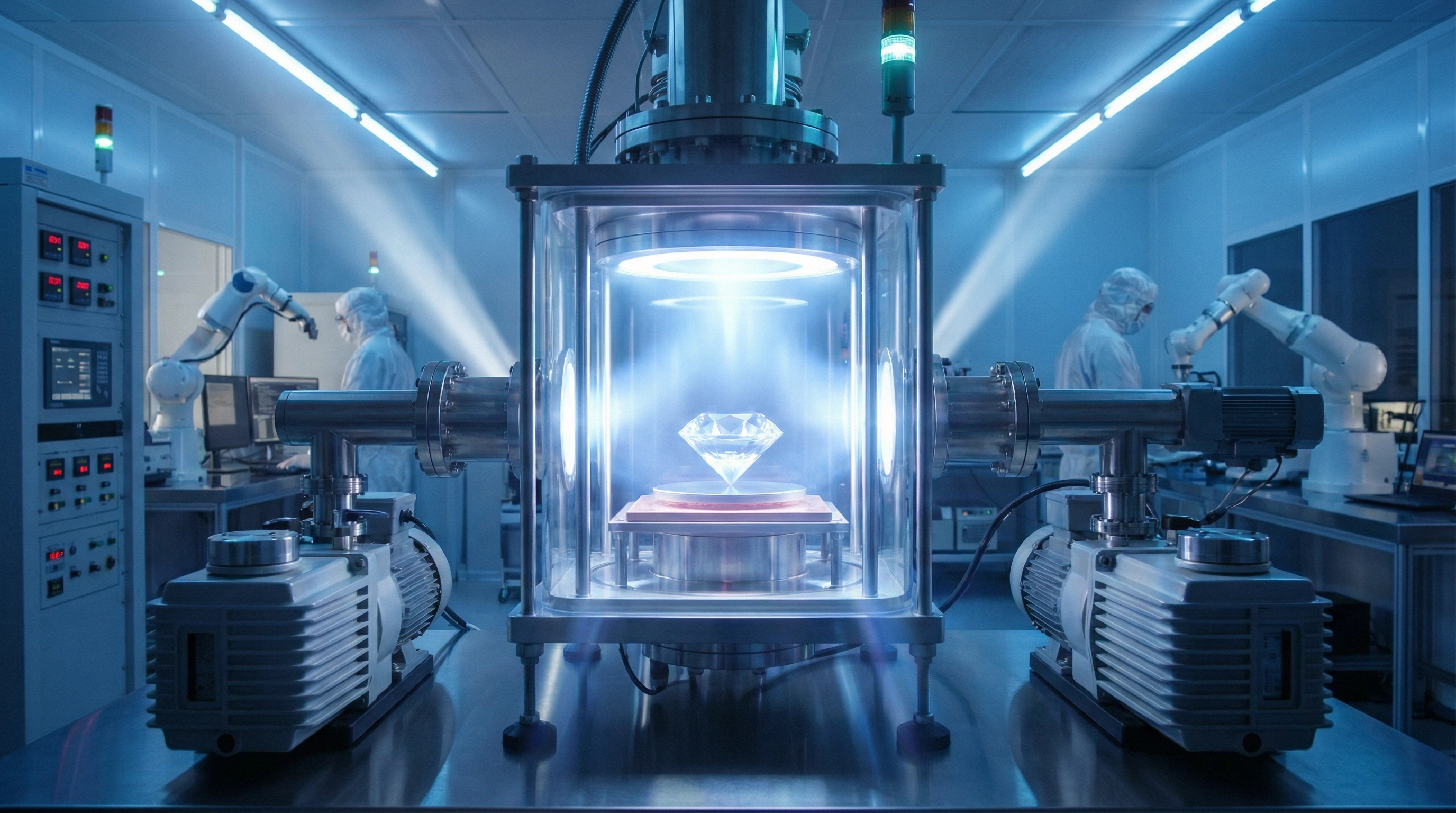
CVD (Chemical Vapor Deposition) grows diamonds from
the ground up — literally one atomic layer at a time. Here is how the
process works:
Seed Preparation. A thin diamond plate (0.5–2 mm)
is cleaned and polished to create a flawless growth substrate.
Chamber Loading. Seeds are placed inside a sealed
vacuum chamber; multiple seeds can grow simultaneously.
Gas Introduction. The chamber is filled with
methane (CH₄) as the carbon source and
hydrogen (H₂) as a stabilizer, with flow rates
carefully calibrated.
Plasma Activation. Microwave energy ionizes the gas
into a superheated plasma (3,000–4,000°C), breaking apart methane
molecules and freeing carbon atoms.
Layer-by-Layer Growth. Carbon atoms bond to the
cooler diamond seed (900–1,200°C), building the crystal lattice at
roughly 20–25 microns per hour.
Periodic Polishing. Every few days the growing
diamond is removed, polished to clear non-diamond carbon, then
returned to the chamber.
Extraction. After two to four weeks the rough
diamond is removed. Each cycle produces ~5 mm of thickness; larger
stones may require two to three cycles.
Cutting, Polishing, and Certification. The rough is
laser-cut, shaped, polished, and submitted to IGI or GIA. The
certificate discloses "CVD" as the growth method.
What Makes CVD Diamonds Distinctive
Exceptional Purity. CVD diamonds are almost always
Type IIa — the purest diamond category, with
virtually no nitrogen impurities. Only ~2% of mined diamonds achieve
this; the Hope Diamond is among the rare natural Type IIa stones.
Excellent Colorless Range. CVD excels at producing
D–F colorless grades — the strongest sellers in
bridal.
Larger Sizes Achievable. Gem-quality CVD diamonds
range from 0.1 ct to 10 ct and beyond.
Ideal for Fancy Shapes. The tabular CVD crystal
habit lends itself to antique cuts, rose cuts, hexagons, and custom
forms.
Post-Growth Treatments
Some as-grown CVD diamonds exhibit a faint brownish tint. A brief
post-growth HPHT treatment removes this color center,
producing a whiter stone. This treatment is standard, permanent, and
always disclosed on the certificate.
Environmental Footprint
CVD operates at low pressures and moderate temperatures, translating
to lower energy consumption per carat than HPHT. Many
CVD facilities run on renewable or mixed-grid electricity, further
reducing their carbon footprint.
How HPHT Diamonds Are Made
The High Pressure High Temperature Process
HPHT (High Pressure High Temperature) recreates the
extreme conditions found 140–240 km beneath the Earth's surface, where
natural diamonds form over billions of years. In the lab, the same
result is achieved in a matter of weeks.
Carbon Source and Seed. High-purity graphite or
diamond powder is placed in a capsule with a diamond seed (0.5–2 mm)
and a metallic catalyst (iron, nickel, and/or cobalt).
Press Loading. The capsule enters a specialized
press — typically a belt press,
cubic press, or
split-sphere (BARS) press.
Extreme Pressure and Temperature. The press ramps
to 5–6 GPa (~870,000–1.5 million psi) and
1,300–1,600°C, placing carbon in its diamond
stability field.
Carbon Migration. The catalyst melts into liquid
flux, dissolving the carbon source. A temperature gradient drives
carbon atoms toward the cooler seed.
Crystallization. Carbon precipitates onto the seed
in a tetrahedral lattice at 0.3–0.5 mm/day. A 1 ct rough takes
~10–14 days; 3–5 ct stones need 3–4 weeks.
Controlled Cooling. The press depressurizes
gradually over 12–24 hours to prevent thermal shock.
Extraction and Processing. The rough crystal is
separated from flux residue, then cut, polished, and certified.
Strong for Colored Diamonds. HPHT is the go-to for
fancy yellow, brown, and blue diamonds and for
decolorizing brownish stones.
Faster for Certain Sizes. For calibrated stones
under 1 carat, HPHT can offer shorter turnaround.
Widely Used for Treatment. HPHT technology also
treats existing lab-grown and natural diamonds to improve color.
Post-Growth Treatments
HPHT-grown diamonds may undergo annealing at up to 2,000–2,200°C and
70–80 kbar to modify color. These treatments are permanent and
disclosed on certificates.
Environmental Footprint
HPHT's sustained extreme pressures and temperatures result in
greater energy consumption per carat than CVD.
However, both methods are significantly more environmentally friendly
than traditional mining.
Side-by-Side Comparison: CVD vs HPHT
Attribute
CVD
HPHT
Growing Process
Carbon-rich gas plasma deposits atoms layer by layer onto a
diamond seed in a vacuum chamber
Carbon dissolves in molten metal catalyst and crystallizes onto
a diamond seed under extreme pressure
Temperature Required
900–1,200°C (substrate)
1,300–1,600°C
Pressure Required
Low pressure (near-vacuum; <1 atm)
5–6 GPa (~870,000–1,500,000 psi)
Typical Growth Duration
2–4 weeks per cycle; larger stones need multiple cycles
10–14 days for 1 ct; 3–4 weeks for larger stones
Diamond Types Produced Best
Colorless (D–F), large stones, fancy shapes
Near-colorless to fancy colored; calibrated smaller sizes
Color Range (As-Grown)
Colorless to faint brown; post-treatment to D–F
Yellow, brown, blue, colorless after treatment
Clarity Profile
Typically IF–VVS; fewer inclusions due to low-pressure growth
Typically VVS–SI; occasional metallic flux inclusions
Common Post-Growth Treatment
HPHT treatment to improve color
Annealing to modify or enhance color
Type IIa Classification
Almost always Type IIa (highest purity)
Varies; may contain trace nitrogen (Type Ib) depending on growth
conditions
Shapes Available
Full range including specialty and antique cuts
Full range; strongest in round and standard shapes
Relative Price
Generally competitive; lower equipment cost supports accessible
pricing
Comparable; can be slightly higher for colorless due to
treatment steps
Certificate Disclosure
Noted as "Laboratory Grown — CVD" on IGI/GIA report
Noted as "Laboratory Grown — HPHT" on IGI/GIA report
Guru Diam Availability
Primary specialty — 11,000+ stones in live inventory
Available — filter by HPHT in live inventory
Quality and Grading — Is One Method Better?
The short answer: no. Neither CVD nor HPHT is
inherently superior. Both produce diamonds spanning the full 4C range.
Quality depends on the producer's skill, growth parameters, and
cutting expertise — not the method itself.
What the Certificate Tells You
Both IGI and GIA grade lab-grown diamonds on the same
Cut, Color, Clarity, and Carat Weight scale used for
mined stones. The report states the growth method and discloses
post-growth treatments — giving your customers transparent quality
assurance regardless of method.
Why Some Retailers Prefer CVD
Purity. CVD's near-universal Type IIa
classification is an easy selling point — it places these diamonds
in the same purity category as the rarest natural stones.
Transparency. The CVD process has become the
dominant method in the U.S. market, and many consumers are already
familiar with the term.
Colorless consistency. CVD excels at producing
high-color stones (D–F) at scale, which are the strongest sellers in
bridal.
Why Some Retailers Prefer HPHT
Colored diamonds. For fancy yellows, blues, and
treated pinks, HPHT remains the go-to method.
Natural analog. Some customers appreciate that HPHT
replicates the same pressure-and-heat conditions found deep within
the Earth.
Calibrated goods. HPHT can be efficient for
producing matching parcels of smaller stones.
Trade Buyer Tip: When a customer asks whether CVD
or HPHT is "better," redirect the conversation to the 4Cs and the
certificate. The growth method is a production detail — the grading
report is the quality guarantee.
Which Should You Stock?
For Most Retailers: CVD Is the Safe Default
CVD represents the majority of the U.S. market and offers the broadest
selection of colorless, high-clarity stones across all carat weights.
For bridal programs,
CVD gives you the widest inventory range with strong
margins and consistent supply.
For Specialty Collections: HPHT for Color
If you carry fancy-colored diamonds or want to offer vivid yellows,
blues, or treated pinks, HPHT stones should have a place in your mix.
They open the door to statement pieces and fashion-forward jewelry
that differentiate your cases.
For Antique and Rare Cuts: CVD Plus Expert Cutting
Guru Diam's in-house cutting specializes in
antique cuts — Old Mine, Old European, Portuguese,
rose, hexagon step, and custom shapes. CVD's tabular crystal habit is
ideal for these forms, and our cutting expertise ensures fidelity to
historical geometry.
Price Considerations
Wholesale pricing is broadly comparable at equivalent grades. CVD's
lower production costs create a slight advantage in colorless stones
above 1 carat, while HPHT may offer better value for saturated fancy
colors.
Trade Buyer Tip: Use the growth-type filter in Guru
Diam's live inventory to compare CVD and HPHT pricing at the same
color, clarity, and carat weight. This is the fastest way to see
where each method offers the best value for your specific needs.
Frequently Asked Questions
1. Can my customers tell the difference between CVD and HPHT?
No. CVD and HPHT diamonds are visually identical to each other and
to mined diamonds. The growth method can only be determined by
advanced spectroscopic equipment in a gemological lab. The only way
to know is to read the grading certificate.
2. Do CVD diamonds test as real diamonds on a diamond tester?
Yes — always. CVD diamonds have the same thermal and electrical
conductivity as natural diamonds and test positive on every standard
tester, including thermal and multi-mode models. The same is true of
HPHT diamonds.
3. Are CVD or HPHT diamonds more expensive?
Pricing is comparable at equivalent grades. CVD holds a slight edge
in colorless (D–F) due to lower production costs; HPHT can be more
cost-effective for fancy colors. The biggest price drivers are
always the 4Cs, not the growth method.
4. Does the certificate show which method was used?
Yes. Both IGI and GIA reports disclose the growth method (CVD or
HPHT) and any post-growth treatments in the Comments or Inscription
section. Every Guru Diam diamond ships with a full certificate.
5. Does Guru Diam stock both CVD and HPHT diamonds?
Yes. Guru Diam primarily specializes in CVD diamonds — our core
strength — but we also carry HPHT stones. Our live inventory of
11,000+ certified diamonds is filterable by growth type, so you can
search for CVD, HPHT, or both.
Explore CVD and HPHT Diamonds in Our Live Inventory
Guru Diam's full inventory of
11,000+ IGI and GIA certified lab-grown diamonds is
searchable by growth method, shape, carat weight, color, clarity, and
more. Use the CVD / HPHT filter to compare
availability and pricing — all in one platform built for the trade.
Trade Buyer Tip: New to Guru Diam? Start by
filtering for CVD, D–F color, VVS–VS clarity to see our strongest
category. Then explore HPHT fancy colors to round out your
selection.
Ready to Browse Our Inventory?
11,000+ IGI & GIA certified lab-grown diamonds — filterable by shape,
carat, color, clarity, cut, growth type, and certification. Same-day
shipping from New York.