
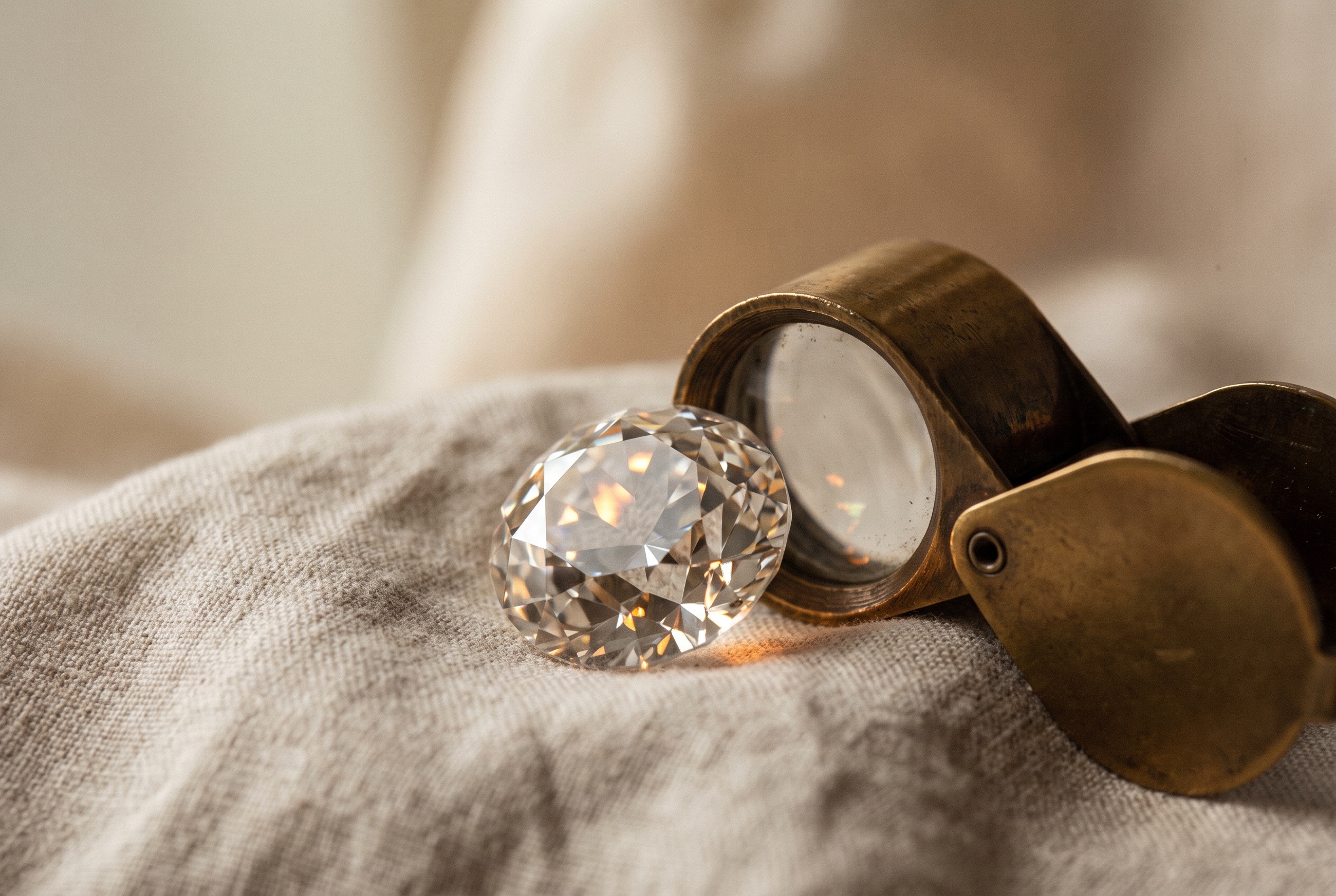
An old European cut diamond is an antique diamond cut, popular roughly from the 1890s through the 1930s, defined by a circular (but not perfectly round) outline, a small table, a high crown, a deep pavilion, and a large culet that's often visible to the naked eye as a tiny flat facet at the stone's base. It's the direct historical precursor to the modern round brilliant — the transitional cut that bridges the squarer old mine cut and the mathematically optimized round brilliant cutters use today — and it produces a warmer, softer, broader sparkle than a modern ideal-cut stone.
Old European cut (often abbreviated OEC) shows up constantly in searches, appraisals, and estate jewelry listings, but it's also one of the more commonly misunderstood antique cuts — confused with old mine cut on one side and dismissed as a "badly cut round brilliant" on the other by buyers applying modern cut-grading intuition to a stone that was never cut to modern standards in the first place. This guide covers what actually defines an old European cut, how it differs from both old mine cut and the modern round brilliant, how it performs optically, how labs grade and certify it today, and what to know before buying one wholesale — including the real, well-documented distinction between genuine antique OEC stones and diamonds newly cut in the old European style to meet current demand.
What Defines an Old European Cut Diamond
The old European cut is identified by a specific cluster of physical characteristics, all of which reflect hand-cutting methods and candlelight-era priorities rather than the light-return optimization that shapes modern cutting:
- Circular but not perfectly round outline — unlike a modern round brilliant, which is cut to a precise, mathematically consistent circle, an old European cut's outline is round in general impression but rarely perfectly symmetrical, a natural result of hand-cutting rough by eye rather than by machine.
- Small table — the flat top facet is noticeably smaller relative to the stone's overall diameter than on a modern round brilliant, letting more light enter through the crown facets rather than the table.
- High crown — the upper portion of the stone rises more steeply than a modern brilliant's, giving old European cuts visible depth and a domed profile from the side, though generally somewhat lower than the even higher crown typical of an old mine cut.
- Deep pavilion — the lower portion of the stone extends deeper than modern proportions call for, another byproduct of cutters prioritizing retained carat weight from the rough over maximizing brightness and fire.
- Large, often naked-eye-visible culet — a flat facet at the very bottom point of the stone, cut larger than modern standards permit, sometimes visible face-up as a small flat "hole" or pinpoint of light (or dark) at the very center of the stone when viewed table-down.
- Chunky, uneven-looking facets by modern standards — old European cuts typically carry the same 58-facet arrangement as a modern round brilliant, but the individual facets are less precisely proportioned and less symmetrical to the eye, since they were faceted by hand rather than cut and polished to computer-verified angles.
Every one of these traits reads as an imperfection on a modern round brilliant cut-grading scale. On an old European cut, they're simply what the cut is — the stone's defining, expected, and in most cases desired identity, not a manufacturing shortfall.
A Brief History: From Old Mine Cut to Modern Round Brilliant
The old European cut emerged in the final years of the 19th century as diamond cutters began moving away from the squarer, more cushion-like old mine cut toward a rounder outline, while cutting technology was still entirely manual — bruting (shaping the girdle) was done by hand, and facets were placed and polished by eye under gas or early electric lighting rather than the daylight-equivalent lamps and precision machinery used today. The cut takes its name simply from where this rounding trend was centered: European cutting houses, as opposed to the earlier "old mine" material associated with pre-1870s mining sources.
Through the 1890s, 1900s, 1910s, and into the 1920s and early 1930s, the old European cut was the dominant round diamond cut in fine jewelry — the era's answer to "what a round diamond looks like," the same way the round brilliant holds that position today. It fell out of favor gradually rather than all at once, as Marcel Tolkowsky's 1919 mathematical work on ideal proportions for light return began influencing cutters, and as bruting and faceting technology improved enough to make precise, mathematically consistent round shapes commercially practical. By the mid-to-late 1930s, most new cutting had shifted decisively toward what would become the modern round brilliant, though old European cutting persisted in pockets for years afterward. That roughly 40-year window — late 1800s through the 1930s — is why an old European cut is one of the clearest single indicators that a diamond, or a piece of jewelry it's set in, dates to that specific period, or was deliberately cut to evoke it.
Old European Cut vs. Old Mine Cut: What Actually Separates Them
Old European cut and old mine cut get used almost interchangeably in casual conversation, and estate listings frequently mislabel one as the other, but they are genuinely distinct cuts from different — if overlapping — periods. Guru Diam covers old mine cut in detail in a separate old mine cut diamond guide, but the short version, specifically as it bears on telling the two apart:
- Old mine cut (roughly 1830s–1900s) has a distinctly squarish or cushion-shaped outline with visibly rounded corners, an even smaller table, and an even higher crown than old European cut — it's the earlier, more angular of the two styles.
- Old European cut (roughly 1890s–1930s) evolved directly out of the old mine cut as cutters worked toward a rounder silhouette and a marginally larger table, moving the style closer to what would eventually become the modern round brilliant — while still keeping the high crown, deep pavilion, large culet, and hand-cut irregularity that mark it as an antique cut rather than a modern one.
The fastest visual test: hold the stone table-up and look at the outline. An old mine cut reads as squared, with distinct corners even if they're softened. An old European cut reads as round — not a machine-perfect circle, but unmistakably circular rather than cushion-shaped. If a buyer is chasing a squared antique silhouette specifically, that's old mine cut territory, covered in the old mine cut guide; if the goal is a round antique-style stone with the same warm, high-crown light character, that's old European cut.
Old European Cut vs. Modern Round Brilliant: A Different Kind of Sparkle
Comparing an old European cut to a modern round brilliant is not a quality comparison in the way comparing two modern round brilliants would be — it's a comparison between two cuts engineered around genuinely different goals, more than half a century apart in their design philosophy. A modern round brilliant, refined from Tolkowsky's proportion work and decades of subsequent optical research, is built to maximize brightness, fire, and scintillation under nearly any lighting condition. An old European cut was never built to that standard, because that standard didn't exist yet — it was cut by eye, under warmer and dimmer ambient light, by cutters prioritizing retained weight from the rough alongside a pleasing look under candlelight and gas lamps, the primary lighting of the era.
The practical result: a modern ideal-cut round brilliant throws tight, sharp, high-contrast pinpoints of light — what's often called crisp scintillation. An old European cut throws broader, softer flashes, with a warmer overall glow sometimes described as a "candlelight" or "soft glow" effect. Both are legitimate, deliberate optical outcomes rather than one being a lesser version of the other; which one reads as more appealing depends entirely on the aesthetic a buyer or designer is after.
Old European Cut vs. Old Mine Cut vs. Modern Round Brilliant
| Characteristic | Old Mine Cut | Old European Cut | Modern Round Brilliant |
|---|---|---|---|
| Era | ~1830s–1900s | ~1890s–1930s | ~1920s (Tolkowsky) to present, refined ongoing |
| Outline | Squarish cushion, rounded corners | Circular, but not perfectly round | Precisely round |
| Table size | Small | Small (slightly larger than old mine) | Larger, optimized (roughly 54–62%) |
| Crown height | High (highest of the three) | High | Moderate, calculated |
| Culet | Large, often visible | Large, often visible to the naked eye | None to very small (often a pinpoint) |
| Facet count / style | 58 facets, hand-cut, individually variable | 58 facets, hand-cut, chunkier and less uniform than modern cuts | 58 facets, precision-cut to consistent, calculated angles |
| Light performance | Warm, soft, broad flashes; strongest "candlelight" effect | Warm, soft, broad flashes; transitional between old mine and modern | Maximum brightness, fire, and tight, sharp scintillation |
Read across a row and the throughline is continuity, not a hard break: old mine cut is the most extreme version of the antique proportions, modern round brilliant is the most optimized-for-light-return version, and old European cut sits genuinely in between — literally the transitional cut connecting the two.
How an Old European Cut Performs Optically
Because of its small table, high crown, deep pavilion, and large culet, light enters and exits an old European cut differently than it does a modern round brilliant. Less light is captured through the table itself (since the table is small), so more of the stone's brightness comes from light entering and returning through the crown facets. The deep pavilion and less mathematically consistent facet angles mean light bounces around inside the stone less predictably than in a modern brilliant, producing broader zones of brightness and shadow rather than the tightly patterned, symmetrical light-and-dark contrast pattern ("fire and scintillation pattern") engineered into a modern ideal cut. The large culet can also let some light escape straight through the bottom of the stone rather than reflecting back to the eye, which is part of why old European cuts read as softer and warmer rather than maximally bright.
None of this makes an old European cut a "worse" performer — it makes it a different performer, genuinely prized specifically for this character rather than in spite of it. Antique and vintage jewelry buyers, and the designers who work with them, actively seek out this warm, soft, candlelight-era sparkle as the entire point of choosing an old European cut over a modern round brilliant. Under warm ambient or incandescent-style lighting in particular, an old European cut can look strikingly alive in a way that reads as genuinely different from — not lesser than — a modern stone under the same conditions.
How Old European Cut Diamonds Are Graded and Certified Today
GIA, IGI, and other major labs do grade and certify antique cuts, and a report on a genuine or reproduction old European cut will typically identify the cut specifically as "Old European Cut" or "Old European Brilliant" on the shape/cut line of the report, rather than grading it as a standard round brilliant. Color and clarity grading — the D-to-Z scale and the Flawless-to-Included clarity scale — apply to old European cuts exactly as they do to any other diamond, since those scales assess the material itself rather than the cutting style.
Cut grade is where things diverge. GIA's Excellent-to-Poor cut grade scale for round diamonds was built around, and calibrated to, modern round brilliant proportions and their measurable light-performance outcomes — it doesn't cleanly apply to an old European cut, since the entire style intentionally departs from those proportions by design, not by cutting error. In practice, this means an old European cut report may not carry the same kind of overall cut grade a modern round brilliant report does, or may note proportions (table percentage, crown angle, pavilion depth, culet size) descriptively without assigning the same Excellent/Very Good/Good scale used for round brilliants. Buyers and appraisers evaluating an old European cut's quality generally need to look at the reported proportions directly, and ideally at real photos or video of the stone, rather than relying on a single cut-grade letter the way they might for a modern round brilliant.
Why Jewelers and Designers Seek Out Old European Cut Stones
Demand for old European cut diamonds is driven by a few distinct, overlapping forces:
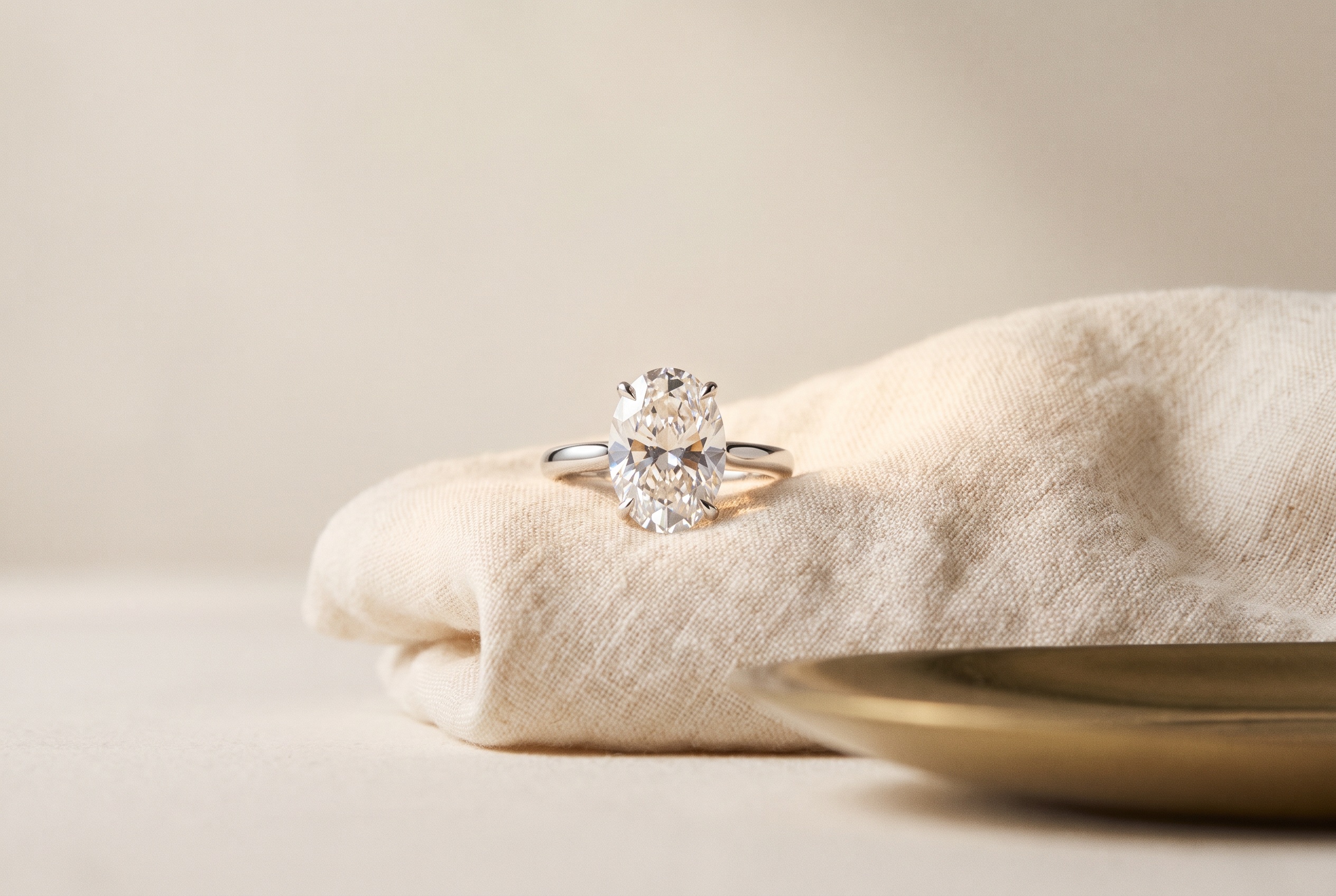
- Vintage and heirloom-style engagement rings. An old European cut is one of the fastest, most recognizable visual signals of genuine period character in a ring — buyers who want a design that reads as inherited or period-accurate, rather than uniformly modern, gravitate toward it specifically because of the traits (small table, visible culet, soft glow) that a modern cut deliberately eliminates.
- Period-accurate restoration work. Jewelers restoring or re-setting genuinely antique pieces — Victorian, Edwardian, Art Deco — need center or accent stones that match the era's actual cutting style, not a modern round brilliant standing in for one. An old European cut is frequently the correct, historically accurate stone for this kind of restoration.
- A broader consumer trend toward antique-cut aesthetics. Independent of any specific restoration need, there's been a sustained shift in bridal and fine jewelry design toward antique-cut center stones generally — old European cut alongside old mine cut, cushion-antique hybrids, and other historic styles — as buyers look for pieces with more visible individual character than a mass-produced modern round brilliant offers.
Genuine Antique vs. Newly Cut Old European Style: A Real Market Distinction
This is a well-known, well-documented distinction across the diamond trade generally, not a claim specific to any one supplier: the old European cut diamonds available in the market today fall into two genuinely different categories, and buyers should know which one they're getting.
- Genuine antique old European cuts are diamonds physically cut sometime in that roughly 1890s–1930s window and sourced today through estate jewelry, antique dealers, and auction channels. Supply is inherently limited — no more of these stones are being made — which makes verified period stones comparatively rare relative to modern round brilliants, and pricing and availability reflect that scarcity.
- Newly cut stones in the old European style are diamonds cut recently — sometimes by hand, sometimes with modern tools deliberately set to replicate historical old European proportions — specifically to meet demand for the look without requiring a genuine period stone. These are cut fresh, in both natural and CVD lab-grown material, and are certified the same way any other cut is, with the report noting the old European cut style specifically.
Neither category is more "legitimate" than the other; they simply serve different buyers. A collector, estate specialist, or a client who specifically wants a verified period stone needs the first category, sourced accordingly and priced for its scarcity. A designer building a vintage-inspired new piece, where the goal is the look and light performance of an old European cut rather than a specific verified age, is well served by the second — and it opens up availability, consistency of supply, and price points that genuine antique material can't match. A straightforward question to any supplier — "is this a verified period antique stone or a modern old-European-style cut?" — should get a clear, direct answer either way.
Evaluating Quality in an Old European Cut
Because standard round brilliant cut-grade scales don't map cleanly onto old European cuts, judging quality comes down to a different set of practical questions rather than a single grade letter:
- Does the stone show the characteristic warm, soft light performance the cut is known for, rather than looking simply dark, dull, or lifeless? A well-cut old European cut should still be visibly animated with light, just in a softer, broader register than a modern round brilliant.
- Is the outline genuinely circular, rather than distinctly squared with corners (which would put it in old mine cut territory instead)?
- Is the culet reasonably centered rather than noticeably off-axis, since an off-center culet can create uneven light distribution or a visibly lopsided look when the stone is viewed face-up?
- Is the hand-cut character tasteful rather than extreme? Some facet irregularity and asymmetry is expected and part of the appeal, but a well-executed old European cut shouldn't look unintentionally lopsided or poorly finished.
- Color and clarity, graded the same way as any diamond — the D-to-Z color scale and standard clarity grading apply unchanged; only the cutting-style-specific proportions and grading language differ from a modern round brilliant report.
Because so much of old European cut evaluation depends on visual judgment rather than a standardized proportion scale, working from real photos or video of the specific stone in question — not just a written spec sheet — matters more here than it does when buying a modern, machine-consistent round brilliant.
Matched Pairs and Setting Considerations
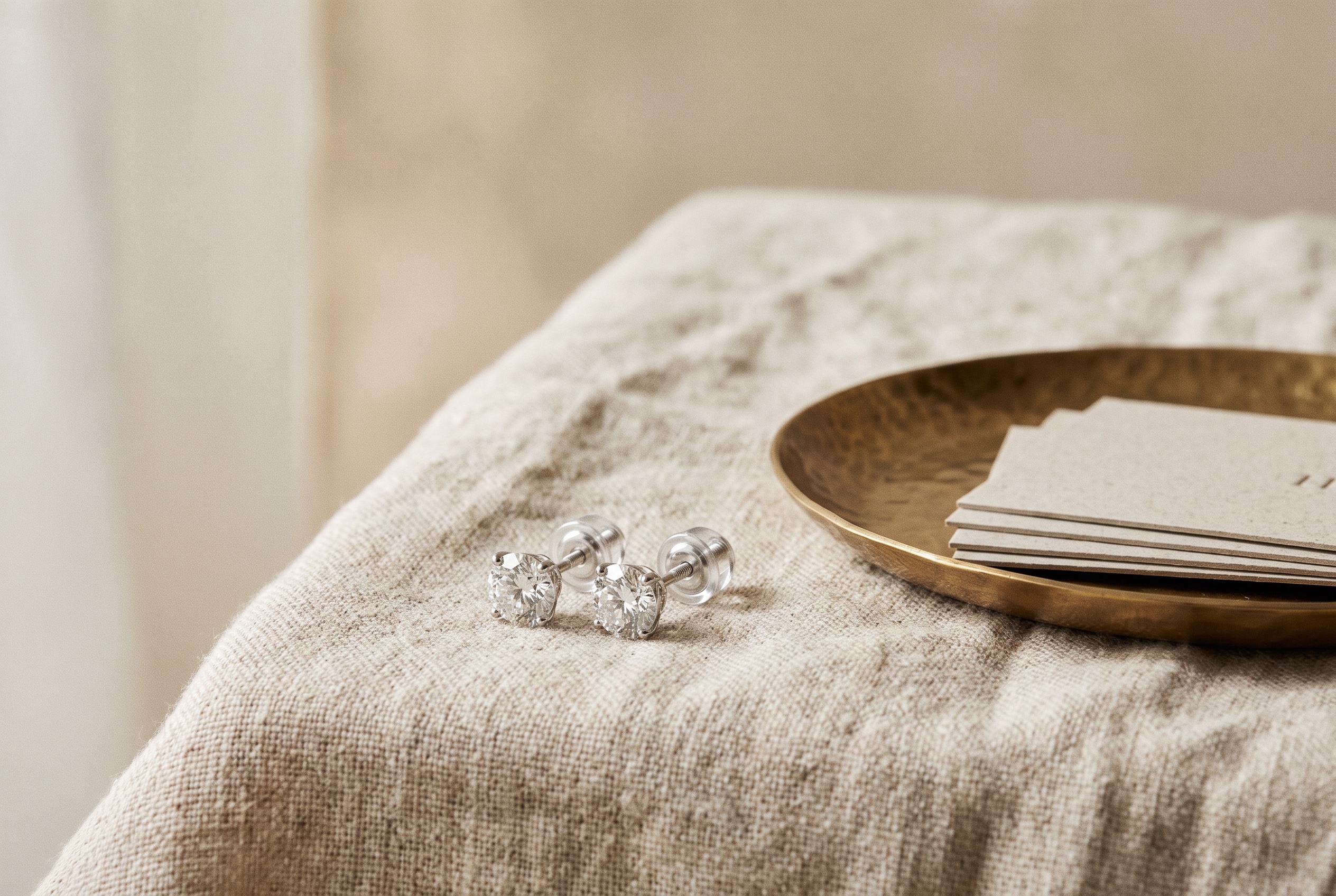
Sourcing a genuinely matched old European cut pair — for stud earrings, a three-stone ring, or a cluster design — is harder than matching modern round brilliants, precisely because no two hand-cut old European stones are naturally identical the way machine-cut modern brilliants are. A well-matched pair needs to align closely enough in outline, table size, crown height, and culet size to read as a cohesive set side by side, which benefits from working with a supplier who can compare candidate stones directly against each other, browsable through a matching pairs inventory, rather than sourcing two stones independently and hoping they align once they're side by side. Setting-wise, old European cuts are frequently paired with bezel and collet settings, milgrain detailing, and warm-toned metals that echo their period origins and let light reach the pavilion and culet from the sides — open or semi-open backs generally let the stone perform closer to its full character than a fully closed setting does.
Sourcing Old European Cut Diamonds Wholesale
Whether a project calls for a verified antique stone or a newly cut old-European-style diamond, a single center stone or a matched suite, the throughline for sourcing old European cut is the same as it is for any antique cut: the value is inseparable from its individual character, and a good supplier presents that honestly — with real photos, accurate certification language, and a clear answer on whether a given stone is genuine period material or a modern reproduction of the style — rather than blurring the two together.
Guru Diam carries old European cut as part of its antique and exotic cut catalog — a premium category alongside old mine, hexagonal, moval, lozenge, kite, trillion, criss-cut, padparadscha, and other true antique-style cuts, sold alongside standard shapes, natural diamonds, certified loose stones, and finished jewelry, with IGI, GIA, and GCAL certification all available. Loose old European cut center stones and matched pairs from on-hand inventory are shipped same-day (NYC orders before 6pm EST, LA before 4pm PST), and custom pieces built around an old European cut center stone are finished in 4–6 days once the stone is selected. Guru Diam's cutting, setting, and polishing are handled in-house, and with 2,000+ active trade accounts sourcing everything from antique-cut center stones to fancy color loose diamonds through one relationship, buyers working across multiple categories can browse certified stock in the certified diamonds category, review current terms at the wholesale hub, or apply for trade access through trade partner — one vendor, one shipment, one relationship, rather than juggling separate sources for antique cuts, fancy colors, and finished pieces.
Frequently Asked Questions
What is an old European cut diamond?
An old European cut diamond is an antique diamond cut popular from roughly the 1890s through the 1930s, defined by a circular but not perfectly round outline, a small table, a high crown, a deep pavilion, and a large culet often visible to the naked eye. It's the direct historical precursor to the modern round brilliant.
What is the difference between old European cut and old mine cut diamonds?
Old mine cut has a squarish or cushion-shaped outline with distinctly rounded corners and predates old European cut. Old European cut evolved from it with a rounder, more circular outline and a slightly larger table, moving the style closer to the modern round brilliant while keeping the same high crown, deep pavilion, and large culet. Guru Diam covers old mine cut specifically in a separate old mine cut diamond guide.
How can you tell an old European cut from a modern round brilliant?
Look at the table size, the culet, and the overall light pattern. An old European cut has a noticeably smaller table, often shows a visible flat culet facet at the very center of the stone face-up, and throws broader, softer flashes of light rather than the tight, sharp scintillation of a modern ideal-cut round brilliant.
Do old European cut diamonds get a cut grade on a GIA report?
GIA and other labs identify the cut specifically as old European cut on the report, and color and clarity are graded the same as any diamond, but GIA's Excellent-to-Poor cut grade scale for round brilliants doesn't cleanly apply to antique cuts, since the style intentionally departs from modern proportions by design. Proportions are often noted descriptively rather than assigned an overall cut grade letter.
Are old European cut diamonds real antiques or newly cut stones?
Both exist in the market and it's a well-known industry distinction. Genuine antique old European cuts were physically cut between roughly the 1890s and 1930s and are sourced today through estate and antique channels in limited supply. Newly cut stones in the old European style are cut recently — in natural or CVD lab-grown material — specifically to replicate that look and are certified accordingly; a reputable supplier will state clearly which one a given stone is.
Is an old European cut a good choice for an engagement ring?
Yes — old European cut is a popular choice for vintage and heirloom-style engagement rings specifically because of its warm, soft light performance and period-authentic character. It's also the historically correct stone for restoring genuinely antique pieces, and it pairs well with bezel or collet settings in warm-toned metals.
Guru Diam is a trade-only wholesale diamond supplier with locations in New York and Los Angeles, carrying antique and exotic cuts — including old European, old mine, hexagonal, and other true antique styles — alongside standard shapes, natural diamonds, certified loose stones, and finished jewelry. Browse antique cut inventory in the certified diamonds category, source matched pairs through matching pairs, or build a custom piece through custom jewelry. Trade accounts can review current inventory and terms at the wholesale hub or apply through trade partner.