
A diamond clarity chart ranks diamonds from Flawless (FL) down to Included (I3) based on the number, size, position, and visibility of internal inclusions and surface blemishes under 10x magnification. The scale — FL, IF, VVS1, VVS2, VS1, VS2, SI1, SI2, I1, I2, I3 — is set by GIA and used identically by IGI and GCAL, and it exists to answer one practical question: how much can a trained grader see inside this stone, and does any of it show up to the naked eye.
Clarity is the 4C that generates the most confusion at the point of purchase, because the grade on a certificate and what a buyer actually sees face-up are two different things. A VS2 diamond can look perfectly clean in a finished ring, while an SI1 in a different shape can show a visible inclusion at arm's length. This guide walks through the full clarity chart, what inclusions and blemishes actually are, how grading works under a loupe, where "eye-clean" thresholds fall by grade and shape, how cut style changes what clarity you need, the price tradeoffs at each tier, and how all of it applies the same way to CVD lab-grown diamonds.
The Full Diamond Clarity Scale, FL to I3
GIA's clarity scale has eleven grades grouped into six categories. Each grade describes how difficult it is for a trained grader, working under 10x magnification, to find inclusions or blemishes in the stone:
- FL (Flawless) — no inclusions and no blemishes visible under 10x magnification. Extremely rare in practice, since even surface polish marks from the cutting process are enough to rule a stone out of this grade.
- IF (Internally Flawless) — no inclusions visible under 10x magnification; minor surface blemishes (typically from polishing) are permitted. IF is the more commonly seen "top tier" grade in the trade, since true FL is genuinely scarce.
- VVS1 / VVS2 (Very, Very Slightly Included) — inclusions are present but extremely difficult for a trained grader to locate under 10x magnification, often requiring the grader to know roughly where to look.
- VS1 / VS2 (Very Slightly Included) — inclusions are minor and range from difficult to fairly easy to see under 10x magnification, but are not visible to the naked eye in the large majority of cases.
- SI1 / SI2 (Slightly Included) — inclusions are noticeable under 10x magnification and can sometimes be visible without magnification, particularly at SI2 and particularly in larger or open-faceted stones.
- I1 / I2 / I3 (Included) — inclusions are visible to the naked eye and can affect transparency or, at I2 and I3, structural durability in more severe cases.
The jump from VS to SI is where "invisible under magnification to a trained eye" becomes "sometimes visible without any magnification at all" — which is why VS2 and SI1 sit at the center of most buying decisions for center stones. For a deeper look specifically at the VVS tier, see our VVS clarity diamond guide.
What Inclusions and Blemishes Actually Are
Clarity grading covers two distinct categories of characteristic, and the terms aren't interchangeable even though buyers often use "inclusion" loosely to mean both:
- Inclusions are internal characteristics — crystals of other minerals trapped inside the diamond during formation, feathers (small internal fractures), clouds (clusters of pinpoint crystals that can create a hazy area), needles, and internal graining. These formed while the diamond was growing and are sealed inside the stone.
- Blemishes are surface characteristics — scratches, nicks, polish lines, extra facets, or naturals (small unpolished patches of the original crystal surface left at the girdle). Most blemishes result from the cutting and polishing process rather than natural formation, and many can theoretically be polished out, though doing so risks losing carat weight.
A stone's final clarity grade reflects the more significant of the two categories present — a diamond with a serious inclusion and pristine polish still grades on the inclusion, while a diamond with flawless interior clarity but a visible surface scratch is capped by that blemish (this is exactly the FL vs. IF distinction above).
How Diamonds Are Actually Clarity-Graded
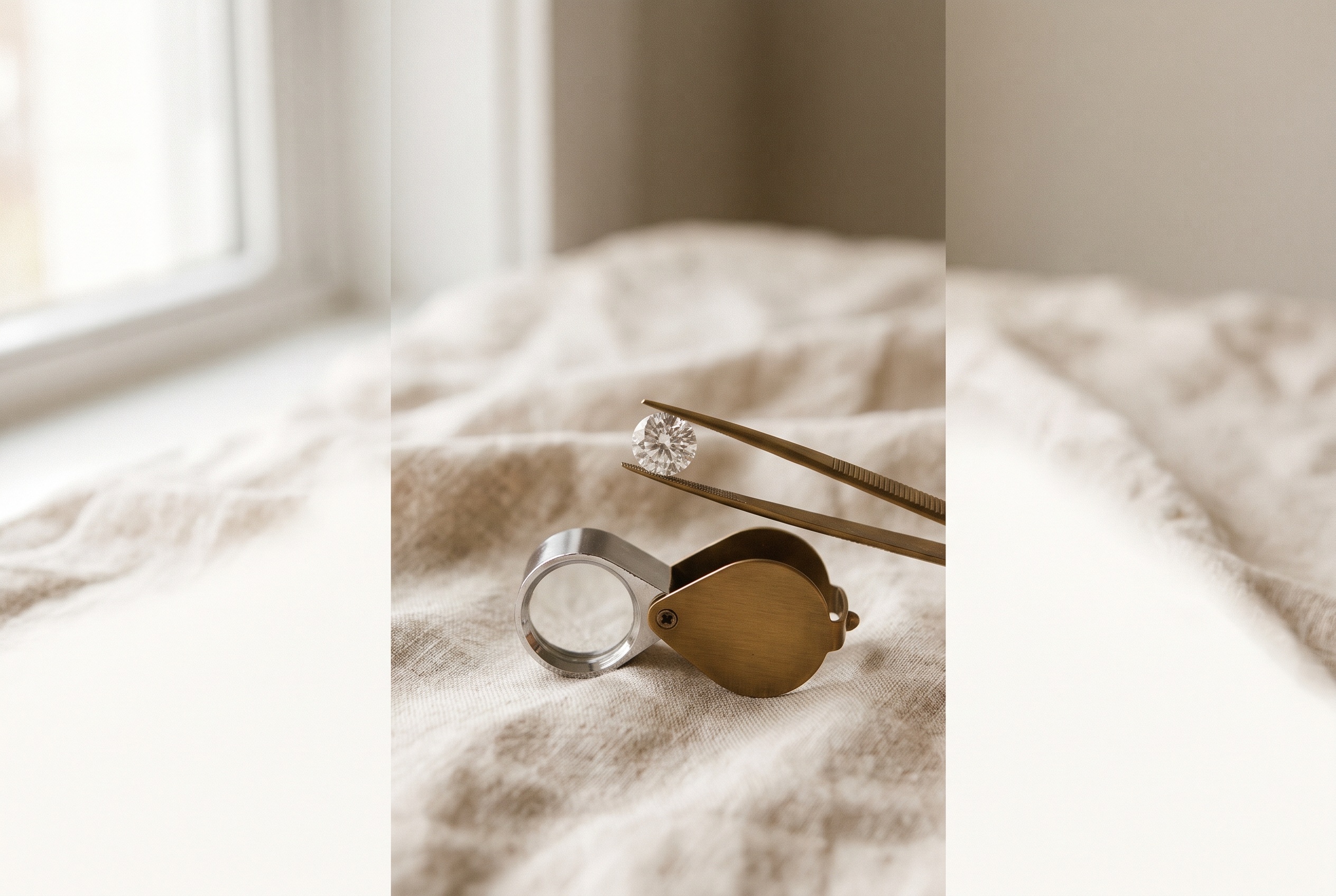
Clarity grading is done by a trained grader examining an unmounted, cleaned diamond under 10x magnification — a standard borrowed from a jeweler's loupe, though labs typically use a binocular microscope at the same effective magnification for consistency. The grader systematically scans the stone from multiple angles (through the table, through the pavilion, from the side) looking for internal and surface characteristics, then plots what they find on a clarity diagram that becomes part of the certificate.
Five factors determine where a given inclusion or blemish lands the stone within its grade range: size (larger reads worse), number (more characteristics compound the grade), position (an inclusion under the table is easier to see than one hidden near the girdle), nature (a feather that reaches the surface is treated more seriously than one fully enclosed), and relief (how much an inclusion's color or reflectivity contrasts with the surrounding diamond — a white, glassy inclusion in a white diamond has low relief and is harder to spot than a dark carbon spot). The 10x standard is deliberately fixed industry-wide specifically so that grading stays consistent across labs and graders rather than drifting with whatever magnification a given grader happens to prefer.
Diamond Clarity Chart: Grade, Visibility, and Buyer Profile
| Grade | Description | Visible Under 10x Loupe? | Visible to Naked Eye? | Typical Buyer Profile |
|---|---|---|---|---|
| FL | Flawless — no inclusions or blemishes | No | No | Collectors, investment stones, rare showcase pieces; premium is about rarity, not visible appearance |
| IF | Internally Flawless — no inclusions, minor surface blemishes only | Blemishes only, with difficulty | No | Buyers wanting top-tier certificate prestige without true-FL scarcity pricing |
| VVS1 | Very, Very Slightly Included (upper) | Very difficult to locate | No | Buyers prioritizing certificate-grade clarity at any carat size, especially larger stones |
| VVS2 | Very, Very Slightly Included (lower) | Difficult to locate | No | Same profile as VVS1 at a comparative value; most common practical VVS pick |
| VS1 | Very Slightly Included (upper) | Minor, somewhat easy to find | Essentially never | Value-focused buyers wanting a comfortable eye-clean margin |
| VS2 | Very Slightly Included (lower) | Noticeable, easier to find | Rare; occasionally in larger stones or step cuts | The most common center-stone sweet spot — clean face-up, strong value |
| SI1 | Slightly Included (upper) | Easily located | Usually not, but stone- and shape-dependent | Budget-conscious buyers; needs shape-by-shape screening |
| SI2 | Slightly Included (lower) | Easily located, sometimes obvious | Often, especially in step cuts or larger stones | Value buyers willing to hand-select for an eye-clean stone |
| I1 | Included (upper) | Obvious | Yes, typically | Melee, accent stones, or budget center stones where visible inclusions are accepted |
| I2 | Included (mid) | Obvious, may affect brilliance | Yes, clearly | Rarely used for center stones; can affect light performance |
| I3 | Included (lower) | Obvious, can affect durability | Yes, clearly, sometimes affecting transparency | Rarely stocked for fine jewelry; durability concerns in severe cases |
What "Eye-Clean" Actually Means
"Eye-clean" describes a diamond with no inclusions visible to an unaided, normally-sighted eye at a typical viewing distance (roughly 6-8 inches) in normal lighting — it's a practical, appearance-based threshold rather than a certificate grade in its own right. Eye-clean is not a fixed clarity grade because it depends heavily on the individual stone, not just its grade line on paper:
- VS2 and above are eye-clean essentially every time, with vanishingly rare exceptions.
- SI1 is eye-clean in the large majority of cases, but individual stones vary — a well-positioned inclusion set near the girdle can be invisible, while a similarly graded stone with an inclusion under the table can show through.
- SI2 is the grade where eye-clean becomes genuinely stone-dependent — some SI2 diamonds look completely clean face-up, others show a visible inclusion, and the difference often isn't predictable from the grade alone without viewing the stone or its clarity plot.
- I1 and below are visibly included to the naked eye in the large majority of cases, though inclusion position still matters at the margins.
Because "eye-clean" is a visual outcome rather than a lab grade, buyers sourcing at the SI tier benefit from reviewing the actual clarity plot on the certificate (which maps exactly where each inclusion sits) rather than relying on the grade letters alone — two SI1 stones can look meaningfully different face-up depending on where their inclusions are plotted.
Eye-Clean Thresholds by Shape
The clarity grade needed to guarantee an eye-clean appearance shifts by shape, because different cutting styles hide or expose inclusions differently:
- Round brilliant — the most forgiving shape for clarity. Its many small facets scatter light in a way that can camouflage minor inclusions, so SI1 and even some SI2 stones frequently read as eye-clean.
- Cushion, princess, radiant — mixed-cut shapes with moderate facet structure. These sit in between: generally forgiving, but less so than round brilliant, so SI1 is a safer floor than SI2 for a guaranteed clean look.
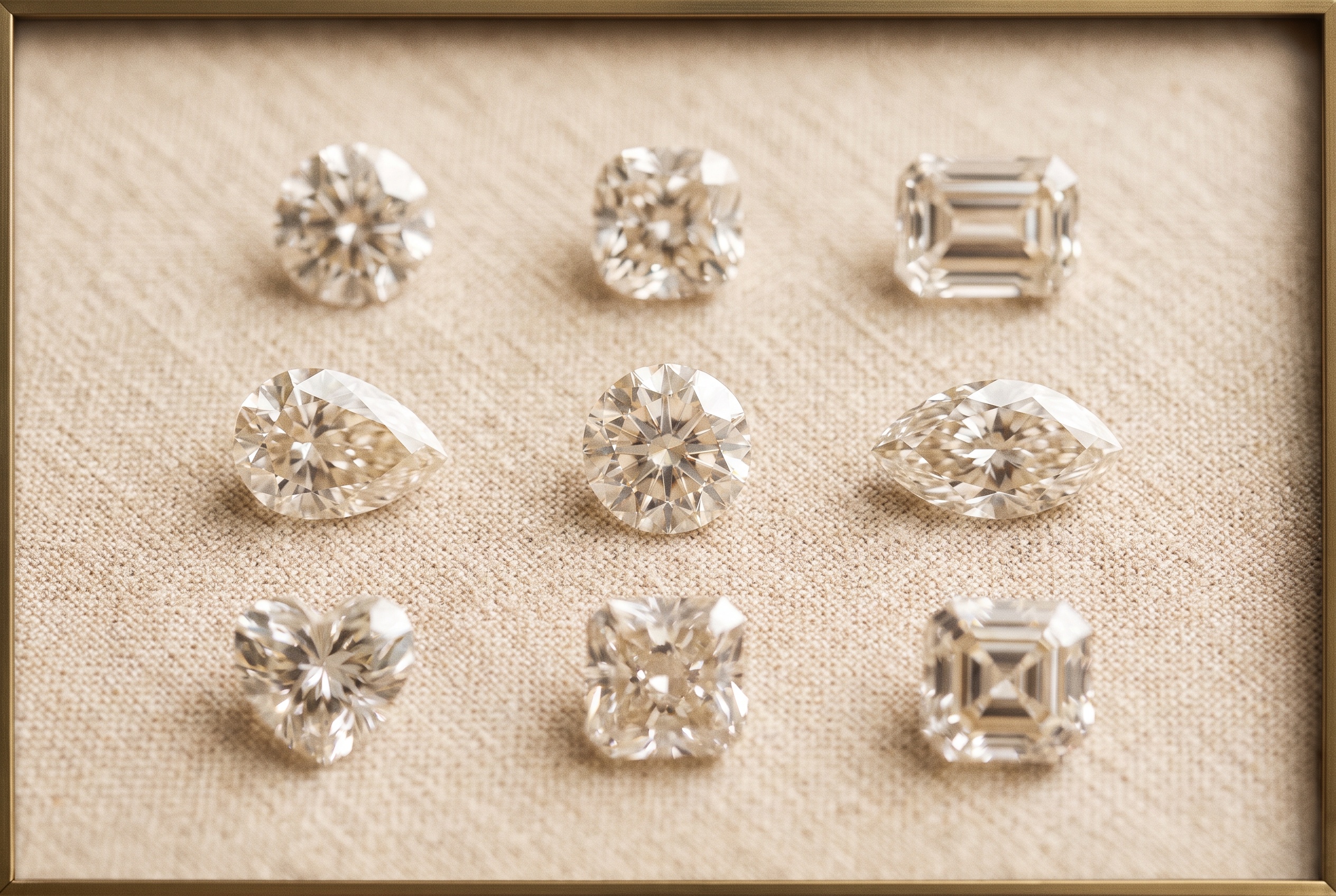
- Emerald, Asscher — true step cuts, covered in detail below. These are the least forgiving shapes for clarity and typically need VS2 or better to guarantee eye-clean.
- Oval, pear, marquise — elongated brilliant-style shapes that can show a "bowtie" effect and tend to concentrate light in the center of the stone, which can make an inclusion positioned there more visible than the same inclusion would be in a round. SI1 is generally a safer floor than SI2 for these shapes.
How Clarity Interacts With Cut and Shape
Clarity and cut style interact more than most buyers expect, because the two things determine together how light moves through a stone and how easily that light exposes an internal flaw:
- Brilliant cuts (round, princess, cushion, oval, radiant) use many small, angled facets that break light into scattered flashes. That scattering pattern helps visually camouflage small inclusions — the eye is drawn to the sparkle rather than settling on any one internal point, which is why brilliant-cut shapes are more forgiving at a given clarity grade.
- Step cuts (emerald, Asscher) use large, rectangular, parallel facets and an open table. Instead of scattering light, a step cut acts almost like a hall of mirrors, creating a clear, uninterrupted view straight into the stone. That same clarity of view is exactly what makes step cuts unforgiving of inclusions — there's no broken-up sparkle pattern to hide behind, so an inclusion that would disappear in a round brilliant can be clearly visible in an emerald cut of the identical clarity grade.
This is the single most common surprise for buyers moving from a round brilliant to a step-cut center stone for the first time: the SI1 that looked flawless in a round brilliant setting does not necessarily translate to the same clean look in an emerald cut, even though the certificate grade reads the same. The practical fix is simple — buy a grade or two higher in clarity for a step-cut center stone than you would for the equivalent round brilliant, or have the specific stone's clarity plot reviewed before committing.
Clarity vs. Price: What the Premium Actually Buys
Clarity pricing is steepest at the top of the scale and flattens out toward the middle, which is the opposite of what many first-time buyers assume:
- FL to VVS carries a real premium for rarity and certificate prestige, but the visual difference between these grades and a clean VS stone is effectively zero to the naked eye. This is the range where buyers are paying almost entirely for the number on the certificate rather than anything visible in the finished piece.
- VS1 to VS2 to SI1 is where the price curve starts to meaningfully soften relative to appearance — these grades sit close together in visible quality but the price gap between them and VVS is substantial, making this range the highest-value zone for most buyers.
- SI1 to SI2 to I1 is where price drops fastest, but so does the reliability of an eye-clean result — this is the range where buying a specific, viewed stone (or one with a favorable clarity plot) matters more than trusting the grade letter alone.
The practical takeaway mirrors the same logic that applies to color: clarity above the point where a stone reads as eye-clean is a premium for rarity and paperwork, not for appearance. Buyers who understand this tend to set a clarity floor based on shape (per the thresholds above), then put remaining budget toward carat weight or cut quality — both of which are visible in every stone, unlike a clarity grade nobody but a jeweler with a loupe will ever check.
Clarity Enhancement and What to Watch For
Some lower-clarity diamonds on the market have been treated to improve their apparent clarity — most commonly laser drilling (which creates a tiny channel to reach and lighten a dark inclusion) or fracture filling (which fills a reaching feather with a glass-like substance to reduce its visibility). Both treatments are disclosable and should appear as a clear note on the certificate; a legitimate lab report will flag any clarity enhancement rather than grading a treated stone as if it were natural clarity. Fracture-filled stones in particular carry practical caveats worth knowing — the filling can be damaged by re-tipping, ultrasonic cleaning, or heat from jewelry repair, which is why a disclosed, verifiable certificate matters more at the SI-and-below tier than almost anywhere else on a diamond's spec sheet.
Clarity in Lab-Grown CVD Diamonds
Clarity grading works identically for lab-grown CVD diamonds as it does for natural stones — the same FL-to-I3 scale, the same 10x loupe standard, the same inclusion and blemish categories, graded by the same major labs. A CVD diamond grows under controlled lab conditions rather than in the earth, but it's still real crystalline carbon subject to internal growth characteristics, and those characteristics get graded on the identical scale as a natural diamond's would be. A VS1 CVD diamond and a VS1 natural diamond carry the same clarity meaning and the same eye-clean expectations for a given shape.
One practical difference worth knowing: CVD-grown diamonds as a category tend to run cleaner on average than mined rough, since lab growth conditions can be controlled more tightly than the geology a natural diamond forms under over millions of years. This doesn't mean every lab-grown stone outgrades every natural one — individual stone variation is still the rule, not the exception — but it's part of why VS and even VVS clarity is more commonly available at accessible price points in CVD lab-grown inventory than in natural stones of comparable size and color.
Clarity for Melee and Side Stones
Clarity works differently once you move from a single center stone to melee — small diamonds, typically 0.8mm to 9.0mm, used in pavé, halo, and side-stone settings. Melee isn't individually graded or certified stone-by-stone the way a 0.30ct-and-up loose diamond is; it's sourced and quality-checked as calibrated parcel goods against a consistent baseline, commonly DEF+/VS+ for white melee, rather than issued with individual certificates. The buying priority for melee clarity is consistency across the parcel — a halo or pavé setting with visibly inconsistent clarity across its small stones reads as uneven in a way a single lower-clarity center stone wouldn't, since the eye scans side-by-side stones under the same light. A well-matched VS+ melee parcel around a VS-clarity center stone generally reads as a cohesive, evenly clean piece, even though the melee wasn't individually certified stone-by-stone the way the center stone was.
Reading a Clarity Plot on a Certificate
Beyond the letter grade, most certificates include a clarity plot — a diagram of the diamond from table and pavilion views with symbols marking the type, size, and position of each inclusion and blemish found. This plot is worth reviewing directly rather than trusting the grade letter alone, especially in the SI range where eye-clean outcomes vary most between individual stones:
- Symbol color typically distinguishes internal characteristics (usually red or green) from surface blemishes (usually green or black), depending on the lab's convention.
- Symbol position shows whether an inclusion sits under the table (higher visibility risk) or tucked near the girdle or pavilion (lower visibility risk).
- Comments section on the report often clarifies specifics — "clouds not shown" is a common note at some labs for very minor characteristics too diffuse to plot precisely.
For buyers building recurring orders rather than sourcing one stone at a time, cross-referencing the plot against the grade — rather than reading the letter grade in isolation — is standard practice for verifying that a batch of SI1 or SI2 stones will actually deliver a consistent eye-clean result before committing to a larger order.
Choosing a Clarity Grade: A Practical Framework
Putting the shape, price, and eye-clean factors together, a reasonable starting framework looks like this:
- Round brilliant, any carat under 2ct: SI1 is a safe, high-value floor; SI2 is workable but benefits from viewing the specific stone or its plot first.
- Round brilliant, 2ct and up: move up to VS2, since larger stones and their proportionally larger facets make inclusions somewhat easier to spot.
- Step cuts (emerald, Asscher), any size: VS2 is a safer floor than SI1 given the open-table visibility step cuts create; VS1 or better for larger step-cut center stones.
- Cushion, oval, radiant, pear, marquise: SI1 is generally a safer floor than SI2 given their tendency to concentrate light centrally.
- Melee and side stones: prioritize a consistent VS+ or DEF+/VS+ parcel baseline over chasing a specific letter grade on stones too small to inspect individually with the naked eye anyway.
This framework pairs naturally with color grade decisions — pairing this guide with our diamond color scale guide covers the two 4Cs most responsible for a diamond's actual face-up appearance, as opposed to carat and cut, which are more visually self-evident on their own.
Sourcing Diamonds by Clarity at Wholesale
Guru Diam is a trade-only wholesale supplier, and clarity is one of the most frequent filters trade buyers apply when building recurring orders — whether that's a jeweler stocking a specific eye-clean floor across a shape range, or a designer sourcing a step-cut center stone that needs a higher clarity minimum than the round brilliant program next to it on the same order. Certified loose diamonds at 0.30ct and up are available with IGI, GIA, and GCAL certification, across the full FL-to-I3 clarity range, in both natural and CVD lab-grown stock. For antique and fancy shapes where clarity-and-shape interaction matters most — Old Mine, Old European, and other step-adjacent cuts alongside standard fancy shapes — clarity plots are available for review before an order is finalized, and matched parcels for pavé, halo, or side-stone programs are sourced through our matching pairs category for consistent, evenly graded results. Antique cuts, fancy color stones, certified loose diamonds, custom engagement rings, and finished jewelry all move through one supplier relationship rather than several — with cutting, setting, and polishing all handled in-house, and same-day shipping on in-stock inventory from both the New York and Los Angeles offices.
Trade accounts sourcing certified stock by clarity grade can browse current inventory in the certified diamonds category, review current wholesale terms at the wholesale hub, or apply for an account through trade partner. Buyers building a full piece around a graded center stone — rather than sourcing loose — can also route the same clarity and shape requirements through custom jewelry, where a matched center stone and setting are handled as one order.
Frequently Asked Questions
What is a good clarity grade for a diamond?
VS1 or VS2 is generally considered the best value range — both grades are eye-clean in the vast majority of stones and shapes while costing meaningfully less than VVS or Flawless grades that offer no visible improvement to the naked eye. SI1 can also be a strong choice, particularly in round brilliant and other brilliant-cut shapes, though it benefits from viewing the specific stone or its clarity plot first.
What does SI1 clarity look like?
SI1 diamonds have inclusions that are easily located by a trained grader under 10x magnification but are usually not visible to the naked eye, especially in round brilliant and other brilliant-cut shapes. Visibility becomes more stone-dependent in step cuts like emerald and Asscher, where the open facet structure makes inclusions easier to spot even at the SI1 grade.
Is VS2 or SI1 better?
VS2 sits one grade above SI1 and is eye-clean essentially every time, while SI1 is eye-clean in most but not all stones and shapes. For round brilliants and other brilliant cuts, SI1 is frequently the better value choice since the visual gap is usually negligible; for step cuts, VS2 is the more reliable pick for a guaranteed clean look.
What is the rarest diamond clarity grade?
Flawless (FL) is the rarest clarity grade — no inclusions or blemishes at all under 10x magnification, including surface polish marks. Internally Flawless (IF), which allows minor surface blemishes but no internal inclusions, is more commonly available and is often what buyers mean when they picture a "flawless-looking" diamond.
Does clarity grading work the same for lab-grown diamonds?
Yes. CVD lab-grown diamonds are graded on the identical FL-to-I3 clarity scale as natural diamonds, using the same 10x loupe standard, by the same major labs — IGI, GIA, and GCAL. A VS1 lab-grown diamond carries the same clarity meaning and the same eye-clean expectations as a VS1 natural diamond of the same shape.
Why do emerald cut diamonds need higher clarity than round diamonds?
Emerald and Asscher cuts are step cuts with large, open, parallel facets that create a clear, direct view into the stone rather than the light-scattering sparkle pattern of a brilliant cut. That open view makes inclusions more visible at a given clarity grade than the same grade would show in a round brilliant, which is why step-cut buyers are generally advised to buy a grade or two higher in clarity.