
A diamond cut is the faceting style and outline a diamond is shaped into — round, cushion, emerald, old mine, and dozens of others — and it is a separate concept from cut grade, which is a quality rating (Excellent, Very Good, Good, Fair, Poor) that applies specifically to how well a round brilliant's proportions were executed. This guide surveys the full landscape of diamond cut styles, organized by tier, so buyers can see how the major shapes relate to one another before sourcing any one of them.
"Types of diamond cuts" is one of the most commonly searched diamond terms, and one of the most commonly confused. Buyers ask for "an excellent cut emerald diamond" or "the best cut for a cushion," not realizing that cut grade — the Excellent-to-Poor scale — is a GIA and IGI standard that applies only to round brilliants. Every other shape, from princess to old mine, is evaluated on cut quality through a different, less standardized set of proportions. Getting that distinction straight is the foundation for understanding everything else in this guide: the modern fancy shapes that dominate contemporary bridal jewelry, the antique and period cuts experiencing a genuine revival in vintage-inspired design, and the structural difference between step cuts and brilliant cuts that explains why two diamonds with identical certificates can look completely different in person.
Cut as Shape vs. Cut as Quality Grade — Two Different Things
The word "cut" does double duty in the diamond trade, and conflating the two meanings is the single most common point of confusion for buyers new to sourcing.
Cut as a shape or style refers to the outline and facet pattern a diamond is cut into — round, princess, cushion, oval, emerald, old mine, rose cut, and so on. This is a design choice. There is no universal "best" shape; a round brilliant and an emerald cut of identical carat weight, color, and clarity are simply different products built for different visual effects, and neither is graded against the other.
Cut as a quality grade refers to a specific rating — Excellent, Very Good, Good, Fair, or Poor on a GIA report, with IGI using a comparable scale — that measures how precisely a diamond's proportions, symmetry, and polish were executed relative to an ideal standard. Critically, this five-tier grade is calculated and issued only for standard round brilliant diamonds. GIA and IGI do not issue an Excellent/Very Good/Good/Fair/Poor cut grade for fancy shapes like cushion, oval, or emerald — those shapes appear on certificates with their individual measurements (depth, table, girdle, culet, polish, symmetry) listed, but without a single overall cut grade to summarize them, because no industry-wide proportion standard exists for fancy shapes the way it does for round.
This is why a buyer can't simply ask a supplier for "an Excellent cut princess diamond" the way they would for a round brilliant — the grading vocabulary doesn't carry over. Evaluating a fancy-shape diamond's cut quality means looking at its individual proportions, symmetry grade, and how it performs face-up, rather than reading a single letter grade off the report. For a full breakdown of how cut grading actually works — table percentage, depth percentage, crown and pavilion angle, and what separates Excellent from Poor — see our round brilliant cut guide, since round brilliant is the only shape where that grading system applies directly.
The Diamond Cut Landscape at a Glance
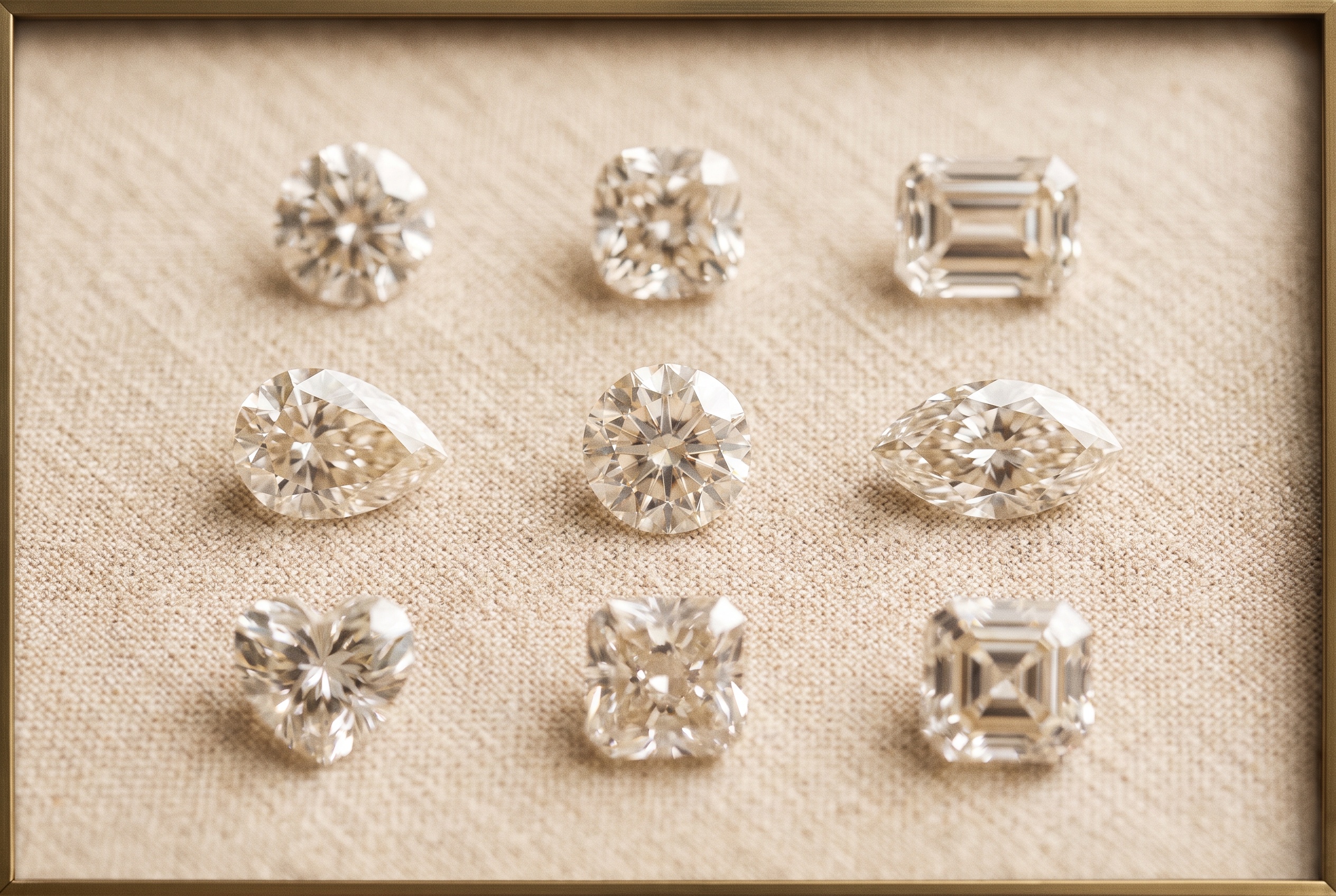
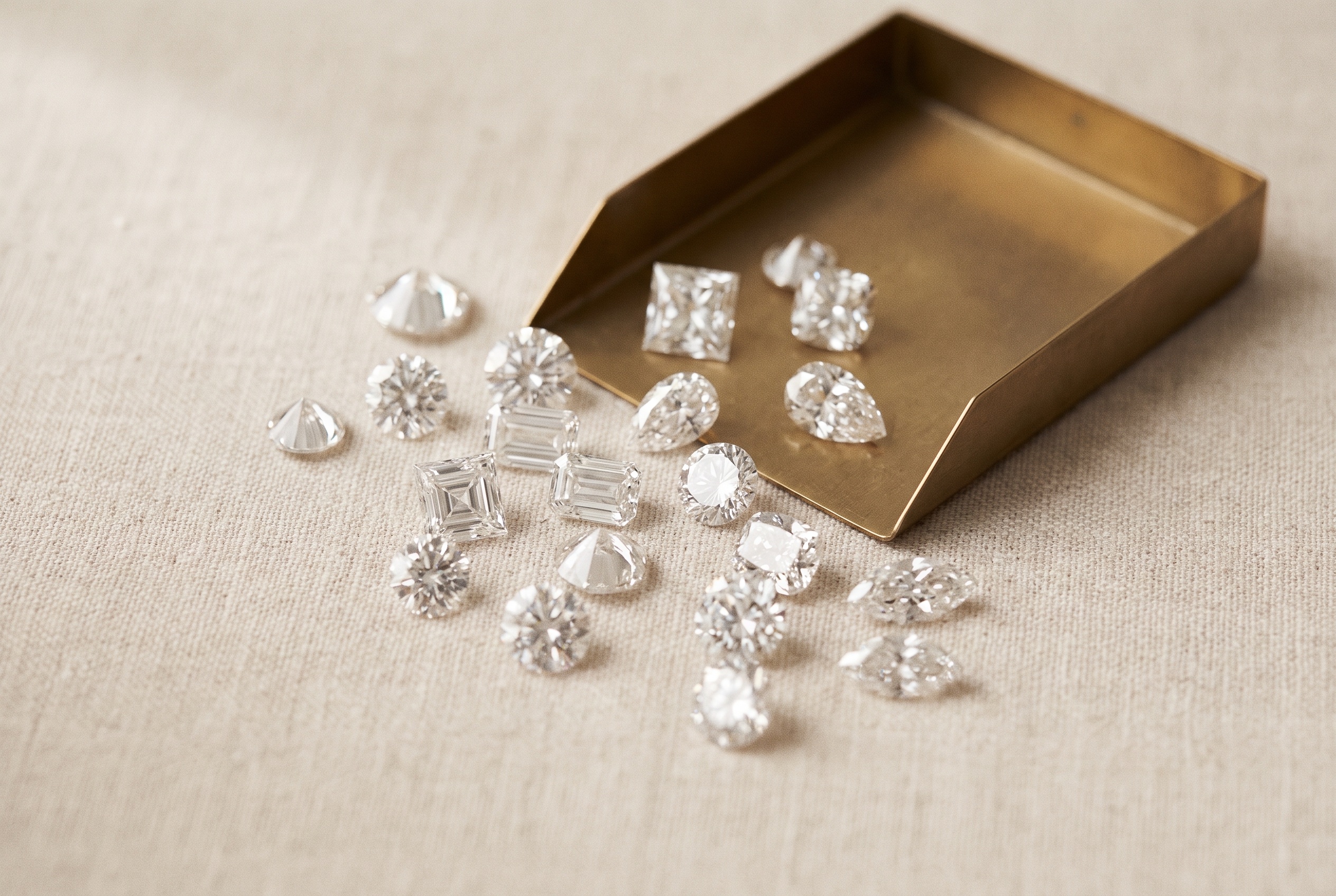
Diamond cut styles fall into three broad tiers based on era of origin, faceting tradition, and current market position. Round brilliant sits alone as the commodity standard. Modern fancy shapes were developed largely across the 20th century and dominate contemporary bridal and fashion jewelry. Antique and period cuts predate modern faceting mathematics, were often cut by hand, and are now experiencing a strong revival in vintage-inspired design.
| Cut Style | Tier | Facet Structure | Era | Best Suited For |
|---|---|---|---|---|
| Round Brilliant | Commodity standard | 57–58 facets, brilliant-cut | Modern (1919 onward) | Maximum light performance; universal demand; classic solitaires |
| Princess | Regular fancy | ~76 facets, brilliant-cut, square outline | Modern (1960s–80s) | Contemporary bridal; efficient use of rough |
| Cushion | Regular fancy | Variable, brilliant-cut, soft square/rectangle | Modern revival of an older outline | Vintage-adjacent look with modern light performance |
| Oval | Regular fancy | Variable, brilliant-cut, elongated | Modern (1960s) | Face-up size per carat; elongated finger effect |
| Pear | Regular fancy | Variable, brilliant-cut, teardrop | 15th century origin, modern faceting | Pendants, drop earrings, distinctive solitaires |
| Marquise | Regular fancy | Variable, brilliant-cut, elongated boat shape | 18th century origin, modern revival | Maximum visual length; statement solitaires |
| Radiant | Regular fancy | 70 facets, cropped-corner rectangle | Modern (1977) | Brilliance in a rectangular outline |
| Emerald | Regular fancy | Step-cut, rectangular | Modern faceting of a historic outline | Clarity display; understated elegance |
| Asscher | Regular fancy | Step-cut, square with cropped corners | Modern (1902) | Art Deco-inspired step-cut geometry |
| Heart | Regular fancy | Variable, brilliant-cut | Modern faceting of a historic outline | Sentimental pendants and statement pieces |
| Old Mine Cut | Antique | 58 facets, cushion-shaped outline, high crown | 18th–19th century | Vintage-inspired bridal; warm candlelight glow |
| Old European Cut | Antique | 58 facets, round outline, small table | Late 19th–early 20th century | Art Deco and Edwardian-style engagement rings |
| Rose Cut | Antique | Flat base, faceted dome, no pavilion | 16th–19th century | Low-profile settings; salt-and-pepper and rustic stones |
| Portuguese Cut | Antique | Double-faceted brilliant, more facets than round brilliant | 20th century antique-style | Maximum fire and depth of color in fancy-color stones |
| Hexagonal / Moval / Lozenge / Kite | Antique | Step-cut or mixed, geometric outlines | Art Deco era | Cluster settings, side stones, geometric statement pieces |
| Trillion | Antique / exotic | Brilliant or step-cut, triangular | 20th century | Side stones, three-stone settings, bold solitaires |
| Criss-Cut | Antique / exotic | Modified step-cut with crosshatched facets | 20th century | Step-cut clarity display with added brilliance |
Round Brilliant: The Commodity Standard
Round brilliant is the cut against which every other shape is implicitly measured, both in demand and in engineering. Its 57-to-58-facet arrangement — table, star facets, kite facets, upper- and lower-girdle facets, and pavilion facets, all cut at mathematically optimized angles — produces more brilliance, fire, and scintillation per carat than any other shape, which is why it accounts for roughly two-thirds of diamonds sold globally and remains the default choice for solitaire engagement rings.
Round brilliant is also the only shape where the standard GIA/IGI five-tier cut grade (Excellent through Poor) applies, and it commands the tightest, most liquid trading market of any shape, both certified and melee. Because it requires cutting away more of the original rough crystal than shapes like princess or cushion, it also tends to be the most expensive shape per carat at comparable color and clarity. For the full breakdown of facet anatomy, cut grading, and what separates a well-cut round brilliant from a poorly cut one, see the round brilliant diamond cut guide.
Modern Fancy Shapes: The Contemporary Bridal Tier
The fancy-shape category covers every non-round outline developed or standardized largely across the 20th century, and it is where the bulk of contemporary engagement ring and fashion jewelry demand outside round brilliant sits. These shapes trade a small amount of round brilliant's light-performance ceiling for distinctive silhouettes, better rough-diamond yield (and therefore often lower per-carat cost), and — in elongated shapes — more visible size per carat.
Princess is a square, brilliant-cut shape with roughly 76 facets, developed as an efficient way to cut brilliant-style facets into a squared outline with strong rough-diamond yield. It remains one of the most popular non-round shapes for engagement rings, prized for combining round-brilliant-adjacent sparkle with clean, modern lines.
Cushion pairs a soft, rounded-corner square or rectangular outline with brilliant-cut faceting, giving it a vintage-adjacent silhouette with the light performance of a modern cut. It has become one of the most requested shapes in vintage-inspired bridal design precisely because it echoes older cutting traditions without the higher cost and scarcer supply of true antique stones.
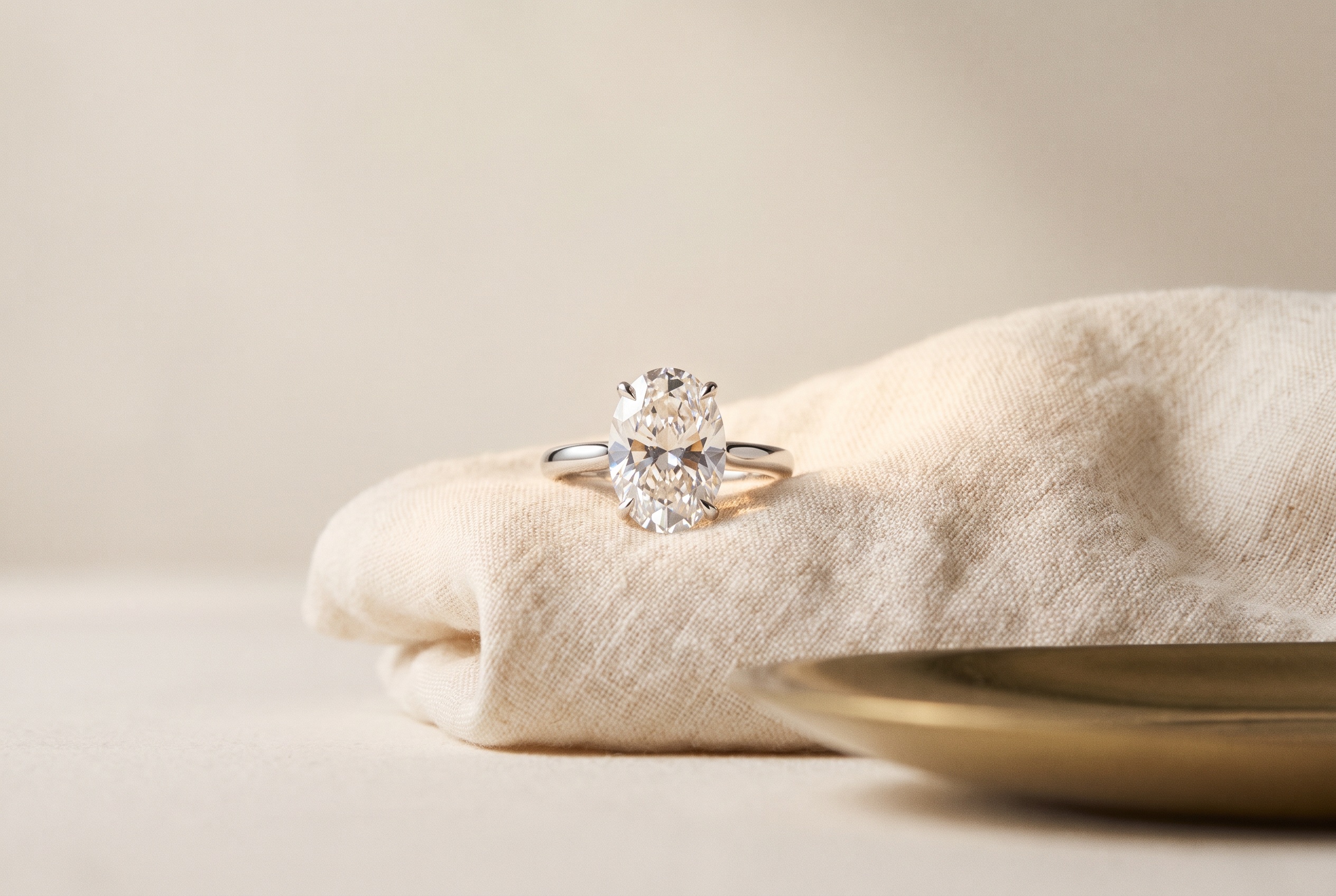
Oval is an elongated brilliant-cut shape that shows more visible surface area per carat than round, making it a popular choice for buyers prioritizing face-up size. Ovals can show a "bow-tie" effect — a dark shadow across the center of the stone — depending on cutting proportions, which is a key thing to check when evaluating individual stones.
Pear combines a rounded end with a pointed end in a teardrop silhouette, tracing its outline back to the 15th century though modern examples use contemporary brilliant faceting. It's a common choice for pendants, drop earrings, and engagement rings for buyers wanting something visually distinct from round or oval.
Marquise is an elongated, pointed-oval "boat" shape that maximizes visual length and face-up size per carat more than almost any other cut, tracing its origin to 18th-century France. It has seen a strong resurgence in recent bridal trends. For a full breakdown of marquise proportions, bow-tie considerations, and buying guidance, see the marquise diamond buying guide.
Radiant is a rectangular or square shape with cropped corners and roughly 70 brilliant-cut facets, combining strong light performance with a rectangular silhouette that step cuts like emerald can't match for sparkle.
Emerald and Asscher are both step-cut shapes — emerald rectangular, Asscher square with cropped corners — using long, parallel facets rather than triangular brilliant facets. Both prioritize clarity display and a distinctive hall-of-mirrors light effect over maximum brilliance, and both trace their modern faceting standardization to the early 20th century.
Heart is a brilliant-cut shape requiring exceptional symmetry to read cleanly as a heart outline face-up, making it one of the more difficult shapes to cut well and a popular choice for sentimental pieces and statement jewelry.
Princess, cushion, radiant, and Asscher each warrant their own deep-dive treatment beyond what a shape survey can cover — proportion ranges, symmetry considerations, and shape-specific buying criteria differ meaningfully across all four — so this overview intentionally stays at a summary level for those four shapes rather than duplicating dedicated coverage.
Antique and Period Cuts: A Guru Diam Specialty
Antique and period cuts predate the mathematically optimized brilliant-cut standards that define round brilliant and most modern fancy shapes. Many were originally cut by hand, using the tools and lighting available to 18th-, 19th-, and early-20th-century cutters — which produced softer, more irregular facet patterns, larger culets, higher crowns, and smaller tables than a modern stone. The visual result is a warmer, softer light performance — sometimes described as a "candlelight" glow rather than the sharper, more clinical sparkle of a modern ideal cut — along with a broader spread of colored flashes.
Antique cuts have seen a genuine and sustained revival over the past several years, driven largely by demand for vintage-inspired and one-of-a-kind engagement rings that don't look mass-produced. Because true antique stones are naturally limited in supply, most current demand is met by newly cut diamonds faceted in traditional antique styles rather than only reclaimed period stones — a category sometimes called antique-style or antique-reproduction cutting.
Old Mine Cut is a cushion-shaped antique cut with a high crown, small table, and large facets, typically carrying 58 facets in an arrangement predating modern round brilliant standards. It's the most requested antique cut for vintage-inspired engagement rings today. See the full old mine cut diamond guide for facet anatomy and buying considerations.
Old European Cut is the direct precursor to the modern round brilliant — a round outline with a small table, high crown, and large culet, popular through the Edwardian and Art Deco periods before Tolkowsky's proportions standardized the modern round brilliant in the 1920s and 30s. Full details are in the old European cut diamond guide.
Rose Cut is one of the oldest cutting styles still in use, consisting of a flat base and a faceted dome with no pavilion at all — meaning it reflects light very differently from any brilliant or step cut, with a soft, glowy sparkle rather than pinpoint fire. Its low profile makes it a popular choice for rustic and salt-and-pepper stones and for settings where a flush, low-set stone is the goal.
Portuguese Cut is a more recent addition to the antique-style category — a modified brilliant with an extra layer of facets beyond a standard round brilliant, producing exceptional depth of fire and color saturation. It's especially popular in fancy-color diamonds, where the extra facet layers intensify the visible hue. See the Portuguese cut diamond guide for more detail, and browse fancy-color inventory generally through the fancy color loose diamonds category.
Beyond those, a cluster of Art-Deco-era geometric shapes rounds out the antique tier: Hexagonal and Moval (an oval-square hybrid) cuts, both prized for clean geometric lines in cluster and cocktail-ring settings; Lozenge and Kite shapes, elongated diamond-outline cuts most often used as side stones or in three-stone settings; Trillion, a bold triangular cut used both as a statement solitaire and as a side-stone accent; and Criss-Cut, a modified step cut with crosshatched facets that adds brilliance to an otherwise step-cut structure. Each of these occupies a narrower niche than old mine, old European, or rose cut, but all are part of the antique-cut revival and appear regularly in vintage-inspired custom design work.
Step Cuts vs. Brilliant Cuts: The Structural Divide
Cutting across every tier above is a more fundamental distinction: whether a diamond is faceted as a step cut or a brilliant cut. This structural choice affects how a diamond looks — and what it hides or reveals — more than almost any other single factor.
Step cuts — emerald and Asscher are the clearest modern examples — use long, parallel, rectangular or trapezoidal facets arranged in concentric rows, like steps descending toward the culet. This produces a hall-of-mirrors optical effect with broad, clean flashes of light rather than the scattered sparkle of a brilliant cut. Step cuts show off a diamond's clarity more openly, since the open facet planes act almost like a window into the stone — which means clarity grade matters more when buying a step cut than it does for an equivalent brilliant cut, and inclusions that would be hidden in a round brilliant can be more visible in an emerald or Asscher cut of similar clarity grade.
Brilliant cuts — round, oval, cushion, princess, marquise, pear, radiant — use small triangular and kite-shaped facets arranged to maximize the number of times light reflects internally before exiting the stone. That higher facet count and more complex reflection pattern is what produces the characteristic scattered sparkle of a brilliant-cut diamond, and it also does a better job of visually masking small inclusions, since light and facet reflections break up the sightline into the stone.
Most antique cuts sit somewhere in between or use their own distinct structure — old mine and old European are brilliant-cut in structure but with different proportions than a modern round brilliant, while rose cut has no pavilion at all and behaves differently from both categories. Understanding whether a shape is fundamentally a step cut or a brilliant cut is one of the most useful shortcuts for predicting how a diamond will look and what clarity grade is worth paying for, regardless of which specific shape a buyer is considering.
How to Choose Between Cut Styles for Different Buyer Priorities
There's no universally "best" cut — the right choice depends on what a specific buyer or client is optimizing for. Four priorities come up most often when sourcing across cut styles.
Maximum Brilliance and Fire
Round brilliant remains the benchmark for sheer light performance, followed closely by other brilliant-cut fancy shapes like oval, cushion, and radiant. Buyers prioritizing maximum sparkle in a modern, symmetrical piece should stay within the brilliant-cut family and pay close attention to individual proportions and symmetry grade, since even within brilliant cuts, execution quality varies significantly stone to stone.
Vintage Character and Warmth
Old mine, old European, rose cut, and antique-style Portuguese cuts trade some raw brilliance for a softer, warmer light performance and a visibly different, hand-cut-inspired facet pattern. This is the fastest-growing preference category in current bridal demand, driven by buyers who specifically want a piece that reads as one-of-a-kind rather than mass-produced.
Budget Efficiency
Shapes that yield more finished carat weight from a given piece of rough — princess, cushion, radiant, emerald — tend to price lower per carat than round brilliant at comparable color and clarity, since less of the original rough is sacrificed in cutting. For buyers optimizing cost per visible carat, elongated shapes like oval, pear, and marquise offer an additional lever: their outlines spread the same weight across more visible surface area, so they tend to face up larger than a round brilliant of identical weight.
Rarity and Differentiation
For jewelers and designers looking to differentiate a collection or a custom piece from standard bridal inventory, antique and exotic shapes — old mine, old European, rose cut, hexagonal, moval, lozenge, kite, trillion, criss-cut — offer genuine scarcity value that round brilliant and the standard fancy shapes can't match. These cuts are harder to source consistently, which is exactly why they carry differentiation value in a market where round brilliant and the major fancy shapes are widely available from many suppliers.
Cut Style, Cut Quality, and Certification: Reading a Report Correctly
Regardless of which cut style a buyer chooses, the underlying grading fields to check on a certificate are largely the same: proportions (table, depth, crown and pavilion angle where reported), polish, symmetry, and — for round brilliants specifically — the overall cut grade. Fancy shapes and antique cuts won't carry that single summary grade, so evaluating them means looking at the individual measurements and, ideally, the stone itself or high-resolution imagery, since two diamonds of the same shape and grade can still look meaningfully different face-up.
IGI, GIA, and GCAL all certify diamonds across shapes, though depth of reporting on non-round shapes and antique cuts varies by lab — worth confirming before sourcing a shape outside round brilliant at any volume, and especially relevant for antique-style cuts where proportion standards are less rigidly codified than they are for round brilliant. Certified stones across shapes, including antique and fancy-color cuts, can be browsed through the certified diamonds category, and buyers sourcing calibrated pairs for earrings or side-stone work across any shape can search matching pairs directly.
Sourcing Diamond Cuts at Guru Diam
Guru Diam is a trade-only wholesale supplier — buyers are independent jewelers, designers, and manufacturers, not retail shoppers — carrying certified loose diamonds and finished jewelry across the full range of cut styles covered above: round brilliant, the modern fancy shapes (princess, cushion, oval, pear, marquise, radiant, emerald, Asscher, heart), and the antique and exotic tier (old mine, old European, rose cut, Portuguese, hexagonal, moval, lozenge, kite, trillion, criss-cut), in both CVD lab-grown and natural stones. IGI, GIA, and GCAL certification are all available across shapes, and cutting, setting, and polishing are all handled in-house.
Antique and period cuts are a genuine specialty within the catalog rather than a peripheral offering — old mine, old European, rose cut, and the broader Art-Deco-inspired geometric shapes are stocked and sourced with the same consistency as the standard fancy-shape tier, which matters for buyers who've found antique-cut supply inconsistent elsewhere. In-stock loose stones ship same day from both the New York (before 6pm EST) and Los Angeles (before 4pm PST) offices — look for "IN STOCK NOW" or "READY TO SHIP" on individual listings — and custom engagement rings built around any cut style, from a round brilliant solitaire to an antique-style old mine center stone, go through the custom jewelry program. Jewelers and designers building out a cut-style assortment across tiers, or sourcing a specific antique shape at volume, can review current inventory and terms at the wholesale hub or apply for a trade account through trade partner.
Frequently Asked Questions
What is the difference between diamond cut and diamond shape?
In everyday use, "cut" and "shape" are often used interchangeably to describe a diamond's outline and facet style — round, princess, emerald, and so on. More precisely, "cut" also refers to a separate quality grade (Excellent through Poor) that GIA and IGI apply specifically to round brilliant diamonds, measuring how well the stone's proportions were executed rather than what shape it is. Both meanings are correct; the context (shape name vs. a letter grade) tells you which one is being used.
What are the different types of diamond cuts?
Diamond cuts fall into three broad tiers: round brilliant, the commodity standard shape; modern fancy shapes like princess, cushion, oval, pear, marquise, radiant, emerald, Asscher, and heart, developed largely across the 20th century; and antique or period cuts like old mine, old European, rose cut, Portuguese, hexagonal, moval, lozenge, kite, trillion, and criss-cut, which predate modern faceting standards and are experiencing a strong revival in vintage-inspired jewelry.
Does cut grade apply to all diamond shapes?
No. GIA and IGI's five-tier cut grade (Excellent, Very Good, Good, Fair, Poor) is issued only for standard round brilliant diamonds. Fancy shapes and antique cuts are reported with individual proportion, polish, and symmetry measurements but do not receive a single overall cut grade the way round brilliants do.
What is the difference between a step cut and a brilliant cut?
Step cuts, like emerald and Asscher, use long parallel rectangular facets that create a hall-of-mirrors light effect and show off clarity more openly. Brilliant cuts, like round, oval, and cushion, use small triangular and kite-shaped facets designed to maximize light reflection and scattered sparkle, which also does a better job of visually hiding small inclusions.
Which diamond cut sparkles the most?
Round brilliant is generally considered to produce the most brilliance, fire, and scintillation per carat, due to its facet count and mathematically optimized angles. Other brilliant-cut fancy shapes — oval, cushion, radiant — come close, while step cuts like emerald and Asscher and antique cuts like old mine or rose cut are designed for a different visual effect (broad flashes or a softer glow) rather than maximum scattered sparkle.
Are antique diamond cuts more expensive than modern cuts?
It depends on supply and the specific stone. True period-cut antique diamonds can command a premium due to scarcity, while newly cut diamonds faceted in antique styles (antique-style or antique-reproduction cutting) are generally priced closer to comparable modern fancy shapes. Either way, antique-cut sourcing tends to be less consistent than round brilliant or standard fancy shapes, which is a bigger factor for buyers than cut style alone.
Guru Diam is a trade-only wholesale diamond supplier with locations in New York and Los Angeles, carrying certified loose diamonds, CVD lab-grown and natural stones, and finished jewelry across every standard, antique, and exotic diamond shape. Browse certified inventory across shapes in the certified diamonds category, or explore antique and fancy-color cuts in more depth through the old mine cut, old European cut, Portuguese cut, and marquise guides.