
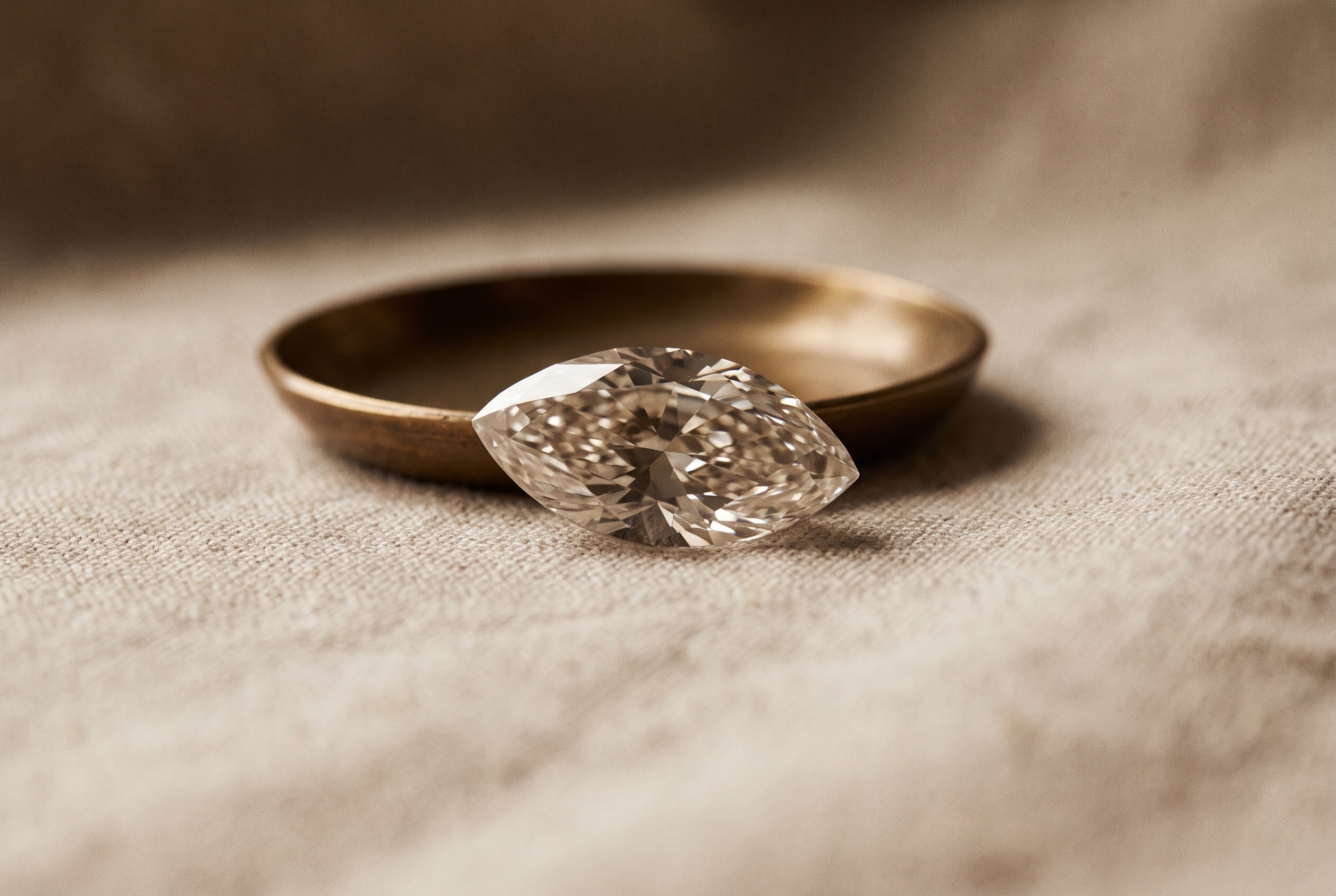
A marquise diamond is an elongated, boat-shaped cut with two pointed ends, typically featuring 56-58 facets and a length-to-width ratio between 1.75 and 2.25. It's classified as a modern fancy shape — not an antique cut — and prized for its ability to make a given carat weight look larger than almost any other diamond shape when viewed face-up.
For wholesale buyers, "marquise diamond" is a deceptively broad search term. It covers everything from a plain modern marquise brilliant to the Dutch marquise (a hexagonal-brilliant variant with a completely different facet structure) and the marquise step cut (an emerald-style faceting pattern on a marquise outline). This guide is about the standard marquise brilliant as most buyers and their retail customers mean it — the shape's history and anatomy, how to evaluate bow-tie effect and ratio, how it compares to other elongated shapes like oval and pear, and what to actually check before committing to inventory or a custom order.
What Is a Marquise Diamond, Exactly?
The marquise (sometimes spelled "marquis," though marquise is the standard trade spelling) is a fancy-shaped brilliant cut — meaning it uses a brilliant-style facet arrangement, kite and triangle-shaped facets radiating from the culet toward the girdle, rather than the parallel step facets of an emerald or Asscher cut. That brilliant faceting is what gives a well-cut marquise its characteristic sparkle and fire, as opposed to the flash-and-mirror look of a step-cut stone.
In Guru Diam's internal cut taxonomy, marquise sits in the regular fancy (mid-market) tier alongside oval, pear, cushion, radiant, emerald, asscher, princess, and heart shapes — distinct from the antique tier (old mine, old European, kite, lozenge, and similar historical cuts) and from round brilliant, which is treated as the commodity baseline. That distinction matters for sourcing and pricing conversations: a marquise diamond is a modern, mainstream fancy shape with predictable supply, not a rare or premium-tier antique cut, even though its dramatic silhouette often gets mistaken for one.
A Brief History of the Marquise Cut
The marquise shape is one of the older fancy cuts still in mainstream production today, with a well-documented origin story in 18th-century France. The most repeated version credits King Louis XV, who reportedly commissioned a diamond cut to resemble the smile — or, in some tellings, the lips — of his mistress the Marquise de Pompadour, giving the shape its name and its elongated, pointed-oval silhouette. Whether or not every detail of that story is precisely accurate, the shape has carried the "marquise" name in the trade for roughly two and a half centuries, making it one of the more durable fancy-shape names in diamond history.
The cut saw a significant popularity wave in the 1960s through 1980s, often set as a solitaire or in three-stone designs, and has cycled in and out of mainstream fashion since — currently enjoying a renewed wave of demand driven partly by vintage and antique-adjacent engagement ring trends, even though the marquise itself is a modern cut rather than a true antique one. This is a useful distinction to make explicit with retail-facing customers: a marquise reads as "vintage-inspired" in styling, but it is not an antique cut in the same category as an old mine or old European stone.
Anatomy of the Marquise Cut
A marquise diamond's structure is what produces both its size illusion and its most commonly cited flaw:
- Points. The two tapered ends are the shape's most fragile feature and the first place a jeweler or buyer should inspect for wear, chips, or inadequate protection in a setting. Points are typically the highest-pressure area in any prong or bezel design built around this shape.
- Girdle outline. The elongated, symmetrical curve between the two points defines the shape's overall "fullness." A girdle that bows out too aggressively or pinches in unevenly near the points reads as a poorly cut or asymmetric stone even before any bow-tie or ratio issue is factored in.
- Crown and pavilion faceting. Standard marquise brilliants carry a kite-and-triangle brilliant facet pattern similar in logic to a round brilliant or oval, adapted to the pointed-oval outline. This is what separates a marquise brilliant from a marquise step cut, which instead uses long, parallel step facets running the length of the stone for a more understated, hall-of-mirrors look with less overall fire.
- Culet. Most modern marquise diamonds are cut with a pointed or very small culet rather than a flat one, which affects light return through the base of the stone and is worth checking on a certificate or in person for larger stones.
The Bow-Tie Effect: What It Is and How to Evaluate It
The bow-tie effect is a dark, bow-tie-shaped shadow that appears across the center of many elongated fancy shapes — marquise, oval, and pear included — caused by the way light travels through an elongated brilliant-cut stone and by the viewer's own head and shoulders blocking light from reaching the center facets from certain angles. It is a structural characteristic of the shape category, not a defect exclusive to poorly cut stones, and no marquise diamond is entirely free of it under all lighting conditions.
What varies is severity. A well-proportioned marquise with well-executed faceting shows a soft, barely noticeable bow-tie that most people won't register without being told to look for it. A poorly cut stone — often one cut too shallow or too deep to maximize carat weight from the rough — can show a bow-tie dark and sharp enough to be the first thing a viewer notices about the stone. For wholesale buyers, this means bow-tie severity is a legitimate cut-quality signal worth checking in person or via video before committing to a specific stone, since certificate grades alone (particularly on stones without a fancy-shape-specific cut grade) don't fully capture it.
Practical takeaway for sourcing: request a well-lit video or in-person viewing under standard indoor lighting for any marquise stone before finalizing a purchase, especially at larger carat weights where bow-tie tends to be more visible. A stone that looks clean in a single static certificate photo can still carry a pronounced bow-tie that only shows up in motion.
Length-to-Width Ratio: Choosing the Right Proportions
Length-to-width ratio (length divided by width) is the single most useful proportion number for evaluating a marquise diamond's overall look, since it determines whether the stone reads as a slim, dramatic sliver or a fuller, rounder silhouette.
| Length-to-Width Ratio | Visual Character | Common Buyer Preference |
|---|---|---|
| 1.50–1.75 | Fuller, rounder silhouette; points less pronounced | Buyers who want the marquise's carat-spread benefit without a highly elongated look |
| 1.75–2.00 | Classic, balanced marquise proportion | The most commonly requested range; reads unmistakably as "marquise" without being extreme |
| 2.00–2.25 | Slim, elongated, dramatic | Fashion-forward buyers, statement east-west settings, elongated finger-flattering look |
| 2.25+ | Very narrow, sliver-like | Niche demand; can look thin or fragile at the points, harder to set securely |
Most retail demand clusters in the 1.75–2.00 range because it hits the visual signature of the shape — pronounced points, clear elongation — without tipping into a ratio so narrow that the stone looks fragile or the points become a durability liability in everyday wear. Buyers stocking inventory or building a custom order program are generally better served keeping the bulk of marquise stock in that middle band and treating anything above 2.20 or below 1.65 as a special-order or design-specific pull rather than core inventory.
Carat Weight and Face-Up Size: The Marquise Illusion
Marquise is widely regarded as the fancy shape with the strongest "spread" — meaning it shows more face-up surface area per carat than almost any other shape, round brilliant included. This comes down to simple geometry: because the shape is elongated rather than compact, a marquise diamond distributes its carat weight across a larger visible area instead of concentrating depth in a smaller footprint the way a round or cushion cut does.
In practical terms, a well-cut marquise diamond can appear noticeably larger — sometimes cited in the trade as 10-15% larger face-up — than a round brilliant of the same carat weight. This makes the shape a genuinely useful lever for a buyer trying to hit a specific "looks like X carats" target at a lower cost basis, and it's one of the more defensible value arguments to make to a retail customer comparing shapes on a budget.
The tradeoff worth being transparent about: that same elongation means a marquise can look thin from certain angles (particularly a side profile) in a way a rounder shape doesn't, and very shallow-cut stones chasing maximum spread can sacrifice brilliance and depth of sparkle for surface area. A marquise cut aggressively shallow to maximize apparent size will often show a weaker, flatter light performance than a slightly smaller stone cut to better proportions — the same tradeoff that shows up across most elongated fancy shapes, and worth flagging to buyers who ask specifically for "the biggest-looking marquise" without qualifying cut quality.
Marquise vs. Other Elongated Fancy Shapes
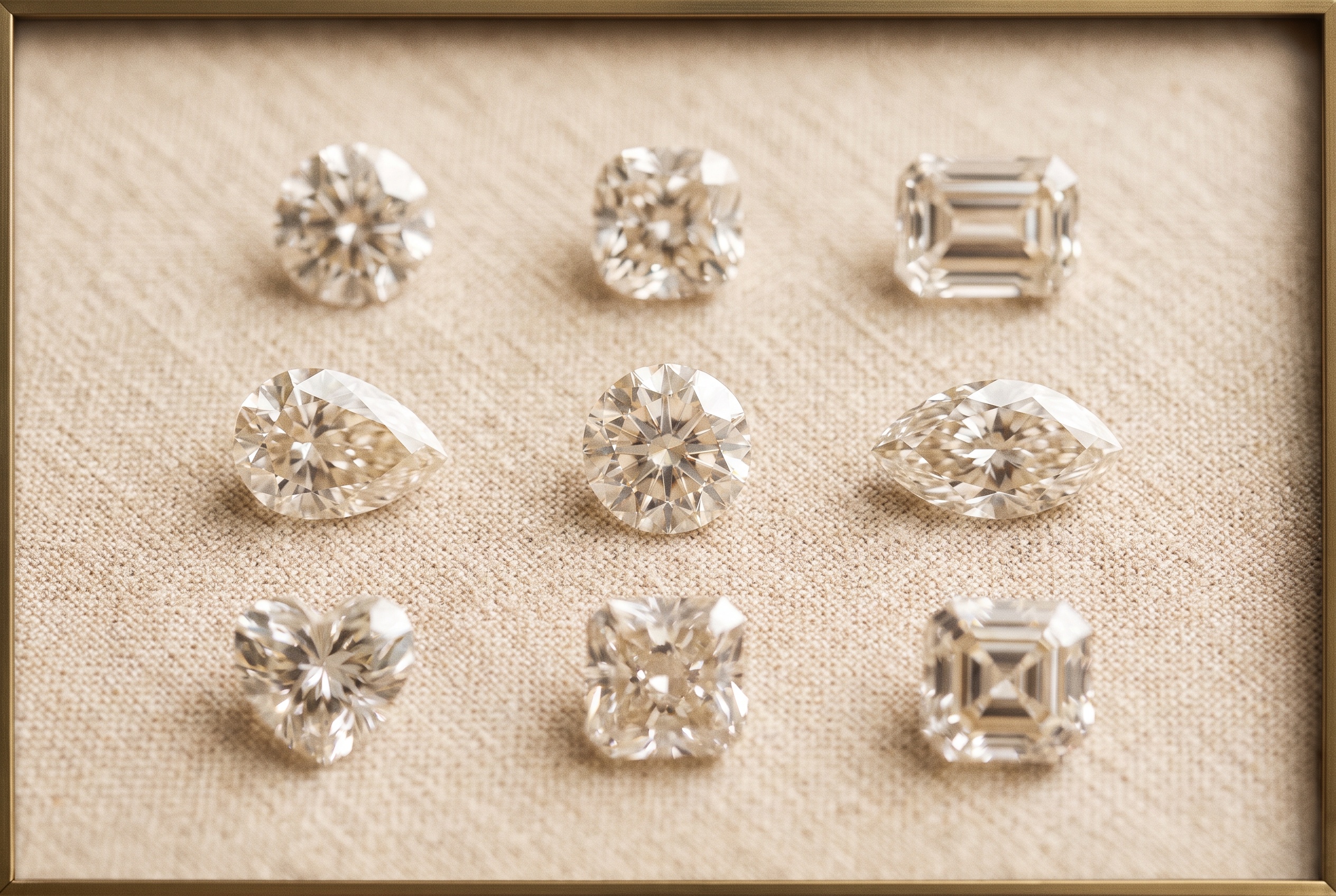
Marquise competes most directly with oval and pear in the elongated-shape category, and buyers frequently ask how the three compare when deciding what to stock or recommend.
| Shape | Points | Bow-Tie Risk | Face-Up Spread | Typical Setting Fit |
|---|---|---|---|---|
| Marquise | Two (both ends) | Moderate to noticeable | Highest of the common fancy shapes | East-west, solitaire, three-stone, chevron/curved bands |
| Oval | None | Moderate — similar risk profile to marquise | High, slightly less than marquise | Solitaire, halo, east-west; more universally wearable day-to-day |
| Pear | One (single point) | Mild to moderate, generally less than marquise | High, especially in elongated pear cuts | Solitaire, drop pendant-style settings, requires point-orientation decision (up or down) |
| Emerald (step cut, for reference) | None (cut corners) | Not applicable — step-cut faceting doesn't produce bow-tie | Lower than marquise; shows inclusions and color more readily | Solitaire, three-stone; reads more understated, less sparkle |
The practical decision points for a buyer choosing between marquise, oval, and pear: marquise offers the most dramatic silhouette and the strongest size illusion but carries two vulnerable points instead of zero or one; oval is the most "safe" elongated choice, with no points to protect and slightly less bow-tie sensitivity for most cut qualities; pear splits the difference, with a single point and a distinctive teardrop identity that some buyers prefer specifically because it reads as less common than round or oval without the full drama of a marquise. None of the three is categorically "better" — the right recommendation depends on the retail customer's durability tolerance, styling goals, and whether they want a shape that reads as classic (oval), dramatic (marquise), or distinctive (pear).
Setting Styles for Marquise Diamonds
How a marquise is set matters as much as the stone's own proportions, both for appearance and for point protection:
- V-prong or double-prong at the points. The standard, near-mandatory protective measure for marquise center stones — a V-shaped prong or paired prongs cradle each point rather than exposing it to a single thin prong tip, meaningfully reducing chip risk in daily wear. Any marquise setting without reinforced point protection should be treated as a design compromise, not a neutral styling choice.
- East-west orientation. Setting the marquise horizontally rather than in the traditional north-south orientation has become a strong fashion trend, giving rings a more elongated, statement-forward look across the finger. This is a purely stylistic choice with no structural downside beyond the same point-protection requirements as a standard orientation.
- Three-stone settings. A classic and enduring use of the marquise shape — either as the center stone flanked by rounds or trapezoids, or as elongated side stones flanking a round or oval center. The shape's pointed ends naturally taper toward the band in a three-stone layout, which is part of why this pairing has stayed popular for decades.
- Halo settings. A marquise halo (a ring of small round or marquise-shaped melee tracing the center stone's outline) amplifies the size illusion further and adds protection along the girdle, though it requires precisely calibrated melee to trace the marquise's curve cleanly — an area where matched, calibrated melee sourcing quality genuinely shows.
- Curved or chevron wedding bands. Because a marquise center stone's pointed ends create an irregular gap against a straight band, buyers frequently pair marquise engagement rings with a curved or chevron-shaped wedding band designed to nest against the points — a detail worth flagging to retail customers early in the buying process rather than after the engagement ring is already finalized.
Clarity and Color Considerations Specific to Marquise
Because a marquise diamond's pointed ends and elongated table concentrate the eye differently than a round brilliant, clarity inclusions near the points are more visually and structurally significant than inclusions of similar size located centrally in the stone — both because they're more visible face-up and because they sit in the shape's most stress-prone area. Buyers evaluating marquise stones for inventory should weight inclusion location, not just clarity grade alone, more heavily than they might for a round brilliant.
On color, the marquise's brilliant faceting (as opposed to a step cut's open facets) does a reasonably good job of masking faint body color, similar to round or oval brilliants, though the elongated shape and larger face-up spread mean tint can still show more readily than in a round of the same carat weight — largely for the same "more surface area" reason color becomes more visible in any larger stone. A near-colorless G-H range remains a reliable, broadly recommendable sweet spot for marquise center stones in white metal settings, with a shift toward I-J or lower acceptable in yellow or rose gold mountings where warmth reads as intentional.
Sourcing Marquise Diamonds at Wholesale: What to Look For
Buying marquise diamonds at volume — for inventory, custom order fulfillment, or matched-pair programs — comes with a few sourcing-specific considerations beyond what applies to a single retail purchase:
- Ratio consistency across a run. If stocking marquise inventory for a bridal or fashion line, consistent length-to-width ratio across multiple stones matters for merchandising and for customers comparing options side by side. A supplier that can quote a tight, predictable ratio range on request — rather than "marquise, various proportions" — saves real evaluation time at scale.
- Point protection at the calibrated-melee level. Marquise appears not just as center stones but as a calibrated fancy shape in melee programs — for halos, side stones, and pavé work tracing a marquise outline. Melee marquise stones need the same point-durability awareness as center stones, just at a smaller scale, and sourcing from a supplier that calibrates fancy shapes (not just round melee) to a consistent size and quality baseline matters here.
- Certification availability. For marquise center stones at 0.30ct and up, third-party certification remains the standard way to verify cut, color, and clarity claims before committing to inventory, particularly given how much bow-tie severity and ratio can vary stone to stone within the same nominal grade. Guru Diam offers IGI, GIA, and GCAL certification across its loose diamond catalog, giving buyers flexibility to match certification preference to their own retail customer base or regional market expectations.
- Natural and lab-grown availability side by side. Marquise is available in both natural and CVD lab-grown stock, and buyers increasingly want to compare both within the same shape and proportion range rather than sourcing from separate suppliers for each category. Working with one supplier that carries both — plus certified loose stones, fancy color diamonds, and finished jewelry — simplifies vendor management for buyers who'd otherwise be splitting orders across multiple relationships for a single shape.
Guru Diam is a trade-only wholesale supplier carrying marquise diamonds across natural and CVD lab-grown stock, with cutting, setting, and polishing all handled in-house and certification available through IGI, GIA, or GCAL depending on buyer preference. Same-day shipping applies to in-stock inventory from either the New York or Los Angeles office, and custom engagement ring builds — including marquise center-stone designs with V-prong point protection or curved companion bands — are finished in 4-6 days once a design is approved. For buyers evaluating marquise alongside other fancy shapes, calibrated matching pairs, or fancy color options in the same sourcing pass, the certified diamonds category, matching pairs, and fancy color loose diamonds categories cover the adjacent inventory most marquise buyers end up cross-shopping.
Marquise Diamonds in Custom Jewelry Programs
Beyond stocked inventory, marquise is a consistently requested shape in custom order work — particularly for east-west settings, curved-band pairings, and three-stone designs that need a specific ratio or point-protection detail dialed in for an individual customer. Because marquise proportions and bow-tie severity vary meaningfully stone to stone, custom programs benefit from being able to review video or in-hand options rather than committing to a shape and carat weight from a spec sheet alone. Buyers running a custom jewelry program for retail clients should build in a stone-selection step for marquise specifically, given how much visual variation exists within a single nominal grade and ratio range.
For buyers newer to sourcing this shape, pairing a marquise order with a broader review of cut fundamentals is worth the extra step — our round brilliant cut guide covers the light-performance concepts (light return, brilliance, scintillation) that apply across shapes, and our diamond color scale guide is directly relevant given how much color visibility shifts with an elongated shape's larger face-up spread.
How to Evaluate a Marquise Diamond Before Buying: A Quick Checklist
- Confirm length-to-width ratio against your target range (1.75-2.00 for a classic look, wider for a slimmer, more dramatic profile).
- Request video or in-person viewing to assess bow-tie severity under normal indoor lighting, not just a static certificate photo.
- Check inclusion location relative to the points specifically, not just overall clarity grade.
- Verify the certifying lab (IGI, GIA, or GCAL) and cross-reference proportions against the certificate.
- Confirm the setting design includes V-prong or double-prong point protection before finalizing a mounting.
- For volume orders, ask whether ratio and cut proportions can be held consistent across multiple stones rather than varying piece to piece.
Frequently Asked Questions
What is a marquise diamond?
A marquise diamond is an elongated, boat-shaped fancy cut with two pointed ends and a brilliant-style facet pattern, typically with a length-to-width ratio between 1.75 and 2.25. It's classified as a modern fancy shape rather than an antique cut, and is known for making a given carat weight look larger face-up than most other diamond shapes.
Why does a marquise diamond show a bow-tie effect?
The bow-tie effect is a dark shadow across the center of the stone caused by light traveling through the elongated brilliant-cut facets and by the viewer's own head blocking light from certain angles. It's a structural characteristic of elongated shapes like marquise, oval, and pear, and severity varies with cut quality rather than being fully avoidable in any stone of this shape.
What is the best length-to-width ratio for a marquise diamond?
Most buyers and retail customers prefer a ratio between 1.75 and 2.00, which reads clearly as a marquise silhouette without looking overly narrow or fragile at the points. Ratios below 1.75 look fuller and rounder, while ratios above 2.25 look very slim and can be harder to set securely.
Do marquise diamonds look bigger than other shapes?
Yes — marquise is generally regarded as the fancy shape with the strongest face-up spread per carat, sometimes appearing 10-15% larger than a round brilliant of the same carat weight because its elongated silhouette distributes weight across more visible surface area. This makes it a popular choice for buyers prioritizing apparent size within a set budget.
How is a marquise diamond different from a Dutch marquise or marquise step cut?
A standard marquise diamond uses brilliant-style kite-and-triangle faceting on a pointed-oval outline. A Dutch marquise (also called hexagonal marquise) is a distinct historical hexagonal-brilliant variant with a different facet structure, while a marquise step cut applies emerald-style parallel step facets to the marquise outline for a more understated, less sparkly look. All three share the pointed-oval silhouette but differ meaningfully in faceting and light performance.
What setting is best for a marquise diamond?
Marquise center stones need V-prong or double-prong protection at both points to prevent chipping, regardless of the overall setting style chosen. Beyond that requirement, popular options include east-west orientation, three-stone designs, halo settings, and curved or chevron wedding bands that nest against the stone's pointed ends.
Guru Diam is a trade-only wholesale diamond supplier with offices in New York and Los Angeles, sourcing marquise and other fancy shapes across natural and CVD lab-grown stock, with cutting, setting, and polishing handled in-house. Browse graded inventory in the certified diamonds category, source calibrated melee and side stones through matching pairs, or explore fancy color loose diamonds for buyers building out a fuller shape and color range. Trade accounts can review current terms at the wholesale hub or apply through trade partner.