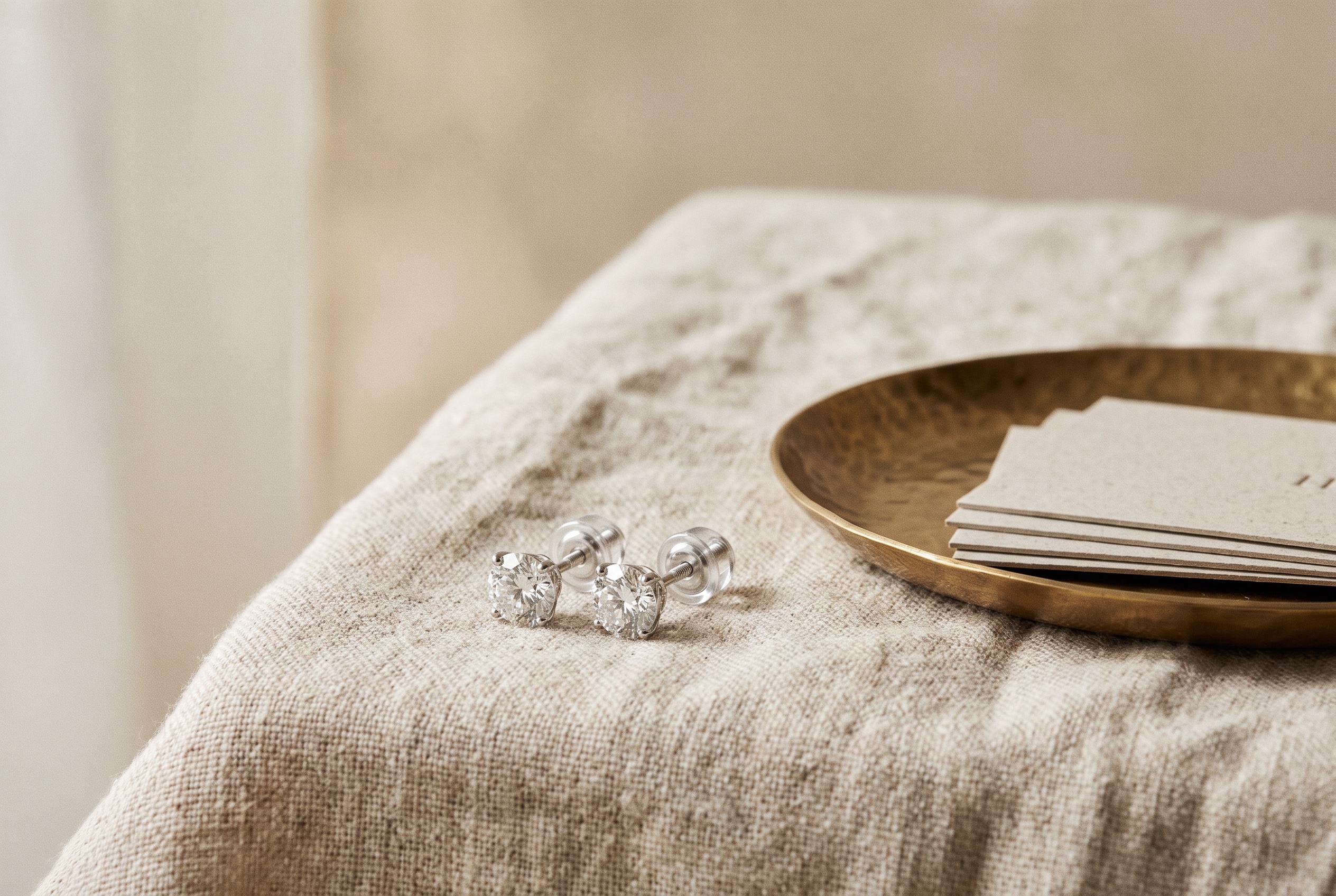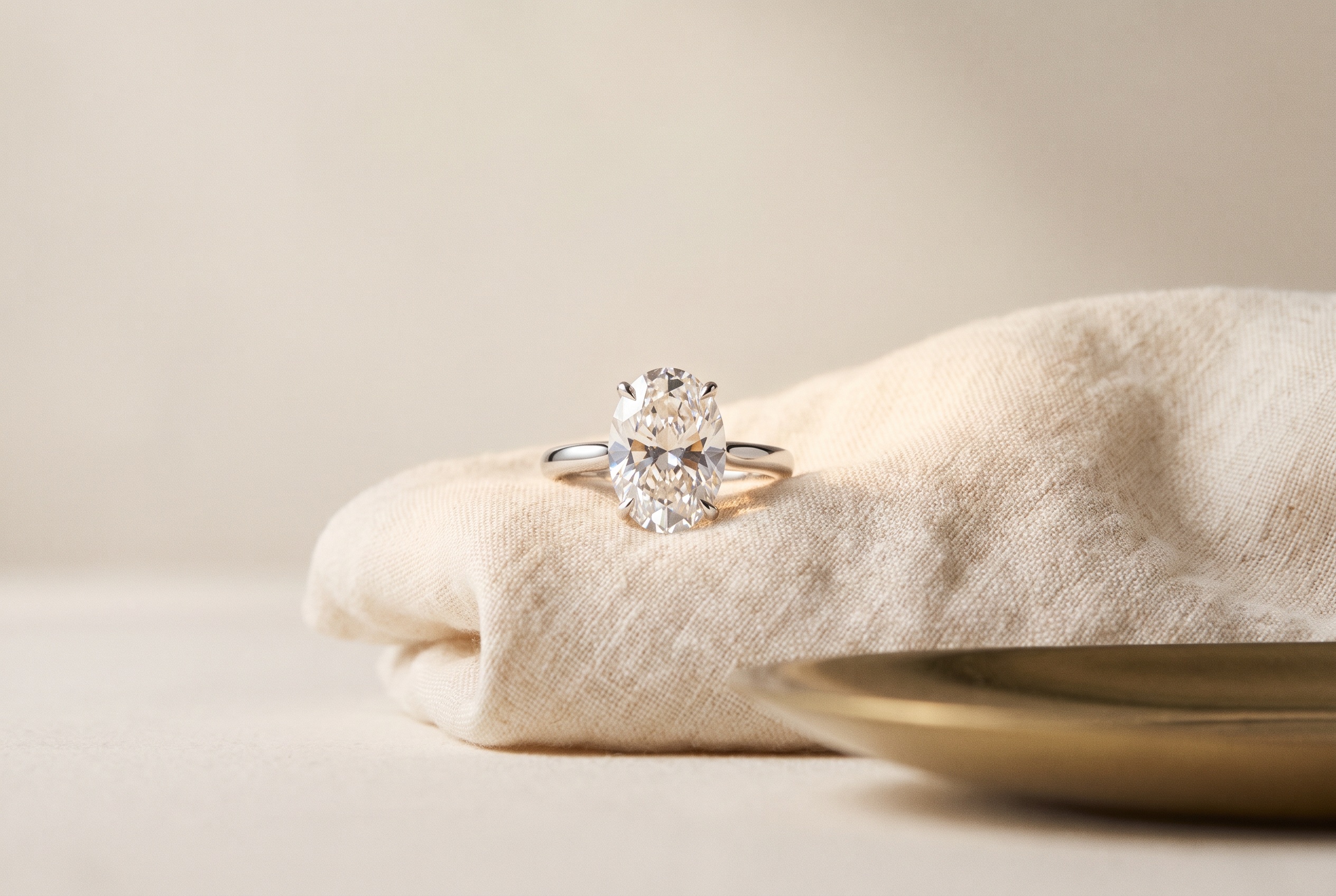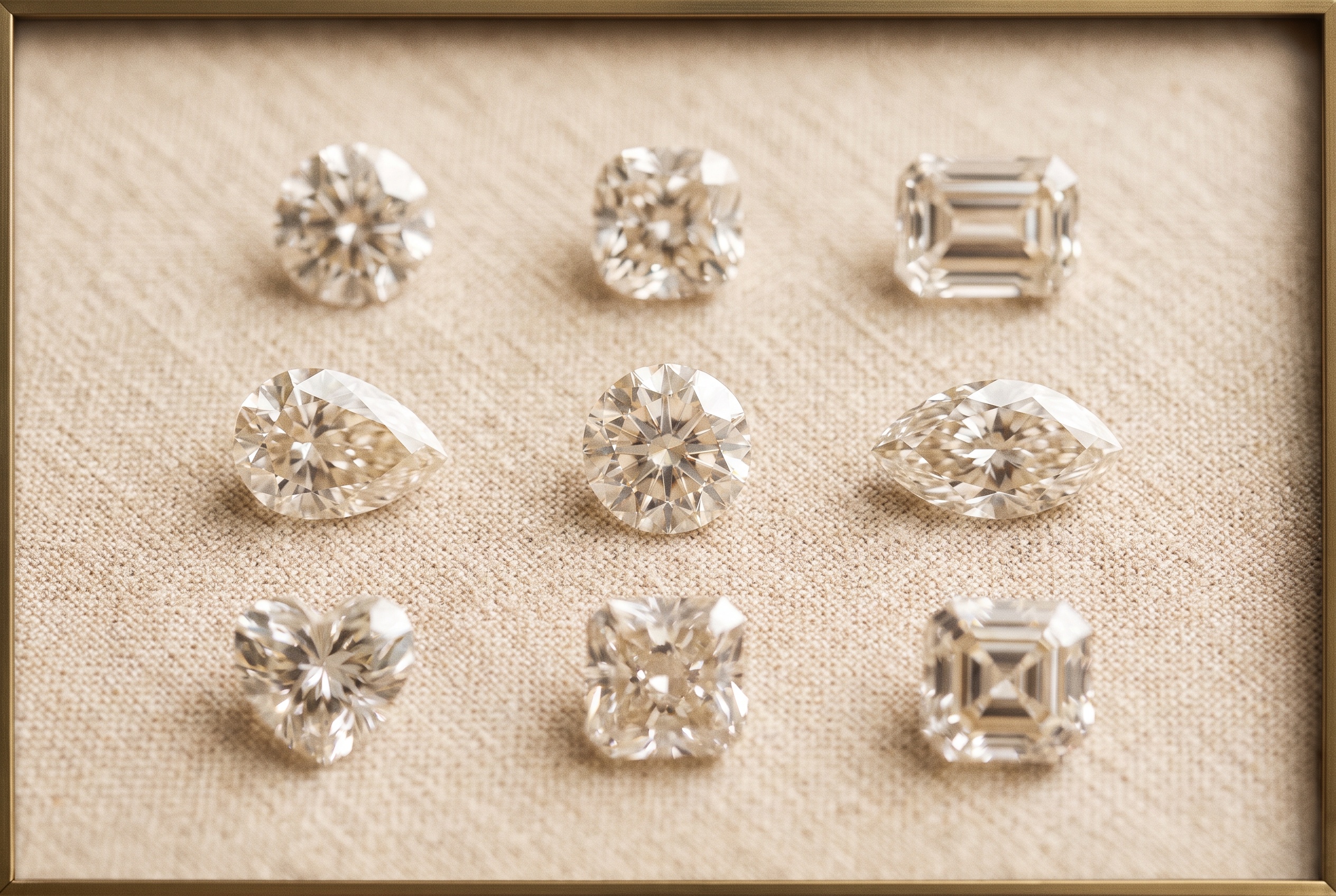

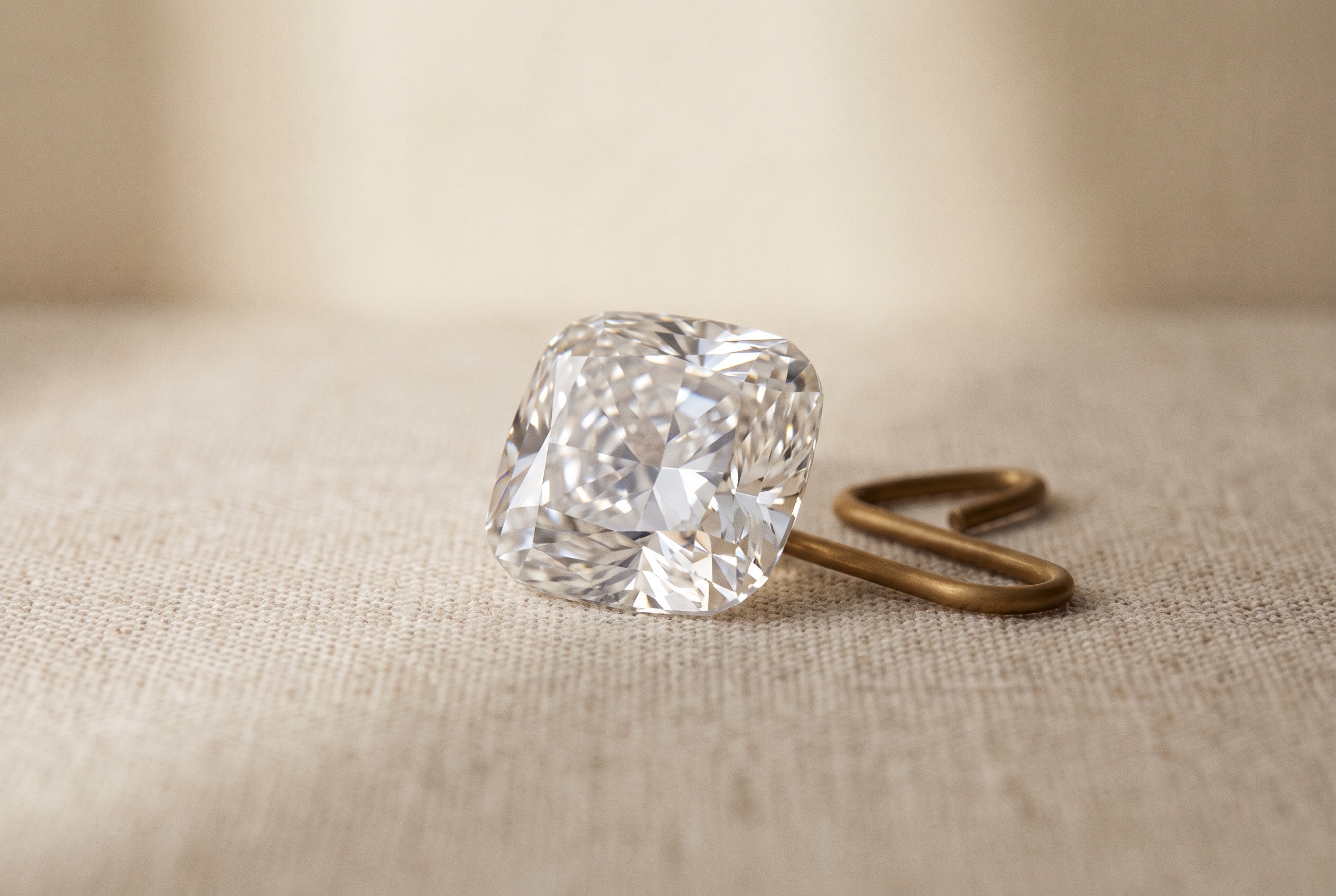
A Portuguese cut diamond is a round brilliant variant cut with 32 additional facets — 76 facets total instead of the standard 58 — arranged in two extra rows on both the crown and pavilion. The result is a stone with noticeably deeper, more layered fire and scintillation than a standard round brilliant, at the cost of some of the sharp, uniform "pop" that step-precision commercial round brilliants are known for.
What Makes a Portuguese Cut Different from a Standard Round Brilliant
A standard round brilliant cut carries 57 or 58 facets (depending on whether a culet facet is present), a pattern refined over the 20th century specifically to maximize light return through mathematically modeled proportions. A Portuguese cut takes that same round outline and effectively doubles the facet structure, adding a second tier of facets both above and below the girdle. Where a round brilliant has a single ring of star facets and a single ring of pavilion mains, a Portuguese cut has two rings of each, creating a more complex light path through the stone.
The practical effect is a diamond that reads as more "fiery" and dynamic under movement — light breaks up into more, smaller flashes rather than fewer, larger ones — while sacrificing some of the crisp, high-contrast brilliance pattern that GIA's cut-grading system was specifically built around for standard round brilliants. Because Portuguese cuts fall outside that standard proportion set, GIA and IGI do not assign them a cut grade the way they do a standard round brilliant; the stone is graded on carat, color, and clarity, with cut assessed qualitatively rather than on the 1-58-facet scale.
A Brief, Honest History
The Portuguese cut's origin is one of diamond trade folklore more than documented fact: the most commonly repeated account traces it to a diamond cutter working in Portugal in the early-to-mid 20th century who reportedly modified a large stone originally intended for a different purpose, adding extra facets to maximize its brilliance. Like many cut-name origin stories in the trade, the details vary by source and aren't independently verifiable — what's well documented is the facet structure itself, which has been consistently produced under the "Portuguese cut" name for decades and is a recognized, if niche, entry in cut nomenclature used by gemologists and diamond cutters worldwide. This is standard, widely available diamond-education history — not a claim about where any particular supplier's stones are cut today.
Portuguese Cut vs. Standard Round Brilliant: Side-by-Side
| Attribute | Standard Round Brilliant | Portuguese Cut |
|---|---|---|
| Facet count | 57-58 | 76 |
| Facet rows (crown/pavilion) | Single row each | Double row each |
| Light performance character | Sharp, high-contrast brilliance | Layered fire and scintillation |
| GIA/IGI cut grade | Assigned (Excellent-Poor) | Not assigned on standard scale |
| Market availability | Widely available, commodity pricing | Specialty item, limited supply |
| Best suited for | Solitaire settings, maximum brightness | Statement pieces, larger center stones |
Why the Extra Facets Change How the Stone Wears
Facet count directly affects how light exits a diamond, and doubling it changes the character of that light rather than simply increasing brightness. A standard round brilliant's fewer, larger facets act like fewer, larger mirrors — each one flashes a bigger, more defined burst of light as the stone moves. A Portuguese cut's 76 smaller facets act more like a mosaic of small mirrors, producing more numerous, smaller flashes that read as a shimmering, almost textured quality rather than isolated flashes. Under movement — walking across a room, gesturing at a dinner table — a Portuguese cut can appear more animated, which is part of why it's historically been favored for larger center stones, where a single-tier facet structure can start to look glassy or "windowed" at bigger sizes.
Where a Portuguese Cut Tends to Outperform a Standard Round Brilliant
The extra facet structure genuinely helps in a few specific scenarios. On larger stones — roughly 2 carats and above — the doubled facet count breaks up the larger flat surface area that can otherwise create a washed-out or "sleepy" look in a standard cut of the same size. It also tends to mask minor inclusions somewhat more effectively than a standard round brilliant, since light bounces through more facet junctions before exiting, scattering the visual field an inclusion would otherwise sit in. For jewelers working with clients who want a large, visually dynamic center stone and are comfortable with a less standardized cut-grading story, a Portuguese cut is a legitimate, differentiated option.
Where a Standard Round Brilliant Still Wins
For most buyers, the standard round brilliant remains the safer, more liquid choice. It has a universally understood, independently verified cut grade from GIA and IGI, which matters to retail customers who want an objective quality benchmark on their certificate. It's also produced at commodity scale, which keeps pricing predictable and supply consistent — a Portuguese cut, by contrast, is a specialty item produced in far smaller volume, so sourcing consistent inventory at a given size and quality is harder, and pricing tends to run at a premium over an equivalent standard round brilliant. For solitaire settings where maximum, uniform brightness is the goal — the classic tiffany-style prong setting, for instance — the standard round brilliant's proportions are still the benchmark the cut-grading system was built to reward.
How to Evaluate a Portuguese Cut Diamond in Person
Because Portuguese cuts don't carry a standardized cut grade, evaluating one relies more on direct visual assessment than on reading a certificate. A few things worth checking:
- Facet symmetry under a loupe. With 76 facets to align instead of 58, symmetry errors are more visually disruptive when they occur — look for consistent, even facet junctions rather than taking symmetry for granted.
- Light performance under movement, not just static light. Portuguese cuts are specifically about dynamic light behavior — evaluate the stone while tilting it, not only under a fixed jeweler's lamp.
- Girdle thickness. The extra facet rows mean girdle proportions matter even more to overall light return than in a standard round brilliant; an overly thick or thin girdle undercuts the cut's advantages.
- Comparison against a standard round brilliant of the same carat and color. The differences are subtle enough that side-by-side comparison is the most reliable way to confirm the stone delivers the layered-fire effect it's chosen for.
Lab-Grown vs. Natural Portuguese Cuts
The Portuguese cut facet pattern applies identically whether the rough is lab-grown (CVD) or natural — the cutting process, not the stone's origin, defines the cut. Lab-grown Portuguese cuts carry the same significant cost advantage over natural that applies across cut styles, which matters more here than in standard round brilliants precisely because Portuguese cuts are often chosen for larger carat weights, where the lab-grown-versus-natural price gap is widest. A buyer sourcing a 2.5-carat Portuguese cut, for example, will typically see a much larger absolute dollar savings choosing lab-grown than they would on a 0.50-carat stone of the same cut.
Certification Considerations for Portuguese Cuts
Because GIA and IGI don't assign a formal cut grade to Portuguese cuts, the certificate for one of these stones will typically report carat, color, and clarity with cut listed as the shape/cutting style rather than a graded quality tier. This isn't a red flag — it's consistent across the trade for any fancy or non-standard cut that falls outside the round-brilliant proportion model GIA's cut grade was built around. Buyers should still insist on full certification from GIA, IGI, or GCAL for carat, color, and clarity; the absence of a formal cut grade on the report is expected for this cut style, not a sign of a lesser-quality certificate.
Portuguese Cut Shapes Beyond Round
While the round Portuguese cut is the classic, most recognized version, the same double-faceting principle is occasionally applied to other outlines — cushion and square Portuguese cuts show up in specialty cutting houses, carrying the same doubled crown and pavilion facet structure adapted to a non-round girdle outline. These variants are considerably rarer than the round Portuguese cut and are typically produced only against specific special orders rather than held as standing inventory, since demand is a small fraction of what the round version sees. Buyers interested in a non-round Portuguese-style cut should expect longer lead times and should confirm upfront with a supplier whether the piece would be cut to order or sourced from existing rough, since that materially affects both price and turnaround.
Pricing and Sourcing Considerations
Portuguese cut diamonds command a premium over an equivalent standard round brilliant, generally in the range of 10-20% at wholesale depending on size and quality, reflecting the specialized cutting skill required to execute 76 facets with clean symmetry rather than 58. Because it's a lower-volume specialty cut, consistent supply at a given size is less predictable than for standard round brilliants — buyers looking to stock this cut regularly benefit from working with a supplier that carries genuine breadth across standard, antique, and exotic shapes rather than one focused narrowly on commodity round-brilliant volume, since that breadth is what makes reliable access to a specialty cut like this possible in the first place.
Setting Recommendations for Portuguese Cuts
Because the Portuguese cut's value proposition is dynamic, layered light performance, settings that expose the stone fully — four- or six-prong solitaires, minimalist halo settings — let that light behavior show, while settings that cover a large portion of the stone's crown work against the effect the extra facets are designed to create. For larger center stones (the size range where Portuguese cuts perform best), a simple prong setting with adequate metal support but minimal visual coverage tends to be the most common styling choice among jewelers who stock this cut.
Common Misconceptions About the Portuguese Cut
A few misunderstandings come up regularly when this cut is discussed, and clearing them up helps both wholesale buyers and their retail customers make an informed choice:
- "More facets always means more sparkle." Not exactly — more facets change the character of the light return (smaller, more numerous flashes) rather than simply increasing total brightness. A well-cut standard round brilliant can outperform a poorly cut Portuguese cut in raw brightness; the comparison only favors the Portuguese cut when both are cut to a high standard.
- "It's an antique cut." The Portuguese cut is sometimes grouped loosely with antique-style cuts in casual conversation because of its unconventional facet count, but it's a distinct, modern-era specialty cut rather than a true antique cut in the same category as Old Mine or Old European, which trace to 18th- and 19th-century cutting technology and have their own distinct crown and pavilion geometry.
- "Every large stone should be a Portuguese cut." The extra facets help specifically with large stones that risk looking flat or washed out in a standard cut, but a well-proportioned standard round brilliant at any size, cut to true Excellent grade, doesn't have that problem in the first place. The Portuguese cut is one solution among several, not a universal upgrade.
- "It's a new or trendy cut." The facet pattern has been in consistent, if limited, production for decades. It periodically resurfaces in trend cycles as buyers look for center-stone options beyond the standard round brilliant, but it isn't a recent invention.
Portuguese Cut Compared to Other Multi-Faceted Round Variants
The Portuguese cut isn't the only round-brilliant variant built around extra faceting — the broader category of "fancy round" cuts includes several other approaches, and understanding where the Portuguese cut sits among them helps buyers make the right choice for a given client. Some cutters produce "magic cut" or checkerboard-style rounds, which use a different, more geometric facet arrangement optimized for a mosaic pattern rather than layered fire. Others produce hybrid cuts that combine a Portuguese-style crown with a standard brilliant pavilion, or vice versa, to balance fire against brightness. None of these variants carry a standardized GIA or IGI cut grade either, which is the common thread across all fancy round styles — buyers evaluating any of them should rely on direct visual assessment and comparison rather than a certificate-based cut score, the same approach outlined above for the Portuguese cut specifically.
Photographing and Presenting a Portuguese Cut for Retail
Because the Portuguese cut's main selling point is dynamic light behavior under movement, static product photography — a single overhead shot under fixed lighting — tends to undersell it compared to a standard round brilliant, whose brilliance pattern reads clearly even in a still image. Retailers stocking this cut generally get better results with short video or GIF-style product media that shows the stone tilting under light, since that's the only way to actually communicate the layered-fire effect the cut is chosen for. In-store, presenting the stone under a jeweler's loupe light while moving it slightly, rather than leaving it static on a tray, does the same job for a walk-in customer deciding between a Portuguese cut and a standard round brilliant.
Care and Durability Considerations
From a durability standpoint, a Portuguese cut wears the same as any round-outline diamond — hardness and resistance to chipping are properties of the diamond material itself (a 10 on the Mohs scale), not the facet pattern. The one practical difference worth noting is that the additional facet junctions create more edges where debris and oil can collect, so a Portuguese cut may show a duller appearance slightly sooner between cleanings than a standard round brilliant with fewer facet edges. Regular cleaning with mild soap and warm water, or an ultrasonic cleaner rated safe for diamonds, keeps the extra facet structure performing as intended; this is a maintenance note worth passing along to retail customers rather than a structural durability concern.
Who Should Choose a Portuguese Cut
Putting the tradeoffs together, a Portuguese cut is the right recommendation for a fairly specific buyer profile: someone shopping for a larger center stone (roughly 2 carats and up) who wants a visibly distinctive, dynamic look rather than the standard round brilliant's maximum-uniform-brightness pattern, and who isn't relying on a formal GIA or IGI cut grade as part of their purchase decision. It's a strong fit for statement engagement rings, right-hand rings, and pendant center stones where the wearer and their jeweler have already decided against the most conventional option. It's a weaker fit for buyers prioritizing resale liquidity, a fully graded certificate across all 4Cs, or budget-tier programs where the specialty-cut premium doesn't pencil out against a well-cut standard round brilliant of the same size.
Sourcing Portuguese Cut Diamonds at Wholesale
Guru Diam carries standard, antique, and exotic diamond shapes — including specialty cuts like the Portuguese cut — across both CVD lab-grown and natural inventory, certified by GIA, IGI, or GCAL depending on the stone. For jewelers looking to offer clients a genuinely differentiated center-stone option beyond the standard round brilliant, having access to a supplier with real depth across exotic cuts, not just the commodity shapes, is what makes stocking something like a Portuguese cut practical rather than a one-off special order that takes weeks to source. In-stock inventory ships same-day from Guru Diam's New York and Los Angeles locations (before 6pm EST in NYC, before 4pm PST in LA), and custom engagement rings built around a Portuguese cut center stone finish in 4-6 days once the loose stone has been selected. Because specialty cuts like this move in lower volume than commodity round brilliants, working with a supplier that also carries certified loose stones and matched pairs across the full range of standard, antique, and exotic shapes gives buyers a single relationship to lean on whether a client's next request is a Portuguese cut, an Old Mine cut, or a straightforward round brilliant solitaire.
Frequently Asked Questions
What is a Portuguese cut diamond?
A Portuguese cut diamond is a round brilliant variant with 76 facets instead of the standard 57-58, arranged in two rows on both the crown and pavilion. The extra facets produce more layered fire and scintillation than a standard round brilliant.
Is a Portuguese cut diamond more expensive than a round brilliant?
Yes, typically by around 10-20% at wholesale for an equivalent carat, color, and clarity, reflecting the additional cutting complexity of 76 facets versus 58 and the lower production volume of the cut.
Does a Portuguese cut diamond have a cut grade on its certificate?
No, GIA and IGI do not assign a standard cut grade to Portuguese cuts the way they do standard round brilliants, since the proportion model those grades are built on doesn't apply to this facet pattern. Carat, color, and clarity are still fully graded and certified.
Are Portuguese cut diamonds available lab-grown?
Yes, the Portuguese facet pattern can be cut into CVD lab-grown rough the same way it's cut into natural rough — the cutting style is independent of the stone's origin.
What size diamond looks best in a Portuguese cut?
Portuguese cuts tend to perform best on larger center stones, roughly 2 carats and above, where the extra facet rows help prevent the washed-out or "sleepy" look that can appear in large standard round brilliants.
How do I know if a Portuguese cut diamond is well-made?
Check facet symmetry under a loupe, evaluate light performance under movement rather than only static light, and compare it side-by-side with a standard round brilliant of the same carat and color — the layered-fire effect should be visibly distinct.
Is a Portuguese cut the same as an antique cut like Old Mine or Old European?
No. It's sometimes loosely grouped with antique cuts because of its unconventional facet count, but it's a distinct modern-era specialty cut with its own crown and pavilion geometry, separate from true antique cuts like Old Mine and Old European.
Quick Summary
The Portuguese cut is a 76-facet round-brilliant variant that trades the standard cut's crisp, high-contrast brilliance for layered fire and scintillation, best suited to larger center stones, statement pieces, and buyers less reliant on a formal GIA/IGI cut grade — available in both lab-grown and natural rough, priced at a premium over an equivalent standard round brilliant, and best evaluated in person under moving light rather than from a certificate alone.