
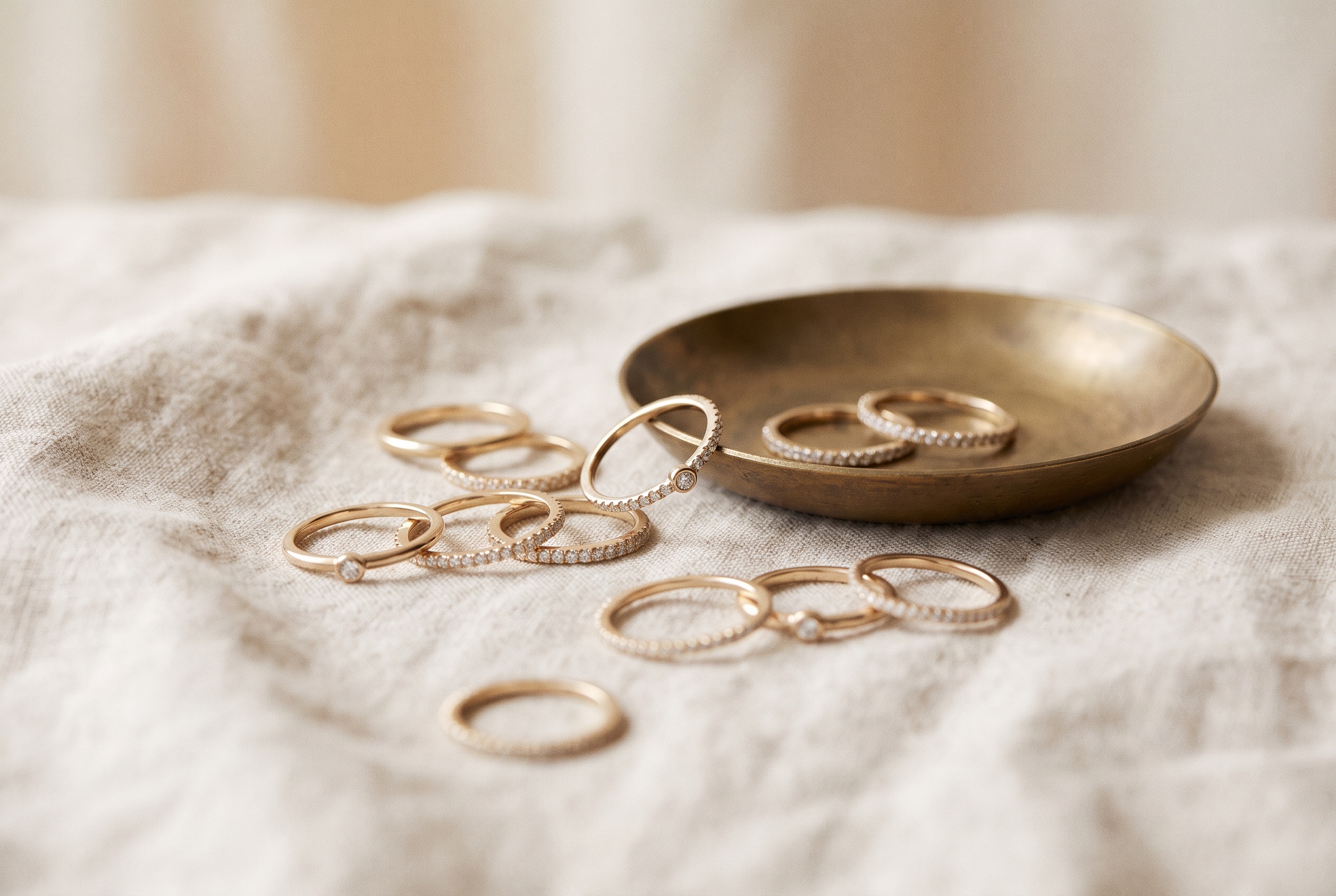
Stackable diamond rings are thin, low-profile bands — typically diamond-set, plain, or textured — designed to be worn several at a time on the same finger, mixed and matched rather than sold or worn as a single piece. For a jeweler or retailer building a stacking program, the sourcing calculus differs from a standard ring line in a specific way: the product is really a modular system of individually thin, individually affordable pieces that only reads as compelling in combination, which changes how inventory, pricing, and merchandising all need to be planned.
This guide is written for the trade — retailers, jewelers, and designers sourcing loose diamonds and finished bands to build or expand a stackable ring program, not a consumer buying guide. It covers what makes a stacking program work commercially, band width and stone sizing conventions, how to plan a coherent multi-SKU collection, lab-grown vs. natural sourcing for this category, and what to look for in a wholesale diamond supplier for stacking-specific production.
Why Stacking Rings Are a Distinct Merchandising Category
A stacking ring almost never sells as a single, standalone purchase decision the way an engagement ring or a statement cocktail ring does. The category's entire commercial logic depends on repeat purchase and combination: a buyer starts with one or two bands, then returns to add more over time, or buys three or four at once specifically to create a curated stack. This has direct sourcing implications — a retailer needs enough design variety within a coherent aesthetic family (consistent metal tones, compatible widths, a shared design language) that pieces bought at different times, or by different people as gifts, still combine convincingly on the finger, rather than reading as a mismatched pile of unrelated bands.
Because individual pieces are thin and comparatively low-cost, margin in this category comes substantially from volume and repeat purchase rather than from any single high-ticket sale — a different economics profile from a center-stone-driven ring line, and one that rewards a retailer who plans the collection architecture deliberately rather than adding stacking SKUs opportunistically.
Band Width and Stone Sizing Conventions
Stackable bands run meaningfully thinner than a standard ring shank specifically so multiple pieces can sit side by side on one finger without becoming bulky or uncomfortable:
| Band Width | Typical Stone Size (if diamond-set) | Stacking Role |
|---|---|---|
| 1.0–1.5mm | 0.01–0.03ct per stone (pavé or bezel accents) | Foundation layer — thinnest bands, meant to sit closest to other rings |
| 1.5–2.5mm | 0.03–0.08ct per stone | Core stacking width — the bulk of most collections |
| 2.5–3.5mm | 0.08–0.15ct, sometimes a small single accent stone | Statement layer — one or two per stack, not the whole set |
| 4mm+ | 0.15ct+ single stone | Anchor piece — a slightly larger single-stone band that a stack builds around |
A well-planned stacking collection covers at least the first three tiers, since buyers building a stack over multiple purchases need thinner foundation pieces to combine with a bolder anchor piece rather than only offering bands at a single width.
Setting Styles Common to Stacking Rings
Pavé Bands
A continuous line of small diamonds set close together around all or part of the band, giving maximum sparkle relative to the band's thin profile. Pavé is the most common stacking-band construction because it reads as a cohesive line of light rather than individual stones, which combines cleanly with plain metal bands and other pavé pieces alike.
Bezel-Set Bands
Individual stones fully or partially enclosed in a metal rim, spaced evenly around the band. Bezel construction holds up especially well to the everyday, frequent wear typical of a stacking piece, and gives a cleaner, more architectural look than pavé for buyers who prefer a graphic, evenly spaced pattern.
Channel-Set Bands
Stones set between two parallel metal walls with no visible prongs, giving a smooth, low-snag profile that's a practical choice for a band meant to be worn stacked against several others daily.
Plain and Textured Metal Bands
Not every piece in a stack needs a diamond — hammered, twisted, or polished plain-metal bands are a standard part of most stacking collections, giving buyers a lower-cost way to add visual texture and volume to a stack without every layer carrying stone cost. A well-planned wholesale order typically balances diamond-set and plain-metal SKUs for exactly this reason.
Building a Coherent Stacking Collection
A retailer assembling a stacking program benefits from planning it as a system rather than a set of unrelated ring SKUs:
- Consistent metal tone family. A collection built primarily in one or two metal tones (say, 14k yellow and rose gold) stacks more convincingly than one where every piece is a different metal, since mismatched metal tones are the most common reason a stack reads as disorganized rather than curated.
- A defined width ladder. Offering pieces across the width tiers above, rather than clustering everything around one width, gives buyers the range needed to build a stack with visual hierarchy — thin foundation pieces, a mid-weight core, and one bolder anchor.
- Compatible stone quality across the line. Diamonds across a stacking collection should sit at a consistent color and clarity standard, since buyers wearing several pieces together will notice a visible mismatch in brightness between bands more readily than they would comparing two rings side by side in a case.
- A repeat-purchase merchandising plan. Because the category depends on customers returning to add to an existing stack, retailers benefit from keeping a stable core collection in stock over time rather than rotating styles frequently — a customer who bought a band eight months ago should still be able to find a matching or complementary piece.
Diamond Quality Standards for Stacking Rings
Given the small individual stone sizes typical of stacking bands, a DEF+/VS+ commercial standard reads as bright and clean to the eye at these sizes, without pricing thin, high-volume pieces beyond what the category's typical price point supports. As covered in more depth in our 4Cs overview guide, clarity characteristics are naturally harder to see in smaller stones, which gives retailers useful room to manage per-unit cost across a multi-SKU stacking line without a visible quality tradeoff between pieces.
Lab-Grown vs. Natural Diamonds for Stacking Production
Because stacking rings compete on being affordable enough to buy in multiples, CVD lab-grown diamonds are a natural fit for the category's economics — they let a retailer offer a fuller pavé line, or a slightly larger anchor stone, at a price point that supports repeat purchase across several pieces. Both natural and lab-grown material can meet the same DEF+/VS+ commercial standard at these sizes; the origin decision is primarily about how a retailer wants to position the price-per-piece across the collection, not a quality distinction.
Metal and Finish Options
14k and 18k gold in yellow, white, and rose tones cover the large majority of stacking-ring demand, with rose gold in particular having grown as a popular anchor tone for mixed-metal stacks. Matte and hammered finishes have become a meaningful share of the plain-band segment specifically, giving buyers texture variation within a stack without adding stone cost. Retailers sourcing a stacking line should plan finish variety alongside stone specification, since texture is one of the primary ways buyers differentiate pieces within an otherwise similar metal-tone family.
Wholesale Pricing Structure for Stacking Ring Diamonds
Because stacking-band stones sit predominantly in the small melee and near-melee range, wholesale pricing for this category runs largely through calibrated melee channels rather than individually certified center-stone inventory. A retailer building a stacking program benefits from a supplier who can quote consistent per-carat pricing across a high volume of small, uniform stones — the defining sourcing need for this category — rather than only competing well on larger individually certified pieces.
Planning Inventory Depth Across a Stacking Line
Because the category depends on repeat purchase and mix-and-match combination, understocking any one width tier or metal tone creates a visible gap in what a customer can build. Retailers typically plan deeper unit inventory on the core 1.5–2.5mm tier (the highest-turnover width) and lighter, more curated inventory on the bolder anchor tier, reflecting how buyers actually build a stack over time — several thin foundation pieces purchased more frequently, one or two statement pieces purchased more deliberately.
What to Look for in a Wholesale Supplier for Stacking Programs
- Calibrated melee consistency across large order quantities, so pavé and channel-set bands from the same production run match visually.
- Certification transparency on any anchor-tier stones large enough to carry individual certification, even when the bulk of the collection runs on uncertified calibrated melee.
- Ability to produce across a metal-tone and width range from one source, simplifying a multi-SKU collection into fewer supplier relationships.
- In-house setting and polishing, reducing the number of separate vendors a retailer needs to coordinate across a wide, fast-turning SKU line.
Merchandising and Display Strategy for Stacking Programs
Because a stacking ring rarely sells as a standalone purchase decision, how a retailer displays the category matters more than it does for most other jewelry lines. A stacking collection shown as individual rings in separate case slots, the way a solitaire or statement ring line is typically merchandised, fails to communicate the category's core value proposition — that these pieces are meant to be combined. Retailers who see the strongest sell-through in this category typically display pre-built sample stacks (three to five rings shown worn together on a finger form or ring stand) alongside the individual pieces, letting a customer see a finished combination before deciding which individual bands to buy.
Point-of-sale staff training matters as much as physical display in this category. Because stacking is inherently a build-your-own-collection format, sales associates benefit from a working knowledge of which widths and finishes combine well, so they can guide a first-time stacking customer toward a coherent starter set rather than a single isolated band that won't obviously combine with a second purchase down the line. Retailers sometimes formalize this with a simple internal reference sheet mapping which SKUs are designed to pair together, reducing reliance on any one staff member's product knowledge.
Common Sourcing and Production Mistakes in This Category
- Treating stacking bands as miniature versions of standard rings. A standard ring shank profile scaled down to 1.5mm often doesn't hold a pavé setting securely at that thickness — stacking-specific band engineering (channel depth, prong height, metal alloy hardness) needs its own specification rather than simply shrinking a standard ring design.
- Underestimating melee consistency requirements. Because stacking pieces are worn and viewed side by side, color and cut mismatches between bands from different production runs are far more visible in this category than in a line where each ring is sold and worn independently. Sourcing melee from a single consistent run for an entire collection launch reduces this risk considerably compared with topping up inventory piecemeal from whatever parcel happens to be available at reorder time.
- Launching too narrow a width range. A collection concentrated entirely around one width (most commonly the 1.5–2.5mm core tier) limits how many pieces a customer can meaningfully add to an existing stack before every additional purchase starts to look redundant. Planning the width ladder deliberately from the outset, as covered above, avoids this ceiling.
- Discontinuing styles too quickly. Because the category depends on repeat purchase over months or years, retailers who rotate their stacking SKUs on the same cadence as seasonal fashion jewelry risk stranding earlier customers who can no longer find a matching piece to add to a stack they started previously.
Customization and Personalization Options
Stacking rings lend themselves naturally to light personalization — an engraved date or initial inside a band, a birthstone accent worked into an otherwise diamond-only stack, or a customer-selected combination of metal tones assembled to order rather than sold as a pre-set bundle. Retailers offering a build-your-own-stack service (letting a customer select individual bands to be sized and delivered together as a set) capture some of the same appeal as a fully custom piece while working from a standing catalog of proven designs rather than one-off custom production for every order, which keeps unit economics closer to a standard wholesale model than true bespoke work.
Care and Durability Considerations Specific to Stacked Wear
Rings worn stacked experience more metal-on-metal contact than a ring worn alone, since adjacent bands rub against each other with every hand movement. This has a couple of practical sourcing implications: softer metal alloys and lower-karat gold are more prone to visible surface wear when worn in a stack over time than they would be worn singly, and prong or bezel edges on adjacent rings can occasionally catch on each other during removal if height and profile aren't reasonably consistent across a stack's pieces. Retailers building a stacking line benefit from specifying a slightly harder alloy blend and consistent, moderate settings-height across the collection, and from including simple stacking-specific care guidance (periodic inspection for prong wear, occasional professional polishing) as a standard part of the sale for this category.
Comparing Stacking Rings to Adjacent Personalized Categories
Stacking rings share their build-your-own, repeat-purchase commercial logic with a handful of other personalized categories covered elsewhere in this queue, and retailers frequently cross-merchandise across them. Our diamond birthstone jewelry guide covers a category that translates naturally into a stacking-ring or stacking-bracelet format, letting a customer build a family or personal stack around meaningful dates and birth months rather than pure aesthetic combination. The diamond initial necklace guide covers a parallel personalization category in the necklace format, sharing the same underlying retail logic — a modular, individually affordable piece that gains commercial value through combination and repeat purchase rather than a single high-ticket transaction. Retailers who build a cohesive personalization strategy across rings, necklaces, and bracelets — rather than treating each as an unrelated category — tend to see stronger cross-sell between them, since a customer already bought into the stacking or personalization mindset in one category is a natural prospect for the same approach in another.
Seasonal and Occasion-Based Demand for Stacking Rings
While stacking rings don't carry the same fixed gifting calendar as, say, birthstone jewelry, the category does see identifiable demand patterns worth planning inventory around. Graduation season and milestone birthdays are common occasions for a first stacking-ring purchase — often gifted as a starter piece meant to be added to over subsequent years — while the winter holiday season drives a large share of "add to an existing stack" purchases, as gift-givers who know a recipient already wears a stack look for a complementary addition rather than a first piece. Anniversary gifting is a third meaningful driver, particularly for couples building a shared stacking tradition where each year's anniversary adds one new band to an ongoing collection. Retailers who recognize these distinct purchase occasions — first piece vs. addition to an existing stack vs. anniversary tradition-building — can tailor merchandising language and staff guidance to each moment rather than treating every stacking-ring sale the same way.
Sourcing a Stacking Ring Program at Wholesale
Guru Diam supplies certified CVD lab-grown diamonds and calibrated melee alongside natural inventory, with cutting, setting, and polishing all handled in-house, giving retailers a single source for building a stacking collection across width tiers, metal tones, and price points rather than coordinating separate melee, center-stone, and finished-jewelry vendors. Retailers can review current calibrated melee and matched-pair inventory through matching pairs, browse certified stones for anchor-tier pieces through certified diamonds, and work through custom jewelry for a bespoke collection design, with finished pieces delivered in 4-6 days. Trade accounts can review terms at the wholesale hub or apply through trade partner. For related pieces that pair naturally into a stacking or layering merchandising strategy, see our guides on diamond cluster rings and hidden halo rings.
Frequently Asked Questions
How thin should a stackable diamond ring band be?
Most stacking bands run 1.0mm to 2.5mm wide, thin enough that three or four pieces can sit comfortably on one finger without becoming bulky. Bolder anchor pieces in a stack can run 3mm or wider, but these are typically limited to one or two per stack rather than the whole set.
What size diamonds are used in stacking rings?
Individual stones typically run from about 0.01ct up to roughly 0.15ct, scaled to the band width — thinner foundation bands carry the smallest stones, while a single bolder anchor band can carry a slightly larger stone in the 0.15ct-plus range.
Should stacking rings be lab-grown or natural diamonds?
Either can meet the same quality standard at the small sizes typical of this category. Lab-grown diamonds are a common choice for stacking programs specifically because their lower per-carat cost supports offering a fuller collection of pieces at a price point that encourages buying multiples.
How many rings should be in a stacking collection?
A well-rounded wholesale collection typically spans at least three width tiers — thin foundation bands, a core mid-weight tier, and one or two bolder anchor styles — plus a mix of diamond-set and plain-metal pieces, giving retailers enough range for customers to build a stack over multiple purchases.
What metal works best for a stacking ring program?
14k and 18k gold in yellow, white, and rose tones cover most demand, with rose gold especially popular as an anchor tone in mixed-metal stacks. Keeping a collection within one or two consistent metal tones generally stacks more convincingly than spreading a line thin across many different tones.
Why do stacking rings use calibrated melee instead of certified stones?
Because individual stones are typically well under a size where individual certification is standard practice, wholesale sourcing for this category runs mostly through calibrated melee channels priced and quality-checked as parcels rather than certified one at a time — the more practical and cost-effective approach at these sizes and order volumes.
How should a retailer merchandise a stacking ring collection?
Displaying pre-built sample stacks alongside individual pieces, rather than showing every band in a separate case slot, helps customers see finished combinations before choosing what to buy — the single biggest merchandising lever in this category, since stacking's appeal is fundamentally about combination rather than any one piece in isolation.
Can stacking rings be personalized?
Yes — engraving, birthstone accents, and build-your-own-stack services (letting a customer select and combine individual bands to order) are all common in this category, offering a lighter-touch alternative to full custom design while still drawing on a standing catalog of proven pieces.