
The 4Cs of diamonds — carat weight, cut, color, and clarity — are the four standardized characteristics grading labs use to describe and evaluate any diamond, developed by GIA as a common framework so buyers, sellers, and appraisers everywhere could talk about diamond quality using the same criteria. This guide explains what each of the 4Cs actually measures, how they interact to affect price and appearance, which one matters most depending on what you're buying, and where to go deeper on each one individually.
Nearly every diamond-buying decision, wholesale or retail, natural or lab-grown, ultimately comes down to balancing these four factors against a budget. This piece is written as an overview and a hub — a clear, complete explanation of all four together, with links out to our deeper dedicated guides on clarity, color, and cut for readers who want to go further on any one of them.
Why the 4Cs Exist
Before the 4Cs became standard, there was no consistent, agreed-upon language for describing diamond quality — a "fine" diamond from one seller might be very different from a "fine" diamond from another, with no objective way for a buyer to compare. GIA introduced the 4Cs framework in the mid-20th century specifically to solve that problem: a shared vocabulary, with defined scales for each characteristic, that any grading lab, jeweler, or buyer anywhere in the world could use to describe the same stone the same way. IGI and GCAL, along with every other reputable grading lab, use this same framework today.
Carat: The Weight of a Diamond
Carat measures a diamond's weight, not its size directly — one carat equals 0.2 grams, and each carat is divided into 100 "points" (a 0.50-carat stone is described as 50 points). Two diamonds of the same carat weight can look different in size depending on how they're cut, since a shallow or spread cut can make a stone look larger for its weight while a very deep cut can make it look smaller.
Carat weight has an outsized effect on price because larger rough diamonds are significantly rarer than smaller ones in nature, which means price doesn't rise in a straight line with weight — it accelerates, particularly at psychologically significant thresholds like 1.00 carat, 2.00 carat, and beyond. Lab-grown diamonds follow a smoother, less dramatically stepped pricing curve across carat weights, since production isn't constrained by natural rarity the same way.
Cut: How Well a Diamond Interacts with Light
Cut is often called the most important of the 4Cs for visual appeal, because it determines how well a diamond reflects and refracts light — its brilliance (overall brightness), fire (flashes of color), and scintillation (sparkle as the stone or viewer moves). Cut grade isn't the same as diamond shape; a round brilliant, an emerald cut, and a cushion cut are all "shapes," while "cut grade" (excellent, very good, good, fair, poor) describes how precisely a stone of any given shape was proportioned and faceted relative to an ideal model for that shape.
A well-cut diamond of a lower color or clarity grade can often look more impressive than a poorly cut diamond with higher color and clarity numbers, because cut governs how much of the stone's inherent brilliance actually reaches the eye. This is a large part of why experienced buyers are told to prioritize cut quality over chasing the highest possible color or clarity number.
Color: How Colorless a Diamond Is
For standard white diamonds, color is graded on GIA's D-to-Z scale, where D is completely colorless and the scale progresses toward increasingly visible yellow or brown tint as it moves toward Z. Grading happens under controlled lighting, viewing the stone table-down against a neutral background, comparing it to a set of master stones with known grades.
Color differences at the top of the scale (D through F, the "colorless" range) are subtle enough that most buyers can't distinguish them with the naked eye — the difference becomes more visible starting around the near-colorless range (G–J) and increasingly so moving toward the lower end of the scale. This is why many experienced buyers deliberately choose a near-colorless grade rather than paying a premium for a D–F stone that would look nearly identical once set.
Clarity: How Free a Diamond Is of Inclusions and Blemishes
Clarity measures the presence of internal inclusions and external blemishes, graded under 10x magnification on a scale running from Flawless (FL) at the top down through Internally Flawless (IF), the VVS and VS tiers, SI, and finally the I (included) tiers. Most inclusions at the higher clarity grades are invisible without magnification and have no effect on a diamond's appearance or durability to the naked eye.
Because of this, "eye-clean" — meaning no inclusions visible without magnification, even if the stone doesn't carry a top clarity grade — is a practical target many buyers use instead of chasing the highest clarity number available, since the visual difference between an eye-clean SI1 and a VVS stone is often undetectable to anyone without a loupe.
The 4Cs at a Glance
| C | What It Measures | Typical Scale | Biggest Effect On |
|---|---|---|---|
| Carat | Weight (0.2g = 1 carat) | Numeric weight, expressed in carats/points | Price — accelerates sharply at natural stones, more smoothly for lab-grown |
| Cut | Precision of proportions and faceting; how well light performance is achieved | Excellent to Poor | Visual brilliance, fire, and sparkle — the most direct driver of how the stone looks |
| Color | Absence of yellow/brown body tint | D (colorless) to Z | Whiteness/warmth of appearance; subtle differences at the top of the scale |
| Clarity | Presence of internal inclusions and external blemishes | FL/IF down through I1–I3 | Whether inclusions are visible; mostly invisible-to-the-eye above SI grades |
How the 4Cs Interact
The 4Cs don't operate independently — a change in one affects how the others read. A diamond with excellent cut can make lower color or clarity grades far less noticeable, since a well-cut stone's brilliance draws the eye and masks subtle color or minor inclusions better than a poorly cut stone does. Conversely, an excellent color-and-clarity stone with a poor cut can look dull and lifeless despite its impressive numbers on paper, because the cut is what actually delivers light performance to the eye.
This interaction is exactly why experienced buyers don't optimize each C independently against a fixed budget — they typically prioritize cut first, then decide how to split the remaining budget between carat, color, and clarity based on what actually shows up visually at the size and setting style they're choosing.
Which of the 4Cs Matters Most?
There's no universal answer — it depends on the buyer's priorities and how the stone will be used:
- Cut matters most for buyers prioritizing visual brilliance and sparkle, since it has the most direct effect on how the diamond actually looks.
- Carat matters most for buyers prioritizing size, particularly for a solitaire or other setting style where the stone is the visual centerpiece.
- Color matters more in settings where the stone is more exposed to direct comparison (a solitaire) than in settings surrounded by metal or other stones that can offset warmth.
- Clarity matters most to buyers targeting resale value or working with larger stones, where inclusions are more likely to become visible to the naked eye at bigger sizes.
Most experienced trade buyers treat cut as close to non-negotiable — a compromise on cut affects the stone's fundamental appearance — while treating carat, color, and clarity as the three dimensions to balance against each other and against budget.
The 4Cs for Lab-Grown vs. Natural Diamonds
The 4Cs framework applies identically to lab-grown and natural diamonds — the same scales, the same grading methodology, graded by the same major labs (GIA, IGI, GCAL). The only addition for lab-grown stones is an explicit origin statement on the grading report. Where the categories differ is availability at the higher end of each scale: high color and high clarity lab-grown stones tend to be more readily available at volume than equivalently graded natural stones, which is part of why lab-grown pricing sits meaningfully below natural at comparable 4C specifications.
A Practical Example: Balancing the 4Cs Against a Budget
Consider a buyer with a fixed budget shopping for a 1-carat round brilliant. If they insist on the top of every scale — D color, Flawless clarity, Excellent cut, and a full carat — the price will land at the extreme high end of what a 1-carat stone can cost, since compounding top grades across all four Cs simultaneously is the most expensive possible combination. A more typical, budget-conscious approach: hold cut at Excellent or Very Good (since it drives the most visible difference), accept a near-colorless grade like G or H (a difference most people can't detect without side-by-side comparison), target an eye-clean SI1 or VS2 clarity rather than paying a premium for internally flawless, and let carat weight land wherever the remaining budget lands. That stone will look dramatically similar to the top-of-scale version to nearly any observer, at a meaningfully lower price — which is exactly the kind of tradeoff decision the 4Cs framework is meant to support.
Common Misconceptions About the 4Cs
- "Higher carat always means a bigger-looking diamond." Not necessarily — cut proportions affect how large a stone appears for its actual weight; a well-cut stone can face up larger than a poorly cut stone of the same carat weight.
- "Clarity matters more than cut." For most buyers, the reverse is true — cut has the most direct effect on a diamond's visible brilliance, while clarity differences above SI grades are often invisible to the naked eye entirely.
- "D color is meaningfully better-looking than G or H." Under normal lighting and typical viewing distance, most people cannot reliably distinguish D from G or H color without side-by-side comparison under controlled lighting — the price difference is real, but the visible difference to a casual observer often isn't.
- "A diamond's certificate number is the same as its 4C grade." The certificate is the document; the 4Cs are the characteristics it reports. Confusing the two leads some buyers to think a longer or more complex-looking certificate number implies a better stone, which it doesn't.
Beyond the 4Cs: Other Factors That Affect a Diamond
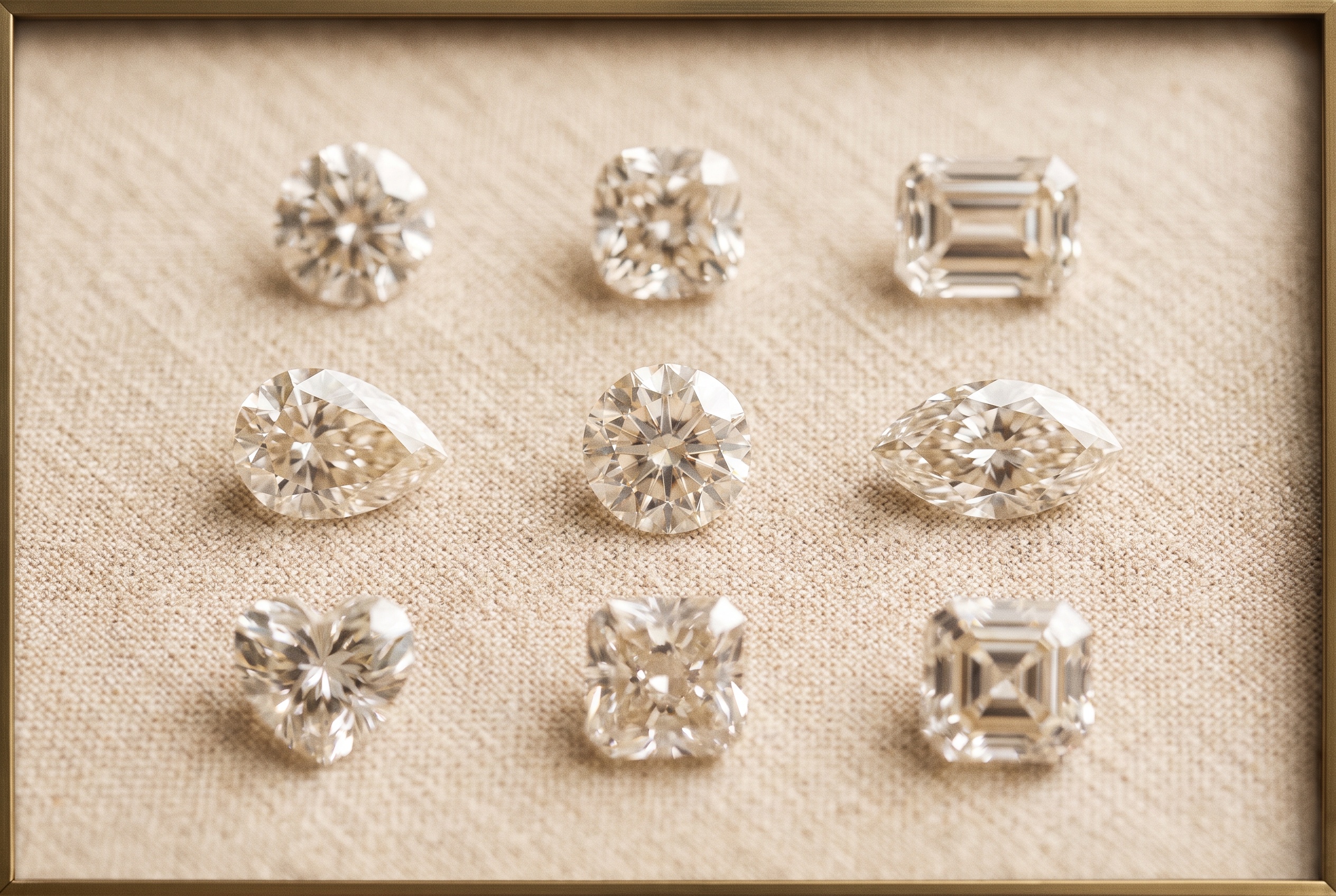
The 4Cs describe a diamond's core specifications, but a few additional factors round out a full evaluation: fluorescence (how a stone reacts under UV light), the specific shape (round, oval, emerald, and so on — a separate choice from cut grade), and certification lab, which affects resale liquidity and buyer trust independent of the stone's actual 4C grades. A buyer comparing two stones with identical 4C numbers should still weigh these secondary factors before deciding between them.
Go Deeper on Each of the 4Cs
This guide covers all four Cs together at an overview level. For a deeper dive into any single one: our diamond clarity chart guide and VVS clarity guide cover clarity in detail, our diamond color chart guide and diamond color scale guide cover color, and our round brilliant cut guide covers cut quality for the most common shape in depth. For how grading itself works and how labs compare, see our diamond graders guide.
The 4Cs and Diamond Shape
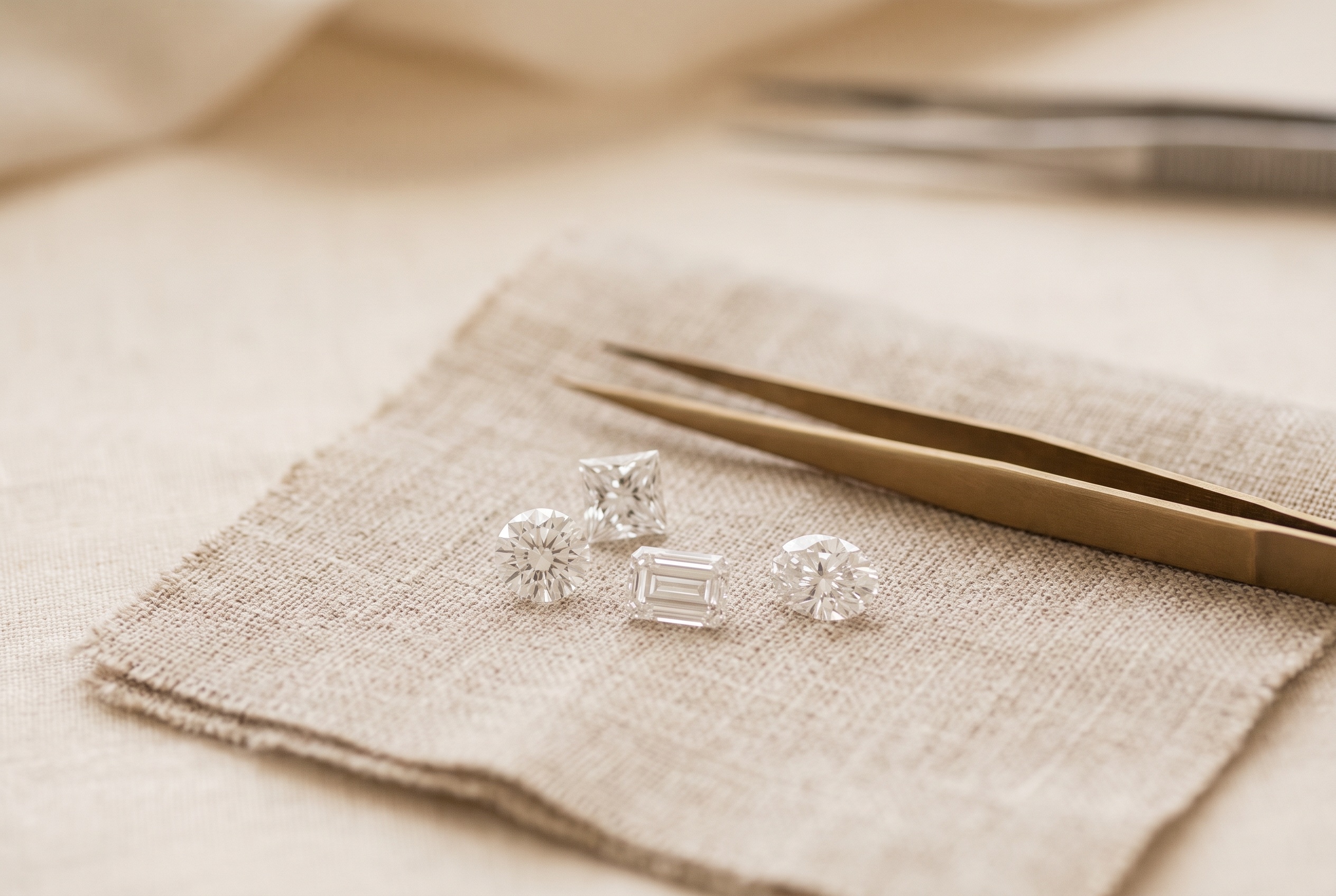
It's worth being explicit that shape (round, oval, cushion, emerald, and so on) is not one of the 4Cs — it's a separate choice made independently of carat, cut, color, and clarity. That said, shape interacts with the 4Cs in a few practical ways. Step-cut shapes like emerald and Asscher have large, open facets that show inclusions more readily than a round brilliant's more fragmented facet pattern, so buyers often prioritize a slightly higher clarity grade for step cuts than they would feel necessary for a round brilliant of the same visual quality. Similarly, some fancy shapes can face up with a visible color tint sooner than round brilliants do at the same color grade, because of how light travels through a shallower or more elongated outline — which is why buyers sometimes choose a slightly higher color grade for certain fancy shapes than they would for an equivalent round stone.
The 4Cs and Certification: Why the Grading Lab Matters Too
A diamond's 4C grades only mean as much as the credibility of the lab that assigned them. Two stones with identical stated 4Cs from two different labs aren't necessarily equivalent in the market's eyes if one lab has a reputation for stricter, more conservative grading than the other — a pattern covered in detail in our diamond graders guide. This is part of why experienced buyers evaluate the 4Cs and the issuing lab together rather than treating the stated grades as a fully portable, lab-independent measure of quality.
Sourcing Diamonds Across the Full 4C Spectrum
Understanding the 4Cs is most useful when it translates directly into a sourcing decision — knowing what to specify, and why, when placing a wholesale order. Guru Diam carries natural and CVD lab-grown diamonds across the full range of standard, antique, and exotic shapes, with IGI, GIA, and GCAL certification available, giving trade buyers the flexibility to specify exactly the 4C combination their project or client calls for rather than settling for whatever a narrower supplier happens to stock. Browse certified inventory in the certified diamonds category, review fancy color stones in fancy color loose diamonds, or source matched pairs through matching pairs. In-stock stones ship same-day from our New York (before 6pm EST) and Los Angeles (before 4pm PST) locations. Trade buyers can apply for an account through trade partner or review current terms at the wholesale hub; custom pieces built around a specific 4C combination can start at custom jewelry.
How the 4Cs Show Up on a Grading Report
On an actual grading report, the 4Cs appear as distinct, clearly labeled fields rather than a single combined score — carat weight as a precise decimal figure, cut as a grade (for round brilliants) or a set of proportion measurements and a description (for fancy shapes), color as a single letter on the D-to-Z scale, and clarity as a grade abbreviation (such as VS1 or SI2) alongside a plotted diagram showing the location of any notable inclusions. Learning to read these four fields together, rather than fixating on any single one in isolation, is the core skill behind evaluating a certificate quickly and accurately — a skill that becomes second nature with enough repetition but can feel overwhelming to a first-time buyer looking at a report for the first time. Reports also typically include supporting data beyond the core 4Cs — measurements, fluorescence, polish and symmetry grades, and, for lab-grown stones, the growth method — which round out the full picture beyond the headline four characteristics.
Applying the 4Cs When Comparing Multiple Stones
When a buyer is comparing several candidate stones against each other rather than evaluating one stone in isolation, the most useful approach is holding one or two Cs roughly constant and letting the others vary — for example, comparing several stones at a similar carat weight and cut grade while looking at how color and clarity trade off against price across the set. This makes the comparison meaningfully easier to reason about than trying to weigh four variables simultaneously across every candidate. Buyers working with a wholesale supplier who can pull a curated shortlist of stones matching a target carat and cut range, rather than sending an overwhelming full inventory list, generally reach a confident decision faster than buyers trying to compare a large undifferentiated set on their own.
The 4Cs as a Shared Language Across the Trade
Perhaps the most practical value of the 4Cs framework isn't any single scale — it's that everyone in the transaction, from grading lab to wholesaler to retailer to end customer, is using the exact same vocabulary to describe the exact same stone. A buyer in Los Angeles and a supplier in New York can agree on a purchase over the phone using nothing but a shape name and four short specifications, with no ambiguity about what's being described, precisely because the 4Cs standardized that language decades ago. That shared vocabulary is easy to take for granted until you consider how much harder diamond trading would be without it.
Frequently Asked Questions
What are the 4Cs of diamonds?
The 4Cs are carat weight, cut, color, and clarity — the four standardized characteristics grading labs use to describe and evaluate a diamond. GIA developed the framework so buyers, sellers, and appraisers everywhere could describe diamond quality using the same shared criteria.
Which of the 4Cs matters most?
It depends on priorities, but many experienced buyers treat cut as closest to non-negotiable, since it has the most direct effect on a diamond's visual brilliance. Carat, color, and clarity are then typically balanced against each other and against budget.
Do lab-grown diamonds have the same 4Cs as natural diamonds?
Yes. Lab-grown diamonds are graded on the identical 4Cs framework and scales as natural diamonds, by the same major labs (GIA, IGI, GCAL). The only addition on a lab-grown report is an explicit origin statement.
Does a higher color and clarity grade always mean a better-looking diamond?
Not necessarily. Cut quality has the most direct effect on how a diamond actually looks — a well-cut stone with slightly lower color or clarity can outperform visually a poorly cut stone with higher grades on paper, since cut governs how much brilliance actually reaches the eye.
What does "eye-clean" mean in relation to clarity?
Eye-clean means a diamond has no inclusions visible to the naked eye without magnification, even if its official clarity grade isn't at the very top of the scale. Many buyers target eye-clean rather than the highest possible clarity number, since the visual difference is often undetectable above certain grades.
Why does carat weight affect price so much more than a straight-line increase?
Larger rough diamonds are significantly rarer in nature than smaller ones, so price accelerates rather than rising proportionally with weight — particularly at thresholds like 1.00 and 2.00 carats. Lab-grown diamonds follow a comparatively smoother pricing curve across carat weights, since production isn't limited by natural rarity in the same way.
Guru Diam is a trade-only wholesale diamond supplier with locations in New York and Los Angeles, carrying natural and CVD lab-grown diamonds with IGI, GIA, and GCAL certification available across standard, antique, and fancy color shapes, alongside finished jewelry. Apply for a trade account through trade partner.