
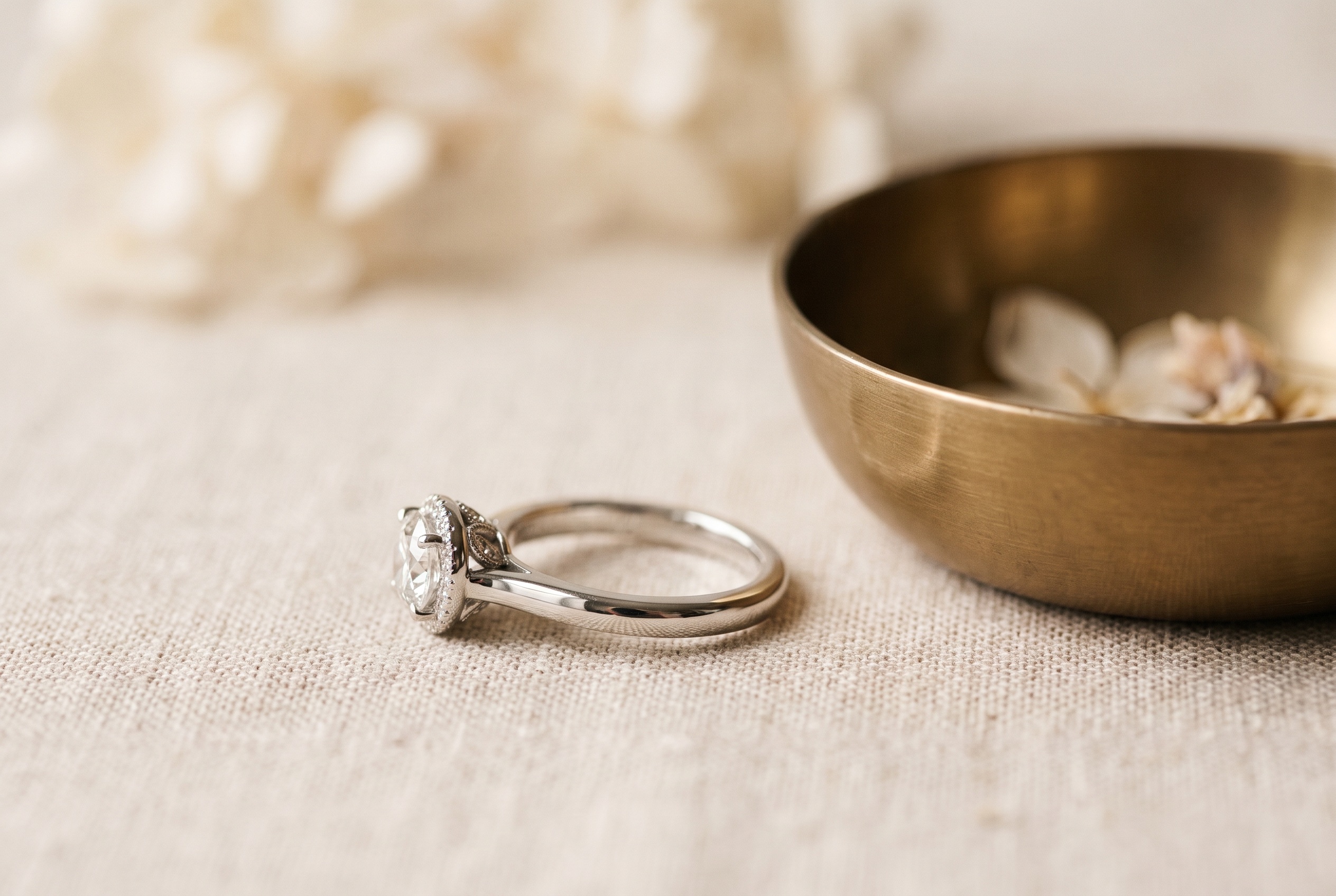
A hidden halo ring is a ring design where a circle of small accent diamonds sits beneath the center stone, tucked under the crown or gallery rather than visible in the standard top-down view — so the ring reads as a clean solitaire from above, but reveals a full halo of sparkle from the side profile. For a jeweler, this construction detail changes the sourcing conversation from a standard halo: the melee is invisible from the primary viewing angle, which shifts its commercial role from "obvious added sparkle" to a design detail buyers discover after purchase, and that changes how a retailer should merchandise and price it.
This guide is written for the trade — retailers, designers, and manufacturers sourcing loose diamonds for hidden halo ring construction — not a consumer shopping guide. It covers how hidden halos differ structurally from standard halos, typical stone sizes, and what to look for in a wholesale diamond supplier for this style.
What Makes a Halo "Hidden"
In a standard halo ring, the ring of accent melee sits at the same level as the center stone, fully visible from directly above — the halo is the point of the design, visually enlarging the center stone and adding surrounding sparkle that reads immediately in a top-down photo or glance. In a hidden halo, that same ring of melee is set lower, beneath the center stone's girdle, tucked into the basket or gallery structure that holds the stone in place. Viewed from above, the ring looks like a clean solitaire; tilted to a side or three-quarter angle, the hidden halo catches light and becomes visible, giving the piece a "surprise" element that standard halos don't offer.
Hidden Halo vs. Standard Halo: Sourcing Differences
Because a hidden halo isn't the primary visual feature of the ring, it plays a different commercial role than melee in a standard halo — see our cathedral setting ring guide for related basket-construction fundamentals. A standard halo's melee needs to read clearly and consistently from directly above, since that's the primary viewing angle for both in-person viewing and product photography. A hidden halo's melee is judged more on its side-profile sparkle and its contribution to the ring's perceived "fullness" from underneath, which gives a retailer somewhat more flexibility on exact stone matching, since the halo isn't the first thing a buyer's eye lands on.
| Factor | Hidden Halo Ring | Standard Halo Ring |
|---|---|---|
| Halo visibility | Hidden from top-down view, visible from side angle | Fully visible from directly above |
| Primary visual role | Reads as a clean solitaire; halo is a "surprise" detail | Halo visually enlarges the center stone immediately |
| Setting complexity | Higher — requires a lower basket/gallery structure | Standard basket construction |
| Melee matching priority | Side-profile consistency | Top-down consistency, highest priority |
Basket and Gallery Construction for Hidden Halos
Building a hidden halo requires a deeper or more elaborately structured basket than a standard prong solitaire, since the design needs enough vertical space beneath the center stone to set a full ring of melee without adding excessive overall ring height that would compromise comfort or durability. This construction requirement is the main reason hidden halo rings typically carry a higher setting-labor cost than either a plain solitaire or even a standard halo — the gallery structure itself is more complex to fabricate and set cleanly, independent of the melee cost. A retailer sourcing hidden halo designs from a manufacturing partner should confirm the partner has specific experience with this basket style, since a poorly executed hidden halo can either be genuinely invisible from any angle (defeating the design's purpose) or, at the other extreme, visible enough from above to look like a construction flaw rather than an intentional standard halo.
Typical Stone Sizes for Hidden Halo Construction
Hidden halo melee typically runs slightly smaller than standard halo melee — commonly 0.01ct to 0.03ct per stone — since the halo sits in a more compact, enclosed space beneath the center stone rather than the more open setting a standard visible halo allows. Total hidden halo carat weight for a typical engagement ring commonly falls between 0.10ct and 0.25ct combined, a modest addition relative to the center stone's weight, which keeps the cost of adding this design detail relatively low even though the setting labor to execute it well is higher than a plain solitaire.
Diamond Shape Choices for Hidden Halo Settings
Round brilliant dominates hidden halo melee for the same reasons it dominates most enclosed, tightly set applications — its symmetrical outline sets efficiently in the compact ring of space beneath the center stone with minimal visible gap. Because the hidden halo isn't a primary visual element, shape variety here matters less than in a standard halo, where the melee shape sometimes echoes or complements the center stone's shape for a coordinated top-down look. Center stone shape for hidden halo rings spans the full range of popular shapes — round, oval, cushion, and pear all pair well with a hidden halo, since the halo's side-profile role doesn't constrain center stone shape the way a standard halo's top-down coordination sometimes does.
Color and Clarity Standards for Hidden Halo Melee
Because hidden halo melee is viewed at an angle rather than straight on, and set in a more enclosed space with less direct light exposure than a standard top-facing halo, a DEF+/VS+ commercial standard remains the right baseline, though the practical visual tolerance for minor inconsistency is somewhat higher than for a standard halo given the less prominent viewing angle. Retailers shouldn't use this as a reason to source a meaningfully lower grade, however — a hidden halo that looks dull or inconsistent when the ring is tilted undercuts the entire "surprise" value proposition the design is built around.
Lab-Grown vs. Natural Diamonds for Hidden Halo Rings
Given the relatively modest total carat weight a hidden halo adds to a ring, the lab-grown versus natural decision for the halo itself matters less commercially than it does for a full standard halo or a cluster design — the cost difference on 0.10ct–0.25ct of melee is small in absolute terms regardless of origin. CVD lab-grown melee remains the practical default for most hidden halo programs simply for consistency with the rest of a retailer's melee inventory and sourcing relationships, while the center stone decision (lab-grown or natural, and at what grade) remains the primary cost and positioning lever for the ring as a whole.
Building a Hidden Halo Ring Program: Inventory Planning
- Source slightly smaller melee (0.01ct–0.03ct) than standard halo programs, sized for the more compact hidden setting.
- Confirm manufacturing partner experience with deeper basket/gallery construction before committing to volume production.
- Offer hidden halo as an upgrade option across multiple center stone shapes (round, oval, cushion, pear), since it doesn't constrain shape the way a standard halo can.
- Price the design detail transparently, reflecting its setting-labor premium rather than bundling it invisibly into a flat "halo upgrade" price that doesn't reflect the more complex construction.
- Keep melee sourcing consistent with existing halo/pavé inventory rather than treating hidden halo as requiring an entirely separate parcel category.
Pricing a Hidden Halo Ring: What Drives the Final Cost
Setting labor, not melee cost, is the primary cost driver that distinguishes a hidden halo from a plain solitaire — the additional 0.10ct–0.25ct of melee adds relatively little to total stone cost, but the deeper, more complex basket construction required to set it cleanly adds meaningfully more bench time than a standard prong solitaire or even a standard visible halo. Retailers should price hidden halo as a distinct upgrade tier reflecting that labor difference, rather than assuming it costs roughly the same as a standard halo simply because the melee weight is similar or lower.
Why Hidden Halos Have Grown as a Design Trend
Hidden halo rings have grown in popularity as engagement ring buyers increasingly look for a piece that photographs as a clean, minimal solitaire for everyday wear and social sharing, while still offering a layer of added sparkle and perceived value that a plain solitaire doesn't. This "best of both" positioning — minimal from the primary angle, more elaborate up close — has made hidden halos a strong upsell from a plain solitaire, since the design doesn't visually compete with current minimalist engagement ring trends while still giving the retailer a meaningful add-on sale opportunity. It pairs particularly well with thin, delicate band styles, where a standard visible halo might feel visually heavy but a hidden halo adds dimension without disrupting the ring's overall clean line.
Quality Control for Incoming Hidden Halo Melee
Because hidden halo melee is set in a more enclosed space with less inspection visibility once mounted, quality control on the incoming parcel matters more before setting than it might for more easily inspected pavé work. A practical checklist covers size consistency within calibration tolerance (undersized stones in a hidden halo are harder to spot post-setting and can leave visible metal gaps), color and cut consistency across the parcel, and a check for surface-reaching inclusions, since even side-profile viewing can catch a visibly flawed stone under angled light.
Common Mistakes When Sourcing for Hidden Halo Production
The most frequent mistake retailers make when adding hidden halo to their assortment is underestimating the setting-labor difference and pricing it too close to a plain solitaire, which erodes margin once the true bench-time cost of the more complex basket construction is accounted for. A second common mistake is working with a manufacturing partner who has strong standard-solitaire and standard-halo experience but hasn't specifically produced hidden halo baskets before — the design has a real learning curve, and an inexperienced setter can produce a halo that's either genuinely invisible from every angle (which undercuts the "surprise" value proposition entirely) or, conversely, peeks out awkwardly from directly above in a way that reads as a flaw rather than an intentional visible halo. A third mistake is sourcing melee at a lower grade than the rest of a retailer's halo inventory on the assumption that "no one will really see it" — a hidden halo that looks visibly dull or inconsistent under angled light undermines the entire point of the design detail, which is specifically to reward closer inspection.
Positioning Hidden Halo as an Upsell, Not a Hidden Cost
Because the hidden halo's value proposition depends on the buyer understanding and appreciating the detail, retailers get the most commercial benefit from explicitly showing and explaining the feature at the point of sale — a side-angle product photo, a brief note in the product description, or an in-person demonstration tilting the ring to reveal the hidden sparkle — rather than treating it as a design detail the customer will simply discover later. Buyers who understand what they're paying the upgrade for generally perceive better value from a hidden halo purchase than buyers who aren't shown the feature clearly and later notice it as an unexplained line-item cost. This makes product photography and sales training a meaningful part of successfully merchandising the category, not just sourcing the right melee and finding a capable setter.
Hidden Halo Combined With Other Design Details
Hidden halos pair well with several other engagement ring design elements a retailer may already stock, extending the category's upsell potential beyond a standalone add-on. Combined with a hidden gemstone accent — a small colored stone set into the gallery alongside or instead of additional diamond melee — a hidden halo can carry personal meaning (a birthstone, an anniversary-date reference) that adds emotional value beyond the visual sparkle alone. Combined with a pavé or diamond-accented band, a hidden halo extends the ring's overall diamond presence without adding a second, more visually dominant halo on top of the band detail, keeping the design cohesive rather than visually busy. Retailers who present hidden halo as one option within a broader menu of "hidden detail" customizations — rather than a single fixed upgrade — capture more of the design-conscious customer segment specifically drawn to rings with a personal or discoverable element.
How Hidden Halo Fits Into a Broader Halo Product Strategy
Most retailers offering hidden halo do so alongside, not instead of, standard visible halo options, and the two styles serve genuinely different customer preferences rather than one simply being a premium version of the other. A customer drawn to a standard halo generally wants the immediate visual impact and perceived size increase a visible halo delivers, while a customer drawn to a hidden halo generally prioritizes a minimal, solitaire-forward look with an added personal or discoverable detail rather than maximum visible sparkle. Stocking melee and offering manufacturing capability for both styles — rather than picking one over the other — lets a retailer capture both customer types without forcing either into a design compromise that doesn't match their actual preference.
Manufacturing Lead Times for Hidden Halo Production
Because a hidden halo requires more complex basket fabrication than a standard prong solitaire or even a standard visible halo, retailers should build slightly longer manufacturing lead times into customer expectations for this style, particularly on fully custom commissions rather than a repeated stock design where the manufacturing partner has already refined the process. A stock hidden halo design produced repeatedly benefits from process consistency once a manufacturing partner has worked through the initial setup, narrowing the lead-time gap versus a standard halo over time — but a first custom hidden halo order, or one built around an unusual center stone shape or size, should be quoted with a realistic buffer rather than promised on the same timeline as a simpler solitaire or standard halo build.
Evaluating a Manufacturing Partner's Hidden Halo Capability Before Committing
Since hidden halo execution quality varies more between manufacturing partners than most other common ring details, retailers considering adding the style to their assortment benefit from requesting sample pieces or reviewing a partner's prior hidden halo work specifically, rather than assuming general halo-setting competence transfers automatically. A useful evaluation approach is checking the finished ring from directly above under normal lighting — the halo should be genuinely invisible or very close to it from that angle — and then from a 30 to 45 degree side angle, where it should become clearly visible and well-lit rather than appearing dim or only partially catching light. A partner who can consistently hit both ends of that visual range, invisible from above and vivid from the side, has the specific skill set this design detail depends on; a partner who produces a halo that's only ever partially visible from any angle hasn't fully mastered the technique, regardless of their broader setting experience.
Photographing Hidden Halo Rings for E-Commerce
A hidden halo's core selling point — the contrast between a clean top-down view and a sparkling side profile — needs to be conveyed visually to an online shopper who can't physically tilt the ring in their hand the way an in-store customer can. Retailers selling hidden halo rings online should include at minimum a straight top-down product shot and a clear three-quarter or side-angle shot showing the halo catching light, rather than relying on a single standard angle that only tells half the design's story. Some retailers go further with a short video or animated GIF showing the ring rotating from the top-down view into the side view, which communicates the "reveal" more effectively than static photography alone, since it replicates the in-person discovery moment that's central to why customers choose a hidden halo over a standard visible one.
Sourcing Diamonds for a Hidden Halo Ring Program Wholesale
Guru Diam supplies CVD lab-grown and natural melee calibrated to the smaller size range used in hidden halo construction, sorted to a consistent DEF+/VS+ quality baseline, alongside certified loose center stones across all popular shapes. Trade buyers can review current melee and certified inventory through certified diamonds and matching pairs, and work with Guru Diam's custom jewelry team on basket and gallery construction through custom jewelry, with custom rings finished in 4-6 days. In-stock inventory ships same-day from Guru Diam's New York and Los Angeles locations. New trade accounts can apply through trade partner, with current terms available at the wholesale hub. For related ring-construction guides, see our cathedral setting ring guide and cluster ring sourcing guide.
Frequently Asked Questions
What is a hidden halo ring?
A hidden halo ring has a ring of small accent diamonds set beneath the center stone, tucked under the crown or gallery, so the ring looks like a clean solitaire from above but reveals a halo of sparkle from the side.
How is a hidden halo different from a standard halo?
A standard halo's melee is visible directly from above and is the design's primary visual feature. A hidden halo's melee is only visible from a side or three-quarter angle, functioning as a discovered detail rather than an immediately obvious one.
Why does a hidden halo ring cost more to produce than a plain solitaire?
The added cost comes primarily from setting labor, not melee cost — a hidden halo requires a deeper, more complex basket or gallery structure than a plain prong solitaire, which takes meaningfully more bench time to fabricate and set cleanly.
What size diamonds are used in a hidden halo?
Hidden halo melee typically runs 0.01ct to 0.03ct per stone, slightly smaller than standard halo melee, with total combined weight commonly between 0.10ct and 0.25ct for the full halo.
Does center stone shape limit hidden halo design?
No — round, oval, cushion, and pear center stones all pair well with a hidden halo, since the halo's side-profile role doesn't require the same top-down shape coordination a standard visible halo sometimes calls for.
Should hidden halo melee be lab-grown or natural?
CVD lab-grown melee is the practical default for most programs, though the cost difference matters less here than in a full standard halo given the hidden halo's modest total carat weight. The center stone choice remains the primary cost lever for the ring overall.
Guru Diam is a trade-only wholesale diamond supplier with locations in New York and Los Angeles, supplying calibrated CVD lab-grown and natural melee alongside certified loose diamonds, for jewelers building hidden halo, standard halo, and other ring settings. Browse current inventory in certified diamonds or apply for a trade account through trade partner.