
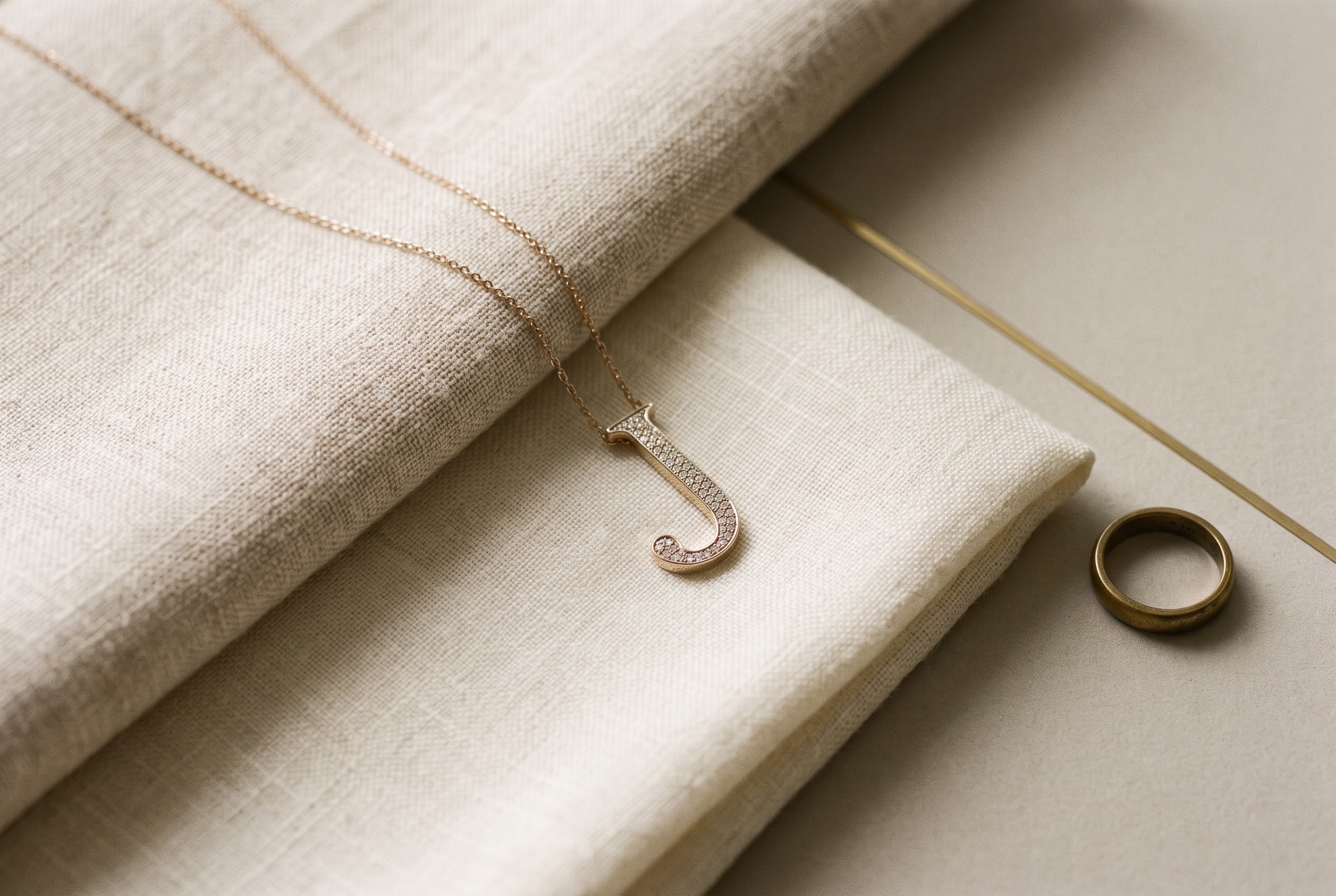
A diamond initial necklace is a pendant shaped as a single letter — typically the wearer's own initial, a partner's, or a child's — set with diamond accents along the letterform, worn on a fine chain as a personalized everyday piece. For a jeweler building this category, the sourcing challenge is less about the diamonds themselves and more about letterform production and stone placement: twenty-six possible letters, each with a different outline length and different natural stone-count requirements, need to be planned as a coherent, repeatable product line rather than one-off custom pieces.
This guide is written for the trade — retailers, jewelers, and designers sourcing diamonds to build or expand a personalized initial necklace line, not a consumer buying guide. It covers letterform and stone-count planning across the alphabet, common construction and setting styles, chain and pendant sizing conventions, and what to look for in a wholesale diamond supplier for this category.
Why Initial Necklaces Are a Distinct Production Challenge
Unlike most jewelry categories, where a single design is produced repeatedly at one specification, an initial necklace line inherently requires twenty-six distinct letterform outlines, each needing its own stone layout planned to follow that letter's specific shape. A letter like "I" has a short, simple outline requiring few stones, while a letter like "M" or "W" has a long, angular outline requiring meaningfully more stones to trace convincingly — meaning per-unit diamond cost varies by letter even when every piece in the line is priced and marketed as a single "diamond initial necklace" product.
| Letter Complexity Tier | Example Letters | Typical Stone Count (pavé outline) |
|---|---|---|
| Simple / short outline | I, L, T, V | 6–12 stones |
| Moderate outline | A, C, E, F, J, N, S, U, Y, Z | 10–18 stones |
| Long / complex outline | B, D, G, H, K, O, P, Q, R | 14–22 stones |
| Longest / most complex outline | M, W | 18–28 stones |
Retailers pricing an initial necklace line typically choose between a flat per-piece price across all letters (simpler for merchandising, absorbing the cost variance across the alphabet) or a tiered price by letter complexity (more accurately reflecting per-unit stone cost) — either approach requires planning stone counts across the full alphabet upfront rather than per individual order.
Common Construction and Setting Styles
Pavé Outline
Small diamonds set continuously along the letterform's outline, the most popular construction for this category since it maximizes visible sparkle relative to the letter's small overall size. Pavé initial pendants are the default entry-level SKU in most initial necklace lines.
Single-Stone Accent
A plain polished metal letterform with a single diamond accent at one point (often where two strokes of the letter meet), giving a more minimalist, lower-cost alternative to a full pavé outline — a useful lower price-tier SKU alongside a pavé line.
Solid Diamond-Set Block Letters
A bolder, more substantial letterform fully paved with diamonds across a wider block-style outline rather than a thin wireframe letter — a higher price-tier statement option within the category.
Script/Cursive Initials
A stylized, connected script rendering of the letter rather than a block capital, often set with diamonds along the flowing stroke — a popular design variant that changes the stone-count math again relative to a standard block-letter outline of the same letter.
Chain and Pendant Sizing Conventions
Initial necklaces are typically sized as a delicate, everyday-layering piece rather than a statement pendant:
- Letterform height: Most commercially popular initial pendants run 8mm to 14mm tall — small enough to layer with other necklaces, large enough for the letter to read clearly at a glance.
- Chain length: 16 to 18 inches is the standard default length for this category, positioning the pendant at or just below the collarbone, though adjustable chains (with a slider or extension) have become increasingly standard to accommodate different necklines and layering preferences.
- Chain gauge: A fine cable or box chain is standard, both to keep the overall piece delicate and because a heavier chain gauge can visually overwhelm a small letterform pendant.
Diamond Quality Standards for Initial Necklaces
Given the very small individual stone sizes used along a pavé letterform (frequently well under 0.01ct per stone), a DEF+/VS+ commercial standard reads as bright and clean to the eye at this scale without requiring the higher grades a larger single-stone piece might call for. As covered in our 4Cs overview guide, clarity characteristics that would be visible in a larger stone are essentially undetectable at these very small sizes, making this category one where sourcing can prioritize consistency of color and cut across a large stone count over pushing for the highest individual stone grade.
Lab-Grown Diamonds for Initial Necklace Production
CVD lab-grown diamonds are well suited to this category's production profile — a single initial pendant may use anywhere from six to nearly thirty individual small stones, and consistent per-carat cost across that volume matters more here than in a single-center-stone product. Lab-grown sourcing lets a retailer offer a fuller pavé outline (more stones, better outline coverage) at a given price point than the same budget would support in natural melee of comparable quality.
Managing a Full-Alphabet Wholesale Order
A retailer launching or restocking an initial necklace line needs to plan diamond quantities across the full alphabet's stone-count variance rather than ordering a single uniform quantity per letter — a straightforward per-letter multiplication once stone counts by complexity tier (as in the table above) are established, but one that's easy to get wrong by under-ordering for the higher-stone-count letters (M, W, and the long-outline tier) if planning is done on an average rather than a per-letter basis. Some retailers manage this by holding deeper stock in the statistically more common initials (based on regional first-name and surname letter-frequency data) while running less common letters made-to-order.
Personalization Beyond a Single Letter
A meaningful share of this category extends beyond single initials into two-letter monograms, connected multi-initial pieces (representing a couple or family), or an initial combined with a small birthstone accent — each adding its own layout and stone-count considerations on top of the base letterform planning above. Retailers building out an initial necklace line often introduce these as a second tier once the core single-letter alphabet is established, rather than launching all variants simultaneously.
Wholesale Pricing Structure for This Category
Because stone sizes in this category run at the smallest end of the melee range, wholesale diamond pricing runs almost entirely through calibrated melee channels rather than any certified center-stone inventory. A supplier who can consistently match color and cut across very small stone sizes, in the volume a full-alphabet production run requires, is the primary sourcing need for this category — more so than access to any individually certified stones.
Merchandising an Initial Necklace Line
Because a shopper needs to find their own specific letter, physical and online display both need to be organized for fast letter lookup rather than the visual-browsing display style that works for most other jewelry categories. In-store, an alphabetized tray or wall display — rather than pieces scattered across a general pendant case — reduces the friction of finding a specific letter and noticeably speeds up the browse-to-purchase path for a category that's frequently an impulse or last-minute gift purchase. Online, a clear letter-select interface at the top of the product page (rather than requiring a shopper to scroll or search) serves the same function.
Gift-purchase framing is a meaningful part of this category's merchandising — a significant share of initial necklace purchases are bought as a gift for someone other than the buyer, which means point-of-sale materials and packaging that clearly present the piece as personalized and gift-ready (rather than as a generic pendant style) tend to perform better than merchandising that treats initials as just another pendant shape option.
Packaging and Presentation Considerations
Because this category leans heavily into personal, sentimental gifting, packaging quality has an outsized effect on perceived value relative to the piece's typically modest price point compared with a center-stone ring or a larger statement necklace. A dedicated presentation box, gift card, or simple engraved note option (for the giver to personalize a message alongside the initial) extends the personalization appeal beyond the piece itself and is a low-cost addition that retailers in this category frequently use to justify a modest price premium over an unbranded or generically packaged equivalent.
Common Production Mistakes in This Category
- Applying a single stone-count template across the whole alphabet. As covered above, letter complexity varies substantially — copying one letter's stone layout and count across every letter either overspends on simple letters or under-covers the outline on complex ones.
- Inconsistent letterform proportions across a collection. If different letters in the same line are produced at inconsistent height or stroke width, pieces don't read as part of one coherent collection when compared side by side, which matters more in this category than most because customers frequently browse multiple letters (their own plus a partner's or child's) in the same visit.
- Underplanning for high-frequency letters. Regional first-name and surname letter-frequency data is publicly available and worth consulting before finalizing initial stock depth — a flat, equal stock quantity across all 26 letters typically leaves the genuinely high-demand letters (common first-initial letters in the retailer's market) undersupplied relative to actual demand.
Layering and Trend Considerations
Initial necklaces are frequently worn as part of a layered necklace stack rather than alone, paired with a slightly longer pendant or a plain chain at a different length — a trend that has pushed demand toward slightly shorter, more delicate chain lengths (16 inches specifically) that sit higher on the neckline and layer cleanly under a longer secondary piece. Retailers building a layering-focused merchandising strategy around initial necklaces often present them alongside a complementary plain-chain or small-pendant piece at a different length specifically to showcase this styling, rather than displaying the initial necklace in isolation.
Adjacent Personalized Categories Worth Cross-Merchandising
Initial necklaces sit within a broader personalized-jewelry trend that also includes birthstone pieces and stacking rings, both covered elsewhere in this queue's sourcing guides. Our diamond birthstone jewelry guide covers a category with a similar gifting profile — meaningful, personal, and frequently purchased for someone other than the buyer — while the stackable diamond rings guide covers the same modular, repeat-purchase commercial logic in a different product format. Retailers building a personalization-focused merchandising strategy often see initial necklaces function as an entry point into the broader category — a customer who buys an initial pendant as a first personalized-jewelry purchase is a reasonable prospect for a birthstone piece or a stacking ring as a follow-on purchase, particularly when a retailer's merchandising actively cross-promotes across these related categories rather than presenting each as unrelated.
Seasonal Demand Patterns for Initial Necklaces
Initial necklaces see demand concentrated around gifting occasions more than any personal-purchase calendar event — Valentine's Day (initials representing a partner), Mother's Day (a child's or children's initials), graduation season, and the winter holidays all drive identifiable demand spikes in this category. New-baby gifting is a further reliable driver, similar to the pattern in birthstone jewelry, with a child's initial necklace bought as a gift for a new mother following a similar seasonality to regional birth-rate patterns. Retailers planning inventory and staffing around this category benefit from recognizing that demand is gift-occasion-driven rather than tied to any single calendar peak, and from ensuring adequate stock depth on commonly gifted initials ahead of each of these occasions specifically, rather than treating restocking as a flat, occasion-agnostic process.
Font and Design Style Variations
Beyond the block-capital, script, and solid block-letter constructions covered above, retailers increasingly offer initial pieces across multiple typographic styles within a single collection — a clean sans-serif block letter, a more traditional serif capital, and a flowing script variant of the same letter, each carrying its own stone-count and layout considerations even for the identical letter. A serif letter's additional strokes (serifs at the terminals of each letterform stroke) can add several additional small stones' worth of outline length compared with the same letter rendered in a simple sans-serif block style, which is worth factoring into cost planning if a collection offers multiple font styles at a single flat retail price rather than pricing by actual stone content. Offering font variety gives a collection broader stylistic appeal — a customer choosing a piece for an edgy, modern aesthetic gravitates toward a clean block letter, while a customer favoring a softer, romantic look tends toward script — but it also compounds the SKU-planning complexity already inherent in a full 26-letter alphabet line, and retailers new to the category often do better launching with one font style proven out before expanding into a second.
Quality Control Considerations Specific to Letterform Production
Because an initial pendant's entire visual identity depends on the letter reading clearly and correctly at a glance, quality control in this category has a dimension most jewelry categories don't share: verifying that each piece is, in fact, an accurate, legible rendering of the intended letter before it ships, not just that the stones are properly set and the metalwork is sound. This matters most for letters that can be visually ambiguous at a small pendant scale if proportions are slightly off — a poorly proportioned "O" can read as a "Q" without its tail rendered clearly, and a compressed "U" can be mistaken for a "V" at small sizes viewed from a slight angle. Retailers sourcing a full-alphabet line benefit from a supplier who applies this letter-legibility check as a standard, distinct quality-control step, separate from the standard diamond-setting and metalwork inspection every piece already goes through.
Turnaround Time Expectations for Personalized Orders
Because a meaningful share of initial necklace demand is gift-driven and often purchased close to a specific occasion date, turnaround time is a more operationally important factor in this category than in many others where a customer is browsing without a fixed deadline. A retailer who can only fulfill less common letters or multi-initial custom orders on a multi-week production cycle risks losing time-sensitive gift purchases to a competitor who can turn around a personalized piece faster. This makes production speed a genuine competitive differentiator for this specific category, not just a general operational nicety, and it's worth retailers weighing turnaround time as seriously as per-unit cost when evaluating a supplier for made-to-order letters outside a standing pre-stocked core alphabet.
Sourcing Diamond Initial Necklaces at Wholesale
Guru Diam supplies calibrated CVD lab-grown melee suited to pavé letterform production, with cutting, setting, and polishing handled in-house and finished custom pieces delivered in 4-6 days — fast enough turnaround to support both a standing alphabet line and made-to-order requests for less common letters or multi-initial designs. Retailers can browse melee and matched-pair inventory through matching pairs and work through custom jewelry for full alphabet production planning or multi-letter piece design. Trade accounts can review terms at the wholesale hub or apply through trade partner. For related personalized-jewelry sourcing, see our guides on diamond birthstone jewelry and diamond tennis necklaces.
Frequently Asked Questions
How many diamonds are in a typical diamond initial necklace?
It depends on the letter — simple letters like I or L may use 6 to 12 small pavé stones, while complex letters like M or W can use 18 to 28. This variance means per-unit diamond cost differs by letter even within one product line.
What size should a diamond initial pendant be?
Most commercially popular initial pendants run 8mm to 14mm tall — small enough to layer with other necklaces while still reading clearly as the intended letter at a glance.
What chain length is standard for an initial necklace?
16 to 18 inches is the standard default, positioning the pendant at or just below the collarbone. Adjustable chains with a slider or extension have become increasingly common to accommodate different necklines and layering styles.
Should initial necklaces use lab-grown or natural diamonds?
Lab-grown diamonds are well suited to this category, since a single pendant can use anywhere from six to nearly thirty small stones — lab-grown sourcing lets a retailer offer fuller outline coverage at a given price point than natural melee of comparable quality would support.
How do retailers plan stone quantities across the full alphabet?
By grouping letters into complexity tiers based on outline length and stone count, then ordering diamond quantities per tier rather than a single flat average across all 26 letters — under-ordering for the higher-stone-count letters (particularly M and W) is a common planning mistake when this step is skipped.
Can initial necklaces include more than one letter?
Yes — two-letter monograms, connected multi-initial pieces for couples or families, and initials combined with a small birthstone accent are all common extensions, typically introduced as a second product tier once a core single-letter alphabet line is established.
How should an initial necklace line be displayed in-store?
An alphabetized tray or wall display, organized for fast letter lookup rather than general visual browsing, reduces the friction of a shopper finding their specific letter and better suits this category's frequent use as an impulse or gift purchase.
Does packaging matter for initial necklaces?
Yes, more than for many other categories — because initial necklaces lean heavily on personal, sentimental gifting, a dedicated presentation box or gift-ready packaging extends the piece's personalization appeal and is commonly used to support a modest price premium over generic packaging.
Why does turnaround time matter more for initial necklaces than some other categories?
Because a large share of demand is gift-driven and tied to a specific occasion date, a retailer who can only fulfill less common letters or custom multi-initial pieces on a slow production cycle risks losing time-sensitive orders. Fast, reliable turnaround on made-to-order letters is a genuine competitive differentiator in this category.
Do different letterform fonts affect stone count and cost?
Yes — a serif capital's additional terminal strokes can add several more small stones' worth of outline length than the same letter in a clean sans-serif block style, which matters if a collection offers multiple font styles at one flat retail price rather than pricing by actual stone content.