
Diamond birthstone jewelry pairs a center or accent diamond with a colored gemstone corresponding to a specific birth month, most commonly in rings, pendants, and stackable pieces built around personalization. For a jeweler sourcing this category, the core decision isn't really about the diamond at all — it's about managing a second, more variable supply chain (twelve different colored gemstones, each with its own sourcing, pricing, and durability profile) alongside a standard diamond program, and building a merchandising system flexible enough to personalize by month without stocking an unmanageable number of SKUs.
This guide is written for the trade — retailers, jewelers, and designers sourcing diamonds and birthstones to build or expand a personalized birthstone jewelry line, not a consumer buying guide. It covers the birthstone list and sourcing profile for each month, how diamond and birthstone pairing typically works across product types, durability considerations by stone, and what to look for in a wholesale supplier for this category.
The Birthstone List and Sourcing Profile by Month
The modern birthstone list (as standardized by trade bodies including Jewelers of America) assigns one or more stones to each month, and sourcing difficulty varies considerably across the list:
| Month | Primary Birthstone | Relative Sourcing Difficulty |
|---|---|---|
| January | Garnet | Low — widely available, affordable |
| February | Amethyst | Low — widely available, affordable |
| March | Aquamarine | Moderate |
| April | Diamond | Low (diamond-only month, simplifies sourcing) |
| May | Emerald | Moderate to high — inclusion-prone, durability tradeoffs |
| June | Pearl / Alexandrite / Moonstone | Moderate — three accepted options complicate a single-SKU approach |
| July | Ruby | High — fine-quality ruby carries real scarcity premium |
| August | Peridot / Spinel | Low to moderate |
| September | Sapphire | Moderate — wide quality/price range available |
| October | Opal / Tourmaline | Moderate — opal requires careful handling in shipping and setting |
| November | Citrine / Topaz | Low — widely available, affordable |
| December | Tanzanite / Turquoise / Zircon | Moderate to high — tanzanite is single-source (Tanzania) and price-volatile |
April being a diamond-only month is a useful anchor for a jeweler's own diamond program specifically, since April birthstone pieces can draw directly on standard loose diamond inventory rather than requiring a separate colored-stone purchase.
How Diamond-Birthstone Pairing Typically Works by Product Type
Rings
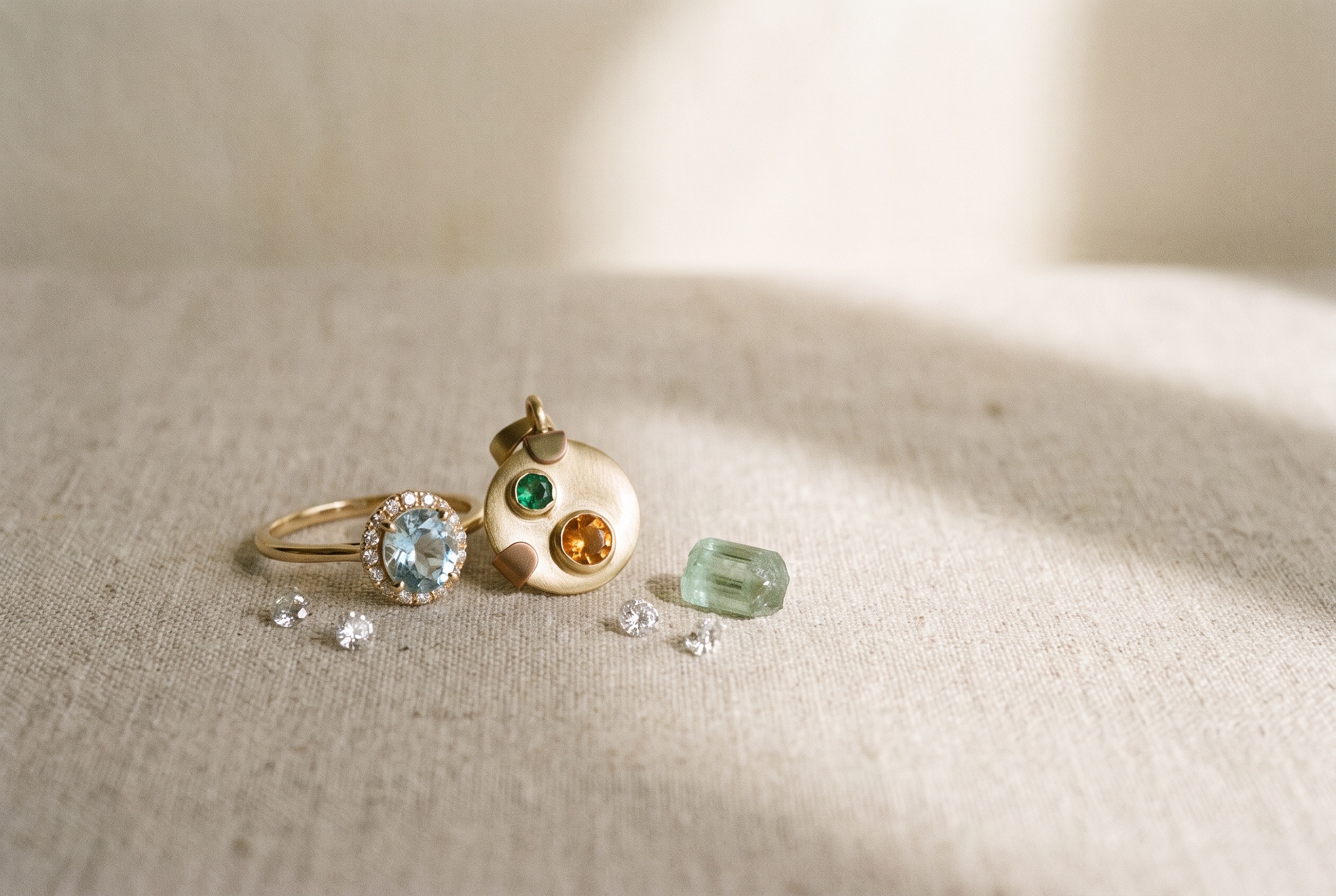
The most common construction pairs a center birthstone with diamond accents (a halo, side stones, or a simple pavé shoulder), giving the birthstone the visual lead role while diamonds add brightness and perceived value around it. A less common but growing alternative flips the ratio — a diamond center stone with a small birthstone accent — for buyers who want a more diamond-forward piece with a personalized detail rather than a colored-stone-forward design.
Pendants and Necklaces
Birthstone pendants frequently use a simple bezel or prong-set single stone, sometimes with a small diamond accent above or below, and are a strong category for multi-generation "mother's necklace" or family-stacking pieces that combine several birth-month stones on one chain or in a cluster pendant.
Stackable Rings and Bracelets
Birthstones translate naturally into a stacking or charm-bracelet format, where each piece represents one family member's birth month — a format that benefits from the same collection-planning logic covered in our stackable diamond rings guide, adapted to accommodate twelve possible stone colors rather than a single diamond specification.
Durability Considerations Across the Birthstone List
Because birthstone jewelry is worn daily by design (it's meant to be a personal, everyday piece, not an occasion piece), stone durability is a real sourcing consideration that a diamond-only line doesn't have to account for:
- Hardest, most durable-for-daily-wear stones: Diamond (10 on the Mohs scale), sapphire and ruby (9), and topaz (8) hold up well to everyday knocks and require little special handling in setting or care instructions.
- Moderate-durability stones needing more setting care: Aquamarine, garnet, amethyst, citrine, and tourmaline (roughly 7–7.5 on the Mohs scale) are durable enough for regular wear but benefit from protective settings (bezel or half-bezel) over exposed prong settings for a ring meant for daily use.
- Softer or more fragile stones requiring the most setting care and clearest customer guidance: Opal, pearl, turquoise, and emerald (despite its hardness rating, emerald is typically heavily included, making it prone to chipping) all benefit from protective settings, and retailers should set clear customer expectations about care for daily-wear pieces using these stones — this is a routine part of selling the category, not a defect to avoid disclosing.
Diamond Specifications for Birthstone Jewelry
Because diamonds in this category typically play an accent or secondary role (with the birthstone as the visual focal point in most designs), a DEF+/VS+ commercial standard is the practical default — bright and clean to the eye at the small accent sizes most common in this category, without the premium pricing a birthstone-forward piece's price point doesn't need to support. For the less common diamond-center-stone birthstone pieces (April birthstone rings, or diamond-forward designs with a small colored accent), sourcing follows the same standard 4Cs evaluation covered in our 4Cs overview guide.
Lab-Grown Diamonds and Birthstone Jewelry
CVD lab-grown diamonds are a natural fit for the diamond-accent role in birthstone jewelry, since the category's overall price point is typically anchored by the colored gemstone rather than the diamond — a lower-cost, consistent-quality lab-grown accent stone lets a retailer keep the diamond component from disproportionately driving up the price of an otherwise personalization-focused, moderately priced piece.
Managing SKU Complexity Across Twelve Birthstones
The core operational challenge in this category is SKU proliferation — a single ring design multiplied across twelve possible center-stone colors, plus size variants, quickly becomes a large matrix of combinations to stock or produce on demand. Retailers typically manage this in one of two ways:
- Made-to-order production on a core set of proven settings, with the birthstone selected at order time and set in-house within a short turnaround — avoiding the need to hold finished inventory across all twelve color variants.
- Selective pre-stocking of the highest-demand months (commonly April, June, September, and December, tied to popular wedding and holiday gifting seasons) while running lower-volume months made-to-order.
A supplier that can set birthstones in-house on a fast turnaround materially simplifies this operational challenge compared with sourcing colored stones and diamonds from separate vendors and coordinating setting through a third party.
Multi-Stone "Family" Pieces
A significant share of birthstone jewelry demand comes from multi-generational family pieces — a mother's ring or pendant featuring each child's birthstone, or a grandmother's piece adding grandchildren's stones over time. These pieces typically combine several different birthstones (and often several different hardness profiles) in a single setting, which raises the setting-engineering bar somewhat compared with a single-birthstone piece, since the design needs to accommodate stones of genuinely different sizes, shapes, and durability characteristics side by side.
Wholesale Pricing Structure for This Category
Because the diamond component in most birthstone pieces runs at accent or small-stone sizes, wholesale diamond pricing for this category runs largely through calibrated melee channels, similar to stacking rings. The colored-stone side of sourcing follows a separate, stone-by-stone pricing structure that varies considerably by birth month — retailers should budget and price this category with the understanding that per-unit cost varies meaningfully by which birthstone a given order calls for, unlike a diamond-only product line with more uniform input costs.
Demand Patterns and Gifting Seasons
Birthstone jewelry sees demand concentrated around a few predictable calendar moments beyond an individual's own birth month: Mother's Day and Christmas both drive a meaningful share of annual category volume, since birthstone pieces are a common gift for a mother, grandmother, or partner regardless of the giver's own birth month. May and December birthstones (emerald and tanzanite/turquoise/zircon respectively) can see a secondary demand bump specifically because those two gifting occasions fall in their vicinity, somewhat independent of how many people are actually born in May or December. Retailers planning inventory depth by month should weight stock levels toward these gifting-driven demand spikes rather than assuming demand tracks birth-month population evenly across the calendar.
New-parent gifting is a second reliable demand driver in this category — a birthstone piece marking a child's birth month is a common baby-gift and new-mother-gift purchase, generating demand that's disconnected from the giver's own birth month and instead follows regional birth-rate seasonality, which in many markets skews toward late summer and early fall births.
Marketing and Merchandising Birthstone Jewelry
Because the category is fundamentally about personalization, effective merchandising leans into that rather than presenting birthstone pieces as a generic colored-gemstone line. A birthstone chart displayed prominently at point of sale (or embedded in an e-commerce product page) helps customers who don't already know their own or a gift recipient's birthstone make a confident purchase decision without needing to ask a sales associate or search separately. Retailers who merchandise by month (a dedicated display case or website category per birthstone) generally see stronger engagement with the category than those who mix birthstone pieces into a general colored-gemstone case without highlighting the personalization angle.
Because family and multi-generational pieces are a meaningful share of category demand, retailers also benefit from clearly presenting a path to add stones over time — a mother's pendant designed with room for a second or third birthstone to be added later as a family grows is a stronger repeat-purchase driver than a piece sold as a single, finished, non-expandable design.
Common Sourcing Mistakes in This Category
- Treating all twelve birthstones as equally easy to source. As the sourcing-difficulty column above shows, stones like tanzanite (single-source, price-volatile) and fine ruby (genuine scarcity premium) require meaningfully more sourcing lead time and price monitoring than garnet or amethyst — planning a launch or restock around a flat per-month sourcing timeline risks stockouts on the harder-to-source months.
- Under-specifying durability guidance for softer stones. Selling an opal or pearl birthstone ring without clear care guidance sets up a higher risk of customer dissatisfaction from everyday wear damage than the retailer intended — this is a routine, expected part of selling these stones in an everyday-wear format, not a sourcing defect, but it needs to be handled proactively rather than skipped.
- Underestimating multi-stone family piece complexity. A piece combining several different birthstones needs setting engineering that accounts for each stone's own size, shape, and hardness — a design template built around a single central stone doesn't always translate cleanly to a three- or four-stone family piece without rework.
Certification and Disclosure for Colored Gemstones
Unlike diamonds, most colored gemstones used in birthstone jewelry — garnet, amethyst, citrine, peridot, and similar stones in this price tier — are not individually certified in the way a diamond over 0.30ct typically is, since certification cost relative to the stone's own value doesn't make economic sense at this category's typical price points. What does matter, and what retailers should be prepared to disclose, is treatment status: many colored gemstones, including several on the birthstone list (heat-treated sapphire and ruby, irradiated topaz, and others), commonly undergo standard, industry-accepted treatments to improve color or clarity. Disclosing treatment status honestly, even when it's an industry-standard practice rather than a defect, is a basic trust-building step for a category that leans heavily on gifting and sentiment — a customer or gift recipient who later learns a stone was treated without having been told, even when the treatment is entirely standard trade practice, can feel misled in a way that damages the retailer relationship disproportionately to the actual issue.
For the higher-value stones on the birthstone list — fine sapphire, ruby, and emerald in particular, where quality and treatment status meaningfully affect price — a grading report from a recognized gemological lab is worth sourcing for pieces at the upper end of a retailer's birthstone price range, even though it's not standard practice across the category as a whole.
Zodiac and Alternative Personalization Systems
Birth-month birthstones are the dominant personalization system in this category, but zodiac (astrological) birthstones — an older, separate tradition assigning stones to the twelve zodiac signs rather than calendar months — represent a smaller but persistent secondary demand segment, particularly popular in some Asian and South Asian markets where astrological birthstone traditions carry longer cultural roots than the modern Jewelers of America birth-month list. Retailers serving customer bases with strong interest in this alternative system sometimes stock a parallel zodiac line alongside the standard birth-month line, though this roughly doubles the SKU-planning complexity covered above (twelve zodiac signs instead of, or in addition to, twelve birth months) and is generally worth pursuing only where a retailer has specific evidence of customer demand for it rather than as a default addition to every birthstone program.
A further personalization layer some retailers offer combines a birthstone with a numerological or symbolic element (a specific gemstone cut associated with luck or meaning in a particular cultural tradition), though this is a more niche, market-specific extension rather than a standard part of a general birthstone jewelry line, and worth pursuing selectively based on a specific customer base's documented interest rather than as a universal addition.
Pricing Structure Across a Twelve-Month Line
Because per-unit colored-gemstone cost varies so widely across the birthstone list — from inexpensive, abundant stones like garnet and amethyst to genuinely scarce, premium-priced stones like fine ruby and tanzanite — retailers face a real merchandising decision in how to price a birthstone line. A flat retail price across all twelve months simplifies merchandising and lets customers shop by preference rather than budget, but it means margin varies considerably by month, with the low-cost-stone months effectively subsidizing the high-cost-stone months at a single shared price point. A tiered pricing structure (grouping birthstones into two or three price tiers based on gemstone cost, similar to the letter-complexity tiering approach covered in our initial necklace guide) more accurately reflects underlying cost, at the expense of a slightly more complex price list for customers and staff to navigate. Most established birthstone lines settle on some version of tiered pricing specifically because the cost spread across the twelve months is too wide to absorb comfortably at a single flat price, particularly once genuinely premium months like July (ruby) and December (tanzanite) are included in the line at meaningful stone sizes.
Working With a Single Supplier Across Diamonds and Colored Stones
A retailer building a birthstone program from scratch often starts by sourcing diamonds from one relationship and colored gemstones from a separate colored-stone vendor, simply because that mirrors how the two product categories are typically supplied in the broader trade. Over time, many retailers find real value in consolidating birthstone-program sourcing toward fewer relationships where possible — even when a single supplier can't be the sole source for every one of the twelve birthstones, reducing the number of separate vendor relationships a small, multi-SKU category like this requires cuts down meaningfully on coordination overhead relative to the modest revenue any single birthstone SKU typically generates. This is one of the more overlooked operational benefits of working with a supplier who can handle both the diamond-accent side of a birthstone piece and the in-house setting work, even where the birthstone itself still needs to be sourced separately.
Sourcing Diamond Birthstone Jewelry at Wholesale
Guru Diam supplies certified CVD lab-grown diamonds and calibrated melee for the diamond-accent side of birthstone jewelry, with cutting, setting, and polishing handled in-house, and finished custom pieces delivered in 4-6 days — a fast enough turnaround to support made-to-order birthstone production without holding inventory across all twelve color variants. Retailers can browse melee and matched-pair inventory through matching pairs, review certified stones for diamond-forward birthstone pieces through certified diamonds, and work through custom jewelry for family or multi-stone piece design. Trade accounts can review terms at the wholesale hub or apply through trade partner. For related personalized-jewelry sourcing, see our guides on diamond initial necklaces and stackable diamond rings.
Frequently Asked Questions
What is the diamond birthstone month?
Diamond is the official birthstone for April. This makes April birthstone pieces simpler to source than other months, since they draw directly on a jeweler's standard loose diamond inventory rather than requiring a separate colored-gemstone purchase.
How are diamonds usually paired with birthstones in jewelry?
Most commonly, a colored birthstone takes the center or focal position while diamond accents (a halo, side stones, or pavé) add brightness and framing around it. A smaller share of designs flip this, using a diamond center stone with a small birthstone accent for a more diamond-forward look.
Which birthstones are best suited for daily-wear jewelry?
Diamond, sapphire, ruby, and topaz are the most durable options for everyday wear. Softer stones like opal, pearl, turquoise, and emerald benefit from protective bezel-style settings and clear customer care guidance for daily-wear pieces.
Should birthstone jewelry use lab-grown or natural diamonds?
Lab-grown diamonds work well for the diamond-accent role common in this category, since the birthstone rather than the diamond typically anchors the piece's price point — a lower-cost, consistent lab-grown accent keeps the diamond component from disproportionately raising the price.
How do retailers manage stocking twelve different birthstones?
Most retailers either produce pieces made-to-order with the birthstone set in-house at order time, or selectively pre-stock the highest-demand months (April, June, September, December) while running lower-volume months made-to-order, rather than holding finished inventory across all twelve variants.
What makes multi-generation "family" birthstone pieces harder to source?
These pieces combine several different birthstones — often with different sizes, shapes, and hardness profiles — in one setting, which raises the setting-engineering bar compared with a single-birthstone piece and requires a supplier comfortable working with mixed colored-stone specifications in-house.
Should a birthstone jewelry line be priced flat or tiered by month?
Most established lines use a tiered pricing structure grouping birthstones into two or three cost tiers, since the underlying gemstone cost spread across the twelve months — from inexpensive stones like garnet to premium stones like fine ruby and tanzanite — is too wide to absorb comfortably at a single flat retail price.
When does birthstone jewelry sell best?
Beyond an individual's own birth month, Mother's Day, Christmas, and new-baby gifting are the category's strongest demand periods — all disconnected from the giver's own birthday and instead tied to gift-giving occasions, which retailers should weight into inventory planning across the calendar year.
How should retailers merchandise a birthstone jewelry line?
Organizing the line by month with a clearly displayed birthstone chart, rather than mixing pieces into a general colored-gemstone case, helps customers who don't already know a birthstone make a confident purchase and reinforces the category's core personalization appeal.