
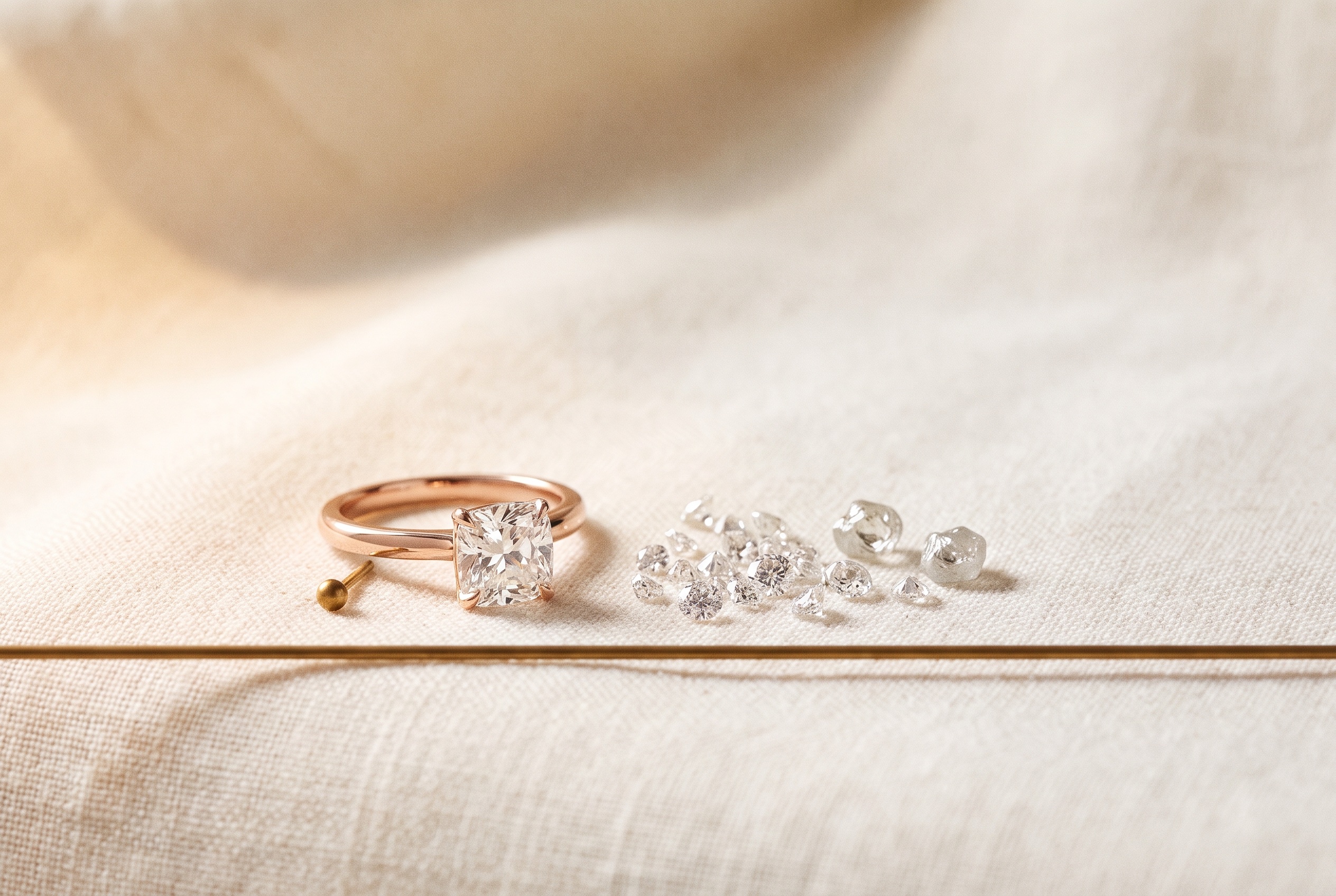
A rose gold diamond ring is a ring where the metal band is a copper-alloyed gold — typically 14k or 18k — set with a diamond center stone and, often, diamond accents, chosen for the metal's warm pink tone rather than the traditional white or yellow. For jewelers and designers, rose gold has moved from a niche vintage-adjacent choice to a mainstream stocking category, and building a rose gold diamond ring program well means understanding the alloy itself, how it interacts with diamond color grading, and how to price and source it at wholesale.
This guide covers what a jeweler actually needs to know to stock or custom-build rose gold diamond rings: the metallurgy behind the color, how rose gold changes diamond color and cut selection, durability and maintenance considerations specific to the alloy, which ring styles and diamond shapes pair best with it, and how to source loose stones and finished settings at wholesale.
What Makes Gold "Rose"
Pure gold (24k) is yellow and too soft for jewelry use on its own, so all fine jewelry gold is alloyed with other metals for strength and, in the case of white and rose gold, color. Rose gold gets its pink-to-red tone from a higher proportion of copper in the alloy relative to silver, compared to standard yellow gold. The higher the copper content, the more pronounced and reddish the color; lower copper content (with more silver) produces the softer, more muted "rose" or "pink gold" look that's become the more commonly stocked variant over the deeper, more copper-forward "red gold" alloys of a generation ago.
| Alloy | Typical Composition (18k) | Color Character |
|---|---|---|
| Yellow gold | 75% gold, ~12.5% silver, ~12.5% copper | Warm classic yellow |
| Rose gold | 75% gold, ~22.5% copper, ~2.5% silver | Warm pink-red, copper-forward |
| White gold | 75% gold, alloyed with palladium/nickel, rhodium-plated | Bright white (plating wears, needs re-dipping) |
Karat weight matters independently of color: 18k rose gold has a deeper, richer pink than 14k rose gold, since 14k contains a higher proportion of the copper-heavy alloy mix relative to its lower overall gold content, which can actually push the visible color slightly warmer and more saturated at the lower karat weight in some formulations — worth confirming with a specific supplier's alloy recipe rather than assuming karat and color scale predictably together.
Why Rose Gold Has Become a Core Stocking Category
Rose gold's rise from a secondary option to a primary stocking metal reflects a few durable shifts rather than a short-lived trend: it photographs warmly against a wide range of skin tones, it reads as distinct from the white-metal-dominated bridal market of the 2000s and 2010s without going as far as traditional yellow gold, and it pairs naturally with the vintage and Art Deco-adjacent styling that's been in sustained demand. For a jeweler, that translates into rose gold functioning less as a seasonal accent color and more as a permanent third pillar alongside white and yellow gold in a well-rounded bridal and fashion case.
How Rose Gold Changes Diamond Color Selection
The metal a diamond is set in visibly affects how its color grade reads, and rose gold is one of the more forgiving settings in this respect. As covered in our diamond color scale guide, warmer setting metals reflect warm tones back into the stone, which can mask a faint yellow or brown tint that would be more noticeable in a white metal or platinum setting.
- G-I color grades — near-colorless to slightly warm — often look effectively colorless once set in rose gold, since the metal's own warmth blends with any faint body color in the stone rather than contrasting against it the way white metal does.
- D-F color grades — the colorless tier — still look excellent in rose gold, but buyers paying a premium for top color specifically to avoid any visible warmth are, in a rose gold setting, paying for a difference that's harder to see than it would be in platinum or white gold.
- Practical upshot for stocking: a rose gold ring program can responsibly lean on G-I color inventory rather than requiring the same D-F weighting a white-metal-heavy case would, which meaningfully changes the cost structure of building out size runs.
This isn't a case for buying the lowest color available — cut quality, clarity, and overall stone character still need to hold up under close inspection — but it is a real, verifiable reason rose gold settings can extend margin without asking a buyer to compromise on how the finished piece actually looks.
Diamond Shapes That Pair Well With Rose Gold
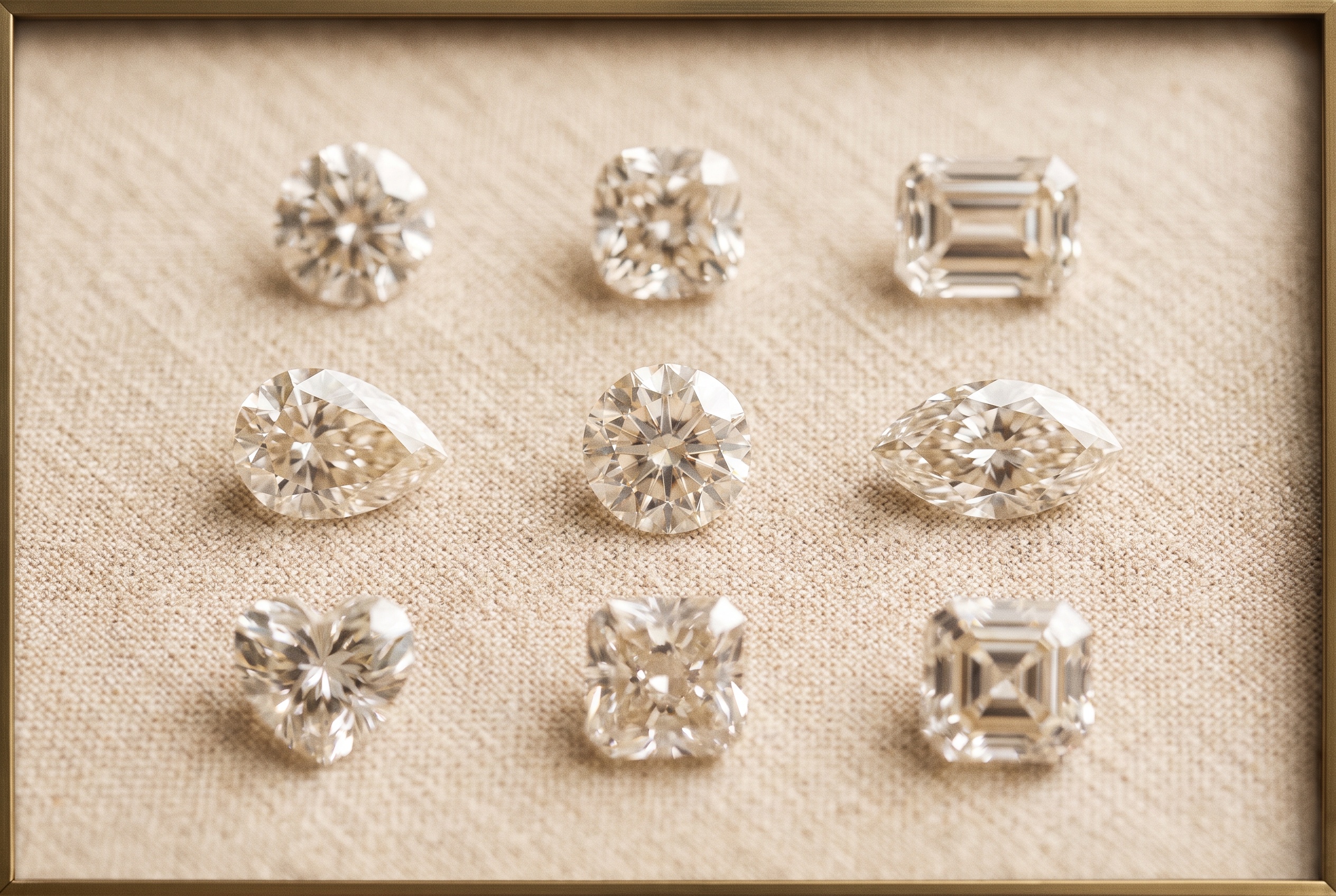
| Shape | Why It Works With Rose Gold |
|---|---|
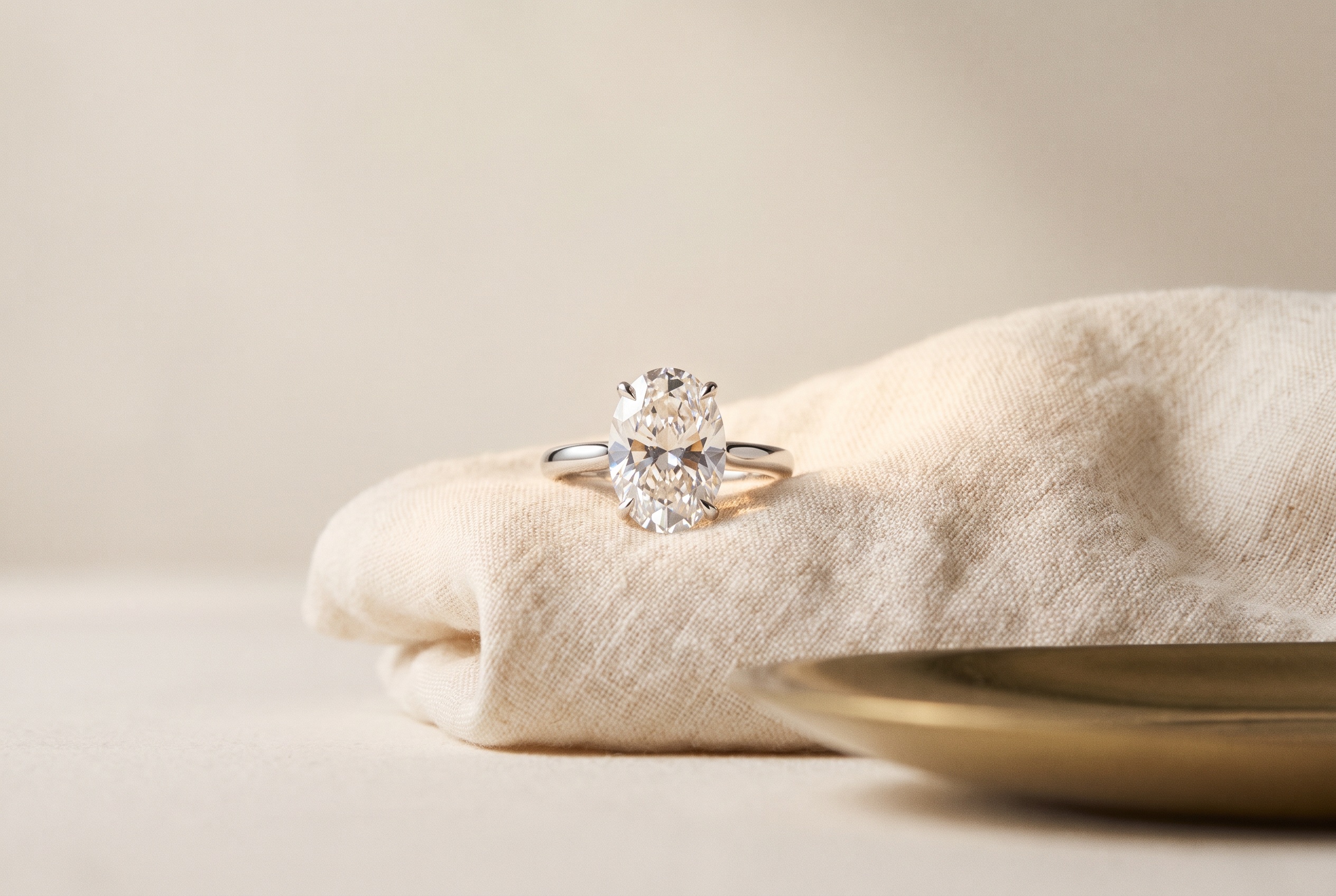
| Oval | Elongated silhouette reads as modern-vintage against rose gold's warmth, popular in solitaire and three-stone styles |
| Cushion | Soft, romantic outline complements the metal's softer tone; a common pairing in halo settings |
| Old Mine and Old European cut | Antique cuts pair naturally with rose gold's vintage association — see our old mine cut guide and old European cut guide |
| Emerald and Asscher | Clean step-cut lines contrast nicely against rose gold's organic warmth for a more architectural look |
| Round brilliant | The universal choice; works in any metal, including rose gold, without any styling caveat |
Durability and Maintenance Considerations
Rose gold's higher copper content has one meaningful practical advantage over white and yellow gold at the same karat weight: copper is a harder metal than the silver it partially replaces, which makes rose gold somewhat more scratch- and dent-resistant in daily wear. It's a genuinely useful talking point for a jeweler selling an active-lifestyle buyer on rose gold over a softer alternative.
- No rhodium plating required. Unlike white gold, rose gold doesn't rely on a rhodium plating layer for its color — the color comes from the alloy itself, so there's no periodic re-plating maintenance cycle to sell the customer on or budget for as an aftercare service.
- Copper can react with skin chemistry for some wearers, occasionally causing mild discoloration on the skin (not the ring) for people with particularly acidic skin pH — worth a brief mention at point of sale so it doesn't surprise a buyer later, though it's a minority experience and not a durability issue with the ring itself.
- Some nickel-sensitive wearers tolerate rose gold better than white gold, since traditional white gold alloys have historically used nickel more heavily than rose gold formulations — still worth confirming a specific supplier's exact alloy for a buyer with a known metal sensitivity.
Setting Styles Worth Stocking in Rose Gold
- Solitaire — the simplest expression, letting the metal-stone color contrast do the work without competing design elements.
- Halo — a rose gold band with a halo in either matching rose gold or a contrasting white metal for the halo itself, a popular two-tone approach that adds perceived size without full rose gold saturation.
- Cathedral — an elevated, architectural profile that pairs well with rose gold's warmth; see our cathedral setting guide for the broader design considerations.
- Three-stone — rose gold's warmth flatters a range of accent stone colors, including warmer-tinted melee that might read as off-color in a pure white-metal setting.
- Vintage-inspired milgrain and filigree detailing — rose gold's association with antique styling makes it a natural pairing for milgrain edging and other period-inspired detail work, without needing to lean on the ornate over-the-top styling that reads dated in 2026 — restraint and clean lines still outperform heavy ornamentation in current bridal demand.
Two-Tone and Mixed-Metal Options
Rose gold doesn't have to be an all-or-nothing metal choice. A common and commercially strong approach mixes rose gold for the band or shank with white gold or platinum for the prongs or halo — the cooler metal around the stone itself maximizes the diamond's perceived brightness and colorlessness, while the rose gold band still delivers the warm styling statement. This mixed-metal approach also gives a jeweler flexibility to use a slightly higher color grade stone in the white-metal prong section while still getting the cost benefit of a more forgiving color range in a full rose gold build — worth having both configurations available for a buyer to compare side by side.
Pricing and Margin Considerations for Wholesale Buyers
Rose gold itself doesn't carry a meaningfully different raw metal cost than white or yellow gold at the same karat weight — copper is inexpensive relative to gold, so the alloy cost difference is negligible. The margin opportunity in a rose gold program comes from two places instead: the color-grade flexibility discussed above (sourcing more G-I stones instead of D-F without a visible quality tradeoff), and the fact that rose gold settings, once cast, don't carry an ongoing rhodium re-plating cost that a retailer might otherwise offer as an included aftercare service on white gold pieces. Both of those add up to a meaningfully better margin profile on a comparable finished ring than an equivalent white gold build, without asking the buyer to accept a lower-quality piece.
Rose Gold in Antique and Vintage-Style Builds
Rose gold's association with antique and vintage-inspired styling isn't accidental — many original period pieces from the late Victorian and Retro eras used rose and copper-heavy gold alloys extensively, so a rose gold build reads as historically grounded rather than purely trend-driven. This makes rose gold a natural pairing for milgrain detailing, filigree accents, and antique-cut center stones like Old Mine and Old European cuts, discussed above. It's worth distinguishing this from Art Deco specifically, which favored platinum and white metal almost exclusively — a rose gold ring styled with heavy geometric Deco linework is a deliberate modern hybrid rather than a period-accurate reproduction, which is fine commercially but worth being clear about with a customer who's specifically asking for authentic period styling. Retro-era design (1935-1950s), by contrast, leaned heavily on rose gold in bold, sculptural forms, and is a more historically accurate pairing for jewelers building a genuinely vintage-inspired rose gold case.
Building a Balanced Rose Gold Case: Stocking Recommendations
For a jeweler adding or expanding a rose gold program, a few practical stocking patterns tend to perform well:
- Lead with solitaire and simple halo styles in the core size run (round and oval shapes especially), since these carry the broadest buyer appeal and the lowest execution risk for a caster newer to consistent rose gold alloy work.
- Stock a mixed-metal option alongside the full rose gold version of at least the top-selling one or two styles, since a meaningful share of buyers prefer the brightness of white metal prongs even when they want a rose gold band overall.
- Pair rose gold center rings with matching wedding bands from the start rather than treating the band as an afterthought — buyers shopping a rose gold engagement ring frequently want to see the matched set together, and a coordinated bridal set (see our wedding set guide) closes more completely than a center ring shown in isolation.
- Weight G-I color stones more heavily than a white-metal case would in the initial buy, given the color forgiveness discussed above, while still keeping a smaller run of D-F stones available for buyers who specifically want top color regardless of setting.
Care Instructions Worth Sharing With Rose Gold Buyers
Because rose gold doesn't carry the same rhodium re-plating maintenance cycle as white gold, the care conversation at point of sale is genuinely different and worth covering explicitly rather than defaulting to generic jewelry-care language:
- Routine cleaning — warm water, mild dish soap, and a soft brush is sufficient for regular at-home cleaning; rose gold doesn't require the specialized care some plated metals do.
- Avoiding harsh chemicals — chlorine and other harsh household chemicals can dull the surface finish over time on any gold alloy, rose gold included, so removing rings before cleaning or swimming is worth mentioning.
- Patina development — some rose gold alloys, particularly higher-copper "red gold" formulations, can develop a very slight, attractive patina with years of wear, which some buyers appreciate as part of the metal's character rather than a flaw to polish away aggressively.
- Periodic professional inspection — the same prong-security and setting-check recommendation that applies to any fine jewelry piece applies equally to rose gold builds, independent of the metal-specific care points above.
Melee and Pavé Considerations in Rose Gold Settings
Accent melee in a rose gold build carries its own set of practical considerations beyond the center stone discussion above. Because rose gold's warmth is more forgiving of body color than white metal, pavé and channel-set melee can lean toward the same G-I comfort range as the center stone, extending the same margin logic across the full piece rather than just the focal stone. That said, consistency across the melee run matters just as much in rose gold as in any other metal — a channel or pavé section with visibly mismatched color or size reads as a flaw regardless of how forgiving the setting metal is, so calibrated sourcing discipline shouldn't be relaxed just because rose gold provides some color cover. Fancy color melee — yellow in particular — can also work well against rose gold's warm tone for buyers wanting a fully warm-toned piece, an option worth having available alongside standard white melee for a customer exploring the category.
Prong and setting metal for pavé work in a rose gold piece typically matches the band metal for a fully cohesive warm-toned look, though some jewelers use white metal prong tips specifically on the melee closest to the center stone to maximize brightness exactly where a customer's eye lands first — a subtle technique borrowed from the same logic behind mixed-metal center stone settings discussed above.
Trend Outlook and Why Rose Gold Demand Has Staying Power
Unlike some color and metal trends that cycle in and out of fashion relatively quickly, rose gold's demand pattern has held up over a genuinely extended period rather than spiking and receding the way a shorter-lived trend typically does. Part of that durability comes from rose gold functioning as a distinct third option alongside white and yellow gold rather than a competitor trying to displace either — a buyer choosing rose gold is usually making a considered style choice rather than chasing a passing look, which tends to produce more stable, repeatable demand for a jeweler's case than trend-driven categories that require constant refreshing to stay current. For a jeweler weighing how much floor and case space to commit to rose gold long-term, that stability is a meaningfully different planning consideration than a shorter-cycle fashion color would warrant.
Rose Gold Alongside Natural and Lab-Grown Center Stones
Rose gold's color-forgiveness advantage applies equally regardless of whether the center stone is natural or lab-grown, since the effect is purely about how the setting metal's warmth interacts with the stone's own body color rather than anything specific to how the diamond was formed. For a jeweler offering both natural and lab-grown options in a rose gold build, this means the same G-I color-range guidance holds across both catalogs — a useful simplification when training sales staff to speak confidently across both product lines without needing separate metal-pairing guidance for each. Where the two catalogs do diverge is price: a natural stone in the G-I range still carries the broader natural pricing premium over its lab-grown equivalent, so the color-flexibility savings compound differently depending on which catalog a specific customer is shopping, worth walking through concretely with a price-conscious buyer comparing both paths in a rose gold setting.
Sourcing Rose Gold Diamond Rings at Wholesale
Building out a rose gold program well means pairing the right diamond color and shape inventory with a setting partner who can execute the alloy consistently across a size run — inconsistent copper content between batches is a common quality complaint when working with less rigorous casters, showing up as visible color drift between pieces in the same collection. Guru Diam sources loose CVD lab-grown and natural diamonds with IGI, GIA, and GCAL certification all available, and finishes custom rings — including rose gold builds — in 4-6 days, with cutting, setting, and polishing handled in-house.
Buyers can browse loose stones through the certified diamonds category, source matched melee for halo and pavé detail work through matching pairs, and build a full custom rose gold ring through custom jewelry. Buyers assembling a bridal set around a rose gold center ring may also find our wedding set guide useful for coordinating a matching band. Trade accounts can review terms at the wholesale hub or apply through trade partner.
Frequently Asked Questions
What karat of rose gold is best for a diamond ring?
14k rose gold is more durable and holds up better to daily wear due to its higher alloy content, while 18k rose gold has a richer gold content and a slightly different color depth depending on the specific alloy recipe. Most bridal jewelers stock both, with 14k as the volume default and 18k offered as an upgrade.
Does rose gold make a diamond look more or less colorless?
Rose gold's warm tone tends to blend with a diamond's own faint body color, which can make a near-colorless stone (G-I range) look effectively colorless once set — a genuinely useful cost consideration, though top-color stones still look excellent in rose gold if a buyer prefers to pay for it.
Is rose gold more durable than white gold or yellow gold?
Rose gold's higher copper content makes it somewhat more scratch- and dent-resistant than white or yellow gold at the same karat weight, and unlike white gold, it doesn't require periodic rhodium re-plating to maintain its color, since the color comes from the alloy itself rather than a plating layer.
Can rose gold cause skin discoloration or allergic reactions?
A minority of wearers with more acidic skin chemistry may notice mild skin discoloration (not damage to the ring) from the copper content, though this is uncommon. Rose gold's typically lower nickel content compared to traditional white gold alloys also makes it a reasonable option for some nickel-sensitive wearers, though a specific alloy should be confirmed for any buyer with a known sensitivity.
What diamond shapes look best in a rose gold setting?
Oval, cushion, and antique cuts like old mine and old European pair especially well with rose gold's warm, vintage-adjacent character, though round brilliant and step cuts like emerald and Asscher also work well and carry no styling restriction in rose gold.
Can rose gold be combined with white gold in the same ring?
Yes — a common approach uses white gold or platinum prongs around the diamond to maximize its perceived brightness while keeping a rose gold band or shank for the overall warm styling statement, giving a buyer both the warmth of rose gold and the brightness benefit of a cooler metal directly around the stone.