
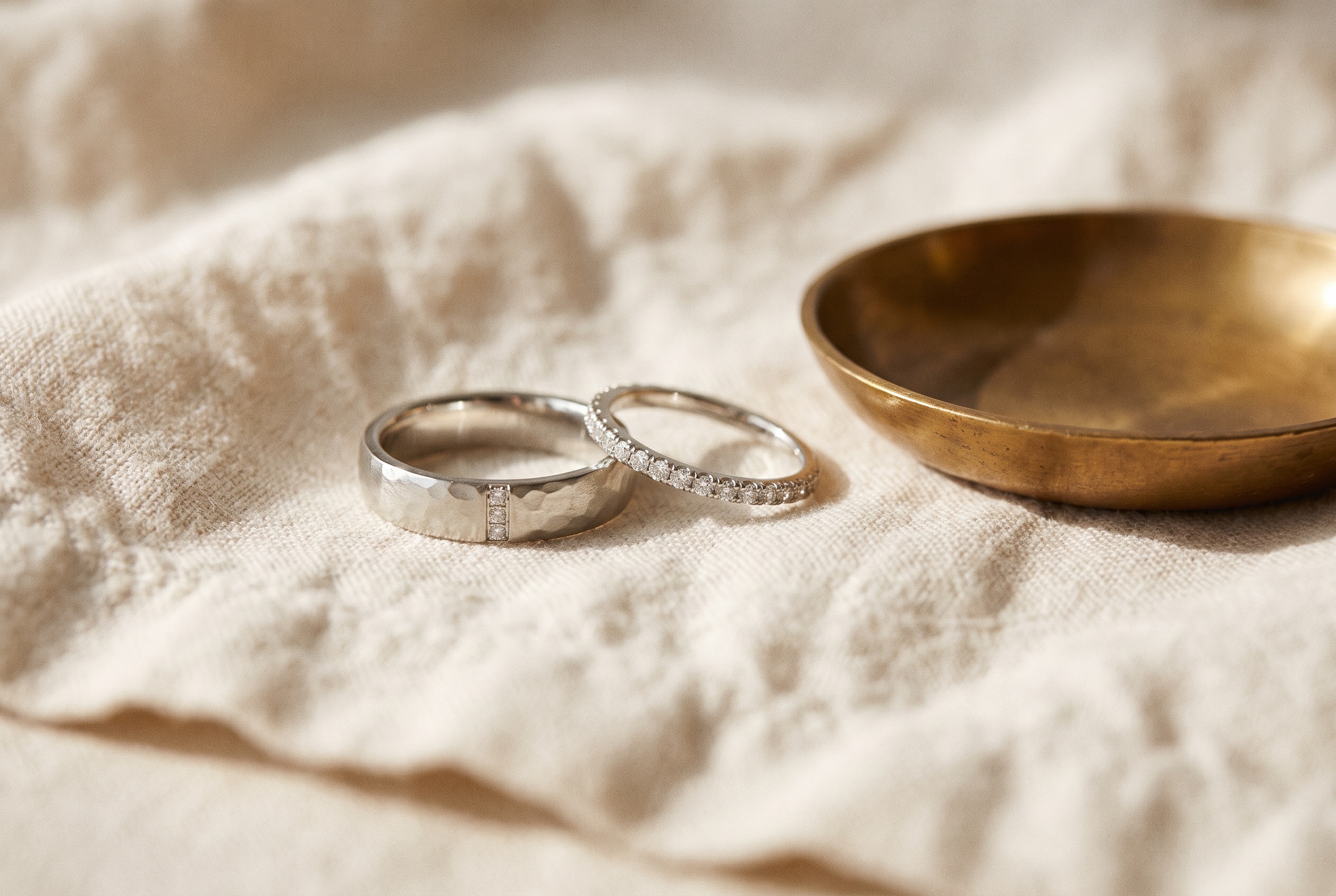
A diamond wedding set, as covered in this guide, refers to a pair of matching wedding bands — most commonly his-and-hers or a couple's pair — produced and sold together as a coordinated pair for the wedding itself, rather than the bride's engagement-ring-and-band pairing (which is its own distinct category, covered separately as a bridal set). Retailers sourcing this category are solving a coordination problem across two rings that will be worn by two different people, often in different metals, widths, and diamond content, but designed to share a visible common thread.
This guide is written for the trade — jewelers, retailers, and designers sourcing matching wedding band pairs — covering what distinguishes a couple's wedding set from a bridal set, design coordination across two differently sized and gendered pieces, sizing conventions, and what to look for in a wholesale supplier for matched-pair band production.
Wedding Set vs. Bridal Set: A Sourcing Distinction
These two terms are frequently used loosely and even interchangeably in casual conversation, but they describe different production problems for a retailer. A bridal set (covered in depth in our bridal set guide) is an engagement ring and its matching wedding band, both worn by the same person and engineered to fit flush against each other. A wedding set, as covered here, is a pair of wedding bands worn by two different people — most commonly a wider, simpler band for one partner and a narrower, sometimes diamond-set band for the other — coordinated by shared design language (a matching finish, a common metal tone, a repeated design motif) rather than by physical fit against each other the way a bridal set's two rings are.
This distinction matters for sourcing because the design and production constraints differ. A bridal set's wedding band must be shape-tested against a specific engagement ring's curve and prong height. A couple's wedding set instead needs the two bands to read as a coordinated pair despite being different sizes, sometimes different widths, and often different diamond content — a design coordination problem rather than a physical fit-matching one.
Common Wedding Set Pairings
| Pairing | Typical Construction | Coordination Element |
|---|---|---|
| His-and-hers diamond pair | A wider plain or diamond-accented band for one partner, a narrower diamond-set band for the other | Matching metal tone and finish across both |
| Matching plain bands | Two bands of different widths, same metal, no diamonds | Identical finish and profile, scaled to each width |
| Diamond-eternity pair | Full or half-eternity diamond band for one partner, a coordinating channel or bezel diamond band for the other | Shared diamond setting style, different diamond density |
| Engraved matching pair | Both bands carry the same engraved motif, initials, or wedding date | Shared engraving design across both pieces |
| Mixed-metal coordinated pair | Two different metal tones (e.g., one white gold, one yellow gold) intentionally paired | Shared design silhouette despite different metal tones |
Design Coordination Across Two Different Pieces
Because a couple's wedding set is worn by two different people rather than stacked on the same finger, the coordination challenge is about shared visual identity rather than literal physical fit. Retailers producing wedding sets typically anchor the pairing around one or two consistent elements — the same metal tone and karat, the same finish (polished, brushed, hammered), or a repeated design detail like a matching bevel edge or the same engraving motif — while allowing width, diamond content, and even overall silhouette to differ meaningfully between the two bands. This is different from a bridal set, where the two pieces need to nearly disappear into each other visually; a wedding set instead needs to read clearly as "these two belong together" while still looking appropriate on two different hands and, often, in two different style registers (a simpler, wider band is a common preference for one partner, a more detailed or diamond-set band for the other).
Retailers should avoid over-matching a couple's set to the point that one partner's ring looks like a scaled-down, less interesting version of the other's — a common design trap that can read as an afterthought piece rather than an equal, coordinated partner ring. A well-designed pair gives both bands their own presence while sharing the connecting design elements described above.
Sizing Considerations for Wedding Sets
Because a wedding set serves two different wearers with potentially very different finger sizes, band widths, and hand shapes, retailers need production flexibility across a wider combined size and width range than a single-wearer category requires. A common pairing might combine a size 6 band at 2mm width for one partner with a size 10 band at 6mm width for the other — production needs to scale proportionally (diamond count and placement adjusted for the wider band, not simply the same design shrunk or stretched) rather than assuming a single design translates cleanly across such different dimensions. Retailers offering wedding sets benefit from a supplier who can produce genuinely different widths within the same coordinated design family, rather than one who can only offer the same width scaled to different finger sizes.
Diamond Content and Placement in Wedding Sets
Diamond content in a couple's wedding set commonly differs between the two bands by design rather than by oversight — one band might carry a continuous eternity line of diamonds while the paired band carries a smaller channel-set accent or no diamonds at all, reflecting different style preferences between the two wearers rather than an attempt to make the two pieces diamond-equivalent. When both bands do carry diamonds, color and clarity consistency between them matters for the same reason it matters within a single stacked bridal set — a visible brightness mismatch between two rings marketed and sold as a coordinated pair undercuts the pairing's premise, even though the two bands aren't worn on the same hand.
Diamond Quality Standards for Wedding Set Bands
Diamond-set wedding bands typically run on calibrated melee at a DEF+/VS+ commercial standard, consistent with standard melee sourcing practice for band-set stones. As covered in our 4Cs overview guide, this standard delivers strong visual brightness at typical band-stone sizes without the added cost of a higher grade that wouldn't be visually distinguishable at that scale — a relevant consideration for a category where two bands, not one, need to be priced within the couple's combined budget.
Lab-Grown vs. Natural Diamonds for Wedding Sets
CVD lab-grown diamonds are a common choice for wedding set bands, particularly for full or half-eternity styles that require a continuous line of stones across two rings rather than one — lab-grown's lower per-carat cost meaningfully affects total set cost when diamond content is doubled across a pair rather than concentrated in a single band. Natural diamonds remain available and commonly chosen for couples who prefer natural stones throughout their wedding jewelry, including the bands. Both origins should be sourced to the same color and clarity standard across both bands in a pair, maintaining the visual consistency the coordinated-set premise depends on.
Metal and Finish Coordination
14k and 18k gold in yellow, white, and rose tones, along with platinum, all see demand in this category. When a couple chooses matching metal tones across both bands, consistency in karat and alloy composition matters — 14k and 18k gold age and patina somewhat differently over years of wear, and a set intentionally paired in the same metal tone should also match in karat to avoid a visible divergence in wear pattern over time between the two rings. For couples who deliberately choose different metal tones for each band (a growing preference, particularly among couples who each already wear a different metal in their existing jewelry), retailers should still coordinate finish and design silhouette to preserve the "matched pair" read despite the different tones.
Wholesale Pricing Structure for Wedding Sets
Because a wedding set involves producing two bands, potentially with different widths, diamond content, and even metal tones, wholesale pricing needs to account for two separate production specifications bundled into one coordinated order rather than a single specification doubled. Retailers benefit from a supplier who can quote both bands together as a designed pair — accounting for shared production efficiencies like coordinated casting or a shared engraving run — rather than pricing each band as an entirely independent, unrelated order.
Building a Wedding Set Program
- Offer genuine width and style range within each pairing. A program limited to one width combination per design family doesn't serve the wide range of size and style differences typical between two partners.
- Support mixed-metal pairings. Increasingly common demand for intentionally different metal tones across a couple's bands requires production capability that maintains coordinated finish and silhouette despite the tone difference.
- Include an engraving-coordinated option. A matching engraved motif or shared wedding date across both bands is a popular, relatively low-cost way to reinforce the "set" identity beyond metal and finish alone.
- Plan diamond content asymmetrically by design. Rather than defaulting to identical diamond placement on both bands, a program should support intentionally different diamond content between the two pieces, reflecting real differences in partner style preference.
- Design without gendered assumptions. A flexible template that doesn't assume a fixed pairing pattern serves same-sex couples and non-traditional pairings as well as it serves a traditional his-and-hers order.
Common Sourcing Mistakes in This Category
- Confusing wedding set sourcing with bridal set sourcing. Treating a couple's wedding band pair as if it needed the same physical fit-testing a bridal set's engagement-ring-and-band pairing requires misapplies a different category's production standard.
- Over-matching the two bands. Making one partner's band a simple scaled-down copy of the other's, rather than giving each band its own appropriate presence within a shared design language, can read as an afterthought piece.
- Karat mismatch within a matched metal tone. Pairing 14k and 18k gold in bands meant to look identically matched creates a wear-pattern divergence over time that undercuts the "matched pair" premise the set was sold on.
- Inconsistent melee quality between two diamond-set bands. When both bands carry diamonds, a color or clarity mismatch between them is more noticeable than a retailer might assume, even though the two rings aren't worn on the same hand.
- No buffer for last-minute sizing changes. Wedding sets are frequently finalized close to the wedding date; a production timeline without room for a final sizing adjustment on either band risks a rushed, lower-quality resize right before the ceremony.
Same-Sex and Non-Traditional Wedding Set Sourcing
The wedding set category has broadened considerably beyond the traditional his-and-hers framing, and retailers benefit from sourcing and merchandising accordingly. Same-sex couples represent a meaningful and growing share of wedding set demand, and the design coordination logic covered throughout this guide — shared metal tone, finish, or motif rather than identical bands — applies equally regardless of the couple's gender composition. Retailers should avoid defaulting to gendered assumptions in how a wedding set is presented (assuming, for instance, that a wider band automatically belongs to one partner and a narrower diamond-set band to the other) and instead let each partner's individual style preference drive band selection independent of any assumed gender convention.
This shift also affects production planning: a supplier sourcing relationship built around flexible, non-gendered width and diamond-content combinations serves this broadened demand better than one built around a fixed his-and-hers template that assumes a specific pairing pattern by default.
Timeline and Production Planning for Wedding Sets
Wedding sets are typically ordered well in advance of the wedding date, but retailers should still plan for a realistic production and fitting timeline given that both bands often need final sizing confirmation close to the wedding, after any last-minute finger size changes. Because a couple's wedding set is frequently purchased as a single combined order rather than staggered separately, production efficiency matters — a supplier who can produce both bands in the same casting and setting run, rather than treating them as two unrelated orders processed independently, both shortens turnaround and helps ensure the finish and metal consistency the coordinated-pair concept depends on. Retailers should build in a buffer before the wedding date for final sizing adjustments, engraving (if included), and quality inspection of both pieces together as a pair before handoff to the couple.
Merchandising Diamond Wedding Sets
Wedding sets sell well merchandised and presented as a pair rather than as two separately cased rings a couple happens to buy together — a shared presentation box, a coordinated point-of-sale display showing both bands together, and sales language that frames the purchase as one decision for the couple rather than two independent ring purchases all reinforce the category's core commercial premise. Because both partners are typically present and involved in this purchase decision (unlike a surprise engagement ring purchase), staff should be prepared to walk both people through width, diamond content, and metal options for their own band individually, rather than defaulting to identical recommendations for both.
Certification and Documentation for Wedding Set Bands
Because wedding set bands typically use calibrated melee rather than a single large center stone, individual stone certification isn't standard practice for most band construction the way it is for a bridal set's engagement ring center stone. Retailers should instead provide clear documentation of the melee quality standard (color, clarity, and total carat weight across the band) for both pieces in the set, giving the couple a record of what they purchased even without individual stone certificates. For wedding sets that do include a larger accent or anchor stone on one band — a small solitaire accent, for example, rather than a continuous eternity line — that stone should carry its own certification consistent with standard practice for individually certified stones, while the balance of the band's melee content follows the calibrated-parcel documentation approach.
Comparing Wedding Sets to Related Categories
For the bride's engagement-ring-and-band pairing specifically, see our bridal set diamond rings guide, which covers the physical fit-matching production standard that distinguishes it from the coordinated-pair approach covered here. Retailers serving male partners' band preferences specifically may also find our men's diamond ring guide useful for sourcing considerations on that side of a wedding set pairing.
Anniversary Upgrades and Replacement Orders
A meaningful share of wedding set demand comes from couples returning years after their original wedding to upgrade or replace a band — a milestone anniversary, a change in ring size, or simply a desire for a more substantial diamond band than the couple could afford at the time of the wedding. Retailers who retained the original set's specification (metal, karat, width, diamond content) can produce a genuinely matching replacement or upgrade for one partner's band without disturbing the coordinated pair the couple originally bought, or can extend the coordination to a new anniversary band that intentionally builds on rather than replaces the original. Without that retained specification, matching a replacement band years later to a partner's existing ring — and to the other partner's still-original band — becomes considerably harder, particularly on metal tone and finish, which shift subtly across different production runs even within the same nominal karat and color.
Sourcing a Wedding Set Program at Wholesale
Guru Diam supplies certified CVD lab-grown and natural diamonds alongside calibrated melee, with cutting, setting, and polishing all handled in-house, giving retailers a single source for producing coordinated wedding band pairs across widths, metal tones, and diamond content, including anniversary upgrade and replacement orders matched to an original set's specification. Retailers can review calibrated melee and matched-pair inventory through matching pairs, browse certified stones through certified diamonds, and work through custom jewelry for a fully bespoke coordinated pair, with finished sets delivered in 4-6 days. Trade accounts can review terms at the wholesale hub or apply through trade partner.
Frequently Asked Questions
What is the difference between a wedding set and a bridal set?
A bridal set is an engagement ring and its matching wedding band, both worn by the same person and engineered to fit flush together. A wedding set, as covered in this guide, is a pair of wedding bands worn by two different partners, coordinated through shared design elements rather than physical fit-matching.
Do the two bands in a wedding set need to match exactly?
No — they typically share one or two connecting elements (metal tone, finish, or a design motif) while differing in width, diamond content, and even overall silhouette to suit each partner's individual style and hand size.
Can wedding set bands be different metals?
Yes, this is a growing and increasingly common preference. When bands use different metal tones, coordinating finish and design silhouette across both helps preserve the "matched pair" identity despite the metal difference.
Should wedding set diamonds be lab-grown or natural?
Both are commonly sourced for this category. Lab-grown diamonds are a frequent choice for eternity-style bands that need a continuous line of stones across two rings, since the cost difference compounds when diamond content is doubled across a pair.
What diamond quality is typical for wedding set bands?
Most diamond-set wedding bands use calibrated melee at a DEF+/VS+ commercial standard — bright and clean at typical band-stone sizes without the added cost of a higher grade that wouldn't be visually distinguishable at that scale.
Can a wedding set include engraving?
Yes — a matching engraved motif, initials, or a shared wedding date on both bands is a popular way to reinforce the set's coordinated identity beyond metal tone and finish alone.
Do wedding sets have to be his-and-hers?
No — the category covers any coordinated pair of wedding bands, and design coordination through shared metal tone, finish, or motif applies equally regardless of the couple's gender composition. Retailers increasingly source flexible, non-gendered pairing combinations rather than a fixed his-and-hers template.
Can a couple upgrade their wedding bands years later?
Yes — anniversary upgrades and replacements are a meaningful, recurring share of demand in this category. A supplier who retains the original set's metal, karat, width, and diamond specification can produce a genuinely matching upgrade or replacement without disturbing the coordinated pair the couple originally purchased.
How far in advance should a couple order a wedding set?
Ordering several months ahead of the wedding date is typical, leaving room for a final sizing check closer to the ceremony in case either partner's finger size shifts. Retailers should build a sizing and inspection buffer into the production timeline rather than treating the initial order as the final step.