
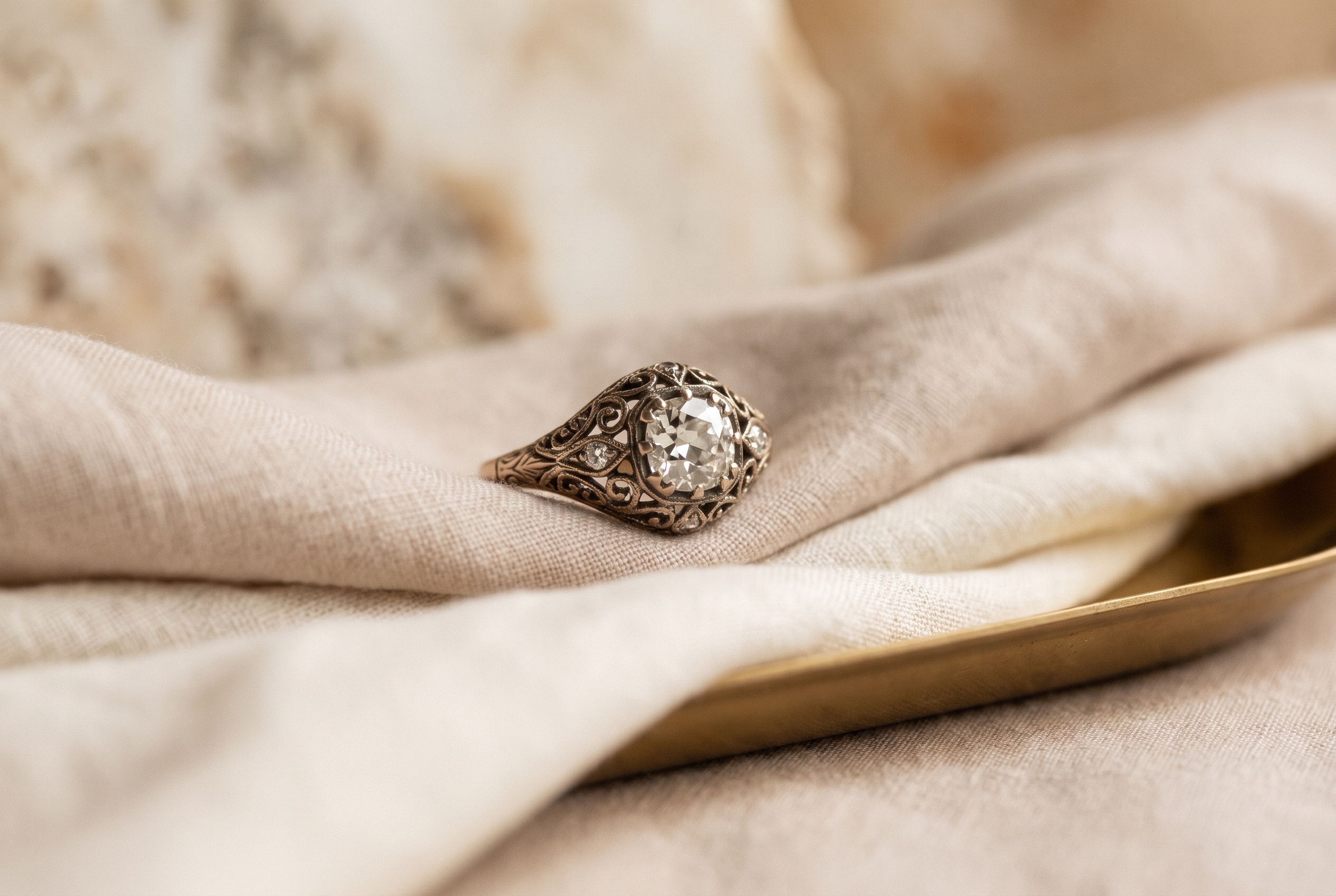
A vintage-style diamond ring is a newly manufactured ring designed to evoke the look of an earlier design era — filigree metalwork, antique-style diamond cuts, milgrain edging, or halo settings drawn from a prior period — without necessarily being a genuine period piece itself. For jewelers, "vintage style" functions as an umbrella category spanning several genuinely distinct design eras, each with its own visual vocabulary, and building the category well starts with understanding which specific look a customer means when they ask for something "vintage," since the term gets used loosely to cover everything from delicate Edwardian filigree to bold Retro-era scale.
This guide covers the design eras that fall under the "vintage style" umbrella, the diamond cuts and settings associated with each, how newly manufactured vintage-style pieces differ from genuine antique or estate jewelry, and how to source and price the category at wholesale.
"Vintage" as an Umbrella Term, Not a Single Style
Unlike a specific, dateable design period, "vintage" in retail use covers any design language borrowed from an earlier era, which means a customer asking for a "vintage ring" could be describing several genuinely different looks. Getting specific about which era's design vocabulary a customer actually means matters for setting accurate expectations on both appearance and price, since these eras are not interchangeable "old-fashioned" variations on the same theme.
| Era | Approx. Period | Defining Character |
|---|---|---|
| Victorian | 1837-1901 | Ornate, nature-inspired motifs (flowers, bows, snakes, hearts), yellow gold dominant, sentimental design themes |
| Art Nouveau | 1890-1910 | Flowing organic curves, floral and insect motifs, enamel work alongside diamonds |
| Edwardian | 1901-1915 | Delicate lace-like platinum filigree, softer curves, garland and bow motifs |
| Art Deco | 1920s-1930s | Geometric symmetry, step cuts, bold color contrast, platinum, machine-age precision — see our dedicated Art Deco diamond ring guide |
| Retro | 1935-1950s | Bold, sculptural rose gold designs, larger scale, less delicate than Deco |
In practice, the two eras that drive the largest share of current vintage-style demand are Edwardian-influenced filigree designs and Art Deco geometric styling — this guide covers the broader category and the shared design elements that cut across eras; for a deep dive specifically on Art Deco sourcing, cuts, and merchandising, see the dedicated guide linked above.
Design Elements Shared Across Vintage-Style Categories
While each era has its own distinct visual grammar, several design elements recur across multiple vintage-influenced styles and define what reads as "vintage" to most buyers regardless of the specific period being referenced:
- Filigree metalwork — fine, lace-like openwork patterns milled or hand-worked into the metal, most associated with Edwardian and Art Nouveau design but present in some form across nearly every pre-1950s era.
- Milgrain edging — a row of tiny beaded detail along a metal edge, adding textural richness without heavy ornamentation, used with varying intensity across eras.
- Halo settings — a ring of smaller accent stones surrounding a center stone, an antique-era design element that has since become a mainstream contemporary bridal staple in its own right.
- Antique diamond cuts — Old European and Old Mine cut stones, whose higher crowns and larger culets produce a warmer, more scintillating light pattern than a modern round brilliant, are the single most reliable design signal of genuine vintage character.
Diamond Cuts for Vintage-Style Rings
| Cut | Era Association | Visual Character |
|---|---|---|
| Old European cut | Victorian through early Art Deco | Higher crown, smaller table, larger culet than a modern round brilliant — warm, distinctive light pattern; see our Old European cut guide |
| Old Mine cut | Georgian through Victorian | Cushion-shaped antique cut, an earlier precursor to the Old European cut; see our Old Mine cut guide |
| Rose cut | Georgian through Victorian, revival in contemporary design | Flat-bottomed, faceted crown only — soft, low-brilliance glow rather than modern fire |
| Emerald and Asscher cut | Art Deco | Clean step-cut geometry matching the era's architectural design language |
| Modern round brilliant | None — reads as present-day in a vintage-style setting | Maximized fire and brilliance, but breaks vintage design authenticity if substituted for an antique cut |
Cut selection is the single most important factor separating a design that genuinely reads as vintage from one that simply borrows a filigree pattern around an obviously modern stone. A modern round brilliant set into an otherwise vintage-styled mounting reads as present-day immediately to anyone with a trained eye, even if every other design element is period-accurate.
Newly Manufactured Vintage-Style vs. Genuine Antique or Estate Pieces
Jewelers serve vintage-style demand in two structurally different ways, each with distinct sourcing, pricing, and inventory implications:
- Newly manufactured vintage-style pieces — built using period-accurate cuts and design language but with modern manufacturing precision, modern certification, and consistent, repeatable sourcing. This is the more scalable approach for a wholesale-sourced program.
- Genuine antique or estate pieces — carrying real collector and provenance value, but with significant condition and sourcing inconsistency piece to piece, and typically no modern grading certification unless a stone has been separately submitted for re-grading.
For a jeweler building a repeatable, scalable vintage-style category, newly manufactured pieces sourced against genuine period-accurate cuts and design vocabulary deliver far more consistent sizing, sourcing, and certification than sourcing individual estate pieces — while still meeting the design authenticity that makes the category work for buyers actively seeking a vintage look.
Rose Cut Diamonds: A Distinct Vintage-Era Cut Worth Understanding
The rose cut deserves particular attention within vintage-style sourcing because its light behavior differs fundamentally from every other cut discussed in this guide. Where a modern round brilliant, Old European, or Old Mine cut all rely on a faceted pavilion beneath the girdle to reflect light back through the crown, a rose cut has a completely flat base with all of its faceting concentrated on the domed crown above — a construction dating to the Georgian and Victorian eras, before modern faceting techniques made a brilliant-style pavilion practical at smaller stone sizes. The result is a soft, gentle glow rather than the fire and scintillation associated with a brilliant-style cut, an aesthetic some vintage-style buyers specifically seek out precisely because it reads as distinctly different from every contemporary diamond they've seen. A jeweler introducing a rose cut option to a vintage-style customer should set expectations accordingly — a rose cut won't out-sparkle a modern round brilliant, and buyers expecting that kind of brilliance should be steered toward an Old European or Old Mine cut instead.
Metal Choices Across Vintage-Style Eras
Metal selection carries real era signaling and is worth getting right for design authenticity: yellow gold dominates genuine Victorian-era design, platinum defines both Edwardian and Art Deco styling due to its strength enabling finer filigree work, and rose gold characterizes the bolder, larger-scale Retro era. White gold functions as a widely accepted, more accessible modern substitute for platinum across any of these eras' filigree-heavy looks, delivering a similar visual result with somewhat less fine-detail tolerance than genuine platinum.
Halo Settings: A Vintage Element Gone Mainstream
The halo setting deserves particular attention in a vintage-style discussion because it has completed an unusual journey from a specifically antique-era design element to one of the most common contemporary bridal setting styles overall, largely disconnected in most buyers' minds from its vintage origins. A jeweler building a genuinely vintage-styled halo ring — pairing the halo with an antique-cut center stone, filigree gallery work, and milgrain edging — delivers a meaningfully different, more period-authentic product than the halo setting alone conveys in most of today's contemporary bridal inventory, and it's worth making that distinction clear in how the piece is presented and priced.
Merchandising Vintage-Style Inventory
Vintage-style pieces merchandise most effectively when a customer can quickly identify both the specific era-inspired look they're responding to and whether the piece is a new build or a genuine antique, since conflating those two distinctions creates confusion and, handled poorly, real trust problems:
- Group by era-specific design language rather than a single generic "vintage" case — separating Edwardian filigree pieces from Art Deco geometric pieces helps customers self-select toward the specific look they actually want.
- Disclose new-manufacture vs. genuine antique status clearly in display copy — a customer researching the category will notice and appreciate transparency here, and it protects against disputes down the line.
- Lead with design vocabulary, not just an era label — "filigree gallery, Old European cut, milgrain edging" communicates more to an informed browsing customer than "vintage-style" alone.
Vintage-Style Engagement Rings and Modern Durability Expectations
A genuine period-era ring was built to the manufacturing standards and daily-wear expectations of its own time, which sometimes fall short of what a contemporary buyer expects from a piece meant for decades of continuous modern daily wear, including exposure to activities and environments a piece from the 1920s was never designed around. A newly manufactured vintage-style piece solves this gap directly — it can faithfully reproduce a period's design vocabulary and antique-cut stone choices while being built with modern manufacturing tolerances, modern prong security standards, and metal alloys suited to contemporary daily wear. This is worth communicating explicitly to a customer choosing between a genuine antique piece and a new vintage-style build, since it's a genuine, practical advantage of the new-manufacture path beyond the sourcing-consistency and certification benefits already covered above.
Common Mistakes in Vintage-Style Sourcing
- Substituting a modern round brilliant for an antique cut to reduce sourcing cost or lead time — the single most common shortcut that undermines a piece's vintage authenticity.
- Conflating distinct eras — mixing Victorian floral motifs with Art Deco geometric linework in one piece reads as confused rather than intentionally eclectic to a buyer who knows the category.
- Failing to disclose new-manufacture status — implying an antique or estate origin a piece doesn't actually have, which creates real trust and disclosure problems once a customer researches further.
- Over-decorating filigree work beyond what any genuine period actually used, pushing a build toward generic "old-fashioned" costume jewelry rather than an authentic period reference.
Pricing Vintage-Style Pieces at Wholesale
Vintage-style builds carry a few input costs beyond a standard contemporary ring's 4Cs-driven pricing: antique-cut center stones like Old European, Old Mine, and rose cut typically carry a modest premium over an equivalent modern round brilliant due to lower cutting yield and more specialized cutting expertise, fine filigree and milgrain metalwork adds labor cost relative to a simple polished band, and platinum carries a materials premium over white gold where period authenticity calls for it. These premiums are worth pricing in and communicating clearly rather than applying a standard contemporary-ring cost template to a category with genuinely different production inputs.
Sourcing Vintage-Style Diamond Rings at Wholesale
Guru Diam carries the full range of antique and standard diamond cuts that anchor genuine vintage-style design — Old European, Old Mine, rose cut, and other true antique-style cuts — alongside natural diamonds, certified loose stones, and finished jewelry. Custom vintage-style rings are finished in 4-6 days, with cutting, setting, and polishing handled in-house, and IGI, GIA, and GCAL certification all available on loose stones.
Buyers can browse antique-cut inventory through the certified diamonds category and coordinate accent-stone work through matching pairs, then build a complete custom vintage-style piece through custom jewelry. Our Art Deco diamond ring guide covers that specific era's sourcing and design vocabulary in depth, and our cathedral setting guide covers another architectural setting style with antique-era roots. Trade accounts can review terms at the wholesale hub or apply through trade partner.
Why Vintage-Style Demand Has Remained Strong
Vintage-style design has proven to be more than a passing trend cycle, in part because it draws on multiple genuinely distinct historical design languages rather than a single look that can feel dated once fashion moves on. A buyer drawn to Edwardian filigree and a buyer drawn to bold Retro scale are responding to meaningfully different aesthetics, which gives the broader "vintage" category more staying power across shifting style preferences than a single trend would carry on its own. For a jeweler, that breadth is an argument for stocking design range within the category — filigree-and-antique-cut pieces alongside bolder Retro-influenced designs — rather than treating "vintage style" as one narrow look to source against.
Talking to Customers About Vintage-Style Terminology
Customers researching vintage-style jewelry arrive with wildly varying levels of familiarity with the specific terminology this guide covers — some know precisely which era and design elements they want, while others simply know they're drawn to an "old-fashioned" or "romantic" look without a clearer vocabulary for it. Meeting both types of customer well means being able to translate fluidly between casual descriptive language and the specific design terms that actually drive sourcing decisions: a customer describing "lacy, delicate, old-looking" is very likely describing Edwardian filigree specifically, while a customer describing "bold, geometric, art-history" is very likely describing Art Deco. Reflecting a customer's own descriptive language back using more precise terminology — gently, and in a way that builds their confidence rather than making them feel corrected — is an effective way to guide the conversation toward the specific era and cut choices that will actually deliver the look they're picturing, rather than leaving them to sort through a case of loosely-labeled "vintage" pieces on their own.
Certification Considerations for Antique-Cut Stones in Vintage-Style Builds
Old European, Old Mine, and rose cut diamonds grade somewhat differently on cut than a modern round brilliant, since cut-grading standards at the major labs were developed primarily around contemporary proportions rather than antique-era cutting conventions. A certificate for an antique-cut stone should be read with that context in mind, rather than expecting the same cut-grade scale used for a modern round brilliant to translate directly or to fully capture the stone's actual visual character. In practice, the more meaningful evaluation for these cuts is often direct visual review of light performance, since antique proportions produce a distinctly different, often warmer and more scintillating pattern that a straightforward modern cut grade doesn't fully account for. A jeweler newer to sourcing antique cuts for vintage-style work benefits from leaning on a supplier who can speak knowledgeably to this distinction, rather than applying modern round-brilliant cut-grading assumptions directly to an Old European, Old Mine, or rose-cut stone.
Vintage-Style Wedding Bands and Coordinated Bridal Sets
A genuinely coordinated vintage-style bridal set extends the chosen era's design language into the wedding band as well as the center ring, a detail that matters more in this category than in most contemporary bridal styling, since much of vintage design's visual strength comes from consistent detailing carried across the full set rather than concentrated entirely in a single center ring. A filigree-detailed band with matching milgrain edging pairs naturally with an Edwardian-styled center ring, while a channel-set baguette band continues an Art Deco center ring's geometric linework. Curved or contoured bands — shaped specifically to nest flush against an ornate vintage-style center ring's gallery — solve a genuine fit problem that a plain straight band can create against a taller or more elaborately detailed antique-style setting, and are worth discussing proactively with a bridal-set customer rather than leaving them to discover the fit issue only after both pieces have already been purchased separately.
Vintage-Style Engagement Rings vs. Fashion and Anniversary Pieces
While engagement rings drive a significant share of vintage-style demand, the same design vocabulary translates naturally into non-bridal categories: anniversary bands using period-accurate milgrain and filigree detailing, vintage-styled pendants and earrings using Old European or rose-cut accent stones, and fashion rings that let a customer explore the aesthetic without the commitment-purchase context of an engagement ring specifically. Building out this adjacent category alongside a core vintage-style bridal offering gives a jeweler additional ways to serve customers drawn to the aesthetic broadly, not only those actively shopping for an engagement ring, and can introduce a customer to a jeweler's vintage-style design capability well before they're in the market for a bridal purchase.
A Note on Sourcing Consistency Across a Vintage-Style Program
A jeweler building a recurring vintage-style program benefits from a sourcing relationship that can deliver consistent antique-cut proportions and quality across repeated orders, not just a one-time supply of period-accurate cuts for a single piece. Because antique cuts like Old European, Old Mine, and rose cut are produced in smaller volumes than modern round brilliants, consistency across separate orders — matching proportions, light performance character, and certification standards from one order to the next — matters more here than in mainstream contemporary sourcing, where standardized modern cutting makes stone-to-stone consistency far less of a sourcing variable to manage.
Frequently Asked Questions
What does "vintage style" mean for a diamond ring?
It describes a newly manufactured ring designed to evoke an earlier design era's look — filigree metalwork, antique diamond cuts, milgrain edging, or halo settings — without necessarily being a genuine period piece. It's an umbrella term spanning several distinct historical eras rather than one specific style.
What's the difference between "vintage style" and "Art Deco" rings?
Art Deco is one specific, dateable design era (1920s-1930s) within the broader vintage-style umbrella, characterized by geometric symmetry and step-cut diamonds. "Vintage style" more broadly covers any earlier era's design language, including Victorian, Edwardian, and Retro looks that differ significantly from Art Deco's geometric aesthetic.
Should I buy a genuine antique ring or a new vintage-style piece?
It depends on priorities. Genuine antique pieces carry real collector and provenance value but come with condition and sourcing inconsistency and typically no modern certification. Newly manufactured vintage-style pieces offer far more consistent sourcing, sizing, and certification while still delivering genuine design authenticity when built with period-accurate cuts.
What diamond cuts are used in vintage-style rings?
Old European and Old Mine cut are the most common for round center stones, along with rose cut for a softer, lower-brilliance look. Emerald and Asscher cut step-cut stones are associated specifically with the Art Deco era within the broader vintage-style category.
Is a halo setting considered "vintage style"?
Halo settings originated in antique-era design, but the style has since become a mainstream contemporary bridal staple largely disconnected from its vintage roots. Pairing a halo with an antique-cut center stone and filigree gallery work produces a meaningfully more period-authentic result than a halo setting alone.
What metal is most authentic for a vintage-style ring?
It depends on the era being referenced — yellow gold for Victorian, platinum for Edwardian and Art Deco, and rose gold for Retro-era styling. White gold is a widely accepted modern substitute for platinum-era looks.
Do vintage-style wedding bands need to match the engagement ring's specific era?
Not strictly, but a band using the same era's design details — filigree and milgrain for Edwardian, channel-set baguettes for Art Deco — reads as a more intentionally coordinated set. Curved or contoured bands also solve a common fit problem against an ornate, taller vintage-style center ring's gallery.