
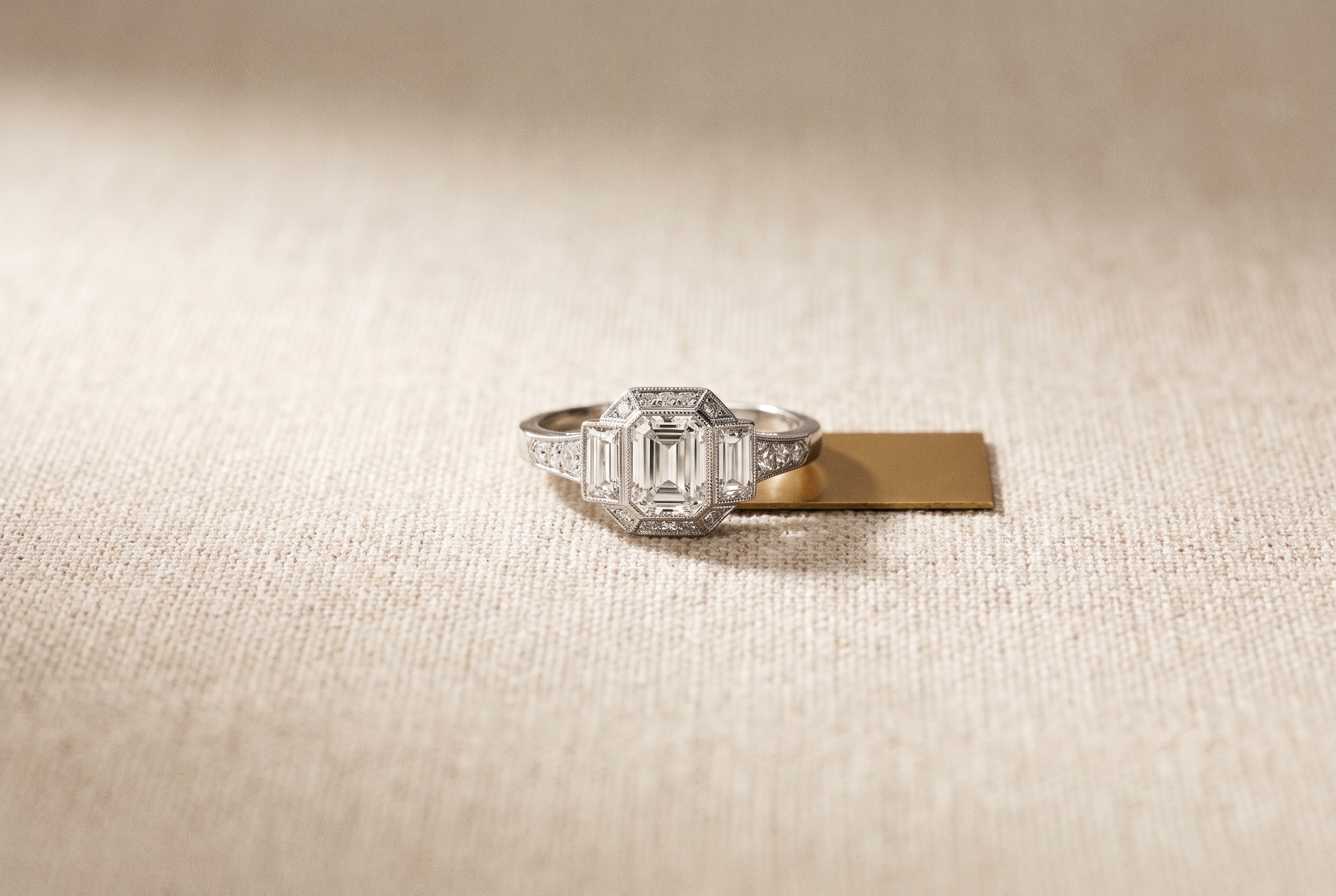
An Art Deco diamond ring is a ring styled after the geometric, symmetrical design language of the 1920s-1930s Art Deco movement — characterized by clean architectural lines, step-cut and antique brilliant diamonds, and contrasting color or metalwork, rather than the softer, organic curves of earlier Edwardian or Victorian styling. For jewelers, Art Deco-style rings remain one of the most durable demand categories in vintage-inspired bridal and fashion jewelry, and building this category well means understanding the specific design vocabulary that makes a ring read as genuinely Art Deco rather than generically "vintage."
This guide covers the defining visual features of Art Deco ring design, which diamond cuts and shapes are period-authentic, how to source and price the category at wholesale, and how to build new Art Deco-style pieces that read as genuine rather than costume-jewelry pastiche.
What Defines Art Deco Ring Design
Art Deco design emerged in the 1920s as a deliberate departure from the flowing, nature-inspired curves of the preceding Edwardian and Art Nouveau periods, drawing instead on geometric abstraction, symmetry, and the machine-age aesthetic of the era. In jewelry specifically, that translates into a distinct and recognizable set of design markers:
- Geometric symmetry — rings built on strong horizontal and vertical lines, often with a strict bilateral symmetry that reads as architectural rather than organic.
- Step-cut and antique brilliant diamonds — emerald and baguette-style step cuts alongside Old European cut round stones, rather than the modern round brilliant's cut proportions.
- Contrasting color accents — sapphire, emerald, or onyx accents set against white diamonds and platinum, a hallmark color-blocking approach distinct from the monochromatic white-metal-and-diamond styling common today.
- Platinum as the dominant metal — platinum's strength allowed for the intricate, delicate filigree and millgrain work characteristic of the period in a way earlier gold-working techniques couldn't achieve as finely.
- Milgrain edging and filigree detailing — fine beaded metal edging and openwork metal patterns, used with restraint on genuine period pieces rather than the heavier, more decorative filigree sometimes associated with the broader "antique" or "vintage" category loosely.
Art Deco vs. Other "Vintage" Ring Styles
"Vintage" is often used as a catch-all in retail, but Art Deco is a specific, dateable design period with its own visual grammar, distinct from the styles that preceded and followed it.
| Period | Approx. Era | Defining Character |
|---|---|---|
| Victorian | 1837-1901 | Ornate, nature-inspired motifs (flowers, bows, snakes), yellow gold dominant |
| Edwardian | 1901-1915 | Delicate lace-like platinum filigree, softer curves, garland motifs |
| Art Deco | 1920s-1930s | Geometric symmetry, step cuts, bold color contrast, platinum, machine-age precision |
| Retro | 1935-1950s | Bold, sculptural rose gold designs, larger scale, less delicate than Deco |
Correctly identifying the period a customer is actually asking for — often using "vintage" or "antique" loosely — matters for setting accurate expectations on both look and price, since these periods carry genuinely distinct design vocabularies rather than interchangeable "old-fashioned" styling.
Diamond Cuts That Define the Art Deco Look
Cut selection is the single most important factor in whether a new build reads as authentically Art Deco or as a generic vintage-adjacent piece:
| Cut | Role in Art Deco Design |
|---|---|
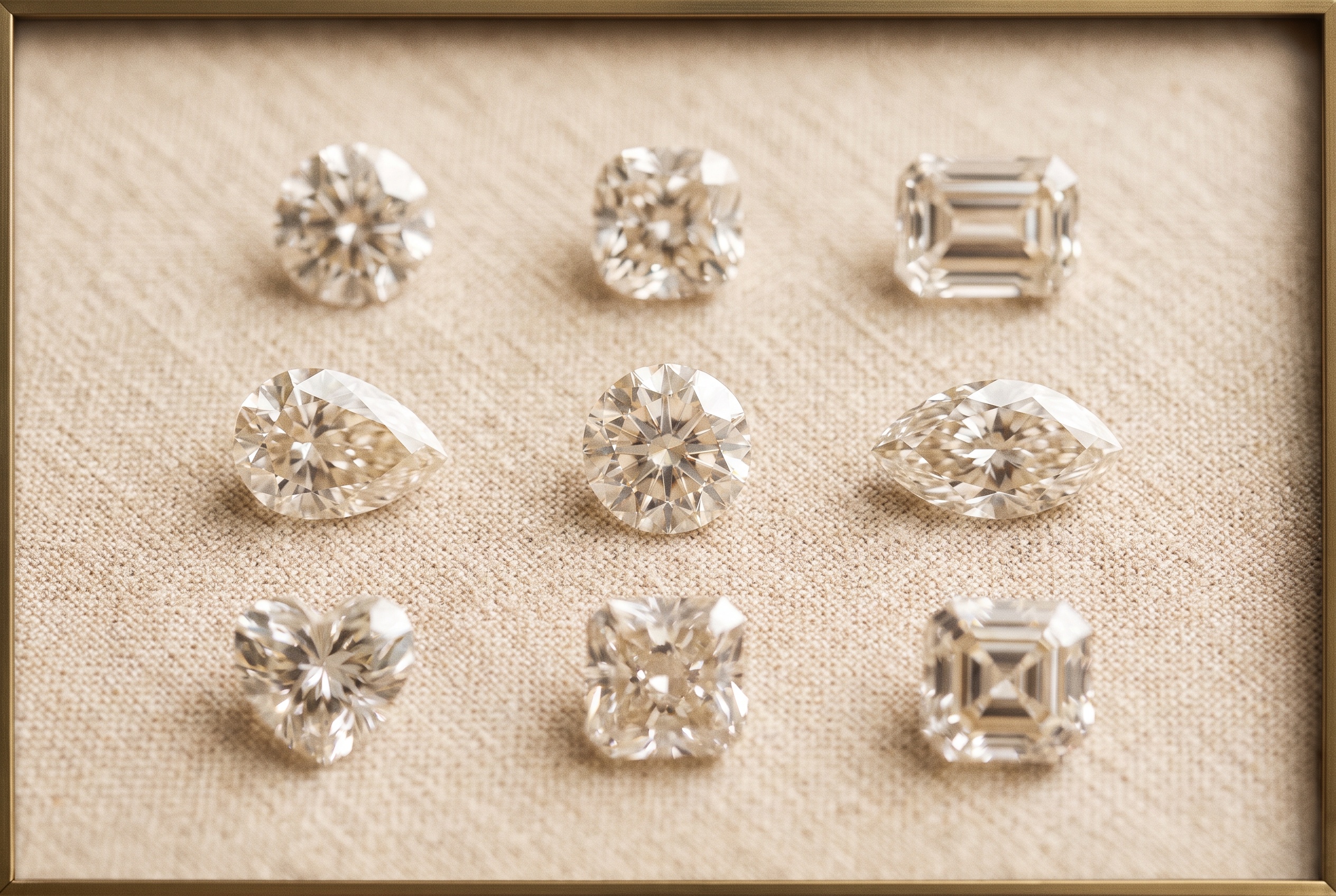
| Old European cut | The dominant round-stone cut of the period, with a higher crown, smaller table, and larger culet than a modern round brilliant, producing a distinctive warm, scintillating light pattern — see our Old European cut guide |
| Emerald cut | The quintessential Deco step cut, its clean rectangular lines and open table matching the era's architectural aesthetic directly |
| Baguette | Small rectangular step-cut stones used extensively as channel-set accents flanking a center stone, a hallmark of the period's geometric linework |
| Asscher cut | A square step cut popularized during the Deco period, sharing the emerald cut's clean lines in a more compact silhouette |
| Old Mine cut | An earlier cushion-shaped antique cut sometimes seen transitioning into the Deco period, particularly in its earlier years — see our Old Mine cut guide |
A modern round brilliant or a contemporary cushion cut, by contrast, reads immediately as a present-day stone even when set in an otherwise period-accurate mounting — cut selection is not a detail that can be substituted without breaking the overall design authenticity.
Color Accent Stones in Art Deco Design
Art Deco's contrasting color-block approach is one of its most identifiable features and a genuine point of differentiation for jewelers building this category, since it departs from the all-white-diamond default of most contemporary bridal design:
- Sapphire — the most common Deco accent color, typically calibrated baguette or French-cut sapphires flanking a diamond center stone in a strong blue-white contrast.
- Emerald and onyx — used for bolder color-block statements, particularly in cocktail rings and fashion pieces rather than bridal center rings specifically.
- Black onyx geometric inlay — a hallmark of higher-drama Deco pieces, providing stark contrast against white diamonds and platinum.
For a jeweler sourcing accent stones for this category, consistent calibrated sizing across a channel-set run matters more than on a standard bridal piece, since Deco design's geometric precision is undermined by any visible inconsistency in accent stone size or spacing.
Platinum and Metal Considerations
Platinum's strength-to-weight ratio made it the material that enabled genuine period Art Deco filigree and millgrain work at the fine, delicate scale the style calls for — a scale that's harder to achieve as crisply in softer gold alloys. For new builds aiming to read as authentically Deco, platinum remains the strongest metal choice for matching the period's characteristic delicacy, though white gold is a common, more accessible substitute that can achieve a similar look with slightly less intricate detail tolerance. Yellow and rose gold are historically inaccurate for genuine Deco styling, though rose gold Deco-inspired pieces have found their own separate contemporary following as a deliberate style hybrid rather than a period-accurate reproduction — worth being clear with a customer about which they're actually buying.
Filigree and Millgrain: Getting the Detail Level Right
One of the most common mistakes in new Art Deco-style builds is over-decorating — genuine period pieces use filigree and millgrain with real restraint, in service of the geometric structure rather than as pure ornamentation layered on top of it. A modern build that piles on heavier scrollwork risks reading as generic "antique-style" costume jewelry rather than authentically Deco. The strongest new Deco-inspired pieces mirror the period's actual design discipline: strong geometric structure first, with filigree and millgrain used to accent and reinforce that structure rather than override it.
Building New Art Deco-Style Rings vs. Sourcing Genuine Antique Pieces
Jewelers serve this demand two distinct ways, each with different sourcing and pricing implications:
- Newly manufactured Deco-style pieces using period-accurate cuts (Old European, emerald, baguette) and design language, built with modern manufacturing precision and modern certification — the more scalable, consistent approach for a wholesale-sourced program.
- Genuine antique or estate pieces from the actual period, which carry collector and provenance value but come with significant sourcing inconsistency, condition variability, and typically no modern certification unless a stone has been separately re-graded.
For a jeweler building a repeatable, scalable Art Deco-style category, newly manufactured pieces using genuine period-accurate cuts and design vocabulary offer far more consistent sourcing, sizing, and certification than hunting estate inventory piece by piece — while still delivering the design authenticity that makes the category work commercially.
Art Deco Wedding Bands and Eternity Bands
A genuinely coordinated Art Deco bridal set extends the geometric design language into the wedding band, not just the center ring — a detail that matters more in this category than in most contemporary bridal styling, since Deco design's strength comes from consistent architectural precision across the full set. Channel-set baguette bands are a period-authentic pairing for an Art Deco center ring, continuing the same rectangular step-cut linework used in the center ring's accent stones. A full eternity band in the same baguette-and-platinum vocabulary works particularly well as a wedding band paired with a Deco engagement ring, since it reads as a continuous design statement rather than two separately conceived pieces brought together. Our wedding set guide covers coordinated bridal set sourcing more broadly.
Merchandising Art Deco Pieces in a Modern Case
Art Deco-style inventory benefits from being merchandised as its own distinct category rather than folded loosely into a general "vintage" or "antique" case section, since customers specifically drawn to the style respond to seeing the geometric design language presented coherently together rather than mixed with softer Victorian or Edwardian pieces that read very differently. A few practical merchandising points worth considering:
- Group by design language, not just by age or general "antique" labeling — grouping true Deco geometric pieces separately from Edwardian filigree work helps a browsing customer identify the specific look they're responding to.
- Lead display copy with the design vocabulary, not just the era name — "geometric step-cut, platinum, contrast sapphire accents" communicates more to a browsing customer than "1920s style" alone.
- Pair center rings with their coordinating bands in display — since Deco design rewards seeing a full coordinated set together more than most contemporary styles do, given how central symmetry and continuity are to the aesthetic.
Common Mistakes When Sourcing Art Deco-Style Pieces
- Substituting a modern round brilliant for an Old European cut to save on sourcing cost or lead time — this is the single most common shortcut that breaks a piece's design authenticity, since the cut's distinct proportions and light performance are core to the period look, not an interchangeable detail.
- Over-decorating with heavy filigree beyond what genuine period pieces actually used, which pushes a build toward generic "antique-style" costume jewelry rather than authentic Deco restraint.
- Using yellow or rose gold without flagging it as a stylistic hybrid — not inherently a problem commercially, but worth being transparent with a customer about, since it departs from historically accurate platinum and white metal.
- Inconsistent calibrated accent stone sizing in channel-set baguette work, which undermines the geometric precision that makes Deco design read as intentional rather than approximate.
Art Deco Styling Beyond Engagement Rings
While engagement rings drive the bulk of Art Deco-style demand, the same geometric design vocabulary translates well into other categories a jeweler may want to build alongside the bridal center ring: cocktail rings with bolder color-block gemstone work, pendant and drop earring pairs using baguette and Old European accents, and stackable band sets that echo the channel-set linework of a Deco engagement ring without requiring a full matching set purchase. Building out a modest Deco-adjacent fashion category alongside the bridal offering gives a jeweler a way to serve customers drawn to the aesthetic who aren't currently shopping for an engagement ring specifically, and can also serve as a lower-commitment entry point that introduces a customer to the look before they're ready for a bridal purchase.
Certification Considerations Specific to Antique-Cut Stones
Old European and Old Mine cut diamonds — the defining round-stone cuts of genuine Deco design — grade somewhat differently on cut than a modern round brilliant, since grading standards for cut quality were developed around contemporary proportions. A certificate for an antique cut stone should be reviewed with that context in mind rather than expecting the same cut-grade scale to translate directly; the more meaningful practical evaluation for these cuts is often direct visual review of light performance, since the antique proportions produce a distinctly different and desirable scintillation pattern that a straightforward cut grade doesn't fully capture. Buyers and jewelers newer to sourcing antique cuts specifically should lean on a supplier who can speak knowledgeably to this distinction rather than applying modern round brilliant cut-grading assumptions directly to an Old European or Old Mine stone.
Talking to Customers About Art Deco Styling
Customers drawn to Art Deco styling are often shopping with a specific, well-researched aesthetic already in mind rather than browsing generally, having encountered the look through estate jewelry, period film and television styling, or direct exposure to genuine antique pieces. This makes accurate design vocabulary a meaningful trust signal in the sales conversation — a customer who's done their own research will notice quickly whether a jeweler actually understands what distinguishes Deco from Edwardian or generic "antique," and correctly using terms like step cut, Old European cut, and milgrain rather than reaching for vaguer language like "vintage-inspired" builds credibility fast with this specific buyer segment. Framing new-build pieces honestly — as newly manufactured using period-accurate design language and cuts, rather than implying an antique or estate origin they don't have — also matters for maintaining that trust once a sale is made and a customer has time to research further on their own.
Sourcing Baguette and Calibrated Accent Stones for Deco Work
Channel-set baguette work is one of the more demanding sourcing requirements in Art Deco-style production, since the geometric precision the style depends on requires tight, consistent calibration across every stone in a run — visible size or proportion inconsistency across a baguette channel is far more noticeable than the same inconsistency would be in a less geometrically strict setting style. A supplier with in-house cutting capability can typically deliver tighter calibration tolerances on baguette and other fancy calibrated shapes than one sourcing pre-cut melee from third parties, since the cutting specifications can be controlled directly against a specific channel or setting's exact requirements rather than selected from whatever standard sizing happens to be available in existing stock.
Why Art Deco Demand Has Proven Durable
Design trends in bridal jewelry tend to cycle, but Art Deco's specific appeal has shown unusual staying power across multiple market cycles rather than fading after an initial revival period. Part of that durability traces to the style's underlying design discipline — geometric symmetry and restrained ornamentation age well precisely because they don't depend on the kind of maximalist detail that can start to look dated within a few years, the way heavier, more decorative styling sometimes does. The style also benefits from continued visibility in film, television, and broader design culture well beyond jewelry specifically, which keeps introducing new customers to the aesthetic independent of any single jewelry marketing cycle. For a jeweler weighing whether to invest meaningfully in this category, that broader cultural staying power is a genuinely different demand signal than a shorter-lived seasonal or micro-trend styling choice would offer, and worth factoring into how much case space and sourcing commitment the category earns relative to more fleeting style trends.
Sourcing Art Deco Diamond Rings at Wholesale
Guru Diam carries the full range of antique and standard diamond cuts that define genuine Art Deco design — Old European, Old Mine, emerald, and other true antique-style cuts — alongside natural diamonds, certified loose stones, and finished jewelry. Custom Art Deco-style rings are finished in 4-6 days, with cutting, setting, and polishing handled in-house, and IGI, GIA, and GCAL certification all available on loose stones.
Buyers can browse antique-cut inventory and calibrated accent stones through the certified diamonds category and matching pairs, and build a full custom Deco-style piece through custom jewelry. Our cathedral setting guide covers another architectural setting style that pairs well with the era's geometric sensibility. Trade accounts can review terms at the wholesale hub or apply through trade partner.
Pricing Art Deco-Style Pieces at Wholesale
Pricing an Art Deco-style build involves a few factors beyond the standard 4Cs of the center stone: antique-cut stones like Old European and Old Mine cut can carry a modest premium over an equivalent modern round brilliant due to lower cutting yield from rough and more specialized cutting expertise required, calibrated baguette accent work adds labor cost relative to simpler prong-set melee, and platinum carries a materials cost premium over white gold that should be factored transparently into a quote rather than surprising a customer at final pricing. None of these premiums are large enough to make the category commercially unworkable — Art Deco-style pieces remain a strong-margin category for jewelers who source the components efficiently — but they're worth understanding and pricing in deliberately rather than applying a standard bridal ring cost template to a category with genuinely different input costs. Communicating these cost drivers clearly to a retail customer — why an antique-cut center stone or platinum build carries a different price than a comparable modern round-brilliant-and-white-gold piece — also helps set accurate expectations up front, rather than leaving a customer to wonder why two rings that look broadly similar in size and grade carry meaningfully different price tags.
Frequently Asked Questions
What makes a ring "Art Deco" style versus just "vintage"?
Art Deco refers specifically to the 1920s-1930s design period, characterized by geometric symmetry, step-cut and Old European cut diamonds, contrasting color accent stones, and platinum filigree with millgrain edging. "Vintage" is a broader, less specific term that can refer to any earlier period, including distinctly different styles like Victorian, Edwardian, or Retro.
What diamond cuts are used in Art Deco rings?
Old European cut (for round center stones), emerald cut, baguette, and Asscher cut are the defining cuts of the period, chosen specifically for how their step-cut or antique-brilliant proportions match the era's geometric, architectural design language. A modern round brilliant or contemporary cushion cut reads immediately as present-day even in an otherwise period-styled mounting.
What metal is used in Art Deco diamond rings?
Platinum is the historically dominant metal, chosen for its strength, which allowed for the fine, delicate filigree and millgrain work characteristic of the period. White gold is a common, more accessible modern substitute; yellow and rose gold are historically inaccurate for genuine period styling, though rose gold Deco-inspired hybrids have their own separate contemporary following.
What color accent stones are typical in Art Deco design?
Sapphire is the most common accent color, typically as calibrated baguette or French-cut stones flanking a diamond center stone. Emerald and black onyx are used for bolder color-block statements, particularly in cocktail rings and fashion pieces.
Should I buy a genuine antique Art Deco ring or a new Deco-style piece?
It depends on priorities — genuine antique pieces carry collector and provenance value but come with sourcing inconsistency and typically no modern certification. Newly manufactured pieces using genuine period-accurate cuts and design language offer far more consistent sourcing, sizing, and certification while still delivering full design authenticity.
What's the difference between Art Deco and Edwardian ring styles?
Edwardian design (roughly 1901-1915) favors delicate, lace-like platinum filigree with softer, more organic garland motifs, while Art Deco (1920s-1930s) favors bold geometric symmetry, step-cut stones, and strong color contrast — a more architectural, less floral aesthetic overall.