
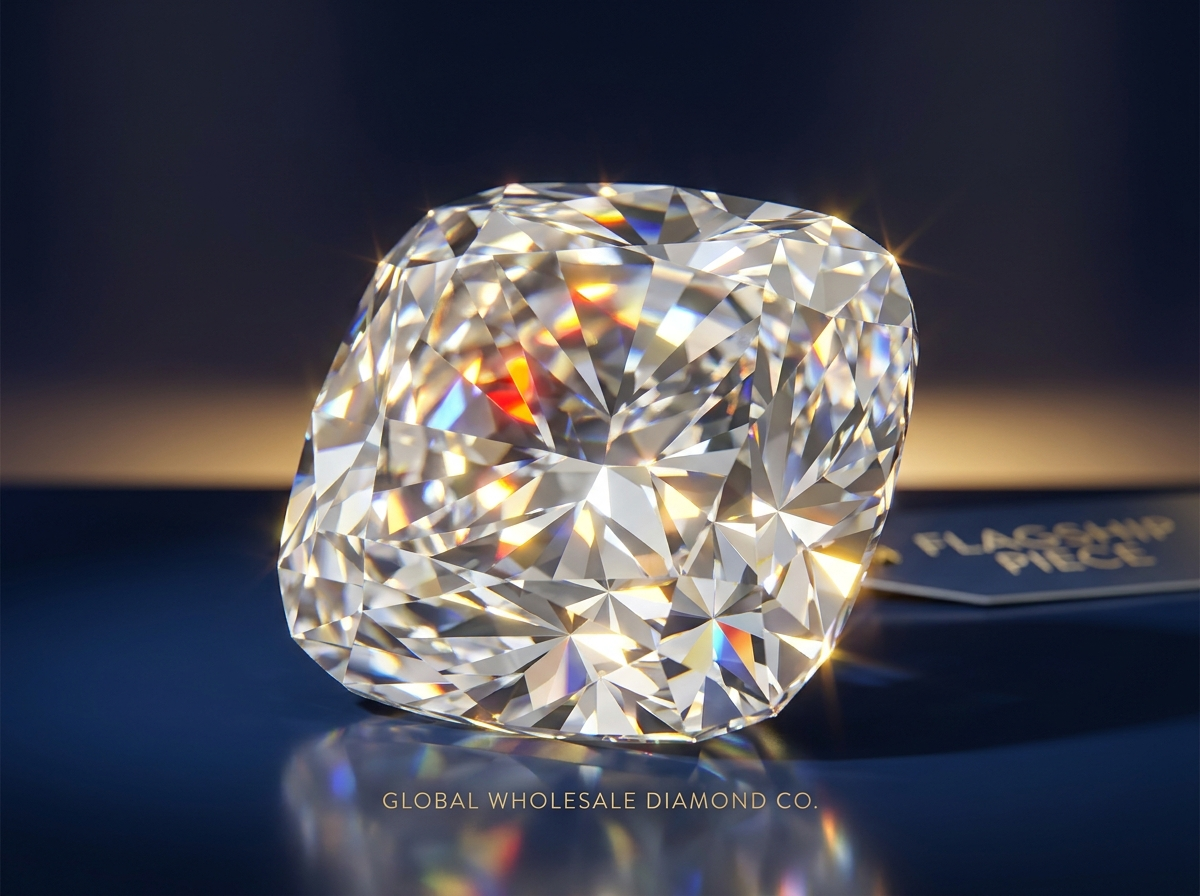
A cushion cut diamond is a square-to-rectangular outline with rounded "pillow" corners, cut as a brilliant, modified brilliant, antique, or elongated variant. Guru Diam stocks 382 cushion cut lab-grown diamonds on hand, CVD-grown, IGI-certified as standard with GIA available on request, from our New York Diamond District desk — the deepest cushion inventory in our full catalog.
Cushion is one of the most consistently requested shapes in the trade, and it's also one of the most misquoted, because "cushion" alone doesn't specify which of four real variants a client means. This is the main sourcing page for the full category — spec table, availability, and certification — with links out to a dedicated guide for each cushion type when you need shape-family depth.
This guide covers the shape from the ground up: how a cushion is actually faceted, where the outline comes from historically, the grading language buyers use on the floor — "crushed ice," "chunky" — that doesn't show up on a certificate, what moves price on a cushion specifically, styling guidance by setting type, and how to place a wholesale order.
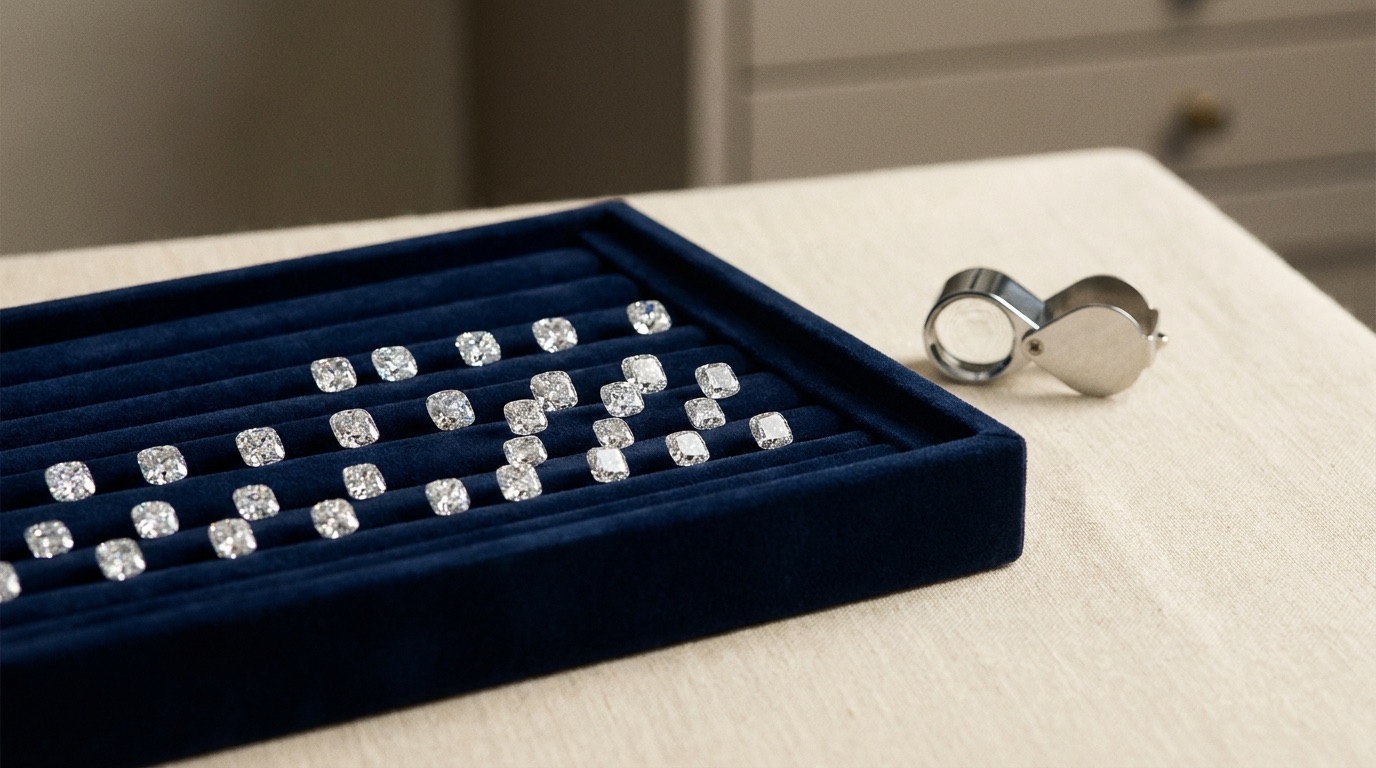
What is a cushion cut diamond?
A cushion cut is defined by its outline, not a single facet pattern: a square-to-rectangular shape with rounded corners, resembling a pillow. Within that outline, cushions split into four real types — cushion brilliant (standard modern faceting), cushion modified brilliant (extra facet rows for denser sparkle), antique cushion (high-crown, open-culet historical faceting), and elongated cushion (rectangular rather than square proportions). See our full breakdown of cushion cut types for how to tell them apart and which to spec for a given client. Guru Diam's cushion inventory is CVD-grown and IGI-certified as standard, with GIA certification available on request for any stone in stock.
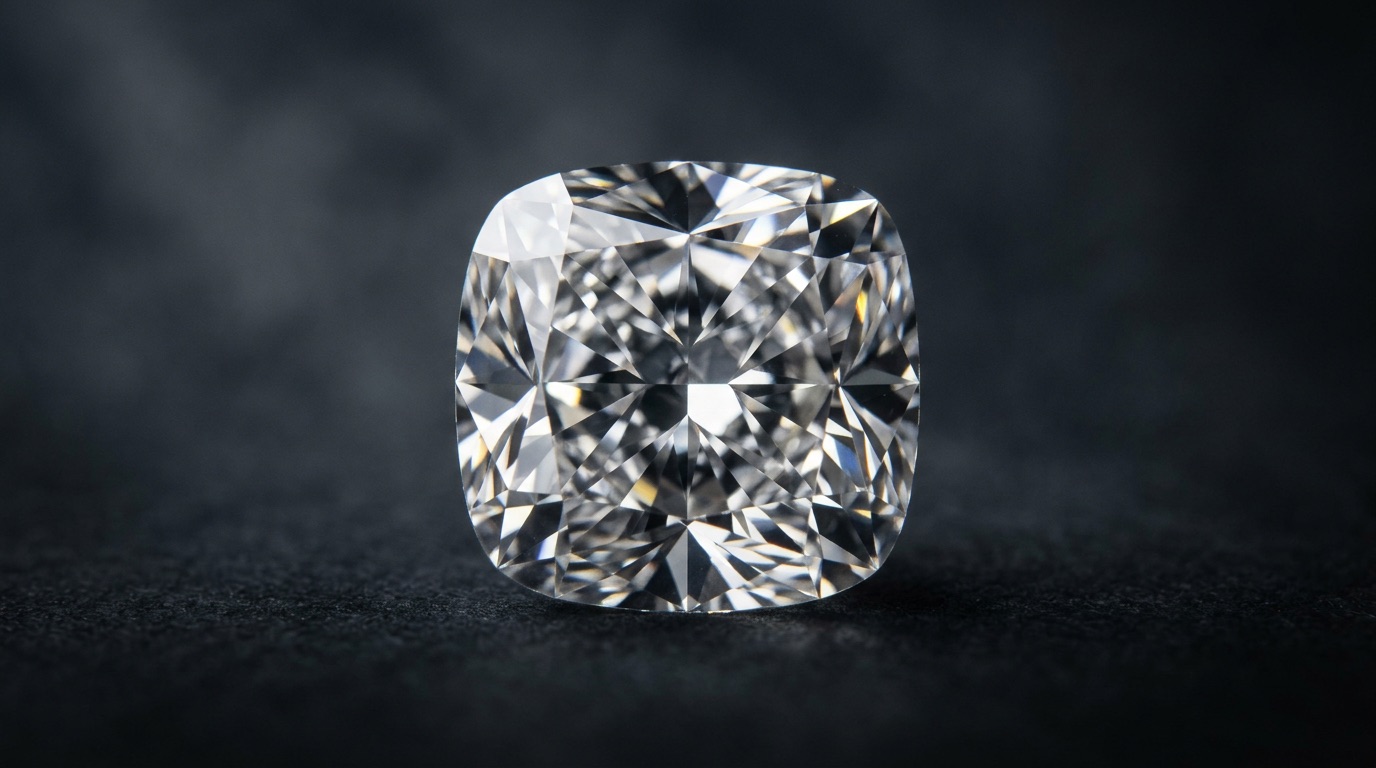
Facet count is where the four variants actually diverge. A standard cushion brilliant runs a crown-and-pavilion structure comparable to a round brilliant reshaped onto a pillow outline — typically in the high-50s to low-60s facet count. A cushion modified brilliant adds extra facet rows on the pavilion, often pushing into the 70s, which is the structural reason it reads differently under light than a plain brilliant. Antique cushion faceting is a different arrangement entirely, built around a higher crown and a larger, sometimes open, culet — a deliberate throwback to pre-electric-light cutting rather than a modern efficiency pattern. None of that is visible on a grading report's shape line, which is why buyers specify by variant name, not just "cushion."
The four cushion variants at a glance
Cushion brilliant — the modern default. Broad, distinct flashes of light, closest in behavior to a round brilliant. Cushion modified brilliant — extra facet rows, denser and more broken-up sparkle, often the "crushed ice" look buyers ask for by name. Full comparison and which-to-spec guidance in our cushion brilliant vs. cushion modified brilliant guide. Antique cushion — high-crown, historical faceting, often confused with a true Old Mine Cut but not the same thing; see our antique cushion vs. Old Mine Cut breakdown for how the modern marketing term and the true period cut differ. Elongated cushion — rectangular rather than square proportions, a finger-lengthening alternative to a classic square cushion; full spec detail in our elongated cushion cut guide.
A short trade history of the cushion cut
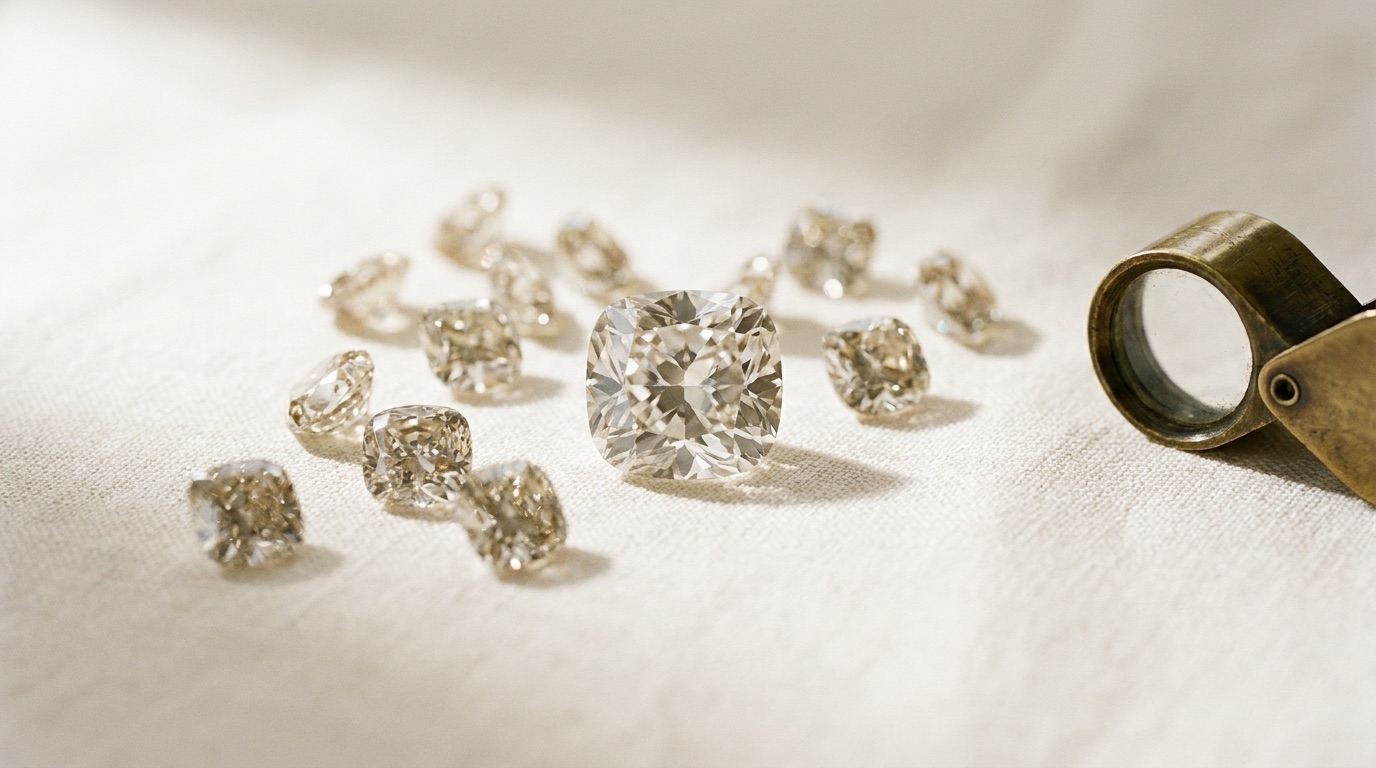
The cushion outline is one of the oldest shapes in diamond cutting, and it didn't start as a bridal fashion choice — it was a practical response to the light sources cutters were working with. Through the 1700s and 1800s, diamonds were cut and worn under candlelight and gaslight, not electric light. Cutters of that era favored high crowns, small tables, and large culets — a faceting style built to catch and hold weak, flickering light rather than to maximize brilliance under a bright showroom bulb. The stones produced under that faceting philosophy are generally referred to today as Old Mine Cuts, and their outline — square-to-rectangular with rounded corners — is the direct ancestor of the modern cushion.
When electric lighting became standard in the early 20th century, cutting style shifted hard toward what would eventually become the round brilliant: smaller crowns, no culet, and a facet arrangement engineered to maximize fire and scintillation under bright, even light. Cushion faceting fell out of mainstream production for most of the 20th century, overshadowed by round and emerald cut demand. It came back into wide bridal use starting in the 2000s, driven by demand for a shape that read as "vintage" without the light-return tradeoffs of sourcing a genuine period-cut antique. Modern cushion brilliant and cushion modified brilliant faceting are re-engineered patterns applied to that historical outline — built for today's lighting, not candlelight — while antique cushion specifically sets out to replicate the older faceting style rather than modernize it. That's the throughline worth knowing when a client asks for "an antique cushion" and means the look, not the literal period cut.
Cushion brilliant vs. cushion modified brilliant
These two get confused constantly because they share the same outline and the same certificate shape line — the difference is entirely in the pavilion faceting, and it changes how the stone reads across a room. Cushion brilliant keeps a facet count close to a round brilliant's, which produces fewer, larger flashes of light — a cleaner, more classic look that reads brighter at a glance and photographs with more distinct sparkle points. Cushion modified brilliant adds extra facet rows to the pavilion, breaking the light up into more numerous, smaller flashes — a denser, more textured sparkle that some buyers describe as softer or more romantic, and others describe by the "crushed ice" nickname covered below.
Neither is objectively better — it's a spec decision based on what the client wants the stone to do in a room. A buyer chasing maximum single-glance brightness for a solitaire should default to brilliant faceting; a buyer who wants the diffused, almost frosted look that's become a strong halo-setting trend should default to modified brilliant. For the full side-by-side — facet counts, light behavior, and a spec checklist for which to order for a given client — see our dedicated cushion brilliant vs. modified brilliant guide.
Why cushion holds a deep spot in wholesale inventory
Cushion's rounded corners make it more chip-resistant in everyday wear than a pointed shape like a marquise or pear, which keeps it in steady demand for engagement rings that see daily use. Its mixed facet character — a brilliant crown paired with a broader pavilion in most variants — gives it a distinct look from a round brilliant without sacrificing much fire, which is also why cushion is the highest-volume shape in our fancy color category (see our fancy color cushion guide). Between classic bridal demand and fancy color demand pulling from the same shape, cushion earns a deep, actively replenished stock position rather than a spot-order category.
It's also a shape where a single SKU line has to cover four genuinely different products — brilliant, modified brilliant, antique, and elongated all get requested under the same word, "cushion," by clients who often don't know the variant name themselves. That pulls inventory depth in a direction most wholesalers under-stock: not just more carats of the same standard cut, but coverage across all four faceting styles and a working range of length-to-width ratios within each.
Grading a cushion cut: crushed ice, chunkiness, and what actually matters
A GIA or IGI report tells you shape, carat, color, clarity, and measurements — it does not tell you how a specific cushion is going to look in a client's hand. Two stones with identical certificate numbers can read completely differently depending on faceting style and proportions, which is why trade buyers lean on floor language a grading report doesn't use.
The "crushed ice" look
"Crushed ice" describes the fractured, sugary pattern of small light-and-dark facets that shows up on many cushion modified brilliants (and some heavily faceted brilliants), as opposed to the fewer, larger, more defined flashes of a standard brilliant cut. It comes directly from the extra facet rows discussed above — more facets breaking the light into smaller pieces. It is not a defect and it won't show up as a deduction on any certificate; it's a style outcome, and buyer reaction to it splits cleanly. Some clients want exactly that soft, diffused, almost frosted sparkle — it's become a defining look for a lot of current halo engagement ring design. Others, especially clients chasing maximum single-glance brilliance, will actively dislike it and should be steered toward brilliant faceting instead. When a client says a cushion "looks cloudy" or "doesn't sparkle like a round," the answer is usually faceting style, not stone quality — worth explaining before assuming there's a grading problem.
Chunky vs. broad-faceted cushions
"Chunky" is trade shorthand for a cushion with a low length-to-width ratio — close to square, generally in the 1.00–1.05 range — combined with a deeper pavilion. A chunky cushion tends to face up smaller relative to its carat weight than a more elongated stone, because more of the weight sits in depth rather than spread across the top. It's not a quality issue, but it is a sizing issue worth flagging to a buyer who's expecting a certain face-up footprint: two stones at the identical carat weight can look meaningfully different in outline. A more elongated cushion, generally 1.15 and up, spreads that same weight across a longer outline and tends to read larger face-up and more contemporary. Our elongated cushion cut guide covers ratio selection in more depth if a client is choosing specifically for finger coverage.
Color and clarity considerations specific to cushion
Cushion's open facet structure, particularly in the modified brilliant and antique variants, can make body color slightly more visible at the corners than it would be in a round of the same grade — corner facets sit at angles that don't recut light as aggressively as a round's uniform pattern. Buyers chasing an icy-white face-up appearance in a cushion often spec a half to full color grade higher than they'd choose for a round of the same size, specifically to compensate. On clarity, the same open faceting means inclusions positioned near the culet can be marginally easier to spot in a cushion than they'd be hidden in a busier round-brilliant pattern — eye-clean VS2 and above is the common trade cutoff for cushion center stones, with SI grades reserved for melee and accent work rather than a focal solitaire.
What drives cushion cut pricing
Carat weight is the largest single lever, as with any shape, but cushion has several shape-specific factors layered on top of the standard color/clarity/carat curve. Faceting variant matters — antique-faceted stones generally carry a premium over standard brilliant faceting because the higher-crown, larger-culet style yields less finished weight from the same rough, and because fewer cutters route rough toward that faceting style at all. Length-to-width ratio precision adds cost at the margin too: a buyer asking for an exact 1.00 square cushion or an exact 1.20 elongated ratio, rather than "whatever's close," narrows the usable selection and pushes price up slightly versus taking the nearest in-stock ratio.
Certification lab choice is a smaller but real factor — IGI, GIA, and GCAL reports each carry different turnaround and cost structures, which is part of why Guru Diam runs IGI as the standing default for cushion inventory with GIA and GCAL available on request rather than certifying every piece to all three labs by default. Matched-pair requests (for studs or symmetric side stones) also carry a premium over single stones, since matching ratio, color, and faceting style across two pieces narrows the pool further than sourcing one stone on its own. And because Guru Diam's catalog is CVD lab-grown across the board, pricing tracks lab-grown market movement rather than mined-diamond pricing — a materially different curve that's worth setting expectations on with clients still anchored to mined comparables.
Cushion cut spec and availability
| Spec | Detail |
|---|---|
| Outline | Square-to-rectangular, rounded "pillow" corners |
| Facet styles available | Brilliant, modified brilliant, antique, elongated |
| Typical L:W ratio range | 1.00 (square) to 1.50+ (elongated) |
| Growth method | CVD-grown |
| Certification | IGI standard; GIA or GCAL available on request |
| Stone type | Certified single stones; matched pairs available on request |
| On-hand count | 382 pieces |
| Typical uses | Engagement ring center stones, halo settings, studs, custom pieces |
How Guru Diam sources and cuts cushion diamonds
Cushion is cut in-house across all four variants, which is the structural reason we can carry 382 pieces deep rather than stocking the standard brilliant heavily and treating the other three as afterthought SKUs. Rough selection for cushion starts earlier than for a round — because facet style, not just carat target, determines which rough shapes are worth routing toward cushion versus another shape, antique-faceting yield planning happens at the rough-buying stage, not after the fact. Every finished stone goes through in-house QC grading against a DEF+/VS+ baseline before it enters certified stock, with IGI as the standing certification default and GIA or GCAL cut to order.
Because cutting sits in-house rather than being routed through a third-party cutting house, a request for a specific ratio, facet variant, or matched-pair spec is a normal production order against current planning, not a special favor that has to be negotiated stone by stone. That's the same reason a buyer can call in and ask for "an elongated modified brilliant at 1.30 ratio" and get a real answer instead of "let me check with our cutter and get back to you."
Styling and use-case guidance: matching the cushion to the piece
Solitaire and halo settings
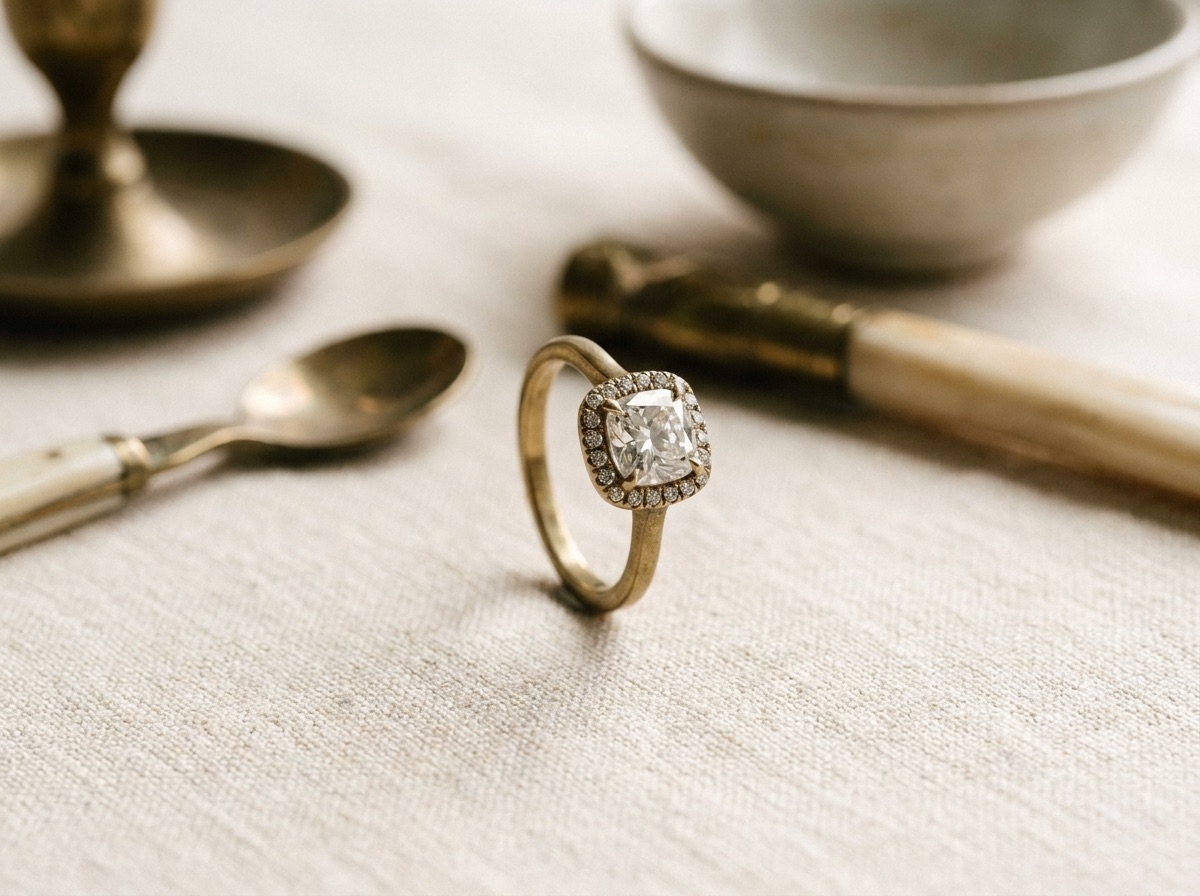
A brilliant-faceted cushion in a low-profile solitaire showcases the outline cleanly and reads bright and classic — the closest cushion gets to a round brilliant's single-glance impact, with the added visual interest of the pillow shape. A modified brilliant or antique-faceted cushion tends to be the better call for a halo: the denser, more textured sparkle of the center stone plays well against a ring of smaller round melee, and the "crushed ice" look that can feel understated in a solitaire reads as intentional and rich once it's surrounded by a halo's additional light.
Three-stone and matched side stones
Cushion centers commonly get flanked by trapezoids, tapered baguettes, or smaller matched cushions for a three-stone build — the rounded corners of the center stone soften the transition into straight-edged side stones better than a shape with sharp points would. Matched pairs are a standing request across the cushion category, whether for stud earrings or symmetric side stones on a single ring; see our matched pairs sourcing guide for how ratio- and color-matching works in practice.
Fancy color cushion for statement pieces
Cushion is the highest-volume shape in Guru Diam's fancy color category, and there's a real optical reason for it: the broader pavilion facets common to cushion faceting hold and return body color more effectively than a shape cut purely to maximize colorless brilliance, which is exactly what a fancy color stone needs to show off its hue. Guru Diam's certified fancy color loose inventory covers yellow, pink, blue, and green cushion stones. Full color-by-color detail, availability, and sourcing guidance live in our fancy color cushion cut guide.
Sourcing cushion cut diamonds wholesale
Realistically, cushion is easy to find as a generic listing and hard to find with real depth across all four variants in one place — most wholesalers stock the standard brilliant heavily and treat antique, modified, and elongated cushions as afterthought SKUs, if they carry them at all. Guru Diam runs 382 pieces deep across the full cushion family, so a request for a specific variant — antique faceting, elongated proportions, extra sparkle — is a normal order against current stock, not a special-order gamble. Matched pairs for studs or side stones are a standard request across the category; see our matched pairs sourcing guide for how pair-matching works.
Guru Diam sources cushion cut diamonds as wholesale, trade-only inventory — no retail markup — from our New York Diamond District desk (36 West 47th Street, Suite 601A) and our Los Angeles office (607 South Hill Street, Suite 241). In-stock pieces ship same-day from New York. For a custom setting, CAD-to-finished-piece turnaround runs 4–6 days.
How to order cushion cut diamonds wholesale
Ordering against current stock is a straightforward three-step process for a verified trade account. First, open a wholesale account — verification confirms trade-buyer status and unlocks trade pricing across the full catalog, not just cushion. Second, request a spec sheet or hold list for the specific variant, ratio range, color, and clarity you need; because all four cushion variants are cut in-house against current stock, most spec requests get a same-day answer rather than a multi-day sourcing round-trip. Third, book time with a gemologist to walk through stone options before committing, especially for a matched-pair order or a client-specific antique-faceting request where seeing options side by side matters more than reading spec numbers off a report.
Ready to buy? Open a verified wholesale account at /signup and book time with a gemologist at /book-appointment.
FAQ
What is a cushion cut diamond? A cushion cut diamond is a square-to-rectangular shape with rounded "pillow" corners. Within that outline, it can be cut as a standard brilliant, a modified brilliant (extra facets for denser sparkle), an antique-faceted stone, or an elongated (rectangular) variant.
How many cushion cut lab-grown diamonds does Guru Diam have in stock? 382 pieces, across cushion brilliant, cushion modified brilliant, antique cushion, and elongated cushion — CVD-grown and IGI-certified as standard, with GIA or GCAL certification available on request.
What's the difference between the cushion cut types? Cushion brilliant is standard modern faceting; cushion modified brilliant adds extra facets for denser sparkle; antique cushion carries historical high-crown, open-culet faceting; elongated cushion has a rectangular rather than square outline. See our types of cushion cut guide for the full comparison.
What does "crushed ice" mean in a cushion cut diamond? It's trade shorthand for the fractured, sugary pattern of small light-and-dark facets common in cushion modified brilliant and some antique-faceted stones, caused by extra facet rows breaking up the light. It's a style outcome, not a defect — some buyers want it specifically, others prefer the fewer, larger flashes of a standard brilliant cut.
Can I order a matched pair of cushion cut diamonds? Yes. Matched pairs for stud earrings or side stones are a standard request across our cushion inventory — see our matched pairs sourcing guide for how matching works.
How fast can I get a cushion cut stone or a finished custom piece? In-stock pieces ship same-day from New York. Made-to-order cutting plus a finished custom piece (CAD to jewelry) runs 4–6 days from our New York and Los Angeles desks.