
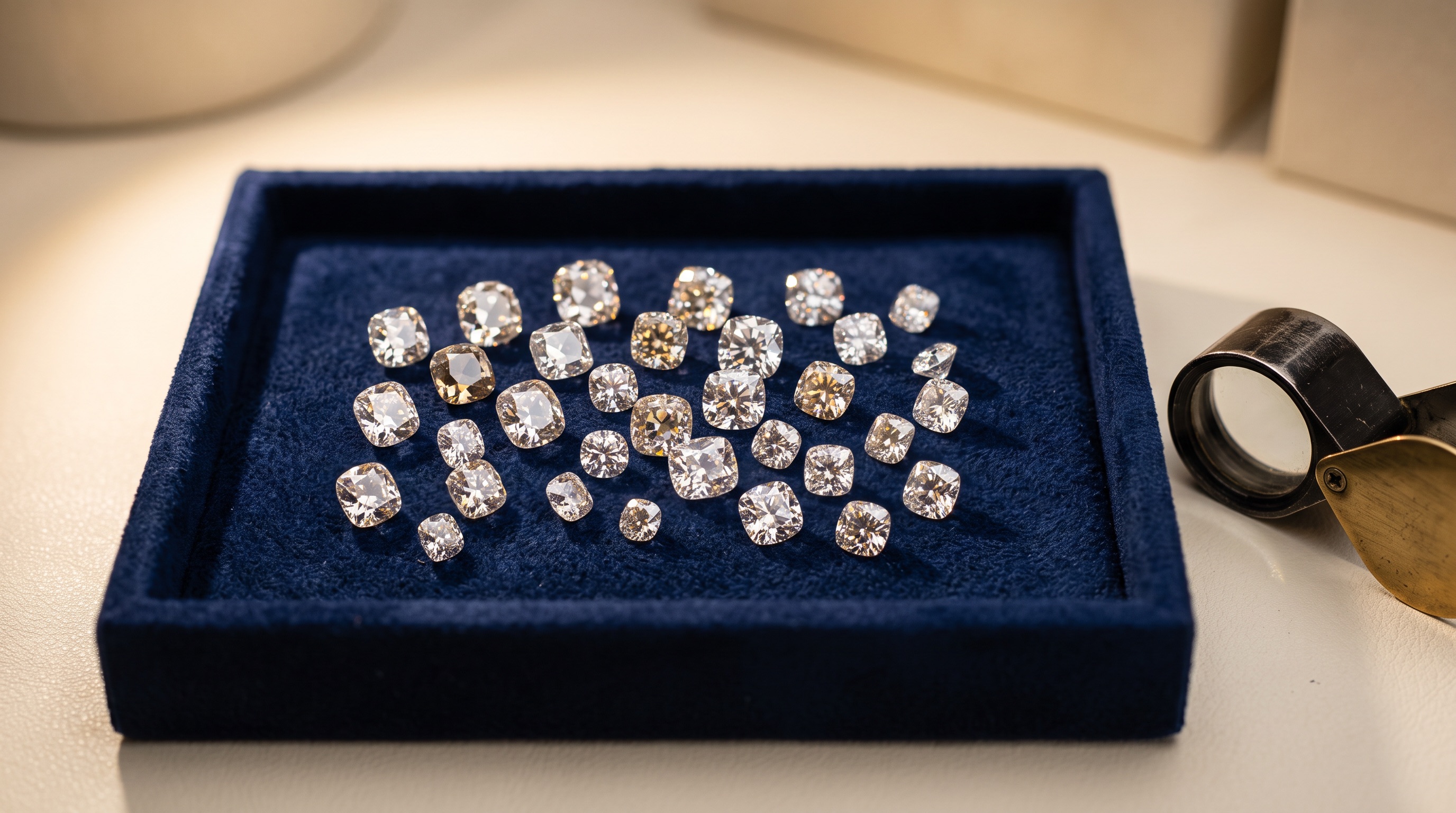
"Antique cushion" and "Old Mine Cut" get used interchangeably in retail marketing, but they're not the same claim. Old Mine Cut is a specific historical faceting standard — high crown, large open culet, chunky hand-cut-style facets. "Antique cushion" is a looser modern marketing term that sometimes means true Old Mine faceting and sometimes just means a standard cushion brilliant set in a vintage-style mounting. Guru Diam stocks both as part of a 382-piece cushion inventory, CVD-grown and IGI-certified.
If you've quoted a client "antique cushion" and had a stone come back that reads more crisp and brilliant than they expected, this is why: the term isn't standardized in the trade the way a lab-grading term is, and two dealers can mean two different stones when they use it.
This guide is a straight head-to-head: how the two are actually faceted, where each term came from historically, how each looks face-up, how Guru Diam sources and cuts both, what drives price on each, how to spec and style them, and how to order either wholesale. For the deep technical reference on Old Mine faceting itself — measurements, comparison against Old European Cut — see our Old Mine Cut vs. Old European Cut guide. For the broader cushion category — all four faceting variants, not just the antique-labeled one — see our full cushion cut types guide. This page exists specifically for the comparison in between: where the marketing label and the historical cut overlap, and where they don't.
What "antique cushion" actually means when a buyer says it
Direct answer: it depends who's saying it, and that's the core problem. In consumer-facing marketing, "antique cushion" is frequently used as a style descriptor — a cushion-shaped diamond, cut with standard modern brilliant faceting, sold or set to evoke a vintage look. In trade and gemological use, "antique cushion" more often signals actual antique faceting character: higher crown, larger and sometimes visible culet, fewer and larger facets that throw broad, warm flashes instead of tight brilliant fire. Both usages are common enough that the term alone doesn't tell you which stone you're getting — you have to ask for the faceting spec, not just the name.
Part of why the term drifted is that it's genuinely useful shorthand for a buyer without gemological vocabulary: "antique" reads as romantic, "cushion" reads as the soft, pillow-shaped outline seen in estate pieces or vintage-inspired boards — it's describing a feeling, not a crown angle. The problem shows up a level down the supply chain, when a jeweler repeats that same phrase to a wholesale desk expecting it to function as a spec rather than a mood. Two dealers hearing "antique cushion" can reasonably fill the order two different ways and both be technically correct, because neither the retail market nor most wholesale price lists have standardized which meaning wins.
What Old Mine Cut specifically means
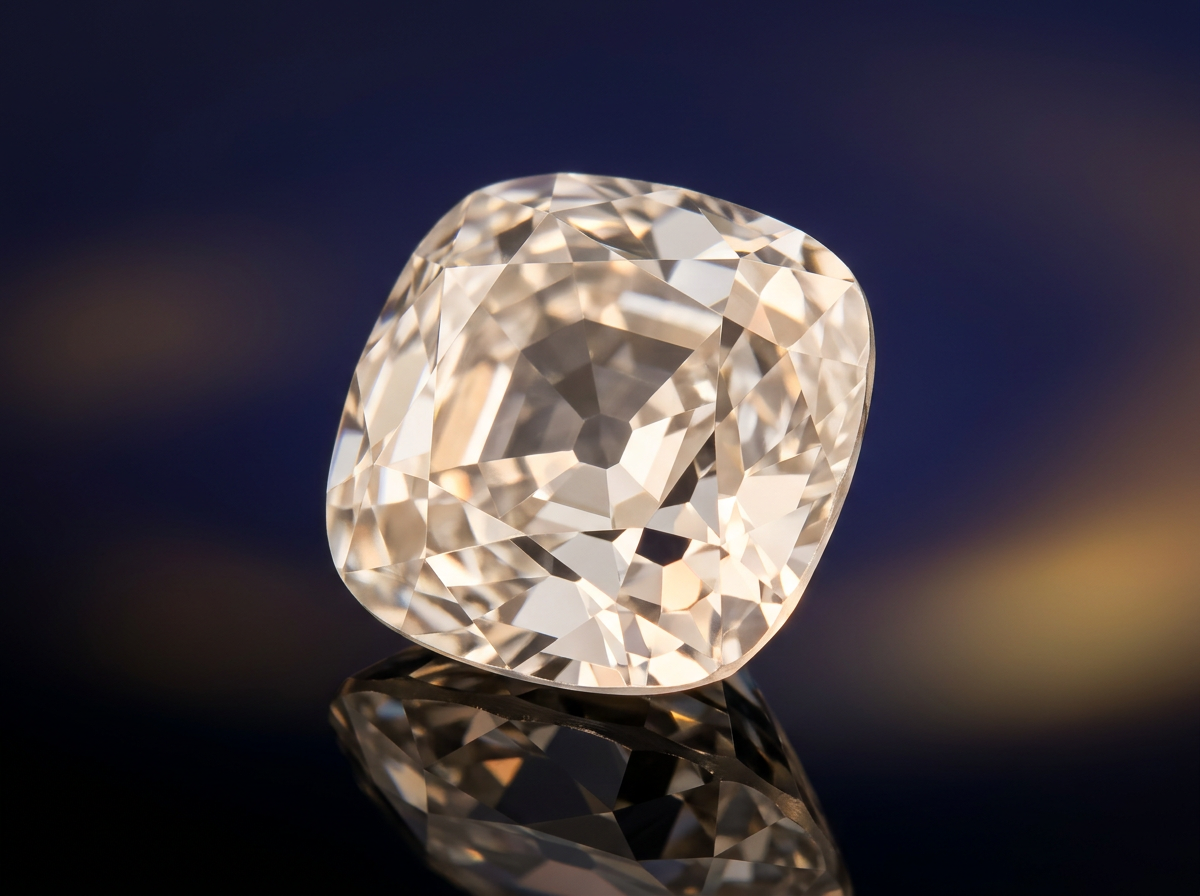
Old Mine Cut is not a style adjective — it's a defined historical cut with a consistent faceting profile: a high crown, a small table, a large open culet (often visible as a small flat facet at the point, rather than coming to a sharp bottom), and irregular, chunky, hand-cut-style facets that produce a soft, candlelit glow rather than crisp modern brilliance. The classic Old Mine outline is a squarish cushion with rounded corners — which is exactly why the two terms get conflated. For the full technical definition, history, and comparison against Old European Cut, see our Old Mine Cut vs. Old European Cut guide — that page is the canonical deep reference for the cut itself; this page exists specifically to clarify where it does and doesn't overlap with "antique cushion" as a category label.
The proportions are the tell. Where a modern brilliant is engineered for a table in the high-50s to low-60s percent range and a crown low enough to keep the stone efficient under bright, even light, Old Mine Cut typically runs a noticeably smaller table and a taller crown, which shifts how weight sits in the stone and how light exits it. Because these were hand-faceted stones cut without today's precision bruting and faceting machines, no two are perfectly identical — girdle outlines run slightly uneven, facet sizes vary stone to stone, and that irregularity is part of the character, not a flaw to be corrected. When Guru Diam cuts Old Mine Cut today, that deliberate irregularity is preserved rather than engineered out — a true Old Mine reproduction that comes back perfectly symmetric has actually missed the brief.
Facet structure, side by side
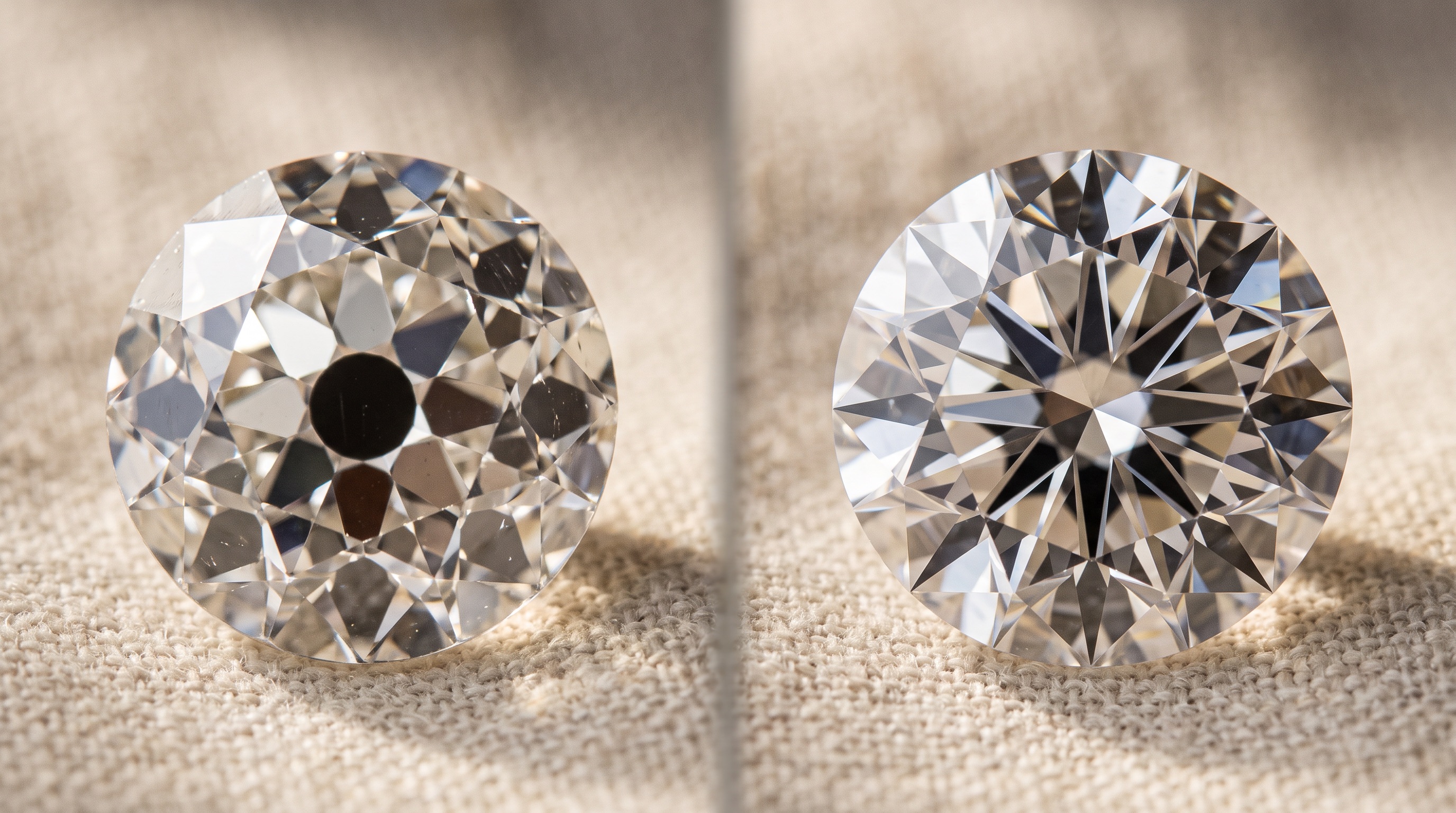
The clearest way to separate the two is to stop talking about "antique cushion" as one thing and instead ask which faceting pattern is actually on the stone. A cushion brilliant — the pattern most "antique cushion" stock is actually cut to — follows a crown-and-pavilion structure close to a round brilliant reshaped onto a pillow outline, engineered for even light return under modern lighting. Old Mine Cut faceting is a different arrangement built around a taller crown and a larger, often visibly open culet, deliberately not optimized for maximum brilliance the way a modern brilliant is.
Crown, culet, and facet count in numbers
A standard cushion brilliant typically carries a table in roughly the high-50s to low-60s percent range, a moderate crown height, and a closed or minimal culet, with a facet count generally landing in the high-50s to low-60s — comparable to a round brilliant's 57-58 facets, just arranged around a squarish outline. Old Mine Cut runs meaningfully different: a smaller table, often in the low-to-mid 50s percent range, a distinctly higher crown, and a large culet — historically cut wide enough to be visible as its own small flat facet when the stone is viewed table-up, sometimes running as much as 15-20% of the girdle diameter on true period-faceted stones. Facet count on an Old Mine can run close to a standard brilliant's total, but the sizes and angles are irregular by design rather than machine-uniform, which is the structural reason the two cuts throw such different light even when the raw facet count looks similar on paper.
| Attribute | "Antique cushion" (as commonly marketed) | Old Mine Cut (specific historical cut) |
|---|---|---|
| What it refers to | A style/marketing label — often just a cushion in a vintage-style setting | A defined historical faceting standard |
| Facet pattern | Frequently standard modern brilliant | High crown, open culet, chunky hand-cut-style facets |
| Consistency of the term | Not standardized — varies by dealer | Consistent, gemologically defined |
| Table size | High-50s to low-60s percent, engineered for even light return | Low-to-mid 50s percent, smaller and less efficient by modern standards |
| Culet | Closed or minimal | Large, often visibly open |
| Light behavior | Can be crisp modern brilliance, despite the "antique" label | Soft, warm, low-contrast glow |
| Outline | Cushion (square-to-rectangular, rounded corners) | Squarish cushion, rounded corners — same family |
| How to verify | Ask for the specific facet spec, not just the name | Confirm crown height, culet size, and facet count/pattern |
Where these two terms came from
Old Mine Cut's name has nothing to do with age as a marketing concept — it refers to where the rough came from. Through the 1700s and into the 1800s, diamond rough reaching European cutting centers was sourced primarily from India and Brazil, the "old" mines, as distinct from the South African deposits discovered in the 1870s that fed the next generation of cutting style, Old European Cut. Cutters working that era's rough, under candlelight and later gaslight rather than electric light, favored high crowns, small tables, and large culets — a faceting philosophy built to catch and hold weak, flickering light rather than to maximize brilliance under bright, even illumination. That faceting style, applied to a squarish outline with rounded corners, is what the trade calls Old Mine Cut today.
When electric lighting became standard through the early 20th century, cutting style shifted hard toward what eventually became the modern round brilliant — lower crowns, no culet, faceting engineered for maximum fire under strong, consistent light. Old Mine faceting fell out of commercial production almost entirely, surviving mainly in original period pieces rather than as an active cutting style. "Antique cushion" has a much more recent history — a late-20th and early-21st century retail-marketing coinage that grew alongside the vintage-inspired bridal trend, describing any cushion-outline stone marketed to evoke that period look, whether or not the faceting matched historical Old Mine proportions. That gap between a genuinely revived historical cut and a modern marketing label borrowing its outline is the entire source of the confusion this guide exists to resolve.
Face-up look: Old Mine glow vs. cushion brilliance
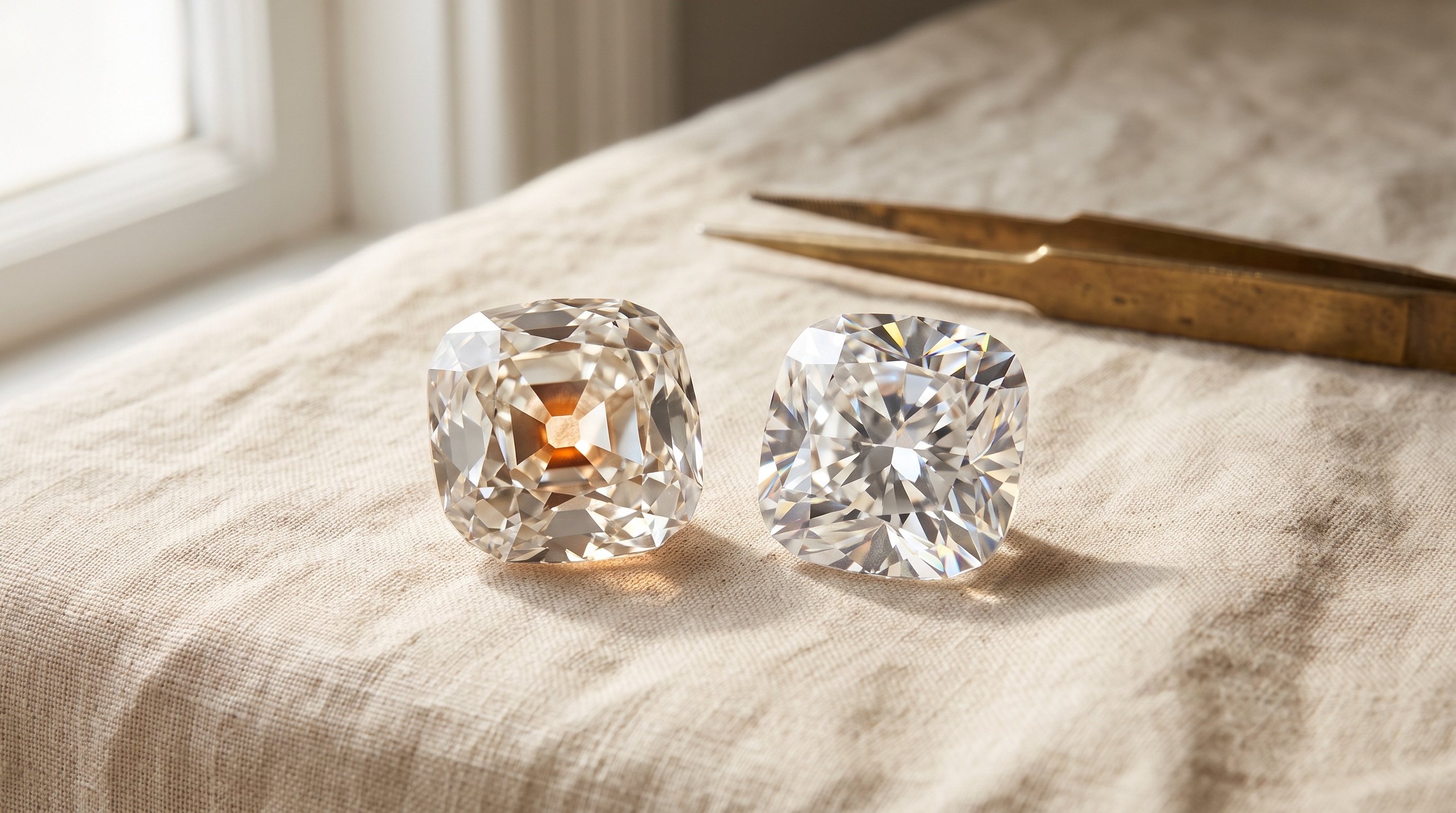
The two cuts don't just measure differently — they behave differently in a client's hand, and that's usually the fastest way to confirm which one you're actually looking at when the paperwork alone doesn't settle it. A cushion brilliant throws distinct, higher-contrast flashes of light, closer in character to a round brilliant than most buyers expect from a "vintage" stone — bright, punchy, reads well under strong showroom lighting and in photography. Old Mine Cut produces a broader, softer glow: fewer and larger facets mean fewer individual points of light, but each one is bigger and warmer, and the large open culet can let a small amount of light pass straight through rather than reflecting back to the eye — historically described as a slightly "sleepy" look, and prized specifically for that quality rather than despite it.
This is also where client expectations most often go sideways. A buyer who has only seen "antique cushion" used for a bright modern stone, then handed a true Old Mine Cut for the first time, can read the softer glow as underwhelming rather than intended — it looks noticeably different under harsh loupe light than under the warm ambient light it was cut for. The reverse also happens: a client wanting that soft glow who gets a standard cushion brilliant labeled "antique" will notice it reads brighter and more modern than expected. Setting that expectation before the sale, not after, is the actual value of knowing which cut is which.
How Guru Diam sources and cuts each
Both are cut in-house, from CVD-grown rough selected specifically for the faceting style being targeted — rough suited to a standard cushion brilliant isn't automatically the right rough for a true Old Mine reproduction, because the proportions and yield math are different from the outset. Cushion brilliant and cushion modified brilliant faceting follow a written, repeatable proportion spec, which is why that side of the inventory can run deep and consistent across 382 pieces. Old Mine faceting is deliberately slower and more hand-finished work: the crown height, culet size, and controlled asymmetry that define a correct Old Mine reproduction don't come off a standardized cutting program the way a modern brilliant does, so it's produced in smaller, more deliberate batches rather than high-volume runs.
Every finished stone across both categories goes through in-house QC grading against a DEF+/VS+ baseline before it enters certified stock. Because cutting sits in-house rather than being routed through a third-party cutting house, a buyer asking for a specific ratio, culet size, or a particular degree of antique faceting character is placing a normal production request against current planning, not asking for a special favor that has to be negotiated stone by stone.
Grading and certification considerations for each
IGI is the standing certification default across both categories, with GIA and GCAL available on request — all three are legitimate labs for either stone, and the choice usually comes down to what the client's market or resale channel prefers rather than any difference in the underlying grading. Where the two diverge is in how well a standard grading report actually captures what makes each stone what it is. Labs generally don't assign a formal cut grade to fancy shapes, cushion included, which means the color, clarity, and carat lines on a certificate for either an antique cushion or an Old Mine Cut are directly comparable to any other cushion-outline stone — but the proportions that define the faceting character, crown height, culet size, table percentage, aren't summarized into a single graded line the way they would be for a round brilliant. That's exactly why trade buyers ask for the actual measurements rather than trusting a shape label alone.
Color grading needs a small adjustment for Old Mine specifically: the large open culet and broader facets can make body color read slightly warmer face-up than the same grade would in a tightly faceted modern cut — expected, and part of the intended look rather than a grading concern. Clarity works the other direction: the large culet can make inclusions near the pavilion tip marginally more visible than in a busier modern pattern, which is why eye-clean VS2 and above is the common trade floor for Old Mine and antique-faceted cushion center stones alike.
What drives price on each
Inside Guru Diam's own production and pricing structure, this distinction isn't cosmetic — it's structural. Old Mine Cut is tracked as an Antique-tier cut, the premium category that also covers Old European, Hexagonal, Moval, Lozenge, Kite, Trillion, Criss-Cut, and Padparadscha — cuts that demand slower, more deliberate hand-finishing and are priced accordingly. Cushion, whether cut as brilliant, modified brilliant, or styled to evoke an antique look, is tracked as a Regular fancy cut alongside Emerald, Asscher, Oval, Pear, Marquise, Radiant, Princess, and Heart. That means a stone quoted as "antique cushion" off a cushion inventory list — even one carrying genuinely higher-crown faceting — is priced and produced within the cushion category, not the antique-cut premium tier. If a client's brief actually calls for antique-tier handling and pricing, Old Mine Cut is the SKU that delivers it; ordering "antique cushion" and expecting antique-tier treatment is the most common mismatch on a wholesale quote.
Why true Old Mine commands a premium
Beyond the tier itself, three factors compound the gap. Yield: the high-crown, open-culet proportions that define correct Old Mine faceting sacrifice more finished carat weight from a given piece of rough than an efficient modern cushion brilliant does. Labor: hand-finished, irregular faceting takes longer per stone than a repeatable, machine-assisted proportion spec, and that time shows up directly in cost. Scarcity: because most cutting capacity is built around modern brilliant faceting, fewer cutters and less rough get routed toward true Old Mine work, keeping supply tighter than for a high-volume shape like cushion. A cushion brilliant or modified brilliant marketed as "antique," by contrast, is cut on the same efficient modern spec as any other cushion — the vintage-inspired setting does the styling work, not the faceting, which is why it's priced at standard cushion levels rather than antique-tier levels.
Styling and setting guidance
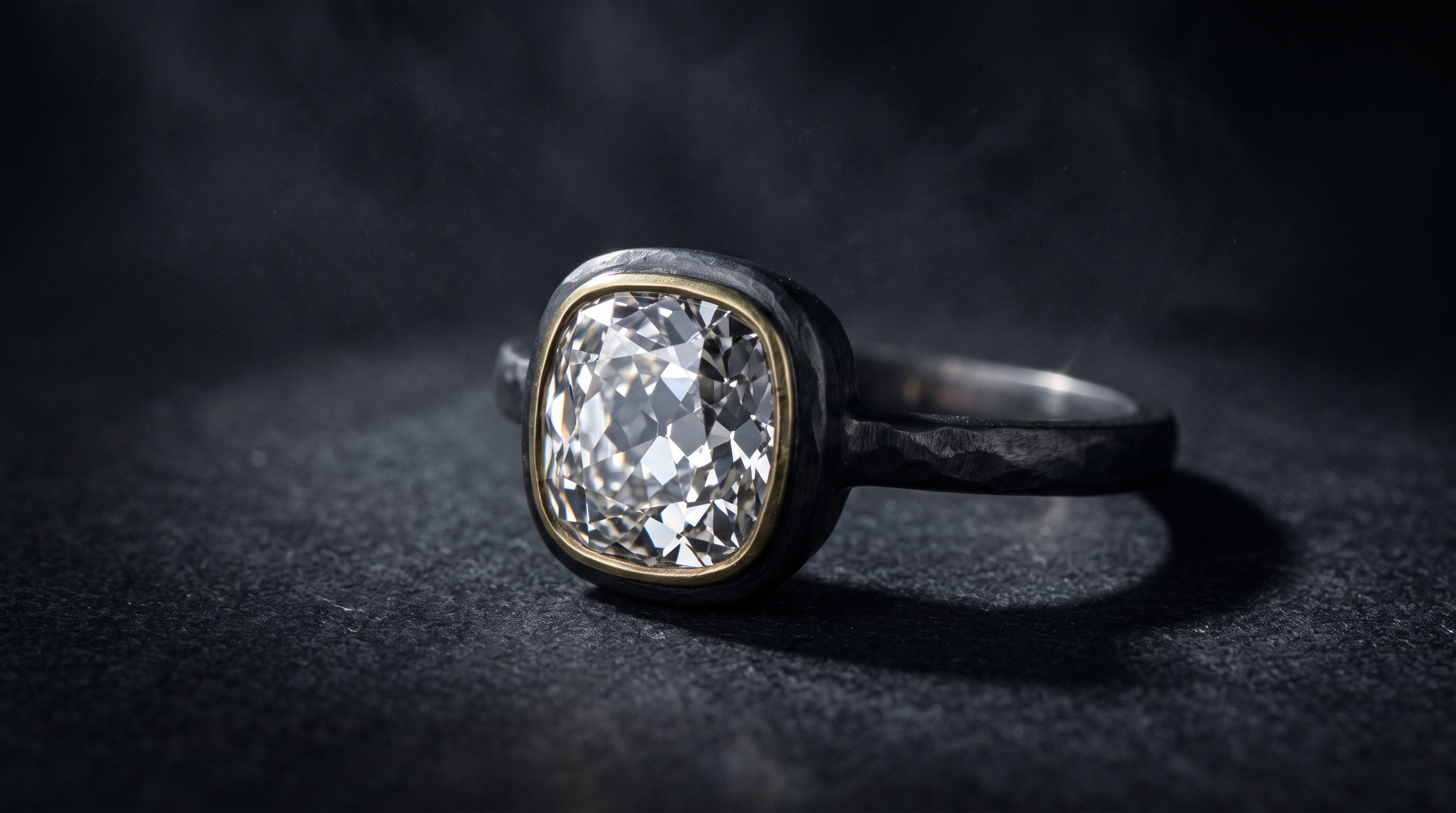
Old Mine Cut pairs naturally with settings built to match its period, not fight it. Bezel and collet settings, especially button-back or "Georgian-back" closed-back collets in black-rhodium-plated 18k yellow gold, put the stone's high crown and warm glow against a dark, architectural setting for maximum contrast — the look associated with true period-inspired jewelry rather than a generic vintage aesthetic. Milgrain detailing and a low, protective setting profile also suit Old Mine well, since the goal is usually to let the stone's own irregular character read as the design statement rather than layering ornamentation on top of it.
A cushion brilliant or cushion modified brilliant marketed as "antique cushion" has a wider practical styling range, because it's optimized for brightness rather than period accuracy — it holds up in a classic halo, a pavé shank, a split-shank, or a straightforward four- or six-prong solitaire without any of those settings fighting the stone's light return. Halo settings in particular play well against the denser, more textured sparkle of a modified brilliant faceting pattern. For clients specifically choosing between a square versus rectangular outline in that same brilliant-cut cushion family, our elongated cushion cut guide covers ratio selection for finger coverage. Matched pairs — for stud earrings or symmetric side stones — are a standard request across both categories; see our matched pairs sourcing guide for how ratio- and color-matching works in practice.
Buyer decision guide: which to order, and when
Start with what the client is actually describing, not the word they used. If a client wants "an antique cushion" and what they're pointing to is a soft, warm, low-contrast glow — the specific look of a period-cut stone — the correct order is Old Mine Cut, spec'd by crown height, culet size, and facet pattern, not by the phrase "antique cushion" alone. If instead they're describing a pillow-shaped stone in a vintage-inspired mounting with bright, distinct sparkle rather than a soft glow, a standard cushion brilliant or modified brilliant is the correct — and meaningfully cheaper — order, and calling it "antique cushion" on the invoice is fine as long as everyone understands it's a styling description, not a faceting spec.
The fix worth building into every quote request is simple: never order off the name alone. Ask the client, or ask the dealer offering the stone, three questions before committing — what's the crown height relative to the stone's diameter, is the culet closed or open and roughly what size, and what's the approximate facet count and pattern. Those three answers separate a true Old Mine reproduction from a modern cushion in a vintage setting faster and more reliably than any amount of back-and-forth over the word "antique." When in doubt, request both options side by side rather than committing to one off a written description — the visual difference under real light is usually more decisive than any spec sheet.
Sourcing both, correctly labeled — how to order wholesale
Guru Diam stocks both true Old Mine Cut inventory and standard cushion brilliant/modified brilliant cushions within our 382-piece cushion category, CVD-grown and IGI-certified as standard, GIA and GCAL available on request, from our New York Diamond District desk (36 West 47th Street, Suite 601A) and our Los Angeles office (607 South Hill Street, Suite 241). Because we label by actual facet spec rather than marketing shorthand, what you order is what you get — an Old Mine Cut request comes back with true antique faceting, and a cushion brilliant request comes back cut to modern brilliant proportions, regardless of which one gets called "antique" on a client-facing quote.
Ordering against current stock follows the same three-step process either way. Open a verified wholesale account to unlock trade pricing across the full catalog. Request a spec sheet or hold list specifying crown height, culet size, and facet pattern rather than just the shape name — since both faceting styles are cut in-house against current planning, most spec requests get a same-day answer. For an antique-faceting order or a client-specific request where the visual difference matters more than reading numbers off a sheet, book time with a gemologist to compare stones side by side before committing. In-stock loose stones ship same-day from New York; a custom setting built around either cut runs 4–6 days from CAD to finished piece.
Ready to buy? Open a verified wholesale account at /signup and book time with a gemologist at /book-appointment.
FAQ
Is antique cushion the same thing as Old Mine Cut? Not necessarily. "Antique cushion" is a loosely used marketing term that can mean true Old Mine faceting (high crown, open culet, hand-cut-style facets) or simply a standard modern cushion brilliant styled in a vintage-inspired setting. Old Mine Cut is a specific, gemologically consistent historical cut. Always confirm the facet spec, not just the name.
Why do these two terms get confused so often? Because the classic Old Mine Cut outline is a squarish cushion with rounded corners — the same broad shape family as a modern cushion. Retail marketing borrowed "antique" as a style descriptor for that outline without necessarily meaning the historical faceting, which is where the two terms blurred together.
How do I know if a stone labeled "antique cushion" has true Old Mine faceting? Check the crown height, culet size, and facet count. True Old Mine faceting has a noticeably high crown, a large often-visible culet, and fewer, larger, hand-cut-style facets. A standard cushion brilliant will have a lower crown, closed or minimal culet, and a standard ~58-facet brilliant pattern.
Should I order "antique cushion" or "Old Mine Cut" for a client who wants the true vintage look? Order Old Mine Cut specifically. It's the gemologically defined term and guarantees the faceting character. "Antique cushion" alone is too ambiguous to guarantee the same result across dealers.
Does the pricing tier actually differ between the two? Yes. Old Mine Cut is tracked internally as an Antique-tier cut — the same premium category as Old European and Hexagonal — because of its slower hand-finishing and lower rough yield. Cushion, including stones marketed as "antique cushion," is tracked as a Regular fancy cut and priced at standard cushion levels regardless of how vintage the setting around it looks.
Are Old Mine Cut and antique cushion diamonds available lab-grown and certified? Yes. Guru Diam's inventory across both is CVD-grown and IGI-certified as standard, with GIA and GCAL certification available on request.