
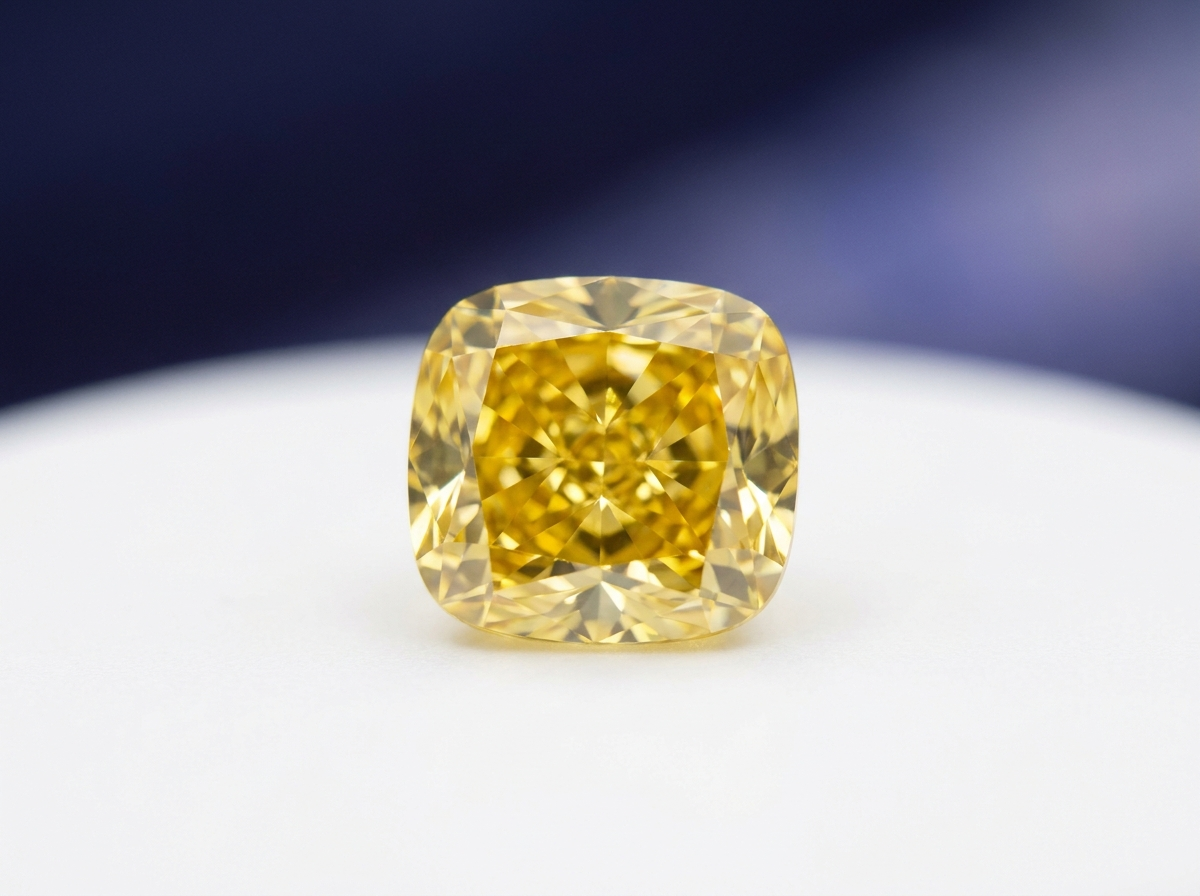
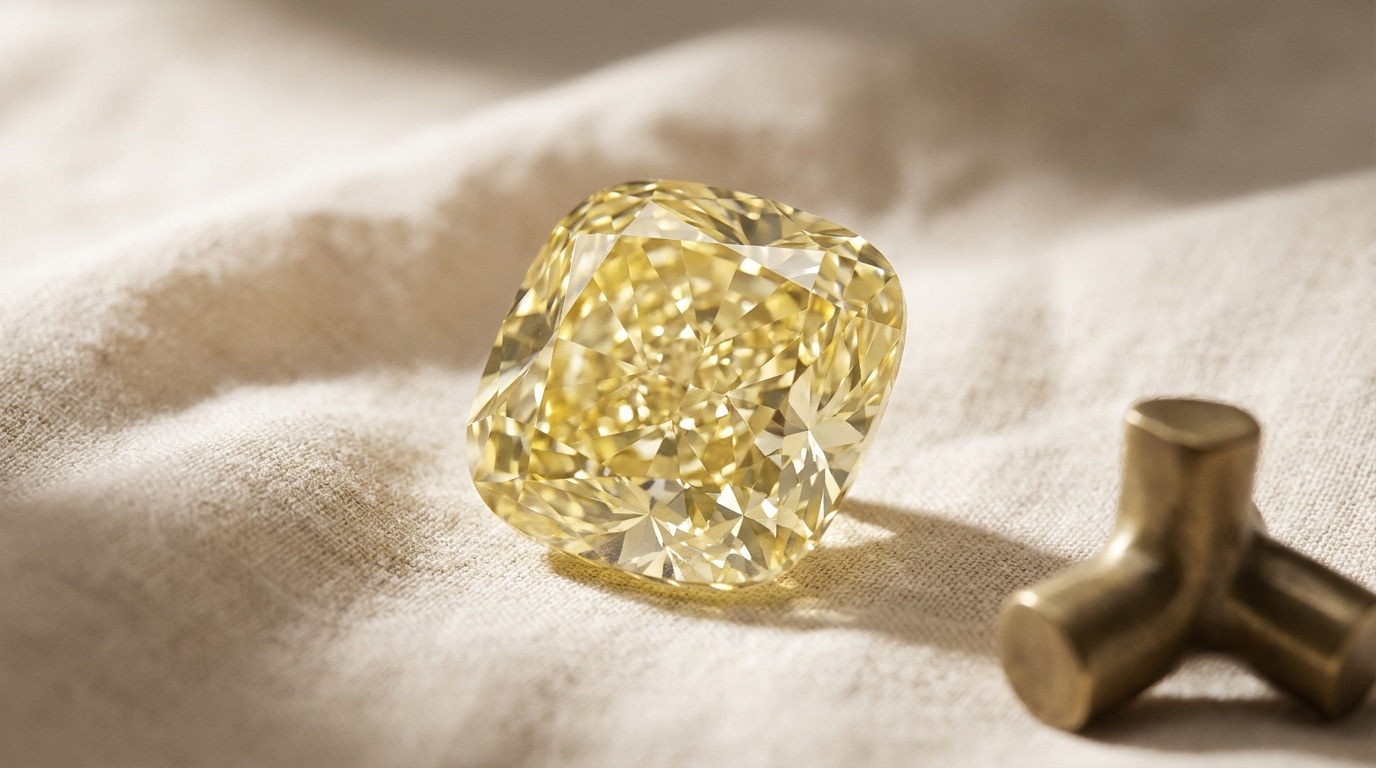
A fancy color cushion cut diamond pairs a squared, rounded-corner "pillow" outline with a mixed brilliant-and-step facet arrangement built to hold color evenly across the face-up view. It's the deepest-stocked fancy color shape in Guru Diam's catalog, and for good reason: cushion's facet geometry is simply the best all-around performer for showing saturated hue without sacrificing the sparkle jewelers' clients expect. This guide covers how the cut works, how fancy color grading actually reads on paper, what to check before buying, what drives price, how to style it, and how a wholesale buyer orders.
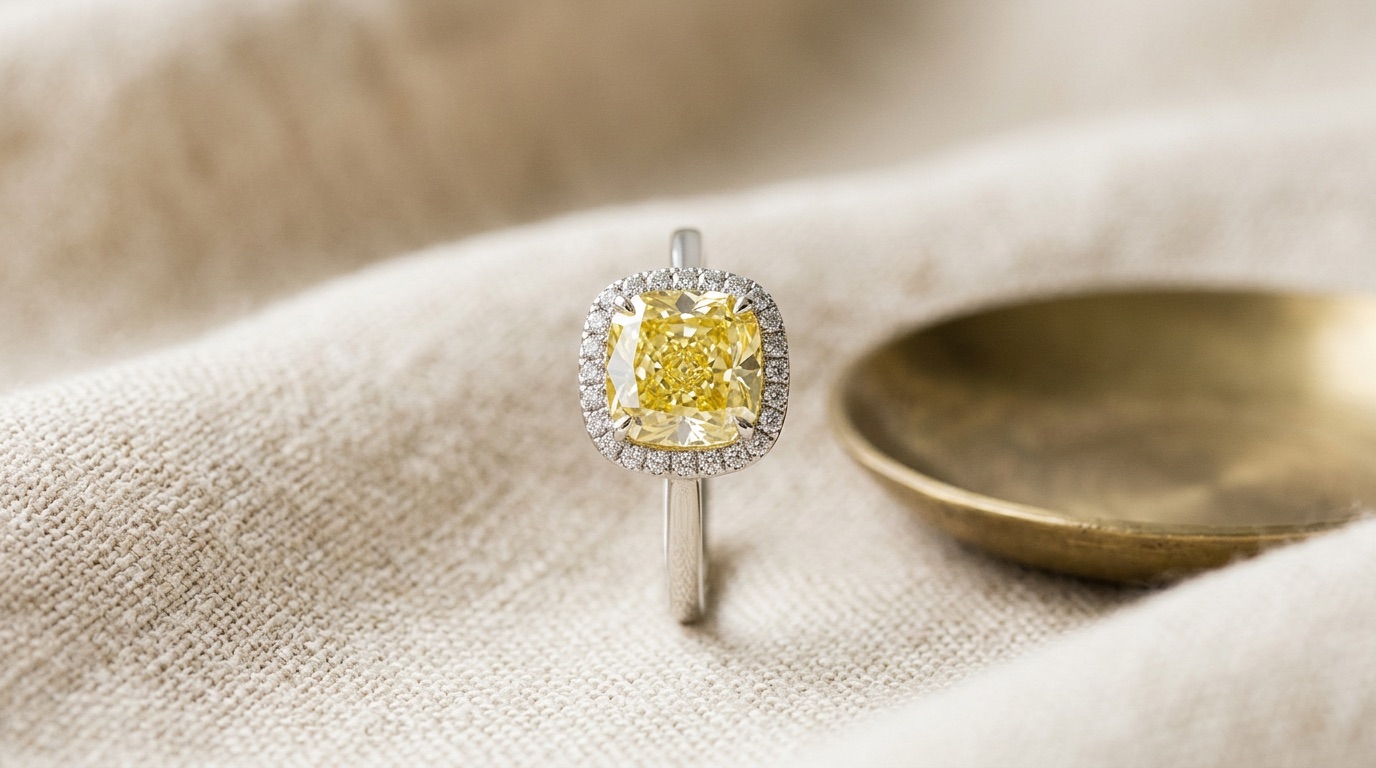
What Is a Fancy Color Cushion Cut Diamond?
A cushion cut is a square-to-rectangular outline with softened, rounded "pillow" corners — the name comes from the resemblance to an old-fashioned cushion or pillow shape. Structurally, it's a mixed cut: the crown is faceted in the brilliant style to generate fire and scintillation, while the pavilion is cut broader and flatter than a round brilliant's, with fewer, larger facet planes doing more of the work of returning light. That combination is exactly why cushion shows up so often in fancy color inventory relative to its share of colorless production — it borrows brilliance from round-style faceting without giving up the color-holding depth of a step cut.
Guru Diam's fancy color cushion inventory is CVD-grown and cut in-house, certified through IGI as standard with GIA and GCAL available on request. It's the deepest-stocked shape across Guru Diam's certified fancy color loose-stone program, spanning the full locked palette — yellow, pink, blue, and green. The broader diamond trade includes other fancy hues, including champagne and cognac tones more commonly associated with natural brown-series stones; those exist in the market generally and are mentioned here for trade context only, not as part of Guru Diam's stocked or made-to-order cushion offering.
A Brief History of the Cushion Cut in Colored Diamonds
Cushion is one of the oldest cutting styles still in commercial production, tracing back to 18th- and 19th-century "old mine" cuts — high-crown, small-table, deep-pavilion stones cut to maximize fire under candlelight rather than the bright fluorescent and LED lighting diamonds are graded under today. That ancestry matters for fancy color specifically: early cutters worked with rough that frequently carried body color, and a disproportionate share of historic fancy color diamonds — including some of the most famous named colored diamonds in trade history — were cut as cushions. The shape and fancy color have been paired in the trade for longer than almost any other cut-and-color combination, and modern cushion cuts split into two general facet families that inherit different pieces of that history — covered next.
Cushion Facet Structure and the "Crushed Ice" Fancy-Color Effect
Within "cushion cut," cutters generally produce one of two distinct facet patterns, and they show fancy color differently.
Chunky Cushion vs. Crushed-Ice Cushion for Color
A classic or "chunky" cushion — closer to the old mine ancestry above — uses fewer, larger facets, similar in spirit to a step cut's broad planes. Light travels further inside the stone before it exits, which carries more body color back to the eye and produces a smaller number of large, distinct color "flashes" as the stone moves. This is the pattern most associated with deeply saturated, high-drama fancy color stones — large fancy vivid yellows and fancy intense pinks are frequently cut this way specifically because the big facets show off strong saturation dramatically.
A modern "crushed ice" cushion — a cushion modified brilliant, built from many small, irregularly arranged facets rather than a handful of large ones — produces a fractured, glittering, almost sugar-like face-up texture instead of distinct flashes. For colorless diamonds, crushed ice is mostly a sparkle-style trend. For fancy color stones specifically, it does something more functional: because the pavilion is broken into so many small planes, body color gets distributed evenly across the entire face rather than concentrated into a few broad zones — the stone reads as a continuous, glowing wash of hue. That evenness is also forgiving of minor color zoning within the rough, blending uneven color the way a mosaic blends individual tiles into a single image at a distance.
Guru Diam's cutting floor selects between the two facet families based on what a given piece of colored rough calls for: strongly and evenly saturated material is often cut chunky to let the color make its own statement; rough with any zoning or lighter starting saturation is more often cut crushed ice to even out the face-up read. Either way, the crown stays brilliant-faceted for scintillation — the difference lives in the pavilion.
How Fancy Color Grading Works: Hue, Tone, and Saturation
Fancy color diamonds are not graded on the D-to-Z colorless scale at all — that scale exists specifically to measure the absence of color. Fancy color stones are graded on three separate variables that together describe the color itself:
- Hue — the color family: yellow, pink, blue, or green, plus any secondary or modifying hue a lab notes on the report (a pink stone can carry a purplish or orangy modifier, for example, and a blue stone can lean slightly green or grey).
- Tone — how light or dark the color reads, independent of how intense it is.
- Saturation — how strong or concentrated the color is, from a faint wash to a powerful, saturated hue.
IGI and GIA both combine those three variables into an intensity scale that runs, roughly: Faint, Very Light, Light, Fancy Light, Fancy, Fancy Dark or Fancy Deep, Fancy Intense, and Fancy Vivid — with Fancy Vivid representing the strongest, purest expression of a hue and typically commanding the largest price step up from the grade immediately below it. GCAL uses comparable fancy color terminology, so a report from any of the three labs is directly comparable on hue, tone, and saturation language.
This is where cut and grading intersect for cushion specifically: two stones can carry the identical graded intensity term — both "Fancy Intense Yellow," say — and still look meaningfully different face-up depending on how the cutter oriented and faceted the rough. A well-cut fancy color cushion tends to read more saturated at a given grade than a poorly proportioned one, because the facet geometry is either concentrating that graded color efficiently or leaking it out through a too-shallow pavilion. The certificate tells a buyer what the lab measured; the cut determines how much of that measured color actually shows in the finished piece.
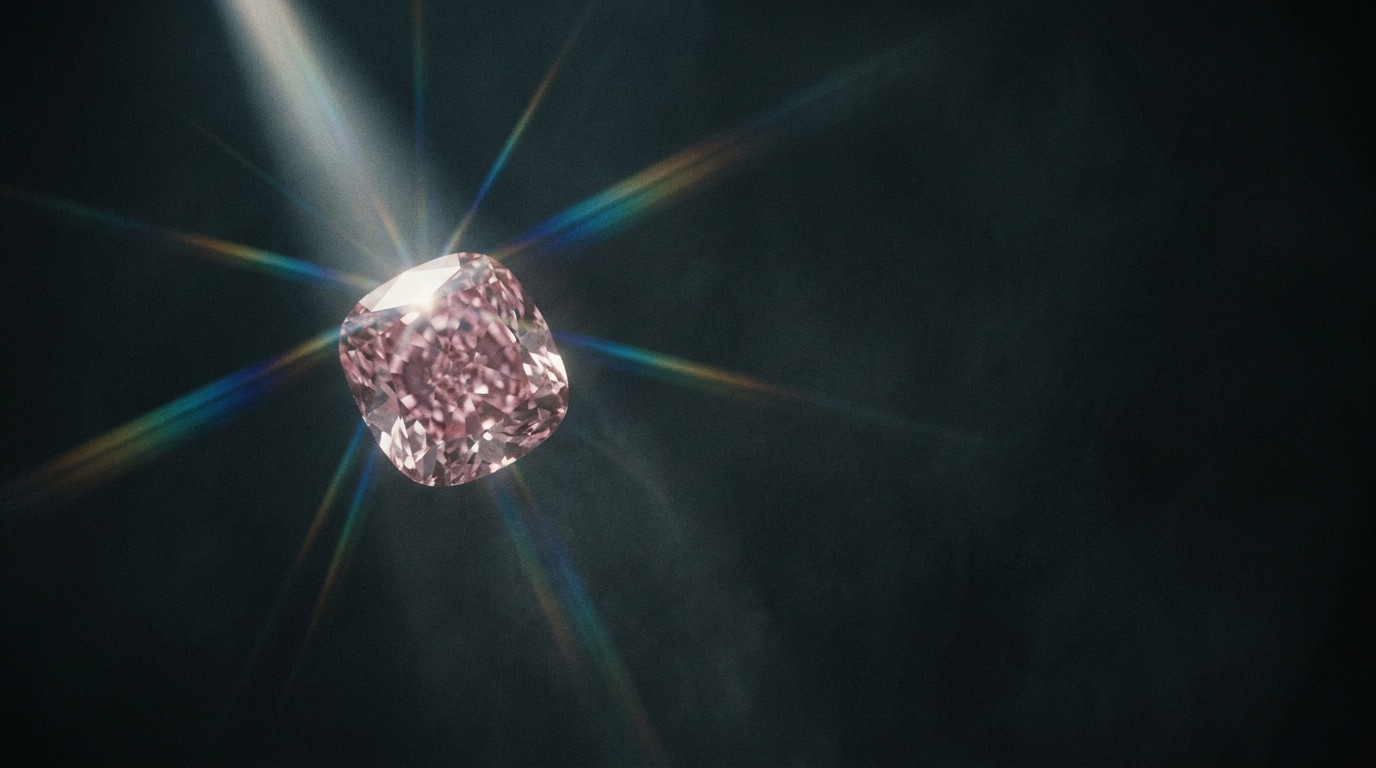
How Guru Diam Sources and Matches Fancy Color Cushion Diamonds
Color origin in CVD-grown diamond differs by hue. Fancy yellow typically comes from nitrogen incorporated into the crystal lattice during growth — built into the growth run itself, not a step applied afterward. Fancy blue typically comes from boron doping during that same growth phase. Pink and green are usually the product of a post-growth color treatment, a standard, disclosed step used broadly across the lab-grown trade. Every fancy color cushion Guru Diam certifies ships with its growth method and any treatment disclosed on the certificate — a condition of IGI, GIA, and GCAL grading, not an optional add-on.
Because cushion is the shape the cutting floor reaches for most often on colored rough, Guru Diam runs real depth here compared to specialty shapes like princess or Asscher — rough is selected for even color distribution, then oriented and faceted (chunky or crushed ice, per above) against what that particular piece of material shows once polished, rather than cut to a single fixed template. That's a different production discipline than cutting colorless goods, where the priority is carat yield first; on colored rough, yield is secondary to getting the color to read correctly face-up, which is part of why fancy color cushion output — the deepest bench in the catalog — still doesn't move at commodity-shape volume.
Quality Considerations Before Buying a Fancy Color Cushion Diamond
Because cushion's mixed facet structure is more forgiving than a pure step cut, buyers can generally accept a clarity grade a step or two below what they'd require in a step-cut shape like Asscher or emerald without a visible face-up tradeoff — the brilliant-style crown facets break up the view into the stone the way they do on a round brilliant, hiding minor inclusions that would be conspicuous under open step faceting. That's a real practical advantage, since a stronger body color already masks small inclusions more effectively than a colorless stone would.
A few things still matter more on a fancy color cushion than the intensity grade alone:
- Windowing. A pavilion cut too shallow lets light — and the body color riding on it — leak straight through the bottom of the stone instead of reflecting back to the eye, creating a washed-out zone near the culet. This is the single most common cut fault that undercuts an otherwise strong color grade.
- Extinction. The opposite problem — a pavilion cut too deep, where light gets trapped and reads as dark patches rather than a rich, even color. There's a narrower proportion window for a colored cushion than for a colorless one.
- Corner symmetry. Cushion's rounded pillow corners should read as a consistent curve on all four sides — visible asymmetry is easy to spot and affects resale as much as any grading factor.
- Color evenness across the table. Even with crushed-ice faceting doing some of the blending work, zoning can still show as a visibly stronger patch of color in one part of the stone. Ask to see the stone under consistent, neutral lighting rather than relying on a photo.
- Fluorescence. Worth checking on the certificate for blue and yellow cushions specifically, where strong fluorescence can shift the face-up color under UV-heavy lighting.
Guru Diam issues certification through IGI as standard on fancy color cushion stones, with GIA and GCAL available on request — all three use comparable fancy color nomenclature, so a report from any lab is directly comparable on hue, tone, and saturation terms.
What Drives Pricing on Fancy Color Cushion Diamonds
Fancy color pricing works on a different logic than colorless pricing, and it's worth walking through for buyers used to pricing white goods against the standard carat/color/clarity grid:
- Saturation is the primary driver, not clarity. A Fancy Vivid stone with modest clarity will often price above a Fancy Light stone with excellent clarity — color intensity is what a fancy color buyer is paying for.
- Hue rarity varies by color. Among yellow, pink, blue, and green, yellow is the most production-efficient to grow and cut, generally the most accessible entry point on price. Blue and pink, and particularly saturated green, are harder to produce consistently and price accordingly higher, even in lab-grown production.
- Facet family. A chunky, large-facet cushion cut for dramatic color flash on strongly saturated rough is a different cutting job than a crushed-ice cushion built to even out lighter or slightly zoned material — the facet decision follows from what the rough needed, which affects the cutting judgment behind the finished stone.
- Size premiums step up, not scale linearly. Price per carat jumps at breakpoints — roughly 0.50ct, 1.00ct, and 2.00ct — rather than climbing smoothly, reflecting how rarely larger colored rough of cushion-appropriate proportions comes through a growth run.
- Certification choice. IGI, GIA, and GCAL carry different turnaround and fee structures, one reason Guru Diam issues IGI as the standard and holds GIA and GCAL on request rather than certifying every stone through all three by default.
None of this is unique to Guru Diam — it's how the fancy color trade prices generally, lab-grown or natural. What's specific to a wholesale desk is that pricing comes without a retail markup layered on top.
Fancy Color Cushion: Spec and Current Availability
| Spec | Detail |
|---|---|
| Outline | Square to rectangular, rounded "pillow" corners |
| Facet style | Mixed brilliant crown; pavilion cut chunky (large facets) or crushed ice (small, irregular facets) depending on the rough |
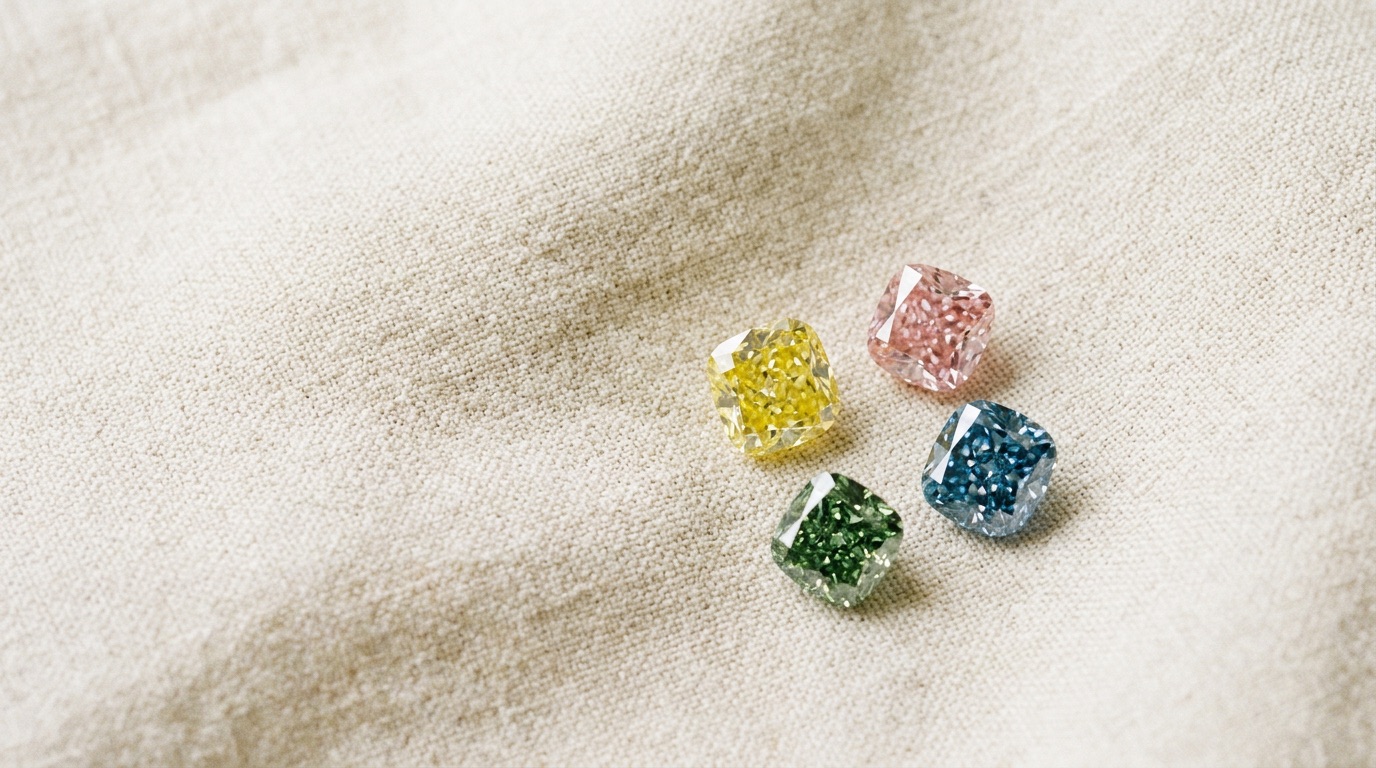
| Color palette (Guru Diam certified loose stock) | Yellow, Pink, Blue, Green |
| Growth method | CVD-grown |
| Certification | IGI standard; GIA available on request; GCAL available on request |
| Stone type | Certified single stones (not melee) |
| On-hand inventory | Deepest-stocked fancy color shape in the catalog — request current count and mix by hue |
| Typical uses | Engagement ring center stones, halo settings, statement rings, pendants |
Guru Diam's fancy color cushion inventory is drawn from the same locked color palette as the rest of the certified fancy color loose-stone catalog — yellow, pink, blue, and green. Other fancy hues, including champagne and cognac tones, exist in the broader diamond trade and appear in natural fancy color markets, but they are not part of Guru Diam's certified loose-stone cushion offering; a project brief calling for a color outside that palette gets a direct answer on realistic sourcing paths rather than a listing as stocked.
Styling and Setting Guidance for Fancy Color Cushion Diamonds
For jewelers building pieces around a fancy color cushion center stone, a few practical setting decisions come up repeatedly:
- Halo settings are the single most common build. A ring of small colorless or tonal melee framing the center stone makes a fancy color cushion read larger and reinforces the color story — the most resale-friendly configuration for this shape and color combination.
- Four-prong or double-claw settings let saturated color carry the design. A strong fancy color cushion already reads as a bold block of color, so restrained metalwork tends to outsell busier settings that compete with the stone's own visual weight.
- Bezel and half-bezel settings suit rounded corners well. Cushion's pillow corners are already the most durable outline among fancy color shapes — no exposed points the way princess or marquise have — so a bezel here is a styling choice, not a structural necessity.
- Metal pairing follows hue. Yellow reads warmest against yellow or rose gold. Pink works either direction — rose gold for a tonal look, white gold or platinum for contrast that pushes the pink to read more vivid. Blue and green are almost always set in white gold or platinum, since a warm metal tends to compete with a cool hue and can read muddier face-up.
- Three-stone and toi-et-moi builds pair well with a fancy color cushion center. Flanking a colored center stone with two smaller colorless or tonal side stones is a reliable way to build a higher-ticket finished piece around a single fancy color center rather than selling it loose.
For jewelers who want a finished piece rather than a loose stone to set in-house, Guru Diam runs custom settings CAD-to-finished-piece in 4–6 days from the New York and Los Angeles desks — a fancy color cushion center can go from spec to a finished, ready-to-ship ring, pendant, or pair of earrings inside that window once a design is confirmed.
Cushion vs. Radiant vs. Oval: Choosing a Fancy Color Shape
Buyers weighing a fancy color cushion against the trade's other popular fancy color shapes are usually choosing between three practical options, each with a different look and a different sourcing profile:
Cushion vs. radiant. Radiant — a rectangular or square brilliant with cropped corners — is widely regarded in the trade as the strongest general-purpose fancy color shape, because its crown facets are brilliant-cut for fire while its cropped corners and deeper structure hold color more effectively than most sharp-cornered shapes. A large share of the fancy yellow diamonds in the market are cut radiant for exactly this reason. Cushion generally holds body color even more effectively than radiant, thanks to its larger, fewer pavilion facets acting more like a step cut's mirrors than a brilliant's pure scattering pattern — part of why cushion has long been the default shape for deeply saturated, estate-style fancy color stones. Radiant tends to read more rectangular and elongated; cushion reads softer and more rounded. Jewelers building a linear, fashion-forward silhouette often reach for radiant; those wanting a softer, more classic outline reach for cushion.
Cushion vs. oval. Oval is a pure brilliant cut — an elongated round brilliant, essentially — built for maximum fire rather than color retention. That makes it the most brilliance-forward of the three shapes but the least efficient at holding fancy color: the same fine faceting that maximizes sparkle in a colorless oval scatters body color into many small flashes instead of letting it concentrate, the same tradeoff seen in round brilliant and princess cuts. Fancy color ovals exist and can look striking in lighter, more delicate saturations, but for a buyer prioritizing depth of color at a given carat weight, cushion is the stronger performer. Oval does share one durability edge with cushion: no exposed corners, so both are lower-risk choices for daily wear than a pointed shape like princess or marquise.
In practice, most jewelers building a fancy color case stock cushion as the volume shape because it balances color depth, brilliance, and durability better than either alternative — radiant and oval both earn a place for clients who want a more elongated or fire-forward look, but cushion remains the default recommendation when color saturation is the priority.
Sourcing Fancy Color Cushion Diamonds Wholesale
Guru Diam sources fancy color cushion diamonds as wholesale, trade-only inventory — no retail markup — from our New York Diamond District desk (36 West 47th Street, Suite 601A, New York, NY 10036) and our Los Angeles office (607 South Hill Street, Suite 241, Los Angeles, CA 90014). In-stock pieces ship same-day when ordered before 6pm EST from New York or 4pm PST from Los Angeles. For a custom setting, CAD-to-finished-piece turnaround runs 4–6 days — that window applies to finished jewelry, not to sourcing or cutting a made-to-order loose stone. For the full fancy color palette, see the fancy color lab-grown diamonds overview; for the shapes compared above, see the fancy color radiant cut and fancy color oval cut pages.
How to Order Fancy Color Cushion Diamonds from Guru Diam
Guru Diam works with more than 2,000 active wholesale accounts across independent jewelers, designers, and manufacturers, and fancy color cushion is ordered the same way as the rest of the catalog:
- Open a verified wholesale account. This is a trade-only catalog — verification comes before pricing and inventory access. Sign up at /signup.
- Request current inventory against your spec. A direct request against hue, saturation, and carat weight gets a faster, more accurate answer than browsing a static listing.
- Or specify a made-to-order cut. For a hue, saturation tier, or carat weight not currently on the shelf, the desk confirms rough availability and cutting timeline against the brief.
- Book a gemologist review, if useful. Buyers who want to see stones in hand — or compare chunky versus crushed-ice cutting — can book time at /book-appointment.
For a finished piece rather than a loose stone, custom settings run CAD-to-finished-piece in 4–6 days once a design is confirmed. Reach the desk over WhatsApp Business for a faster back-and-forth on hue and saturation photos ahead of a formal order.
Frequently Asked Questions
What is a fancy color cushion cut diamond?
A colored diamond cut in the cushion shape — a square-to-rectangular outline with rounded "pillow" corners and a mixed facet pattern: a brilliant-faceted crown for fire, paired with a broader, flatter pavilion (either large "chunky" facets or many small "crushed ice" facets) that holds body color evenly across the face.
Why is cushion the most popular shape for fancy color diamonds?
Cushion's mixed facet structure shows color as continuous saturation rather than scattering it into small flashes the way a round or princess brilliant does, while still keeping enough brilliant faceting in the crown to read bright and lively rather than flat. It's also the most durable outline among fancy color shapes, with no exposed points to chip.
What does "crushed ice" mean on a fancy color cushion, and does it affect the color?
Crushed ice describes a cushion modified brilliant pavilion built from many small, irregular facets rather than a handful of large ones, producing a fractured, glittering texture. For fancy color stones, it tends to distribute body color evenly across the whole face and can smooth out minor color zoning in the rough — a different look and effect than a classic "chunky" cushion, which shows fewer, larger, more dramatic color flashes.
Are fancy color cushion diamonds lab-grown, and are they certified?
Yes — CVD-grown and cut in-house, IGI-certified as standard, with GIA and GCAL certification available on request. Every certificate discloses growth method and any color treatment as a condition of grading.
What colors does Guru Diam offer in fancy color cushion cut?
Yellow, pink, blue, and green — the same locked color palette used across Guru Diam's certified fancy color loose-stone program. Other fancy hues, including champagne and cognac tones, exist in the broader diamond trade but are not part of Guru Diam's stocked or made-to-order cushion offering.
How fast can I get a fancy color cushion stone or a finished custom piece?
In-stock loose stones ship same-day from New York or Los Angeles. A finished custom piece — center stone set into a ring, pendant, or earrings — runs CAD-to-finished-piece in 4–6 days from either desk. That turnaround applies to finished jewelry, not to sourcing or cutting a made-to-order loose stone, which depends on matching color-suitable rough.