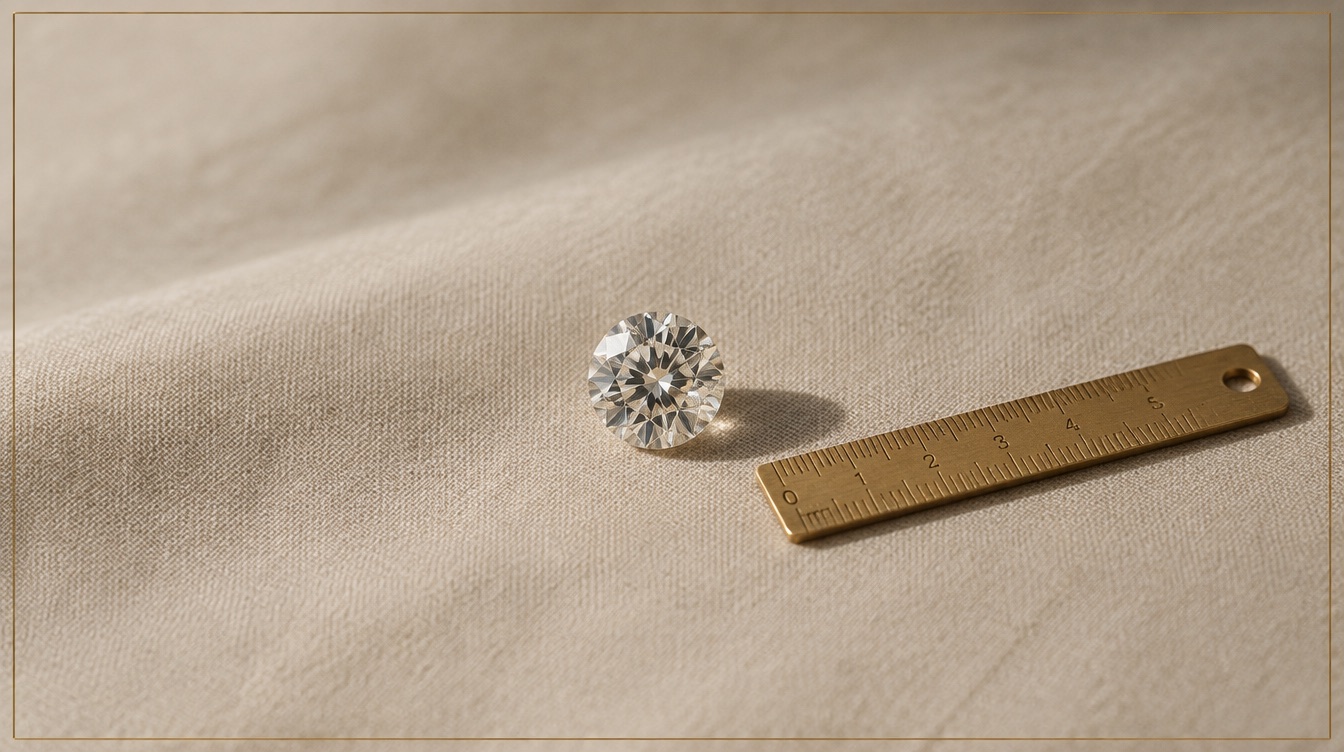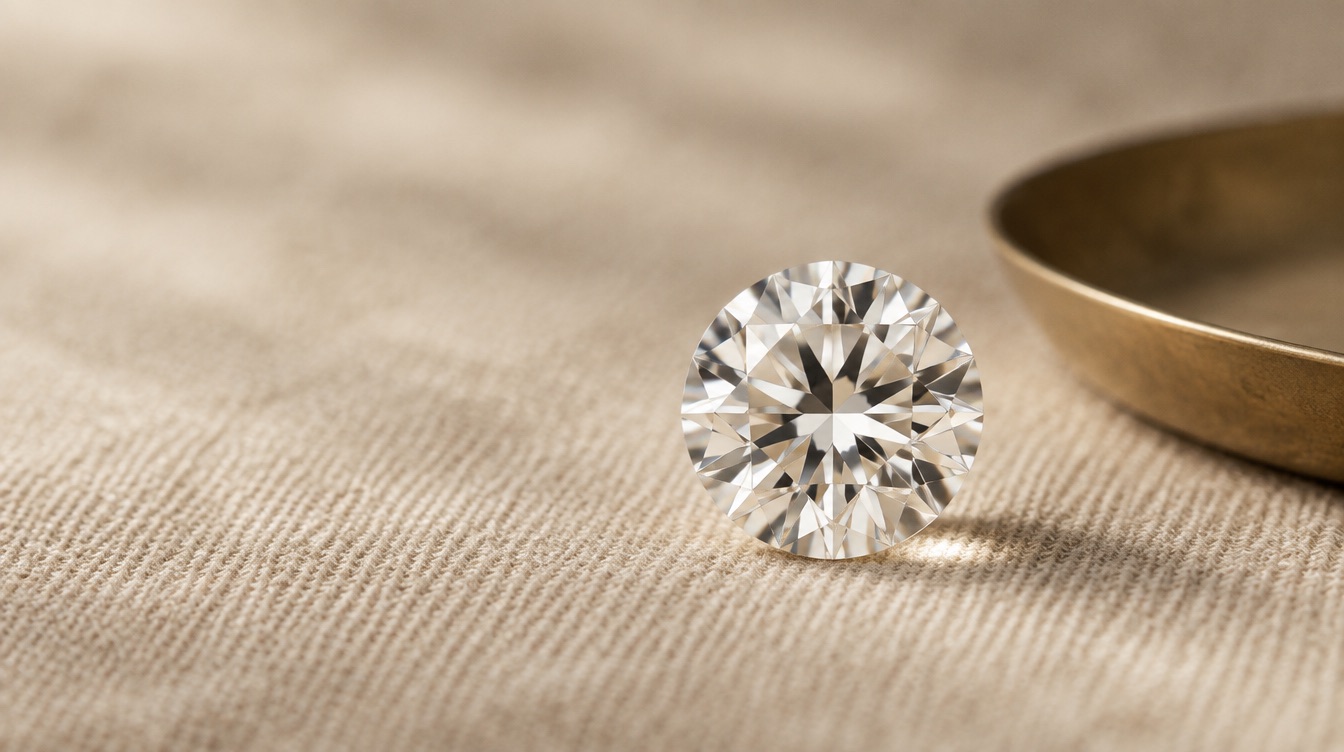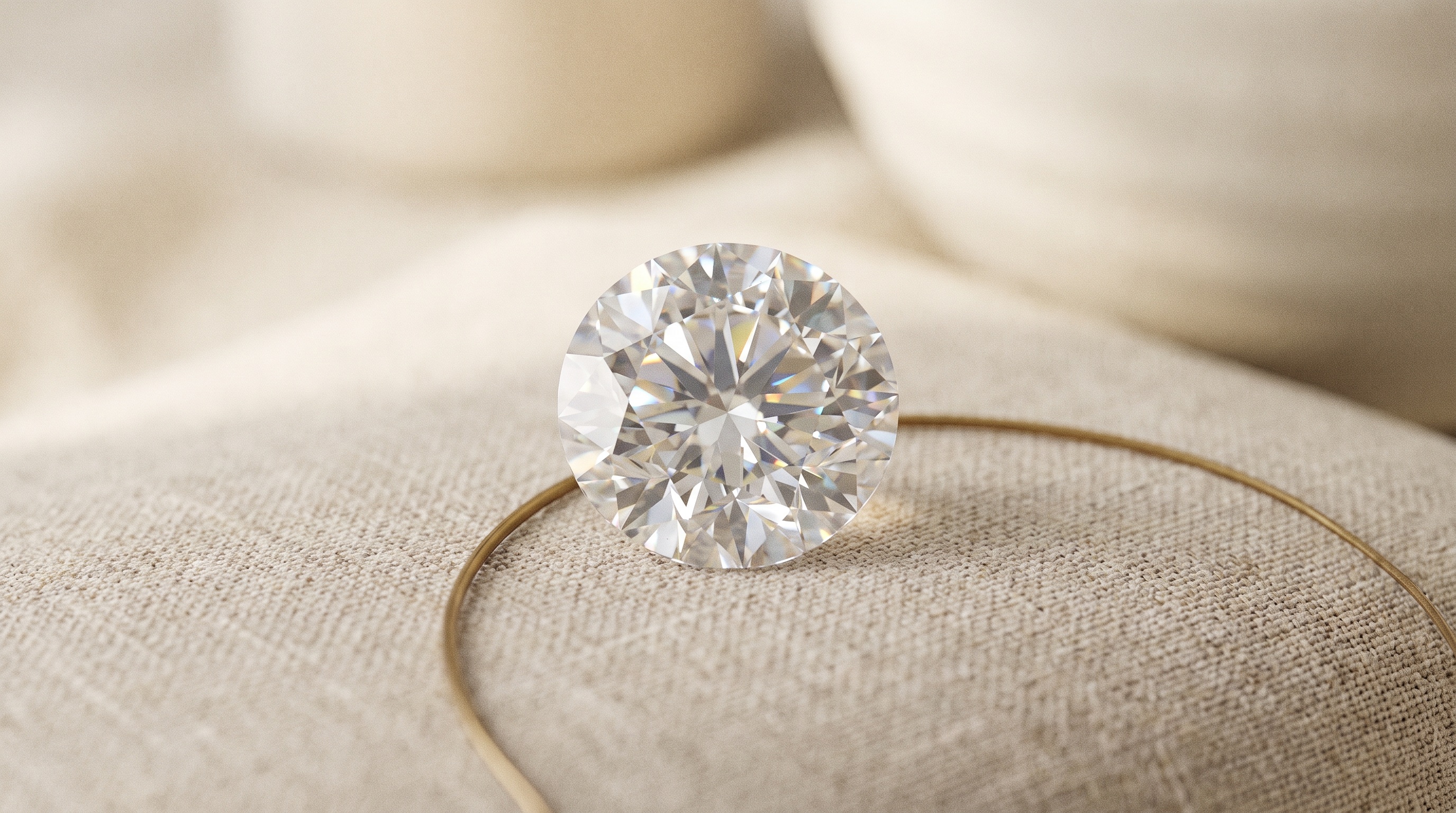
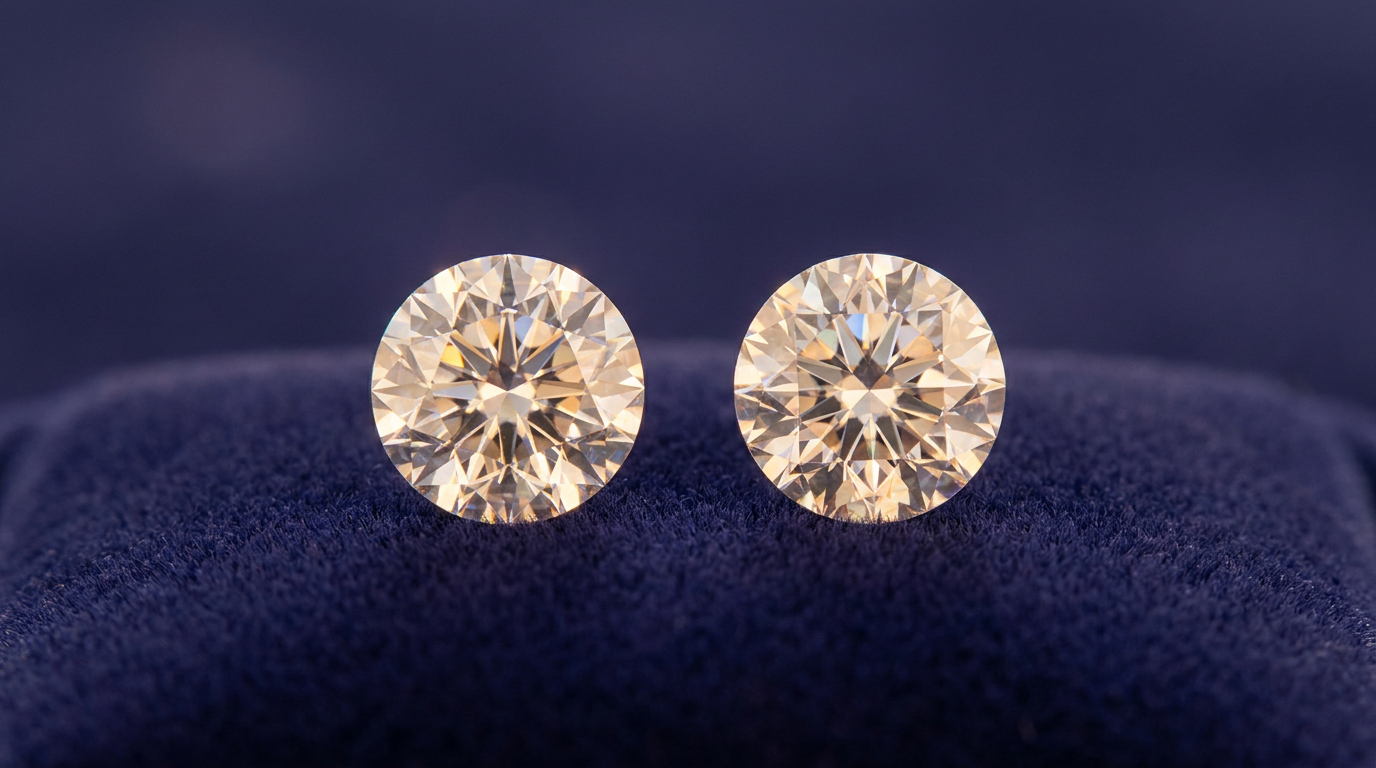
A genuine matched pair functions as one diamond seen twice — consistent in shape, size, color, and cut from the loupe to the finger.
Matched pairs consist of two lab-grown diamonds selected or produced to appear identical in shape, size, color, and cut. They serve as the foundation for stud earrings, drop earrings, symmetrical side stones, and any setting where two diamonds sit close enough together that a buyer's eye compares them directly. Achieving wholesale-scale matching requires deep inventory to draw from and in-house production to close the gap when a market-ready pair does not already exist, with individual IGI documentation carried by each stone. This guide covers matched pairs across every shape category — round brilliants, cushions, ovals, pears, emeralds, asschers, and the antique cuts — the criteria that make a pair "true," how sourcing and certification work, and where the premium for a well-matched set comes from. If the shape on your bench is specifically a step cut — emerald, asscher, baguette, or carré — our dedicated guide to matched pair step cut diamonds wholesale goes deeper on that niche; this page is the general reference for matching across the full shape range.
What "Matched Pair" Means, Across Any Shape
A genuine matched pair comprises two diamonds whose shape, measurements, color, clarity, and cut grade align closely enough that a viewer perceives one stone duplicated rather than two similar stones set side by side. Visual symmetry takes precedence over documentation: the pair has to perform when mounted and worn under normal light, not only when the two certificates are laid next to each other on a desk. That distinction matters more than it sounds — a pair can carry near-identical grading on paper and still read as mismatched in the ear or on the finger if the proportions, face-up color, or light return diverge even slightly.
Weight is the criterion buyers reach for first, and it is the least reliable one on its own. Two stones of the same carat weight can look entirely different sizes if their proportions differ, which is why weight is matched alongside diameter (for round shapes) or length-and-width (for fancy shapes), plus total depth, so both stones sit at the same height and present the same face-up footprint once set. For round brilliants, matching centers on diameter and total depth — get those two numbers aligned and the pair reads as identical from across a room. For fancy shapes — ovals, pears, marquise, emerald, cushion, radiant — outline ratio and length-to-width proportion carry equal weight to the carat figure, because two ovals of matching weight can look dissimilar if one runs narrow and the other runs wide.
Color and clarity are matched as perceived qualities across the pair, not just as adjacent letters on a grading scale. Two stones one color grade apart can clash visibly if one reads warm and the other cool face-up, particularly under mixed lighting in a jewelry case. Clarity matching goes beyond the numeric grade to inclusion placement: a stone with an eye-clean grade but a visible inclusion positioned under the table still breaks the symmetry of the pair, even if its certificate grade matches its partner's. Cut, polish, and symmetry grades are held to the same standard across both stones so brightness and contrast pattern agree — a well-cut stone paired with a slightly duller one always reads as "the good one and the other one," regardless of what the paperwork says.

Which Shapes Get Bought as Matched Pairs, and Why
Not every shape gets requested as a matched pair with equal frequency, and the reasons trace back to how each shape is worn and where the eye lands on it. Brilliant-cut shapes — round, oval, cushion, pear, and pear-adjacent cuts — dominate matched-pair demand because they are the default choice for stud earrings and three-stone rings, the two settings where a matched pair is functionally required rather than optional. A round brilliant stud earring is, by definition, a matched pair; there is no single-stone version of the category. The same logic drives demand for oval and pear pairs in drop earrings, and for round or cushion pairs as the flanking stones in a three-stone engagement ring, where the two side stones need to read as a mirror image of each other across the center diamond.
Step-cut shapes — emerald, asscher, baguette, and carré — get matched for a different reason: structural symmetry rather than brilliance matching. Because step cuts show their proportions and facet lines openly (there is no scintillation to hide a slightly off ratio the way a brilliant's fire can), a mismatched step-cut pair is more visually obvious than a mismatched brilliant pair of the same size. Buyers sourcing step-cut pairs are usually building baguette side stones for an emerald-cut center, an asscher-cut stud order, or an Art Deco–style setting where the geometry of the cut is the entire point of the design. Because step-cut matching carries its own tolerance rules and its own set of buyer questions — window alignment, table-to-length ratio, corner symmetry — we cover that shape category in dedicated depth in our matched pair step cut diamonds wholesale guide. This page stays at the general level: what matching means and how it is delivered across the full shape range, brilliant and step-cut alike.
Fancy shapes outside the step-cut family — marquise, heart, radiant — see matched-pair demand concentrated in a narrower set of use cases: statement drop earrings, toi et moi rings, and antique-style settings where the shape itself is the design statement. These shapes carry the tightest outline tolerances of any category, because their asymmetry (a marquise's points, a heart's cleft) makes any mismatch between the two stones immediately visible to the eye, even to a buyer who has never held a loupe.
Matching Tolerances by Shape Category
The table below breaks out how matching priorities shift by shape category. The underlying principle — shape, size, color, clarity, and cut all have to agree — holds across every category; what changes is which criterion carries the most weight and how tightly it has to be held.
| Shape Category | Primary Matching Focus | Typical Tolerance | Where It Shows If Off |
|---|---|---|---|
| Round Brilliant | Diameter and total depth | Tightest — diameter matched to a fraction of a millimeter, depth held close so both stones sit at the same crown height | Uneven height in a setting; one stone reads larger side-by-side even at equal carat weight |
| Brilliant Fancy Shapes (oval, cushion, pear, radiant) | Length-to-width ratio and outline | Moderate on weight, tight on ratio — a wider tolerance on carat than on the outline shape itself | One stone reads narrower or rounder than its partner even when both share the same weight |
| Step Cuts (emerald, asscher, baguette) | Table-to-length ratio, corner alignment, window symmetry | Tightest on proportion — step cuts expose facet lines directly, so ratio mismatches are visible without magnification | Open windows or corner mismatch read instantly under normal light, unlike a brilliant's fire, which can mask a small ratio gap |
| Fancy Pointed Shapes (marquise, heart, kite) | Outline symmetry and point/cleft placement | Tightest on outline — asymmetry in the points or cleft is the first thing a buyer's eye catches | Uneven points or a shifted cleft break the mirror effect even when weight and color match exactly |
| Antique Cuts (old mine, old European) | Facet pattern and crown height, alongside size | Moderate on strict optical grading, tight on visual character — the pair is matched to look like it belongs to the same era and cutting style | One stone reading noticeably more modern or "crisp" than its partner undercuts the antique pairing |
How Matched Pairs Are Sourced: Cut Together vs. Matched From Inventory
There are two practical routes to a matched pair, and most wholesale suppliers use both depending on what the order calls for. The first is sourcing from existing inventory: scanning a deep stock of loose stones for two that already align on shape, size, color, clarity, and cut closely enough to pass as a pair. This route is fastest when the requested spec is a common size and color combination, since the odds of finding two naturally close stones rise with the depth of stock available to search. The tradeoff is that an inventory match is only as good as what happens to already exist on the shelf — a rare size, an unusual color, or a tight ratio request on a fancy shape may not have a ready partner sitting in stock.
The second route is cutting a pair together, either from the start or as a corrective step. When a near-match exists but falls short on one dimension — an outline ratio slightly off, one stone a touch deep — in-house cutting can bring the second stone closer to its partner rather than settling for "close enough." When no match exists at all, the stronger approach is planning both stones as a pair from the rough: cutting them side by side to the same target proportions from the start, rather than cutting two stones independently and hoping they land close. That is the difference between a pair brought together after the fact and one built to match from the first cut.
In-house production is what makes the second route available at all. A supplier without cutting capability is limited to whatever two stones happen to coincide in the open market or a third party's stock — a matter of chance, not control. With in-house CVD growth and cutting under one roof, a near-match can be finished to close the remaining gap, and a pair that does not yet exist in any inventory can be produced to spec rather than approximated. That is the practical difference between "these two are close enough" and "these two were brought to match" — and the reason an exacting spec (an unusual ratio, size, or color window) gets better results from a supplier who cuts in-house than one reselling whatever pairs already exist.
Certification for a Pair: Two Reports, One Side-by-Side Check
Each stone in a matched pair is certified individually, so a completed pair arrives with its own IGI documentation for both diamonds, with GIA available on request. That gives the retailer independent grading for each half rather than a single shared report — a meaningful distinction, since a pair is two separate assets, not one. Each stone carries its own shape, measurements, color, clarity, and cut grade on its own certificate, which means the value of both diamonds can be shown, appraised, and insured separately. If one stone in a pair of stud earrings is ever lost or damaged, the surviving stone has its own paper trail independent of its partner, and a replacement can be sourced against that certificate rather than a vague verbal description.
But paper alone does not confirm a match — two stones can carry nearly identical certificate grades and still read differently side by side, which is why matching is judged first as a side-by-side visual and physical comparison, and only secondarily by comparing the two certificates line by line. The certificates confirm the grades of each stone; the physical comparison — placed together, viewed face-up, checked under the same light — confirms the two stones actually read as a pair rather than as two similar diamonds that happen to carry similar grades. A buyer building a matched-pair order should expect both: individual grading reports for each stone, and confirmation the pair was checked against each other before being sold as a set.
The Premium on a Well-Matched Pair
A well-matched pair of lab-grown diamonds typically carries a premium over two single-sourced stones of similar individual specs, and the reason is straightforward: matching work has a cost, whether it happens through inventory search or through cutting. Sourcing two stones that already share shape, size, color, clarity, and cut to a tight tolerance takes time and depth of stock — the larger the search, the better the odds of a close match, but the search itself is not free. When no close match exists and a stone has to be cut or re-cut to close the gap, that cutting work is a direct cost a single, independently sold stone never incurs.
The premium also reflects what the pair is worth assembled versus what the two stones were worth apart. Two diamonds that meet spec individually but do not match each other are worth their individual grades; the same two stones, matched and sold as a set, are worth more because the matching has solved a problem the retailer would otherwise solve on their own. The premium scales with tolerance: a loosely matched pair in a common size and color costs closer to the sum of its parts, while a tightly matched pair in an uncommon size, color, or fancy-shape ratio commands more, since fewer candidates exist and more cutting or searching is required to produce it. The practical takeaway is to specify tolerance up front — a pair that only needs to pass at arm's length costs less than one built to survive loupe-level inspection, and knowing which a given piece needs avoids paying for tolerance it does not require.
Where Matched Pairs Go: Earrings, Three-Stone Rings, and Toi et Moi
The most common application for matched pairs, across every shape category, is stud and drop earrings. The pair sits at equivalent heights on either side of the face, frequently within inches of each other in mirrors and photographs, so any discrepancy in size, color, or brightness becomes immediately apparent. This is the setting where matching tolerance matters most in absolute terms, since the two stones are compared constantly and at close range.
Three-stone and side-stone rings are the second major application. The two flanking diamonds should mirror each other across the center stone so the finished setting reads as balanced and deliberate rather than assembled from whatever stones were on hand. The side stones do not need to match the center stone's exact specs, but they do need to match one another closely enough that the ring reads as symmetrical from either side.
Toi et moi designs — two stones set side by side as equal or near-equal focal points rather than one dominant center stone with supporting accents — place matched pairs in a different role: co-equal stars of the piece rather than symmetrical supports. This raises the matching bar further, since there is no center stone to draw attention away from any inconsistency between the two. Matched pairs also serve as anchor stones in tennis bracelets and as paired stones in coordinated bridal sets, where a bride's ring and a matching pendant or earring share a common stone specification. Across all of these applications, the retailer benefits from a pair backed by two IGI certificates, which lets the value of both stones be explained to the end purchaser individually, even when the design treats them as a single visual unit.
How Guru Diam Sources Matched Pairs Across the Shape Range
In-house CVD production is what makes consistent matching possible at wholesale scale, because matching depends on supply that can be controlled rather than supply that has to be found by chance. When a pair can be selected from deep inventory — or grown and cut to spec when a match is not already on hand — a buyer is not limited to whatever two stones happen to coincide on the open market. With 10,000+ loose stones on hand and in-house cutting, a near-match can be finished to close the gap, and a pair that does not yet exist can be made to order rather than approximated.
This capability spans the full shape range covered on this page: round brilliants and brilliant fancy shapes for earrings and three-stone rings, fancy pointed shapes like marquise and heart for statement pieces, and antique cuts like old mine and old European for period-style settings. The same in-house capability that produces calibrated melee, certified center stones, and fancy colors is what enables holding a pair to a single visual standard and certifying both halves through IGI, with GIA available on request. For step-cut pairs specifically — emerald, asscher, baguette, and carré, where table-to-length ratio and window alignment carry their own set of tolerance rules — our matched pair step cut diamonds wholesale guide covers that shape family's sourcing and matching detail directly; this page and that guide are meant to be read together when a step-cut order is on the table.
Provide the shape, target size, color, and clarity for the pair, plus the intended use — studs, side stones, toi et moi, or a specific design — and the sourcing process works from inventory first, then cuts to spec to complete the match when needed. The more context provided about the finished piece, the tighter the match that can be delivered. A clear spec typically comprises: cut shape; carat weight or millimeter size per stone; color and clarity range; for fancy shapes, the length-to-width ratio wanted; and whether the pair is for earrings or for flanking a known center stone.
Trade buyers can reach our teams directly. In New York we are at 36 West 47th Street, Suite 601A, New York, NY 10036, in the heart of the Diamond District, reachable at (212) 652-7108. On the West Coast we are at 607 South Hill Street, Suite #241, Los Angeles, CA 90014. We are trade-only and made-to-order, so a request that does not match existing stock becomes a cutting brief rather than a dead end.

A Buying Checklist for Matched Pairs, Any Shape
Whatever shape category the order falls into — brilliant, step cut, or fancy pointed — the same checklist applies before placing a wholesale matched-pair order:
- Shape and cut style — confirm both stones are the same cut, not just visually similar shapes (an oval brilliant and an oval modified brilliant will not match).
- Size, stated two ways — carat weight alone is not enough; specify diameter or length-and-width in millimeters so proportion is locked in alongside weight.
- Outline ratio, for fancy shapes — state the length-to-width ratio wanted, since two stones of equal weight can present very differently if their ratios diverge.
- Color grade and how it should read — request the pair matched for face-up appearance, not only for identical certificate grades.
- Clarity grade and inclusion placement — ask whether inclusions are positioned to stay eye-clean in the pair, not just within an acceptable grade range.
- Cut, polish, and symmetry grade — hold both stones to the same grade so brightness and contrast pattern agree once mounted.
- Intended setting — studs, three-stone side stones, toi et moi, or bracelet anchors each carry different practical tolerance needs; state the use case up front.
- Tolerance level needed — specify whether the pair needs to pass casual viewing or hold up under close, loupe-level inspection, since tighter tolerance affects both sourcing time and price.
- Certification — confirm both stones will carry individual IGI reports (GIA on request), not a single combined document.
- Sourcing path — ask whether the pair is coming from existing inventory, a corrective cut to close a near-match, or a from-rough pair cut together to spec, since each path has different lead implications for an uncommon size or color.
Frequently Asked Questions
What does "matched pair" mean for lab-grown diamonds?
A matched pair is two lab-grown diamonds chosen or produced to read identically in shape, size, color, and cut, so they look like one stone seen twice. The match is judged face-up and on the finger, not only on paper, and each stone is certified individually for the retailer regardless of shape — round, fancy brilliant, step cut, or fancy pointed.
Are matched pairs only used for earrings?
No. Studs and drop earrings are the most common use, but matched pairs also serve as symmetrical side stones flanking a center diamond, as anchor stones in bracelets, and in toi et moi designs where two stones sit as equal focal points. Any piece where two diamonds are compared side by side benefits from a true matched pair rather than two similar stones set together.
How are fancy-shape pairs matched differently from round pairs?
Round brilliants are matched primarily on diameter and total depth. Fancy shapes — ovals, pears, marquise, emerald, radiant — are matched on outline and length-to-width ratio as well as weight, because two stones of equal carat can look unequal if one runs narrow and one runs broad. Step cuts add a further layer, since table-to-length ratio and window alignment are visible without magnification and have to be held tightly for the pair to read cleanly.
Can a pair be cut to a specific spec if nothing in stock already matches?
Yes. Sourcing works from deep inventory first, and when a match is not already on hand, in-house CVD production grows and cuts to spec. Made-to-order cutting means a pair that does not yet exist can be produced to a stated shape, size, color, and clarity rather than approximated from whatever happens to be close.
Do both stones in a matched pair come certified?
Yes. Each diamond in the pair is certified individually, so a matched pair arrives with IGI documentation for both stones, with GIA available on request. This gives the retailer independent grading for each half, which supports separate appraisal and insurance for the end client even though the two stones are sold and set as a pair.
How do I request matched pairs wholesale in NYC or LA?
We are trade-only. Share the shape, size, color, clarity, and intended use, and our New York team in the Diamond District at 36 West 47th Street, Suite 601A can build or cut the pair. Reach us at (212) 652-7108, or visit our Los Angeles office at 607 South Hill Street, Suite #241. If the order is specifically step-cut pairs, our matched pair step cut diamonds wholesale guide covers that shape family's tolerance and sourcing detail in more depth.