
A solitaire setting is a ring style that holds a single center diamond alone, with no side stones, halo, or accent detailing to compete for attention — just a stone, a head of prongs or a bezel to secure it, and a plain or lightly detailed band. It's the oldest and most enduring engagement ring format in the modern trade, and its entire design logic comes from restraint: strip everything away except the center stone, and let the diamond's own cut, color, and clarity carry the piece.
Because a solitaire has nowhere for a lower-grade stone to hide — no halo to boost apparent size, no pavé to distract the eye — it's also the setting style most likely to expose the true quality of the center diamond, for better or worse. This guide covers what actually defines a solitaire setting, the prong styles and structural variations within the category, how solitaire compares to halo, cathedral, and bezel settings, the real advantages and tradeoffs of going with a single-stone design, which shapes and stones suit it best, metal and durability considerations, how solitaires pair with wedding bands, and what to check before ordering one.
What Defines a Solitaire Setting
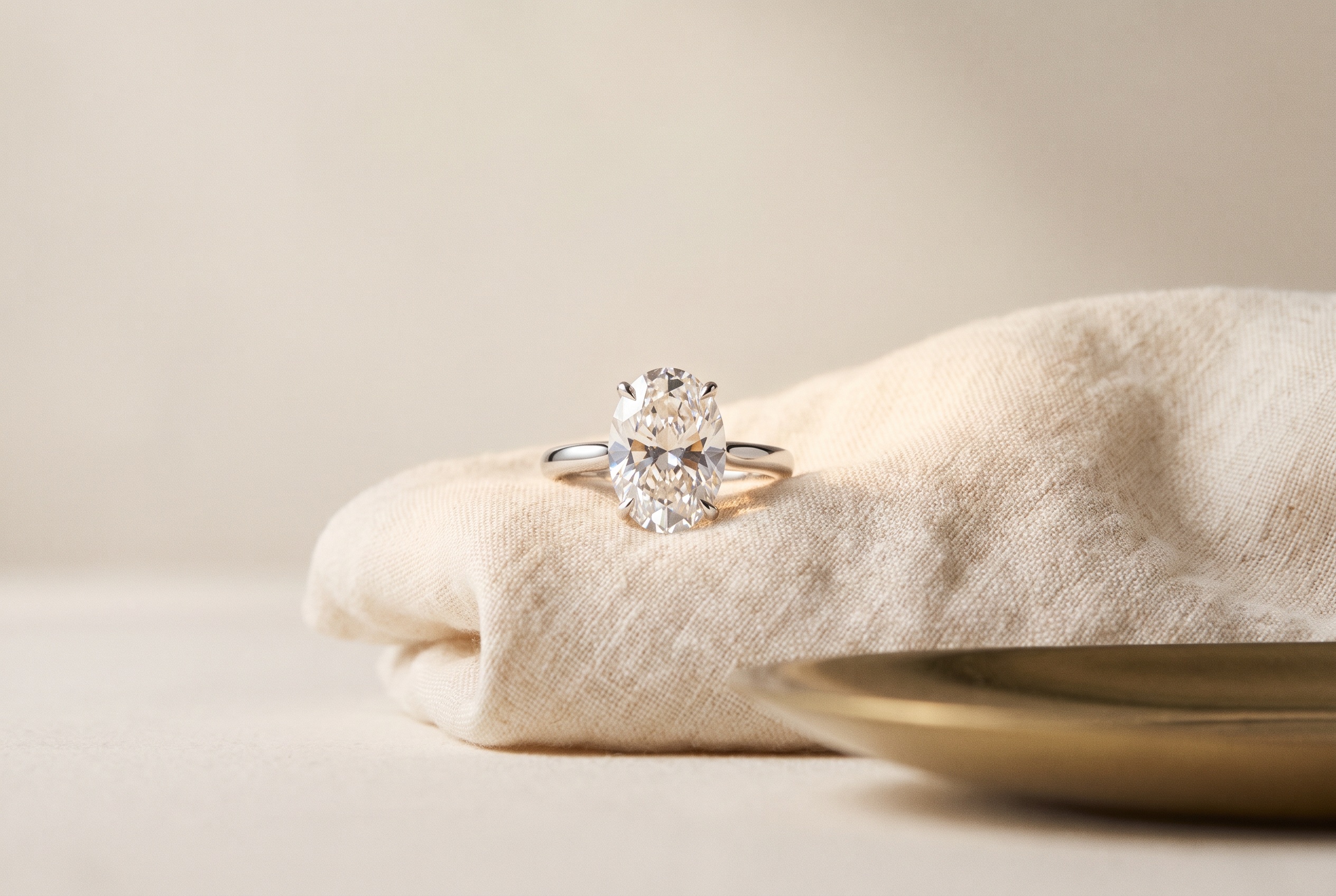
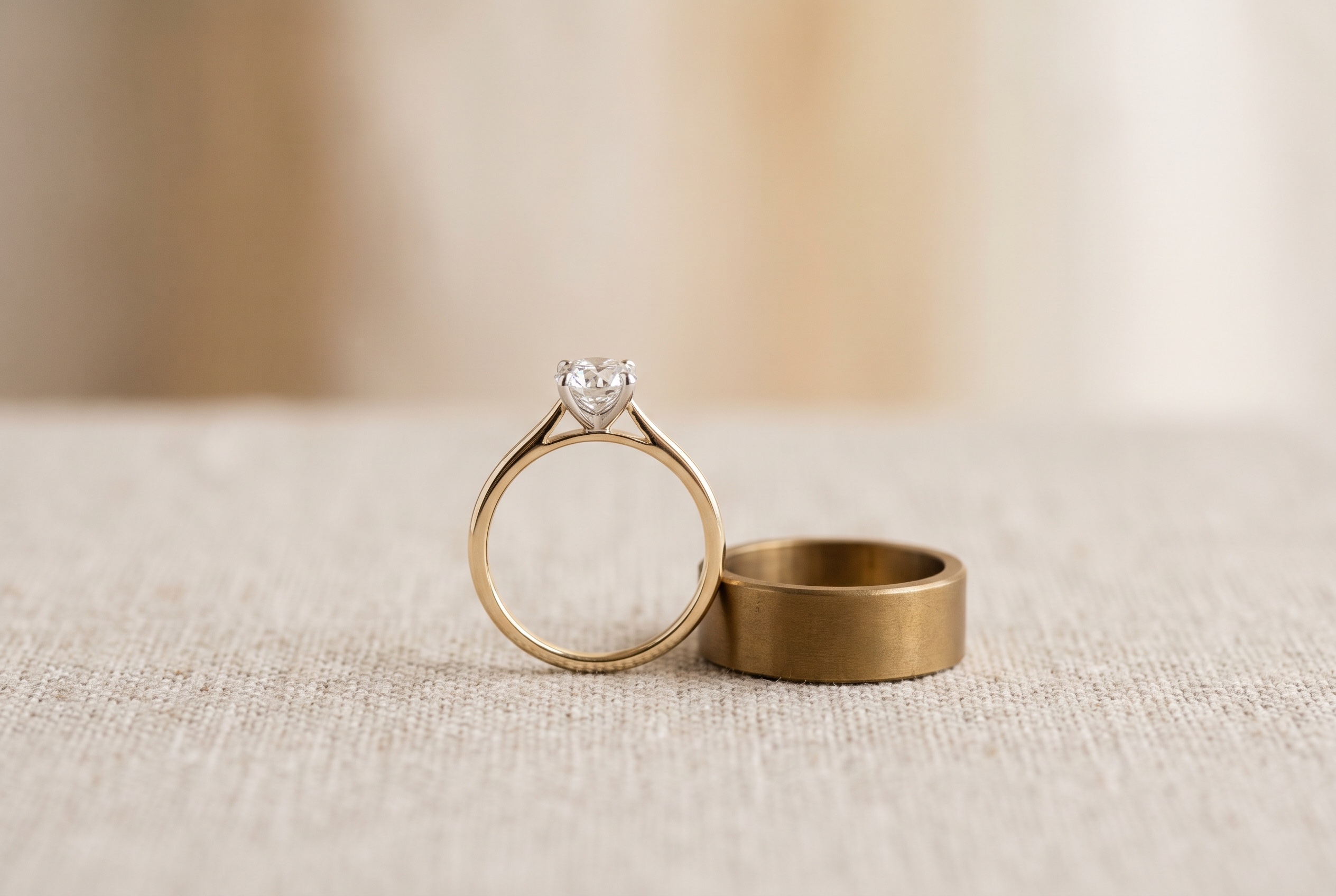
The defining feature of a solitaire is what it lacks, not what it has: no side stones, no halo, no pavé along the shank, no secondary design element sharing visual weight with the center stone. A solitaire consists of exactly three structural components — the band (shank), a head or basket that connects the band to the stone, and the mechanism (prongs or a bezel) that actually secures the diamond. Everything about the design is built around presenting one stone as the singular focal point.
This distinguishes a true solitaire from a few closely related styles it's sometimes confused with:
- Hidden halo: Looks like a solitaire from a normal viewing angle, since the halo sits beneath the crown of the center stone rather than around its visible perimeter — but it's not technically a true solitaire, since a ring of smaller diamonds is still present, just concealed.
- Cathedral solitaire: Still a single-stone design with no halo or side stones, but the shank rises in arched shoulders toward the head rather than staying flat and low — a solitaire remains a solitaire even with a cathedral-style shank, since "solitaire" refers to the absence of accent stones, not the shank's profile.
- Three-stone setting: A genuinely different category — a center stone flanked by two smaller side stones, which by definition isn't a solitaire, even though the center stone itself can be identical in cut and grade to one used in a true solitaire.
Prong Styles Used in Solitaire Settings
| Prong Style | Prong Count | Stone Exposure | Best For |
|---|---|---|---|
| Classic round (Tiffany-style) | 4 or 6 | High — maximum light entry from the sides | The most recognizable solitaire silhouette; round brilliant and most fancy shapes |
| Double-claw | 8 (paired prongs) | High | Larger center stones needing extra security without adding visible bulk |
| V-tip / V-prong | 4 or 6, angled | High, with corner protection | Pointed shapes — princess, marquise, pear, heart — where standard prongs would leave a vulnerable exposed corner |
| Flat / trellis prong | 4 or 6 | High | A slightly more decorative variation where the prongs cross in a woven pattern before reaching the stone |
| Bezel | N/A — full metal rim | Lowest | Buyers prioritizing security and a smooth, snag-resistant profile over maximum light entry |
Four-prong heads show slightly more of the stone's surface area and are the more classic, minimal choice, while six-prong heads add extra security — a meaningful consideration for larger center stones or buyers with an especially active lifestyle. Neither is objectively "better"; the tradeoff is visibility versus holding power, and it's worth walking a buyer through explicitly rather than defaulting to one without asking about lifestyle and stone size.
Solitaire vs. Other Popular Setting Styles
| Setting Style | Visual Focus | Apparent Size Boost | Cost Relative to Solitaire | Best For |
|---|---|---|---|---|
| Solitaire | Center stone only | None — reads at true size | Baseline (lowest labor cost of common styles) | Buyers who want the center stone's own quality to be the entire story |
| Halo | Center stone framed by a ring of pavé | Significant — can read one size class larger | Higher, due to the added melee and setting labor | Buyers maximizing perceived size on a fixed carat budget |
| Cathedral | Center stone, elevated | Slight — raised profile adds visual presence | Slightly higher | Buyers wanting an architectural, elevated silhouette without a halo |
| Three-stone | Center stone plus two side stones | Moderate — total visual carat weight increases | Higher, due to the two additional side stones | Buyers who want symbolic past-present-future meaning or added total sparkle |
| Bezel | Center stone, fully framed in metal | None; can read slightly smaller due to the metal rim | Comparable to solitaire | Buyers prioritizing durability and a smooth, low-snag profile |
A solitaire's lower relative cost isn't a quality compromise — it reflects less metalwork and no additional melee, not a lesser center stone. For a buyer working with a fixed total budget, a solitaire setting often frees up more of that budget to spend on the center stone's own cut, color, and clarity, rather than on surrounding metal or accent diamonds. For a deeper look at how a raised, arched profile changes the picture, see our cathedral setting guide.
Advantages of a Solitaire Setting
- Timeless, won't date. Because a solitaire's design language is minimal by definition, it doesn't carry the trend-cycle risk that more ornamental styles do — a well-cut center stone in a classic prong solitaire from decades ago still reads as current today.
- Puts the full budget into the stone. With no melee, halo, or side stones to fund, a buyer working within a fixed budget can direct more of it toward a higher grade or larger center stone.
- Maximum light entry. An open, unobstructed prong solitaire exposes more of the stone's surface to ambient light from every angle than almost any other setting style, which can genuinely improve visible brilliance for a well-cut stone.
- Easiest to clean and maintain. With no pavé channels or halo settings to trap lotion, soap, and dust, a solitaire is the lowest-maintenance common setting style for routine at-home cleaning.
- Versatile pairing with any wedding band. A simple, low-profile solitaire shank pairs cleanly with almost any straight or curved wedding band, without the fit complications a more elaborate shank can introduce.
Drawbacks and Practical Considerations
- No forgiveness for a lower-grade stone. With nothing to distract the eye, a solitaire is the least forgiving setting for a center stone with a visible inclusion, a weaker cut grade, or a noticeable tint — the stone's actual quality is fully on display.
- Reads at true size. Unlike a halo, a solitaire doesn't create any perceived-size boost, which matters for a budget-conscious buyer who wants a piece that looks larger than its actual carat weight.
- Less overall sparkle from the piece as a whole. A solitaire's total light output comes entirely from one stone, whereas a halo or pavé-shank design adds sparkle from every additional facet in the surrounding melee.
- Prongs are exposed. Classic prong solitaires expose the securing metal more than a bezel does, which carries a modestly higher snag and impact risk for an especially active lifestyle — a tradeoff covered further below under metal and durability.
Which Diamond Shapes Work Best in a Solitaire
A solitaire is genuinely shape-flexible, but a few pairings dominate the market for specific reasons:
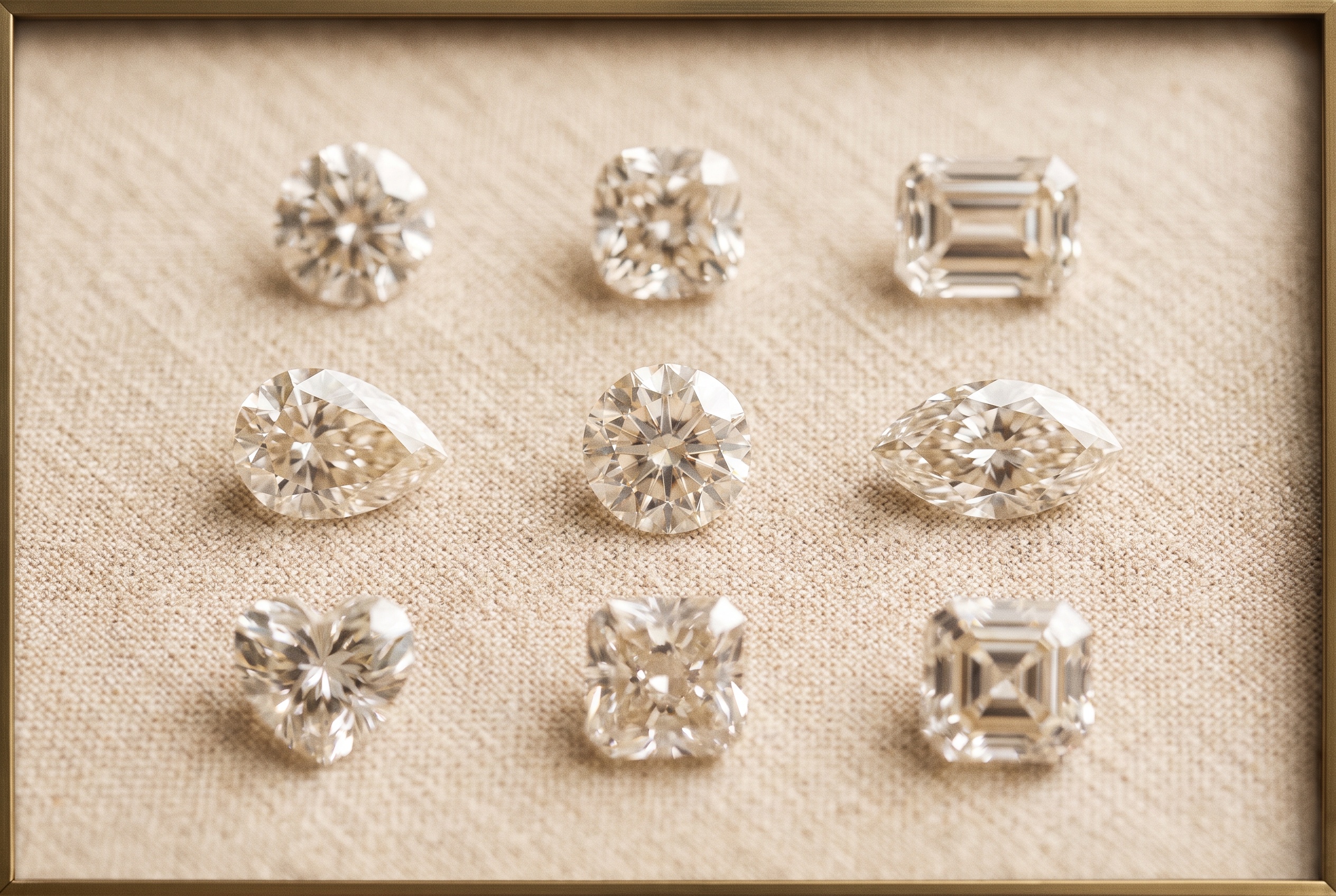
- Round brilliant. The single most common solitaire pairing by a wide margin — the round's symmetry and light performance are fully exposed with no distraction, which is exactly what a solitaire is built to showcase.
- Oval, pear, and marquise. Elongated shapes benefit strongly from a solitaire's unobstructed profile, since the shape's full silhouette is visible without a halo interrupting the outline.
- Emerald and Asscher. Step cuts pair naturally with a clean, minimal solitaire aesthetic, since the stone's own geometric lines don't compete with any additional ornamentation.
- Cushion and princess. Both work well in a solitaire, though cushion in particular is frequently paired with a halo instead specifically to boost apparent size — a solitaire cushion leans into the shape's soft, rounded-corner outline on its own merits.
- Antique cuts (Old Mine, Old European). A classic, historically accurate pairing — antique cuts were originally set almost exclusively as solitaires, and the pairing remains a strong choice for buyers building a period-appropriate design. See our old mine cut diamond guide and old European cut diamond guide for more on sourcing antique cuts specifically.
Metal Choice and Durability
| Metal | Durability for Prong Solitaires | Notes |
|---|---|---|
| Platinum | Excellent | Dense and highly durable; the strongest common choice for a six-prong head holding a larger center stone, though it develops a matte patina over time |
| 18k white/yellow/rose gold | Very good | Strong and widely used; slightly softer than platinum, so thinner prong designs benefit from a slightly heavier gauge |
| 14k gold | Good | Harder and more scratch-resistant than 18k due to higher alloy content, a practical daily-durability choice |
Because a solitaire's prongs carry the full weight of securing the stone with no supporting halo or side-stone structure to share the load, prong gauge matters more here than in some more elaborate settings — a jeweler should confirm adequate prong thickness for the specific center stone's size and weight before finalizing a custom build, particularly for larger stones set in a 4-prong head.
Pairing a Solitaire Engagement Ring with a Wedding Band
A solitaire's simple, typically low-profile shank is the easiest of the common setting styles to pair with a wedding band, since there's no arched shoulder or elaborate shank detail for a straight band to clash against. A plain straight band, a curved contour band, or an eternity band can all sit flush against a standard solitaire shank without the custom-fit considerations a cathedral or split-shank design requires. Buyers wanting a coordinated look sometimes choose a band with pavé or milgrain detailing that echoes the solitaire's head style, but this is purely an aesthetic choice rather than a fit requirement, unlike the pairing considerations that come with a more structurally complex engagement ring shank.
Choosing a Solitaire: A Practical Framework
- Buyers prioritizing stone quality over apparent size: a solitaire directs the full budget into cut, color, and clarity, since there's no halo or side stones competing for that same budget.
- Buyers wanting the largest possible apparent size on a fixed budget: a halo setting will generally outperform a solitaire on perceived size at the same total spend, since a solitaire adds nothing beyond the stone's own true dimensions.
- Buyers with an active or hands-on lifestyle: a bezel solitaire offers the same single-stone minimalism with meaningfully better snag and impact protection than an open-prong version.
- Buyers building a period-accurate antique piece: a classic solitaire, especially with a Tiffany-style or V-prong head, is the most historically consistent choice for Old Mine, Old European, and other antique-cut center stones.
Solitaire Settings Beyond Engagement Rings
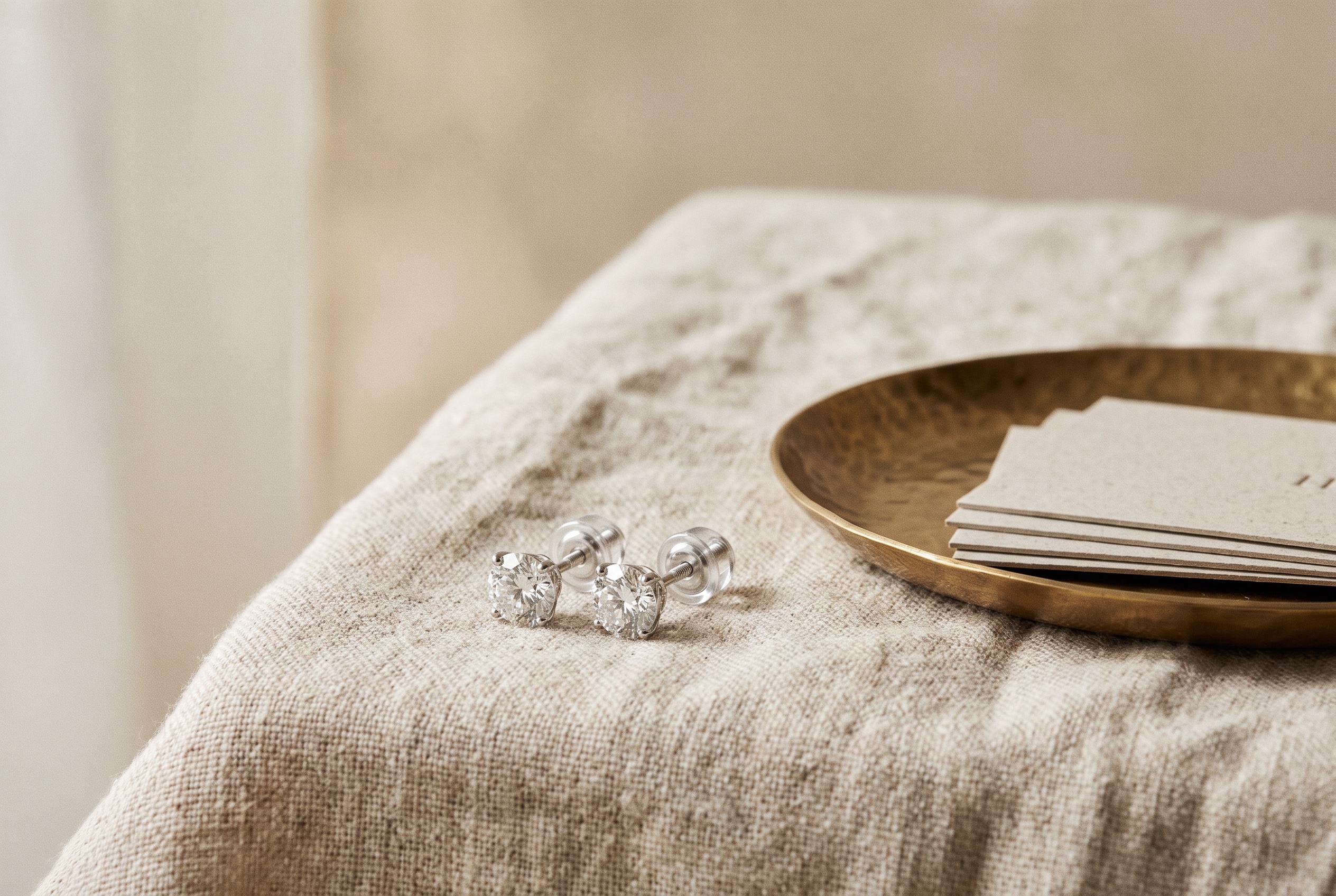
While "solitaire" is most associated with engagement rings, the same single-stone design logic applies across other jewelry categories, and the term is used the same way in each: a solitaire pendant holds one diamond on a chain with no surrounding accent stones, a solitaire stud earring holds one diamond per ear with a simple post-and-back mechanism, and a solitaire cocktail ring applies the format outside the bridal context entirely. In every case, the underlying tradeoff is identical to the engagement-ring version — a single stone carries the full visual weight of the piece, which rewards a well-cut, well-graded diamond and exposes a weaker one. Retailers sourcing across multiple solitaire product categories can generally apply the same quality-grading logic (prioritize cut, then color and clarity) across all of them, since the "nowhere to hide" principle doesn't change just because the setting has moved from a ring to a pendant or an earring.
Solitaire Pricing Considerations for Retailers
Because a solitaire's total cost concentrates almost entirely in the center stone rather than in setting labor or accent melee, retail pricing conversations around a solitaire piece are simpler and more transparent than they are for a halo or multi-stone design — a customer comparing two solitaire quotes is, in practice, comparing two diamonds rather than two different combinations of stone-plus-setting complexity. This makes a solitaire a useful entry point for training newer sales staff on diamond grading fundamentals, since there's no additional setting variable diluting the conversation about cut, color, and clarity. It also means a solitaire's finished-piece margin structure is more predictable for a retailer to model than a style with variable melee sourcing built in, since setting labor for a simple prong or bezel head doesn't fluctuate the way melee availability and matching cost can for a halo or pavé-shank design.
A Brief History of the Solitaire Setting
The modern solitaire's defining format traces to 1886, when Tiffany & Co. introduced the "Tiffany Setting" — a six-prong head raised above the band on a simple shank, designed specifically to lift the stone up and expose more of its surface to light than the flush, closed-back settings common at the time. Before that innovation, diamonds were typically set low and backed with metal or foil to enhance their appearance under candlelight, since cut quality itself was far less consistent. The Tiffany Setting's raised, open-prong structure let a well-cut stone's own brilliance do the work instead, and that basic structural idea — elevate the stone, open it to light, remove the distraction — is still the foundation of every classic solitaire made today, even though most contemporary solitaires are lower-profile than the original 1886 design. This is a well-documented piece of jewelry-industry history rather than a claim about any specific supplier's own manufacturing, but it's genuinely useful context for a retailer explaining why a plain-looking setting can still carry a well-known name.
Common Mistakes Buyers Make When Choosing a Solitaire
- Underestimating how exposed the center stone's quality will be. A buyer stretching budget by dropping color or clarity grade should understand that a solitaire won't hide the compromise the way a halo or busier setting might.
- Choosing 4-prong purely for a minimal look without weighing security. For a larger or heavier center stone, 6-prong or double-claw options offer meaningfully more holding security with only a modest visual tradeoff.
- Not considering a bezel for an active lifestyle. Buyers who work with their hands or lead an especially active daily routine sometimes default to a classic prong solitaire out of habit, without being offered the more snag-resistant bezel alternative that keeps the same single-stone minimalism.
- Assuming a solitaire will read as large as a halo at the same carat weight. A solitaire shows the stone's true size with no visual boost — a buyer specifically chasing maximum apparent size should be told this plainly before committing to the style.
Maintenance and Long-Term Care for a Solitaire
A solitaire's minimal structure makes it the easiest of the common setting styles to keep clean and to inspect — there's no pavé channel or halo perimeter to trap debris or hide a bent prong from view. A routine jeweler check every six to twelve months, focused on prong tightness and any signs of metal wear at the points of highest contact, is a reasonable baseline for any prong-set solitaire, with slightly more frequent checks warranted for an especially active lifestyle or a larger center stone carrying more weight on the prongs. Bezel solitaires require even less routine prong maintenance, given the absence of exposed prongs altogether, though the bezel rim itself should still be checked periodically for any gap or looseness that could develop over years of wear.
Sourcing Solitaire Setting Rings and Center Stones at Wholesale
A solitaire's minimal design puts real pressure on the center stone to perform on its own, which makes cut quality, color, and clarity genuinely higher-stakes decisions for this style than for a busier setting that can lean on surrounding melee for overall sparkle. Guru Diam supplies certified loose diamonds — natural and CVD lab-grown, with IGI, GIA, and GCAL certification all available — across round brilliant and the full range of fancy and antique shapes that suit a solitaire's clean, unobstructed presentation, giving buyers a single source for both the stone and the setting decision that goes with it.
For jewelers and designers building solitaire pieces to order, the custom jewelry program handles the full build in-house — cutting, setting, and polishing all managed internally, with finished pieces delivered in 4-6 days. Center stones can be sourced through the certified diamonds category, and buyers building a fancy-color solitaire can browse fancy color loose diamonds. Trade accounts can review current terms at the wholesale hub or apply through trade partner. For buyers weighing a solitaire against a setting style that boosts apparent size, our cathedral setting guide and hidden halo ring guide cover two of the most common alternatives.
Frequently Asked Questions
What makes a ring a "solitaire setting" specifically?
A solitaire setting holds a single center diamond with no side stones, halo, or pavé accents — just the stone, a head or basket, and a band. The defining feature is what's absent: no additional diamonds sharing visual weight with the center stone.
Is a solitaire setting cheaper than a halo setting?
Generally, yes — a solitaire requires no additional melee or the extra setting labor a halo needs, so more of a fixed budget can go toward the center stone itself rather than surrounding metalwork and accent diamonds.
Does a solitaire setting make a diamond look smaller?
A solitaire doesn't add any perceived-size boost the way a halo does — it shows the stone at its true dimensions. It doesn't make a diamond look smaller than it is; it simply doesn't add the visual enlargement effect a surrounding halo provides.
How many prongs does a solitaire setting have?
Four and six prongs are both standard. Four-prong heads show slightly more of the stone and read as more minimal; six-prong heads add extra security, which matters more for larger or heavier center stones.
What diamond shapes look best in a solitaire setting?
Round brilliant is the most common pairing by far. Elongated shapes like oval, pear, and marquise, step cuts like emerald and Asscher, and antique cuts like Old Mine and Old European all pair well, since a solitaire's unobstructed profile shows off each shape's full outline without a halo interrupting it.
Is a bezel setting a type of solitaire?
Yes — a bezel setting is a single-stone design with no side stones or halo, which technically qualifies it as a solitaire. It trades some of a prong solitaire's light exposure for meaningfully better snag and impact protection.