
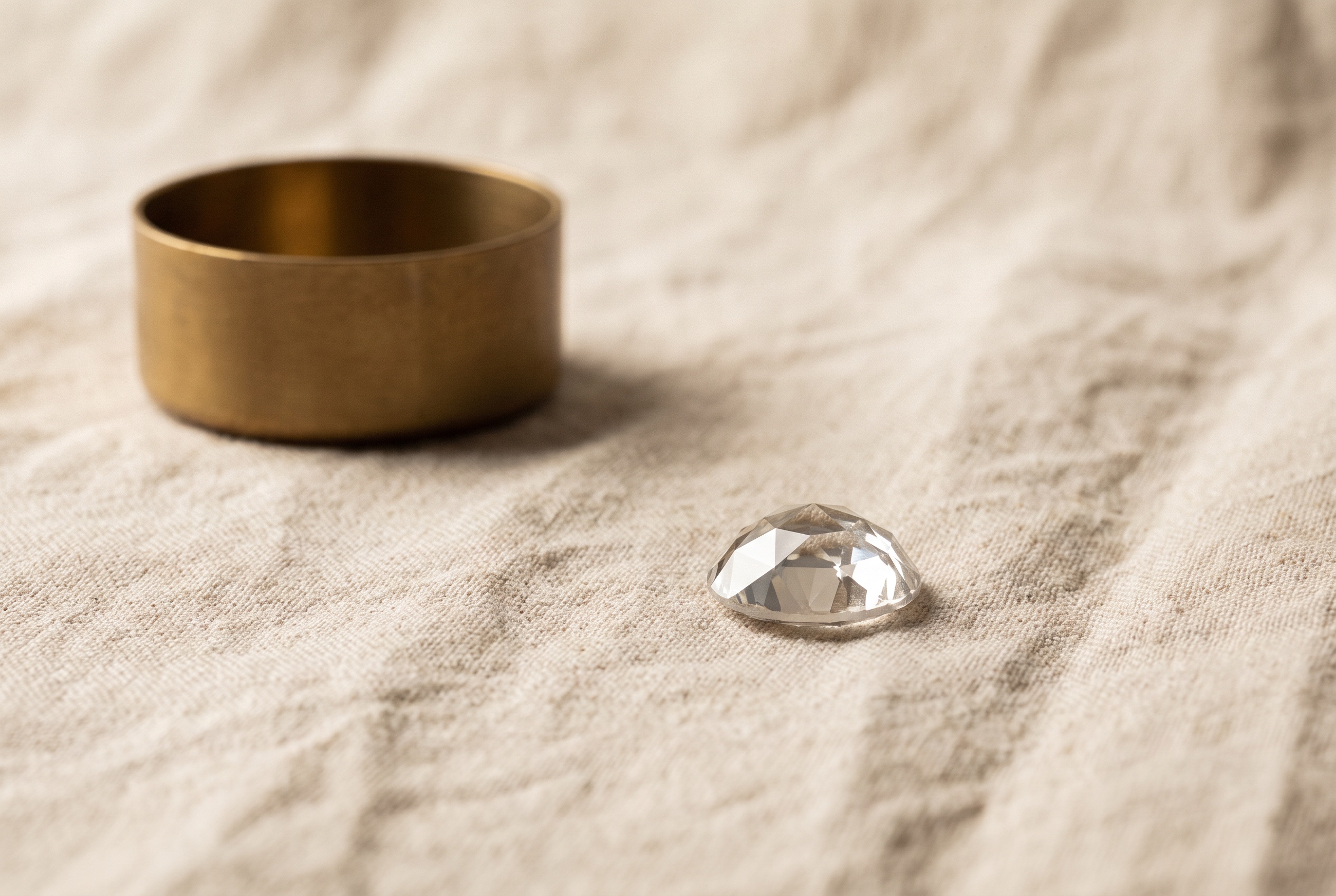
A rose cut diamond is a diamond with a flat or nearly flat base and a domed, faceted crown rising to a point — typically 3, 6, 12, or 24 triangular facets — and no pavilion, no girdle in the modern sense, and no table facet. Because there's no pavilion to bend and return light back through the top of the stone, a rose cut relies on external reflection off its angled crown facets, producing a soft, diffused glimmer rather than the fiery internal light return of a modern brilliant cut.
Rose cut is one of the oldest diamond cutting styles still in commercial production, and it's currently having a real resurgence, driven by antique and vintage-inspired jewelry trends and a broader taste for softer, less clinical stones. It's also one of the most misunderstood cuts in casual conversation — frequently lumped together with other historical or unconventional cuts it has little in common with, most notably the Portuguese cut, which despite the similar-sounding "old world" association is an entirely different, modern-era faceting style built on a standard round brilliant's crown and pavilion structure. This guide covers what actually defines a rose cut, where it came from, how it performs optically compared to a modern brilliant, its sub-variants, how it's graded today, and what wholesale buyers should look for when sourcing it.
What Defines a Rose Cut Diamond
A genuine rose cut diamond has a specific, recognizable structure that sets it apart from every other cut style in the trade:
- Flat or near-flat base — the bottom of the stone is flat, or very close to it, with no pavilion facets angling down to a culet point the way almost every other diamond cut has. This is the single most defining structural fact about a rose cut: there's nothing below the girdle line doing the light-bending work a pavilion normally does.
- Domed, faceted crown — the top of the stone rises in a low dome made up of triangular facets that meet at a central point (or, in some historical and modern executions, a very small flat apex rather than a true point).
- No table facet — unlike a modern brilliant, which has a large flat table facet at the very top, a rose cut has no table at all; the crown facets converge directly to a point instead of being interrupted by a flat top.
- Facet counts in multiples that define the sub-variants — most commonly 3, 6, 12, or 24 facets on the crown, with the facet count itself used to name the specific sub-variant (covered in detail below).
- No standardized girdle — because rose cuts are traditionally cut from thin, flat pieces of rough (historically, macle-shaped rough or flat cleavages that couldn't support a full brilliant-cut pavilion), the girdle is often thin and can vary meaningfully in outline — round, oval, pear, or irregular — rather than conforming to a single standardized shape.
This structure is genuinely distinct from every other antique cut in the trade. Old mine and old European cuts, for instance, still have a full pavilion and a culet — they're antique proportions applied to a standard crown-table-pavilion structure. A rose cut has no pavilion at all, which is the core reason its light behavior is categorically different rather than just "softer" on a spectrum with those other antique styles. For a closer look at how old mine and old European cuts handle that crown-and-pavilion structure differently from each other, see our old mine cut guide and old European cut guide.
A Brief History: One of the Oldest Cuts Still in Use
The rose cut predates the modern brilliant cut by centuries and is widely regarded as one of the earliest deliberate diamond-faceting styles, emerging roughly in the 16th and 17th centuries in Europe and India, well before Marcel Tolkowsky's early-20th-century mathematical work on brilliant-cut proportions gave the diamond trade a formalized optimization model to cut toward. Early cutters working with primitive tools and a limited understanding of how to safely remove material from the bottom of a stone found that a flat-bottomed, faceted-crown approach was both achievable with the technology of the era and effective at producing sparkle from thin or irregularly shaped rough — material that would have been difficult or impossible to fashion into a deep, full-pavilion cut with the cutting wheels and polishing techniques available at the time.
The style became genuinely dominant in European jewelry from the 17th through 19th centuries and reached particular popularity during the Georgian era (roughly 1714–1837) and continued strongly through the Victorian era (1837–1901), appearing in everything from elaborate court jewelry to more modest mourning and sentimental pieces. Rose cuts were commonly used both as center stones in earlier Georgian pieces and, later, as accent and pavé stones surrounding a larger center diamond in Victorian-era work, since the flat base made them easy to set flush against a metal backing. As diamond mining expanded and cutting technology advanced through the 19th and early 20th centuries — culminating in the mathematically optimized modern round brilliant — the rose cut was gradually displaced as the dominant style for major center stones, though it never disappeared entirely and has remained in continuous, if niche, production ever since. This is well-documented general diamond-trade history, consistent with what's taught in standard gemological education.
How a Rose Cut Actually Looks and Performs
The optical difference between a rose cut and a modern brilliant comes down to one structural fact: a modern brilliant has a pavilion designed to catch light entering through the crown, bend it via total internal reflection, and send it back out through the table and crown facets toward the viewer's eye — that's the mechanism behind the sharp, high-contrast "fire and brilliance" a well-cut round brilliant is known for. A rose cut has no pavilion to do that work. Light passes into the stone through the crown facets, and without a pavilion to redirect it back up in a concentrated way, much of what the viewer sees is external reflection off the angled crown facets themselves, along with some softer internal scatter rather than a strong, directed light return.
The practical result is a diamond that reads as quieter and more diffused than a modern brilliant — a soft, glinting sparkle rather than sharp pinpoint flashes, and a stone that can look almost candlelit or silvery under warm, ambient light, similar in spirit to (though structurally different from) the warm glow associated with old mine and old European cuts. Rose cuts also tend to look larger face-up relative to their carat weight than a deep, full-pavilion cut of the same weight, since so much of the stone's mass sits in a wide, flat, visible top rather than a deep pavilion hidden below the girdle line. This is genuinely useful information for buyers to have upfront, not a marketing point: a rose cut is not a like-for-like substitute for a modern brilliant in light performance, and clients who specifically want maximum fire and scintillation should be steered toward a round brilliant or a similarly optimized modern cut instead.
Rose Cut vs. Modern Round Brilliant: Side-by-Side
| Characteristic | Rose Cut | Modern Round Brilliant |
|---|---|---|
| Pavilion | None — flat or near-flat base | Full pavilion angled to a culet |
| Table facet | None — crown facets meet at a point | Large flat table (typically 54-62% of diameter) |
| Facet count | 3, 6, 12, or 24 (crown only) | 57-58 (crown and pavilion combined) |
| Primary light source | External reflection off crown facets | Internal reflection through the pavilion |
| Light character | Soft, diffused glimmer | Sharp, high-contrast brilliance and fire |
| Face-up size vs. carat weight | Appears larger — mass concentrated at the top | Standard — weight distributed through pavilion depth |
| Cut grade on certificate | Not assigned on the standard proportion scale | Assigned (Excellent-Poor) |
| Typical era | 16th-19th century origin; still cut today | Standardized in the early-mid 20th century |
| Setting fit | Especially suited to bezel/collet, flush-set flat-back styles | Suited to prong settings that expose the pavilion to light |
Rose Cut Sub-Variants: Full, Half, Single, and Briolette
"Rose cut" isn't a single fixed facet pattern — it's a family of related styles distinguished primarily by facet count and, in one case, overall three-dimensional shape. The main variants a wholesale buyer will encounter are:
| Variant | Facet count | Notes |
|---|---|---|
| Full rose cut (Holland rose) | 24 facets | The most elaborate and most common rose-cut variant in circulation today; sometimes called the "Dutch rose" or "Holland rose" cut, arranged in two tiers of 12 facets each around the domed crown. Generally the best light performance among rose-cut variants due to the higher facet count. |
| Half rose cut | 12-13 facets | A single tier of facets around the crown; simpler light behavior than the full rose cut but still a clearly faceted, domed profile. Common on mid-sized antique and antique-style stones. |
| Single rose cut | 6 facets | The simplest true rose cut, most often seen on small melee-sized stones used as accents or pavé in antique-style settings rather than as center stones, where the low facet count limits sparkle at larger sizes. |
| Briolette | Variable, often 60-100+ | A related but distinct style — a fully three-dimensional, faceted teardrop or pear-shaped stone with rose-style triangular facets covering its entire surface (no flat base at all), rather than a flat-bottomed rose cut proper. Briolettes are drilled and hung rather than set flat, most often in drop earrings or pendants. |
It's worth being precise about the briolette distinction specifically, since it's the most common point of confusion: a true rose cut has a flat base and is meant to be set face-up like any other stone, while a briolette has no flat base at all — it's faceted on every surface and designed to hang and rotate, most commonly drilled through the top for suspension. The two share the same small-triangular-facet aesthetic and the same absence of a pavilion-and-table structure, which is why they're often discussed together, but a briolette isn't simply "a rose cut with more facets" — it's a genuinely different overall form.
How Rose Cuts Are Graded and Certified Today
Rose cut diamonds get the standard 4Cs treatment from GIA, IGI, and GCAL for carat weight, color, and clarity — those assessments work the same way for a rose cut as for any other diamond. Cut grade is where rose cuts diverge from a standard round brilliant certificate: because GIA's Excellent-to-Poor cut grading scale is built specifically around the proportion model of a full crown-table-pavilion structure, it doesn't apply to a cut that has neither a table nor a pavilion in the first place. A rose cut's certificate will typically list the cut style by name rather than assign it a graded cut score — the same general situation that applies to old mine cut, old European cut, Portuguese cut, and other antique or fancy cuts that fall outside the standard proportion model. This isn't a gap in the certification or a lesser-quality report; it's a structural fact about which cuts the standard grading scale was designed to score in the first place, and it's worth explaining to retail-facing clients upfront so a missing cut grade doesn't read as a red flag.
The Aesthetic Revival: Rose Cuts in Vintage and Antique-Style Bridal Jewelry
Rose cuts have seen a genuine resurgence over the past several years, driven largely by the same forces pulling buyers toward old mine and old European cuts: a preference for pieces that read as heirloom or period-accurate rather than uniformly modern, and a growing appetite for softer, individually characterful light performance over maximum manufactured brilliance. Rose cuts play especially well into the Georgian-era aesthetic specifically — flat-backed, foil-backed, or closed-back settings, warm gold tones, and the increasingly popular "blackened gold" or oxidized-metal look some jewelers use to evoke period-authentic patina, since a rose cut's soft glimmer reads naturally against a darker metal in a way a hard-brilliance modern cut doesn't need to lean on. Full rose cuts and briolettes both show up frequently as center stones and drop elements in this style of bridal and fine jewelry, while single and half rose cuts are common as accent melee scattered through a vintage-inspired halo or cluster design.
This revival runs parallel to — but is genuinely distinct from — the broader antique-cut trend covered elsewhere on this site around old mine and old European cuts. Those two styles still have a full pavilion and produce a warm-but-directed light return; a rose cut's appeal is a different, more muted register entirely, and buyers and designers should treat the two trends as related but not interchangeable when advising clients on what look they're actually after.
Lab-Grown vs. Natural Rose Cut Diamonds
Rose cut is a faceting style, not a material property, so it applies identically to lab-grown and natural rough — CVD lab-grown diamond can be cut into any rose-cut sub-variant with the same facet pattern and the same optical result as a rose cut fashioned from natural rough. As with other antique-style cuts, this matters more for rose cuts than it might for a standard round brilliant: because most rose cuts sold today are modern re-creations of a historical style rather than genuine period-antique stones (true antique rose cuts exist but are comparatively rare and typically move through estate or auction channels rather than standard wholesale supply), the natural-vs-lab-grown decision is really a decision about material cost and sourcing rather than about the look of the cut itself, which is the same either way. Both lab-grown and natural rose cuts are graded and certified the same way described above, with cut style noted by name rather than a proportion-based grade.
Buying Considerations for Rose Cut Diamonds
A few things are worth checking closely when evaluating or sourcing rose cut stones, since the absence of a standardized cut grade means more of the quality assessment falls on direct visual and physical inspection:
- Facet symmetry. With no pavilion to distract the eye, symmetry issues in the crown facets are more visually obvious on a rose cut than they might be on a standard brilliant — uneven facet junctions or an off-center apex point are easy to spot and worth checking under a loupe.
- Light leakage from the absent table. Because there's no table facet directing a concentrated column of light straight back at the viewer, light behavior across a rose cut's crown is more diffuse by design — this isn't a flaw to correct, but it does mean stone-to-stone comparison should account for how evenly light plays across the whole crown surface, not just at one viewing angle the way a table-down assessment works for a brilliant cut.
- Girdle thickness. Rose cuts are traditionally cut thin, and girdle thickness can vary noticeably between stones; an excessively thin girdle raises durability concerns at the edge, particularly for a stone that will sit in a setting with less structural support than a full-pavilion stone gets from a deep-set mounting.
- Base flatness and finish. Since the base is fully visible in an open or semi-open setting and makes direct contact with the setting's metal in a bezel, a genuinely flat, well-polished base (rather than a rough or unevenly finished one) matters more for a rose cut than the underside of almost any other cut, where the pavilion is hidden from view once set.
- Match quality for pairs or clusters. As with other hand-cut and antique-style stones, no two rose cuts are naturally identical in outline or facet proportions, so sourcing a matched pair for earrings or a cohesive set of accent melee for a cluster design benefits from comparing candidate stones directly against each other rather than ordering blind from separate lots.
Settings That Suit a Rose Cut's Flat-Bottomed Profile
A rose cut's flat base is genuinely well suited to bezel and collet settings — closed-back or partially open metal surrounds that hug the stone's outline and hold it flush against the mounting — in a way that plays directly to the cut's structural strengths rather than fighting them. A prong setting, by contrast, is built to expose a stone's pavilion to light from underneath, which is largely wasted on a rose cut that has no pavilion to expose in the first place; bezel and collet settings instead frame the visible crown facets and let the stone's characteristic external-reflection glimmer read cleanly from every angle, which is a large part of why rose cuts appear so consistently in Georgian and Victorian-era bezel-set jewelry historically and in bezel-heavy antique-revival designs today. Foil-backed and closed-back settings — a period-authentic technique where a reflective foil or metal backing sits directly behind the stone's flat base to boost its light return — are a related historical approach still used in some antique-reproduction pieces, though open-back settings are more common in contemporary work for practical cleaning and maintenance reasons.
Common Points of Confusion When Buying Rose Cut Diamonds
- Confusing rose cut with Portuguese cut. These are unrelated cuts that happen to share an "old world" naming association in casual conversation. A rose cut has no pavilion and no table at all; a Portuguese cut is a modern-era round brilliant variant with a full pavilion and 76 facets across a doubled crown-and-pavilion structure. See our Portuguese cut diamond guide for a full breakdown of that cut on its own terms — the two should never be treated as interchangeable or as variations on the same idea.
- Assuming a low facet count means poor quality. A single rose cut's 6 facets aren't a lesser or unfinished version of a full rose cut's 24 — they're a distinct, historically established sub-variant suited to a different use case (small accent melee rather than a center stone), the same way a smaller facet count on any cut reflects its intended role rather than a quality shortfall.
- Judging a rose cut against round-brilliant cut-grade expectations. Applying an Excellent-to-Poor proportion scale, or expecting round-brilliant-style fire and scintillation, sets a rose cut up to look like a failure by a standard it was never cut to meet. Evaluate it on facet symmetry, finish, and how well it delivers its own characteristic soft glimmer instead.
- Treating "briolette" and "rose cut" as the same thing. As covered above, a briolette is a fully three-dimensional faceted drop with no flat base, while a rose cut proper has a flat base and sits face-up in a setting — related aesthetics, different physical forms.
Sourcing Rose Cut Diamonds
Rose cut sits within Guru Diam's antique and exotic cut catalog — the premium tier of the diamond taxonomy alongside old mine, old European, hexagonal, moval, lozenge, kite, trillion, criss-cut, and other true antique-style cuts, and one of the categories where having a supplier with genuine depth beyond commodity round-brilliant volume matters most. Rose cut is available across full, half, and single rose-cut facet counts as well as briolette-style stones, in both CVD lab-grown and natural material, with IGI, GIA, and GCAL certification all available on loose stones. Given how much of a rose cut's final look depends on facet symmetry and base finish rather than a standardized proportion grade, working with a supplier that can show real photos or video of individual stones — rather than relying purely on a spec sheet — is especially useful for this category, the same way it is for old mine and old European cuts.
Certified loose rose cut stones and matched pairs or melee lots ship same-day on in-stock inventory from Guru Diam's New York (before 6pm EST) and Los Angeles (before 4pm PST) locations, with cutting, setting, and polishing all handled in-house. For jewelers building antique-revival or Georgian-style bridal pieces around a rose cut center stone or accent melee, custom mounting work — bezel and collet settings especially, given how well they suit this cut's flat-bottomed profile — runs through custom jewelry. Loose certified stones can be browsed through the certified diamonds category, matched pairs and sets through matching pairs, and trade accounts can review current antique-cut inventory and terms at the wholesale hub or apply through trade partner. For a look at the other end of the historical spectrum — squared, high-crown antique proportions with a full pavilion rather than a flat base — our old mine cut guide and round brilliant cut guide cover cuts with a fundamentally different light-return mechanism than the rose cut relies on.
Frequently Asked Questions
What is a rose cut diamond?
A rose cut diamond is a diamond with a flat or nearly flat base and a domed, faceted crown made up of triangular facets meeting at a point — typically 3, 6, 12, or 24 facets, depending on the sub-variant. It has no pavilion and no table facet, so it relies on external light reflection off the crown rather than the internal light return a modern brilliant cut produces.
Is a rose cut diamond the same as a Portuguese cut diamond?
No, they're unrelated cuts. A rose cut has no pavilion and no table at all. A Portuguese cut is a modern-era round brilliant variant with a full pavilion, a table, and 76 facets total across a doubled crown-and-pavilion structure. The similar "old world" association in casual conversation is the only thing they have in common.
Do rose cut diamonds sparkle less than modern brilliant cut diamonds?
They produce a different kind of light performance rather than simply less sparkle — a soft, diffused glimmer from external reflection off the crown facets, compared to the sharp, high-contrast fire and brilliance a modern brilliant cut produces through internal reflection off its pavilion. Which one reads better depends on the intended aesthetic, not a quality hierarchy.
What is the difference between a rose cut and a briolette?
A rose cut has a flat base and is set face-up like most other diamonds. A briolette is a fully three-dimensional, faceted teardrop or pear shape with no flat base at all, drilled and typically suspended rather than set flat — most often used in drop earrings or pendants. They share the same small-triangular-facet aesthetic but are structurally different forms.
Does a rose cut diamond have a cut grade on its certificate?
No, GIA, IGI, and GCAL don't assign a standard cut grade to rose cuts the way they do to a round brilliant, since the proportion model those grades are built on assumes a table and pavilion that a rose cut doesn't have. Carat weight, color, and clarity are still fully graded and certified; the certificate lists the cut style by name instead of a proportion-based grade.
Can you get a lab-grown rose cut diamond?
Yes. Rose cut is a faceting style, not a material, so it can be cut into CVD lab-grown diamond rough the same way it's cut into natural rough, with the same facet pattern and optical result either way. Both are graded and certified the same way, IGI, GIA, and GCAL among them.
What setting style works best for a rose cut diamond?
Bezel and collet settings tend to suit rose cuts especially well, since they frame the stone's flat base and visible crown facets directly rather than trying to expose a pavilion that doesn't exist on this cut. Prong settings, which are built to let light reach a pavilion from underneath, offer less benefit for a rose cut than they do for a full-pavilion cut like a round brilliant.