
A men's diamond ring is any ring style — wedding band, signet, statement, or pinky ring — designed and proportioned for a men's hand, typically featuring a lower-profile setting, wider band, and different stone-to-metal ratio than comparable women's designs. For a jeweler, men's diamond jewelry has moved from a niche category to a genuine growth line over the past several years, which has real sourcing implications: the melee sizes, setting styles, and metal weights that work for men's rings differ enough from women's bridal inventory that they warrant a distinct sourcing plan rather than an afterthought pulled from existing stock.
This guide is written for the trade — retailers, designers, and manufacturers sourcing loose diamonds to build or expand a men's ring line — not a consumer shopping guide. It covers the main men's ring categories, typical stone sizes and setting approaches, and what to look for in a wholesale diamond supplier for this growing segment.
Why Men's Diamond Rings Are a Distinct Sourcing Category
Men's rings differ from women's rings in ways that directly affect stone sourcing, not just design. Band widths run wider — commonly 6mm to 10mm versus 2mm to 4mm on a typical women's band — which changes how stones sit relative to the metal and often calls for a lower, flush, or bezel setting that protects stones from the harder daily wear men's hands tend to see. Ring sizes run larger on average, which affects total metal weight and, for eternity or half-eternity styles, the number of stones needed to complete a full band. Design language also skews toward understated or geometric over sparkle-forward, which shifts stone selection toward fewer, larger, well-cut stones rather than dense pavé.
Main Categories Within Men's Diamond Rings
Men's Diamond Wedding Bands
The largest-volume category by unit count. Designs range from a single row of channel or flush-set diamonds along a wide band to a discreet single accent stone, with brushed, matte, or hammered metal finishes common to keep the look understated. This category overlaps directly with eternity band construction — see our ring size chart guide for sizing fundamentals that apply across men's and women's bands alike.
Signet and Statement Rings
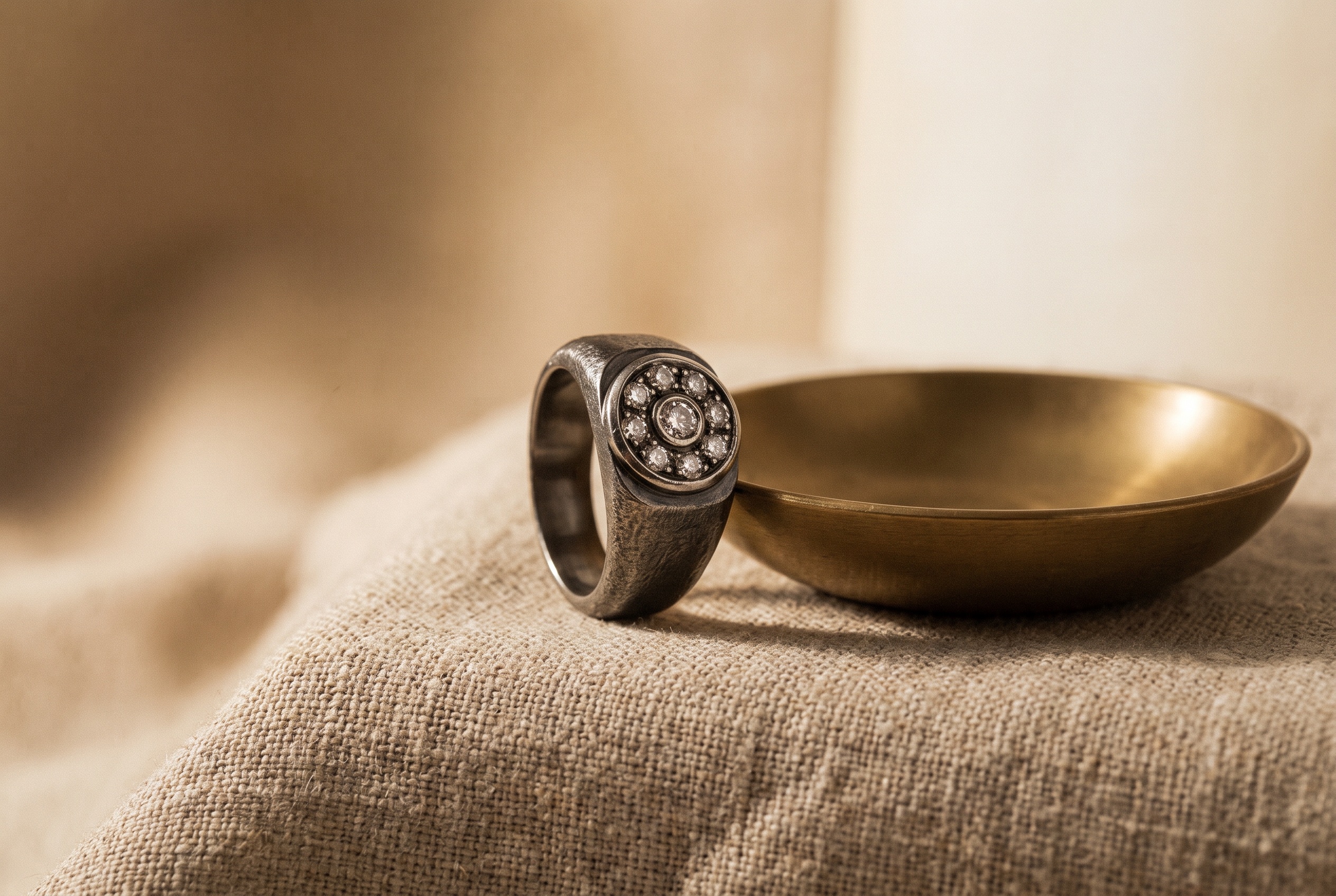
A growing category built around a flat or slightly domed top surface, historically used for a monogram or crest and increasingly set with a single diamond or small cluster instead. Statement rings extend the same wide-band, bold-silhouette approach with larger center stones or geometric multi-stone layouts, positioned as a men's equivalent to a women's cocktail ring.
Men's Pinky Rings
A distinct sub-category covered in depth in our pinky ring sourcing guide — smaller-scale statement pieces worn on the smallest finger, often featuring a single larger stone or a small cluster in a compact setting.
Men's Eternity and Half-Eternity Bands
Full or partial rows of channel or flush-set stones around a wider band, popular as both a standalone wedding band and an anniversary upgrade piece. Because men's bands run wider and larger on average, a full-eternity design uses meaningfully more total stones than the equivalent women's band.
| Style | Typical Band Width | Stone Approach | Common Setting |
|---|---|---|---|
| Wedding band | 6mm–10mm | Single row, channel or flush-set | Channel, flush, bezel |
| Signet/statement | 8mm–14mm (top surface) | Single center stone or small cluster | Bezel, flush, low-profile prong |
| Pinky ring | Varies, compact profile | Single stone or small cluster | Bezel, prong |
| Eternity band | 6mm–8mm | Full/half row, uniform melee | Channel, flush |
Typical Stone Sizes for Men's Ring Construction
Men's wedding and eternity bands most commonly use melee in the 0.02ct to 0.08ct range per stone, set channel-style or flush along the band — larger than the 0.005ct–0.02ct range typical of women's pavé, since the wider band and bolder design language call for stones that read clearly at a glance rather than a fine sparkle texture. Signet and statement rings vary more widely depending on design, ranging from a single 0.25ct–1ct+ center stone in a solitaire-style men's ring down to a cluster of similarly sized melee in a geometric layout. A retailer building a men's line should generally source a slightly larger average melee size than for equivalent women's channel work, since the bolder design context calls for it.
Setting Styles Built for Men's Wear Patterns
Flush and bezel settings dominate men's ring construction more than they do women's, and for a practical reason: men's hands, on average, see harder daily wear — manual work, gym use, more frequent impact — and a flush or bezel-set stone sits protected within or below the metal surface rather than raised on a prong, reducing the risk of a snagged or chipped stone. Channel setting serves the same protective function for a row of stones along a wedding band. Raised prong settings do appear in men's statement and signet rings, but far less commonly than in women's rings of comparable stone size, reflecting the category's practical-durability priority.
Diamond Shape Choices for Men's Rings
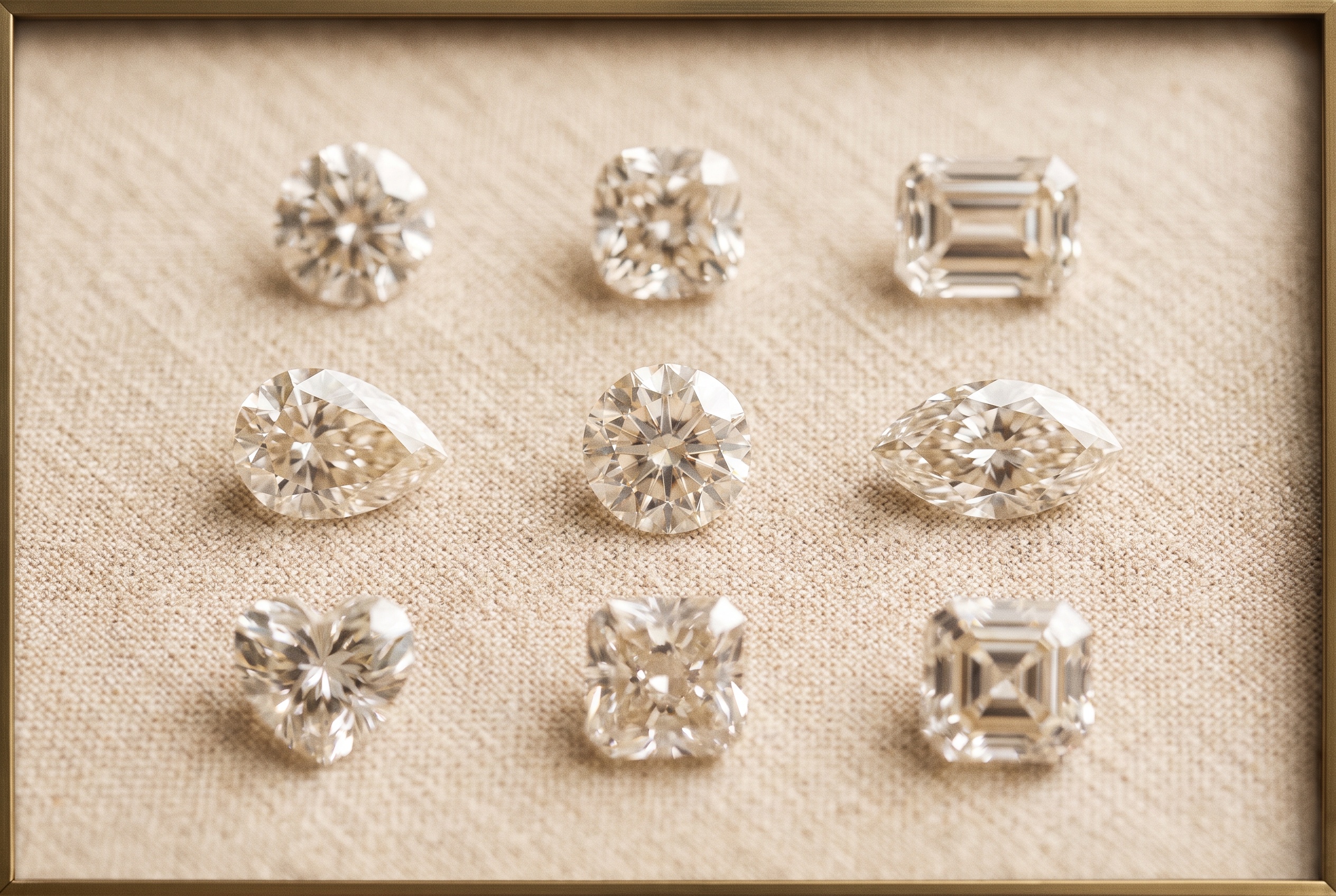
Round brilliant remains the most common shape across men's ring categories generally, valued for its consistent brilliance and flexibility across channel, flush, and bezel settings alike. Emerald and baguette cuts appear disproportionately often in men's statement and signet rings specifically, where their clean, geometric lines suit the understated, architectural design language the category favors over a sparkle-forward round stone. Black and salt-and-pepper diamonds — see our salt and pepper diamond guide — have also grown as a distinct men's-ring trend, offering a bolder, less traditionally "bridal" look that some men's-focused retailers now stock specifically for this category.
Color and Clarity Standards for Men's Ring Diamonds
Because men's designs frequently favor fewer, larger, more visible stones over dense pavé, individual stone quality tends to matter more per stone than it does in a women's cluster or pavé piece, where the effect is collective. For channel and flush-set band work, a DEF+/VS+ commercial standard applied consistently across the row remains the right baseline. For a men's ring built around one visible center stone — a signet or statement piece — sourcing a certified stone at 0.30ct or above with individual grading paperwork is worth the additional step, since the stone functions as the design's focal point rather than a supporting texture.
Lab-Grown vs. Natural Diamonds for Men's Rings
CVD lab-grown diamonds work well across the men's ring category broadly, delivering strong per-carat value for both channel-set band melee and larger center stones in signet or statement designs, at pricing that supports the category's growing volume without pushing retail prices out of reach for a segment that's historically been more price-sensitive on jewelry purchases than the bridal category. Natural diamonds remain a solid choice for retailers building premium men's lines marketed specifically on natural provenance, or for customers who specifically request natural stones for a wedding band purchase, but lab-grown material is generally the more efficient default for the core of a men's ring program.
Metal Choices in Men's Diamond Rings
White metals — platinum and white gold — and darker alternative metals like tungsten and black zirconium remain popular in men's wedding bands specifically, often paired with brushed or matte finishes that read as more understated than a polished shine. Yellow and rose gold have grown meaningfully in men's statement and signet ring design over recent years as part of a broader shift toward bolder, more individualized men's jewelry, moving away from the assumption that men's pieces default to white metal and a plain finish.
Building a Men's Diamond Ring Program: Inventory Planning
- Source slightly larger channel/flush melee (0.02ct–0.08ct) than typical women's pavé, matched to wider men's band widths.
- Stock certified center stones at 0.30ct+ for signet and statement ring designs where one stone carries the visual focus.
- Weight setting style toward flush and bezel construction, reflecting men's harder average wear patterns.
- Add emerald and baguette melee alongside round brilliant for the geometric design language common in men's statement pieces.
- Consider a black/salt-and-pepper diamond option as a distinct, growing men's-specific product line.
Pricing a Men's Diamond Ring: What Drives the Final Cost
Total metal weight plays a larger role in men's ring pricing than in comparable women's rings, simply because men's bands run wider and men's ring sizes run larger on average — a straightforward function of more metal by volume. On top of that base, stone cost tracks the design approach: a channel-set wedding band prices primarily on melee carat weight and setting labor, while a signet or statement ring with one certified center stone prices closer to a solitaire, driven by that single stone's grade. Retailers should price men's channel-set bands with metal weight as a first-order input, not an afterthought behind stone cost the way it might be for a lighter women's band.
Growth Trends in Men's Diamond Jewelry
Men's diamond jewelry has grown as part of a broader shift in how men engage with fine jewelry purchasing — both self-purchase and gift purchase from a partner — moving well beyond the traditional wedding band into signet rings, statement pieces, and layered jewelry generally. Retailers who build a dedicated men's case or online category, rather than treating men's rings as an incidental subset of the bridal case, tend to see stronger results from the category, since it benefits from being merchandised and marketed on its own design terms rather than as a smaller version of women's inventory. This mirrors the growth documented in our men's earrings sourcing guide, where the same broader trend applies.
Custom vs. Stock Men's Ring Production
Men's rings split between standard stock designs — a fixed wedding band or signet style produced repeatedly — and custom commissions, which run disproportionately common in this category relative to women's bridal rings, since men's ring buyers more often want a specific monogram, an unusual stone choice like black or salt-and-pepper diamond, or a nonstandard band width that off-the-shelf inventory doesn't cover. A retailer serving this category benefits from a supplier relationship that supports both bulk channel-melee ordering for stock production and quick-turn certified stone sourcing for one-off custom pieces without a bulk minimum getting in the way.
Durability Considerations Worth Communicating to Men's Ring Buyers
Men's rings, on average, are subjected to more physical wear than women's rings — more frequent contact with tools, equipment, and hard surfaces depending on the wearer's occupation and lifestyle — which makes durability messaging a more central part of the sales conversation than it typically is for a bridal engagement ring. Retailers selling into this category benefit from being upfront about which construction choices hold up best under heavy use: flush and bezel settings protect stones better than raised prongs, wider bands resist bending and warping better than thin ones, and harder alternative metals like tungsten or black zirconium resist scratching better than traditional gold or platinum, though at the tradeoff of being harder to resize. Framing these tradeoffs clearly at the point of sale reduces the odds of a damage-related warranty claim or a dissatisfied customer down the line, and positions the retailer as a knowledgeable resource rather than simply a seller.
Sizing Considerations Specific to Men's Rings
Men's ring sizing carries a few practical wrinkles worth building into a sourcing and inventory plan. Average men's ring sizes run larger than women's — commonly in the 9 to 13 range versus 5 to 7 for women's rings — which affects how much metal (and, for eternity-style bands, how many stones) a given design requires per unit produced. Men's finger width also tends to fluctuate more with temperature, activity level, and time of day than women's, which has pushed some retailers toward offering a half-size sizing buffer as standard practice, or recommending slightly looser fits than they would for an equivalent women's ring, particularly for wider bands where a snug fit reads as noticeably tighter than the same numeric size would in a narrower band.
Merchandising Men's Diamond Rings Effectively
Because men's diamond jewelry is a newer, less established buying category for many customers than women's bridal jewelry, how a retailer merchandises and presents the category affects conversion meaningfully. A dedicated men's case or clearly labeled online category, separated from the general engagement ring or fashion ring assortment, signals to a browsing customer that the retailer takes the category seriously rather than treating it as a small afterthought bolted onto women's inventory. Photography and display that shows pieces on an actual hand at scale — rather than isolated product shots that don't convey the wider band width or bolder proportions — also measurably helps customers who aren't yet familiar with how men's diamond jewelry differs from women's in scale and styling.
Who Buys Men's Diamond Rings
Purchase patterns in this category split across a few distinct buyer profiles worth accounting for in both inventory planning and sales approach. Self-purchase by men buying for themselves has grown as a share of the category, driven partly by broader cultural shifts toward men engaging more actively with personal style and jewelry generally, and this buyer typically wants to see and try pieces in person before committing, favoring retailers with a genuine in-store men's assortment over online-only options. Gift purchase — a partner buying a men's ring as an anniversary, wedding, or milestone gift — represents another significant share, and this buyer often needs more guidance on sizing and style preference than a self-purchasing customer would, since they're buying for someone else's taste rather than their own. A smaller but valuable segment includes matching-set bridal purchases, where a couple buys both partners' wedding bands together, which rewards retailers who can present coordinated his-and-hers options using shared design language across both pieces.
Warranty and Resizing Policy Considerations for Men's Rings
Given men's rings' generally harder wear patterns and the fact that alternative metals like tungsten and black zirconium can't be resized using standard jeweler's tools the way gold or platinum can, retailers should set clear expectations at the point of sale about what warranty coverage and resizing options apply to a given metal choice. A customer purchasing a tungsten band, for instance, needs to understand upfront that a future size change likely means purchasing a new ring entirely rather than resizing the existing one — information that affects both the purchase decision and long-term customer satisfaction if it isn't communicated clearly before the sale. Retailers who build this into standard sales conversation, rather than leaving it as fine print discovered only when a resizing request comes in later, avoid a meaningful source of post-purchase friction specific to this category's popular alternative-metal options.
Comfort-Fit Construction for Everyday Men's Rings
Comfort-fit banding — a rounded, slightly domed interior profile rather than a flat-backed band — has become close to a default expectation for men's wedding and daily-wear rings, since it slides on and off more easily and feels less restrictive across a full day of wear than a flat-interior band of the same nominal size. This construction detail interacts with stone setting choices in a men's ring specifically: channel and flush settings work well with comfort-fit interiors, since the stones sit within the band's outer profile rather than depending on the interior shape, while certain bezel constructions require slightly more careful engineering to maintain a comfortable interior curve without compromising how securely the stone sits. Retailers sourcing from a manufacturing partner for men's ring production should confirm comfort-fit capability as a standard offering across the men's line, since it's increasingly an expected feature rather than a premium upgrade in this category.
Sourcing Diamonds for a Men's Ring Line Wholesale
Guru Diam supplies CVD lab-grown and natural diamonds across the size range used in men's ring construction — from channel-set melee to certified center stones at 0.30ct and above — including black and salt-and-pepper options, sorted to a consistent commercial standard. Trade buyers can review current melee and certified inventory through certified diamonds and matching pairs, and work with Guru Diam's custom jewelry team on setting construction through custom jewelry, with custom pieces finished in 4-6 days. In-stock inventory ships same-day from Guru Diam's New York and Los Angeles locations. New trade accounts can apply through trade partner, with current terms available at the wholesale hub. For related sourcing guides, see our men's pinky ring guide and men's earrings sourcing guide.
Frequently Asked Questions
What makes a men's diamond ring different from a women's ring, sourcing-wise?
Men's rings use wider bands (6mm–10mm vs. 2mm–4mm), larger average ring sizes, and setting styles biased toward flush and bezel construction for durability. These differences call for slightly larger melee and a distinct sourcing plan rather than pulling from women's inventory.
What size diamonds are used in men's wedding bands?
Most channel or flush-set men's bands use melee in the 0.02ct to 0.08ct range per stone, larger on average than typical women's pavé, to read clearly against the wider band and bolder design language.
What setting style is most common in men's diamond rings?
Flush and bezel settings dominate, since they protect the stone within or below the metal surface, suiting the harder average daily wear men's hands typically see compared to women's rings.
Should men's ring diamonds be lab-grown or natural?
CVD lab-grown diamonds work well across the category, offering strong value for both channel melee and larger center stones. Natural diamonds remain a solid option for premium lines or specific customer requests.
What diamond shapes work best for men's statement rings?
Round brilliant is most common overall, but emerald and baguette cuts appear disproportionately in signet and statement designs for their clean, geometric lines. Black and salt-and-pepper diamonds have also grown as a distinct men's trend.
Is custom production more common for men's rings than women's?
Yes, relatively — men's ring buyers more often request a specific monogram, an unusual stone, or a nonstandard band width, making custom commissions a larger share of the category than in standard women's bridal rings.
Guru Diam is a trade-only wholesale diamond supplier with locations in New York and Los Angeles, supplying CVD lab-grown and natural diamonds — including certified loose stones, calibrated melee, and black/salt-and-pepper options — for jewelers building men's diamond ring lines. Browse current inventory in certified diamonds or apply for a trade account through trade partner.