
A ring size is a standardized measurement of the inside circumference (or diameter) of a ring's band, expressed as a number or letter depending on the sizing system used — most commonly a whole or half number in the US/Canada system (e.g., size 6, 6.5, 7), a letter in the UK/Australia system (e.g., L, M, N), or a numeric measurement in millimeters in most of continental Europe and Asia. None of these systems are interchangeable at a glance, which is why a reliable conversion chart matters as much as the measurement itself.
Getting a ring size wrong is one of the most common — and most avoidable — friction points in both retail and custom jewelry orders, and it happens for a predictable set of reasons: a buyer measures at the wrong time of day, converts between sizing systems incorrectly, orders based on a partner's size guess rather than an actual measurement, or doesn't account for how a band's width or a stone's height changes how a given size actually fits. This guide covers the full US-to-UK-to-EU conversion chart, several reliable ways to measure ring size without a professional sizer on hand, how to measure an existing ring's inside diameter accurately, the factors that cause ring size to fluctuate day to day, how resizing works (and its limits) once a ring is made, and how to handle sizing when buying a ring as a surprise gift.
Ring Size Systems: US, UK, EU, and the Rest of the World
Three sizing systems account for the overwhelming majority of the world's ring sizing:
- US / Canada. A numeric scale running roughly from size 3 to size 13+ for adult rings, in half-size (and sometimes quarter-size) increments, based on the ring's inside circumference in millimeters mapped to a standardized numeric scale.
- UK / Ireland / Australia / South Africa / New Zealand. An alphabetic scale running from A (smallest) through Z and beyond (with "half sizes" denoted by a ½ after the letter, e.g., "N ½"), also based on inside circumference but mapped to letters instead of numbers.
- EU / most of continental Europe. A direct numeric measurement of the inside circumference in millimeters — so an EU size of "52" literally means the inside circumference measures 52mm. This is the most literal of the three systems, since the "size" and the physical measurement are the same number.
Japan, China, and several other Asian markets use their own numeric scales that don't map cleanly onto any of the three systems above by simple arithmetic — a jeweler sourcing or shipping internationally should confirm which specific scale a customer or partner is using rather than assuming a direct conversion, since a mismatch of even one size step is enough to make a finished ring uncomfortably tight or loose.
Full Ring Size Conversion Chart
The table below maps the most commonly ordered adult ring sizes across all three major systems, along with the inside circumference and inside diameter in millimeters that each size actually corresponds to. Diameter and circumference are related by the standard formula (circumference = diameter × π), and both figures are useful depending on which measuring method is being used.
| US Size | UK / AU Size | EU Size (mm circumference) | Inside Diameter (mm) |
|---|---|---|---|
| 3 | F | 44 | 14.1 |
| 3.5 | G | 45 | 14.5 |
| 4 | H | 46.5 | 14.9 |
| 4.5 | I | 47.5 | 15.3 |
| 5 | J | 49 | 15.7 |
| 5.5 | K | 50 | 16.1 |
| 6 | L | 51.5 | 16.5 |
| 6.5 | M | 52.5 | 16.9 |
| 7 | N | 54 | 17.3 |
| 7.5 | O | 55 | 17.7 |
| 8 | P | 56.5 | 18.1 |
| 8.5 | Q | 57.5 | 18.5 |
| 9 | R | 59 | 18.9 |
| 9.5 | S | 60 | 19.4 |
| 10 | T | 61.5 | 19.8 |
| 10.5 | U | 62.5 | 20.2 |
| 11 | V | 64 | 20.6 |
| 12 | X | 66.5 | 21.4 |
| 13 | Z | 69.5 | 22.2 |
These figures represent widely used industry standards, but small rounding differences exist between manufacturers and mandrels — for anything going into production, a jeweler should confirm against the specific sizing mandrel or ring sizer being used for that order rather than treating any single published chart as the absolute final word to a fraction of a millimeter.
How to Measure Ring Size at Home: Four Reliable Methods
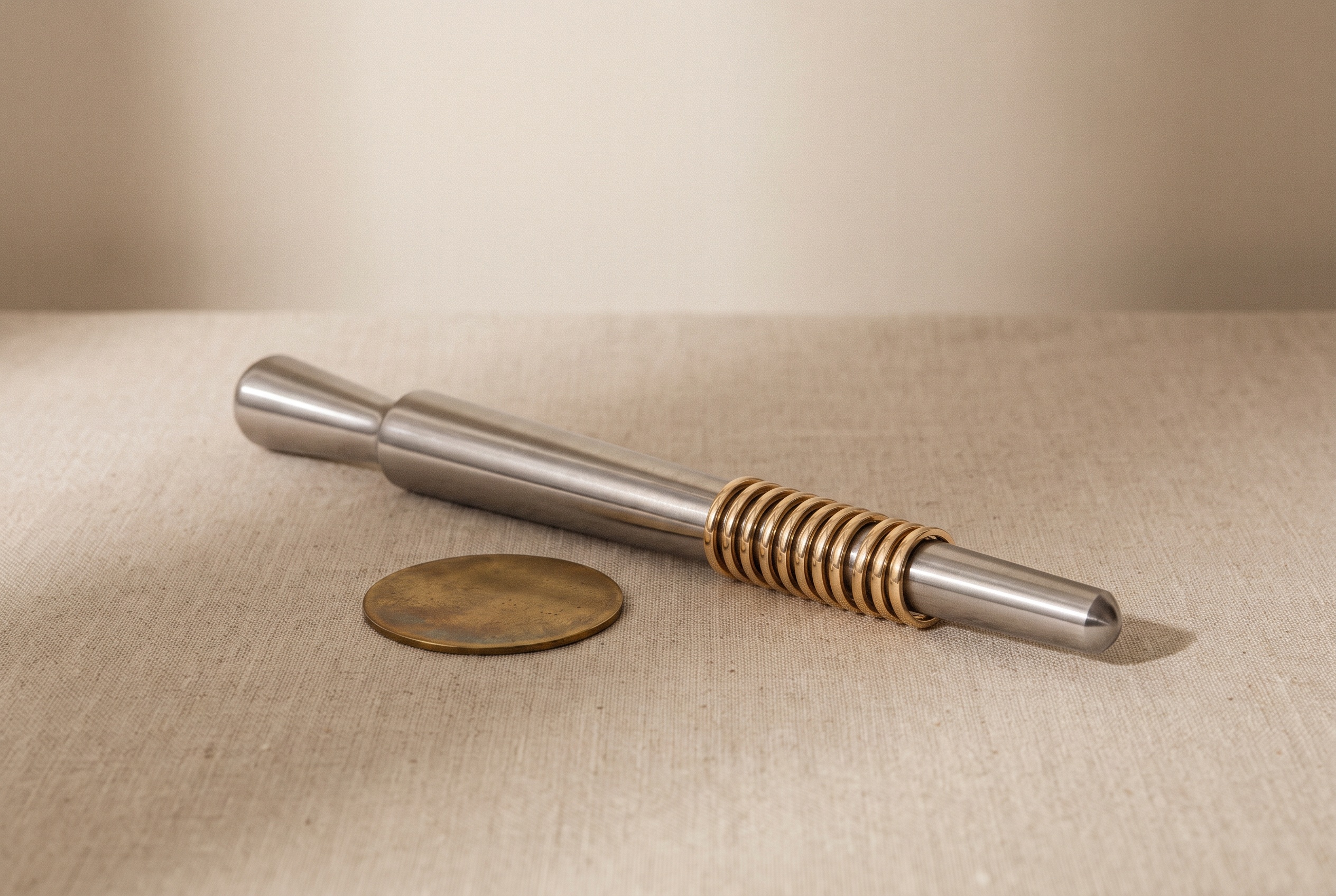
A professional ring sizer — a graduated metal or plastic mandrel a jeweler slides a finger through — is the most accurate method, but it isn't always available. These methods, in descending order of reliability, work well without one:
Method 1: The String or Paper Strip Method
Wrap a thin strip of string, dental floss, or paper snugly around the base of the finger being sized (not too tight, not loose enough to slide over the knuckle). Mark the point where the material overlaps, then measure that length flat against a ruler in millimeters. That number is the finger's circumference — match it against the chart above to find the corresponding size. This method is free and reasonably accurate, though it's more prone to human error than a rigid sizer, particularly around getting the tension right (too tight understates the size, too loose overstates it).
Method 2: Measuring an Existing Ring
If the person already owns a ring that fits the correct finger comfortably, measuring that ring directly is one of the more reliable non-professional methods, since it removes finger-swelling and tension variables from the equation entirely. See the dedicated section below for exactly how to do this correctly.
Method 3: A Printable or Plastic Ring Sizer
Plastic ring sizer sets — a series of graduated rings on a keyring, sized to standard increments — are inexpensive and widely available, and they function similarly to a professional mandrel since they test actual fit rather than relying on a flat measurement translated into a circumference. Printable paper ring sizers exist as well but carry a meaningful risk of inaccuracy, since most home and office printers introduce small scaling errors when printing at "actual size," and even a 2-3% scaling error is enough to shift the result by a full size in some ranges. A physical plastic sizer set avoids that failure mode entirely.
Method 4: A Jeweler's In-Person Sizing
The gold standard remains an in-person measurement with a professional mandrel at a jewelry counter, ideally done more than once (see the timing factors below) to account for natural size fluctuation. For a significant purchase — a center-stone engagement ring, a custom piece — an in-person sizing is worth the extra step even if a home method has already produced a number, simply because the cost of resizing (in time, and sometimes in a stone reset) after the fact is higher than the cost of getting it right up front.
How to Measure an Existing Ring's Size
Measuring a ring the wearer already owns is a common and effective strategy for surprise proposals, since it doesn't require asking the recipient directly. Two approaches work:
- Measure the inside diameter directly. Using a ruler with millimeter markings, measure straight across the inside of the band at its widest point (edge to edge through the center), then match that diameter figure against the chart above. This is the most direct method, but it requires a precise, steady measurement — a ring placed slightly off-center on the ruler will read smaller than its true diameter.
- Trace the inside circle and measure the tracing. Place the ring on a flat piece of paper, trace the inside edge with a fine pencil held vertically, then measure the diameter of the traced circle with a ruler. This method is slightly more forgiving than measuring the physical ring directly, since the flat tracing is easier to line up a ruler against precisely.
A useful sanity check either way: borrow a ring worn on the correct finger, not a different finger, since finger diameters vary meaningfully from one finger to the next on the same hand (typically increasing from the pinky to the middle or ring finger, depending on the individual). A ring pulled from the wrong finger will produce a confidently wrong size.
Factors That Change Ring Size Day to Day
Finger size isn't a fixed number — it fluctuates meaningfully based on several factors, which is why sizing guidance generally recommends measuring more than once, at different times, rather than trusting a single reading:
| Factor | Effect on Finger Size | Sizing Recommendation |
|---|---|---|
| Time of day | Fingers are typically smallest in the morning and swell slightly larger by evening as fluid retention increases through the day | Measure in the mid-to-late afternoon or evening for a size that accounts for typical daily swelling |
| Temperature | Cold causes fingers to shrink (vasoconstriction); heat and humidity cause them to swell | Avoid measuring right after being outside in cold weather or right after a hot shower or workout |
| Salt and fluid intake | High sodium intake and dehydration can both cause temporary swelling | Measure under normal, typical conditions rather than immediately after a particularly salty meal |
| Physical activity | Exercise increases blood flow and can temporarily enlarge fingers | Measure at rest, not immediately post-workout |
| Pregnancy | Significant, often temporary swelling is common, especially in later stages | Sizing during pregnancy for a ring intended for long-term wear should account for the fact that the size may not be representative of pre- or post-pregnancy size |
| Dominant hand | The dominant hand's fingers are often very slightly larger due to more frequent use and muscle development | Always measure the specific hand and finger the ring will actually be worn on |
| Age and weight changes | Finger size can shift gradually over years with weight changes, arthritis, or general aging | A ring sized years ago may no longer reflect current finger size — remeasure rather than assuming an old size still applies |
Given all of these variables, taking two or three measurements on different days under different conditions and using the middle or most frequent result is a more reliable approach than relying on a single reading, particularly for a ring that's expensive or time-consuming to resize.
How Band Width and Stone Height Affect Fit at the Same "Size"
A ring size number describes the inside circumference of the band — but a band's width and a setting's height both change how a ring of the "correct" size actually feels and fits, which is why two rings that are technically the same measured size can fit differently on the same finger:
- Wider bands fit tighter than narrow bands at the same nominal size. A wide band (6mm and up) contacts more surface area of the finger than a thin band, which generally means a wide band needs to be sized slightly larger than a thin band would be for the same finger to feel equally comfortable — many jewelers recommend going up a half size when moving from a thin band to a substantially wider one.
- A tall setting can shift the ring's center of gravity. A ring with a high-profile setting (a tall prong setting over a large center stone, for instance) tends to rotate on the finger more than a flush, low-profile band, which some wearers compensate for by sizing very slightly snug rather than exactly true-to-measurement.
- Knuckle size versus base-of-finger size matters for larger knuckles. If a wearer's knuckle is noticeably larger than the base of the finger, a ring sized to fit comfortably at the base may be difficult to get over the knuckle, while a ring sized to clear the knuckle easily may spin loosely at the base. This is a genuine fit tradeoff without a universal right answer — it comes down to the wearer's preference between security at the base and ease of removal.
Resizing: What's Possible and What Isn't
Most rings can be resized after the fact, but not infinitely, and not always without tradeoffs — understanding the limits before ordering avoids an unpleasant surprise later.
| Ring Type | Resizing Outlook |
|---|---|
| Plain metal band (no stones, no engraving on the inside) | Generally easy to resize up or down within a couple of sizes by cutting, stretching, or adding metal |
| Solitaire with prong or basket setting | Usually resizable within a moderate range without disturbing the center stone, since the shank can be worked on away from the setting |
| Eternity band or full-diamond-wedding-band (stones set all the way around) | Difficult or impossible to resize without removing and resetting stones, since there's no plain metal section left to cut and adjust — sizing needs to be right the first time, or accept a partial-eternity (¾ or half) style instead if future resizing is a real possibility |
| Rings with inside engraving | Resizing can shorten, stretch, or distort an engraved inscription, depending on how much the size needs to change |
| Tension-set rings | Generally the most difficult and expensive style to resize, since the setting relies on precisely calibrated metal tension to hold the stone, and that tension is disrupted by cutting or stretching the band |
| Rings with a fixed-size inlay (wood, ceramic, or a non-metal material inside the band) | Often not resizable at all, or only within a very narrow range, since the inlay material doesn't stretch or accept a metal insert the way a plain gold or platinum band does |
For any style toward the harder-to-resize end of this table, getting sizing right before the order goes into production matters considerably more than it does for a simple plain band — which is exactly why a genuine, verified measurement (rather than a guess) is worth the extra step for anything beyond a low-stakes purchase.
Sizing for a Surprise: Getting It Right Without Asking
Proposal rings are the classic case where the recipient can't simply be asked their size without spoiling the surprise. A few strategies, in rough order of reliability:
- Borrow and measure an existing ring worn on the correct hand and finger, using the tracing or direct-diameter method described earlier, then return it before it's missed.
- Ask a close friend or family member who might already know, or who can casually find out without tipping off the recipient — many people have shared this information with someone close to them at some point.
- Compare against a ring the buyer already owns from the same person — if their hands are a similar size, a same-hand comparison against the buyer's own ring can at least narrow the range, though this is the least precise method on this list and best used only to rule out obviously wrong sizes.
- Size slightly larger rather than slightly smaller when genuinely uncertain, since a ring that's marginally too big is a straightforward, low-drama resize, while a ring that's too small can be more disruptive to fix (and in the eternity-band or tension-set cases above, sometimes can't be resized down at all without remaking the piece).
Whichever method is used, most retailers and custom jewelers build a one-time complimentary or low-cost resize into the first weeks after a ring purchase specifically because getting a surprise size exactly right on the first try is genuinely difficult — treating that first resize as a normal, expected step rather than a failure of the original guess keeps expectations realistic.
Sourcing Correctly Sized Custom Rings at Wholesale
For jewelers and designers building custom pieces for clients, ring sizing isn't a one-time consumer question — it's a recurring production variable that has to be nailed down accurately on every order, since a mis-sized center-stone ring means either an awkward early resize on a finished piece or, in harder-to-resize styles, a full remake. Guru Diam's custom jewelry program builds engagement rings and other finished pieces to a client's specified size from the outset, with cutting, setting, and polishing all handled in-house and finished pieces delivered in 4-6 days — fast enough that even a same-week correction, when one is genuinely needed, doesn't stall a client relationship for weeks the way a slower production cycle would.
Because sizing needs shift by style — a wide band, a tall halo setting, or a full-eternity design all carry different sizing considerations, as covered above — working with a supplier who can flag those tradeoffs at the order stage rather than after a piece is finished is worth more than a fast turnaround alone. Buyers building a custom program can review center-stone options through the certified diamonds category, source calibrated melee and matched sets through matching pairs for pavé or halo work, and browse fancy color stones for statement pieces through fancy color loose diamonds. Trade accounts can review current program terms at the wholesale hub or apply through trade partner, and full builds — from stone selection through a correctly sized, finished ring — run through custom jewelry. For buyers also weighing setting styles for a build, our cathedral setting ring guide covers one of the more requested style categories in more depth.
Frequently Asked Questions
What is the most accurate way to measure ring size at home?
Measuring an existing ring the wearer already owns — one that fits the correct finger comfortably — is generally the most reliable non-professional method, since it removes finger-swelling and measuring-tension variables entirely. A plastic ring sizer set is the next most reliable option; a string or paper-strip measurement works but is more sensitive to tension error, and printed paper sizers carry real risk of scaling inaccuracy from home printers.
How do I convert a US ring size to UK or EU?
Use a conversion chart matched against the same inside-circumference measurement — a US size 7, for example, converts to a UK size N and an EU size of roughly 54mm. All three systems measure the same underlying circumference, just mapped to different numbering conventions, so converting requires going through the physical measurement rather than a direct number-to-number formula.
Why does my ring size seem to change throughout the day?
Fingers genuinely change size due to temperature, fluid retention, salt intake, physical activity, and time of day — most people's fingers are smallest in the morning and swell slightly larger by evening. This is why sizing guidance generally recommends measuring in the afternoon or evening and, ideally, on more than one occasion under different conditions.
Can any ring be resized to a different size later?
Most plain bands and standard prong-set solitaires can be resized within a moderate range. Full eternity bands, tension-set rings, and rings with a fixed inlay material are much harder — sometimes impossible — to resize without remaking the piece, since there's no plain section of metal left to cut and adjust or because the setting relies on exact original proportions.
How do I find someone's ring size without them knowing, for a proposal?
Borrowing and measuring a ring they already wear on the correct hand and finger is the most reliable discreet method — trace the inside of the band on paper and measure the diameter, or measure the inside diameter directly with a ruler. Asking a close friend or family member who might already know the size is another common, reliable approach.
Should I size up or down if I'm between two sizes?
Sizing up slightly is generally the safer choice when genuinely uncertain, since a ring that's marginally loose is a simple, inexpensive resize, while a ring that's too tight can be more disruptive to correct — particularly in styles like eternity bands or tension settings that resize poorly or not at all.