
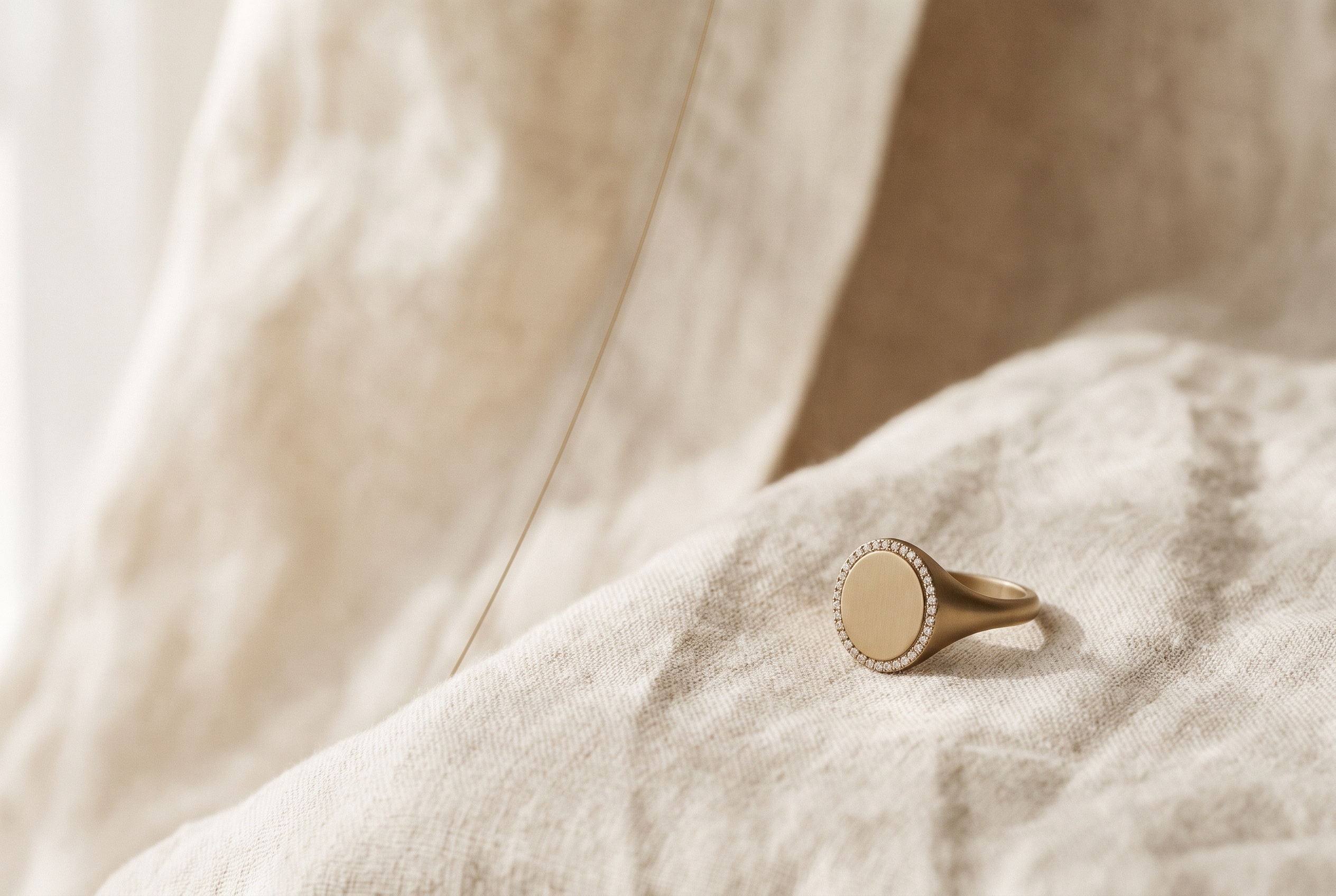
A diamond signet ring is a flat-topped ring — traditionally used to stamp a wax seal with a family crest or monogram — updated with diamond accents, either set into the flat face itself, bordering it, or replacing the engraved crest entirely with a diamond-set design. Unlike most fine-jewelry ring categories built primarily around a center stone, a signet ring's core identity is its flat, engravable face; diamonds are an accent to that structure rather than the piece's central feature.
This guide is written for the trade — jewelers, retailers, and designers sourcing diamond signet rings for a personalized or unisex jewelry line — covering what distinguishes the category from center-stone-driven rings, engraving and personalization considerations, stone placement conventions, sizing for a category worn by all genders, and what to look for in a wholesale supplier for signet-ring production.
Why Signet Rings Are a Distinct Sourcing Category
Signet rings occupy an unusual position in fine jewelry: the category's commercial appeal rests heavily on personalization (an engraved initial, monogram, or symbol) and on unisex, heirloom-adjacent positioning, rather than on diamond carat weight the way most other diamond ring categories are marketed. A retailer sourcing signet rings needs production capability oriented around a flat, engravable surface and precise diamond placement around or within that surface, which is a different setting discipline than mounting a center stone in a prong or halo setting.
The category has also grown meaningfully as a unisex and men's fine jewelry item, a demand segment that most other diamond ring categories don't serve well. This broadens the sourcing consideration beyond typical bridal or women's fashion ring conventions — sizing range, band thickness, and design language all need to work for a genuinely mixed customer base rather than skewing toward one gender's typical preferences.
Signet Ring Diamond Placement Styles
| Style | Diamond Placement | Engraving Compatibility |
|---|---|---|
| Diamond-bordered signet | Small diamonds set around the perimeter of the flat face | Full — center face remains open for a crest, initial, or monogram |
| Single accent stone signet | One small diamond set into a corner or edge of the face | Full — diamond doesn't interfere with the main engraving area |
| Diamond-set initial signet | Diamonds set to form or trace the initial itself, in place of engraving | None — the diamond placement replaces traditional engraving |
| Pavé shank signet | Diamonds set along the band, flat face left plain or engraved | Full — diamonds are on the shank, not the face |
| Diamond-framed crest signet | A line of diamonds outlining a raised or engraved crest design | Partial — crest area still engravable, framed rather than covered |
Engraving and Personalization Considerations
Because personalization is central to why customers buy a signet ring, retailers need a production path that supports engraving — hand engraving or laser engraving, depending on the design's complexity — as a standard part of fulfillment rather than an occasional add-on. A diamond-bordered or single-accent-stone signet is the easiest construction to pair with engraving, since the flat face remains fully open for a monogram, initial, family crest, or symbol without any diamond placement competing for that space. Retailers offering engraving should be able to accommodate both a small number of standard font and layout options for straightforward requests and a custom design path for a family crest or more complex symbol, since signet ring buyers span a wide range of how much personalization detail they want.
Engraving depth and technique also matter for durability: a shallow laser engraving on a heavily worn everyday ring will wear faint faster than a deeper hand-engraved design, a tradeoff retailers should communicate to customers choosing between a lower-cost laser option and a more durable, more expensive hand-engraved one.
Sizing and Design for a Unisex Category
Signet rings are worn across a wider range of hand sizes and style preferences than most fine-jewelry ring categories, given the segment's genuinely unisex demand. This has direct sourcing implications: retailers need a broader size range in stock than a typically women's-skewed category requires, and band thickness options spanning a noticeably wider range — thinner, more delicate profiles for customers who want a subtler piece, and substantially heavier, wider bands for customers (often but not exclusively men) who want a bolder, more traditional signet presence. A single band thickness sourced to split the difference between these preferences tends to satisfy neither end of the demand range well.
Diamond Quality Standards for Signet Rings
Because diamonds are an accent rather than the focal point in most signet ring designs, stone sizes typically run small — well under 0.05ct per stone in a diamond-bordered design — making a DEF+/VS+ commercial melee standard appropriate for the category, consistent with standard melee sourcing practice at these sizes. As covered in our 4Cs overview guide, clarity characteristics become progressively harder to see as stone size decreases, giving retailers latitude to manage per-unit cost on a category where the engravable face, not the diamonds, is typically the primary design and cost driver.
Lab-Grown vs. Natural Diamonds for Signet Rings
Both lab-grown and natural diamonds are sourced for signet ring accents, and because stone sizes are generally small, the price difference between origins is less decisive to this category's overall cost than it is in a center-stone-driven ring. CVD lab-grown melee remains the more cost-efficient default for a diamond-bordered design requiring a larger number of small stones, while natural melee suits retailers positioning signet rings at a heritage-adjacent, premium tier where natural origin aligns with the category's traditional, heirloom-style positioning.
Metal Options for Signet Rings
14k and 18k gold in yellow, white, and rose tones all see demand in this category, with yellow gold remaining the most traditional and still the highest-volume choice given the signet ring's historical association with yellow-gold family crest rings. Heavier gauge metal is generally used for signet rings than for a comparably sized fashion ring, both to support the flat engravable face structurally and to meet customer expectations for a substantial, traditional feel that lighter-weight construction doesn't deliver as convincingly in this specific category.
Wholesale Pricing Structure for Signet Rings
Because metal weight and engraving labor, not diamond carat weight, drive a larger share of signet ring cost than in most other diamond ring categories, wholesale pricing needs to account for metal gauge and engraving complexity alongside the relatively modest diamond cost. Retailers benefit from a supplier who can quote engraving as an integrated part of the piece's production rather than as a separate after-the-fact service, since coordinating a third-party engraver after the ring is already cast or set adds both cost and turnaround time to what customers often expect as a fast, personalized purchase.
Building a Signet Ring Program
- Offer a genuine size and thickness range. Covering both delicate, subtler profiles and substantially heavier, bolder bands captures the category's full unisex demand rather than skewing toward one end.
- Make engraving a standard, integrated service. A signet ring program without built-in engraving capability is missing the category's core value proposition; retailers should treat personalization as a default part of fulfillment, not an optional add-on.
- Include both diamond-accented and plain engravable styles. Not every signet ring customer wants diamonds at all — some are purely there for the engravable face — so a full program benefits from covering both, letting the diamond-accented pieces serve as a premium upsell from a plain base style.
- Stock a mix of traditional and modern designs. Classic oval or shield-shaped faces in yellow gold serve the category's heritage-leaning customer, while diamond-set initial designs and non-traditional shapes serve a more fashion-forward buyer.
- Retain design specifications for reorders. Keeping a customer's crest, monogram, or engraving specification on file supports both family-set coordination and future re-engraving or refresh requests without starting the design process over from scratch.
Common Sourcing Mistakes in This Category
- Treating diamonds as the piece's main feature. Overinvesting in diamond placement or carat weight at the expense of face size, metal weight, or engraving quality misreads what actually drives purchase decisions in this category.
- Insufficient size and thickness range. A narrow size run or a single band thickness fails to serve the category's genuinely unisex, wide-ranging customer base.
- Outsourcing engraving as an afterthought. Sending finished rings to a separate engraver after production, rather than building engraving into the core fulfillment process, adds turnaround time and coordination risk to a category where customers often expect a relatively fast personalized purchase.
- Underestimating metal gauge requirements. A flat engravable face needs enough metal thickness to hold a crisp, durable engraving over years of wear; a design cast too thin will show engraving wear and face distortion faster than the category's heirloom-adjacent positioning implies it should.
- No re-engraving or refresh pathway. Given how many signet rings are worn for years or passed down, a retailer without a way to refresh worn engraving or add new personalization to an existing ring misses a meaningful aftercare and repeat-relationship opportunity specific to this category.
Durability and Long-Term Wear Considerations
Signet rings are frequently positioned and worn as heirloom or long-term pieces — passed down, added to over a lifetime, or worn daily for years as a signature accessory — which raises the durability bar compared with an occasional-wear fashion ring. The flat face in particular takes direct wear from daily contact with surfaces, keys, and tools, which is part of why heavier metal gauge matters more here than in most other ring categories: a face cast too thin will visibly flatten and lose engraving definition faster under the kind of daily contact signet rings are specifically designed to withstand. Diamond placements around the border of the face should sit slightly recessed or protected relative to the face's highest point where possible, reducing the chance that stones take the same direct surface contact the flat face itself is built to absorb.
Because these are often worn as long-term, even lifetime, pieces, retailers should plan for a re-engraving or refresh service as part of the category's aftercare — a design worn for a decade or more may need its engraving refreshed, or the ring passed to a new owner may need new personalization added, and a retailer able to offer this without requiring the customer to source a separate engraver builds meaningful long-term relationship value from a category that's inherently oriented around long ownership rather than a single transaction.
Family Crest and Custom Symbol Work
A meaningful share of signet ring demand, particularly at the higher end of the category, involves a specific family crest, coat of arms, monogram cipher, or personal symbol rather than a simple single-letter initial. This is a more involved production path than standard engraving: it typically requires converting a customer-supplied image or description into an engraving-ready design, confirming proportions and detail level will translate cleanly onto the ring's face size, and in some cases producing a wax or digital proof for customer approval before final engraving. Retailers who can manage this process in-house, coordinated with the same supplier producing the ring itself, offer a meaningfully smoother experience than one requiring the customer to separately source and vet an outside engraver capable of custom crest work — a common friction point in this category that a well-integrated supplier relationship removes.
Merchandising Diamond Signet Rings
Signet rings merchandise well alongside a retailer's broader personalization offer — engraved pendants, initial jewelry, and other monogram-driven pieces — since the customer mindset (wanting something uniquely theirs, not an off-the-shelf design) carries across these categories. Point-of-sale staff who can walk a customer through engraving options (font choices, symbol or crest availability, hand versus laser engraving tradeoffs) convert better in this category than staff simply presenting the ring as a finished, non-customizable product, given how central personalization is to the purchase decision. Gifting occasions — graduations, coming-of-age milestones, and family heirloom gifting in particular — are a meaningful demand driver worth reflecting in seasonal merchandising and marketing language.
A physical or digital sample display showing the range of available crest styles, monogram layouts, and engraving depths helps customers unfamiliar with signet ring conventions understand their options faster than a verbal explanation alone, particularly for first-time buyers who may not know the category well enough to know what to ask for. Retailers who invest in this kind of visual reference at the point of sale tend to see faster decision-making and fewer post-purchase engraving revisions than those relying entirely on staff description.
Wearing Conventions: Which Hand and Finger
Signet rings carry more established wearing conventions than most fashion ring categories, which retailers benefit from understanding when advising customers on sizing and design. Traditionally worn on the pinky finger of the non-dominant hand, a convention with roots in the ring's historical use for stamping wax seals, this remains the most common placement, though a growing share of buyers — particularly in the category's more fashion-forward, unisex resurgence — wear signet rings on the index or middle finger instead, sized and styled somewhat differently than a traditional pinky signet. Pinky placement generally calls for a smaller, more compact face than an index or middle-finger signet can comfortably carry, which is a useful sizing and design consideration for retailers stocking multiple face sizes across the same core design.
Because finger placement affects both the appropriate face size and how much daily wear and contact the ring will realistically experience, retailers benefit from asking customers about intended wear (which hand and finger, how frequently) before finalizing size and metal gauge, rather than defaulting to one standard specification across the whole category.
Comparing Signet Rings to Related Categories
Signet rings share personalization logic with several other categories in this queue. Our diamond initial necklace guide covers a parallel monogram-driven category in the necklace format, useful for retailers building a coordinated personalization offer across rings and necklaces. For retailers serving the category's substantial men's demand specifically, our men's diamond ring guide and diamond pinky ring guide cover adjacent categories with overlapping unisex and men's-fashion customer bases.
Coordinating Signet Rings Within a Family or Set
Because signet rings carry heirloom and family-identity associations more strongly than most jewelry categories, retailers see meaningful demand for coordinated pieces — matching or complementary signet rings produced for multiple family members, sometimes sized differently but sharing the same crest, monogram cipher, or design language. This is a distinct production request from a single custom piece: it requires the same engraving design applied consistently across rings of different sizes and sometimes different metal tones, which benefits from the crest or monogram artwork being saved and reusable rather than recreated from scratch for each family member's order, particularly when orders for different family members arrive months or years apart rather than all at once.
Retailers who can offer this kind of coordinated, multi-piece family order — and who retain the design and specification from an earlier order so a later one can match it precisely — build a different kind of ongoing relationship with a customer than a single-transaction sale typically produces, since the category's heirloom framing naturally invites a customer to return for additional family pieces over time.
Sourcing a Signet Ring Program at Wholesale
Guru Diam supplies certified CVD lab-grown and natural diamonds alongside calibrated melee, with cutting, setting, and polishing all handled in-house, giving retailers a single source for building a signet ring program across metal weights, diamond placements, and engraving styles, including custom crest and family-set coordination work. Retailers can review calibrated melee inventory through matching pairs, browse certified stones for accent placements through certified diamonds, and work through custom jewelry for bespoke crest or monogram designs, with finished pieces delivered in 4-6 days. Trade accounts can review terms at the wholesale hub or apply through trade partner.
Frequently Asked Questions
What is a diamond signet ring?
A signet ring is a flat-topped ring traditionally used to stamp a family crest or monogram into wax; a diamond signet ring adds diamond accents, either bordering the flat face, set at a corner, or forming the design itself, while typically keeping some or all of the face available for engraving.
Can a diamond signet ring still be engraved?
Yes, in most designs. Diamond-bordered and single-accent-stone signets leave the flat face fully open for engraving; some diamond-set initial designs use the diamonds themselves to form the personalization instead of traditional engraving.
Are signet rings only for men?
No — signet rings are a genuinely unisex category, worn across a wide range of hand sizes and style preferences. Retailers typically stock a broader size and band-thickness range for this category than for more gender-skewed ring styles.
What diamond quality is used in signet rings?
Most diamond-accented signet rings use small calibrated melee at a DEF+/VS+ commercial standard, since diamonds are typically an accent to the flat, engravable face rather than the piece's central feature.
Should signet ring diamonds be lab-grown or natural?
Both are sourced for this category. Because stone sizes are generally small, the price difference between origins matters less to overall cost than in a center-stone-driven ring; natural diamonds suit retailers positioning signet rings at a heritage-leaning, premium tier.
What metal is best for a signet ring?
Yellow gold remains the most traditional and highest-volume choice, though white and rose gold both see demand. Signet rings are generally cast in a heavier gauge than a comparably sized fashion ring, both to support the engravable face structurally and to deliver the substantial feel customers expect from the category.
Which finger is a signet ring traditionally worn on?
Traditionally the pinky finger of the non-dominant hand, rooted in the ring's historical use for stamping wax seals. A growing share of buyers now wear signet rings on the index or middle finger instead, typically in a somewhat larger face size than a traditional pinky signet.
Can a signet ring be re-engraved later?
Yes, provided the metal gauge was cast thick enough to support it. Because signet rings are often worn for years or passed down as heirlooms, retailers who offer a re-engraving or refresh service give customers a way to restore worn engraving or add new personalization without replacing the ring itself.
Can multiple family members order matching signet rings?
Yes — coordinated family orders sharing the same crest or monogram are common in this category, sometimes placed months or years apart. Retaining the original design specification and engraving artwork lets a supplier match a later family member's order precisely to earlier pieces already in circulation.