
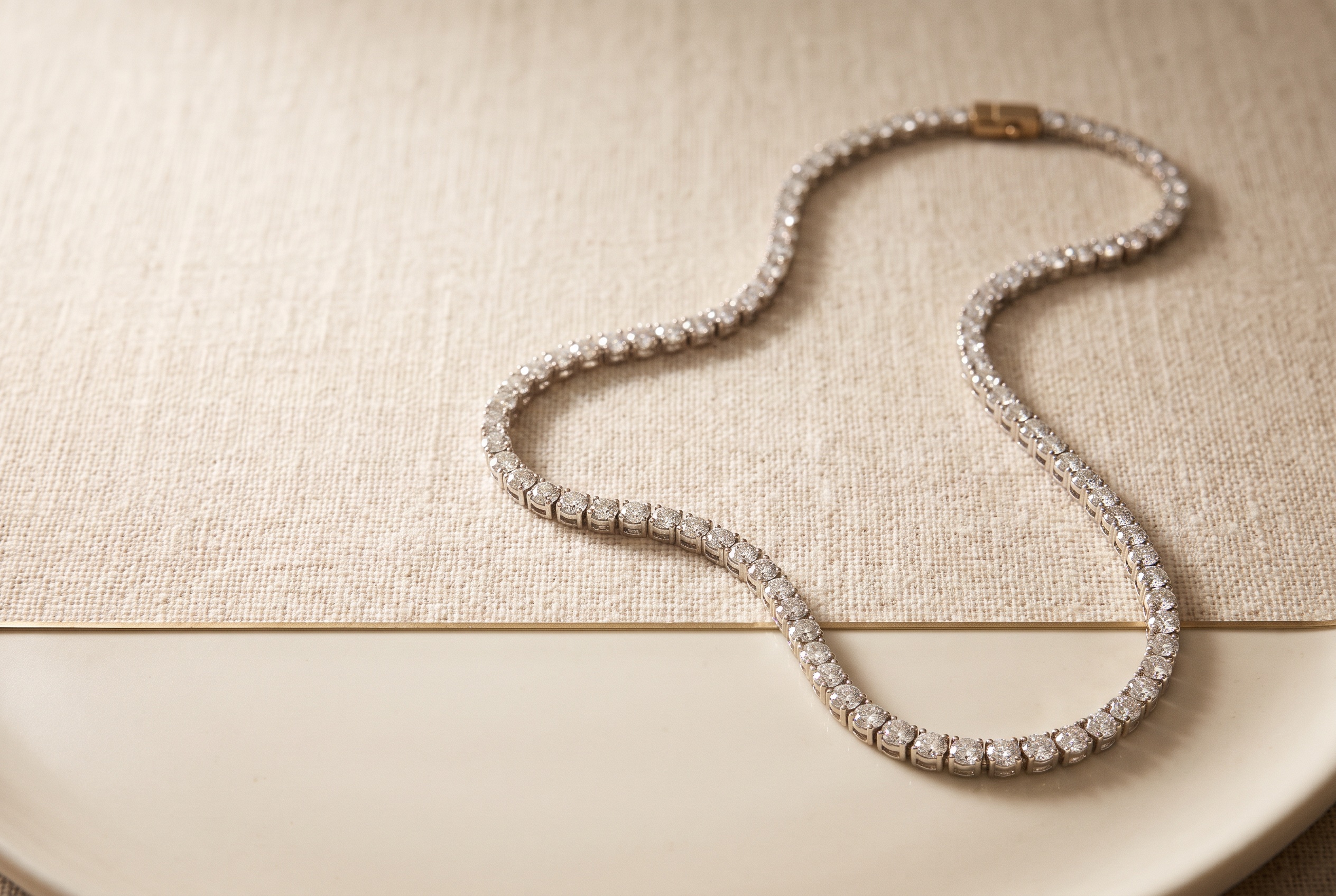
A diamond tennis necklace is a continuous line of individually set diamonds of matching size and cut, connected by a flexible metal chain so the diamonds sit in an unbroken row around the neck. For a jeweler or manufacturer building or restocking a tennis necklace line, the sourcing challenge is fundamentally different from sourcing a single center stone: it comes down to matching dozens of diamonds consistently, choosing a setting style that holds up to daily wear, and pricing a line item where total carat weight, not any one stone's specs, drives the cost.
This guide is written for the trade — jewelers, designers, and manufacturers sourcing loose diamonds and diamond melee to build tennis necklaces for their own retail or wholesale lines, not a consumer shopping guide. It covers what a tennis necklace actually requires from a sourcing standpoint, setting styles, matching considerations across a long line of stones, carat-total math, and what to look for in a wholesale supplier for this specific product category.
What Makes Tennis Necklace Sourcing Different
Sourcing a single center stone for a ring or pendant is a one-stone decision. A tennis necklace typically requires anywhere from 40 to over 100 individual diamonds depending on stone size and necklace length, and every one of those stones needs to read as visually consistent with its neighbors once mounted in a continuous line. A mismatch that would be invisible in a pair of earrings — where only two stones sit side by side — becomes far more obvious across a long row of stones under close inspection, which is why tennis necklace sourcing puts a premium on lot consistency rather than the characteristics of any single exceptional stone.
This also changes how a buyer should think about grading reports. Individual diamond melee below roughly 0.18ct is not individually or parcel-certified in standard wholesale practice — it ships as uncertified parcel goods graded against a consistent quality baseline (commonly a DEF+/VS+ standard) rather than stone-by-stone paperwork, because certifying each of a hundred small stones individually would be neither practical nor cost-effective for either the supplier or the buyer. Larger individual diamonds used in a necklace design — a graduated center stone or larger anchor stones — can be certified at 0.30ct and above the same way any loose stone would be.
Carat Weight and Total Carat Weight (TCW) Math
Tennis necklace pricing and design planning both run on total carat weight (TCW) — the sum of every stone's weight in the piece — rather than any single stone's carat weight. A 4-carat TCW necklace and a 4-carat TCW bracelet made from the same average per-stone size will use roughly the same overall diamond weight but a very different stone count, since a necklace is longer. Getting this math right up front matters for cost planning: TCW, not stone count alone, is what a wholesale diamond order should be priced and quoted against.
| Necklace Length | Typical Stone Count Range | Common TCW Range |
|---|---|---|
| 14–16 inches (choker-length) | Roughly 40–60 stones | 2–5 TCW, depending on stone size |
| 17–18 inches (standard) | Roughly 55–75 stones | 3–8 TCW, depending on stone size |
| 20+ inches | Roughly 70–100+ stones | 5–15+ TCW, depending on stone size |
These ranges vary meaningfully with individual stone size — a necklace built from smaller, more numerous melee reaches a lower TCW at a given length than the same length built from larger stones — but they're a reasonable planning baseline for a manufacturer estimating diamond needs before placing an order.
Diamond Quality Standards for Tennis Necklaces
Because a tennis necklace displays so many stones at once, most manufacturers standardize on a consistent quality tier across the entire piece rather than mixing grades — a DEF+/VS+ baseline (near-colorless to colorless, very slightly included or better) is a common commercial standard that reads as clean and bright to the eye across a long line of stones without pricing the piece at the level of individually certified inventory. Buyers targeting a higher-end line sometimes step up to a tighter color range (E-F) or a stricter clarity floor (VVS+) for a more uniformly white, eye-clean look, understanding that tightening the quality band on every single stone in a 60-to-100-stone piece meaningfully increases sourcing cost and lead time versus a standard commercial grade.
Setting Styles Used in Tennis Necklaces
Prong (Shared-Prong) Setting
The classic tennis-necklace setting style, where adjacent stones share prongs in a continuous line. Prong settings maximize light entry around each stone for maximum brilliance, but the prongs themselves are more exposed to daily wear and catching than a bezel, which is a practical consideration for a piece meant to be worn frequently.
Bezel Setting
A metal rim surrounds each stone fully, offering more protection against snagging and impact — a meaningful consideration for a necklace, which sits against skin and fabric constantly — at the cost of slightly reduced light entry and a more modern, geometric look compared to a classic prong tennis line.
Channel Setting
Stones sit between two parallel metal rails with no visible prongs at all, giving a smooth, low-profile line that reads as more architectural and contemporary. Channel settings offer strong physical protection for the stones but require tighter manufacturing tolerances to keep the row perfectly aligned.
Clasp and Safety Mechanisms Manufacturers Should Specify
Because a tennis necklace is a continuous, high-value line of stones, clasp failure is one of the most common (and most costly) points of loss in the category. Manufacturers sourcing components for a tennis necklace line typically specify a box clasp with a secondary safety latch, or a lobster clasp reinforced with a figure-eight safety chain, rather than a single-point clasp — a detail worth confirming with any setting or finishing partner before a production run, since it has a direct bearing on the finished piece's return and warranty-claim rate.
Metal Choices and How They Affect Sourcing
Tennis necklaces are most commonly set in 14k or 18k white gold or platinum, both of which read as neutral and don't compete visually with the diamond line — a warmer metal like yellow or rose gold is used less often for this style specifically because it introduces a visible color contrast against colorless stones that some buyers find distracting in a piece meant to showcase the diamonds themselves rather than the metalwork. Metal choice doesn't change diamond sourcing requirements directly, but it does affect finished-piece pricing and should be confirmed before finalizing a diamond order, since some setters adjust prong or bezel dimensions slightly depending on metal.
Lab-Grown vs. Natural Diamonds for Tennis Necklace Production
Because a tennis necklace's cost scales directly with total carat weight across dozens of stones, the natural-vs-lab-grown decision has an outsized effect on total piece cost compared to a single-stone product like a ring. CVD lab-grown diamonds let a manufacturer offer a significantly higher TCW at a given price point, or the same TCW at a significantly lower price point, than natural material of comparable color and clarity — a meaningful consideration for a retailer positioning a tennis necklace line at a specific price tier. Both natural and lab-grown material can meet the same DEF+/VS+ commercial standard described above; the origin decision is primarily a pricing and positioning choice for the retailer rather than a difference in how the finished piece looks or wears.
Matched-Pair and Lot Consistency: What to Ask a Supplier
- Is this melee sold as a matched, graded lot, or pulled from mixed inventory? A supplier who sells calibrated melee specifically for line work will maintain tighter internal consistency than one selling loose, ungraded parcel stock.
- What's the size tolerance across the lot? A tight millimeter tolerance across every stone in the order matters more for a continuous line than it does for a scattered-stone design.
- Can I review physical samples before committing to a full production order? For a first order with a new supplier, requesting a representative sample of the actual lot — not just a spec sheet — is standard practice before committing to a full quantity.
- What's the reorder consistency like if I need to match this exact grade again for a future production run? A supplier who can reliably reproduce the same commercial grade on reorder is more valuable to an ongoing retail line than one whose stock varies significantly between orders.
Wholesale Pricing Structure for Tennis Necklace Diamonds
Wholesale pricing for tennis necklace diamonds is typically quoted per total carat weight at a given quality standard, rather than per individual stone — a DEF+/VS+ melee lot priced per carat lets a manufacturer estimate finished-piece diamond cost directly from the TCW target established during design. Buyers ordering at production volume (multiple necklaces per order, or standing reorders for a retail line) should expect per-carat pricing to improve with order volume and with looser size tolerance requirements, since tighter calibration tolerances require more selective sorting from a supplier's available stock.
Graduated vs. Uniform Tennis Necklace Designs
Most tennis necklaces use a uniform stone size throughout the line, which is simpler and generally less expensive to source since every stone in the order needs to match the same single size and quality target. Graduated designs — where stone size increases gradually from the clasp toward the center front of the neck — are a distinct, higher-complexity sourcing project, since it requires assembling multiple size tiers that all still need to match in color and clarity across the whole piece, not just within each size tier. A retailer or manufacturer considering a graduated design should expect a longer sourcing lead time and a higher per-carat cost than an equivalent-TCW uniform design, and should confirm upfront that a supplier can deliver consistent color and clarity matching across every size tier in the graduation, not just within each individual tier in isolation.
Colored Tennis Necklaces: Sourcing Fancy Color Melee
Fancy color tennis necklaces — built from yellow, pink, blue, or green melee rather than colorless stones — have grown as a distinct sub-category, offering retailers a differentiated product against an otherwise commoditized colorless tennis necklace market. Sourcing fancy color melee for a line-set piece carries an added consistency requirement beyond what a colorless order needs: every stone in the line needs to match not just size, but hue, tone, and saturation closely enough that the finished piece reads as a deliberately uniform color rather than a visibly mismatched mix. This makes fancy color melee sourcing meaningfully more selective than sourcing colorless melee at the same size, and buyers should expect both a longer lead time and a higher per-carat price for a well-matched fancy color lot compared to an equivalent colorless order.
Common Manufacturing Defects to Screen For
A finished tennis necklace involves dozens of individual prong-setting or bezel-setting operations performed in sequence, which creates real opportunities for manufacturing defects that a retailer should screen for before accepting a finished piece from a setting partner. Uneven spacing between stones, visible gaps or twisting along the line, prongs that are under-filed and catch on fabric, and inconsistent stone alignment (where stones don't sit at a uniform depth or angle relative to the chain) are the most common issues found in finished tennis necklace production. Requesting a physical inspection of a finished sample piece under magnification, rather than relying on photographs alone, before approving a full production run is standard practice for a manufacturer working with a new setting partner.
Repair and Warranty Considerations for Retailers
Because a tennis necklace holds so many individually set stones in a single continuous piece, it carries a structurally higher lifetime repair rate than a single-stone piece like a ring or pendant — a lost stone from one worn or damaged prong is a realistic, expected part of owning a tennis necklace over years of wear, not a sign of poor original construction. Retailers building a tennis necklace program should plan for this from the outset: maintaining a small reserve of matching replacement melee from the original production lot makes future repairs faster and keeps a repaired necklace visually consistent, rather than having to resource a single replacement stone that may not perfectly match a lot that's since sold through. Communicating a clear repair and re-stringing policy to the end customer at the point of sale is also standard practice in the category, given how directly wear affects a continuously-set piece like this one.
Tennis Necklace vs. Tennis Bracelet Sourcing: What Carries Over
Tennis necklaces and tennis bracelets share the same underlying sourcing logic — a continuous line of matched, calibrated stones set in a flexible chain — and a manufacturer already sourcing melee for a tennis bracelet line can generally apply the same lot-consistency and quality-standard principles directly to a necklace program. The main practical difference is scale: a necklace typically requires two to three times the total carat weight and stone count of a bracelet at a comparable per-stone size, given the difference in length between a wrist and a neck. This has a direct implication for lot sourcing — a supplier who can reliably deliver a large, consistent lot at necklace scale (rather than only smaller bracelet-scale lots) is a meaningfully more valuable long-term partner for a manufacturer looking to offer both products from a matching or coordinated diamond quality across an entire line.
Sourcing Tennis Necklace Diamonds Wholesale
Guru Diam supplies both calibrated diamond melee and larger certified loose stones for jewelers and manufacturers building tennis necklace lines, across natural and CVD lab-grown material and across the standard color and clarity ranges used in commercial-grade necklace production. Melee is available in round brilliant and calibrated fancy shapes at DEF+/VS+ and tighter tiers, sold as consistent, gradable lots rather than mixed parcel stock, which is specifically what a continuous-line piece like a tennis necklace needs from a supplier. In-stock inventory ships same-day from Guru Diam's New York and Los Angeles locations, and trade accounts can review current melee stock in matching pairs, browse certified larger stones in certified diamonds, or check fancy color options for a colored tennis line in fancy color loose diamonds. Manufacturers building a custom design around a tennis necklace can start at custom jewelry, and new trade accounts can apply through trade partner, with current terms available at the wholesale hub. For background on sourcing loose diamonds generally before scaling into a specific finished-piece category, our loose diamonds wholesale guide is a useful starting point.
Why It's Called a "Tennis" Necklace
The name traces back to a widely told story from a 1987 U.S. Open match, when tennis player Chris Evert's diamond line bracelet broke and fell off her wrist mid-match, prompting play to briefly stop while it was recovered from the court. The style — previously known simply as a diamond line bracelet or necklace — was renamed "tennis" bracelet and "tennis" necklace in the press coverage that followed, and the name stuck permanently across the jewelry trade. This is a widely repeated piece of jewelry-industry history rather than a claim tied to any specific supplier, but it's genuinely useful context for retailers, since customers frequently ask about the name's origin and it's a natural, low-effort piece of product storytelling to have on hand at the point of sale.
Frequently Asked Questions
How many diamonds are in a tennis necklace?
Most tennis necklaces contain anywhere from roughly 40 to over 100 individual diamonds, depending on the necklace's length and the size of the stones used. Sourcing and pricing are generally planned around total carat weight (TCW) rather than stone count alone.
What clarity and color should tennis necklace diamonds be?
A DEF+/VS+ standard (near-colorless to colorless, very slightly included or better) is a common commercial baseline that reads clean and bright across a long line of stones. Higher-end lines sometimes tighten to E-F color or VVS+ clarity for a more uniform, eye-clean appearance, at additional sourcing cost.
Are tennis necklace diamonds individually certified?
Individual melee-sized stones (typically below roughly 0.18ct) are not individually certified — they're sold as graded parcel goods against a consistent quality standard. Larger individual stones used as anchor or accent points in a design can be certified at 0.30ct and above.
What setting style is best for a tennis necklace?
Shared-prong settings are the classic choice and maximize brilliance, bezel settings offer more physical protection for frequent wear, and channel settings give a smooth, low-profile modern look. The right choice depends on the intended price point and design direction of the finished piece.
Should a tennis necklace use natural or lab-grown diamonds?
Either can meet the same quality standard and look identical in the finished piece. Because a tennis necklace's cost scales directly with total carat weight across dozens of stones, CVD lab-grown diamonds let a manufacturer offer a meaningfully higher TCW at a given price point, which is why lab-grown material is common in this specific product category. The origin decision is primarily a pricing and retail-positioning choice rather than a difference in how the finished piece looks or wears day to day.
How is tennis necklace diamond pricing quoted?
Wholesale pricing is typically quoted per total carat weight at a specified quality standard, rather than per individual stone, since manufacturers plan the piece around a TCW target during design.
Why is it called a tennis necklace?
The name comes from a widely told story involving tennis player Chris Evert, whose diamond line bracelet broke and fell off during a 1987 U.S. Open match, prompting a brief pause in play while it was recovered. The style was renamed "tennis" bracelet and necklace in press coverage afterward, and the name has stuck across the trade ever since.
Can a tennis necklace be made with fancy color diamonds?
Yes. Fancy color tennis necklaces built from yellow, pink, blue, or green melee are a real, growing sub-category, though they require tighter hue and saturation matching across every stone in the line than a colorless order, which typically means a longer lead time and higher per-carat cost than an equivalent colorless piece.
Guru Diam is a trade-only wholesale diamond supplier with locations in New York and Los Angeles, supplying calibrated diamond melee and certified loose stones — natural and CVD lab-grown — for jewelers and manufacturers producing tennis necklaces and other line-set jewelry. Browse current melee inventory in matching pairs or apply for a trade account through trade partner.