
What Is a Triangle Cut Diamond?
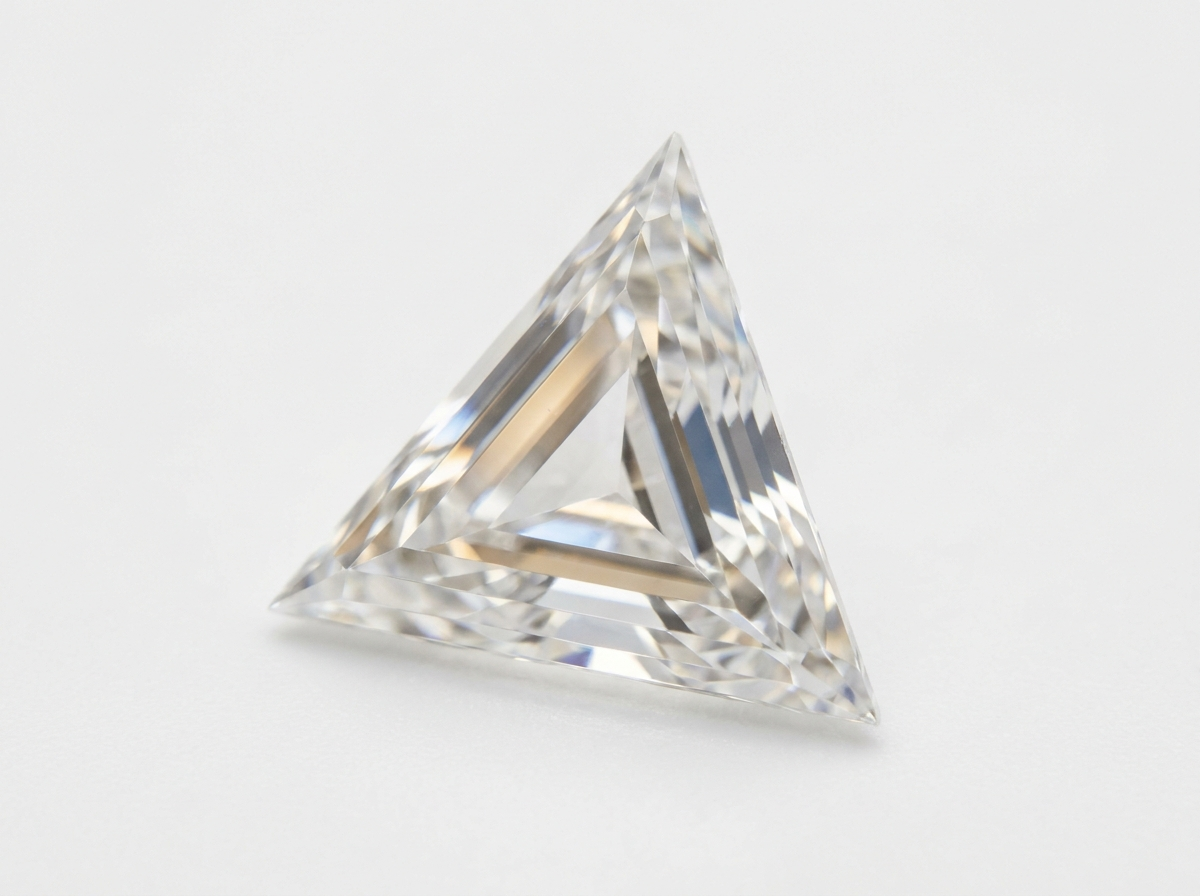
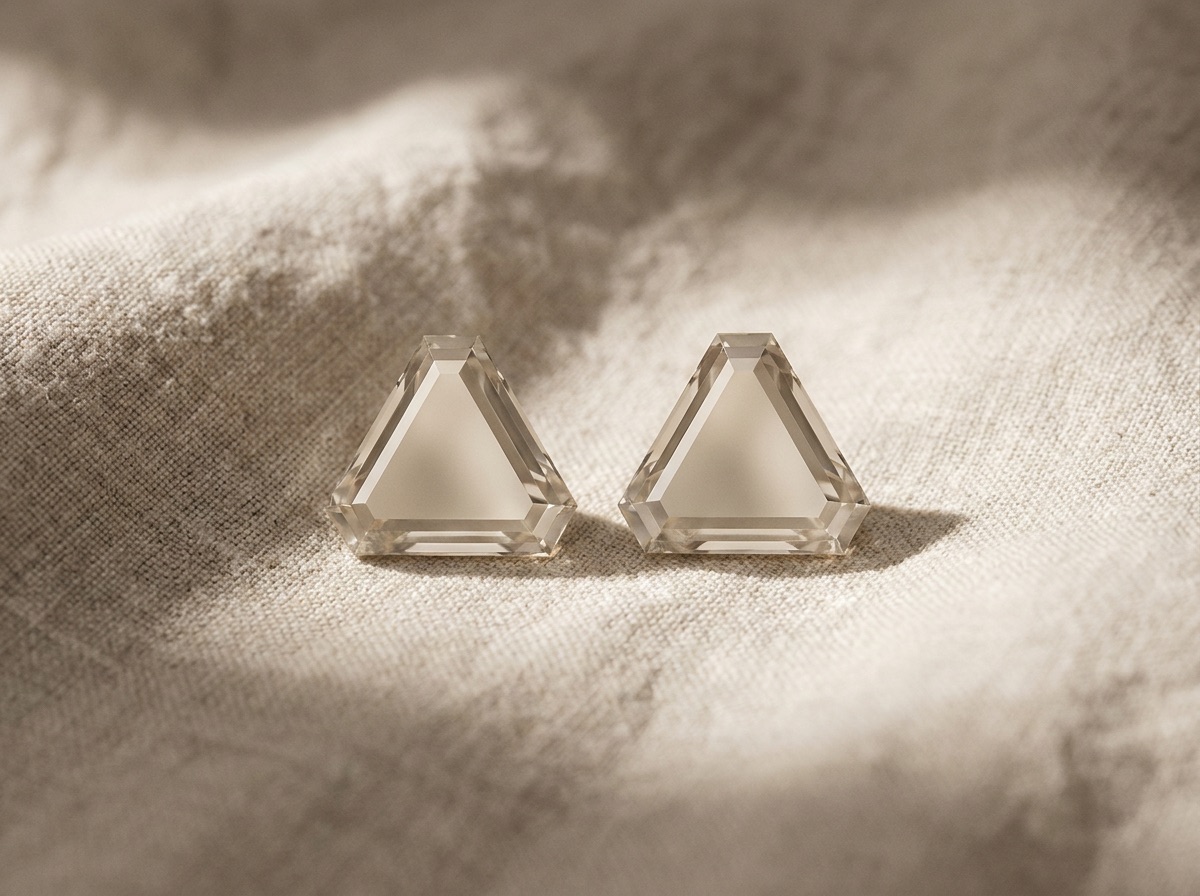
A triangle cut diamond is a calibrated fancy shape defined by three straight sides meeting at three sharp, well-defined points. Unlike round brilliants or the antique cuts that build fire from dozens of small facets, a triangle is faceted with broad, flat step-cut planes — parallel lines of facets running in tiers down toward the culet, the same faceting family as an emerald or asscher cut, just compressed into a three-cornered outline instead of a rectangle or square.
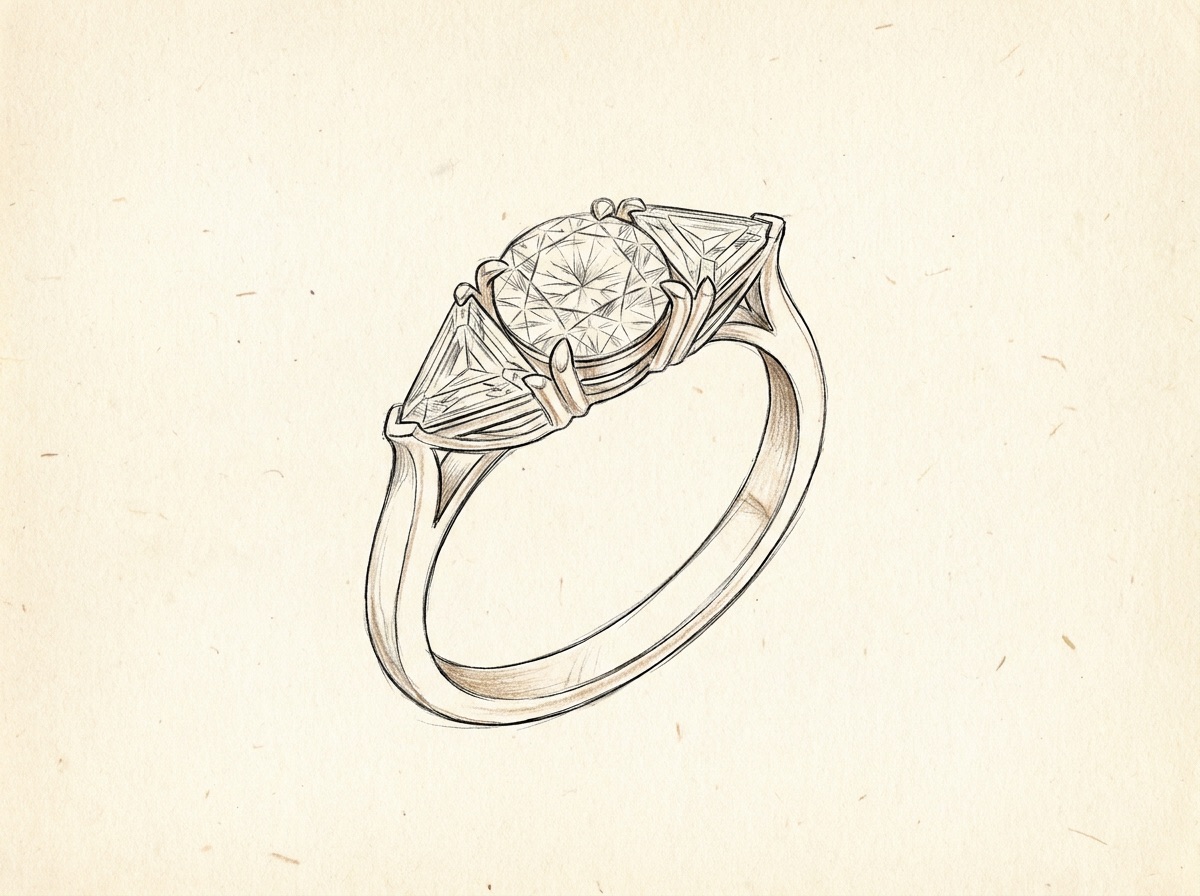
In the wholesale trade, triangle cut diamonds are almost always ordered and sold as accent stones, not center stones. Their primary job is flanking a larger diamond in a three-stone or trilogy ring, where the flat planes of the triangle read as a quiet, geometric counterpoint to the brighter scintillation of the center stone. That division of labor — bold center, restrained flanks — is exactly why step-cut faceting suits the shape: a triangle cut into a brilliant pattern would compete with the center stone instead of framing it.
Because triangles are purpose-built for pairing, they are stocked, matched, and sold differently than solitaire shapes. A jeweler ordering a single round brilliant is buying one stone against a spec sheet. A jeweler ordering triangles is buying a pair (or occasionally a set of four for a cluster design) that has to read as identical from across a showroom counter — same size, same angle, same face-up color. That distinction runs through everything else in this guide, from how the stones are graded to how they're priced and matched.
Facet Structure: Step-Cut Geometry vs. Brilliant Faceting
The facet arrangement is what actually separates a triangle cut from every other three-cornered fancy shape, and it's worth walking through in some detail because it drives both the optical character of the stone and how it should be graded.
A step-cut triangle has a large, flat table at the center, bordered by long, rectangular or trapezoidal facets arranged in parallel rows — usually one to three tiers per side, depending on the depth of the cut and the size of the stone. Each facet is cut at a shallow, consistent angle relative to the one beside it, which produces broad flashes of light rather than the scattered pinpoint sparkle of a brilliant cut. The visual effect reads as glassy and architectural: wide planes of light and dark (the "hall of mirrors" look associated with emerald and asscher cuts) rather than the all-over glitter of a round or princess.
This matters for two practical reasons. First, step-cut faceting is less forgiving of inclusions — the open table and broad facets act like a window into the stone, so clarity that would be invisible under brilliant faceting can show up as a visible flaw under a triangle's flat planes. Second, step-cut faceting is what makes a triangle read as calm and geometric next to a brighter center stone, which is precisely the design role it's asked to play. A brilliant-faceted three-cornered stone would draw the eye away from the center diamond instead of framing it — which is exactly the difference between a triangle and its closest lookalike, the trillion, covered in the next section.
Point-Up vs. Point-Down: Orientation and Setting Geometry
Because a triangle has one axis of symmetry rather than the multiple symmetry lines of a round or square stone, orientation is a real design decision, not a cosmetic detail — and it's one buyers should specify at order time, not leave to the setter's judgment.
Set point-up (apex toward the fingertip, flat base toward the palm), a triangle echoes the natural taper of a ring shank as it narrows toward the shoulder. This is the more conventional orientation for three-stone and trilogy rings, and it's what most jewelers default to unless a client specifically asks for something else. Set point-down (apex toward the palm, flat base toward the fingertip), the same stone reads as flatter and more graphic — a look that's gained traction in geometric and Art Deco-inspired designs over the last few seasons, where the flat base sitting flush against the center stone creates a cleaner sightline.
Neither orientation is more "correct" — it's a design call driven by the center stone's shape and the overall silhouette of the setting. What matters for a wholesale buyer is confirming orientation before cutting or matching a pair, since a triangle set the wrong way against its partner stone (one point-up, one point-down) is an immediately visible mismatch, not a subtle one.
Triangle vs. Trillion: Same Outline, Different Cut
These two shapes get confused constantly, in the trade and in consumer-facing marketing alike, because they share the same three-sided outline. The confusion is understandable but the shapes are not interchangeable, and getting the distinction right matters for both sourcing and grading.
Triangle cut: Step-cut faceting, sharp and clearly defined corners, quiet and geometric flash rather than fire. Sold exclusively as a side or accent stone — it is not cut or marketed as a center-stone shape. Guru Diam currently holds 520 triangle cut diamonds in stock.
Trillion (trilliant) cut: Brilliant faceting, rounded corners rather than sharp points, high fire and scintillation. A trillion can serve as either a center stone or a side stone, and it sits in a different tier of the trade altogether — trillion is classified among the antique-style premium cuts, alongside old mine, old European, kite, and lozenge, and priced accordingly. Guru Diam currently holds 981 trillion cut diamonds in stock.
The rounded-corner detail is the fastest way to tell the two apart at a glance: a trillion's corners are softened and slightly blunted, almost bullet-shaped, where a triangle's corners come to a true, sharp point. That rounding isn't a grading defect on a trillion — it's a defining feature of the cut, built in deliberately to control light return and reduce the chipping risk that sharp-cornered stones carry (more on that under quality considerations below). A triangle, by contrast, is cut sharp on purpose, because the crisp geometric point is the whole visual argument for using it as a side stone next to a softer or rounder center shape.
For a full breakdown of trillion cut sourcing, grading, and pricing, see our Trillion Cut Diamonds Wholesale guide.
Triangle vs. Kite: Distinguishing the Three- and Four-Cornered Fancy Shapes
The other shape buyers occasionally confuse with triangle is the kite cut — understandable, since both are pointed, antique-adjacent accent shapes used in side-stone work, but the geometry is genuinely different once you look past the general silhouette.
A triangle has three sides and three points. A kite has four sides and two points — a longer axis running from one point through the center to the opposite point, with two wider "shoulder" corners in between, giving it a diamond-lozenge silhouette rather than a true triangular one. Kite is also a step-cut shape in most cuttings, so the faceting family is similar to a triangle's, but the outline and the way it sits in a setting are different: a kite typically flanks a stone in a linear or graduated arrangement (running up a shank, for instance), where a triangle flanks a stone laterally, echoing the shank's taper from the side.
Both shapes fall in Guru Diam's antique-tier premium cut category alongside trillion, old mine, old European, and lozenge. The table below summarizes how the three compare.
| Shape | Sides / Points | Facet style | Typical role |
|---|---|---|---|
| Triangle | 3 sides, 3 sharp points | Step-cut | Side/accent stone only |
| Trillion | 3 sides, 3 rounded points | Brilliant | Center or side stone |
| Kite | 4 sides, 2 points | Step-cut | Side/accent stone, linear or graduated settings |
See our Kite Shape Diamonds Wholesale guide for sourcing and grading detail on that cut specifically.
Sourcing and In-House Cutting at Guru Diam
Triangle cut diamonds at Guru Diam are cut, calibrated, and matched in-house, with calibration and matching operations run out of our New York and Los Angeles locations. Because these are lab-grown CVD stones rather than natural rough, cutters have more control over starting material — CVD boules can be grown and selected specifically for the proportions a calibrated shape like a triangle needs, rather than having to cut around inclusions or work with whatever rough happens to be available. That control is part of why calibrated pair goods in fancy shapes have gotten easier to source consistently over the last several years.
Ready-to-ship matched pairs are held as on-hand inventory and ship same-day. Custom sizing, non-standard ratios, or larger sets (beyond a matched pair, for a four-stone or six-stone cluster design, for example) are cut and calibrated in-house to the buyer's exact spec — those are handled as build-to-order requests rather than pulled from stock, so timing is quoted per order rather than promised as a blanket turnaround. If you need a fully finished ring built around triangle side stones rather than loose stones, that's a different production path: custom engagement rings ship in 4–6 days once the design and stone selection are locked.
Matching Triangle Diamonds for Three-Stone and Trilogy Settings
A single triangle diamond is graded and sold like any calibrated fancy shape. A matched pair is a different product, and it's matched on three independent variables that all have to line up before a pair is sellable as a set.
Size. Millimeter dimensions (length and width) have to match within a tight tolerance — a pair that's visibly mismatched in size is the single most common complaint in three-stone side-stone work, and it's usually caught (or missed) at the matching stage, not after setting.
Angle. The crown and pavilion angles need to be consistent between the two stones. Two triangles cut to different angle specs can be the same millimeter size and still throw noticeably different amounts of light, which reads as a mismatch even though the outlines match perfectly.
Tone. Face-up color has to read the same under consistent lighting. This is graded visually against the pair, not just against an independent color grade — two stones can both grade, say, G color independently and still read slightly differently face-up depending on how the step-cut facets interact with body color, which is more visible in open step-cut tables than in brilliant faceting.
This is where deep calibrated inventory matters more than it does for solitaire shapes. A supplier with a shallow triangle inventory is matching by approximation — closest available stone, not true match. Guru Diam's current 520-stone triangle inventory gives cutters and matchers enough range to pull genuine matched pairs (and, for cluster designs, matched sets) rather than settling for "close enough," which is the difference retail-facing jewelers actually notice when a finished ring comes back from setting.
Grading and Quality Considerations: Corner Protection
The sharp points that make a triangle visually distinctive are also its most vulnerable feature, and it's worth understanding why before you're grading, setting, or fielding a return on a chipped stone.
A pointed corner on any diamond — triangle, kite, marquise, pear — concentrates stress at a single, thin edge of material. Step-cut faceting compounds this slightly versus brilliant faceting, because the open, flat planes of a step cut have less internal faceting to help distribute impact around the point. In practice this means triangle corners are graded and handled with more attention to the point tips than a comparably sized round or cushion would need.
Girdle Thickness and Point Protection
Girdle thickness at the points is the primary variable buyers should be checking on a triangle. A girdle that's cut too thin at the corners is more prone to chipping in normal wear and during setting; too thick, and it adds unwanted bulk and can make the stone look smaller than its carat weight suggests. Reputable cutting keeps the girdle marginally thicker specifically at the three points relative to the straight edges — a deliberate reinforcement, not a grading flaw.
Setting Style as Structural Protection
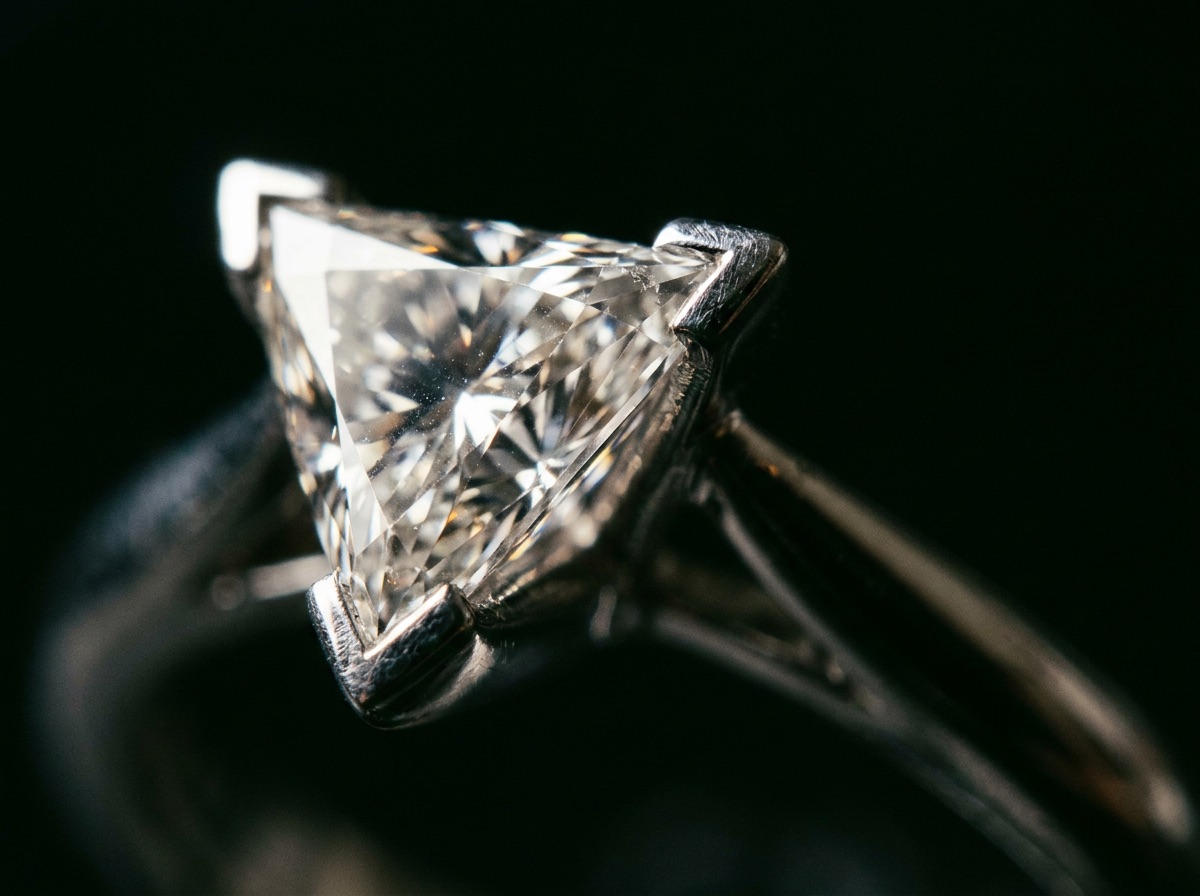
Beyond the stone itself, setting design does real protective work. V-prongs (or bezel points) at each corner of a triangle are standard practice, not a decorative upgrade — a straight prong or claw that doesn't fully cap the point leaves the most fragile part of the stone exposed to everyday knocks. Buyers speccing custom settings around triangle side stones should default to V-prong or double-prong corner protection unless there's a specific design reason not to, and should flag this explicitly when placing a custom order rather than assuming it's automatic.
Certification: IGI, GIA, and GCAL
Triangle diamonds most commonly ship as calibrated pair or set goods rather than individually certified solitaires — that's standard practice across the fancy-shape accent-stone trade, not a Guru Diam-specific limitation, since pair goods are graded and matched as a unit rather than certified stone-by-stone. Lab-grown CVD triangle diamonds are gradable through IGI, GIA, or GCAL upon request.
For three-stone and trilogy designs, it's the center stone that typically carries its own individual certificate, since that's the stone the end consumer is paying for and comparing against a report. Individual certification for the triangle side stones can be arranged on a per-order basis if a buyer needs it — for appraisal documentation, insurance purposes, or a client request — but it's not the default for calibrated pair goods, and pricing/lead time for individually certified side stones should be confirmed at order time rather than assumed.
Pricing Factors for Triangle Cut Diamonds Wholesale
Several variables move price on triangle cut diamonds beyond the basic carat-weight-times-rate math that applies to round brilliants, and buyers pricing out a job should account for all of them, not just carat weight.
Carat weight and total spread. Because triangles are almost always bought in pairs, pricing is quoted per pair (or per set) against a target total carat weight, not per individual stone. A buyer speccing "0.50ct total weight, matched pair" is giving a meaningfully different order than "two 0.25ct triangles" even though the math is identical — the former implies matching tolerance the latter doesn't.
Length-to-width ratio. Triangle proportions aren't fixed the way a round brilliant's are. A more elongated triangle and a more equilateral one both exist in the market and price differently depending on cutting yield and demand for that specific ratio — equilateral (all three sides roughly equal) is the more commonly requested proportion for symmetric three-stone work.
Matching premium. A true matched pair — same size, angle, and tone, verified against each other rather than independently graded — commands a premium over two individually acceptable triangles that happen to be similar. This premium reflects the labor of pulling and verifying a genuine match out of deep inventory, not a markup on the stones themselves.
Clarity, given step-cut visibility. Because step-cut faceting shows inclusions more readily than brilliant faceting, clarity requirements for triangle side stones tend to run a notch higher than what a buyer might accept in a brilliant-cut accent stone of the same size, particularly for stones that will sit close to a light-colored metal or an open setting where the pavilion is visible from the side.
Set size. A four- or six-stone cluster design (matching four or six triangles instead of two) compounds the matching premium — more stones that all have to agree on size, angle, and tone means a smaller pool of qualifying candidates within any given inventory, even a deep one.
Styling and Use-Case Guidance: Side Stones to Statement Settings
Three-Stone and Trilogy Rings
This is the core use case and the reason triangle inventory exists at wholesale scale in the first place. A matched pair of triangles flanking a round, oval, or cushion center stone is a well-established bridal silhouette — the geometric points of the triangles read as a deliberate contrast to a rounder center shape, and the step-cut faceting keeps the eye on the center stone rather than competing with it. Point-up orientation is the default recommendation for this application (see the orientation section above) unless a client is specifically after a more graphic, Art Deco-leaning look.
Halo and Cluster Accents
Beyond the classic three-stone format, triangles work well in small clusters — three or four stones grouped at a shoulder or gallery, or alternating with round melee in a graduated pattern. Because the flat step-cut planes read as more subdued than brilliant melee, triangle clusters tend to work best against a plainer setting rather than a heavily encrusted one, where the geometric shape can actually register instead of disappearing into overall sparkle.
Statement and Cocktail Settings
While triangles are sold and marketed as accent stones, some custom statement-ring and cocktail-ring designs use a larger triangle as a focal element in an asymmetric or east-west composition, particularly in geometric or Art Deco-revival styles where the sharp points and step-cut planes are the design statement rather than a supporting one. This is a smaller share of orders than trilogy-ring accent work, but it's a legitimate custom request worth flagging to a wholesale rep if that's the design direction — sourcing and grading priorities shift slightly when a triangle is the visual anchor rather than a flanking stone.

How to Order Triangle Cut Diamonds Wholesale
Ordering triangle cut diamonds at wholesale follows the same basic path as any calibrated fancy shape, with a few triangle-specific details worth confirming up front.
1. Open a wholesale account. Trade buyers — independent jewelers, designers, and manufacturers — can open a wholesale account to access calibrated inventory, pricing, and ordering.
2. Specify total carat weight and orientation. State target total carat weight for the pair (or set) and confirm point-up or point-down orientation before matching begins — this is the single most common detail that gets assumed rather than specified, and it's the hardest to fix after the fact.
3. Confirm ratio and clarity preference. Flag whether you need an equilateral or elongated proportion, and confirm clarity tolerance given step-cut visibility — particularly for open, unbacked settings where the pavilion will be visible.
4. Request certification if needed. Ready-to-ship pairs are IGI/GIA/GCAL-gradable on request; individual per-stone certification for side stones should be requested explicitly and confirmed against pricing and availability.
5. Ship or build. In-stock matched pairs ship same-day. Custom-matched sets or non-standard sizing are cut and calibrated in-house to spec; if you're ordering a finished ring rather than loose stones, that moves to our custom jewelry production path with a 4–6 day turnaround on the finished piece.
For sourcing background on related calibrated fancy shapes, see our guides to Lozenge Diamonds Wholesale and Matched Pair Step Cut Diamonds Wholesale. For fancy color side-stone options, see our Fancy Color Heart Diamonds Wholesale guide.
Frequently Asked Questions
What is a triangle cut diamond used for?
Triangle cut diamonds are calibrated, three-sided step-cut stones used almost exclusively as accent or side stones — most commonly flanking a center diamond in a three-stone or trilogy ring, and occasionally arranged in small clusters or shoulder accents. They are not cut or marketed as center-stone shapes.
Is a triangle cut diamond the same as a trillion cut?
No. The two share the same three-sided outline but differ in faceting and corner geometry: a triangle is step-cut with sharp, defined points and is sold only as a side stone, while a trillion is brilliant-cut with rounded corners and can serve as either a center or side stone. The rounded-versus-sharp corner is the fastest visual way to tell them apart.
How does a triangle cut diamond differ from a kite cut?
A triangle has three sides and three sharp points. A kite has four sides and two points, with a longer axis and two wider shoulder corners, giving it a lozenge-like outline rather than a true triangular one. Both are step-cut, antique-tier accent shapes, but they sit differently in a setting — kite typically runs in a linear or graduated line, while triangle flanks a center stone laterally.
How are triangle diamonds matched for a three-stone ring?
Matching is done across three variables: millimeter size, crown/pavilion angle, and face-up tone/color. All three have to align for a pair to read as a true match rather than an approximation. Deep calibrated inventory lets a supplier pull genuinely matched pairs — and matched sets, for cluster designs — instead of settling for the closest available stones.
Why do triangle diamonds need extra corner protection when set?
The sharp points that define the triangle's silhouette are also its most vulnerable feature — a pointed corner concentrates stress at a thin edge of material, and step-cut faceting offers less internal reinforcement against impact than brilliant faceting does. V-prong or bezel-point protection at each corner is standard practice for this reason, along with slightly thicker girdle cutting specifically at the points.
Are triangle cut diamonds certified?
Triangle diamonds most often ship as calibrated pair or set goods rather than individually certified solitaires, which is standard for the fancy-shape accent-stone trade generally. They are gradable through IGI, GIA, or GCAL upon request, and individual per-stone certification can be arranged for a specific order. In a three-stone design, it's typically the center stone that carries its own individual certificate.