
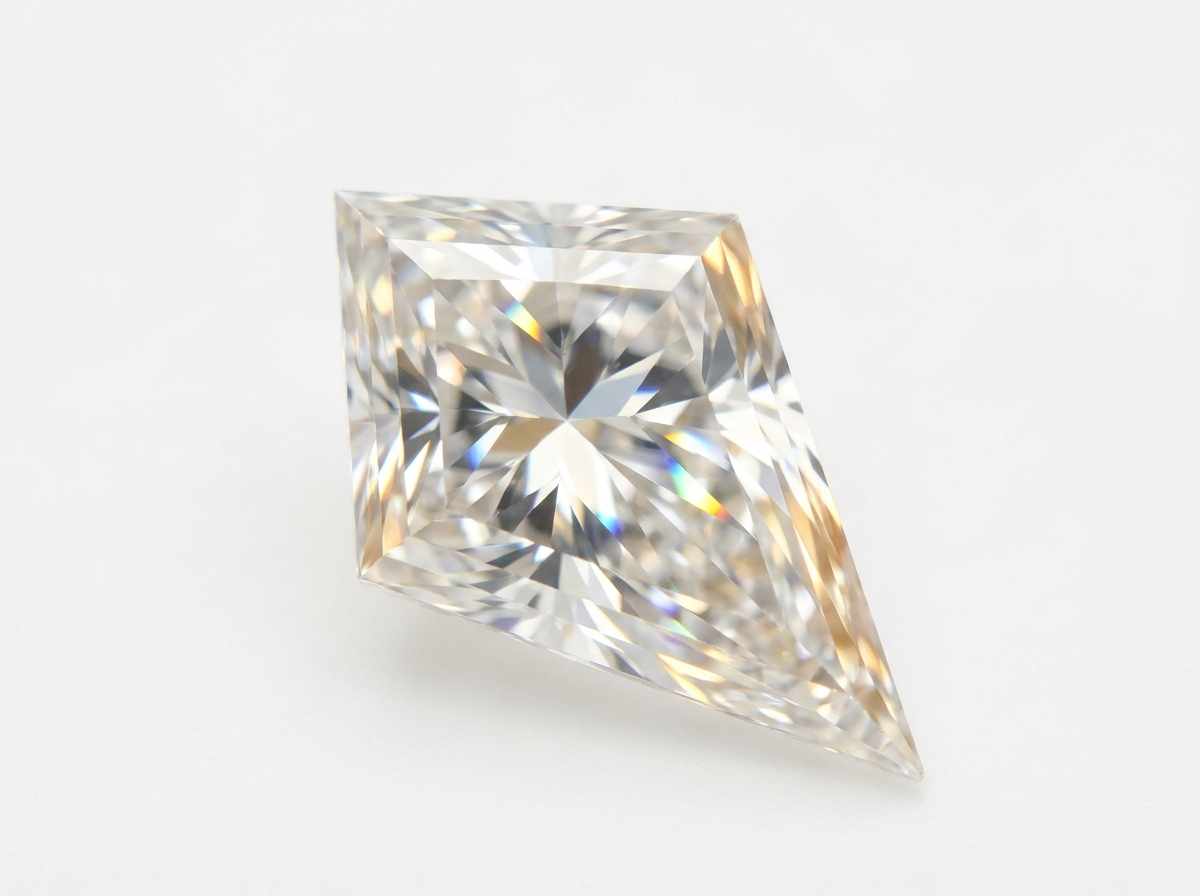
A kite shape diamond is a calibrated, four-sided side stone — a quadrilateral with two pairs of adjacent equal sides that taper to a point at top and bottom, like the outline of a kite — used as accent stones in halo settings and fancy-shape engagement rings, especially flanking pear and marquise center stones. Guru Diam stocks 595 kite diamonds on hand, calibrated and matched, IGI-gradable on request. This guide covers the cut's facet structure, how kite sets are sourced and matched in-house, what separates a well-matched set from a rushed one, and how wholesale pricing and ordering actually work.
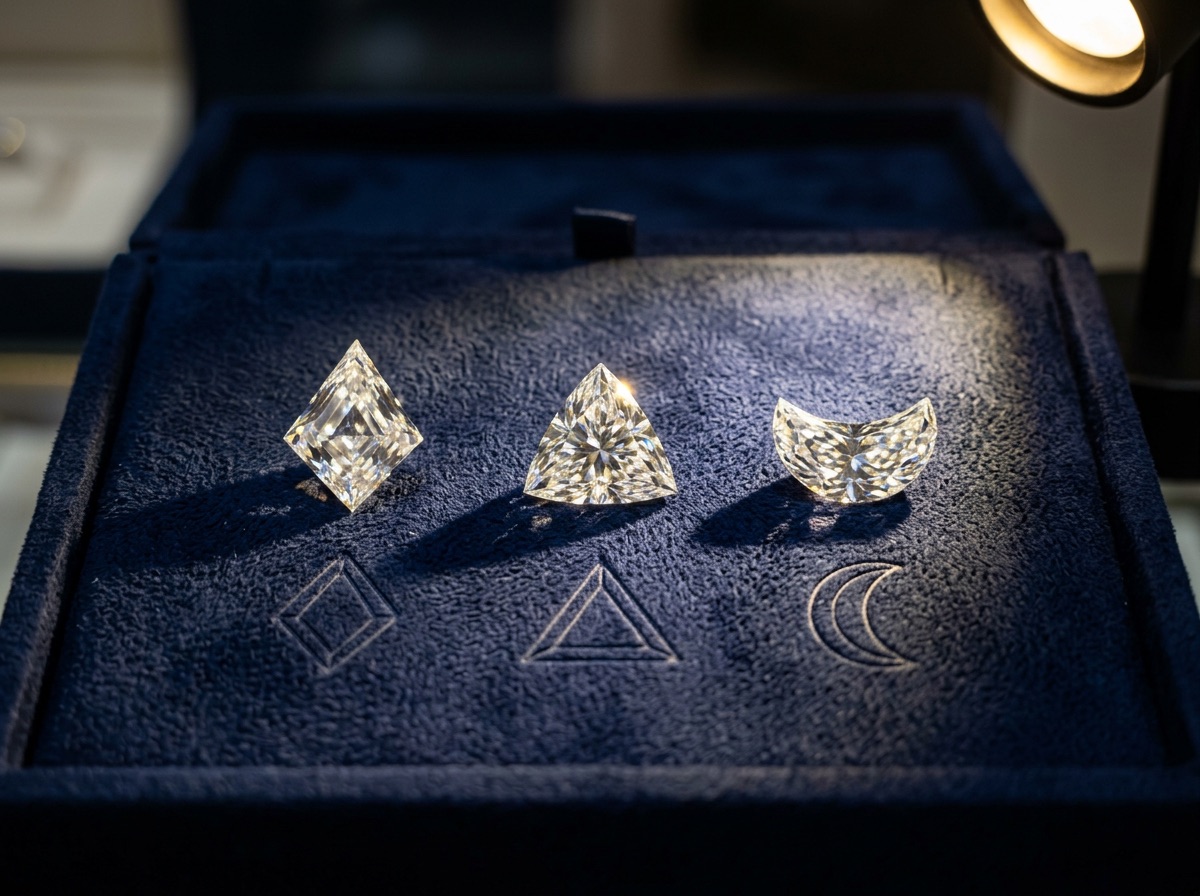
What is a kite shape diamond?
A kite is a four-sided stone with two pairs of adjacent equal sides — unlike a square or rectangle, its symmetry runs along only one axis, so the top point and bottom point are usually different lengths. That asymmetry is what makes a kite useful as a side stone: the longer, narrower point can nest into the point of a pear or marquise center stone, while the shorter point sits toward the shoulder of the ring.
Geometrically, a kite sits in the same family as trapezoids, half moons, shields, and bullets — the group of "fancy side stone" shapes cut specifically to fill the space around a center stone rather than to stand alone as a primary stone. Within that family, the kite is distinguished by its point-to-point profile: two long upper facets converge to a top point, two shorter lower facets converge to a bottom point, and the widest part of the stone sits somewhere between the two — usually closer to the top for a traditional kite outline.
Kites are most often brilliant-faceted rather than step-cut, since they typically sit in a visible halo position where extra sparkle is the point. A brilliant-faceted kite carries triangular and kite-shaped facets radiating toward a culet or small keel line, similar in principle to a round brilliant's crown facets but reshaped to the four-sided outline. That faceting choice matters for buyers: a step-cut kite — flat, parallel facets like an emerald cut — reads quieter and shows inclusions more readily, while a brilliant-cut kite hides minor inclusions in its facet pattern and throws more light back at the viewer, which is why it's the default faceting style for kite side stones in halo work.
Kite is classified in the antique-cut family alongside Old Mine, Old European, Hexagonal, Moval, Lozenge, Trillion, Criss-Cut, and Padparadscha — cuts defined by hand-set faceting geometry and lower stone yield per rough, rather than the mechanized proportions of modern commercial cuts like round brilliant or princess. That lower yield is part of why antique-cut side stones like kite command a wholesale premium over round melee of comparable carat weight: more rough is lost to the cut, and every stone in a matched set has to hold the same angles and proportions as its neighbors.
Facet structure and cutting anatomy
A kite diamond's face-up outline is built from four sides, but its facet structure below the outline determines how it actually performs in a setting. Working from the table — the flat top facet — down: a brilliant kite carries a girdle outline that mirrors the four-sided shape, a crown built from triangular and kite-shaped facets angled to catch and return light, and a pavilion cut to a shallower or steeper angle depending on how deep the stone needs to sit in a low-profile halo mount. Because a kite has no rotational symmetry — it's asymmetric top-to-bottom — cutters have to hold consistent facet angles on both the long upper pair of sides and the shorter lower pair, or the stone reads unevenly bright from one half to the other.
Brilliant vs. step-cut faceting
Most kite side stones ship brilliant-cut: crown and pavilion facets angled to maximize scintillation, the same logic that makes a round brilliant sparkle more than an emerald cut. Step-cut kites exist — long, parallel facets running the length of each side, echoing the clean lines of a baguette or emerald cut — but they're closer to a special-order shape for buyers building a fully step-cut suite, such as an Art Deco-style ring with baguette or trapezoid accents, rather than a stock item. For halo work specifically, where the kite sits close to a bright center stone and needs to hold its own visually, brilliant faceting is close to universal in current production.
Kite cuts in trade context
Kite-shaped stones have circulated in fine jewelry for as long as jewelers have needed a pointed accent shape to flank a fancy-shape center stone — the cut shows up in Art Deco-era three-stone rings and eternity bands well before "antique cut" became a marketing category. What's changed is availability: kite is a low-yield shape to cut from rough, with more waste per carat than a round or princess, and matching multiple kites to the same angle, size, and face-up brightness for a halo is a production problem most cutters don't take on for a single custom order. That's part of why kite sits in the antique-cut tier in wholesale pricing — alongside Old Mine, Old European, Trillion, Moval, and Lozenge — rather than the regular-fancy or commodity round tiers.
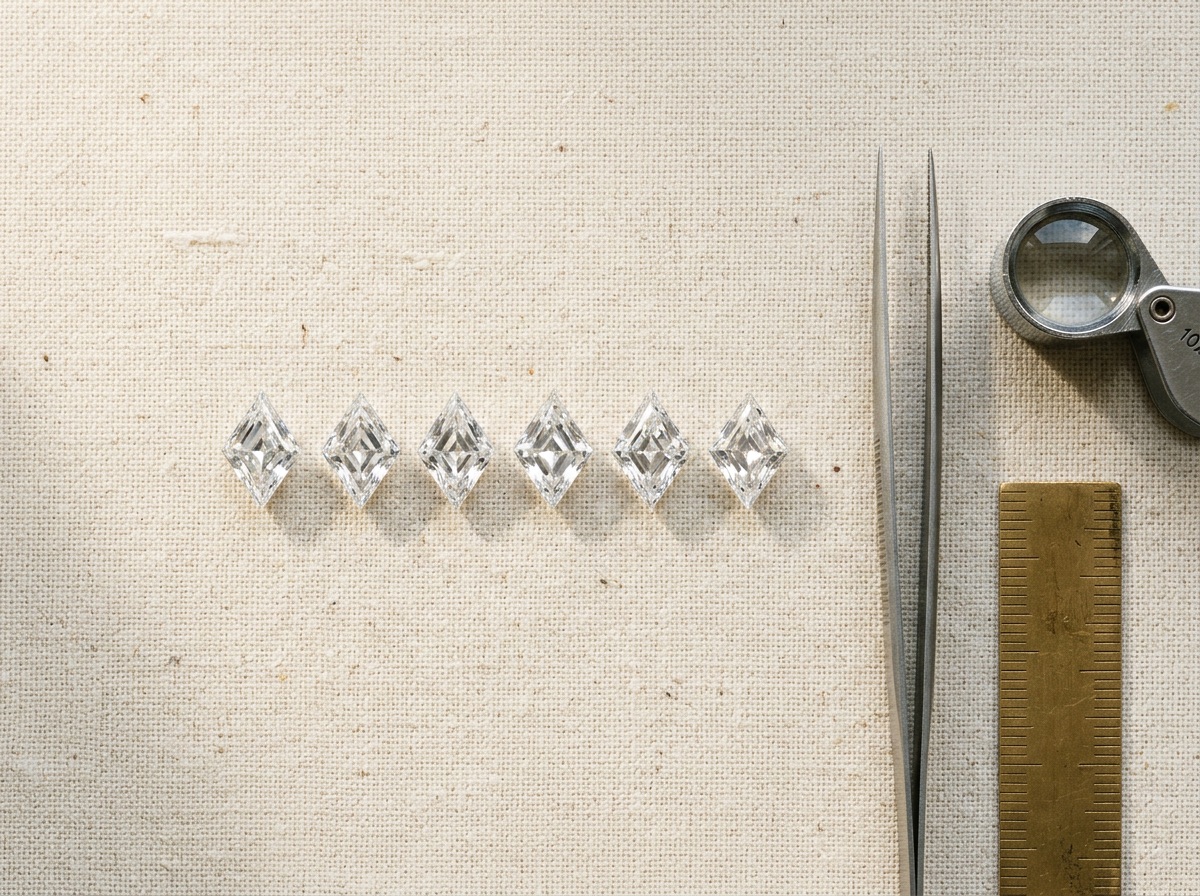
For trade buyers, that translates into a straightforward sourcing reality: a jeweler who wants two, four, or six kites cut to identical specs for a halo is asking for a matching job, not a pull-from-inventory purchase. Suppliers who stock kite only as odd lots from mixed production runs will struggle to fill anything beyond a single-pair order. Suppliers who cut and match kite sets as a standing part of production can fill a six-stone halo order to spec without the buyer compromising on size or angle consistency.
Guru Diam's in-house sourcing and cutting
Kite orders are a matching problem before they're a grading problem: a halo needs multiple kites that read identically in angle, size, and tone, oriented correctly around the center stone. Guru Diam calibrates and matches kite sets in-house — CVD lab-grown, IGI-gradable on request — and can cut to a specific halo count and center-stone size rather than approximating from generic stock.
Because cutting, matching, and polishing happen under one roof rather than being split across multiple outside vendors, a kite order doesn't have to travel through several hands before it reaches quality control. That matters most on sets larger than a pair: a four- or six-stone halo where every kite has to hold the same crown angle and table percentage is easier to guarantee when one team cuts the whole set against one spec sheet, rather than assembling stones pulled from separate lots cut to slightly different tolerances.
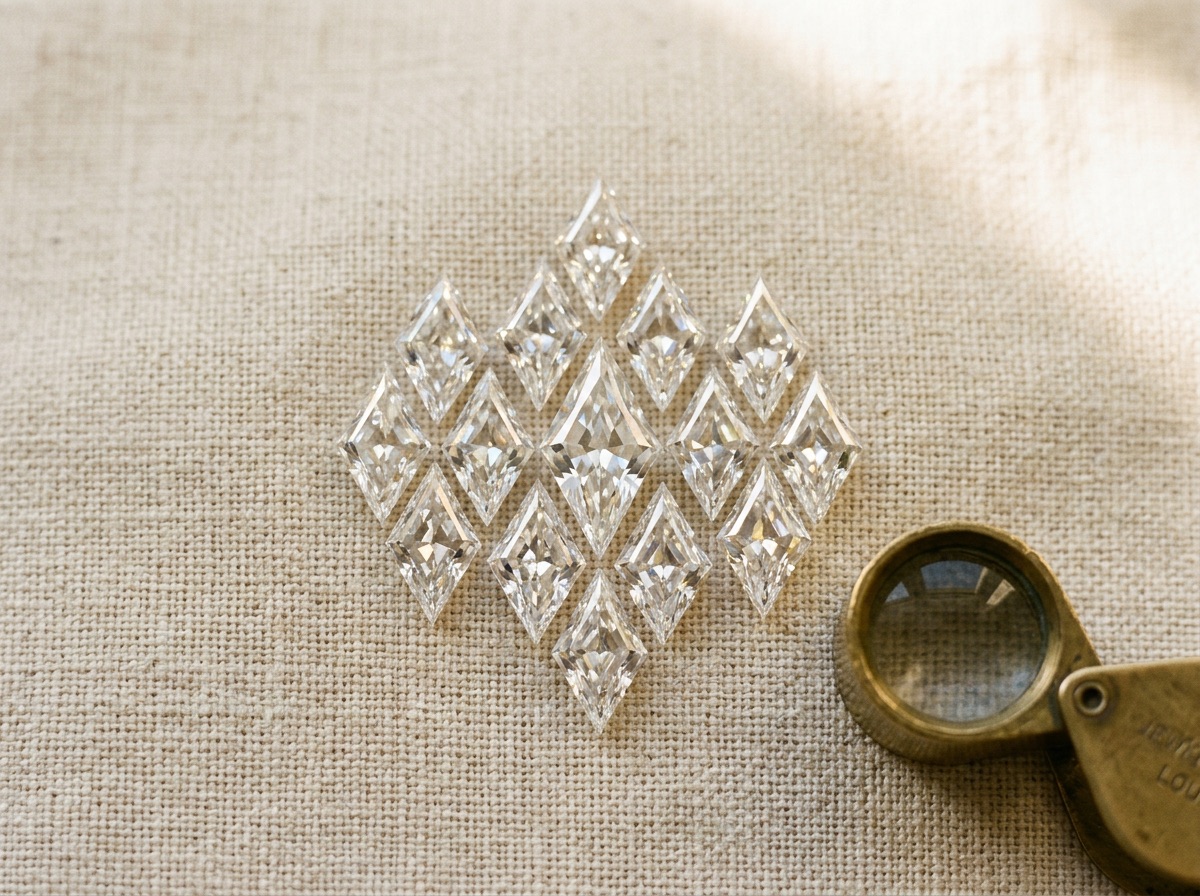
Guru Diam holds 595 kite diamonds on hand at any given time, calibrated and matched, IGI-gradable on request — part of a broader antique-cut inventory that also includes Old Mine, Old European, Hexagonal, Moval, Lozenge, Trillion, Criss-Cut, and Padparadscha shapes. For buyers building a collection around a fancy-shape or antique-cut line rather than a single SKU, that breadth means kite side stones, matched pairs for a specific project, and the center stones they'll flank can move through one vendor relationship instead of several.
Open a wholesale trade account for live kite pricing, current on-hand counts by size, and to request a matched set cut to a specific halo count or center-stone dimension.
Grading and quality considerations
Kite side stones are evaluated on the same four fundamentals as any diamond — color, clarity, cut, and carat weight — but the weighting shifts for a stone going into a matched set rather than standing alone. Color and clarity matter less in isolation than they do in consistency: a set where one kite reads half a color grade whiter than its neighbor will show in a halo even if every individual stone would grade acceptably on its own. Most wholesale kite sets are quoted against a DEF-to-near-colorless, VS-and-cleaner baseline, matched tightly enough that the set reads as one tone under the same light.
Cut precision and angle matching
Cut grading for a fancy shape like kite doesn't run through the same standardized cut-grade scale that applies to round brilliants — there's no universal "excellent/very good/good" cut grade for kite the way there is for round. Instead, buyers evaluate cut on symmetry and proportion consistency across the set: table percentage, crown angle, and outline symmetry should match stone to stone, and the top-point-to-bottom-point ratio should be consistent so every kite in the halo sits at the same visual angle. A kite that's cut slightly off-center or asymmetric between its top and bottom half will catch light unevenly compared to its neighbors — the kind of flaw that's invisible on a cert but obvious in a finished ring under a loupe or even the naked eye. Center stones paired with a kite halo are typically certified separately — IGI, GIA, or GCAL, per the buyer's preference — while the kite set itself ships as calibrated, matched goods, IGI-gradable on request.
Pricing factors for wholesale kite diamonds
Kite pricing runs on a different logic than round melee. A handful of factors move the per-stone and per-set wholesale price:
Carat weight and yield. Kite is cut from rough less efficiently than round or princess, and that lower yield carries through to price — a kite runs at a premium over a round of equivalent carat weight, consistent with its place in the antique-cut tier alongside Old Mine, Old European, and Trillion.
Matching, not just sizing. A single loose kite prices differently than a kite pulled as one unit of a four- or six-stone matched set. Matching cost is real: cutting multiple stones to the same angle, tone, and outline tolerance takes more production time than cutting one kite to a general spec and calling it close enough.
Set size. A pair is the simplest matching job; a six-stone halo — three per side — is a harder one, since angle and tone drift compounds across more stones. Wholesale quotes typically price per matched set rather than multiplying a single-stone price by stone count, because the labor scales with set size.
Orientation and sorting. Sets cut and sorted specifically for left/right placement — so the halo reads as a mirror image on each side of the center stone — cost more to produce than stones sized to a single spec without orientation sorting, but they save the jeweler from re-sorting mixed stock at the bench.
Center-stone fit. Kite sets cut to a specific center-stone size and point angle, rather than a generic size range, are a custom-matching job and priced accordingly, but they eliminate the fitting problems that come with forcing a generic kite into a halo it wasn't sized for.
Open a wholesale account for current per-set pricing — kite pricing moves with lab-grown production costs and isn't fixed to a static list.
Styling and use-case guidance for side stones
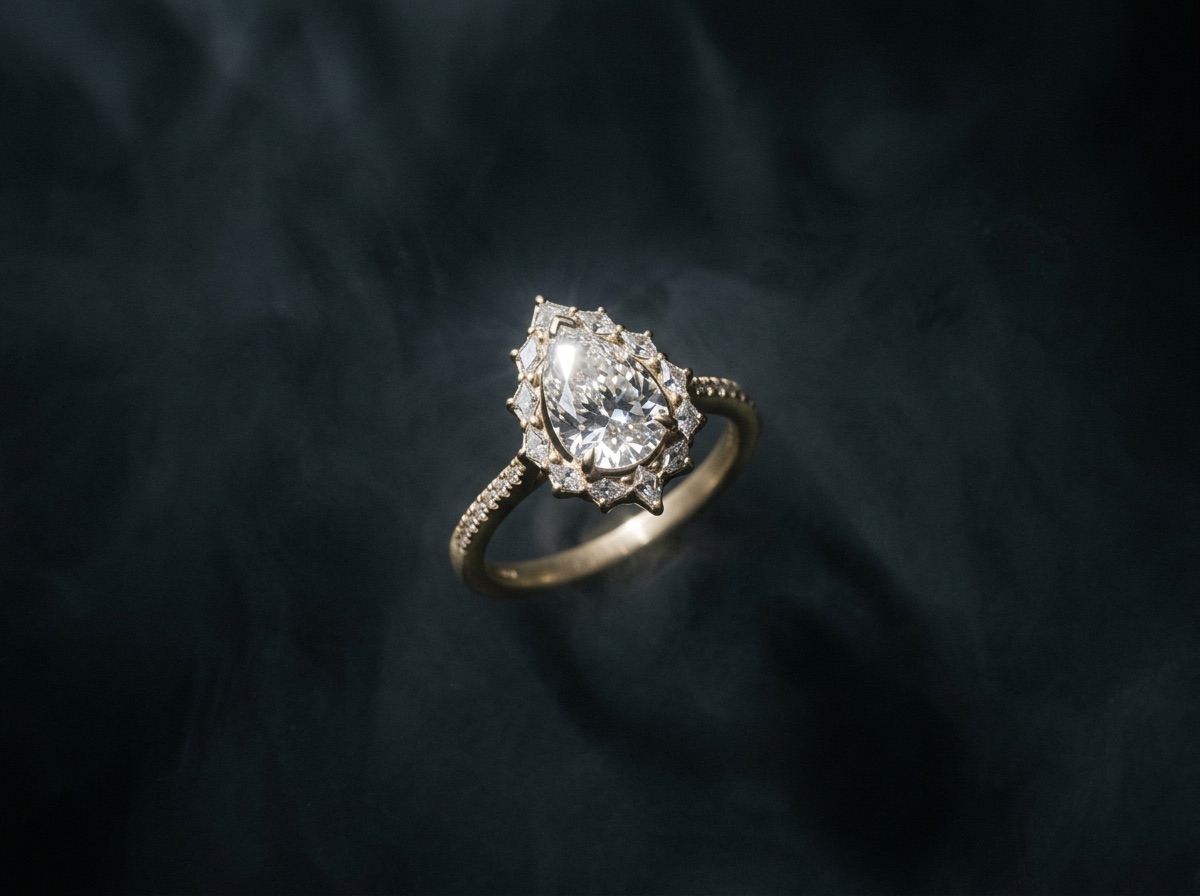
Kites are set in pairs or small clusters as part of a halo around a fancy-shape center stone, most commonly pear and marquise centers, where the kite's pointed top follows the line of the center stone's point. They also appear in fancy three-stone and cluster designs alongside trapezoids or half moons, and as a repeating accent in fancy-shape eternity bands. Because the shape is asymmetric top-to-bottom, kites are always sold and set with orientation in mind, not as a generic filler stone — a fact that shapes how a jeweler should brief a custom order from the start.
Halo settings with pear and marquise centers
The most common kite application is a two- or four-stone halo flanking a pear or marquise center: one or two kites per side, points angled to continue the line the center stone's own point establishes. Getting this right depends on matching the kite's top-point angle to the center stone's point angle — a mismatch here is the single most common styling error in kite halo work, and it's a cutting-and-matching problem to solve before the stones reach the bench, not a setting problem to fix afterward. For a low-profile halo, a shallower pavilion angle keeps the kite from sitting proud of the center stone; for a raised halo with more light play, a deeper cut reads brighter but adds height.
Cluster and three-stone designs
Beyond the standard halo, kites appear in fancy three-stone designs — a pear or marquise center flanked by single kites rather than a full halo — in toi-et-moi and cluster rings that mix kite with trapezoid or half-moon accents for an asymmetric geometric look, and as a repeating accent in fancy-shape eternity bands, where a run of kites set point-to-point creates a continuous zigzag line around the band. Mixed-shape clusters — kite alongside trapezoid, half moon, or round brilliant melee — are increasingly common in current fancy-shape engagement ring design, and they raise the matching bar further: the kites in a mixed cluster need to read consistently not just against each other but against a different shape's brightness and tone. Custom rings built around a kite cluster or halo finish in 4–6 days once stones are matched, approved, and moved to the bench — loose-stone sourcing and matching is a separate step ahead of ring production.
What to check before you buy
Because a kite's top and bottom points differ in length, orientation is the first thing to confirm — ask whether the set is cut and sorted specifically for left/right placement around the halo, not just sized to a single spec. A set that hasn't been oriented will still contain matched stones, but the buyer, or the setter, is left sorting which kite goes left and which goes right, and on an asymmetric shape that's not always obvious by eye.
Also check angle consistency across the set: a halo exposes any stone that sits slightly off from its neighbors far more than a channel or pavé setting would, since the eye reads a halo as one continuous ring of light rather than individual stones. Ask for the table percentage and crown angle range across the set, not just an average — a set quoted as "matched" with a wide tolerance range isn't matched in any way that will show cleanly in the finished ring.
For pear or marquise centers, confirm the kite's top-point angle lines up with the center stone's point before committing to a set — worth confirming against an image or spec sheet before the stones ship, since a point-angle mismatch is difficult to correct once the halo is set. For sets sold with a color or clarity range rather than a single grade, ask whether the range applies stone-to-stone or represents the spread across the whole set — the difference determines how consistent the set will actually look under one light source.
How to order kite diamonds wholesale
Ordering kite diamonds wholesale starts with a trade account, not a product page — because kite is a matching-driven shape, most orders beyond a single pair are built to spec rather than pulled directly from a public catalog listing. The typical process:
Open a wholesale account. Trade accounts get access to live pricing, current on-hand kite inventory by size and set, and direct contact for custom matching requests — accounts are for independent jewelers, designers, and manufacturers buying for resale or production, not individual consumers.
Specify the set. Tell your supplier the halo count — a pair, a four-stone set, a six-stone set — the center-stone shape and size the kites need to flank, and whether left/right orientation sorting is needed. The more specific the brief, the less back-and-forth on fit once the stones arrive at the bench.
Confirm grading and documentation. Decide whether the set ships with a grading report — IGI-gradable on request for kite sets; IGI, GIA, or GCAL for a separately certified center stone — or as calibrated set goods without individual certification. Melee-adjacent shapes like kite are commonly sold uncertified against a stated color/clarity baseline, which keeps cost down on sets where per-stone certification wouldn't change the buying decision.
Request a fit check before setting. For a custom halo, ask for a quick sizing or angle confirmation against the center stone before final setting, especially on sets built around an unusual pear or marquise point angle.
Reorder against the same spec. Once a kite set has been matched and approved for a design that goes into repeat production, later orders can reference the original spec sheet directly, which keeps every batch consistent without re-briefing the match from scratch.
Kite vs. trillion vs. half moon
Kite, trapezoid, half moon, and trillion get requested interchangeably by buyers who know they want "something antique and geometric" without a fixed shape in mind, but the four cuts behave differently as accent stones and aren't interchangeable once a center stone and setting style are locked in.
| Spec | Kite | Trapezoid | Half Moon | Trillion |
|---|---|---|---|---|
| Sides | 4, two pairs of adjacent equal sides | 4, two parallel edges of different lengths | Crescent — 1 flat edge, 1 curved edge | 3, equal sides |
| Symmetry axis | Vertical only (top ≠ bottom) | Horizontal (left-right symmetric) | Mirrored pair (left/right) | Full rotational (3-fold) |
| Typical faceting | Brilliant | Step-cut | Step-cut | Brilliant |
| Common pairing | Pear, marquise (halo) | Any center (general-purpose) | Round, oval, cushion | Round, cushion, non-pointed centers |
Kite vs. trillion is the comparison that comes up most for buyers deciding between two antique-cut shapes for the same halo brief. Both are brilliant-faceted and both hold antique-cut premium pricing, but a trillion is a triangular stone with three equal sides and full rotational symmetry, which makes it read the same from any of its three points — useful as a standalone accent or a symmetric three-stone flank, but without the directional "point toward the center" logic a kite offers. A kite's asymmetric top-to-bottom profile is specifically what makes it work as a halo stone that echoes a pear or marquise point; a trillion works better as a side stone next to a round, cushion, or other non-pointed center where directional matching isn't the goal.
Kite vs. half moon comes up for buyers choosing between a pointed and a curved accent style. A half moon is a crescent — one flat edge, one curved edge, no point — and it sets a softer, rounded line against a center stone rather than the kite's sharp geometric angle. Half moons pair well with round, oval, and cushion centers where a curved accent complements the center stone's own curve; kites pair better with pointed centers where the accent's own point continues a line the eye is already following.
FAQ
What is a kite shape diamond used for? Kite shape diamonds are calibrated accent stones used in halo settings and fancy-shape engagement rings, most commonly flanking pear and marquise center stones. Their pointed, asymmetric outline follows the line of the center stone.
How is a kite diamond different from a trapezoid? A kite has two pairs of adjacent equal sides and is symmetric only along its vertical axis, giving it a distinct top point and bottom point. A trapezoid has two parallel edges of different lengths and is symmetric left-to-right, with no pointed ends — the two shapes suit different settings and pairing conventions.
How are kite diamonds matched for a halo? A halo needs multiple kites matched in size, angle, and tone, oriented consistently around the center stone. Suppliers with deep in-house cutting can supply a full matched set to a specific halo count rather than pulling individual stones from mixed lots.
Are kite shape diamonds certified? They're sold as calibrated set goods, IGI-gradable on request, following the same convention as other side-stone shapes. The center stone in the halo is typically certified separately — IGI, GIA, or GCAL, per the buyer's preference.
How is kite diamond pricing determined for wholesale orders? Price moves with carat weight, cutting yield, and the labor cost of matching a set — a pair prices differently than a six-stone halo, and sets cut to a specific center-stone fit or sorted for left/right orientation cost more than generic stock. Open a wholesale account for current per-set pricing.
What's the difference between a kite and a trillion cut diamond? A kite is a four-sided, top-to-bottom asymmetric shape built to point toward a pear or marquise center; a trillion is a three-sided, fully symmetric triangle that reads the same from any point, making it better suited to round, cushion, or other non-pointed centers.