
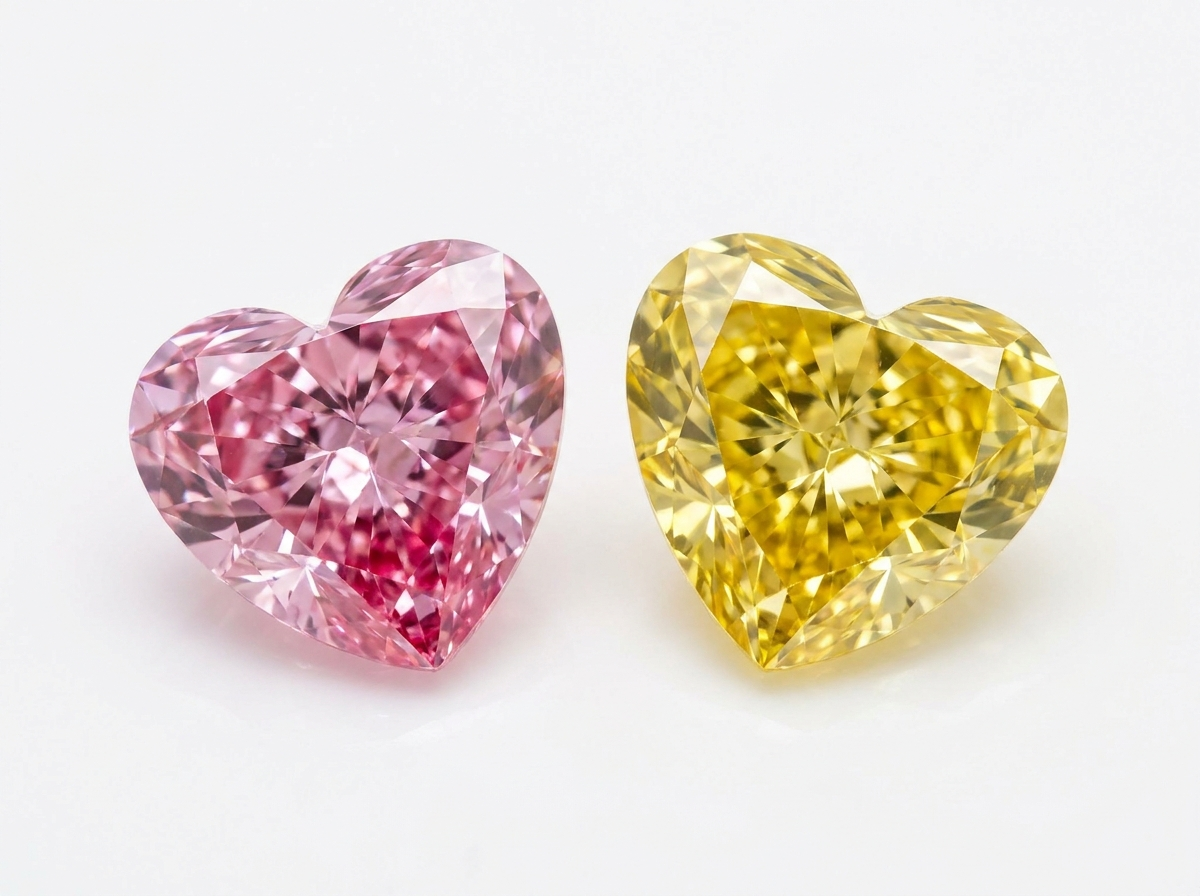
A fancy color heart is a heart-shaped lab-grown diamond — two symmetrical lobes meeting at a defined cleft, tapering to a single point — cut in an intentional hue rather than graded colorless. Guru Diam stocks fancy color hearts as IGI-certified, CVD-grown loose inventory, with 15 pieces on hand across yellow, pink, blue, and green.
Heart is the shape clients ask for by name more than almost any other. Pairing that instant recognition with color turns a familiar romantic shape into a genuine statement stone, which is why heart holds a permanent place in a fancy color inventory even though it isn't the highest-volume cut in the range. For a wholesale buyer, that combination — an outline every retail customer already recognizes, paired with a color story most of them have never been offered in this shape — is what turns a heart-shape stone from a novelty case-filler into a stone that actually reorders.
What Makes a Heart Cut Diamond "Fancy Color"?
A heart cut is a modified brilliant, not a step cut. Two rounded lobes sit at the top, separated by a defined cleft, and the outline narrows through the wings to a single point at the bottom. It's faceted the way a round brilliant is faceted — for fire and scintillation — rather than with the broad, flat planes of an emerald or asscher cut. Getting that outline right is already one of the harder symmetry problems in diamond cutting: the cleft depth, the curve of each wing, and the sharpness of the point all have to mirror each other, or the stone reads as visibly lopsided face-up, even to a buyer who couldn't say why it looks off.
"Fancy color" describes a diamond that's cut and sold for an intentional hue rather than being graded on the colorless-to-light-yellow scale most buyers know from round brilliants. Instead of chasing a D-to-Z color grade, a fancy color stone is graded on its own scale — hue, tone, and saturation — and priced for how vivid and even that color reads face-up, not for how close it comes to "white." Cutting a fancy color stone into a heart adds a second variable a cutter has to hold steady alongside the outline: hue and saturation need to stay even across a shape with more directional variation in facet angle than a round or a cushion. A well-cut fancy color heart has to solve both problems at once — the geometry and the color — which is part of why heart-shape colored stones command real attention from buyers who know what they're looking at.
Guru Diam's fancy color heart inventory spans the full locked palette — yellow, pink, blue, and green — CVD-grown and IGI-certified as standard, with GIA available on request.
How Fancy Color Is Produced in Lab-Grown Diamonds
Every fancy color stone in Guru Diam's inventory starts life the same way any CVD diamond does: a thin diamond seed plate goes into a chemical vapor deposition chamber, where a carbon-rich gas is broken down under controlled heat and pressure and deposited onto the seed one atomic layer at a time. That's the entire growth method across Guru Diam's lab-grown catalog — CVD, full stop, no exceptions.
Color enters the process through the growth chemistry itself. Introducing trace elements into the gas mixture during growth — nitrogen, boron, and other dopants in carefully controlled concentrations — changes how the crystal lattice forms and what wavelengths of light it absorbs, which is what produces a visible hue rather than a colorless or brown-tinted result. Some hues come through largely as-grown; others need an additional controlled treatment stage after the rough comes out of the chamber to set the final color and bring saturation up to a sellable intensity before the rough is ever handed to a cutter. Either way, the color is locked in before faceting starts — a heart isn't cut first and colored after. That sequencing matters for buyers: it means the color you see in a loose stone is stable under normal wear and cleaning, not a surface treatment sitting on top of a colorless diamond.
None of this is unique to heart-shape stones — the same CVD growth and color process feeds every fancy color shape Guru Diam stocks. What's specific to heart is what happens next, at the cutting wheel, where the outline and the color both have to come out right at the same time.
Heart Cut vs. Other Fancy-Color-Friendly Shapes
As a brilliant-faceted shape, a heart doesn't hold saturation quite as evenly as a mixed-cut shape like cushion or radiant — the smaller, more numerous facets scatter light the same way a round brilliant does, which can make color look slightly less uniform across the face of the stone. Where a heart earns its place in a color line is the point: color tends to pool visibly at the tip and along the cleft, which reads as depth and gives the stone a focal detail a plainer outline doesn't have. For a single statement stone rather than a matched suite, that weighting toward the point is usually an asset, not something to correct for.
Buyers building out a fancy color case often stock heart alongside two or three other shapes precisely because each one shows color differently, and a retail customer's preference for how saturated a stone should look face-up is as personal as their preference for outline. The table below is a working reference for how the shapes most commonly requested in fancy color compare.
| Shape | How It Shows Color | Common Use |
|---|---|---|
| Heart | Brilliant-faceted; color pools visibly at the point and cleft, giving a focal highlight rather than an even wash | Pendants, statement rings, sentimental and milestone gifts |
| Cushion | Mixed brilliant-and-step facets with a broader, more open pavilion; distributes saturation evenly across the whole face | Halo engagement rings, solitaires, color-forward showcase pieces |
| Pear | Similar taper to heart but a single point with no cleft; color often deepens gradually toward the tip | Pendants, drop earrings, elongated statement rings |
| Oval | Brilliant-faceted and elongated; spreads color evenly along the length, with minimal bowtie shadowing in a well-cut stone | Solitaires, three-stone rings, east-west set pieces |
None of this makes heart a "lesser" color shape — it just means a heart's color story is concentrated rather than spread evenly, which is exactly the effect a lot of retail buyers are shopping for when they ask for a fancy color heart by name instead of settling for whatever fancy color shape happens to be on the counter.
Grading Fancy Color: Hue, Tone, and Saturation
Fancy color diamonds aren't graded on the D-to-Z colorless scale most buyers already know from round brilliants. Instead, labs like GIA and IGI describe a colored stone across three separate dimensions, and understanding all three is the difference between reading a color report correctly and just glancing at the headline color name.
- Hue is the basic color family the stone falls into — yellow, pink, blue, green, or a modifier combination like "yellowish green." This is the word most buyers fixate on, but it's only one-third of the grade.
- Tone describes how light or dark the color reads, independent of how intense it is — a pale pastel pink and a deep, dark pink can share the same saturation grade while sitting at opposite ends of the tone scale.
- Saturation is the intensity or strength of the color itself, and it's what most of the trade actually means when they talk about a stone's "color grade." Labs typically bucket saturation into tiers — moving up from faint and light grades through fancy, fancy intense, and fancy vivid — with vivid grades commanding the strongest attention and, generally, the strongest per-carat pricing within a given hue.
For a wholesale buyer, the practical takeaway is to read a color report as a full sentence, not a single word. "Fancy vivid yellow" and "fancy light yellow" are the same hue but a completely different stone in terms of how it reads face-up and how it should be priced and displayed. When comparing two fancy color hearts side by side, put the full grade next to each other — hue, tone, and saturation together — rather than assuming two stones labeled "pink" are interchangeable.
Certification and What to Check When Buying Fancy Color Heart Wholesale
A color report on a fancy color stone should specify the same core data a colorless-stone report does — carat weight, measurements, clarity grade, and cut/symmetry/polish — plus the origin call (natural or laboratory-grown) and the full hue, tone, and saturation description covered above. Guru Diam issues fancy color hearts with IGI reports as standard, with GIA certification available on request for buyers who need it for a specific retail relationship or resale requirement.
Symmetry deserves extra scrutiny on a heart specifically, because a heart has more places for a cutter to get the outline wrong than a round or an oval does. Check for:
- Cleft depth and shape — the notch between the two lobes should be a clean, symmetrical V, not shallow on one side or off-center.
- Matching wings — both sides of the heart should curve and taper identically; lay a straight edge down the center line and check that each half mirrors the other.
- Point sharpness — the bottom point should come to a defined, undamaged tip. A rounded, chipped, or blunted point is one of the most common symmetry deductions on heart-shape stones and one of the easiest defects to spot without a loupe.
- Length-to-width ratio — heart shapes vary from a rounder, fuller outline to a longer, narrower one; if you're buying more than one stone for a set or a pair, confirm the ratio is consistent across all of them.
The table below summarizes the spec profile for Guru Diam's current fancy color heart inventory.
| Spec | Detail |
|---|---|
| Outline | Two symmetrical lobes, defined cleft, single bottom point |
| Facet style | Modified brilliant |
| Color palette (Guru Diam) | Yellow, Pink, Blue, Green |
| Growth method | CVD-grown |
| Certification | IGI standard; GIA available on request |
| Stone type | Certified single stones (not melee) |
| On-hand count | 15 pieces |
| Typical uses | Pendants, statement rings, anniversary and milestone pieces, statement earrings |
Pricing Factors for Fancy Color Heart Diamonds
Fancy color pricing doesn't move the way colorless pricing does, and heart shape adds its own variables on top of the usual color factors. When you're evaluating a quote on a fancy color heart, the levers worth understanding are:
- Saturation, not just hue. Two stones with the same hue name can carry very different pricing depending on where they land on the saturation scale — a fancy vivid stone in a given color is a meaningfully different (and typically pricier) stone than a fancy light in the same hue, even at the same carat weight.
- Symmetry precision. Because a heart's outline is harder to execute cleanly than a round or oval, a heart with excellent symmetry — a crisp cleft, matched wings, a defined point — is scarcer within any given rough yield than an equivalently colored round or oval, and that scarcity shows up in price.
- Carat weight and outline balance. Heart shapes are usually judged as much on how balanced the outline looks as on raw carat weight — a smaller, well-proportioned heart with strong color and clean symmetry can outsell a larger stone with an uneven outline or an off-center cleft.
- Clarity, at a lower priority than usual. Because color is the headline feature, minor inclusions that would matter more on a colorless stone often carry less weight on a fancy color heart, provided they aren't visible face-up.
- Matching, when buying more than one. If you're sourcing two or more fancy color hearts for a paired piece, expect a premium over buying the same stones individually — matching hue, tone, and saturation across two hearts is a harder sourcing problem than matching two rounds.
None of these factors work in isolation — a wholesale quote on a fancy color heart is really a read on how all five line up on one specific stone, which is why asking for the full grading breakdown up front, rather than a single "fancy pink" headline, gets you a much more useful basis for comparison.
Best Jewelry Applications for Fancy Color Heart Diamonds
Heart's sentimental shape does most of the selling on its own, which is why it shows up most in pendants, anniversary and milestone gifts, and one-of-a-kind statement rings rather than as a default engagement-ring center. Buyers looking to build a fancy color case around heart-shape stones tend to find the strongest sell-through in a handful of specific applications:
- Pendants and focal drops — a heart hanging as a solo pendant lets the outline read clearly at a glance, and the point-weighted color described earlier becomes a natural focal point rather than something that needs correcting for.
- Statement rings — a fancy color heart set as a solitaire or with a simple halo makes the shape and the color the entire story, without competing design elements pulling attention away from either.
- Halo settings — a ring of smaller white or tonal melee around a fancy color heart center frames the color and reinforces the outline at the same time, which is useful when a customer wants the heart shape to read unmistakably even from across a room.
- Statement earrings — a single heart-shape drop earring, or a heart used as an accent on a larger earring design, works well precisely because the outline itself is doing the design work.
- Anniversary and milestone pieces — heart's built-in sentimental association makes it a natural fit for gifting occasions, where a customer is already looking for a shape with meaning attached before color even enters the conversation.
It also works well as a focal drop in a pendant or a single statement earring, where the outline itself is the design and the color adds a second layer of distinction on top — a combination that's harder to build with a plainer shape.
Sourcing Fancy Color Heart Wholesale from Guru Diam
With 15 pieces on hand across the color palette, fancy color heart offers enough breadth to cover a specific hue and size request, with made-to-order cutting available for anything outside current stock. Because outline symmetry matters as much as color here, request the exact hue, saturation, and size up front rather than "a fancy color heart" as a generic ask — the more specific the request, the faster a supplier can tell you whether it's an on-hand match or a made-to-order job.
When you're sourcing, it's worth asking for a few things beyond the headline color name: the full grading breakdown (hue, tone, and saturation, not just the color word), symmetry notes specific to the cleft and point, and — if the piece calls for two stones — whether a matched pair is available or needs to be produced. Single statement stones are the more common request for heart shape, but matched heart pairs can be produced for drop earrings on request, and hue-matching a pair is worth discussing directly with whoever is sourcing the stones rather than assuming any two same-color hearts will read as a set.
Guru Diam sources fancy color heart diamonds as wholesale, trade-only inventory — no retail markup — from our New York Diamond District desk (36 West 47th Street, Suite 601A) and our Los Angeles office (607 South Hill Street). In-stock pieces ship same-day; a custom setting runs CAD-to-finished-piece in 4–6 days. For the full fancy color category across every shape, see our fancy color lab-grown diamonds overview.
Ready to buy? Open a verified wholesale account at /signup and book time with a gemologist at /book-appointment.
Buying Checklist: Red Flags for Wholesale Fancy Color Buyers
Before confirming an order on any fancy color heart parcel, run through this list:
- Color consistency across a parcel. If you're buying more than one stone in the same hue, check that hue, tone, and saturation all match across the group — not just the headline color name. Two stones can both be labeled "pink" and still look noticeably different side by side.
- Fluorescence. Ask whether fluorescence is noted on the report and what it does to face-up color under different lighting. In some fancy color stones, fluorescence can shift how saturated or even the color looks in daylight versus indoor lighting — worth knowing before a customer sees the stone in their own store's lighting rather than yours.
- Cleft and point condition. Confirm the report's symmetry grade lines up with what you see under a loupe — a chipped point or an uneven cleft won't always tank a symmetry grade enough to show up as a red flag on paper alone.
- Origin and growth method stated clearly. The report should state plainly that the stone is laboratory-grown, with the growth method disclosed — never take a verbal assurance in place of what's printed on the certificate.
- Full grading language, not a shorthand color name. Insist on the complete hue/tone/saturation description before agreeing on price — "vivid yellow" and "light yellow" are not close enough to negotiate as the same stone.
- Photos or video that match the certificate number. For any stone you can't inspect in person, ask for imagery tied directly to the report number, not a generic stock photo of "a similar stone."
None of this is unique to Guru Diam's inventory — it's the same checklist worth running against any wholesale fancy color heart quote, from any supplier, before it goes into a customer-facing case.
Frequently Asked Questions
What is a fancy color heart-shape diamond?
A fancy color heart-shape diamond is a colored diamond cut into the heart outline — two symmetrical lobes, a defined cleft, and a single point — rather than graded and sold colorless. It's a modified brilliant cut, and its brilliant faceting scatters light the way a round does, so color tends to pool visibly toward the point and cleft rather than reading as evenly as a mixed-cut shape.
Are fancy color heart diamonds lab-grown, and are they certified?
Yes. Guru Diam's fancy color heart inventory is CVD-grown and IGI-certified as standard, with GIA certification available on request, in yellow, pink, blue, and green.
Can I get a matched pair of fancy color hearts?
Single statement stones are the more common request, but matched heart pairs can be produced for drop earrings on request — see our guide on matched pairs for how hue-matching works.
How fast can I get a fancy color heart stone or a finished custom piece?
In-stock pieces ship same-day from New York. Made-to-order cutting plus a finished custom piece runs 4–6 days from our New York and Los Angeles desks.
What do hue, tone, and saturation mean on a fancy color grading report?
Hue is the basic color family (yellow, pink, blue, green, or a modified combination). Tone is how light or dark that color reads. Saturation is the strength or intensity of the color, and it's the dimension that most affects how a stone is priced within its hue. Reading all three together, not just the headline color word, is the only way to compare two fancy color stones accurately.
What should I check for symmetry when buying a heart-shape fancy color diamond wholesale?
Check that the cleft between the two lobes is a clean, centered V, that both wings curve and taper identically, and that the bottom point is sharp and undamaged rather than rounded or chipped. If you're buying more than one heart for a set, also confirm the length-to-width ratio is consistent across all the stones.
Related Articles
Lozenge Diamonds Wholesale Guide
Wholesale Lozenge (rhombus) lab-grown diamonds — calibrated elongated side stones for Art Deco-style settings and geometric accent work. IGI-gradable, NYC stock.
Matched Pair Step Cut Diamonds Wholesale
Wholesale matched pair step cut lab-grown diamonds — two identical step-cut stones cut and matched together for stud earrings and symmetrical side-stone settings. IGI-gradable, NYC stock.
Fancy Color Marquise Diamonds Wholesale
Wholesale fancy color Marquise lab-grown diamonds for jewelers and designers sourcing elongated colored shapes at trade pricing.