
What Is a Trillion Cut Diamond?
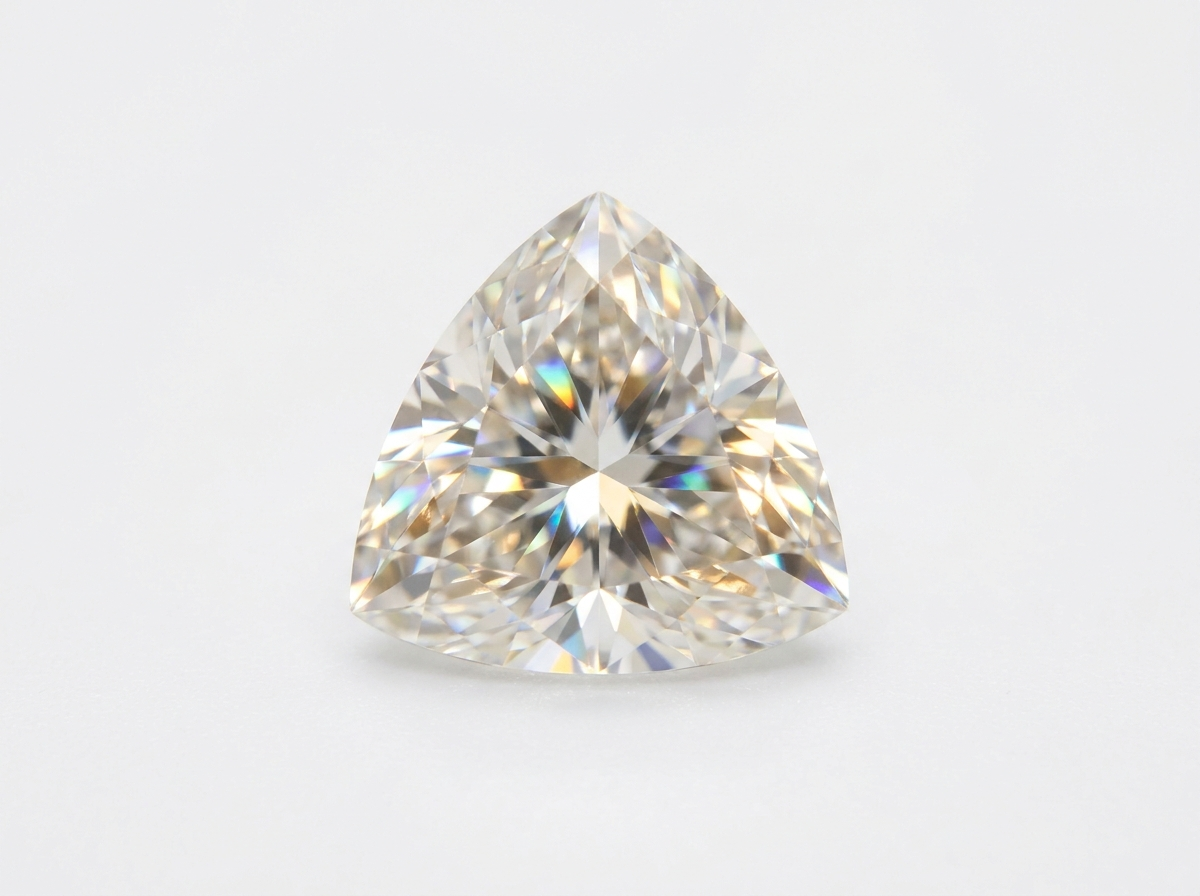
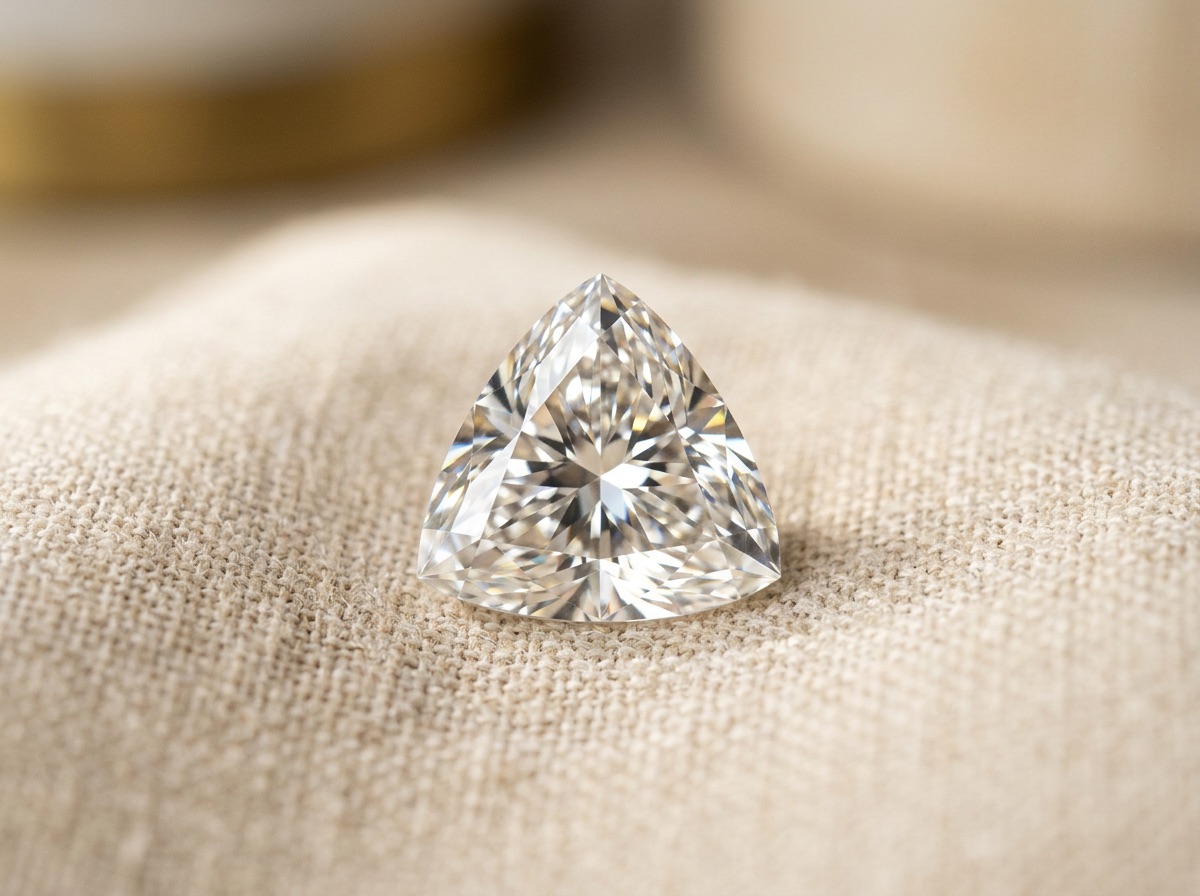
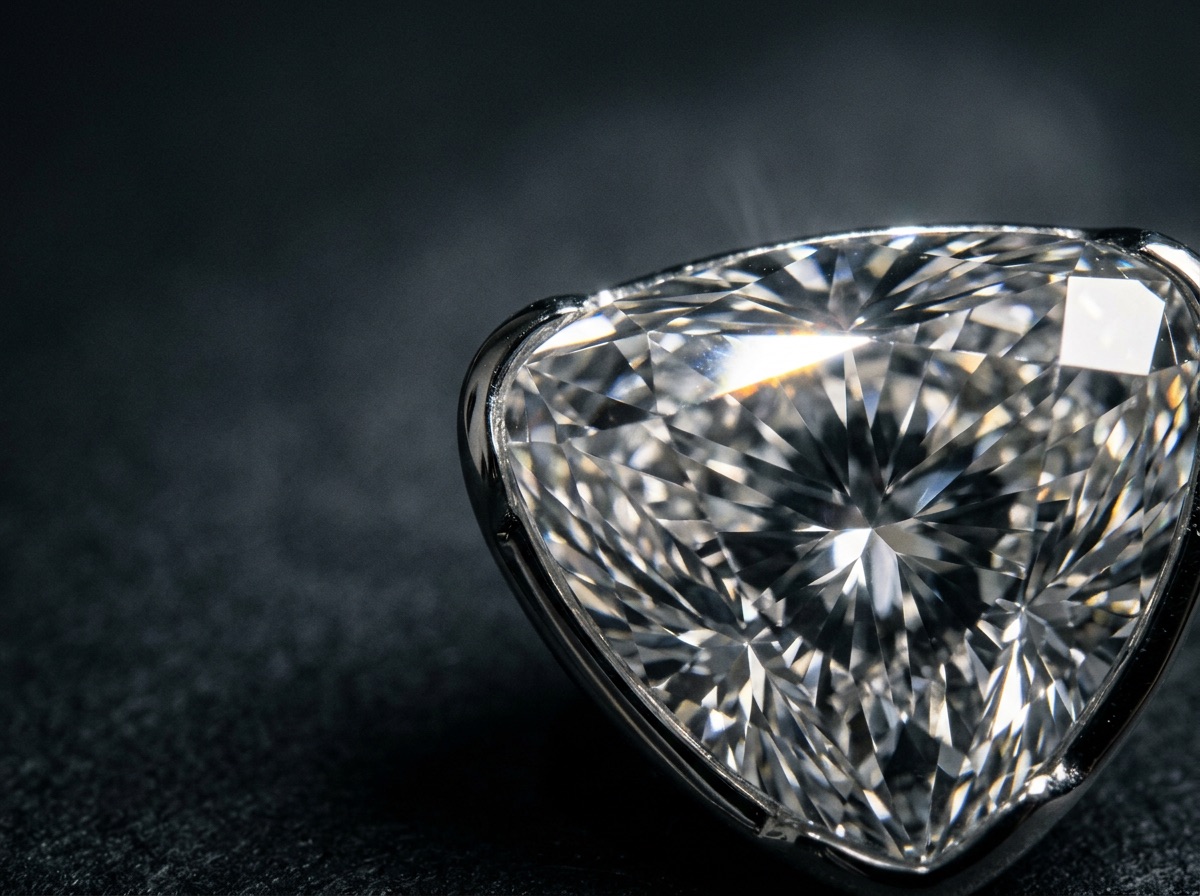
A trillion — also called a trilliant — is a triangular brilliant-cut diamond with rounded corners and multi-facet faceting built for maximum fire, distinct from the flat step-cut triangle shape. The faceting pattern is the same family as a round brilliant — dozens of small, angled facets radiating outward from the culet — just mapped onto a three-cornered outline instead of a circular one. That's the detail that defines the cut: a trillion isn't a triangle with the points sanded off, it's a completely different faceting system wearing a triangular silhouette.
The rounded corners do two jobs at once. Optically, they soften the outline compared to a sharp-pointed step-cut triangle, which changes how the stone reads in a setting — less graphic, more organic. Structurally, they remove the thinnest, most stress-concentrated point of material on the stone, which is exactly the spot a sharp-cornered shape is most likely to chip in everyday wear or during setting. Both effects come from the same design decision, which is worth keeping in mind later when we get to grading and setting.
Because the faceting throws real fire and scintillation rather than the quiet, geometric flash of a step cut, a trillion can do something a step-cut triangle can't: carry a ring on its own as a center stone, not just support one as a side stone. Guru Diam stocks 981 trillion diamonds on hand — the highest-volume side-stone shape in our current inventory — used as both statement center stones and side stones, IGI-certified as standard.
Facet Anatomy: How a Trillion's Brilliant Pattern Is Built
Cutting a brilliant facet arrangement onto a triangular outline is a harder engineering problem than it looks. A round brilliant's facets repeat around a single axis of symmetry — the same angle, mirrored sixteen or seventeen times, with no corners to complicate the geometry. A trillion has to do the same job — table, crown facets, girdle, pavilion facets, culet — while also negotiating three rounded corners where the facet pattern has to compress, bend, and rejoin cleanly without leaving visible seams or dead spots where light doesn't return properly.
The crown (the upper portion above the girdle) carries the bulk of the fire-producing facets, angled to catch and disperse white light into the spectral flashes that read as "fire." The pavilion (the lower portion) is cut to bounce light back up through the table rather than leaking it out the bottom — a trillion cut too shallow or too deep in the pavilion loses brightness the same way a poorly proportioned round does, just harder to spot at a glance because buyers are less calibrated to trillion proportions than round ones. The rounded corners themselves carry a cluster of smaller facets that have to align with the straight-edge facet rows on either side, which is the technically demanding part of cutting the shape well — a poorly executed trillion often shows its weakest cutting exactly at those corner transitions, as a slightly duller or less symmetrical patch of light return.
None of this is visible to a buyer eyeballing a stone, which is why symmetry grading matters more for a trillion than for a shape with a simpler facet geometry — more on that under quality considerations below.
A Short History of the Trillion Cut
The trillion as a defined, trademarked cut dates to 1962, when Asscher Diamond Company registered the name for a brilliant-faceted triangular stone — a deliberate departure from the step-cut triangles and other three-cornered shapes that had circulated informally in the trade for decades before that. The point of the innovation was exactly the distinction this guide keeps coming back to: applying brilliant faceting to a triangular outline to get fire and scintillation out of a shape that had previously only existed as a quiet, step-cut accent stone.
"Trillion" and "trilliant" are used interchangeably in the trade today, and cutters have refined corner rounding and facet proportions considerably since the 1960s original — modern trillion faceting is more consistent and better optimized for light return than early cuttings of the shape. The underlying idea, brilliant faceting on a three-sided outline, hasn't changed. It's still what separates a trillion from every other triangular diamond shape on the market.
Trillion vs. Triangle: Brilliant vs. Step Cut
These two shapes get confused constantly because they share the same three-sided outline, but they are not interchangeable, and the distinction matters for sourcing, grading, and price.
| Spec | Trillion / Trilliant | Triangle |
|---|---|---|
| Faceting | Multi-facet brilliant | Flat step-cut planes |
| Corners | Rounded | Sharp, defined points |
| Light behavior | High fire and scintillation | Quiet, geometric flash |
| Typical role | Center stone or side stone | Side/accent stone only |
| Best for | Statement rings, sparkle-forward side stones | Understated three-stone accents |
| On-hand at Guru Diam | 981 | 520 |
The practical takeaway: if a design needs side stones that hold their own next to a brilliant center, or the center stone itself needs to be triangular with real fire, trillion is the correct call. If the goal is a calm, uniform frame that won't compete with the center diamond, the step-cut triangle is the better fit. For a full breakdown of triangle cut sourcing, matching, and grading, see our Triangle Cut Diamonds Wholesale guide — we won't re-derive that comparison in depth here since it's covered thoroughly there.
Trillion vs. Kite: Two Antique Silhouettes, Different Jobs
The other shape worth distinguishing trillion from is kite — both are antique-tier fancy shapes with pointed geometry, and both show up in side-stone work, but the outline and the role in a setting are genuinely different once you look past the general silhouette.
A trillion has three sides and three corners, all rounded, all optically active thanks to brilliant faceting. A kite has four sides and two points, with a longer axis running from one point through the center to the opposite point and two wider shoulder corners in between — a lozenge-adjacent outline, not a triangular one, and cut step-cut in most cuttings rather than brilliant. That faceting difference matters in the same way it matters for triangle: a kite reads quieter and more geometric, where a trillion reads brighter and more active. Kite also tends to run in a different setting geometry — linear or graduated, up a shank or around a cluster — where trillion more often flanks a center stone laterally or anchors a design on its own.
Both shapes sit in Guru Diam's antique-tier premium cut category, alongside old mine, old European, and lozenge — a tier defined by cutting complexity and category scarcity rather than carat weight. See our Kite Shape Diamonds Wholesale guide for sourcing and grading detail on that cut specifically, and our Antique Cut Diamonds Wholesale guide for how the full antique-tier category is organized.
Why Trillion Is Our Highest-Volume Side-Stone Shape
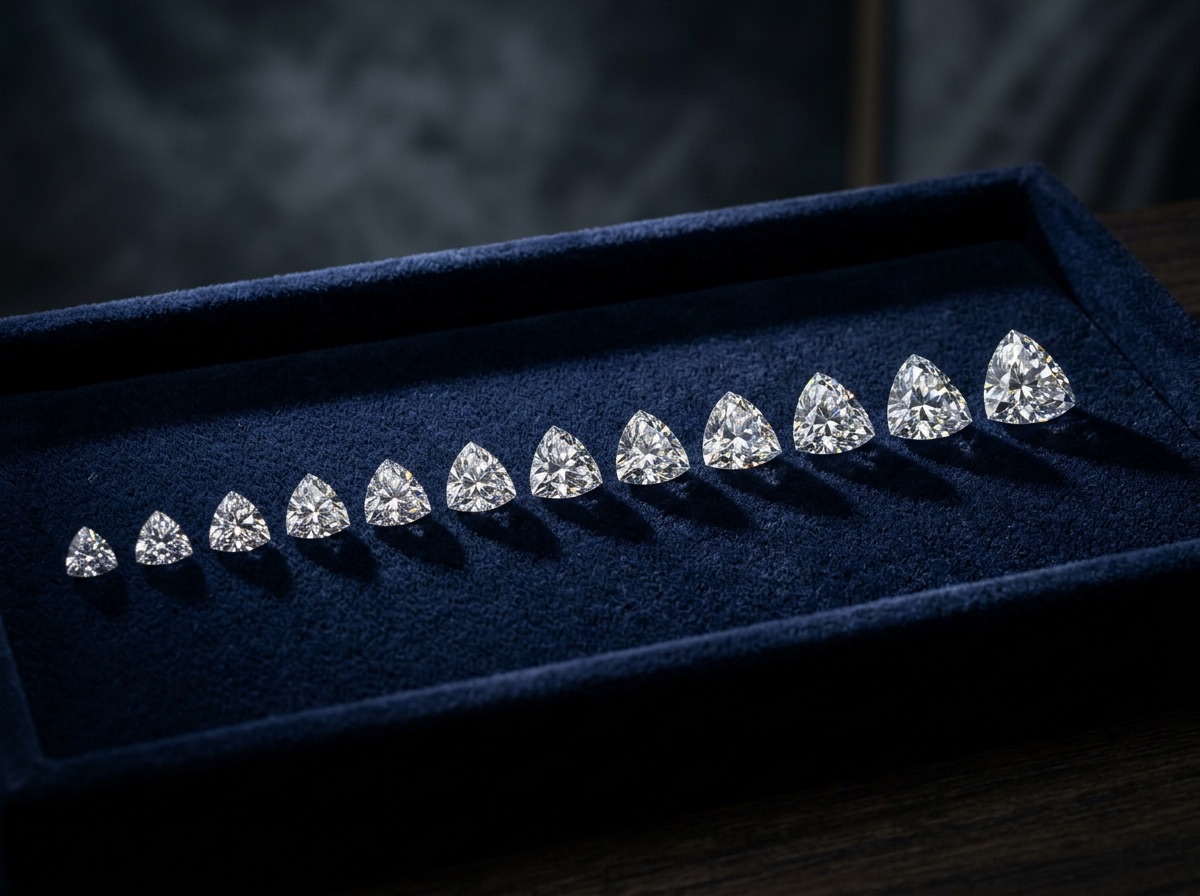
At 981 pieces on hand, trillion is the deepest-stocked side-stone shape in Guru Diam's current inventory — ahead of every other calibrated fancy shape we carry, including the step-cut triangle it's most often confused with. That depth serves two different kinds of orders in practice.
A center-stone request for a single, well-cut trillion in a specific size and color has a wider size/color range to draw from — a buyer isn't settling for the closest available stone, they're choosing from genuine range. A side-stone request for a matched pair, or a larger set for a cluster design, has enough volume behind it that a true match is a normal pull from stock rather than a special search that stalls an order. That second point is the one that actually shows up in production timelines: shallow inventory in a fancy shape means every matched-pair request becomes a sourcing project; deep inventory means it's a same-day pull.
It's also worth noting what that volume reflects about demand. Trillion earns its position as the highest-volume antique shape in stock because it does double duty — most calibrated fancy shapes are either center-stone candidates or side-stone candidates, rarely both, which forces a supplier to stock two separate ranges to cover both use cases. Trillion covers both out of one inventory line, which is part of why it moves faster and gets restocked deeper than single-purpose shapes.
Grading and Quality Considerations
Because the shape is faceted for fire rather than flat geometry, a few checks matter more on a trillion than they would on a step-cut equivalent — and matter more than they would on a round brilliant, where the facet pattern doesn't have corners to negotiate at all.
Corner Rounding and Chip Resistance
The degree of corner rounding is a design variable, not a fixed spec — more rounded reads softer and safer for everyday wear, while a tighter, closer-to-sharp rounding reads more dramatic but carries slightly more chip risk, the same trade-off a triangle's sharp point makes in the extreme. Confirm the degree of rounding matches the design intent before ordering, particularly for a center stone that will see daily wear versus a side stone in a protected setting. A trillion's rounding is never "no rounding" — even the more dramatic cuttings keep enough radius at the corner to avoid the true point-stress problem a step-cut triangle has to manage with setting hardware instead.
Facet Symmetry on a Triangular Outline
Brilliant faceting on a triangular outline is harder to cut symmetrically than on a round, for the reasons covered in the facet anatomy section above — the corner transitions are where cutting quality shows up first. Check symmetry grading closely, especially for a center-stone purchase where the stone is the visual focus of the piece rather than one of a matched pair where minor individual variation is less noticeable. A trillion with poor symmetry often looks acceptable in a still photo and disappointing in hand, under moving light — exactly the failure mode symmetry grading exists to catch before a stone ships.
Matching for Side-Stone Sets
If sourcing a pair or set for side-stone use, confirm size, angle, and color/tone are matched across every stone in the set — not just graded individually and assumed to be close enough. Two trillions can each carry an acceptable independent grade and still read as a visible mismatch face-up, the same risk that applies to matched triangle pairs. This is where Guru Diam's 981-piece inventory does real work: a deep pool of trillion stock means a matcher is pulling a genuine match, not settling for the nearest approximation.
Certification
Guru Diam's trillion inventory is CVD-grown and IGI-certified as standard, with GIA certification available on request for individual stones. For center-stone purchases, individual certification is the norm — buyers and their retail clients want a report tied to the specific stone going into a statement piece. For side-stone matched sets, certification is typically handled at the discretion of the order: some buyers want every stone in a set individually graded, others are satisfied with the set graded and matched as a unit, similar to how calibrated pair goods are handled across other fancy shapes. Either path can be arranged — flag your preference when placing the order rather than assuming a default.
Pricing Factors for Trillion Diamonds Wholesale
Several variables move price on trillion beyond straightforward carat-weight math, and they don't all point the same direction, so it's worth pricing a job against the full list rather than carat weight alone.
Carat weight and role. A center-stone trillion is priced and shopped like any solitaire — carat, color, clarity, and cut quality against a target size. A side-stone trillion is more often priced per pair or per set against a total carat weight target, the same convention used for triangle and other matched-accent shapes.
Cut quality and symmetry. Because brilliant faceting on a triangular outline is genuinely harder to execute well than on a round, well-cut trillions with clean corner transitions and strong symmetry command a real premium over merely acceptable cutting of the same carat weight and color — this is a bigger price swing on trillion than on shapes with simpler facet geometry.
Length-to-width ratio. Trillion proportions aren't fixed the way a round brilliant's are. More equilateral cuttings (all three sides close to equal) are the more commonly requested proportion for both center-stone and side-stone use, and demand for that ratio shows up in pricing relative to more elongated cuttings.
Matching premium. A verified matched pair or set — same size, angle, and tone, checked against each other rather than independently graded — commands a premium over stones that are individually acceptable but not verified as a match. That premium reflects the labor of pulling a genuine match from inventory, not a markup on the stones themselves.
Certification. Individually certified stones price differently than uncertified or set-certified matched goods, particularly for center-stone purchases where a report tied to the specific stone is expected.
Sourcing and In-House Cutting
Trillion diamonds at Guru Diam are cut, calibrated, and matched in-house, with operations run out of our New York and Los Angeles locations and real-time online inventory visible to trade accounts. Because these are lab-grown CVD stones rather than natural rough, cutters have more control over the starting material — CVD boules can be grown and selected specifically for the proportions a shape like trillion needs, rather than cutting around inclusions or working with whatever natural rough happens to be on hand. That control is a meaningful part of why deep, consistent calibrated inventory in a demanding shape like trillion is achievable at the scale we carry it.
In-stock pieces ship same-day. Custom sizing, color requests, or matched sets outside current stock are cut and calibrated in-house to spec — those are build-to-order requests, so timing is quoted per order rather than promised as a blanket turnaround for loose stones. If the trillion is going into a finished piece rather than shipping loose, that's a different production path: custom engagement rings built around a trillion center or side stones complete in 4–6 days once the design and stone selection are locked.
Styling and Use-Case Guidance
Trillion as a Statement Center Stone
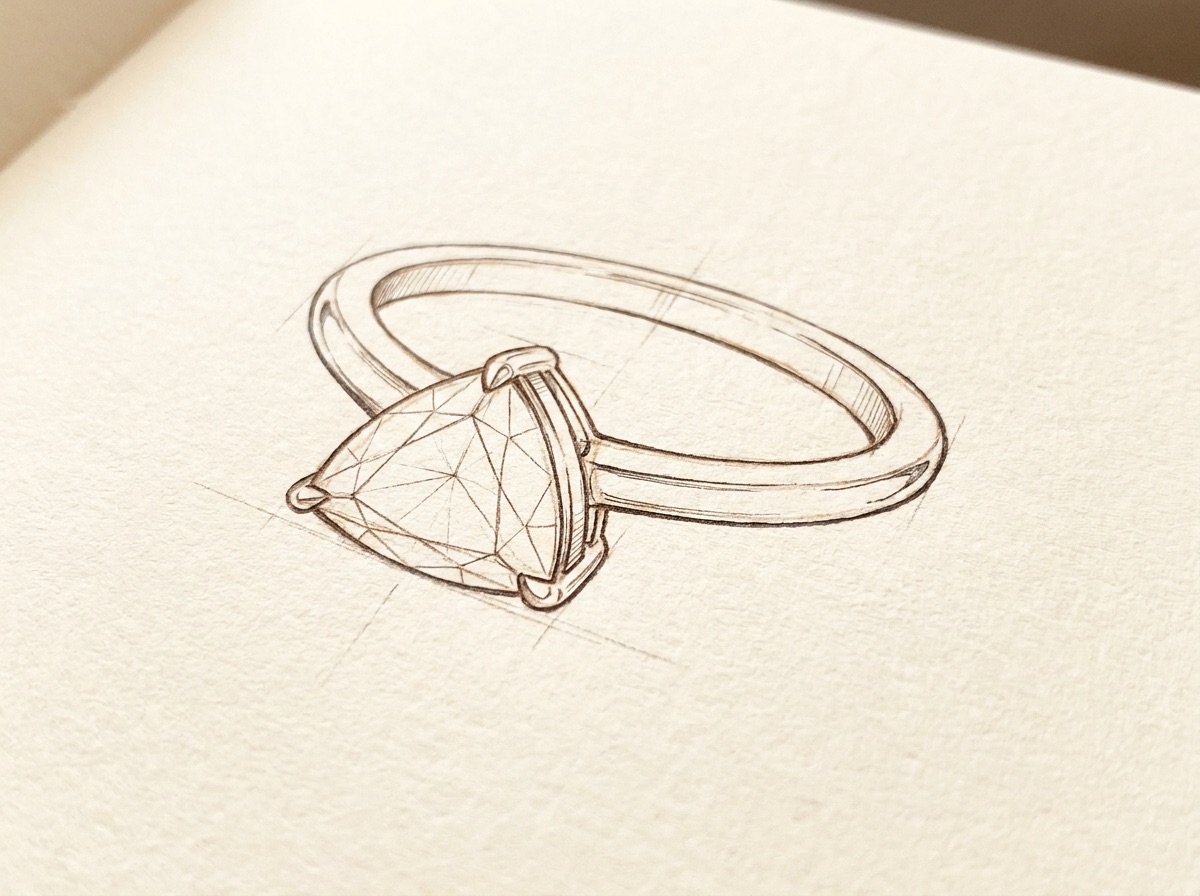
Because trillion's brilliant faceting throws real fire, it's one of the few triangular shapes that reads convincingly as a solo center stone rather than needing a rounder shape to anchor a design. Statement and cocktail rings built around a single trillion — set point-up in a low-profile prong or bezel setting that shows off the shape's outline without hiding the corners — are a distinct and growing custom-order category, separate from the side-stone volume that makes up most of Guru Diam's trillion business. A trillion center stone reads more architectural and less traditional than a round or cushion, which is exactly the appeal for buyers sourcing something their clients can't find at a typical retail counter.
Trillion as Side Stones
The more common application by volume: a matched pair of trillions flanking a round, cushion, or emerald center, chosen specifically because trillion's fire holds its own next to a brighter center stone in a way a step-cut triangle can't. This is the design logic behind trillion's role as the go-to side stone whenever a client wants the accents to actively sparkle rather than just frame — three-stone rings, trilogy settings, and halo-adjacent designs where the side stones are meant to be noticed, not just present.
Setting Considerations
Even with rounded corners reducing chip risk relative to a step-cut triangle, trillion corners still benefit from setting hardware that caps rather than exposes them — a low-profile prong or partial bezel over each corner is standard practice for both center-stone and side-stone applications. For side-stone work, channel or shared-prong settings are common where trillions sit close together in a cluster; for a solo center stone, a simple three- or six-prong setting that lets light into the pavilion from all angles preserves the fire that's the whole point of choosing brilliant faceting over a step cut in the first place.
How to Order Trillion Diamonds Wholesale
Ordering trillion at wholesale follows the same basic path as any calibrated fancy shape, with a few trillion-specific details worth confirming up front.
1. Open a wholesale account. Trade buyers — independent jewelers, designers, and manufacturers — can open a wholesale account to access real-time calibrated inventory, pricing, and ordering.
2. Specify role and orientation. State whether the trillion is going in as a center stone or a side stone, and confirm point-up or point-down orientation before matching or setting begins — assumed orientation is the most common detail that has to be corrected after the fact.
3. Confirm ratio, symmetry, and clarity preference. Flag whether you need an equilateral or more elongated proportion, and be specific about symmetry expectations for the corner transitions, particularly for a center-stone purchase where cutting quality is more visible.
4. Request certification. IGI is standard; GIA is available on request for individual stones. Confirm whether you need every stone in a matched set individually certified or graded as a set.
5. Ship or build. In-stock pieces ship same-day. Matched sets outside current stock or non-standard sizing are cut and calibrated in-house to spec; a finished ring built around trillion stones moves to our custom jewelry production path with a 4–6 day turnaround once design and stone selection are locked. You can also book time with a gemologist to work through a center-stone selection or a matched side-stone set before ordering.
For sourcing background on related antique-tier shapes, see our guides to Lozenge Diamonds Wholesale and Kite Shape Diamonds Wholesale. For matched-pair sourcing across shapes, see our Matched Pairs Diamonds Wholesale guide.
Frequently Asked Questions
What is a trillion cut diamond?
A trillion, or trilliant, is a triangular diamond with rounded corners and brilliant, multi-facet faceting built for maximum fire. It's distinct from a step-cut triangle, which has sharp points and flat, quiet facets.
Can a trillion diamond be used as a center stone, or only a side stone?
Both. Trillion's brilliant faceting gives it enough fire to stand alone as a center stone in a statement ring, and it's also widely used as a side stone flanking a round, cushion, or emerald center — a versatility the step-cut triangle doesn't share.
What's the difference between a trillion and a triangle cut diamond?
A trillion is brilliant-faceted with rounded corners, built for fire and usable as a center or side stone. A triangle is step-cut with flat facets and sharp points, used almost exclusively as a side-stone accent. The rounded-versus-sharp corner is the fastest way to tell them apart at a glance.
How does a trillion compare to a kite cut diamond?
A trillion has three sides and three rounded corners with brilliant faceting. A kite has four sides and two points with a longer axis, cut step-cut in most cuttings — a lozenge-adjacent outline rather than a triangular one. Both are antique-tier shapes, but trillion reads brighter and works as a center stone, while kite is a quieter, side-stone-only shape typically used in linear or graduated arrangements.
Why does Guru Diam stock so much trillion inventory?
Trillion is the highest-volume side-stone shape in our current inventory at 981 pieces on hand — ahead of every other calibrated fancy shape we carry. That depth supports both single center-stone selections across a wide size and color range, and true matched pairs or sets for side-stone orders.
Are trillion diamonds certified?
Guru Diam's trillion inventory is CVD-grown and IGI-certified as standard, with GIA certification available on request for individual stones. Matched side-stone sets can be certified individually or graded as a set, depending on the order.