
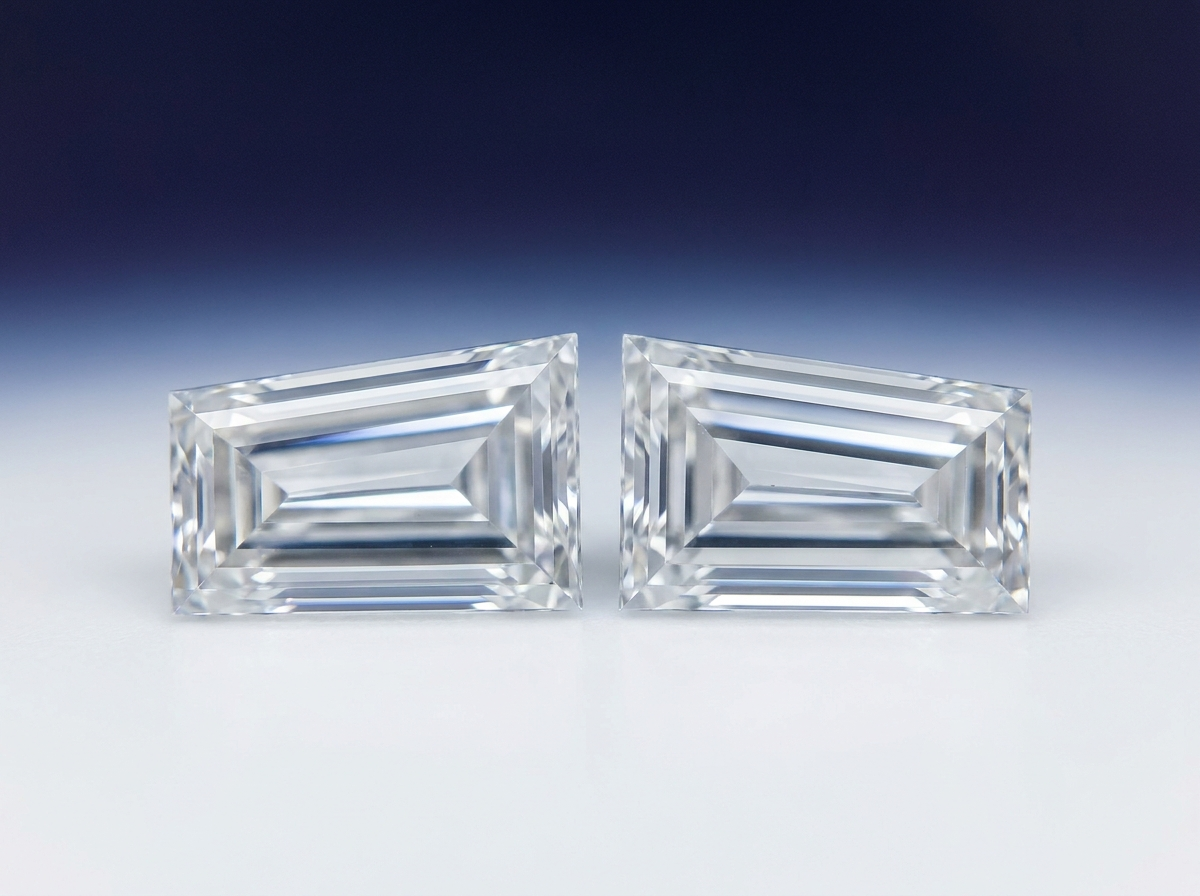
Pair Step Cut is a matched-pair product line rather than a single shape — two step-cut diamonds (typically baguette, trapezoid, or tapered baguette outlines) cut and matched together as one unit, built for stud earrings and any setting that needs two identical side stones. Guru Diam holds 58+ Pair Step Cut sets on hand, IGI-gradable on request. For wholesale jewelers comparing a step cut diamond against a round brilliant for side-stone work, the matched-pair sourcing process below is the part that actually determines whether two stones will sit level in a finished setting.
What Is a Step-Cut Diamond, and What Does "Matched Pair" Mean?
A step cut diamond is defined by its facet arrangement, not by its outline. Instead of the triangular and kite-shaped facets that radiate out from the culet on a round brilliant, a step cut is built from broad, flat, rectangular facets that run parallel to the girdle, stacked in rows like steps on a staircase — which is where the name comes from. That faceting style shows up across a range of outlines: baguette, tapered baguette, trapezoid, emerald, asscher, and kite are the most common. Any of them can be cut as a step cut diamond, and any of them can, in principle, be sold as a matched pair.
"Matched pair" is a separate concept from the outline or the faceting style — it describes two individual stones sold and evaluated together because they're intended to sit opposite each other in the same piece of jewelry. A pair only qualifies as genuinely matched when four things line up: weight (both stones within a tight fraction of a carat of each other), color (same grade, or close enough that no difference is visible face-up), clarity (same grade, or close enough that inclusions don't create a visible contrast), and proportions (same depth percentage, table size, and length-to-width ratio, so the two stones read as the same size and shape from across a room). Two loose stones that happen to share a certificate's stated carat weight aren't automatically a matched pair — proportions and face-up appearance matter as much as the numbers on the report.
Guru Diam's Pair Step Cut line takes that definition and builds it into the product itself: two step-cut diamonds, in baguette, tapered baguette, or trapezoid outlines, are cut and matched together as one unit rather than assembled after the fact from separate lots. The rest of this guide covers what wholesale buyers should know before ordering a matched step-cut pair from any supplier — including the questions worth asking regardless of who's selling the pair.

Which Diamond Shapes Come in Step-Cut Form
Step faceting isn't exclusive to any one outline, which is part of why "step cut" shows up as a search term on its own — buyers are usually trying to figure out which shape they're actually looking at. The outlines wholesale buyers most commonly ask about are:
- Baguette — a narrow rectangle, the most common step-cut outline for calibrated side stones in eternity bands and three-stone rings.
- Tapered baguette — a baguette with one end narrower than the other, cut in mirrored left/right pairs so it can angle around a curved shank or channel.
- Trapezoid — a four-sided shape with two parallel sides of different lengths, typically cut in mirrored pairs for the same reason as tapered baguettes.
- Emerald — a rectangular or square outline with cut corners, step-faceted, more commonly sold as a center stone than a side stone but still available as a matched pair for drop earrings or a three-stone setting.
- Asscher (square emerald) — the square version of the emerald outline. A buyer searching for a square step cut diamond is almost always describing an Asscher, and matched Asscher pairs are typically requested for stud earrings rather than side stones.
- Kite — a four-sided shape that comes to a point at top and bottom, cut in mirrored pairs and used almost exclusively as an accent stone rather than a center stone.
Matched pairs matter more for step-cut shapes than they do for a diamond round brilliant cut, and the reason comes back to the faceting. A round brilliant's facet pattern breaks up light in a way that's forgiving of small size or proportion differences between two stones — the sparkle pattern distracts the eye. A step cut has none of that camouflage. Two flat, mirror-like facets sitting side by side in a pair of studs will show any mismatch in size, angle, or tone immediately, because there's no scintillation pattern to hide it. That's why baguette, tapered baguette, trapezoid, emerald, asscher, and kite pairs get sold and graded as matched sets far more often than round stones do — the shape itself makes mismatches visible in a way brilliant cuts don't.
How Wholesale Buyers Should Expect Matched Pairs to Be Matched
Not every "matched pair" on a price list was actually matched with the same rigor. Two sourcing paths produce very different results: a supplier can either cut two stones together as one job, controlling size, angle, and tone from rough to polish, or pull two already-finished loose stones out of separate parcels and pair them after the fact because their certificates happen to list similar numbers. The first approach produces a tighter, more reliable match. The second can still work, but it depends entirely on how carefully someone compared the two stones face-up — under a loupe, side by side, in the same lighting — rather than just on paper.
Before a wholesale order ships, a buyer should be able to confirm four things about a matched pair: that the two stones were visually compared side by side (not just certificate-matched), that their weight falls within an acceptable tolerance of each other, that their color and clarity grades are consistent enough not to read as different stones face-up, and that their proportions (depth, table, length-to-width ratio) are close enough that the outlines look identical when set. The table below is a reasonable baseline for what "acceptable" should mean on each of those points.
| Matching Criteria | Acceptable Tolerance | Why It Matters |
|---|---|---|
| Weight | Within roughly 0.02–0.05 ct of each other for smaller calibrated sizes; tighter as a percentage on larger stones | A visible weight gap usually shows up as a visible size gap once the stones are set side by side |
| Color | Same grade, or one grade apart only if both fall on the same side of a visual color line (for example, both G rather than F next to H) | Step facets show body color more openly than brilliant facets, so a one-grade gap can be visible face-up in a way it wouldn't be on a round stone |
| Clarity | Same grade, or close enough that neither stone shows an inclusion visible without magnification | Step-cut facets act like a hall of mirrors for inclusions, so clarity mismatches are more visible than on a brilliant cut |
| Proportions (depth %, table %, length-to-width ratio) | Within a few percentage points on depth and table; length-to-width ratio close enough that the two outlines look identical | Even identical carat weight can look mismatched if one stone is cut shallower or narrower than the other |
| Visual symmetry (side-by-side check) | No substitute — always confirm with an in-person or high-resolution photo comparison, not certificate numbers alone | Certificates report rounded numbers within a range; two stones can share a certified grade and still look different next to each other |
None of this replaces asking to see the pair together before it ships. A supplier confident in a match will show both stones side by side, not just hand over two separate certificates and let the buyer assume.
Certification for Matched Step-Cut Pairs: Individually or as a Set?
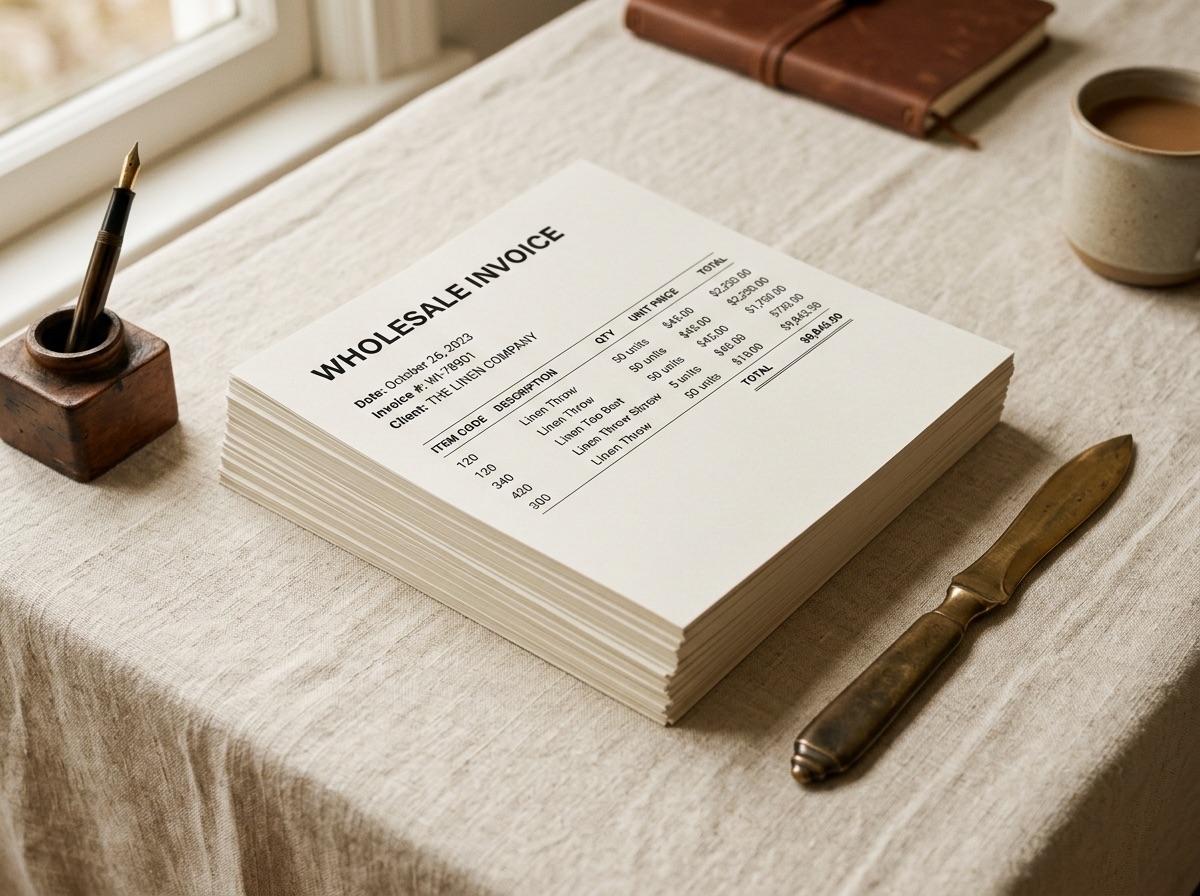
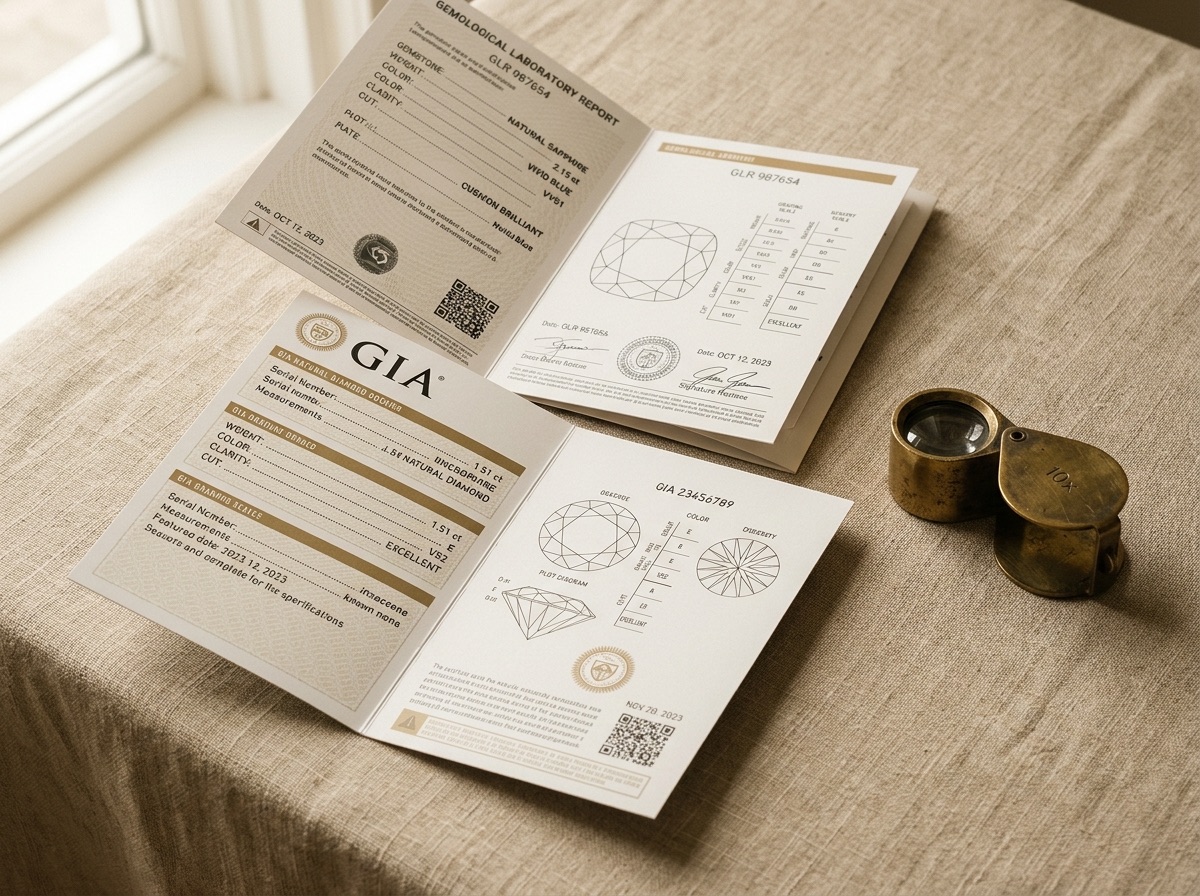
Certification for matched pairs works a little differently than it does for a single loose stone, and it's worth understanding the general practice before asking a specific supplier how they handle it. Both IGI and GIA will grade and certify a matched pair's two stones as individual stones, each with its own report — that's the standard approach, since certification labs grade one diamond per report by design. What changes for a pair is the paperwork buyers actually use to compare the two stones: alongside the two individual certificates, a reputable supplier should be able to provide a side-by-side comparison — either a combined summary sheet or simply the two reports plus photos taken under the same lighting — so the two grades can be checked against each other at a glance.
Guru Diam's Pair Step Cut sets are IGI-gradable on request, following the same certification convention used across the rest of the catalog's calibrated and paired shapes. Buyers placing a wholesale order for a matched step-cut pair should ask upfront whether certification is included by default or available as an add-on, since suppliers vary on this — some certify matched pairs standard, others only on request.
Grading Nuances Specific to Step Cuts
Step cuts grade differently than a diamond round brilliant cut in one specific way that matters more for matched pairs than for single stones: clarity. A round brilliant's facet pattern breaks light into dozens of small, high-contrast flashes, which has the side effect of camouflaging small inclusions — a light scatter of tiny inclusions can hide inside the sparkle. A step cut has the opposite effect. Its broad, flat facets act like a hall of mirrors, reflecting a single inclusion across the stone's open table and making it far more visible than the same inclusion would be in a brilliant-cut stone of the same clarity grade.
That means two things for a wholesale buyer evaluating step-cut clarity. First, a certificate's clarity grade doesn't tell the whole story on its own — a VS2 step cut with an inclusion positioned dead-center under the table will look worse face-up than a VS2 step cut with the same size inclusion tucked near the girdle, even though both stones carry the same grade. Second, for a matched pair specifically, clarity consistency matters even more than it does for a single stone: two stones at the same clarity grade can still look mismatched if one has an inclusion positioned where it's visible and the other doesn't. Asking to see, or get a photo of, the table-up view of both stones in a pair — not just the certificate grade — is the fastest way to catch this before an order ships.
Color reads more openly through a step cut for the same structural reason — the large, flat facets act more like a window than a brilliant's faceted surface does, so body color is more visible face-up at the same grade. This is a reason some buyers deliberately size up, asking for a slightly higher color grade, for step-cut orders compared to what they'd request for a round brilliant of the same size.
Pricing Factors for Matched Pairs vs. Single Stones
A well-matched pair of step-cut diamonds typically prices at a premium over two individually sourced single stones of the same combined weight, and the premium is earned rather than arbitrary. Cutting two stones together as one job — controlling size, angle, and tone from rough to polish — takes more planning and yields less usable rough per finished carat than cutting two unrelated stones on their own schedules. That cost shows up in the price.
The alternative — sourcing two single stones separately and pairing them after the fact — can come in cheaper, but it shifts the cost from the supplier's side to the buyer's side in the form of time and risk: someone still has to sort through inventory to find two stones close enough to pair, and there's no guarantee a close-enough match exists in stock at the size and quality a project calls for. For a one-off project, or when close-enough is good enough, single-sourcing can work. For anything a jeweler expects to reorder consistently — a stud earring program, a recurring three-stone ring style — ordering a pair matched at the cutting stage removes that sourcing risk from every future order, not just the first one.
Within matched-pair pricing itself, the same factors that drive single-stone pricing still apply — carat weight, color, clarity, and cut quality — but tolerance also plays a role. A pair matched to a tighter tolerance (closer weight, closer color, closer proportions) generally commands a higher premium than a pair matched to a looser, more commercial tolerance, because a tighter match takes more selective cutting or more selective sourcing to produce.
Best Jewelry Applications for Matched Step-Cut Pairs
Matched step-cut pairs are built around a specific set of settings where two identical stones are structurally part of the design, not just a stylistic choice:
- Stud and drop earrings — the most common application by far. Two identical stones sit at eye level on either side of a face, so any mismatch in size, angle, or tone is the first thing anyone notices. This is the use case matched pairs were built to solve.
- Three-stone rings — a center stone flanked by two matching side stones, typically baguette, tapered baguette, or trapezoid step cuts angled to frame the center. The two side stones need to mirror each other exactly, since they're compared directly across the width of the ring.
- Toi-et-moi styles — two stones set side by side, rather than a center stone plus accents, where a matched step-cut pair reads as a single balanced design instead of two unrelated stones sharing a ring.
- Symmetrical pendant and drop-necklace accents — smaller step-cut pairs used as the two flanking stones on a pendant, following the same matching logic as earrings.
In all four cases, the design fails visually the moment the two stones stop reading as a matched set — which is the core argument for sourcing a pair as a pair, cut and graded together, rather than assembling one from two separate purchases.
Sourcing Matched Step-Cut Pairs Wholesale from Guru Diam
Guru Diam holds 58+ Pair Step Cut sets on hand across baguette, tapered baguette, and trapezoid outlines, cut in-house as CVD lab-grown diamonds and IGI-gradable on request. Because the matching happens at the cutting stage rather than after the fact, on-hand sets are already matched for size, angle, and tone — a buyer isn't relying on a second search through inventory to find a stone that's close enough.
For an outline or size not currently on hand, the same in-house cutting process that produces the standing inventory can be used to cut a pair to a specific request. When asking for a custom matched pair, it's worth being specific about: the outline (baguette, tapered baguette, or trapezoid), the total or per-stone carat weight, the color and clarity range needed, and, for tapered baguette or trapezoid pairs specifically, whether the setting needs a mirrored left/right pair or two stones of identical angle. The more specific the request, the tighter the match a cutter can plan for.
Wholesale accounts get live pricing and can request a specific outline, size, and grade for a pair directly through Guru Diam's New York Diamond District desk.
Buying Checklist: What to Verify Before Purchasing a "Matched" Pair Wholesale
Not every pair sold as "matched" in the wholesale market meets the same bar. Before finalizing an order — from any supplier, not only Guru Diam — a buyer should verify the following:
- Side-by-side visual comparison, not just certificate numbers. Two stones can carry the same certified grades and still look different next to each other. Ask to see both stones together, ideally photographed under the same lighting, before the order ships.
- Matching fluorescence. Fluorescence isn't always listed as a matching criterion, but mismatched fluorescence between two stones can cause one to look slightly hazier or bluer than the other under UV-heavy lighting, including some retail and event lighting. Ask whether fluorescence was checked as part of the match, not just weight, color, and clarity.
- Color consistency under more than one light source. A pair that looks matched under warm incandescent light can show a subtle tint difference under daylight or LED lighting. If possible, check the pair under at least two light types before confirming.
- Proportion consistency, not just carat weight. Two stones can share a carat weight and still look different in size if one is cut deeper, shallower, or narrower than the other. Ask for depth percentage, table percentage, and length-to-width ratio on both stones, not just the weight.
- Clarity plot comparison for step cuts specifically. Because step facets show inclusions more openly than brilliant facets, ask for the clarity plot or a table-up photo of both stones, not just the grade on the certificate.
- Whether the pair was cut together or sourced separately. This isn't disqualifying either way, but it changes what "matched" actually means for that pair, and it's a fair question to ask any supplier directly.
Frequently Asked Questions
What is a Pair Step Cut diamond?
Pair Step Cut isn't a single outline — it's a product line where two step-cut diamonds (baguette, trapezoid, or tapered baguette shapes) are cut and matched together as a set from the start, rather than paired after the fact from separate loose stones. The step-cut faceting itself refers to broad, flat, parallel facets rather than the multi-faceted brilliant style used on round diamonds. Guru Diam currently holds 58+ Pair Step Cut sets on hand.
What is Pair Step Cut used for?
It's used primarily for stud earrings, where two identical stones are required, and for symmetrical side-stone applications in rings, pendants, and toi-et-moi styles that call for two matching step-cut accents rather than a single stone or a larger graduated set.
How is a Pair Step Cut set matched?
The two stones are cut and graded together as one job, controlling size, angle, and tone from the start rather than sourcing a second stone to match an existing one. This produces a tighter match on weight, color, clarity, and proportions than pairing two loose stones pulled from separate lots, and it's worth confirming with any supplier which approach they used.
Are Pair Step Cut diamonds certified?
They're sold as matched-set goods, IGI-gradable on request — the same convention used for other calibrated and paired shapes in the catalog. Each stone in the pair receives its own certificate, since certification labs grade one diamond per report, but a reputable supplier should also be able to show both reports side by side for comparison.
What's the difference between a step cut and a round brilliant cut diamond?
The difference is entirely in the faceting. A diamond round brilliant cut uses dozens of small triangular and kite-shaped facets to scatter light into a high-contrast sparkle pattern, while a step cut uses broad, flat, rectangular facets stacked in parallel rows, producing a quieter hall-of-mirrors effect instead of scintillation. That structural difference is also why step cuts show color and inclusions more openly than round brilliants of the same grade.
Why does fluorescence matter for a matched step-cut pair?
Fluorescence isn't one of the primary matching criteria alongside weight, color, or clarity, but mismatched fluorescence between two stones in a pair can cause one to look slightly hazier or differently toned than the other under UV-heavy lighting. It's worth asking whether fluorescence was checked as part of the match rather than assumed to be consistent just because the other grades line up.
Related Articles
- Lozenge Diamonds Wholesale Guide — Wholesale Lozenge (rhombus) lab-grown diamonds — calibrated elongated side stones for Art Deco-style settings and geometric accent work. IGI-gradable, NYC stock.
- Fancy Color Heart Diamonds Wholesale
- Fancy Color Marquise Diamonds Wholesale