
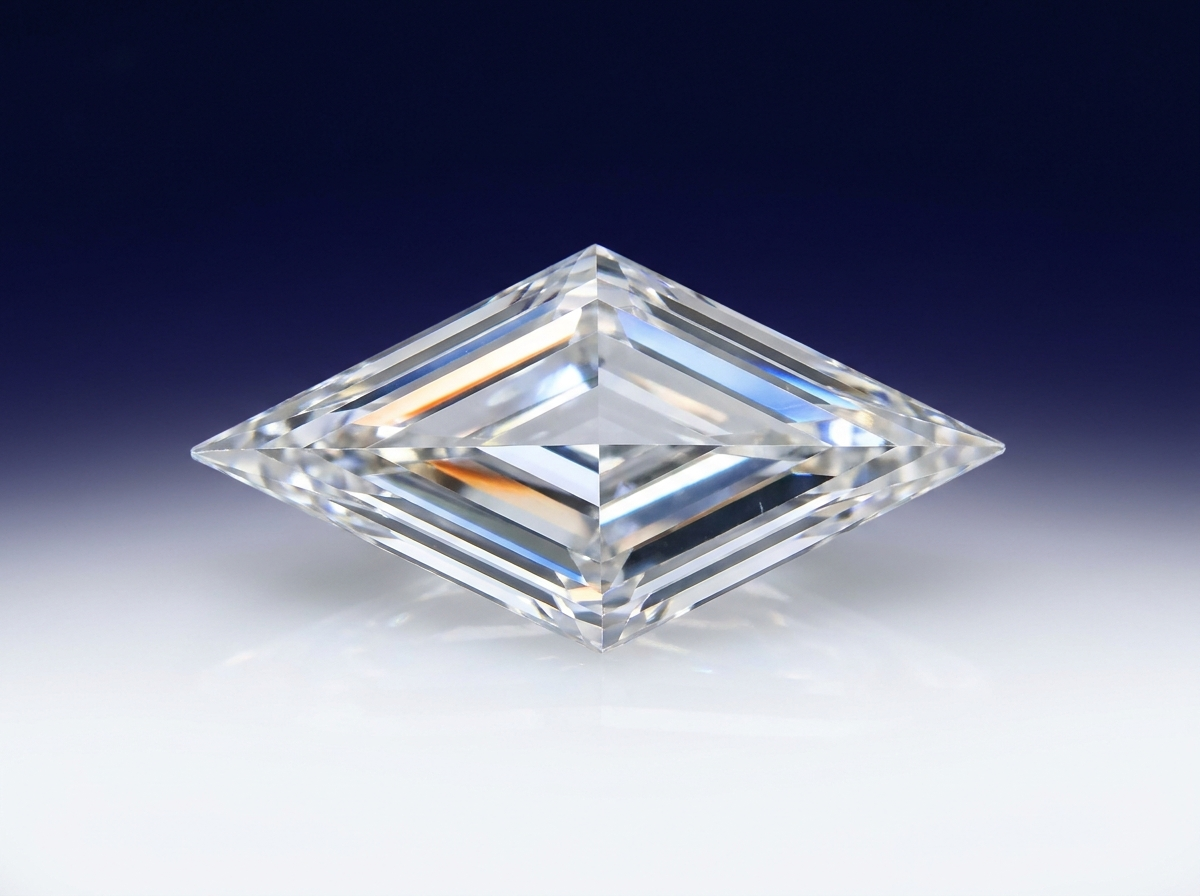
A Lozenge diamond is a calibrated elongated rhombus — four equal sides meeting at two acute and two obtuse angles, giving it a diamond-shaped (in the geometric sense) outline. It's used as an accent and side stone in Art Deco-style settings and geometric jewelry design. Guru Diam stocks 146+ Lozenge diamonds, calibrated and matched, IGI-gradable on request.
What Is a Lozenge Cut Diamond?
The outline is a true rhombus: four sides of equal length, stretched along one axis so two of the corners are sharp (acute) and two are wider (obtuse). That elongated shape is where the name comes from — it's the same silhouette as a lozenge shape in geometry or heraldry, not a reference to the diamond's grade or type. The faceting is typically step-cut, consistent with the other calibrated side-stone shapes in this category, which keeps a Lozenge reading as a clean geometric accent rather than a competing source of fire.
Step-cut faceting means the crown and pavilion are built from long, parallel facets that run in concentric bands around the outline, echoing the shape of the girdle rather than breaking it into small triangular and kite-shaped facets the way a brilliant cut does. A Lozenge typically carries a fraction of the facet count of a round brilliant of comparable size — fewer, larger planes instead of dozens of small ones — which is exactly why the shape reads as clean geometry rather than fire and scintillation. That's a design choice, not a shortcut: a side stone that competed with the center stone for sparkle would work against the setting.
Proportion is where a Lozenge lives or dies as a wholesale item. The length-to-width ratio determines how elongated the rhombus reads — most buyers are looking for something in a fairly narrow band rather than a shape that drifts toward a kite or a marquise silhouette. The acute-corner angle has to be held consistently, because a Lozenge that's a few degrees off from its neighbors in a set will visibly break the line of a channel or an eternity row even if each stone looks fine in isolation on its own. Table-to-depth ratio matters too, for the same reason it matters on any step cut: too shallow and the stone washes out under the table, too deep and it looks small for its face-up size next to the rest of the set.
One practical way to spot a well-cut Lozenge without special equipment: lay it face-up and check that the two acute points look genuinely sharp rather than slightly rounded off, and that the outline reads as a clean elongated rhombus rather than drifting toward a kite or a marquise. Rounded points and an inconsistent taper are the two most common tells that a stone was cut to an approximate shape rather than a calibrated one.
Where the Lozenge Shape Comes From
The rhombus itself is an old shape in decorative design, long used in heraldry and architectural ornament before it ever showed up on a jeweler's bench — the word "lozenge" predates diamond cutting by centuries and originally just meant a diamond-shaped panel or motif. Its move into fine jewelry tracks the broader shift toward geometric, linear design in the Art Deco period of the 1920s and 1930s, when jewelry design pulled away from the curved, floral settings that had dominated before it and leaned into hard edges, symmetry, and repeated geometric motifs instead.
Step-cut shapes as a category — baguette, trapezoid, and Lozenge among them — suited that design language better than brilliant-cut shapes did, because their flat planes and straight or angled edges could be lined up edge-to-edge in a way that reinforced a design's geometry instead of interrupting it. A Lozenge specifically filled a gap the others couldn't: a shape sharp enough on two corners to point directly at a fancy-shaped center stone, while still reading as part of a matched, calibrated run alongside it.
That's also why the shape has stayed relevant well past the original Deco period. Every time engagement ring and fine jewelry design cycles back toward geometric, minimalist lines — as it has again over the past several years — Lozenge and its step-cut relatives come back with it, this time paired with modern settings rather than exclusively period-correct ones.
None of that history changes how the shape performs as a wholesale item today, but it does explain why the demand tends to arrive in waves tied to broader design trends rather than as a steady baseline the way round melee is. A jeweler building a Deco-revival collection, or a designer chasing a geometric bridal look, is usually the buyer asking for the shape by name rather than discovering it while browsing a general parcel.
Lozenge vs. Related Step-Cut and Geometric Shapes
Buyers sourcing a Lozenge diamond ring or a Lozenge cut diamond ring project are usually also considering a short list of other calibrated geometric shapes, and it's worth knowing where each one fits before placing an order.
Baguette is the shape most buyers already know — a rectangular step cut with no pointed corners, used constantly in channel settings and classic and vintage-reissue jewelry. It's the highest-volume calibrated shape in the trade, which means supply is deep and consistent, but it's also the least distinctive: a baguette channel is a familiar look, not a statement.
Kite is the shape closest to Lozenge in spirit — four sides, but only one pair of equal-length sides meeting at a point, giving it a single sharp vertex rather than two. Kites are typically used in pairs or sets of four around a fancy-shaped center stone, doing a similar pointing job to a Lozenge but with a different, more asymmetric outline.
Trapezoid drops the equal-sides requirement entirely — two parallel sides of different lengths and two angled sides — and is mostly seen tapering a channel down toward a ring shoulder or flanking an emerald or Asscher-cut center where the straight top edge needs to match the center stone's corner.
A Lozenge sits apart from all three because it's both fully symmetrical (all four sides equal) and doubly pointed (two acute corners, not one), which is what makes it read as a complete geometric motif on its own rather than a supporting shape that only works in relation to something else.
| Shape | Typical Use | Relative Rarity (Wholesale) |
|---|---|---|
| Lozenge | Art Deco settings, channel and eternity rows, corner accents around angular centers | Rare — antique-style calibrated cut |
| Baguette | Straight-line channel settings, classic and vintage-reissue pieces | Common — high-volume calibrated staple |
| Kite | Four- or six-stone clusters flanking a fancy-shaped center | Rare — antique-style calibrated cut |
| Trapezoid | Tapered channels, graduated bands, flanking emerald or Asscher centers | Uncommon — occasional calibrated demand |
How Lozenge Diamonds Are Cut
Cutting a lozenge step cut diamond starts from the same discipline as any step cut: long, flat facets laid in parallel bands rather than the small faceted clusters used on a brilliant. What's specific to the Lozenge outline is that the cutter is working toward two different corner angles at once — the acute pair and the obtuse pair both have to land within tolerance, and both have to match every other stone that will eventually sit next to this one in a finished piece.
That's the real difference between cutting a single fancy shape and cutting a calibrated one. A one-off Lozenge only has to look correct against its own proportions. A calibrated Lozenge has to look correct against a target angle and a target length-to-width ratio that a whole batch of stones needs to hit, because the end use is almost never a single stone — it's a pair, a run, or a channel where any stone that drifts off-spec stands out immediately once it's set next to its neighbors.
That's why calibration and matching are treated as a single step in production rather than two separate ones. A cutter working a batch of Lozenge rough is cutting to a shared angle and ratio target from the start, not cutting each stone to its own best proportions and hoping enough of them land close enough together afterward. It's a slower, more deliberate process than cutting fancy shapes to individual best proportions, and it's the reason depth of matched inventory — not just raw carat count — is the real constraint on how fast a wholesale Lozenge order can be filled.
Certification and What to Check When Buying Lozenge Wholesale
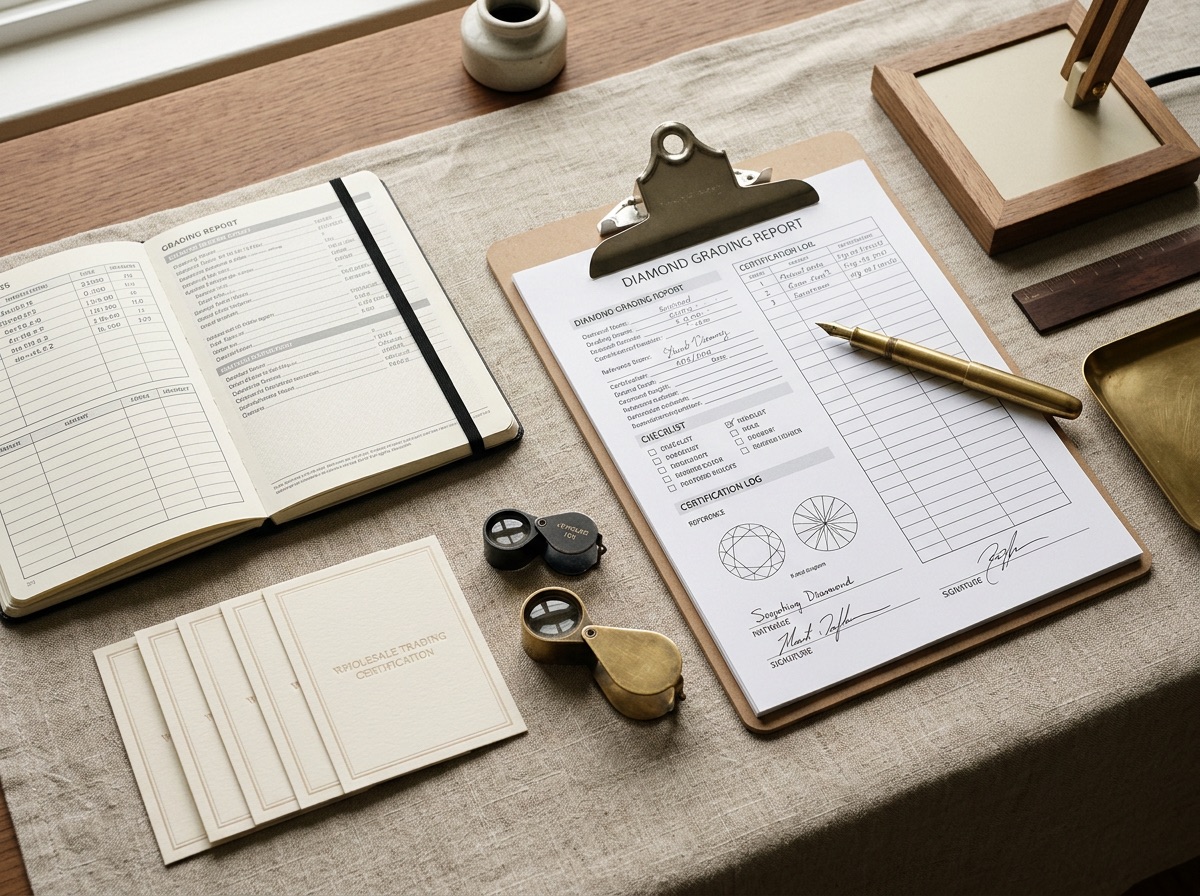
Fancy shapes don't get the kind of official cut grade IGI and GIA assign to round brilliants — there's no universal "Excellent" or "Ideal" rating for a step-cut rhombus the way there is for a round. That doesn't mean quality can't be assessed; it means buyers need to check the right proxies themselves, or confirm their supplier already checks them, rather than leaning on a single grade on a report.
Symmetry Across the Set
For a single stone, symmetry means the two halves of the outline mirror each other cleanly. For a matched set, it means every stone in the run mirrors every other stone — same outline, same proportions, viewed side by side rather than one at a time.
Angle Consistency
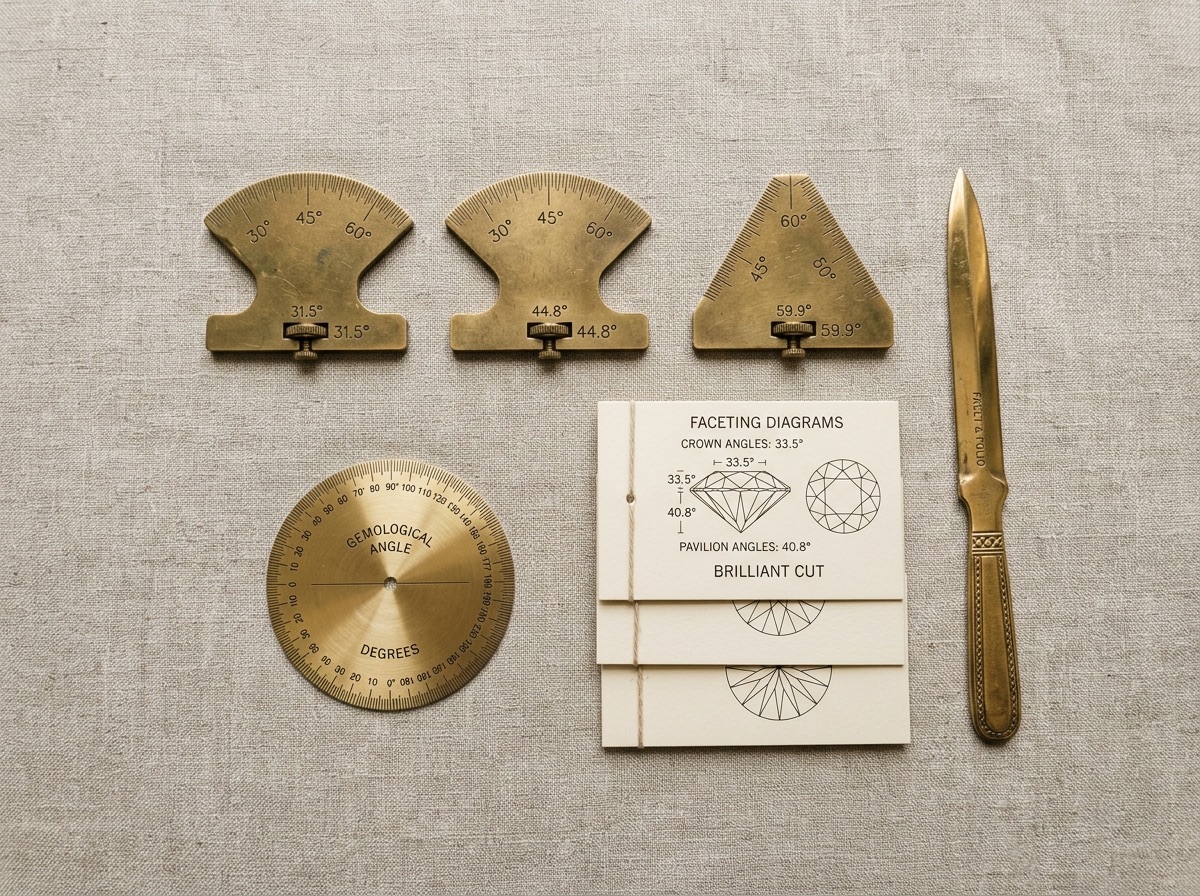
Check that the acute-corner angle and the obtuse-corner angle are consistent stone to stone, not just correct on any single stone. A batch with a few degrees of drift between pieces will show visible gaps or overlaps once it's channel-set, even though each individual stone might pass inspection on its own.
Table-to-Depth Ratio
A step cut's brightness lives in this ratio more than in facet count. A Lozenge cut too deep for its table will look smaller and duller face-up than its carat weight suggests; cut too shallow, it can wash out. Ask for the ratio, not just the carat weight, when comparing stones or sets.
Certification Paper
IGI and GIA are both standard labs for wholesale lab-grown paper, and reputable suppliers should be able to accommodate either for a Lozenge order or its center stone. Confirm upfront which lab you need and whether the calibrated side stones are graded individually or sold as gradable-on-request goods with the center stone certified separately — the two are priced and documented differently.
The same proxies apply whether you're buying loose stones for a custom build or sourcing a set to match diamonds already set in an existing piece. In the second case, ask the supplier to work from a physical stone, a precise angle and ratio measurement, or clear reference photos rather than a verbal description — "elongated rhombus, roughly this size" isn't enough information to calibrate a genuine match against.
Pricing Factors Specific to Lozenge Diamonds
Pricing a Lozenge order isn't the same exercise as pricing a single fancy-shape stone. A one-off Lozenge prices roughly the way any comparable step cut would — carat weight, color, clarity, and cut quality doing the usual work. A matched set prices differently, because the harder cost to satisfy isn't any one stone's quality, it's how tightly the whole set matches.
The biggest driver is calibration tolerance. A loosely matched pair costs less to assemble than a tightly matched pair, because a tighter tolerance means pulling from a deeper pool of calibrated stock to find pieces that land within a narrow angle and ratio band of each other. That cost compounds with set size — a mirrored pair for stud earrings is a much smaller matching problem than a long graduated run for a full eternity band, even at the same total carat weight.
Color and clarity still factor in the normal way, but they interact with matching too: a set doesn't just need consistent color and clarity grades stone to stone, it needs consistent face-up appearance, which isn't always the same thing once cut and proportion differences are in play. Quantity also moves price — a supplier quoting a small pair off shelf stock is a different job than sourcing or cutting a dozen-plus stones to one spec, and the second scenario typically carries a higher per-stone premium to account for the matching labor, not just the material.
Because calibrated goods are priced on the matching work as much as the stones themselves, per-carat comparisons across suppliers can be misleading unless the calibration tolerance and set size are the same on both sides. A wholesale buyer comparing quotes should ask what tolerance each quote assumes before treating two per-carat prices as apples to apples.
It's also worth ordering with some margin built in rather than the exact count a design calls for. Because a Lozenge order is a matching exercise, going back for one or two additional stones months later to complete a set — after the original matched batch has already been broken up and sold into other pieces — is a harder and pricier ask than it would be for a common shape like round or baguette. Buying the full set, plus a spare or two for a multi-piece collection, up front is usually the cheaper path over the life of a project.
Best Jewelry Applications for Lozenge Diamonds
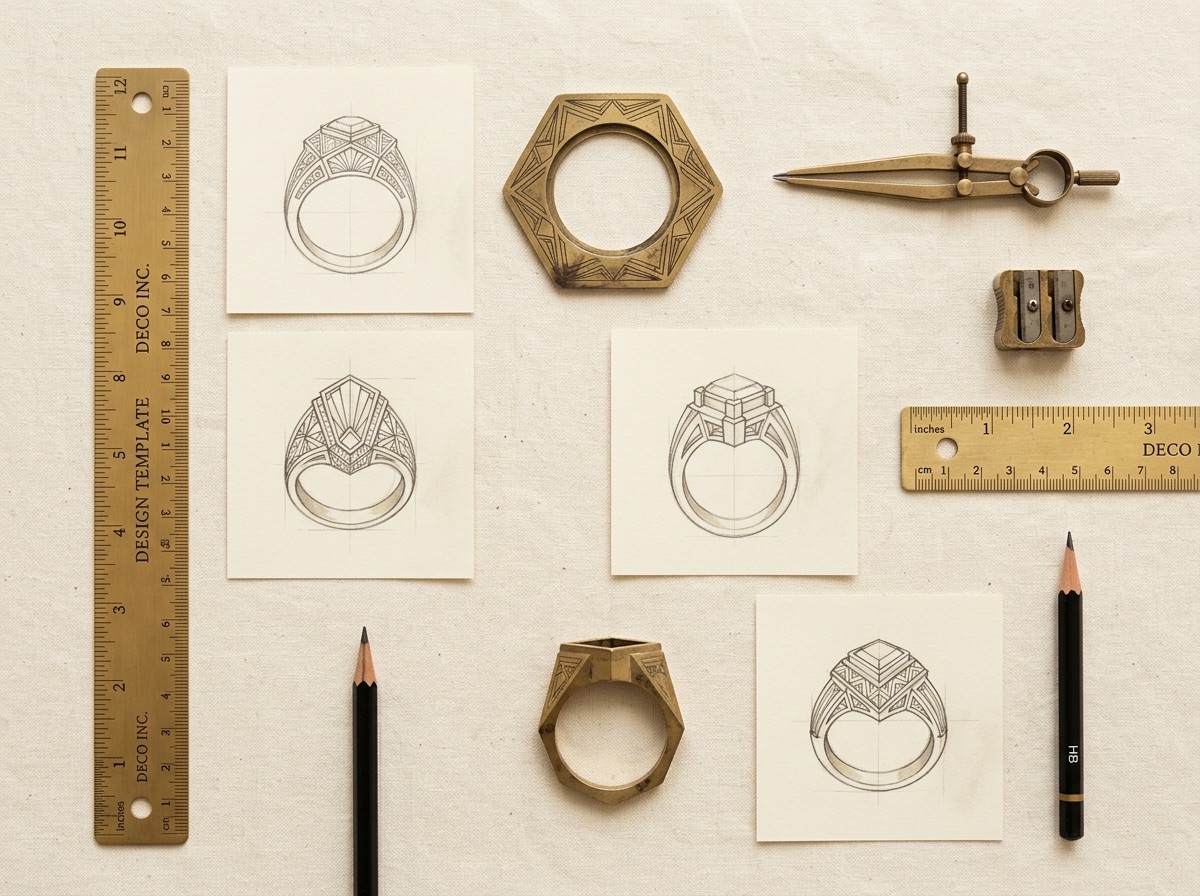
Lozenges are built for geometric, linear jewelry design more than for flanking a single round or oval center. Their sharp-angled outline is a natural fit for Art Deco-style settings, where clean straight lines and repeated geometric shapes are the point of the design, and for eternity-style or channel work where a run of Lozenges creates a continuous angular pattern rather than a single focal accent.
They also work well as corner or point accents around a fancy-shaped center stone — emerald, princess, or another angular cut — where a curved side stone would break the line the design is going for. In a lozenge cut diamond ring built around an emerald or Asscher center, a pair of Lozenges set point-to-point at each end of the center stone extends its line instead of competing with it, which is the effect most buyers asking for the shape are actually after.
Beyond rings, the same properties translate well to pendant and earring layouts where a design leans on repetition and symmetry — a vertical run of Lozenges down a pendant drop, or a cluster arranged into a compass or star pattern, both lean on the shape's clean geometry in a way a curved stone can't replicate. Any lozenge diamond ring or pendant that's trying to read as architectural rather than romantic is a good candidate for the shape.
Sourcing Lozenge Diamonds Wholesale from Guru Diam
As with any calibrated shape, a Lozenge order is a matching exercise first. A short run for a pair of earrings needs two stones that mirror in size and angle; a channel or eternity application needs a longer graduated or uniform set. Getting that consistently requires a supplier holding real depth in the shape, not one or two Lozenges pulled from a mixed parcel.
Guru Diam calibrates Lozenge stones in-house and matches sets to spec, CVD lab-grown, IGI-gradable on request. Open a wholesale account for live pricing and to request a matched Lozenge set for a specific project from our New York Diamond District desk.
When you request a set, be specific about what you actually need rather than just a carat total: the number of stones, the length-to-width ratio you're designing around, and the calibration tolerance the setting can tolerate before a mismatch becomes visible. It's also worth confirming on-hand availability before finalizing a design — calibrated inventory in a specific size range moves differently than round melee does, and a supplier working from live on-hand stock can confirm a full matched set is actually available rather than quoting against a size that has to be pulled together from multiple lots.
If the same project also needs a center stone, side melee in another shape, or finished mounting work, it's worth asking whether one supplier can cover the whole order. Sourcing a matched Lozenge set from one vendor and a center stone from another adds a second point of failure to a color-and-cut match that's already precise — one vendor, one shipment, and one point of contact for the full order removes that risk rather than just moving it around.
Buying Checklist and Red Flags for Wholesale Lozenge Buyers
Questions to Ask Before You Order
- What calibration tolerance does the quote assume, and is it tight enough for the setting you're designing?
- Is the full set being pulled from on-hand inventory, or partially sourced to fill out the size or quantity you need?
- Which lab — IGI or GIA — can the center stone and, if requested, the side stones be graded through?
- What's the length-to-width ratio and table-to-depth ratio on the actual stones being quoted, not just the carat weight?
- How is the set packaged and documented so the match can be verified against the original quote on arrival?
Red Flags to Watch For
- A quote based on carat weight and stone count alone, with no mention of angle or ratio tolerance.
- A supplier unwilling to confirm how many matching Lozenges they actually hold on hand before taking the order.
- Photos or a single sample stone offered in place of a look at the actual set being shipped.
- Vague or shifting answers about which lab is grading the stones, or reluctance to name one at all.
- Pressure to substitute a different shape — kite, trapezoid, or trimmed baguette — without flagging that it changes the design's geometry.
Frequently Asked Questions
What is a lozenge cut diamond? A Lozenge is a calibrated elongated rhombus — four equal sides meeting at two acute and two obtuse angles. It's used as a side stone and accent shape, most often in Art Deco-style and geometric jewelry design.
What is a lozenge diamond used for? Lozenges are used in linear and geometric settings — Art Deco-style pieces, channel and eternity work, and as corner accents around angular center stones like emerald or princess cuts, where a straight-edged side stone keeps the design's lines clean.
How are lozenge diamonds matched for a project? Matching is done by size and angle across the full set a piece needs, from a single mirrored pair to a longer graduated run for channel or eternity settings. Deep on-hand inventory lets a supplier pull a genuinely matched set rather than approximating from scattered lots.
Are lozenge diamonds certified? They're sold as calibrated matched-set goods, IGI-gradable on request, the same convention used for other calibrated side-stone shapes. Center or focal stones in the same piece are certified separately.
What's the difference between a lozenge and a kite diamond? A Lozenge has four equal sides and two sharp corners; a kite has only one pair of equal sides and a single sharp point. Both do a similar job pointing toward a fancy-shaped center stone, but a Lozenge's full symmetry lets it stand as a complete geometric motif rather than a one-sided accent.
Can lozenge diamonds be bought as a single stone, or only as part of a set? A single Lozenge can be sourced for a one-off design, but most wholesale demand is for matched sets — pairs for earrings, or graduated runs for channel and eternity work — since the shape's main appeal is how consistently it reads across a repeated geometric layout.