
Round vs Pear Diamond: A Wholesale Buyer's Guide
Round and pear diamonds sit at opposite ends of the same spectrum: round is the classic maximum-brilliance cut with the highest resale and liquidity value of any diamond shape, while pear is a teardrop-shaped hybrid — one pointed end, one rounded end — that elongates the finger and works well as a solo center stone, halo, or pendant. They serve different buyer profiles: classic and timeless versus distinctive and personal. Most wholesale programs need both, in different ratios depending on the retail account.
For a wholesale buyer, the practical question isn't which shape is objectively better — it's which retail customer each one is built to close, and in what ratio to stock them. This guide walks through the light performance, resale dynamics, sourcing criteria, and design considerations that separate round from pear in enough depth to build a shape assortment with intention.
What Is a Round Brilliant Diamond?
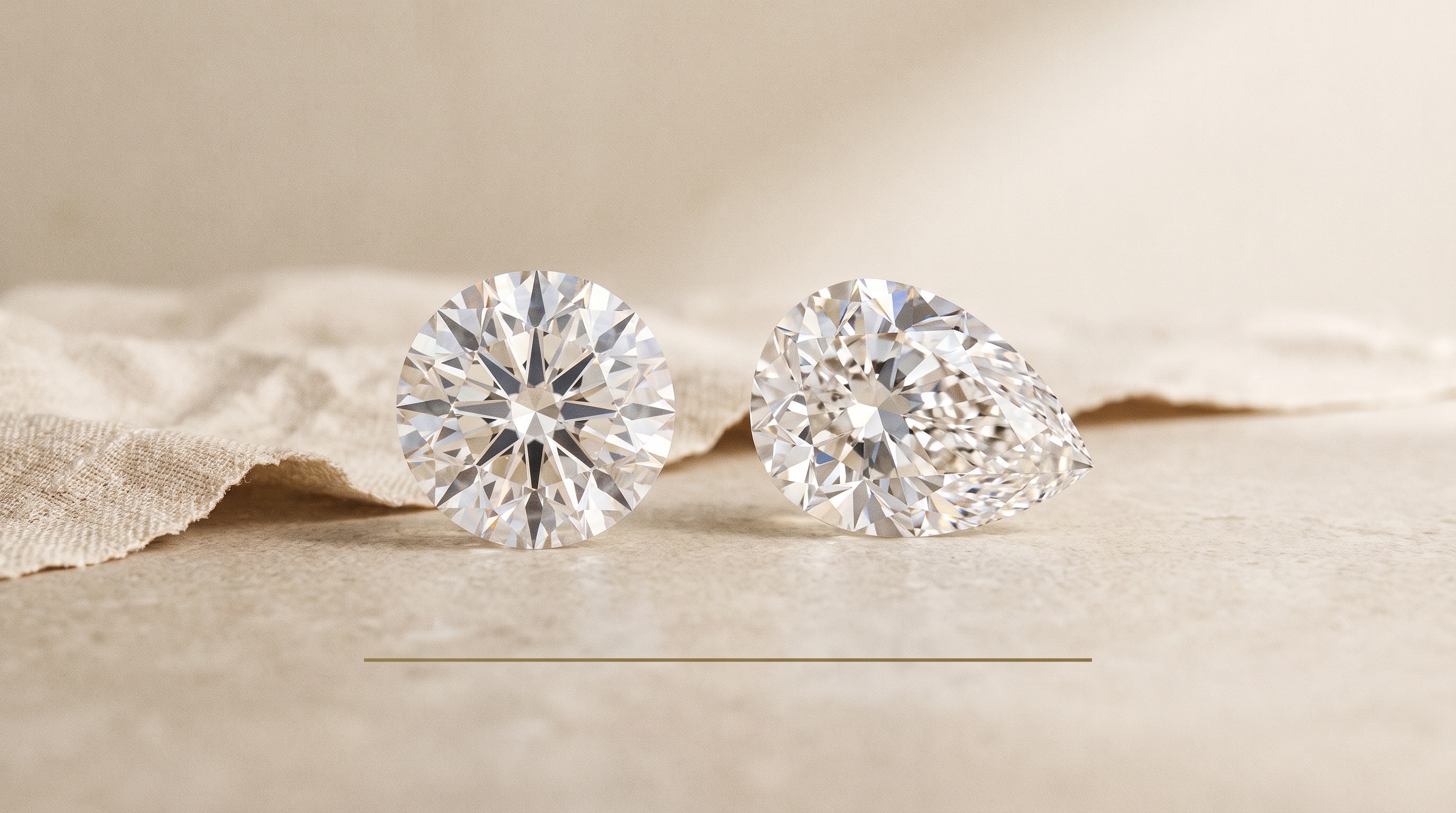
The round brilliant is the reference cut against which every other diamond shape gets measured. It typically carries 57 or 58 facets, arranged in a mathematically modeled pattern designed to maximize the amount of light that enters the stone, reflects internally, and returns to the viewer's eye as brightness, fire, and scintillation. That precision is the result of over a century of refinement in cutting theory, and it's why round consistently delivers the highest and most consistent light performance of any diamond shape.
Round is also the shape with the deepest, most liquid resale market. Because it's the default choice for the majority of engagement ring buyers globally, there's a standing, well-established secondary market for round diamonds that fancy shapes simply don't have to the same degree — appraisers, resellers, and buyers all have a clear reference point for value. For a wholesale buyer, that liquidity translates into lower inventory risk: round goods that don't move through one retail account can typically be redirected or resold with less friction than an equivalent fancy shape.
What Is a Pear Shaped Diamond?
A pear cut — sometimes called a teardrop cut — is a modified brilliant that combines the rounded curve of an oval on one end with the tapered point of a marquise on the other. It's typically cut with 58 facets, following the same light-return principles as a round brilliant, but the asymmetric outline gives it a visual identity no other standard shape shares. Worn with the point facing the fingertip, it visually elongates the finger; worn point-down as a pendant, it reads as a classic, elegant teardrop.
Because a pear diamond retains more of the original rough than a round brilliant does when it's cut, it's generally considered a higher-yield shape from the cutter's perspective — a meaningful factor in per-carat pricing that's covered in more detail below. Pear also has a longer history in fine jewelry than most people assume: it's one of the older fancy shapes in continuous use, though its appeal today is driven less by that history and more by its current standing as the shape of choice for buyers who want something recognizably different from round or oval without moving into a niche antique cut.
Round vs Pear Diamond: Quick Comparison Table
| Attribute | Round Brilliant | Pear Shape |
|---|---|---|
| Cut family | Brilliant cut (the reference standard) | Modified brilliant (oval + marquise hybrid) |
| Visual character | Classic, symmetrical, maximum sparkle | Teardrop outline — one point, one rounded end; distinctive |
| Light performance | Highest, most consistent brilliance and fire of any shape | Strong brilliance with directional sparkle; point can appear slightly less bright |
| Resale / liquidity | Highest of any diamond shape — deepest secondary market | Lower than round; a stable but smaller resale market |
| Bow-tie effect risk | Not applicable | Present in some proportions; needs QC screening |
| Price tier | Highest per-carat price for comparable grade | Priced below round for comparable grade; strong yield from rough |
| Best for | Solitaires; broad, classic bridal appeal | Solitaires, halos, and pendants; distinctive, personal styling |
Light Performance: Brilliance vs Directional Sparkle
Round brilliant cutting theory has been refined for well over a hundred years specifically to optimize light return, and it shows — no other shape returns light as consistently across the entire face of the stone. Every facet is calculated and positioned to work together, which is why round is the benchmark buyers use when evaluating cut quality on a certificate: the grading systems themselves were built around round's proportions first.
Pear inherits much of that brilliant-cut light performance, since it uses the same faceting logic as round and oval, but the asymmetric shape changes how that light distributes across the stone. The rounded end typically performs close to round or oval brilliance, while light behavior near the pointed end is more directional and can appear slightly dimmer if the cutter hasn't balanced the proportions carefully. This is also where the bow-tie effect shows up most in pear-shaped stones — a shadow that can appear across the center of the stone depending on the cutting angle and the light source, similar to what shows up in oval and marquise cuts. It's a cut-quality variable, not an inherent flaw in the shape, and it's one of the first things to screen for when sourcing pear inventory.
Resale Value and Liquidity
This is where round separates itself most clearly from every fancy shape, pear included. Because round is the default choice for most engagement ring buyers, there's a large, standing base of demand for round diamonds in the secondary and trade-in market — jewelers, appraisers, and resellers all have deep familiarity pricing round goods, which keeps the resale spread relatively tight. That liquidity is one of round's most durable selling points to a retail customer who's thinking about long-term value alongside romance, and it's a genuine advantage a sales associate can point to honestly.
Pear's resale market is smaller and less standardized. It's not an illiquid shape — pear has consistent, stable demand and a real secondary market — but the buyer pool interested in a used pear diamond is narrower than the buyer pool for round, which typically means a wider spread between what a pear diamond sells for new and what it resells for used. For a wholesale buyer, this doesn't make pear a weaker shape to stock — it makes it a shape that sells on different terms: personal expression and distinctiveness rather than investment-grade liquidity. Framing that distinction correctly for retail partners avoids setting the wrong expectations with their end customers.
Carat Weight, Face-Up Size, and the Bow-Tie Effect
Round diamonds read true to their carat weight — proportions are standardized enough that a well-cut 1.00-carat round from any reputable cutter looks close to any other well-cut 1.00-carat round. Pear, like other elongated shapes, tends to read larger face-up than its actual carat weight because the elongated outline spreads the same weight across more visible surface area, giving retail partners a way to market apparent size relative to price.
Length-to-width ratio is the key proportion to screen on incoming pear inventory. A ratio around 1.50–1.75 is generally considered the most classic, balanced pear silhouette; shorter ratios start to read more like a rounded teardrop, while longer ratios can emphasize the point in a way that increases bow-tie visibility and chip risk at the tip. Buyers building a consistent pear assortment should treat length-to-width ratio as a hard screening criterion the same way they'd screen clarity or color — a pear labeled correctly on a certificate can still look visually inconsistent with the rest of an assortment if the ratio varies too widely from stone to stone.
Symmetry is the other screening factor that matters more for pear than for round. Because the human eye is quick to notice asymmetry in a shape that's already asymmetric by design, a pear with an off-center point or unevenly curved shoulders reads as a flawed cut even at an otherwise strong grade. Round's symmetry standards are stricter in absolute terms on most grading reports, but a minor deviation is far less visually obvious in a shape that's already meant to be perfectly round — the same deviation is much easier to spot in a pear, which is why experienced buyers often eyeball pear inventory in addition to reading the certificate.
Setting Styles and Design Applications
Round is the most setting-flexible shape in the trade — solitaires, halos, three-stone designs, pavé bands, and virtually every mounting style in production was designed with round proportions as a starting point. That flexibility is part of why round remains the default recommendation for a retail customer who hasn't already formed a strong shape preference.
Pear works exceptionally well as a solo center stone in a solitaire or halo setting, where the elongating effect and distinctive silhouette are the whole point of the purchase. It's also one of the strongest fancy shapes for non-ring applications — pear pendants and pear drop earrings are a long-standing category of their own, independent of bridal, because the teardrop shape reads naturally in a pendant orientation without needing an engagement-specific setting. A wholesale buyer stocking pear should think beyond the ring case: pendant and earring demand for pear is a meaningfully different, and sometimes steadier, channel than bridal demand.
Pear also shows up frequently as a side stone rather than a center stone — a small matched pair of pears flanking a round or oval center is a recognizable "toi et moi"-adjacent styling choice that gives a retail partner a way to sell pear to a customer who isn't ready to commit to it as the main event. That side-stone role is a meaningful reason to stock pear in smaller calibrated sizes alongside larger center-stone sizes, since the two use cases pull from different parts of a buyer's carat-weight range.
Price Per Carat and Wholesale Positioning
Round consistently carries the highest per-carat price of any diamond shape for a comparable color, clarity, and cut grade. The reason is structural: cutting a round brilliant from rough sacrifices significantly more material than cutting a fancy shape does, since the round's symmetrical, deep proportions don't map efficiently onto most rough crystal forms. That yield loss gets priced into round at every stage of the supply chain, and it's a widely understood trade dynamic that wholesale buyers already factor into their catalogs.
Pear, by contrast, is a relatively efficient shape to cut — its elongated, tapered outline maps well onto a wider range of rough shapes, which keeps its per-carat pricing below round for a comparable grade. That pricing gap is one of the practical reasons pear performs well for retail partners chasing a specific carat-weight target on a tighter budget: a buyer can often source a larger, similarly graded pear for the same spend that would buy a smaller round.
Buyer Profiles: Classic vs Distinctive
Round sells to the broadest possible customer base. It's the shape a retail customer pictures by default when they hear "diamond ring," and it requires the least amount of sales education to close — the sparkle and symmetry sell themselves. For a wholesale program serving accounts with high foot traffic and a broad, general bridal customer, round should be the volume anchor of the assortment.
Pear sells to a customer who's already looking for something that reflects a more personal or distinctive taste — someone who wants a diamond that reads as intentional and considered rather than default. It performs well with customers upgrading from a round or replacing a piece, and it has genuine crossover appeal outside bridal in pendants and earrings, which broadens its addressable customer beyond the engagement-ring buyer entirely. A wholesale buyer serving a boutique, design-forward, or self-purchase-driven retail account can weight pear more heavily than a buyer serving a mass-bridal account would.
Durability and Everyday Wear
Diamond hardness doesn't change with shape — both round and pear rate a 10 on the Mohs scale — so the practical difference between them comes down to structural vulnerability rather than material toughness. Round has no exposed corners or points, which makes it the most chip-resistant standard shape and one reason it's frequently recommended for customers who want a low-maintenance daily-wear stone.
Pear's tapered point is its one structural vulnerability — it's the thinnest, most exposed part of the stone and the most common place a pear diamond chips if it isn't protected. A V-prong or a similarly reinforced setting at the point is a practical requirement for a pear mounting, not an optional upgrade, and it's worth making sure retail partners spec it correctly on every pear order. With that protection in place, pear performs as a fully durable daily-wear stone; without it, the point is a genuine risk point over years of wear.
Cleaning and maintenance visibility follow a similar pattern to the shapes' light behavior. Round's dense, scattered brilliance tends to camouflage minor surface oils and dust between professional cleanings, while pear's mix of brilliant faceting and a narrower point can show buildup near the tip a little sooner. Neither difference is significant enough to affect a sourcing decision on its own, but it's a useful detail for retail partners fielding aftercare questions from either type of customer.
Sourcing Round and Pear Diamonds at Wholesale
Guru Diam is a B2B, trade-only wholesale supplier serving independent jewelers, designers, and manufacturers, with a lab-grown catalog that is CVD-only — no HPHT anywhere in the line — and IGI, GIA, and GCAL certification all available. Round and pear are both carried as standard inventory alongside Guru Diam's full range of antique and exotic shapes, so a buyer isn't choosing between a deep round program and a shallow fancy-shape program; both are stocked at wholesale depth.
In-stock loose diamonds ship same day from both US locations — New York (HQ) before 6pm EST and Los Angeles before 4pm PST — which is particularly relevant for round, given how frequently it moves as a fast-turn, high-velocity SKU in a retail case. Browse certified loose diamonds to filter by shape, carat, and certification lab. For buyers setting round or pear into a finished piece, custom engagement rings are finished in 4–6 days — a detail that applies to the finished mounting, not to loose stone lead time, which is same-day out of stock. Pear center stones set with round or pear side stones, and matched pear pairs for earrings, can be sourced through matching pairs, and a custom engagement ring build is the fastest path from loose stone to finished piece for either shape.
Which Shape Should You Stock More Of?
For most wholesale programs, round should be the largest single line in a diamond assortment by unit volume — it's the shape with the broadest demand, the deepest liquidity, and the least sales friction. Pear earns its place as a meaningful secondary line rather than a token SKU: it has real, standing demand across bridal, pendants, and earrings, and it gives retail partners a genuine answer for the customer who's already decided round isn't for them.
Neither shape should be sourced as an afterthought to the other — round drives volume and repeat sell-through on its own, while pear drives differentiation, average order value on distinctive pieces, and a non-bridal revenue stream through pendants and earrings that round doesn't reach in the same way. The sourcing discipline differs between the two more than volume alone suggests. Round assortments benefit from tight cut-grade consistency, since cut quality is the single biggest lever on a round's light performance and therefore its sell-through. Pear assortments benefit from length-to-width ratio screening and confirmed point protection on any piece that's going into a mounting, since those two factors — more than clarity or color — determine whether a given pear reads as well-cut or awkward on the case. For more on how Guru Diam structures wholesale accounts, certification, and reorder terms, see the wholesale hub or the trade partner program page. If round is the shape you're weighing against something other than pear, see round vs. oval diamonds; if pear is the one in question, oval vs. pear diamonds covers how it stacks up against a second brilliant-cut elongated shape. And for a tradeoff built around clarity and light performance rather than resale liquidity, see our guide to emerald vs. oval diamonds.
Frequently Asked Questions
Is a round or pear diamond more expensive per carat?
Round is consistently the most expensive shape per carat for a comparable color, clarity, and cut grade, because cutting a round brilliant from rough sacrifices more material than cutting a pear does. Pear's more efficient yield from rough is a major reason it prices below round at the same grade.
Does a pear diamond always have a bow-tie effect?
No. A bow-tie — a dark shadow across the center of the stone — depends on how the stone is cut and can range from unnoticeable to pronounced. It's worth screening for at the sourcing stage, but it isn't present in every pear diamond, and a well-proportioned cut minimizes it significantly.
Which end of a pear diamond should point toward the fingertip?
Most settings orient the point toward the fingertip, which is the traditional styling and the one most associated with an elongating effect on the hand. Some designs reverse the orientation deliberately, particularly in pendant and drop-earring applications, where the point naturally faces downward instead.
Do round diamonds hold their value better than pear diamonds?
Round has the deepest and most liquid secondary market of any diamond shape, which generally means a tighter spread between original and resale price. Pear has a smaller but real resale market — it's not an illiquid shape, but the buyer pool for a used pear diamond is narrower than for round.
Is a pear-shaped diamond more likely to chip than a round diamond?
The pointed tip of a pear is more exposed than any part of a round diamond and is the shape's one real vulnerability, which is why a V-prong or similarly reinforced setting at the point is important. With that protection in place, a pear is suitable for the same daily wear as a round.
Can I get round and pear diamonds certified by IGI, GIA, or GCAL?
Yes. Guru Diam carries CVD lab-grown round and pear diamonds with IGI, GIA, and GCAL certification all available, and both shapes ship same day from stock out of the New York and Los Angeles locations.