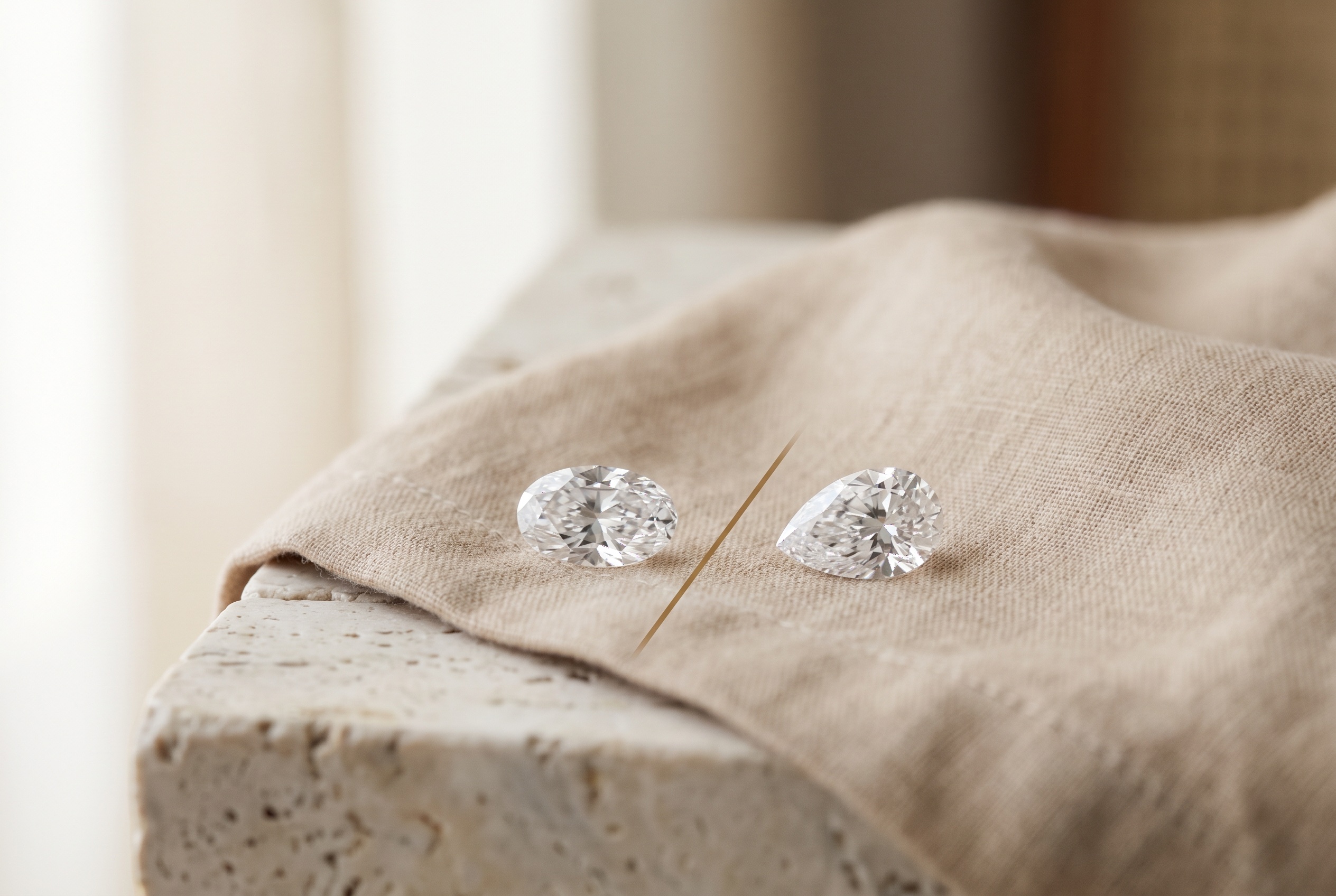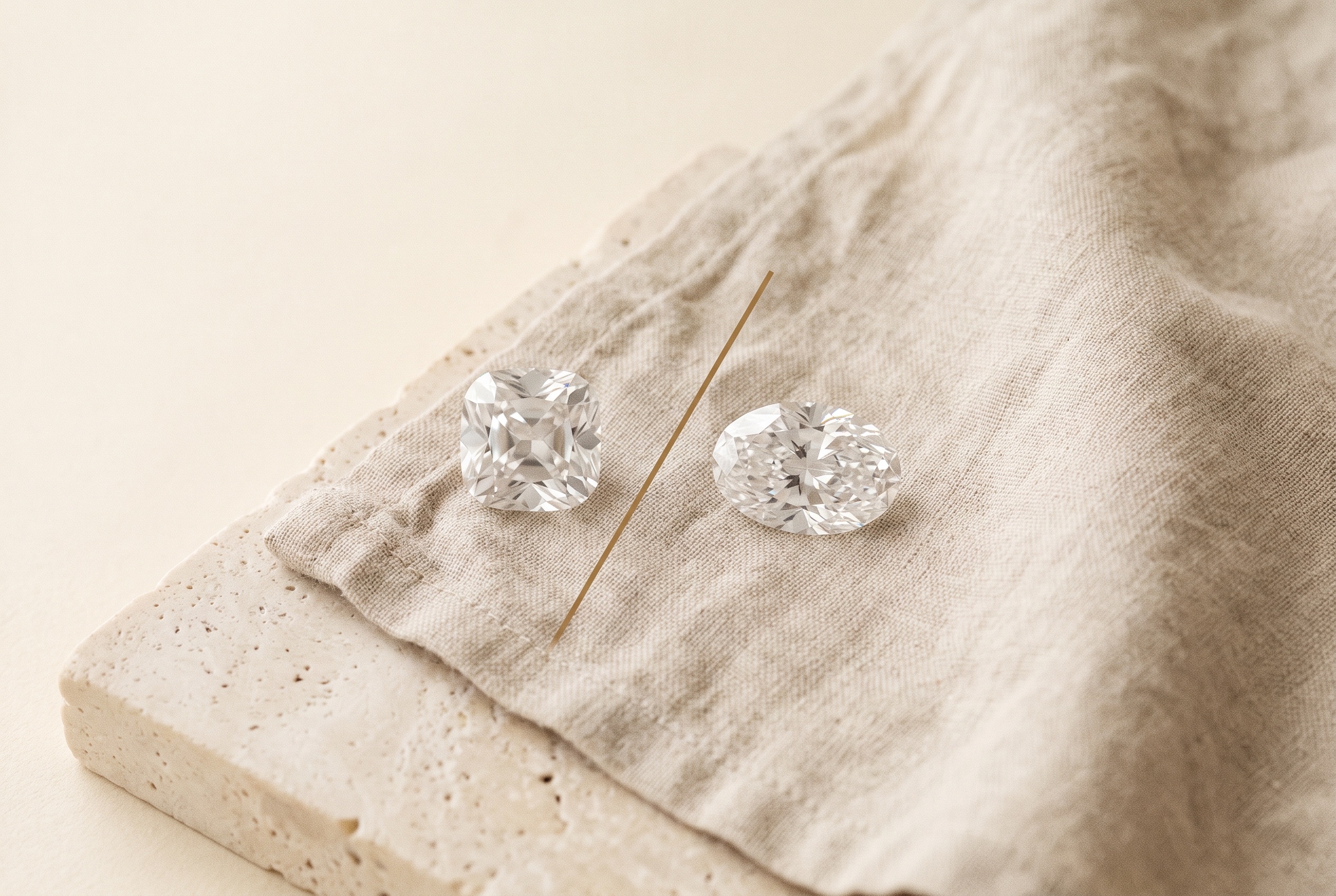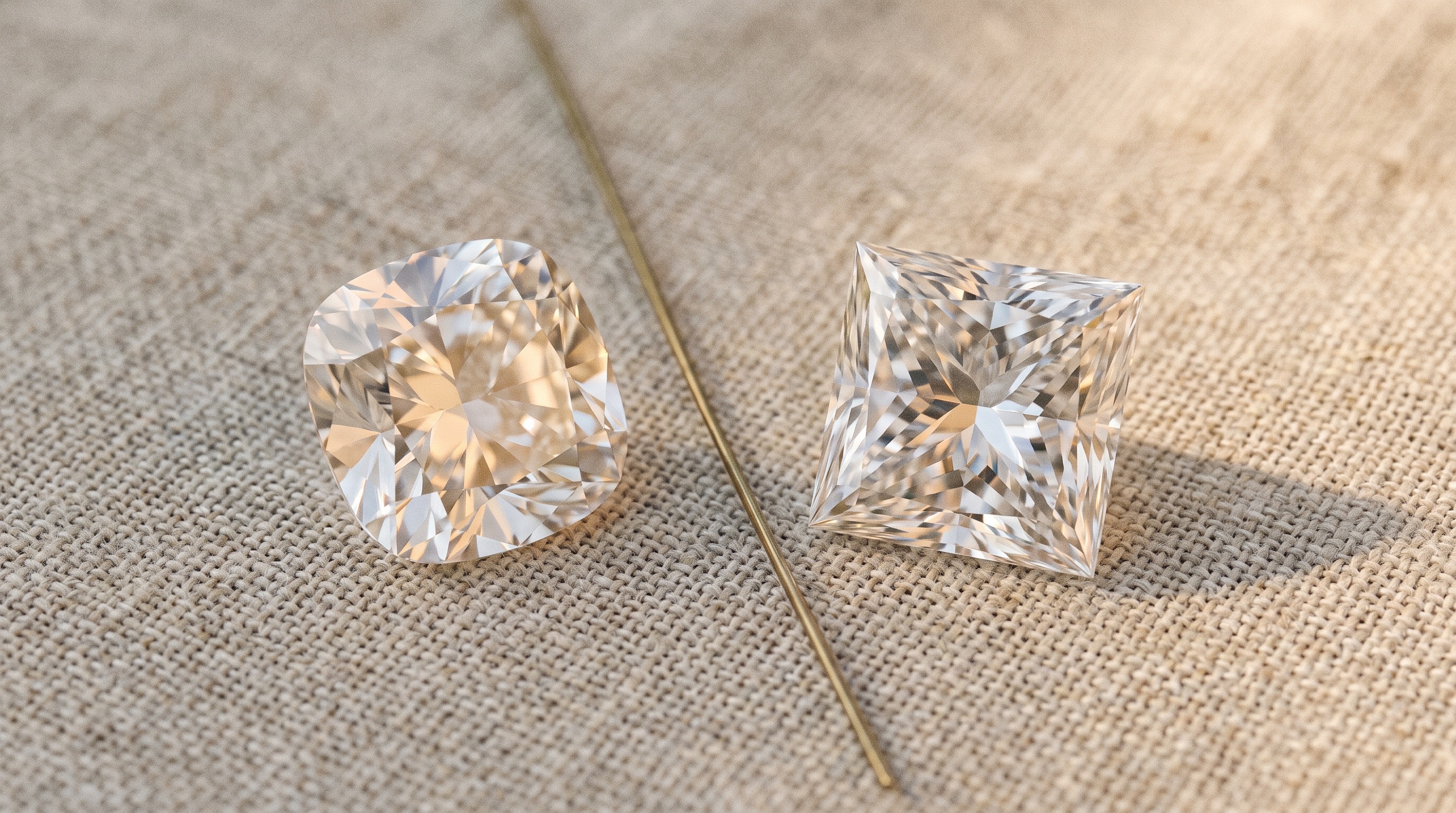

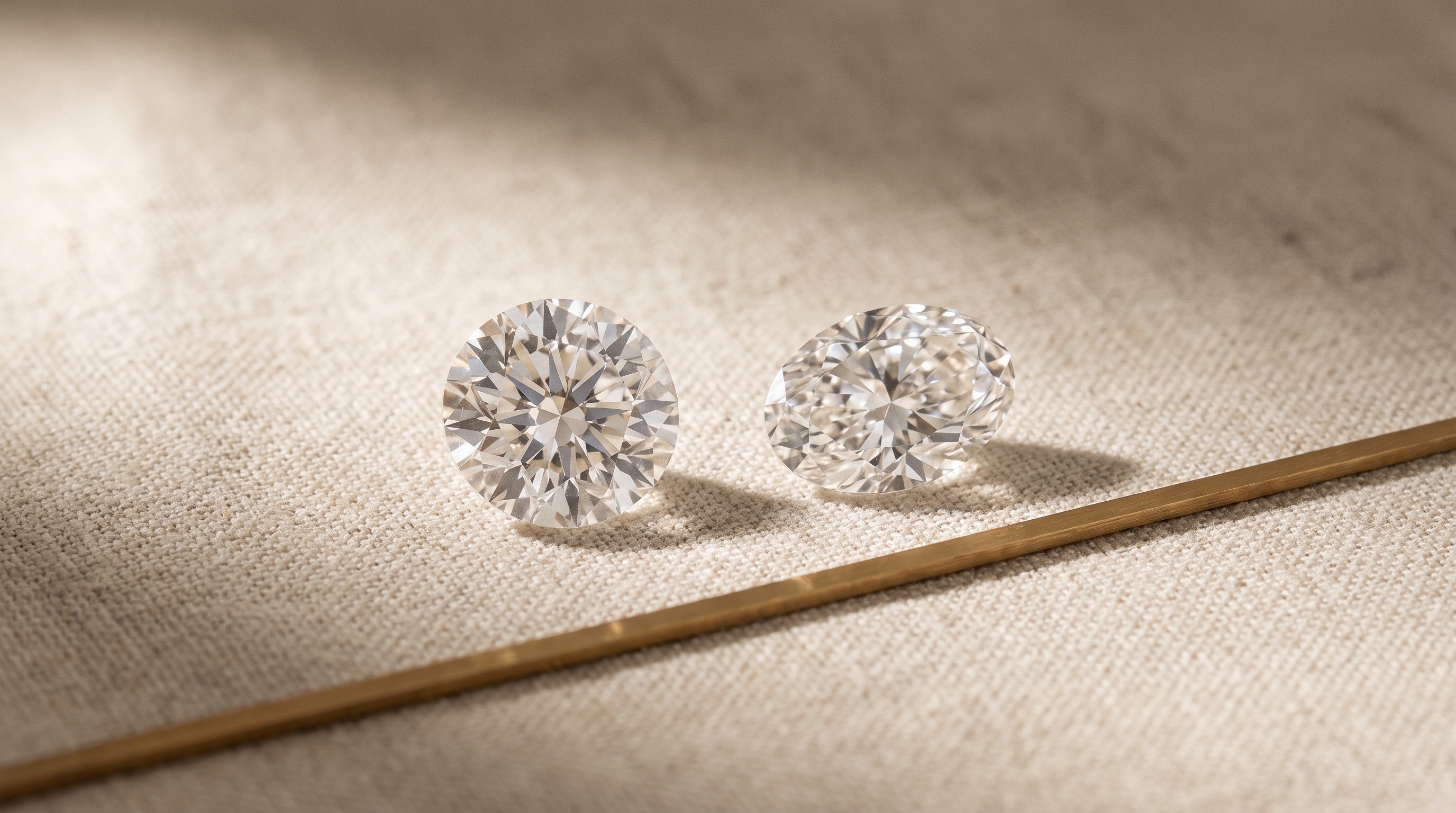
A round diamond is a brilliant-cut circular stone with 57-58 facets engineered for maximum light return; an oval diamond is an elongated modified-brilliant cut that carries the same facet logic into a stretched silhouette, trading a small amount of sparkle-per-carat for a larger face-up appearance and a more flattering finger profile. Both are strong sellers — the difference is which tradeoff your customer cares about more.
For wholesale buyers stocking bridal and fashion cases, the round-vs-oval decision isn't academic. It shapes what you pay per carat, how a stone photographs on a countertop, what your customer expects to pay at retail, and how liquid that inventory is if it comes back on a trade-in. This guide breaks down the real differences — light performance, pricing, durability, certification quirks, and resale — so you can stock both shapes with a clear rationale instead of a hunch.
Quick Comparison: Round vs Oval Diamond
| Round Brilliant | Oval | |
|---|---|---|
| Visual character | Symmetrical, classic, uniform sparkle from every angle | Elongated, slimming on the finger, modern-editorial look |
| Light performance | Highest brilliance and fire of any shape — facet pattern is purpose-built for light return | Strong brilliance with visible pattern movement; can show a bow-tie shadow across the center |
| Face-up size vs carat | Reads true to carat weight | Reads 10-15% larger face-up than a round of the same carat due to elongated outline |
| Price tier | Highest price-per-carat of any shape — lowest rough-to-polish yield | Meaningfully lower price-per-carat than round at comparable quality |
| Cut grade on cert report | GIA issues a formal Cut grade (Excellent-Poor) | GIA does not issue a Cut grade for fancy shapes; proportions must be judged manually |
| Best for | Solitaires, classic bridal, resale-conscious buyers, matched pairs | Statement centerstones, elongating settings, fashion-forward bridal, three-stone designs |
Round Brilliant Diamonds: Cut Anatomy and Light Performance
The round brilliant is the reference cut of the entire diamond trade. Its 57 or 58 facets (56 plus the table, sometimes with a culet) were refined over a century, most notably by Marcel Tolkowsky's 1919 proportion study, specifically to maximize the amount of light that enters the stone, bounces internally, and exits back through the top. No other shape gets this much engineering attention because no other shape needs it — round is a shape of pure geometry, with no elongation or corners to manage, so every facet can be optimized purely for optical performance.
Practically, this means a well-cut round diamond delivers the highest brilliance (white light return), fire (spectral flashes), and scintillation (sparkle-in-motion) of any diamond shape, carat for carat and clarity for clarity. It also means round is forgiving: because the proportions are so well studied, it's easier to find a round stone that performs beautifully across a wide range of price points than it is with more geometry-dependent fancy shapes.
The tradeoff is yield. Cutting a round brilliant from rough diamond material wastes more of the original rough than almost any other shape — often 40-60% of the rough is lost to achieve round's proportions and symmetry. That inefficiency is baked directly into round's price-per-carat, which we'll get to below.
Oval Diamonds: Cut Anatomy and Light Performance
The oval is a modified brilliant cut — it borrows the round brilliant's faceting logic (kite and triangle facets radiating from the culet) and stretches it into an elongated, symmetrical shape with no corners to protect. It was popularized in its modern form by Lazare Kaplan in the 1960s and has spent the last decade as one of the fastest-growing fancy shapes in bridal, driven largely by its flattering, finger-elongating profile and its larger face-up presence.
Because an oval keeps the same radiating-facet structure as round, it retains a lot of the round brilliant's light performance — a well-cut oval throws real brilliance and fire, not the softer, broader flashes you'd see in a step cut like an emerald. What it doesn't retain is round's total optical efficiency: stretching the facet pattern along one axis introduces optical dead zones near the center of the stone that a perfectly symmetrical round doesn't have.
Oval's real advantage is on the outline, not just the interior. The elongated shape reads larger face-up than its actual carat weight suggests, and it visually lengthens the finger — two selling points that matter enormously at the retail counter and that no amount of round brilliance replicates.
Brilliance, Fire, and Scintillation: How the Two Shapes Compare
If you rank diamond shapes purely on light performance, round sits at the top, and oval sits close behind it — both meaningfully ahead of step cuts (emerald, Asscher) and most other fancy brilliants. The reason is structural: both shapes use the same brilliant-cut facet arrangement, radiating triangular and kite-shaped facets from a central culet, which is the single most effective geometry for breaking light into flashes of color and white sparkle.
The gap between them comes down to consistency. A round diamond's symmetry means light performance is even across the entire face of the stone — there's no "weak spot." An oval's elongation means the facet pattern has to stretch and compress to fill the outline, and that stretching creates the one optical issue unique to elongated shapes: the bow-tie effect, covered in detail below. A well-cut oval minimizes this to the point of being barely noticeable in normal lighting; a poorly proportioned one can show a distracting dark band across the center that undercuts the "big and bright" selling point the shape is known for.
For wholesale buyers, this means cut quality matters more on oval than it does on round. A mediocre round still looks respectable. A mediocre oval can look visibly worse than its lab report suggests — which is exactly why proportion review (not just the grade on the paper) matters more on this shape.
The Bow-Tie Effect: What It Is and Why It Matters on Ovals
The bow-tie effect is a dark, bowtie-shaped shadow that can appear across the width of an elongated diamond — oval, marquise, and pear all show some version of it. It happens because the observer's own head and shoulders block light from reaching the center of the stone at certain viewing angles, and elongated facet patterns make that shadow more visible than a round's symmetrical pattern does.
Every oval diamond has some bow-tie effect; the question is only how visible it is. A well-cut oval with balanced length-to-width ratio and properly aligned facets shows a soft, barely perceptible bow-tie that most people never notice outside of direct inspection. A poorly cut oval — often one cut to preserve carat weight rather than optimize proportions — can show a heavy, obvious dark band that's visible across the room.
This is the single most important quality-control checkpoint specific to oval diamonds, and it's not something a standard 4Cs certificate flags directly. Buyers sourcing oval inventory at wholesale should ask suppliers about proportion review and visual inspection standards, not just rely on carat/color/clarity/cut-grade-adjacent language on the report — because for fancy shapes, that report often doesn't include a cut grade at all.
Carat Weight vs Face-Up Size: Why Oval Looks Bigger
This is oval's single biggest selling point, and it's a real optical effect, not marketing spin. Because an oval's outline is elongated rather than circular, it spreads the same carat weight over more visible surface area when viewed from above. A well-proportioned 1.00ct oval typically reads 10-15% larger face-up than a well-proportioned 1.00ct round, even though the two stones weigh exactly the same and, if cut to similar depth, contain roughly the same volume of diamond.
For a retail customer working within a fixed budget, this matters enormously: an oval lets them "buy up" in apparent size without paying for the extra carat weight a round of the same visual footprint would require. For a wholesale buyer, it means oval inventory in the 0.75-1.50ct range punches above its carat weight on the sales floor — a genuine advantage when a customer's mental budget is anchored to "how big does it look," not to the number on the certificate.
The size effect isn't unlimited, though. Length-to-width ratio drives it — an oval cut closer to 1.35:1-1.50:1 (the range most buyers consider classically proportioned) reads noticeably larger than one cut closer to round (1.00:1-1.10:1, sometimes marketed as "chubby oval"). Stocking a spread of ratios, not just one default cut, lets a counter sales team match the shape to what the customer is actually asking for — bigger-looking vs. more traditional.
Price-Per-Carat: Why Round Costs More Than Oval
At equivalent color, clarity, and cut quality, round diamonds command a meaningfully higher price-per-carat than oval diamonds — and the gap is driven almost entirely by rough utilization, not demand. Cutting a round brilliant from rough diamond material sacrifices a large share of the original rough to achieve round's proportions and symmetry. Fancy shapes like oval are cut to follow the natural outline of more rough diamond crystals, which means less waste, more finished carats per unit of rough, and a lower cost basis passed down the supply chain.
Round also carries a demand premium on top of the yield premium: it remains the single most requested diamond shape for engagement rings globally, and steady, universal demand supports pricing that a trend-driven fancy shape doesn't always sustain in the same way. Combined, these two forces mean round is consistently the most expensive shape per carat in both natural and lab-grown categories, with oval sitting in the mid-tier of fancy-shape pricing — more than budget-friendly shapes like pear or marquise in some quality tiers, but reliably below round.
For a wholesale buyer, this price gap is also a merchandising tool. A customer priced out of the round they wanted at a given carat weight can often step into a same-quality oval at a lower price point, or a larger-looking oval at the same price point — a real, honest upsell/downsell conversation that doesn't depend on compromising quality.
Cut Grade and Certification: What GIA, IGI, and GCAL Actually Grade
One of the most common gaps in buyer knowledge is assuming every diamond shape gets graded the same way. It doesn't. GIA issues a formal Cut grade — Excellent, Very Good, Good, Fair, Poor — only for round brilliant diamonds, because round is the only shape with a large enough, standardized enough dataset to support an automated cut-grading system. Oval, like every other fancy shape, does not receive a GIA Cut grade. The report will still list proportions (depth, table, girdle, length-to-width ratio), symmetry, and polish, but there's no single letter grade summarizing overall cut performance the way there is on round.
This is exactly why proportion review and, ideally, an in-person or high-resolution visual check matter more for oval than for round: two ovals with identical carat, color, and clarity can look meaningfully different depending on proportions the certificate doesn't boil down into one number.
Certification lab choice applies the same way across both shapes. IGI, GIA, and GCAL are all available certification options at Guru Diam, and buyers can request whichever standard their customer base expects — some regions and price tiers lean IGI, others GIA, others GCAL — without needing to source from different vendors for different lab preferences. Full certified inventory across both shapes is browsable in the certified diamonds category.
Durability and Everyday Wear
Both shapes hold up well to daily wear, but the specific risk points differ. Round has no corners or points to chip — its continuous curved girdle is one of the more resilient outlines in the diamond world, which is part of why it remains the default choice for customers who want a low-maintenance daily-wear ring.
Oval also has no sharp corners (unlike marquise or pear, which taper to true points), so it doesn't carry the same chip risk those shapes do. The area to watch on oval is the "bulge" points at the widest part of the stone — the sides curve out further than a round's uniform radius, which means a prong or bezel setting needs to be positioned carefully to protect that widest point from catching on fabric or impact. This is a setting consideration, not a cut-quality issue, and it's easily solved with a well-designed mounting — but it's worth flagging to customers who ask about everyday durability, since the honest answer is "both are durable, oval just needs a slightly more deliberate setting."
Resale Value and Market Liquidity
Round is the most liquid diamond shape in the secondary market, full stop. Because it's the shape most buyers recognize and most jewelers are equipped to resell or trade in, a round diamond is the easiest shape to move if a customer later upgrades, resizes into a different stone, or sells. This liquidity is a real selling point for resale-conscious customers, and it's one of the few genuinely durable advantages round holds that isn't about optics — it's about market depth.
Oval's resale position is different, not necessarily worse. Fancy shapes generally see more demand volatility than round, moving with trend cycles — oval in particular has spent the last several years as one of the most requested fancy shapes in bridal, which has kept resale demand relatively strong compared to shapes further out of trend. But oval demand is still more cyclical than round's structurally steady demand, and buyers should set customer expectations accordingly: round is the safer bet for someone whose primary concern is "what will this be worth to someone else later," while oval is the stronger bet for someone prioritizing how the stone looks and wears today.
For matched-pair configurations — oval or round side stones flanking a center stone, a common ask in three-stone bridal designs — sourcing calibrated pairs in either shape is available through the matching pairs category.
Which Shape Fits Which Buyer: Bridal, Fashion, and Category Mix
Round remains the default recommendation for a customer who wants a classic, unambiguous engagement ring, prioritizes maximum brilliance, or is budget-anchored around resale value and liquidity. It's also the safer stock choice for a jeweler who needs one shape to cover the widest range of customer requests with the least explanation required — everyone already knows what a round diamond looks like.
Oval is the stronger recommendation for a customer who wants their stone to look as large as possible for the money, wants a shape that visually elongates the finger, or is drawn to current bridal trend imagery — oval has been one of the most searched and most Pinterest/Instagram-visible fancy shapes in recent bridal cycles. It also opens up east-west settings, hidden-halo designs, and three-stone configurations that round doesn't lend itself to as naturally.
For a wholesale buyer building out a case, the practical answer is rarely "pick one" — it's stocking enough depth in both to answer whichever question a customer walks in with. Guru Diam carries the full range of standard, antique, and exotic shapes, including both round and oval loose stones, so a single order can cover both ends of that conversation instead of splitting a case across separate vendors.
Sourcing Round and Oval Lab-Grown Diamonds Wholesale
Guru Diam is a B2B wholesale diamond supplier, trade-only, and every lab-grown stone in the catalog — round, oval, and every other shape — is CVD-grown, with no HPHT anywhere in the lab-grown line. Certification is available through IGI, GIA, or GCAL depending on what a given order or customer base requires, so a buyer isn't locked into one lab's standard across their whole assortment.
In-stock round and oval inventory ships same-day out of both US locations — New York (HQ) and Los Angeles — with cutoffs of 6pm EST in New York and 4pm PST in Los Angeles, so a counter sale doesn't have to wait on a multi-day fulfillment cycle for on-hand stones. For buyers building custom pieces around either shape — a round solitaire, an oval east-west setting, a three-stone design with matched pairs — finished custom engagement rings turn around in 4-6 days, all cutting, setting, and polishing handled in-house rather than farmed out across separate vendors.
Because Guru Diam covers the full shape range — commodity round, regular-fancy shapes like oval, and antique cuts like Old Mine and Old European in the same catalog — a buyer stocking both round and oval doesn't need a second vendor relationship to fill in the fancy-color or antique side of their case either; the fancy color loose diamonds category and the rest of the antique-cut assortment sit under the same account. For buyers evaluating a primary or secondary supplier relationship, the wholesale hub is the starting point for account setup and catalog access, and the trade partner page covers what's required to open a trade account. Custom builds referenced above — round or oval centerstones set into new mountings — run through the custom jewelry program.
Frequently Asked Questions
Is a round diamond or an oval diamond more expensive per carat?
Round is more expensive per carat at equivalent color, clarity, and cut quality. Cutting a round brilliant wastes significantly more rough diamond material than cutting an oval, and round also carries a steady, universal demand premium that fancy shapes don't always sustain to the same degree. The gap holds in both natural and lab-grown categories.
Does an oval diamond look bigger than a round diamond of the same carat weight?
Yes. A well-proportioned oval typically reads 10-15% larger face-up than a round of the same carat weight, because the elongated outline spreads the same carat weight over more visible surface area. The effect is strongest on ovals cut to a classic 1.35:1-1.50:1 length-to-width ratio.
What is the bow-tie effect on an oval diamond?
The bow-tie effect is a dark, bowtie-shaped shadow that can appear across the center of elongated diamond shapes, including oval, marquise, and pear. It's caused by the viewer's own head blocking light at certain angles combined with how the facet pattern stretches to fill an elongated outline. A well-cut oval shows only a faint, barely noticeable bow-tie; a poorly proportioned one can show a heavy, obvious one.
Which has better resale value, round or oval diamonds?
Round diamonds are generally more liquid in the resale market because they're the most universally recognized and requested shape, which makes them easier for a jeweler to resell or take in trade. Oval holds strong demand as a currently trending fancy shape, but that demand is more cycle-dependent than round's structurally steady demand.
Does GIA assign a cut grade to oval diamonds the way it does for round diamonds?
No. GIA issues a formal Cut grade (Excellent through Poor) only for round brilliant diamonds. Oval and other fancy shapes get proportion, symmetry, and polish data on the report, but no single overall cut grade — which is why manual proportion review matters more when evaluating oval stones.
Can I source both round and oval lab-grown diamonds certified from one wholesale supplier?
Yes. Guru Diam carries CVD lab-grown round and oval diamonds certified through IGI, GIA, or GCAL, along with the full range of antique and fancy shapes, so a wholesale buyer can fill a case across shapes from a single trade account rather than splitting orders across vendors.