
Emerald vs Oval Diamond: A Wholesale Buyer's Guide
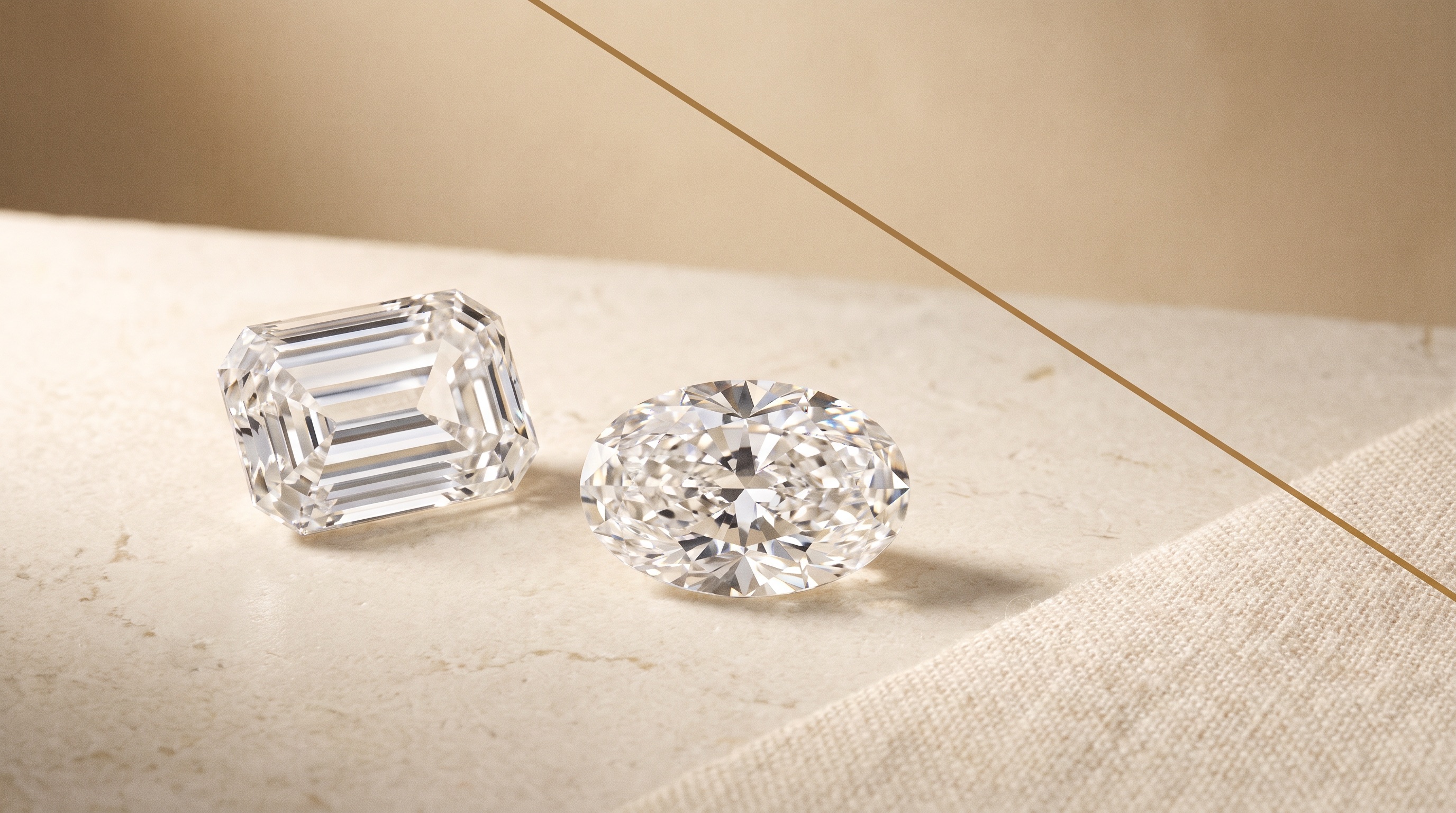
Emerald and oval are both fancy-shape diamonds, but they deliver almost opposite effects: emerald is a rectangular step cut with cropped corners, prized for a quiet "hall of mirrors" flash and a sleek, architectural look, while oval is an elongated brilliant cut built for maximum fire, sparkle, and a classic engagement-ring silhouette. Emerald's open facets also show inclusions more readily, so clarity matters more when sourcing it; oval is more forgiving of minor inclusions. Neither shape is objectively "better" — they serve different customers and different price points, and most wholesale programs benefit from carrying both.
For a wholesale buyer, the choice rarely comes down to picking a winner — it comes down to understanding which retail customer each shape is built to serve, then stocking accordingly. This guide walks through the optical, structural, and sourcing differences between emerald and oval in enough depth to build a shape assortment with intention rather than guesswork.
What Is an Emerald Cut Diamond?
The emerald cut belongs to the step-cut family, alongside the Asscher. Instead of the triangular and kite-shaped facets used in brilliant cuts, an emerald cut is built from long, parallel, rectangular facets arranged in tiers — like steps descending toward the culet — with the four corners cropped into an elongated octagon outline. That facet structure is what produces the shape's signature optical effect: wide, flat planes of light and dark that flash and disappear as the stone moves, rather than the scattered pinfire sparkle of a brilliant cut. Jewelers and designers often describe it as a "hall of mirrors" look, and it's the reason emerald cuts read as sleek, tailored, and architectural rather than romantic or sparkly.
Because the step-cut table is large and open, an emerald cut also shows off a stone's clarity more directly than a brilliant cut would — there's nowhere for an inclusion to hide behind scattered light. That makes the cut a natural fit for buyers who want a diamond that reads clean and confident at a glance, and it's also why sourcing and grading discipline matter more with this shape than with almost any other.
What Is an Oval Cut Diamond?
An oval is a modified brilliant cut — the same faceting logic as a round brilliant, stretched into an elongated form. It typically carries 56 to 58 facets arranged to maximize light return, which gives the oval a fire and scintillation profile close to round while presenting a noticeably larger face-up appearance per carat, thanks to its elongated outline. That combination — brilliant-cut sparkle plus an elongated, finger-flattering silhouette — is a large part of why oval has become one of the most requested fancy shapes in bridal in recent years, sitting alongside round as a shape most consumers recognize on sight.
Because the facet structure scatters light rather than presenting it in flat planes, an oval is more forgiving of minor inclusions than a step cut at the same clarity grade — a stone can face up cleaner than its certificate might suggest. That forgiveness gives wholesale buyers more room to work with mid-clarity goods without a visible tradeoff for the end consumer.
Emerald vs Oval Diamond: Quick Comparison Table
| Attribute | Emerald Cut | Oval Cut |
|---|---|---|
| Cut family | Step cut | Modified brilliant cut |
| Visual character | Flat, geometric "hall of mirrors" flash; sleek and architectural | Scattered fire and brilliance; elongated, classic silhouette |
| Light performance | Fewer, larger flashes of light; less overall sparkle | High scintillation, close to round brilliance |
| Clarity sensitivity | High — inclusions are more visible through the open table | Lower — brilliant faceting helps mask minor inclusions |
| Face-up size vs. carat weight | Reads true to carat weight; narrower profile | Reads larger than carat weight due to elongation |
| Bow-tie effect risk | Not applicable (step cut) | Present in some proportions; needs QC screening |
| Price tier | Mid-market fancy shape; priced below round for comparable grade | Mid-market fancy shape; priced below round for comparable grade |
| Best for | Minimalist, editorial, vintage-architectural styling; three-stone and East-West settings | Solitaires, halos, elongated pendants; broad bridal appeal |
Light Performance: Hall-of-Mirrors Flash vs Maximum Brilliance
The single biggest difference between these two shapes is how they handle light, and it comes down to geometry. A brilliant cut like the oval uses small triangular and kite facets angled to bounce light back and forth internally before releasing it toward the viewer's eye — that's what produces the rapid, scattered sparkle jewelers call scintillation. A step cut like the emerald uses long rectangular facets that behave more like a hall of mirrors: light enters and exits in broad, flat planes, producing fewer but larger flashes rather than a constant shimmer.
Neither effect is a flaw — they're simply different optical signatures, and different customers respond to each differently. Buyers stocking for a younger, trend-forward bridal customer tend to lean oval, because the brilliance reads as more traditionally "diamond-like" at a glance. Buyers serving a design-forward or vintage-revival customer often lean emerald, because the quieter, more geometric flash pairs better with architectural settings and reads as more considered rather than maximalist. A wholesale program that carries both shapes in comparable quality tiers gives retail partners the flexibility to sell to either customer without a special order.
Clarity Requirements: Why Emerald Cuts Need a Closer Look
Clarity grading matters for every diamond shape, but it carries more weight in a purchasing decision for emerald cuts specifically. The wide, open step facets act almost like a window into the stone — inclusions that would be camouflaged by a brilliant cut's scattered light are laid bare under an emerald cut's flat planes. In the trade, this is sometimes called the step cut's "clarity penalty": a stone that would face up clean as a round or oval at VS2 might show visible inclusions as an emerald at the same grade.
Practically, this means wholesale buyers building an emerald cut assortment should prioritize eye-clean stones — generally VS2 and above, with particular attention to any inclusions positioned near the center of the table — even if that means sourcing at a slightly higher clarity tier than they would for round or oval goods at the same price point. Oval buyers have more flexibility: because the brilliant facet pattern helps break up and hide minor inclusions, SI1 and even some SI2 stones can face up clean, giving retail partners a lower clarity floor to work with before visible inclusions become a concern.
Carat Weight and Face-Up Size
Because an emerald cut's rectangular outline is closer to its true footprint, a 1.00-carat emerald generally reads close to its actual carat weight — there's little optical "stretch." An oval, by contrast, is elongated and shallower in typical proportions, which means a 1.00-carat oval commonly appears larger face-up than a round or emerald of the same weight. For retail partners marketing on visual size — a common lever in bridal — that spread effect makes oval a strong option for customers trying to maximize apparent size relative to carat weight and price.
This has a direct sourcing implication: a buyer trying to hit a specific face-up size target for a retail program may need to stock a heavier emerald cut than an equivalent oval to achieve the same visual footprint, which affects per-unit cost and inventory planning across a season's assortment.
Length-to-width ratio adds another layer to both shapes. A more traditional emerald cut sits around 1.30–1.40, while a longer, more elongated look pushes past 1.50. Oval follows a similar range, with 1.35–1.50 generally considered the most flattering and market-friendly proportion — ovals cut shorter than that start to read closer to a rounded rectangle, and ovals cut longer start to lose the balanced brilliance the shape is known for. Screening incoming inventory against a target ratio range, rather than accepting any stone labeled "emerald" or "oval," is one of the simplest ways a buyer can keep a fancy-shape assortment consistent across reorders.
Design and Setting Considerations
Emerald cuts pair naturally with clean, architectural settings — bezel, East-West orientations, and three-stone designs flanked by trapezoid or baguette side stones are especially common, since the shape's straight lines and cropped corners echo Art Deco design language. Because the corners are the most vulnerable point of the stone, prong placement at each corner is a practical requirement, not just an aesthetic choice — under-protected corners are the most common point of chipping in a step cut.
Oval cuts are more setting-flexible. Solitaires, halos, and three-stone designs with round or pear side stones all work well, and the elongated shape lends itself naturally to pendant and earring designs where a vertical line is flattering. One design consideration specific to oval — and other elongated brilliants — is the bow-tie effect: a dark, ribbon-like shadow that can appear across the widest part of the stone depending on cut proportions and the angle of the light source. It's not a defect in every stone, but it's worth screening for at the sourcing stage, since a pronounced bow-tie is one of the more common reasons a retail customer rejects an oval on sight.
Price Per Carat and Wholesale Positioning
Both emerald and oval sit in the same general wholesale price tier — solidly mid-market, positioned below round for a comparable grade. Round diamonds typically command the highest per-carat pricing of any shape because cutting a round brilliant from rough sacrifices more material than fancy shapes do; step cuts and modified brilliants like emerald and oval retain more of the rough, which is reflected in their per-carat pricing relative to round at the same color, clarity, and cut quality.
Within that shared tier, the spread between emerald and oval pricing on any given day comes down to supply and cut-quality consistency rather than a structural difference between the shapes — well-cut goods in both shapes trade at similar levels. What differs more meaningfully is the clarity tier a buyer needs to stock to hit "eye-clean" for each shape, which is the real lever on landed cost: an emerald assortment built at VS2-and-above will carry a different average price point than an oval assortment that can lean on SI1 and SI2 goods for the same visual result.
Emerald and Oval in Fancy Color Diamonds
Both shapes also show up regularly in fancy color programs, and the optical differences between them carry over directly. An emerald cut's flat step facets tend to pool and deepen a fancy color's saturation — the same "hall of mirrors" effect that shows off inclusions also concentrates and evens out body color across the table, which is part of why emerald is a popular cut for fancy yellow and fancy blue stones specifically. Oval's brilliant faceting scatters color the same way it scatters light, which can make a fancy color oval look slightly lighter or less saturated than an emerald of the same grade, even when the underlying color grade is identical.
Buyers building a fancy color assortment alongside a white diamond program should treat shape selection as part of the color strategy, not an afterthought — an emerald cut is often the stronger choice when saturation is the selling point, while oval can work well for buyers who want a fancy color stone with more traditional brilliant-cut sparkle layered on top of the color. Guru Diam's fancy color loose diamonds category carries both shapes across its available color range.
Which Shape Fits Which Customer? Buyer Profiles
Oval tends to sell to a broader base. It reads as a familiar, brilliant-cut diamond with an elongated twist, which makes it an easy recommendation for a retail sales associate working with a customer who wants something a little different from round without straying far from the classic engagement-ring look. It's a strong volume shape for a program that needs consistent sell-through across a wide customer base.
Emerald skews toward a more design-literate customer — someone who already has a point of view about vintage or architectural styling, or who's specifically drawn to the quieter, geometric flash over maximum sparkle. It sells in lower unit volume than oval for most retail partners, but it commands strong loyalty among the customers who choose it, and it pairs well with a jeweler's higher-end or custom offering rather than a walk-in case. A wholesale buyer building a balanced assortment typically weights oval for volume and emerald for differentiation and design-forward positioning.
Durability and Everyday Wear
Diamond is a 10 on the Mohs hardness scale regardless of cut, so day-to-day hardness isn't the differentiator — vulnerability to chipping is, and it's shape-dependent. Emerald cuts have exposed, unprotected corners by design, which makes them somewhat more chip-prone than a brilliant cut if the setting doesn't cover each corner with a prong or protective metal. This is a setting question more than a stone question, but it's worth flagging to retail partners so they specify corner protection when building emerald cut mountings.
Oval cuts have a more rounded outline with no sharp corners to protect, which generally makes them a bit more forgiving in everyday-wear settings like a solitaire with minimal metal coverage. Neither shape presents a durability concern that should steer a sourcing decision on its own — both are suitable for daily-wear engagement rings — but it's a detail worth passing along to retail partners specifying mountings.
The other practical wear factor is how each shape hides — or shows — everyday wear like fingerprints, oils, and minor surface debris. Emerald's flat, open facets can make smudges and residue more visible between cleanings, since there's less scattered light to camouflage them, while oval's brilliant faceting tends to mask the same buildup for longer between cleanings. It's a minor point, but one that occasionally comes up when retail partners field customer questions about maintenance, and it's worth having an answer ready for either shape.
Sourcing Emerald and Oval Diamonds at Wholesale
Guru Diam is a B2B, trade-only wholesale supplier — every account is an independent jeweler, designer, or manufacturer, not a retail consumer — and the lab-grown catalog is CVD-only, with IGI, GIA, and GCAL certification all available depending on the stone. Both emerald and oval are carried as standard fancy-shape inventory alongside Guru Diam's full range of antique, exotic, and fancy-color cuts, so a buyer building out a shape assortment isn't limited to round and one or two fancy alternatives.
In-stock loose diamonds ship same day from both US locations — New York (HQ) before 6pm EST and Los Angeles before 4pm PST — which matters for wholesale buyers filling case inventory against a live retail calendar rather than working weeks ahead. For buyers building emerald or oval into a finished piece rather than selling loose, custom engagement rings are finished in 4–6 days. Browse certified loose diamonds to filter by shape, clarity, and certification lab, or start a custom engagement ring build if the order is going straight into a mounting. Emerald cuts sourced for three-stone or East-West designs often need matched side stones — see matching pairs for calibrated trapezoid and baguette sets sold specifically for that purpose.
Choosing Between Emerald and Oval for Your Program
The practical answer for most wholesale buyers isn't emerald or oval — it's both, weighted differently depending on the retail account. A program serving a broad bridal customer base should lean oval for volume, with emerald stocked in smaller, higher-clarity quantities to serve the design-forward segment of that same customer base. A program serving a boutique, vintage-revival, or architecturally minded retail account can weight the other way, with emerald as the anchor shape and oval as the accessible alternative.
Whichever mix a program lands on, the sourcing discipline differs by shape more than it might first appear: emerald assortments need a higher clarity floor to guarantee eye-clean goods, while oval assortments need bow-tie screening at the cut-quality stage. Buyers who understand that distinction going in build tighter, more sell-through-efficient inventory than buyers who treat every fancy shape the same way. For a broader view of how Guru Diam structures wholesale accounts, certification options, and reorder terms, see the wholesale hub or the trade partner program page. If oval is the shape you're weighing against something other than emerald, see how it compares to the trade's default cut in round vs. oval diamonds, or to another elongated fancy shape in oval vs. pear diamonds. And for a shape comparison built around resale liquidity rather than clarity and light performance, see round vs. pear diamonds.
Frequently Asked Questions
Is an emerald cut or an oval cut more expensive per carat?
Both sit in the same general mid-market price tier, below round for a comparable color, clarity, and cut quality. The bigger cost driver between them isn't the shape itself but the clarity tier each shape needs to look eye-clean — emerald typically requires a higher clarity floor than oval, which can push average landed cost up for an emerald assortment even when per-carat rates are similar.
Does an emerald cut diamond sparkle less than an oval?
Yes, by design. An emerald cut is a step cut that produces broad, flat flashes of light rather than scattered brilliance, while an oval is a modified brilliant cut engineered specifically for high scintillation. Emerald's quieter light performance is a stylistic choice, not a quality shortfall.
Which shape looks bigger for the same carat weight, emerald or oval?
Oval generally reads larger face-up per carat because its elongated, shallower proportions spread the same weight across a larger visible area. Emerald cuts read closer to their true carat weight, with a narrower overall footprint.
Do oval diamonds always have a bow-tie effect?
No. A bow-tie — a dark shadow across the widest part of the stone — depends on cut proportions and can range from unnoticeable to pronounced. It's a cut-quality variable to screen for at sourcing, not an inherent feature of every oval.
What clarity grade should I buy for an emerald cut vs an oval cut?
For an eye-clean result, emerald cuts generally need VS2 or higher because the open step facets expose inclusions more directly. Oval's brilliant faceting helps mask minor inclusions, so SI1 and some SI2 stones can still face up clean, giving buyers more flexibility at a lower clarity tier.
Can I get both emerald and oval diamonds certified by IGI, GIA, or GCAL?
Yes. Guru Diam carries CVD lab-grown emerald and oval diamonds with IGI, GIA, and GCAL certification all available, and both shapes ship same day from stock out of the New York and Los Angeles locations.