
Oval vs Pear Diamond: A Wholesale Buyer's Guide
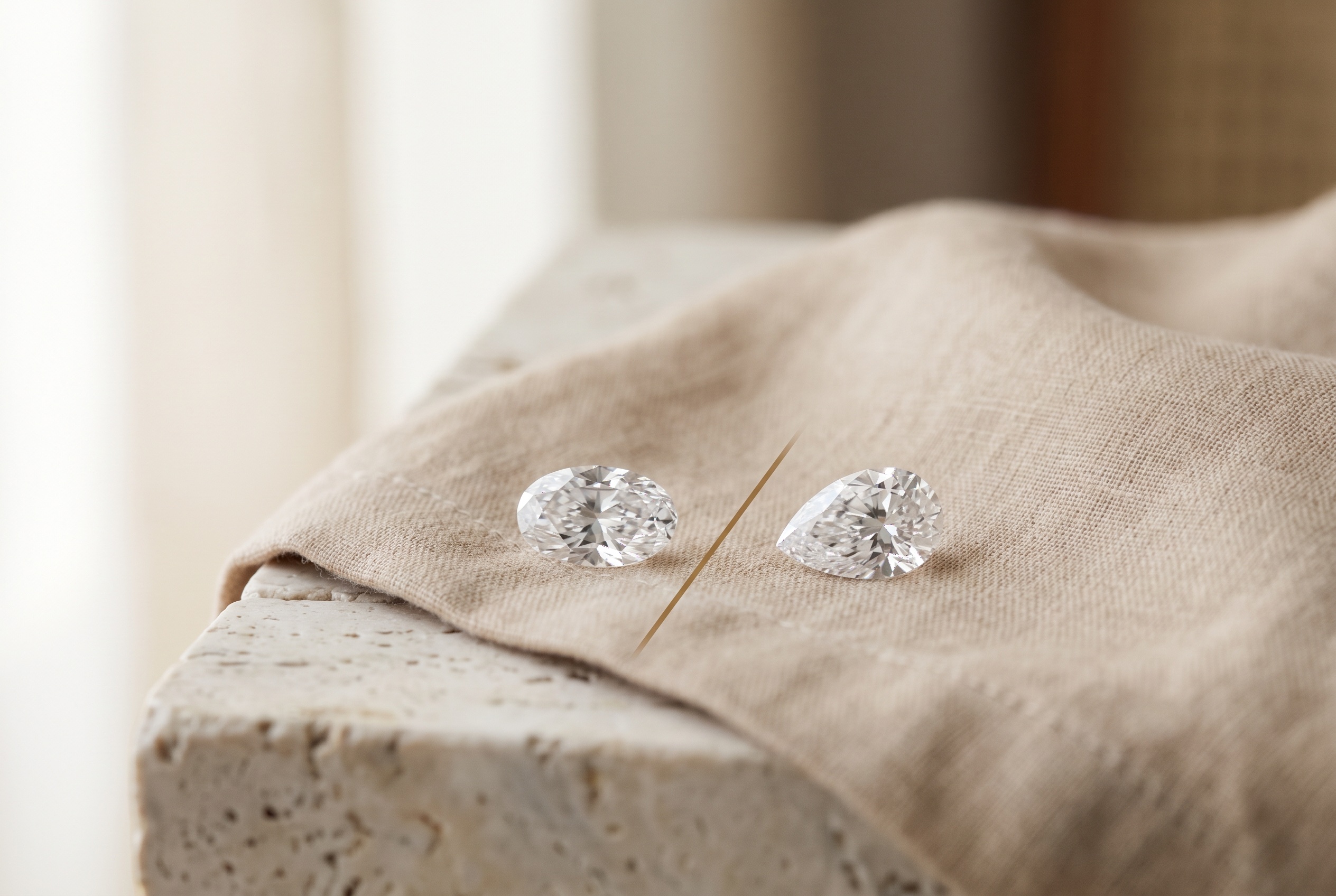
Oval and pear are both elongated brilliant-cut diamond shapes that make the finger look longer and the stone look larger per carat than a round diamond of equal weight. The core difference: an oval is symmetrical at both ends, while a pear tapers to a single point on one end and rounds off on the other — a design difference that changes durability, setting choice, styling versatility, and resale value for anyone buying wholesale.
For a jeweler or designer stocking a case, that single structural difference cascades into almost every purchasing decision — what settings to pair each shape with, how much inventory risk each carries, and which customer walks in asking for which one. This guide breaks down oval vs pear diamond in the terms that actually matter at the counter: shape, light performance, setting requirements, resale, and where each shape earns its keep beyond the engagement ring case.
What Is an Oval Cut Diamond?
An oval cut diamond is a modified round brilliant — it uses the same faceting logic as a round brilliant (typically 56 to 71 facets) but stretches the outline into an elongated ellipse with two identical, rounded ends. Because it shares its facet arrangement with the round brilliant, a well-cut oval throws off comparable fire and scintillation to a round stone of the same quality, while reading larger across the top due to its elongated footprint.
The oval cut is a relatively modern shape in commercial terms, popularized in the 1960s as cutters looked for a fancy shape that kept round-brilliant-level brilliance without round-brilliant proportions. That round-brilliant lineage is exactly why oval performs so consistently: buyers get a familiar, high-brilliance cut in a shape that visually elongates the hand and reads bigger face-up than its carat weight alone would suggest.
Symmetry is the oval's defining structural trait. Both ends mirror each other, and the widest point sits at the true center of the stone. That symmetry is what makes oval diamonds easy to set, easy to pair (for studs or three-stone designs), and easy to resell — a buyer who wants "elongated but classic" reaches for oval first.
What Is a Pear Cut Diamond?
A pear cut diamond — also called a teardrop — combines a rounded end with a single point, essentially merging a round brilliant and a marquise into one silhouette. It's one of the oldest fancy shapes in diamond cutting history, with roots tracing back to 15th-century faceting innovations that first broke diamonds out of purely symmetrical outlines. Modern pear cuts use brilliant faceting (typically 58 to 71 facets) adapted to the asymmetric outline.
The pear's single point is its defining visual signature and its main engineering challenge. That point is the thinnest, most vulnerable part of the stone — a corner with no surrounding girdle bulk to absorb an impact — so it needs deliberate setting protection that an oval, with no vulnerable point anywhere on its outline, simply doesn't require.
Pear diamonds are typically worn point-down in a ring (pointing toward the wrist), which is the traditional orientation and the one most buyers expect. Point-up orientation shows up more in drop earrings and pendants, where the point becomes a deliberate design element rather than a vulnerability to manage. Length-to-width ratio matters more for pear than for almost any other shape — a "fat," short pear reads squat, while a well-proportioned pear (commonly cited around 1.50–1.75:1) reads as the classic elegant teardrop.
Oval vs Pear Diamond: Quick Comparison Table
| Attribute | Oval | Pear |
|---|---|---|
| Visual character | Symmetrical elongated ellipse, both ends rounded | Teardrop — one rounded end, one point |
| Light performance | Round-brilliant-level fire and scintillation across a larger visual footprint | Strong brilliance near the rounded end, softer light return toward the point |
| Price tier (vs. round of same shape/quality tier) | Regular fancy — priced below round per carat, comparable to other modern fancy cuts | Regular fancy — similarly priced to oval; length-to-width ratio affects cost more than for oval |
| Best for | Buyers who want maximum versatility, easiest resale, and a shape that pairs cleanly with any setting style | Buyers who want a distinctive, less common silhouette and don't mind (or specifically want) an asymmetric look |
| Setting demands | Standard prong or bezel setting; no vulnerable points | Requires a V-prong or protective bezel at the point; point orientation matters |
| Common uses | Engagement ring centers, three-stone designs, stud earrings, tennis-line accents | Engagement ring centers, drop earrings, pendants, halo designs |
Shape and Silhouette: Symmetry vs. a Single Point
The single biggest thing separating these two shapes on sight is symmetry. An oval is bilaterally and axially symmetrical — cut it in half either way and the two halves match. A pear only has one axis of symmetry, running from the point straight through to the center of the rounded end. That asymmetry is the whole reason a pear reads as distinctive: it's visually more architectural, more "designed," where an oval reads as a clean, familiar elongation of a round stone.
This matters at the wholesale level because symmetry drives ease of matching. Oval diamonds are dramatically easier to pair for stud earrings or a matched-set order — two oval stones of similar dimensions look identical from either angle. Pear diamonds require matching not just carat weight and color but also point orientation and length-to-width ratio, which is a tighter spec to fill consistently. Buyers sourcing matched pairs should factor that extra matching complexity into lead time and price when quoting pear pairs versus oval pairs.
Light Performance and Brilliance: Which Sparkles More?
Because the oval shares its facet structure with the round brilliant, it's the more consistently brilliant of the two shapes edge to edge — light bounces evenly around the stone's uniform curve. Pear diamonds concentrate more brilliance toward the rounded end (where the facet geometry behaves more like a round brilliant) and less toward the point, where the narrowing outline produces smaller, more elongated facets that scintillate differently than the broader facets near the round end.
Cut quality closes most of that gap. A well-proportioned pear from a skilled cutter shows strong, even brilliance across the stone; a poorly proportioned one shows a visible dark or dull patch near the point where light leaks rather than reflects. This is a place where certification matters more than shape alone — GIA and IGI cut-quality notes (even on fancy shapes without an official "Excellent" cut grade) and a visual review of light return under standard lighting should be part of any pear diamond order, more so than for oval.
The Bow-Tie Effect in Both Shapes
Elongated fancy shapes — oval, pear, marquise, and radiant among them — are prone to what's called the "bow-tie effect": a dark, bow-tie-shaped shadow that can appear across the center of the stone, caused by the wearer's own head or shoulders blocking light from reaching that part of the stone at certain angles. It's a function of proportion and cutting, not a flaw exclusive to either shape, and both oval and pear can show it if the cutter doesn't manage facet angles carefully through the stone's midsection.
A subtle, barely visible bow-tie is normal and even expected in most well-cut elongated stones — jewelers shouldn't market "zero bow-tie" as an absolute claim for either shape. What matters wholesale is degree: a faint bow-tie that shifts with movement is a non-issue; a static, high-contrast dark band that doesn't move is a cutting problem worth flagging back to the supplier, in oval or pear alike.
The Finger-Flattering Effect: Why Both Shapes Elongate
Both oval and pear diamonds owe their popularity in large part to the same optical trick: an elongated outline running along the length of the finger makes the finger itself look longer and slimmer, which is a large part of why both shapes have held steady demand for decades regardless of trend cycles. A round or square stone of the same carat weight sits as a compact block; an oval or pear of the same weight stretches out, visually lengthening the hand.
The degree of elongation differs slightly. A pear's point adds a directional pull that some buyers find even more slimming than an oval's evenly rounded ends — the eye follows the point toward the fingertip. An oval delivers a gentler, more uniform stretch. Neither effect is dramatically stronger than the other; the choice mostly comes down to whether a buyer's end customer wants that pointed accent or prefers a fully rounded, classic outline.
Setting Considerations: Protecting the Pear's Point
This is the most important practical difference between the two shapes for a jeweler setting stones, not just selling them. An oval has no structurally weak point anywhere along its outline — standard four- or six-prong settings, bezels, and halo mountings all work without special reinforcement. A pear's point is genuinely vulnerable: it's a thin, sharp corner of diamond with minimal surrounding material, and a hard knock can chip it if it's left exposed.
The standard fix is a V-shaped prong (or a small protective bezel) specifically engineered to cradle the point and distribute impact away from that thin corner. Any pear diamond set without a V-prong or equivalent point protection is a callback risk — it's worth flagging to retail customers as a non-negotiable setting spec, not an upsell. Oval diamonds carry no equivalent requirement, which is one more reason oval settings are simpler and faster to fabricate at scale.
Halo settings are a popular workaround for pear specifically, since a continuous ring of smaller accent stones wrapping the point adds a second layer of physical protection on top of the V-prong, while also visually reinforcing the outline for a wearer worried about the point catching on fabric. Tension settings, by contrast, are a poor match for pear — they rely on pressure applied at two opposing points, which doesn't translate cleanly to an asymmetric outline — and are far more common on round or oval centers instead.
All of this should factor into a wholesale quote, not just a retail one: a pear order that specifies a low-profile four-prong setting without a V-prong detail is worth a clarifying call before it goes into production, since it's a far more common source of post-sale chips and warranty claims than any comparable oval order.
Versatility and Resale: Why Oval Edges Ahead
Oval is the more versatile shape by almost every wholesale metric. It suits more setting styles (solitaire, halo, three-stone, vintage-inspired, modern minimalist) without looking out of place in any of them, it's simpler to match for pairs, and — because of steadier, broader consumer demand — it tends to hold resale and trade-in value more predictably than pear. Pear's asymmetry is precisely what makes it distinctive, but that same asymmetry narrows its audience: it's a shape people choose deliberately, not a default, which makes secondary-market liquidity somewhat less consistent.
That doesn't make pear a weaker stocking choice — it makes it a different one. Pear diamonds serve buyers who specifically want a less common, more architectural silhouette, and that customer tends to be a decisive buyer once they've decided on the shape. For a wholesale buyer building a balanced case, oval functions as the safer, higher-turnover staple; pear functions as the differentiated, higher-margin specialty piece that pulls in a customer who already knows exactly what they want.
Beyond the Ring: Pear for Pendants and Earrings Too
Pear diamonds have a strong second life outside engagement rings that oval doesn't lean on quite as heavily. The point-up orientation — awkward in a ring, where point-down is the convention — becomes a natural design feature in a pendant, where the point can hang directly below the bail as a clean, elongated drop. Pear diamond stud and drop earrings are also a long-standing category on their own, worn either point-down or point-up depending on the design.
Oval diamonds show up in pendants and earrings too, but the category isn't quite as closely identified with the shape the way "teardrop pendant" is practically synonymous with pear. For a wholesale buyer stocking fine jewelry beyond bridal, that makes pear diamonds worth carrying even for a case that isn't primarily an engagement-ring business — pendant and drop-earring demand for pear runs independently of ring trends.
Clarity and Color: What to Grade For in Each Shape
Elongated brilliant cuts like oval and pear have larger, more open facets than a round brilliant of the same weight, and that has two practical consequences for grading. First, inclusions have more room to hide behind smaller round-brilliant-style facets in the round end of a pear or across an oval's uniform curve, but they also have fewer places to disappear into compared with a step-cut shape like emerald or asscher — a mid-tier clarity grade (VS2 to SI1) still generally faces up clean in both oval and pear, which makes them efficient shapes to stock at accessible price points.
Second, both shapes can show body color more readily at the corners and tips than a round brilliant does, because color tends to concentrate visually at a stone's narrowest points. In an oval, that shows up faintly at both rounded ends; in a pear, it concentrates specifically at the point, which is already the part of the stone drawing the eye. For that reason, buyers grading pear diamonds for color should look slightly stricter at the tip than they would for the same color grade in a round or cushion stone — a G that faces up bright in a round brilliant can read warmer at a pear's point. Guru Diam's certified inventory in both shapes ships with full IGI, GIA, or GCAL grading reports so this is a documented spec, not a guess made across the counter.
Price Per Carat and the Carat-Weight Illusion
Both oval and pear sit in the "regular fancy" cut tier alongside emerald, cushion, marquise, radiant, and princess — priced below round brilliant per carat, since round remains the commodity benchmark shape with the highest cutting yield from rough. Within that tier, oval and pear price similarly carat for carat and quality for quality; the bigger price lever for pear specifically is length-to-width ratio, since a well-proportioned pear (rather than an unusually stubby or unusually narrow one) commands a premium for matching the silhouette buyers actually want.
Both shapes also share the same "spread" advantage over round: because they're elongated rather than compact, a 1.00ct oval or pear reads visually larger face-up than a 1.00ct round of the same weight, since more of the carat weight is distributed across the visible top surface rather than depth. This is a genuine selling point for both shapes with budget-conscious buyers who want the stone to look as large as possible without paying for extra weight.
Which Shape Fits Which Buyer?
Oval is the safer recommendation for a first-time fancy-shape buyer, for anyone prioritizing resale value, or for anyone who wants an elongated look without committing to a more unusual outline. It's also the better choice when the setting needs to be simple and fast to fabricate, or when matching a pair of stones is part of the order.
Pear is the better fit for a buyer who already has a distinctive silhouette in mind, who wants a shape that reads unmistakably different from round, oval, or cushion at a glance, or who's shopping specifically for a pendant or drop-earring design rather than a solitaire ring. It also tends to suit buyers looking for a shape with strong vintage and antique-jewelry associations — the pear has centuries of faceting history behind it, longer than most other fancy shapes on the market today.
Sourcing Oval and Pear Diamonds Wholesale
Guru Diam is a trade-only, B2B wholesale supplier working with independent jewelers, designers, and manufacturers — our lab-grown catalog is CVD-grown exclusively, with IGI, GIA, and GCAL certification all available depending on what a given order calls for. Both oval and pear are part of the standard fancy-shape range we carry, alongside the full spread of antique and exotic cuts, so a mixed order covering both shapes (plus matching side stones or a fancy color accent) can move through a single relationship rather than multiple vendors.
We ship same-day on in-stock inventory from both US locations — New York before 6pm EST, Los Angeles before 4pm PST — so a case order for either shape doesn't sit in a queue. Custom engagement ring builds using oval or pear centers finish in 4-6 days once a design is approved. For loose certified stones in either shape, browse our certified diamonds inventory, or check matching pairs if you're filling an order for oval or pear studs. Oval and pear also both show up regularly in our fancy color loose diamonds range for buyers looking beyond white stones. New accounts can get oriented at our wholesale hub or apply directly through trade partner onboarding, and finished designs — including pear and oval centers — route through custom jewelry.
If cushion is also on your shortlist alongside oval, our companion guide on cushion vs oval diamond breaks down that comparison in the same depth.
Frequently Asked Questions
Is an oval or pear diamond more expensive per carat?
They're priced similarly carat for carat and quality for quality — both sit in the same "regular fancy" pricing tier below round brilliant. The main price variable within each shape is length-to-width ratio: a well-proportioned stone in either shape commands a premium over an unusually stubby or narrow one of the same weight.
Does a pear diamond need a special setting?
Yes. The point is the thinnest, most vulnerable part of the stone and needs a V-prong or protective bezel to cradle it and prevent chipping. An oval diamond has no equivalent weak point and can be set in a standard prong or bezel mounting without extra reinforcement.
Which shape looks bigger for the same carat weight, oval or pear?
Both look larger than a round diamond of equal weight, and by roughly similar margins, because their elongated outlines spread carat weight across more visible surface area. Between the two, it comes down more to individual proportions than shape — a well-cut oval and a well-cut pear of the same carat weight read close to the same size.
Do oval and pear diamonds get a bow-tie effect?
Both can. The bow-tie effect — a dark shadow across the stone's center — is common to elongated shapes generally, including oval, pear, marquise, and radiant. A faint, movement-sensitive bow-tie is normal in a well-cut stone; a static, high-contrast one signals a cutting proportion issue worth flagging to the supplier.
Which way should a pear diamond point in a ring?
The traditional and most common orientation is point-down, toward the wrist. Point-up is less conventional for rings but is standard in pear diamond pendants and some drop-earring designs, where the point becomes a deliberate design element rather than something to protect.
Is oval or pear easier to resell?
Oval generally holds resale value more predictably because demand is broader and steadier, and matched replacement stones are easier to source. Pear has a smaller but decisive buyer base — it's not a weaker stone, but its resale market is narrower because fewer buyers shop for it as a default choice.