
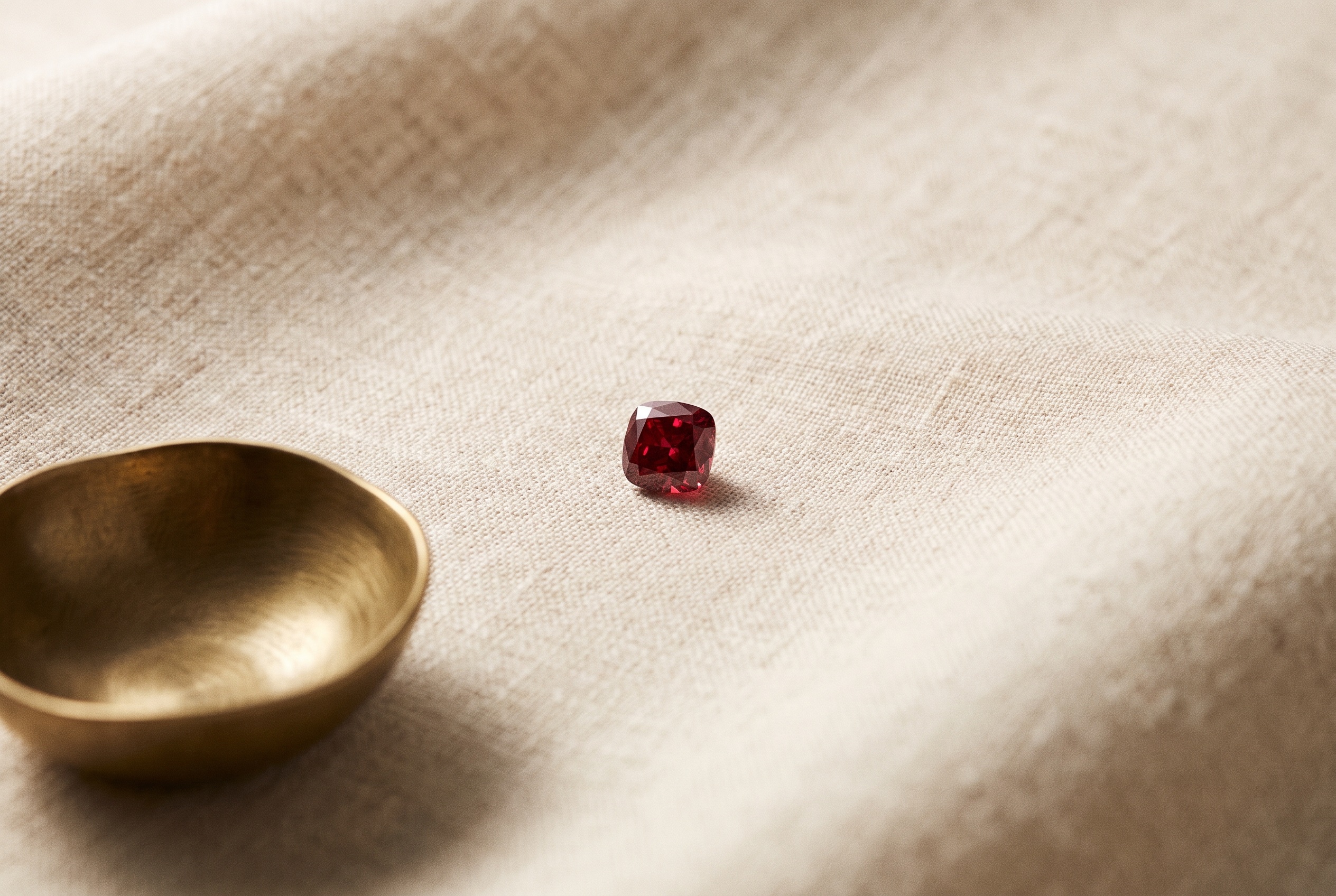
A red diamond is a diamond colored by the same plastic-deformation lattice distortion mechanism responsible for pink diamonds, but at an intensity strong enough to register as true red rather than a shade of pink. Red is, by a wide margin, the rarest color grade GIA assigns to a diamond — fewer than roughly thirty true red diamonds are believed to exist in a gradable size worldwide, which makes red diamonds a subject of enormous public curiosity but not a category any wholesale buyer can realistically source as regular inventory.
This guide covers what causes red diamond color, why the category is so much rarer than every other fancy color including pink, how GIA grades red separately from other hues, notable historical red diamonds, and what wholesale buyers interested in exceptional color should look at instead, given that red itself is not a commercially available category at any meaningful volume.
What Causes Red Diamond Color
Red diamond color shares its underlying physical cause with pink: a distortion in the crystal lattice known as plastic deformation, produced by intense pressure acting on the diamond during or after its formation deep in the earth. The difference between a pink diamond and a true red diamond is largely one of degree — a stronger, more concentrated version of the same lattice distortion produces a deeper, more saturated color that crosses the threshold from pink into red. Because that level of distortion is itself an extreme and poorly understood outcome even within the already-rare category of pink-causing deformation, true red is dramatically less common than pink at any comparable saturation level.
This is a meaningfully different situation from blue diamonds, where a specific trace element (boron) provides a well-understood, reproducible color mechanism. Red diamond color depends on a rare combination of geological conditions that current diamond science can describe in general terms but cannot reliably reproduce or predict — which is the central reason red remains essentially unavailable at commercial scale, in either natural or lab-grown form, unlike blue, pink, yellow, and green.
Just How Rare Are Red Diamonds?
Gemological estimates place the total number of gem-quality red diamonds known to exist, across every source and every era of mining, somewhere in the range of twenty to thirty stones — a figure repeated widely across gemological literature and GIA's own public commentary on the color. For context, that's a smaller known population than several categories of rare natural gemstones entirely. Most true red diamonds that do surface are small, frequently well under half a carat, since the intensity of color needed to register as red rather than deep pink appears to become geologically rarer as a stone's size increases.
This extreme scarcity is precisely why red diamonds generate outsized public search interest and media coverage relative to their actual presence in the market — they function almost entirely as museum pieces, documented historical stones, and occasional record-setting private or auction sales, not as a product category any retailer or wholesaler stocks.
How GIA Grades Red Diamonds
GIA's fancy color grading system evaluates hue, tone, and saturation the same way it does for any colored diamond, but red occupies a distinct position on the hue circle from pink, purplish-pink, or brownish-red — GIA will only assign a "Fancy Red" grade to a stone whose color genuinely reads as red rather than an intensely saturated pink or a reddish-brown. Because so few stones ever reach that threshold, "Fancy Red" is treated in the trade as effectively its own tier of rarity above and beyond the standard Fancy / Fancy Intense / Fancy Vivid saturation ladder used for other colors — a graded red diamond, at almost any size, is treated as an exceptional, individually significant stone rather than inventory to be compared against a price-per-carat chart.
Notable Historical Red Diamonds
A small number of named red diamonds account for much of what's publicly documented about the color. The Moussaieff Red, a roughly 5.11-carat triangular brilliant-cut stone, is among the largest and most famous graded red diamonds and a frequently cited benchmark in discussions of the color. The Hancock Red, a much smaller stone at well under a carat, set a widely reported per-carat auction price record at the time of its sale specifically because of how rarely a red diamond of any size comes to market at all. These are documented historical and auction facts about specific, individually known stones — not a claim about current market availability or any supplier's own inventory.
Why Red Diamonds Aren't a Wholesale Category
Every other fancy color covered in trade content — blue, pink, yellow, green, purple, and others — exists somewhere on a spectrum from "extremely rare in nature but reproducible via CVD lab growth" to "reasonably available in nature at scale." Red sits outside that spectrum entirely. Because the color depends on an extreme, poorly reproducible degree of lattice distortion rather than a controllable trace element like boron (blue) or a manageable growth-and-treatment process like the one used for pink, lab-grown production of true red diamonds at any meaningful, consistent volume has not become commercially viable in the way it has for blue, pink, yellow, and green. This is why red diamonds don't appear as a stocked wholesale category anywhere in the trade, in contrast to the other fancy colors, which are genuinely available as CVD lab-grown loose stones and melee at commercial scale.
Red Diamonds vs. Other Rare Fancy Colors
| Color | Color-Causing Mechanism | Approx. Rarity | Commercially Available as CVD Lab-Grown? |
|---|---|---|---|
| Red | Extreme plastic deformation (lattice distortion) | Fewer than ~30 known gem-quality stones worldwide | No — not commercially viable at meaningful volume |
| Pink | Plastic deformation (lattice distortion) | Extremely rare in nature; more available via lab growth | Yes |
| Blue | Trace boron in the crystal lattice | Extremely rare in nature; reliably reproducible via lab growth | Yes |
| Purple | Believed related to structural lattice effects, less understood than pink | Very rare in nature and in lab-grown supply | Limited |
| Yellow | Trace nitrogen in the crystal lattice | The most common fancy color, in both natural and lab-grown material | Yes |
The Science Gap: Why Red Diamond Formation Still Isn't Fully Understood
Diamond science has made real progress explaining color mechanisms across most fancy colors — boron for blue, nitrogen for yellow, and a reasonably well-characterized model of lattice deformation for pink. Red diamonds sit at an unusual edge case within that research: gemologists broadly agree the color relates to the same plastic-deformation family of causes as pink, but the specific combination of pressure, temperature, and duration needed to push that deformation to red-level intensity, rather than stopping at pink, hasn't been isolated or reliably reproduced. This is a meaningfully different situation from a color like blue, where the causal mechanism is well enough understood that a lab can introduce a controlled amount of boron during CVD growth and reliably get a blue result. With red, researchers can describe what's happening in general terms after the fact, in a stone that already exists, without yet being able to say precisely how to engineer that outcome deliberately and repeatably. That gap in the science — not simply a matter of limited raw material or funding — is the practical reason a commercially viable lab-grown red diamond hasn't emerged the way lab-grown blue, pink, yellow, and green have.
Red Diamonds in Museums and Private Collections
Given how few red diamonds exist, a disproportionate share of the known population sits in museum collections, well-documented private collections, or major auction house sale records rather than circulating through ordinary trade channels at all. This is publicly available historical and auction information about specific, individually named stones — the kind of fact pattern any gemology reference or major auction house's own public sale archive documents — rather than a claim about any particular supplier's access to or handling of red diamond material. For most people encountering a red diamond at all, it will be through a museum exhibit, a documentary, or historical photography rather than any commercial transaction.
Media and Search Interest vs. Market Reality
Red diamonds generate an unusually large volume of online search interest and "rarest diamond" content relative to their near-total absence from actual commerce — a gap worth naming directly, since it's easy for that search interest to create a false impression that red diamonds are simply an ultra-premium version of a normal buying category, the way a natural fancy vivid yellow or an exceptional natural pink might be for a well-capitalized collector. In practice, red functions closer to a historical curiosity or a piece of gemological trivia than a market segment with active listings, comparable sales data, or any path a typical retailer, designer, or even high-end private buyer could realistically follow to acquire one. Recognizing that gap up front is useful context for anyone whose interest in red diamonds started from a search query rather than direct trade experience with the category.
How to Spot Red Diamond Misrepresentation
Precisely because red diamonds are so rare and so widely searched, the term occasionally gets misapplied — deliberately or carelessly — to stones that aren't true graded red diamonds at all. Buyers should treat a few specific patterns with particular caution:
- Heavily saturated brown or orangey-brown diamonds marketed as "red." Some sellers apply "red" loosely to a dark brownish-orange stone that GIA would grade as Fancy Deep Brown or a similar brown-family color, not Fancy Red. A genuine GIA "Fancy Red" grade should appear explicitly on the report — a seller's own color description isn't a substitute for the lab's actual grade designation.
- Irradiated or treated stones misrepresented as naturally colored. Certain treatments can push a diamond's apparent color toward a reddish tone; a legitimate lab report will disclose treatment status clearly, and any red-colored stone offered without treatment disclosure on an independent lab report warrants real skepticism.
- Red gemstone simulants sold as "red diamonds." Because true red diamonds are so scarce, some sellers use the term loosely for red-colored diamond simulants or even unrelated red gemstones. A genuine diamond — of any color — should always come with third-party lab verification confirming it is, in fact, diamond, not another material.
The reliable check in every case is the same: an independent grading report from a major lab (GIA, in particular, for fancy color natural diamonds) that explicitly states both the stone's identity as diamond and its specific fancy color grade — not a seller's descriptive language alone.
What to Look at Instead of Red
Buyers drawn to red diamonds out of curiosity or a desire for the rarest possible color are, in practice, almost always redirected toward one of two paths: a deeply saturated Fancy Vivid pink or purplish-pink stone, which shares red's underlying color mechanism and can present a genuinely intense, warm-toned appearance at a fraction of red's essentially unattainable rarity and price, or an equally rare but commercially available color like a strongly saturated blue or a fancy vivid yellow, both of which offer the visual impact of an exceptional fancy color diamond backed by real, gradable wholesale supply. Guru Diam carries CVD lab-grown blue, pink, yellow, and green as certified loose stones and calibrated melee — the four fancy colors where lab-grown production has become genuinely commercially viable — and does not stock red, champagne, or cognac diamonds as part of its fancy color line, consistent with where the current lab-grown fancy color market actually exists.
A Note on Diamond Rarity and Investment Framing
Red diamonds are frequently cited in "rarest diamond" and diamond-investment content precisely because the numbers are so extreme and so easy to state plainly — fewer than thirty known stones is a genuinely striking fact. It's worth separating that historical and gemological rarity from any implication that red diamonds function as a normal, accessible investment or collecting category the way, say, natural fancy yellow or a strong natural pink might for a well-capitalized private buyer. A true graded red diamond is closer to a one-of-a-kind historical artifact than a market with any meaningful liquidity, comparable pricing data, or regular transaction volume.
Frequently Cited Red Diamond Facts, Checked Against the Record
Because red diamond content circulates so widely online, a few specific claims are worth stating precisely rather than repeating loosely. The often-cited figure of "fewer than thirty known red diamonds" is a widely repeated gemological estimate rather than an exact, universally agreed count — different sources place the number anywhere from roughly twenty to thirty depending on how strictly "gem-quality" and "gradable size" are defined, and new stones occasionally surface from private collections or estate sales that revise the working estimate slightly. The Moussaieff Red's weight (approximately 5.11 carats) and the Hancock Red's record-setting per-carat auction result are both documented, verifiable sale and grading facts tied to specific, named stones. Readers should treat any claim of an exact, definitive worldwide red diamond count with reasonable skepticism — the honest, defensible statement is "an extremely small number, most commonly cited in the low tens," not a single precise figure presented as settled fact.
Sourcing Fancy Color Diamonds Wholesale
While red itself isn't a category any wholesale supplier realistically stocks, Guru Diam carries certified CVD lab-grown fancy color diamonds in blue, pink, yellow, and green — the colors where reproducible lab growth actually exists at commercial scale — as loose stones at 0.30ct and above and as calibrated melee for production-scale jewelry work, all with a choice of IGI, GIA, or GCAL certification. In-stock fancy color inventory ships same-day from Guru Diam's New York and Los Angeles locations. Trade buyers can browse current stock in the fancy color loose diamonds category, review certified inventory generally in certified diamonds, or apply for a trade account through trade partner. Current terms are available at the wholesale hub. For a deeper look at the two fancy colors Guru Diam does carry that share red's underlying color science, see our pink diamond buying guide and blue diamond buying guide. Readers wanting more background on how color grading works across the full D-to-Z and fancy color scales may also find our diamond color chart guide useful.
Why Red Diamond Interest Keeps Growing Despite the Lack of Supply
Search interest in red diamonds has continued climbing even as the actual number of known stones stays essentially fixed, a pattern that tracks a broader trend in how rare, extreme facts travel well online regardless of whether they connect to any purchasable product. Content built around "world's rarest" framings — rarest diamonds, rarest gemstones, rarest colors — performs consistently well because the underlying fact (fewer than thirty known stones) is genuinely striking and easy to share, independent of whether the person searching has any intention of ever buying one. For a wholesale supplier or retailer, this means red diamond content serves a real informational and brand-authority purpose — answering a question people are actively asking — even though it will essentially never convert into an actual red diamond transaction, which is a meaningfully different outcome than most product-adjacent content is built to produce.
Frequently Asked Questions
Why are red diamonds so rare?
Red diamond color comes from an extreme degree of a lattice distortion called plastic deformation — the same underlying mechanism that causes pink, but at an intensity that's dramatically rarer geologically. Gemologists estimate fewer than roughly thirty gem-quality red diamonds are known to exist worldwide.
Can you buy a lab-grown red diamond?
Not at any meaningful commercial scale. Unlike blue, pink, yellow, and green — all of which are reliably produced as CVD lab-grown fancy color diamonds today — true red depends on an extreme, poorly reproducible degree of lattice distortion that has not become commercially viable to manufacture consistently.
What is the most famous red diamond?
The Moussaieff Red, a roughly 5.11-carat triangular brilliant cut, is among the largest and most frequently cited graded red diamonds. The much smaller Hancock Red also set a widely reported per-carat auction price record due to the extreme rarity of any red diamond coming to market.
How much is a red diamond worth?
Because so few red diamonds exist and sales are so infrequent, there's no standardized per-carat pricing the way there is for more available colors. Historical sales have set some of the highest per-carat prices ever recorded for any diamond, reflecting the extreme scarcity rather than a predictable market rate.
What's the difference between a red diamond and a pink diamond?
Both share the same underlying color-causing mechanism (plastic lattice deformation), with red representing a much more extreme, much rarer degree of that same distortion. GIA only assigns a "Fancy Red" grade when a stone's color genuinely reads as red rather than an intensely saturated pink, which is why the two are graded as distinct color categories despite the shared underlying cause.
If I want an extremely rare fancy color diamond, what's actually available?
A deeply saturated Fancy Vivid pink or purplish-pink diamond shares red's color mechanism and offers real rarity and visual intensity at a fraction of red's price and availability. Strongly saturated blue and fancy vivid yellow diamonds are also genuinely rare, visually striking colors available as certified CVD lab-grown stones at commercial wholesale volume.
Is a "red diamond" ever just a treated brown diamond?
Sometimes the term gets applied loosely to a heavily saturated brown or orangey-brown stone that a lab would actually grade as Fancy Deep Brown or a similar brown-family color, not a genuine GIA Fancy Red. Always confirm the specific color grade printed on an independent lab report rather than relying on a seller's own description of a stone as "red."
Do any wholesale diamond suppliers stock red diamonds?
No wholesale supplier stocks true red diamonds as regular inventory — the category simply doesn't exist at any commercial scale, natural or lab-grown. Buyers interested in the color are generally better served looking at a deeply saturated pink or purplish-pink diamond, which shares red's underlying color mechanism and is genuinely available through certified fancy color suppliers. A supplier claiming to have red diamonds in regular stock warrants real scrutiny of exactly what's being offered and what the accompanying lab report actually states.
Guru Diam is a trade-only wholesale diamond supplier with locations in New York and Los Angeles, carrying CVD lab-grown fancy color diamonds in blue, pink, yellow, and green, alongside natural diamonds, antique and standard cuts, and finished jewelry, with IGI, GIA, and GCAL certification available. Browse current fancy color inventory in the fancy color loose diamonds category or apply for a trade account through trade partner.