
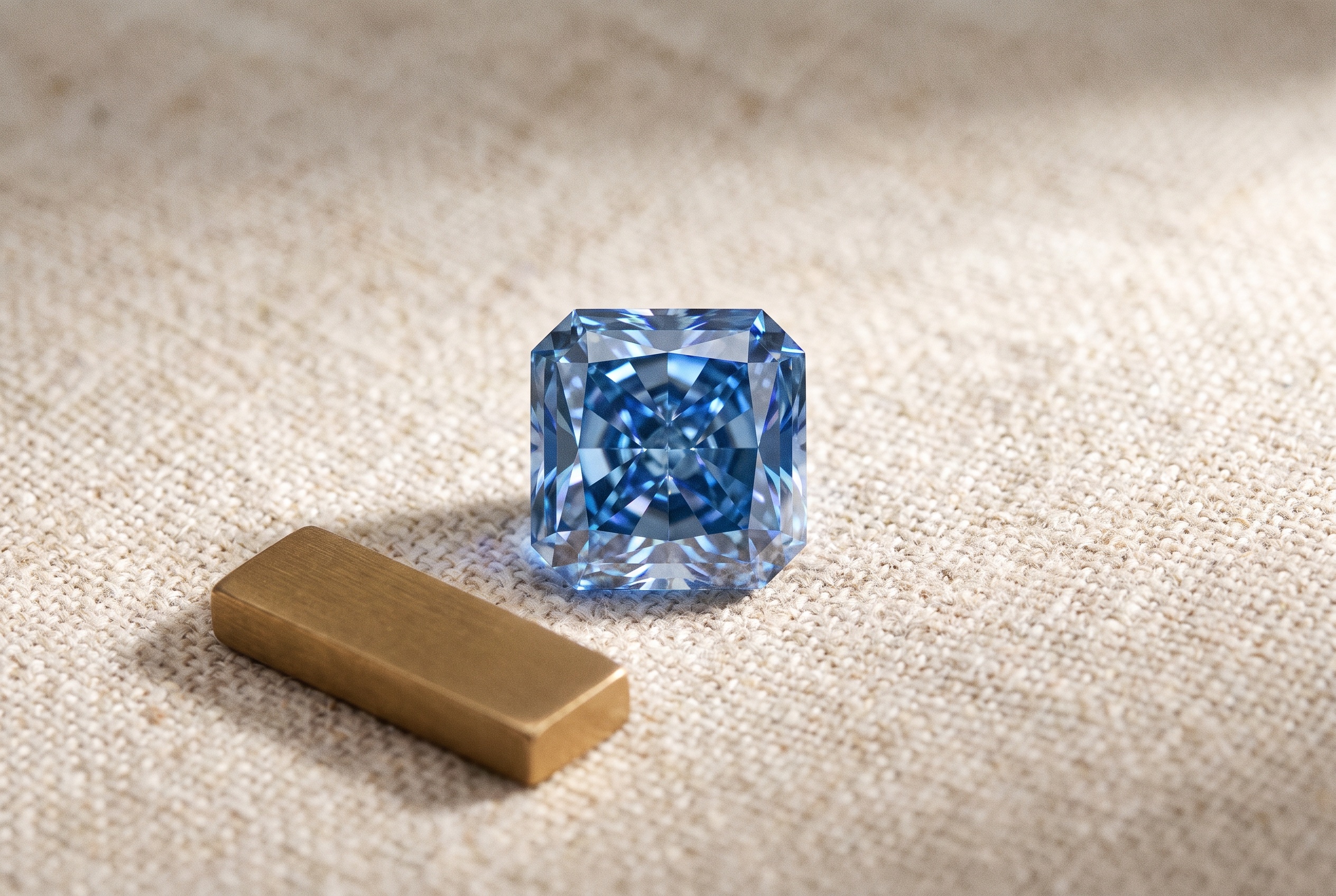
A blue diamond is a diamond whose crystal structure contains trace amounts of boron, which absorbs red light and gives the stone a blue body color instead of the colorless-to-yellow range of a standard diamond. Natural blue diamonds are among the rarest fancy colors in the world, while CVD lab-grown blue diamonds reproduce the same boron-driven color mechanism under controlled lab conditions, making blue a color that trade buyers can now source at wholesale-viable volume and price.
This guide covers what actually causes blue color in a diamond, how natural and lab-grown blue diamonds differ, how GIA and other labs grade blue color intensity, what drives price in this category, and what a wholesale buyer needs to know before sourcing blue diamonds for retail, custom design, or resale.
What Actually Makes a Diamond Blue
Diamond is, at its purest, a lattice of carbon atoms with no color at all. Color in a diamond comes from either structural defects in that lattice or trace elements that get incorporated into the crystal as it forms. For blue diamonds specifically, the responsible element is boron. Boron atoms substitute for carbon atoms in the crystal lattice and absorb light in the red end of the visible spectrum, which shifts the diamond's apparent color toward blue. The more boron present and the more evenly it's distributed through the stone, the stronger and more saturated the resulting blue.
This is a genuinely different color mechanism from most other fancy colors. Yellow diamonds typically get their color from nitrogen impurities, and colors like pink or brown are usually linked to structural distortions in the crystal lattice caused during formation rather than a specific trace element. Blue's boron mechanism is comparatively well understood, which is part of why it has been one of the more successful colors to reproduce in a lab-grown setting.
Natural Blue Diamonds: Formation and Rarity
Natural blue diamonds form under the same extreme heat and pressure conditions as any natural diamond, deep in the earth's mantle, but with boron present in the surrounding material at the moment of crystallization. Boron is not a common trace element in the environments where most diamonds form, which is the core reason natural blue diamonds are so rare — a rarity long recognized in the trade well before lab-grown material existed as an alternative. Some of the most famous diamonds in history are natural blues, most notably the Hope Diamond, a well-documented deep blue stone whose history is a matter of public historical record rather than a claim about any specific supplier's inventory.
Because of that rarity, natural blue diamonds at any meaningful size and saturation command prices that put them out of reach for all but the highest end of the trade — a single carat of strong, saturated natural blue can trade for prices that have no equivalent anywhere else in the diamond category. Most buyers who want blue diamonds at a usable wholesale volume are, as a practical matter, looking at lab-grown material instead.
Lab-Grown Blue Diamonds: How CVD Reproduces the Color
CVD (chemical vapor deposition) is the process used to grow lab-grown diamonds by depositing carbon atoms, layer by layer, onto a diamond seed inside a controlled growth chamber. To produce a blue lab-grown diamond, a small, precisely controlled amount of boron is introduced into that growth environment, so the same boron-substitution mechanism that colors natural blue diamonds occurs deliberately and repeatably during crystal growth. The resulting stone is chemically, optically, and structurally a real diamond — not a simulant or a treated stone — with color created by the same physical mechanism as its natural counterpart, just produced under lab conditions rather than over geologic time underground.
This is the development that has made blue diamonds newly relevant to wholesale buyers. A color that was previously accessible only at extraordinary natural-diamond prices is now available as CVD lab-grown material at a cost structure that supports retail and custom-design use across a much wider range of price points, without changing what the stone fundamentally is.
Natural vs. Lab-Grown Blue Diamonds: Key Differences
| Factor | Natural Blue Diamond | CVD Lab-Grown Blue Diamond |
|---|---|---|
| Origin of color | Trace boron incorporated during natural crystallization | Trace boron introduced during controlled CVD growth |
| Rarity | Extremely rare; among the rarest fancy colors in nature | Reproducible at commercial wholesale volume |
| Typical price position | Among the highest per-carat prices in the entire diamond market | A fraction of natural blue pricing at comparable color and clarity |
| Physical composition | Real diamond (carbon crystal) | Real diamond (carbon crystal) — chemically identical |
| Certification | GIA is the dominant reference lab for natural fancy color | GIA, IGI, and GCAL all grade and certify lab-grown fancy color, clearly labeled by origin |
| Availability at scale | Effectively unavailable in consistent wholesale quantity | Available as loose stones (0.30ct+) and as calibrated melee |
How Blue Diamonds Are Graded
Fancy color diamonds, including blue, are graded on a different system from the standard D-to-Z scale used for colorless-range diamonds. Instead of measuring the absence of color, fancy color grading measures three separate qualities of the color that's present: hue (the actual color family — in this case, blue, or a secondary variant like blue-green or gray-blue), tone (how light or dark the color is), and saturation (how strong or intense the color is). Grading labs combine these into a fancy color grade that describes the overall visual strength of the color.
The Fancy Color Grade Scale for Blue Diamonds
- Faint / Very Light Blue — barely perceptible blue tint
- Fancy Light Blue — clearly visible but soft, understated blue
- Fancy Blue — a solid, well-saturated blue that reads clearly as a colored stone
- Fancy Intense Blue — a strong, vivid blue with high saturation
- Fancy Vivid Blue — the most saturated, sought-after grade, commanding the highest premium at any given size
- Fancy Dark Blue / Fancy Deep Blue — a darker-toned blue, often with more gray or black undertone
Unlike colorless diamonds, where a "better" grade almost always means closer to D, fancy color grading is about matching buyer preference for hue and tone as much as it is about a strict quality hierarchy — though within blue specifically, higher saturation (Intense and Vivid) reliably commands a stronger per-carat premium than lighter or grayer tones.
Clarity Considerations Specific to Blue Diamonds
Clarity grading for blue diamonds follows the same 10x-magnification standard used for any diamond, but the practical impact of clarity on visual appearance differs. In a strongly saturated colored stone, minor inclusions are often considerably less visible to the naked eye than the same inclusions would be in a colorless diamond, because the body color itself dominates the eye's first impression of the stone. This means buyers sourcing blue diamonds sometimes reasonably prioritize color grade and saturation over the very top clarity tiers, since a VS-clarity blue stone with strong, even saturation frequently reads as flawless to an untrained eye in a way a VS colorless stone would not.
Shapes and Cuts for Blue Diamonds
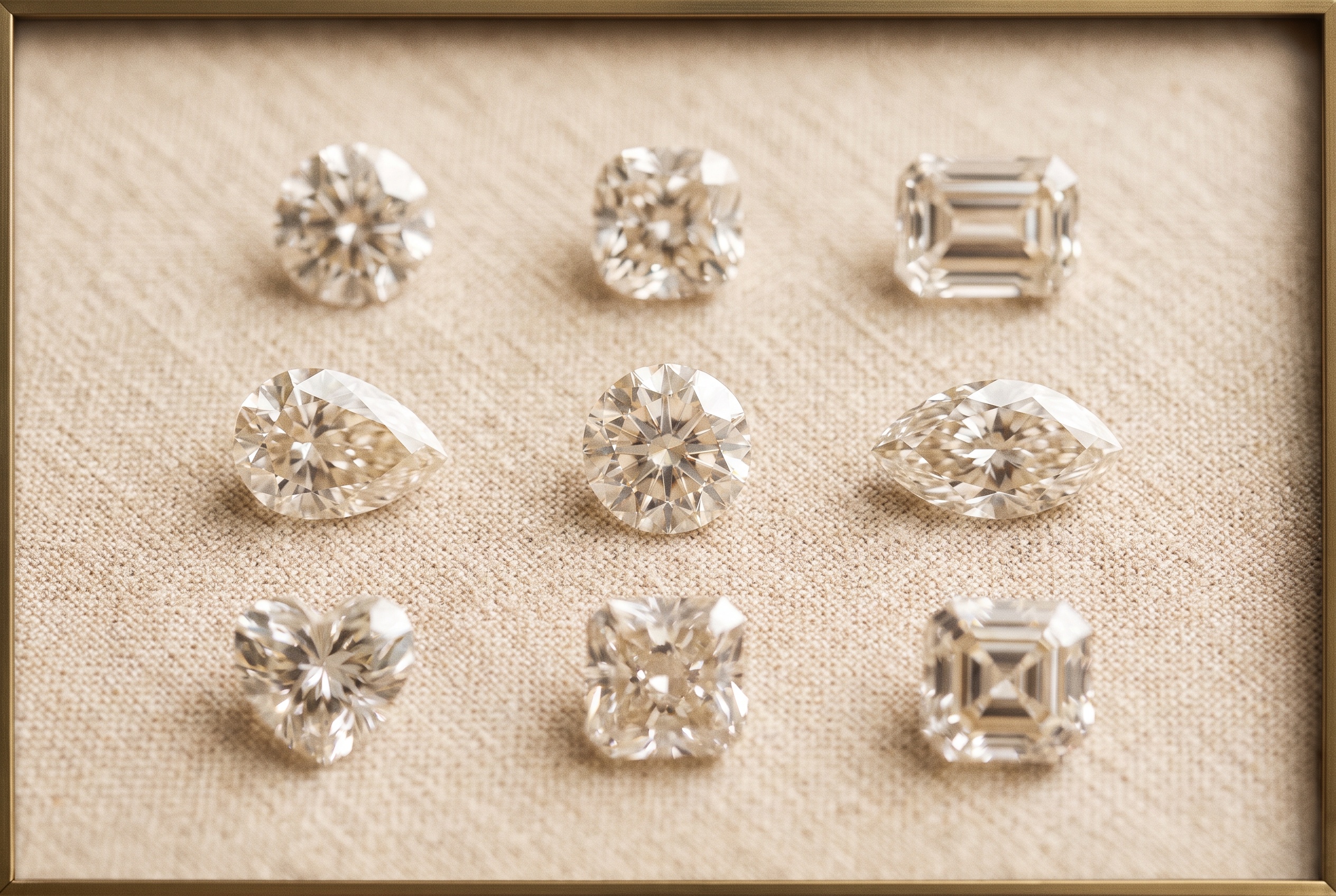
Blue diamonds are cut across the same range of shapes as any other diamond category — round brilliant, oval, cushion, emerald, radiant, pear, and the full range of fancy shapes — with the choice of cut style having a real effect on how the color reads. Step cuts like emerald and Asscher tend to pool color in broad, even planes that emphasize a stone's overall tone, while brilliant-faceted shapes like round, oval, and cushion break up color into smaller flashes that can make a lighter-saturation stone appear more vivid than its lab grade alone would suggest. Buyers selecting a shape for a blue diamond intended as a statement piece often lean toward cushion or oval brilliant cuts specifically because that faceting pattern tends to maximize perceived color intensity relative to actual saturation grade.
What Drives Blue Diamond Pricing
For lab-grown blue diamonds specifically, several factors combine to set price at a given carat weight: color grade (saturation is the single biggest lever — Vivid and Intense grades price well above Fancy or Fancy Light at the same size), clarity, cut quality, carat weight (with per-carat price accelerating at common milestone weights the same way it does for colorless stones), and certifying lab. Because fancy color pricing doesn't follow the same standardized per-carat pricing tables that exist for colorless diamonds, two blue stones of similar carat weight can price quite differently based on how their hue, tone, and saturation combine — which is part of why buying fancy color inventory benefits from direct comparison of physical stones or detailed lab imagery rather than specs alone.
Secondary Hues: Not Every Blue Diamond Is Pure Blue
Few blue diamonds show a perfectly pure blue with no other color influence at all — most carry a secondary hue modifier that a grading report will note alongside the primary color. Gray-blue and green-blue (sometimes called blue-green) are the two most common variants, and each affects both appearance and price differently. A gray-blue stone reads as slightly cooler and more muted, often described in the trade as a "steely" blue, while a green-blue stone picks up a subtle warmth that some buyers find more versatile for everyday jewelry design. Violetish-blue is a rarer secondary hue that tends to command a premium over gray-blue or green-blue stones of comparable saturation, since a cleaner, single-hue blue is generally viewed as the more classic and desirable presentation of the color. None of these secondary hues make a stone lesser — they're simply a factual part of what a buyer is looking at, and worth understanding before comparing two stones that share the same primary color grade but look noticeably different side by side.
How to Evaluate a Blue Diamond in Person
Photographs and even professional lab imagery consistently struggle to capture a fancy color diamond's true appearance, because color saturation and secondary hue both shift depending on the lighting conditions and camera settings used. For any purchase above a token size, viewing the physical stone under multiple lighting conditions — daylight-equivalent lab lighting, a jewelry showroom's typical spot lighting, and ordinary indoor light — gives a far more reliable sense of how the stone will actually look once it's set and worn day to day. Buyers should also view a candidate blue diamond face-up (as it will sit in a finished piece) rather than only through the side or table-down, since face-up color intensity is what actually matters for how the stone reads in a ring, pendant, or earring once complete. Comparing two or three candidate stones side by side, rather than evaluating one stone in isolation against a mental reference, is the single most reliable way to judge relative color strength before committing to an order.
Blue Diamonds in Jewelry Design: Metal and Setting Pairings
Metal choice has a real, visible effect on how a blue diamond's color reads once mounted. White metals — platinum and white gold — are the most common pairing for blue diamonds because they create no competing warmth, letting the stone's cool color read at full strength against a neutral backdrop. Yellow gold, by contrast, introduces a warm-toned contrast that can make a blue diamond's color pop dramatically for a bolder design statement, though it's a less common choice for buyers wanting the most classic, understated presentation of the color. Halo settings using small white melee diamonds around a blue center stone are a popular design choice specifically because the surrounding brilliance amplifies the center stone's perceived size and color intensity without altering the color itself — a practical design lever for a jeweler working with a smaller or more lightly saturated blue center stone.
Carat Milestones and Price Scaling
As with colorless diamonds, blue diamond pricing accelerates disproportionately at common carat milestones — a stone just over 1.00ct or 2.00ct commands a meaningfully higher per-carat price than one just under that threshold, even though the visual size difference is negligible. For lab-grown blue diamonds specifically, this milestone effect is softer than it is for natural stones, since lab-grown supply doesn't carry the same scarcity premium tied to any particular carat weight — but it hasn't disappeared entirely, and buyers assembling inventory across a range of sizes should expect per-carat pricing to step up somewhat at each half-carat and full-carat threshold rather than scaling in a perfectly straight line.
Common Misconceptions About Blue Diamonds
- "All blue diamonds are treated." Natural blue diamonds derive their color entirely from boron present during formation and require no treatment. Lab-grown blue diamonds are colored during the CVD growth process itself through controlled boron introduction, not through a post-growth treatment — a distinction from lab-grown pink diamonds, which typically do involve a disclosed post-growth treatment step.
- "A darker blue is always a better blue." Tone and saturation are separate qualities. A very dark blue can actually reduce perceived brilliance by absorbing more light overall, and many buyers prefer a mid-tone Fancy Intense or Fancy Vivid blue over an extremely dark Fancy Deep Blue for everyday wear.
- "Blue diamonds are only available as center stones." Calibrated blue diamond melee exists at commercial wholesale scale for jewelers producing halo, pavé, and accent designs — the category isn't limited to single large stones.
Certification for Blue Diamonds
GIA remains the most widely referenced lab for natural fancy color diamonds, with a fancy color grading system the rest of the trade has largely adopted as the reference standard. For lab-grown blue diamonds, GIA, IGI, and GCAL all grade and issue reports that clearly state both the color grade and the diamond's growth origin — buyers should always confirm a lab-grown fancy color stone's report explicitly discloses CVD origin rather than relying on price or appearance alone to infer it. A trustworthy fancy color report will state hue, tone, saturation, and origin together, not just a single color name.
Where Natural Blue Diamonds Are Found
Natural blue diamond production has historically been concentrated in a small number of mining locations where boron-bearing conditions happen to coincide with diamond formation — most notably South Africa's Cullinan mine (formerly known as Premier), which has produced a disproportionate share of the world's significant natural blue diamonds, including several stones now held in major museum and royal collections. This is documented mining and gemological history, publicly available in industry references, rather than a claim about any current supplier's sourcing. The practical takeaway for a wholesale buyer is straightforward: natural blue diamond supply was always geographically concentrated and limited even before demand for fancy color diamonds grew as much as it has in recent years, which is precisely the supply gap that CVD lab-grown blue diamonds have stepped in to fill.
Blue Diamonds as a Retail Category: Positioning Considerations
For a retailer building out a fancy color case or online category, blue diamonds occupy a distinct positioning niche from pink or yellow: the color reads as cool, modern, and somewhat unconventional for a center stone, which makes it a strong fit for a customer specifically looking for a piece that stands apart from the traditional colorless or warm-toned fancy color options most competitors carry. Blue also photographs and displays well under typical LED showroom lighting, which tends to bring out saturation more than warmer incandescent lighting does — a practical merchandising detail worth factoring into how a blue diamond case or display is lit.
Sourcing Blue Diamonds Wholesale
Blue is one of four fancy colors — alongside yellow, pink, and green — that Guru Diam carries as CVD lab-grown material, both as loose certified stones at 0.30ct and above and as calibrated fancy color melee in round and fancy shapes for setters building color-forward pieces at scale. Every certified blue diamond in Guru Diam's inventory ships with a choice of IGI, GIA, or GCAL certification, clearly documenting hue, tone, saturation, and CVD origin, and the same wholesale account structure applies across blue as it does across the rest of the catalog — one supplier for fancy color, antique cuts, natural diamonds, and finished jewelry rather than a narrow single-category source. In-stock blue diamond inventory ships same-day from Guru Diam's New York and Los Angeles locations. Trade buyers can browse current stock in the fancy color loose diamonds category, source calibrated melee for larger production runs, review certified inventory generally in certified diamonds, or apply for a trade account through trade partner. Current terms are available at the wholesale hub, and buyers designing a custom piece around a blue center stone can start at custom jewelry. For a companion color, our pink diamond buying guide covers the same ground for Guru Diam's other flagship fancy color.
Frequently Asked Questions
What causes a diamond to be blue?
Trace amounts of boron incorporated into the diamond's carbon lattice absorb red light and shift the stone's apparent color toward blue. This happens naturally during formation in natural blue diamonds, and is deliberately introduced during the CVD growth process for lab-grown blue diamonds.
Are lab-grown blue diamonds real diamonds?
Yes. A CVD lab-grown blue diamond is chemically, optically, and structurally a real diamond — the same carbon crystal structure as a natural diamond, colored by the same boron mechanism, just grown under controlled lab conditions rather than formed underground over geologic time.
Why are natural blue diamonds so expensive?
Natural blue diamonds are extremely rare because boron is uncommon in the environments where natural diamonds typically form. That rarity, combined with strong collector and investment demand for historically significant natural fancy colors, puts natural blue diamonds among the highest per-carat prices in the entire diamond market.
What is the best color grade for a blue diamond?
Fancy Vivid Blue and Fancy Intense Blue represent the highest saturation grades and command the strongest per-carat premiums. That said, "best" also depends on buyer preference and intended use — a lighter Fancy Blue or Fancy Light Blue stone still reads clearly as a colored diamond at a more accessible price point.
Can blue diamonds be certified?
Yes. GIA is the primary reference lab for natural fancy color grading, and GIA, IGI, and GCAL all grade and certify lab-grown blue diamonds, with reports that document hue, tone, saturation, and growth origin.
Are blue diamonds available in melee sizes for jewelry production?
Yes. Lab-grown blue diamond melee is available in calibrated round and fancy shapes for setters producing color-forward jewelry at volume, separate from the certified loose-stone tier used for center stones.
Guru Diam is a trade-only wholesale diamond supplier with locations in New York and Los Angeles, carrying CVD lab-grown fancy color diamonds — including blue, pink, yellow, and green — alongside natural diamonds, antique and standard cuts, and finished jewelry, with IGI, GIA, and GCAL certification available. Browse current fancy color inventory in the fancy color loose diamonds category or apply for a trade account through trade partner.