Natural Melee Pricing Across Sieve Sizes: 2026 Rate Guide
Natural melee diamond pricing in 2026 runs from about $370 per carat at the smallest sieve sizes up to $900 per carat at the largest, tracking Guru Diam's current sell-price grid across eight size bands from roughly 0.8mm to 4.0mm (Sieve 8/9 through Sieve 36/38) and four EF/GH, VS/SI quality tiers. This guide is the rate card itself — every sieve size lined up against its millimeter range and per-carat price — so treat every figure below as a quote-confirmed starting point, not a locked catalog price.
What Is Guru Diam's Full Natural Melee Price Grid for 2026?
This is the reference table: Guru Diam's current sell price per carat for round natural melee, current as of August 2026. It's built on eight size bands and four quality columns — EF VS, EF SI, GH VS, and GH SI — where EF means E–F color and GH means G–H color, each as a blended trade range rather than a single exact grade, and VS/SI are the corresponding clarity bands.
| Size (mm) | EF VS | EF SI | GH VS | GH SI |
|---|---|---|---|---|
| up to 1.20 | — | — | $480 | $450 |
| 1.20–1.70 | — | — | $390 | $370 |
| 1.70–2.20 | $450 | $420 | $417.50 | $400 |
| 2.30–2.60 | $510 | $480 | $447.50 | $430 |
| 2.70–2.80 | $625 | $595 | $565 | $547.50 |
| 2.90–3.00 | $680 | $650 | $592.50 | $575 |
| 3.50 | $700 | $670 | $602.50 | $585 |
| 4.00 | $900 | $870 | $855 | $840 |
Two blank cells matter as much as the filled ones: EF has no listed price below 1.70mm, because no vendor in this size class has ever reliably quoted true E–F color that small — we don't fill that gap with a guess, and neither should you when budgeting a small-stone order. Above 4.00mm, this grid simply stops; that's the current sourcing ceiling for Guru Diam's natural melee program, covered in more detail further down. Everything on this table is the sell price for round natural melee only — Guru Diam's separate lab-grown (CVD) melee line runs its own spec and its own pricing, and the two are never interchangeable numbers.
How Do Sieve Sizes Map Onto This Price Grid?
The table above is organized by millimeter band because that's how Guru Diam quotes it, but the natural melee trade itself sorts and specs by sieve size — the plate a stone falls through and the plate it rests on. Overlaying sieve numbers onto the same eight price bands turns the grid above into a true rate card: pick your sieve size, read across to your quality tier, get your per-carat number.
| Price Band (mm) | Approx. Sieve Size | EF VS | EF SI | GH VS | GH SI |
|---|---|---|---|---|---|
| up to 1.20 | Sieve 8/9–11/12 | — | — | $480 | $450 |
| 1.20–1.70 | Sieve 12/13–16/17 | — | — | $390 | $370 |
| 1.70–2.20 | Sieve 17/18–20/22 | $450 | $420 | $417.50 | $400 |
| 2.30–2.60 | Sieve ~22/24–24/26 | $510 | $480 | $447.50 | $430 |
| 2.70–2.80 | Sieve 26/28 | $625 | $595 | $565 | $547.50 |
| 2.90–3.00 | Sieve 28/30 | $680 | $650 | $592.50 | $575 |
| 3.50 | Sieve ~32/34 | $700 | $670 | $602.50 | $585 |
| 4.00 | Sieve ~36/38 | $900 | $870 | $855 | $840 |
Read the "Approx. Sieve Size" column as a reference point, not a precision instrument. Guru Diam's price grid is built on its own quoting bands, and those bands don't always land on a clean sieve-plate boundary — sieve numbering conventions themselves vary slightly by supplier and by region, which is exactly why the 2.30–2.60mm and 3.50mm rows above carry an approximate ("~") sieve label rather than an exact one. If your purchase order needs an exact sieve number rather than a millimeter range, confirm it against the specific parcel at quote — the mm figure is the number Guru Diam prices against, and the sieve label is the trade shorthand for locating it.
What Does "Sieve Size" Mean, and Why Does the Trade Quote Against It?
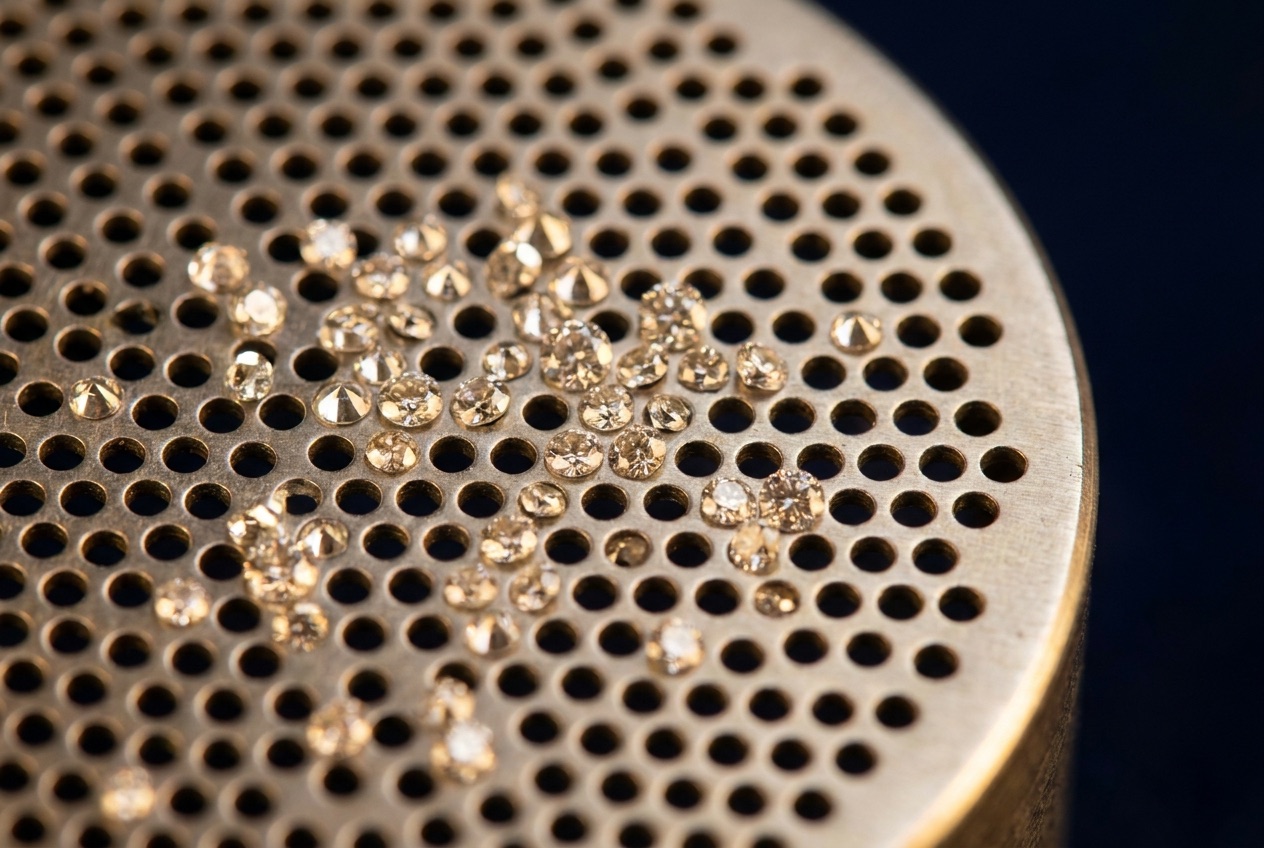
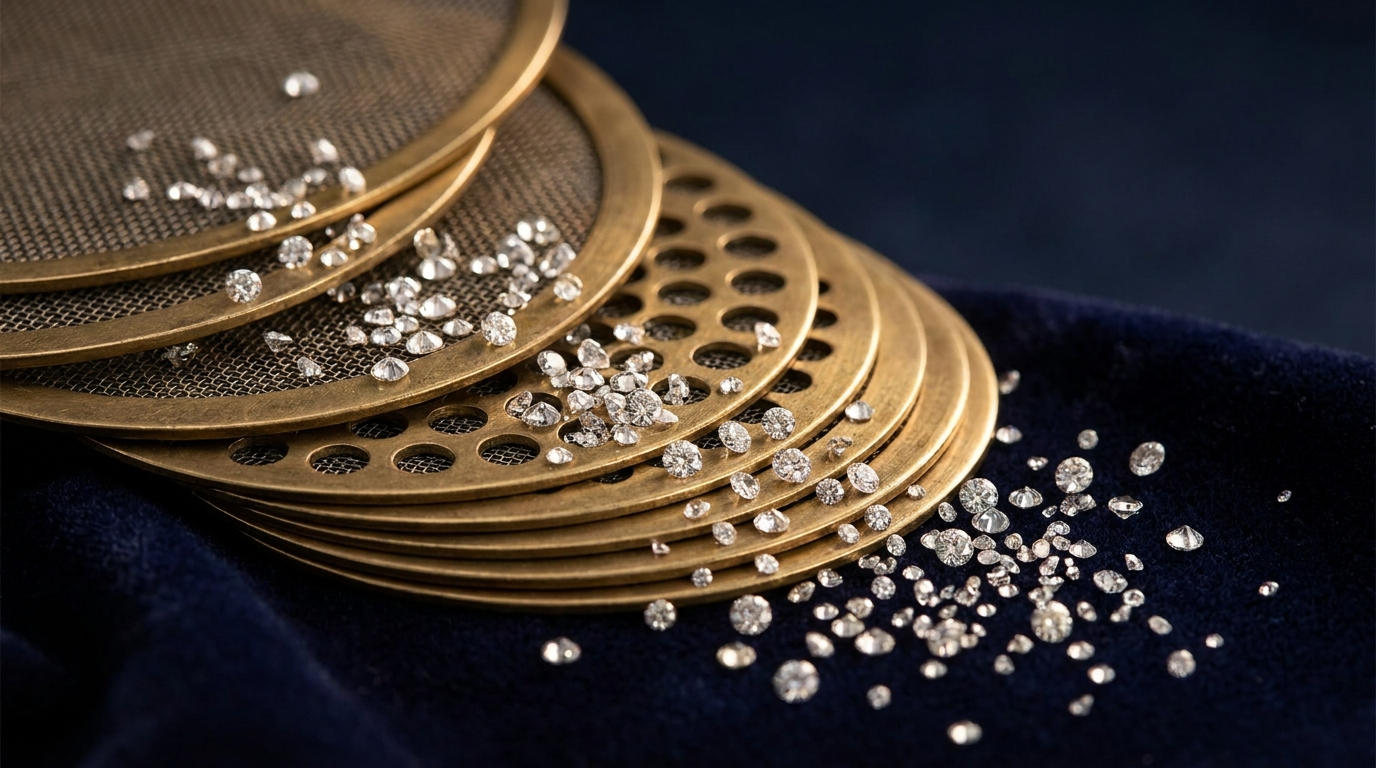
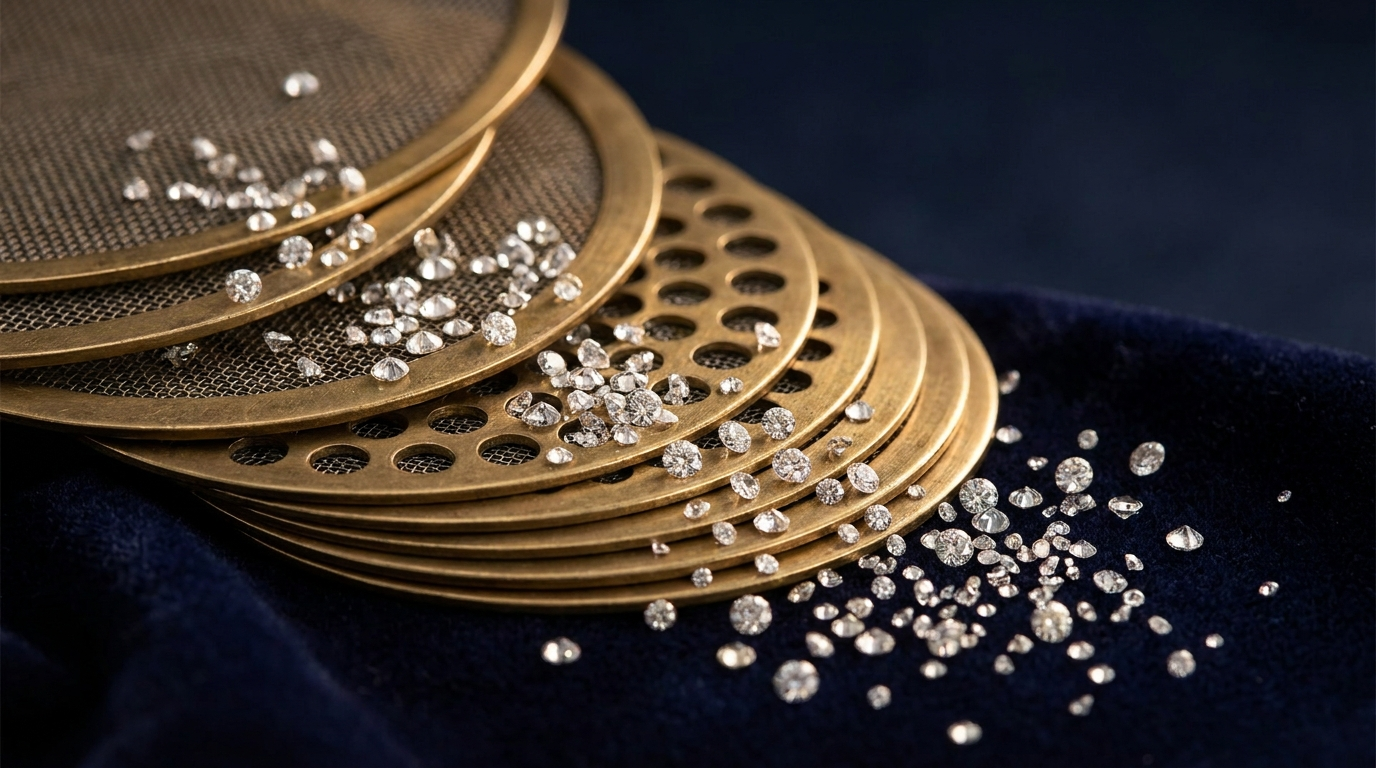
Sieve size is a physical sorting measurement, not a quality opinion. Loose round stones are shaken through a stack of metal plates, each drilled with a slightly larger row of holes than the one below it. A stone that falls through one plate but rests on the next is bracketed between two known mesh openings — sold, for example, as "17/18 sieve." That's faster and more consistent at melee volume than hand-measuring thousands of tiny rounds with a gauge, and it's why parcels get quoted by sieve size first and carat weight second, with the price grid above riding on top of that same sizing convention.
This matters for a 2026 rate card specifically because sieve size, not carat weight, is usually the first thing a buyer knows when speccing a job. A CAD file or a repair ticket typically calls out a millimeter or sieve size the setting needs to hold — not a carat figure. The rate card above lets you go straight from that spec to a per-carat number without an intermediate conversion step, provided you're reading the correct row for your size.
Why Does Price Per Carat Climb as Sieve Size Increases?
Walk any single quality column top to bottom on the rate card and the price climbs steadily from the smallest sieve size to the largest — roughly 2.3x from the cheapest cell to the most expensive, even though every stone on the grid is still comfortably under a carat. The driver is rarity, and it compounds two separate ways as sieve size increases.
First, diamond weight scales with the cube of diameter, not the diameter itself. A stone cut to Sieve 36/38 (around 4.00mm) holds roughly eight times the volume, and by extension weight, of one cut to Sieve 19/20 (around 2.00mm) — because volume scales with the cube of diameter (2³ = 8), not with the mm figure directly. Each step up the sieve stack pulls from a proportionally smaller, more competitive slice of available rough than the step below it, which is the main force behind the steady climb from Sieve 8/9 up to Sieve 36/38 on this rate card.
Second, there's a labor exception worth flagging at the very bottom of the card: GH SI actually prices lower at Sieve 12/13–16/17 ($370) than it does at Sieve 8/9–11/12 ($450). That's the one place on the whole grid where the smaller sieve size costs more, not less — and it's a cutting and sorting labor effect, not a rarity effect. Star-size melee at Sieve 8/9–11/12 can run 200+ stones to the carat, meaning far more handling per carat of finished weight than the row just above it. Below that size, labor drives the price; above it, sieve-driven rarity takes over and the climb is steady the rest of the way to Sieve 36/38.
How Do Color (EF/GH) and Clarity (VS/SI) Move the Rate at a Given Sieve Size?
Hold sieve size constant and the rate card still moves, because color and clarity are a second, independent axis on top of size. Within any row, EF always prices above GH, and VS always prices above SI — at Sieve 17/18–20/22, for example, EF VS runs $450 against GH SI's $400, a roughly 12.5% spread at the identical sieve size. That gap tracks the same rarity logic as size: rough crystals close to colorless (E–F) and cleaner internally (VS) make up a smaller share of what comes out of the ground than warmer, more included material, and that scarcity holds at melee scale even though the color and clarity difference is subtler to the eye at 2mm than at half a carat.
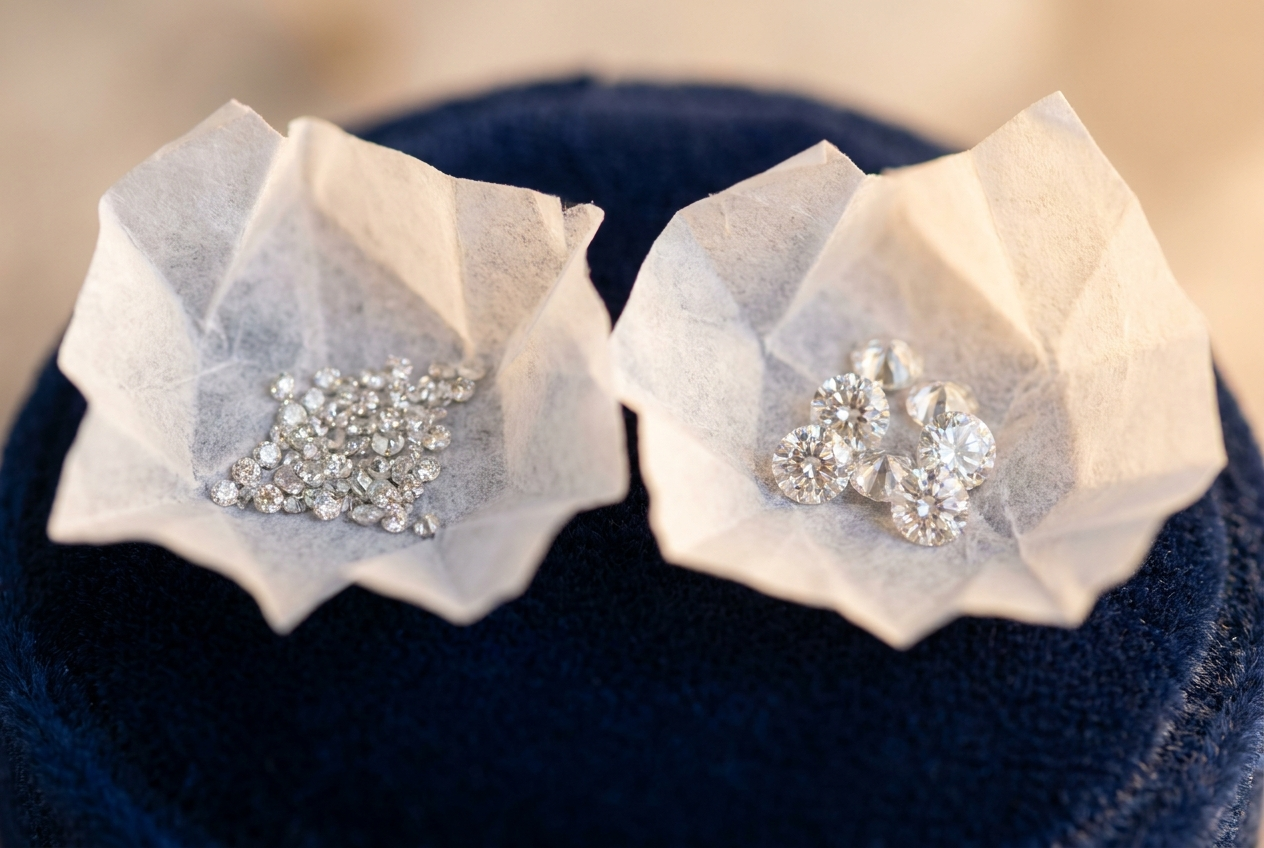
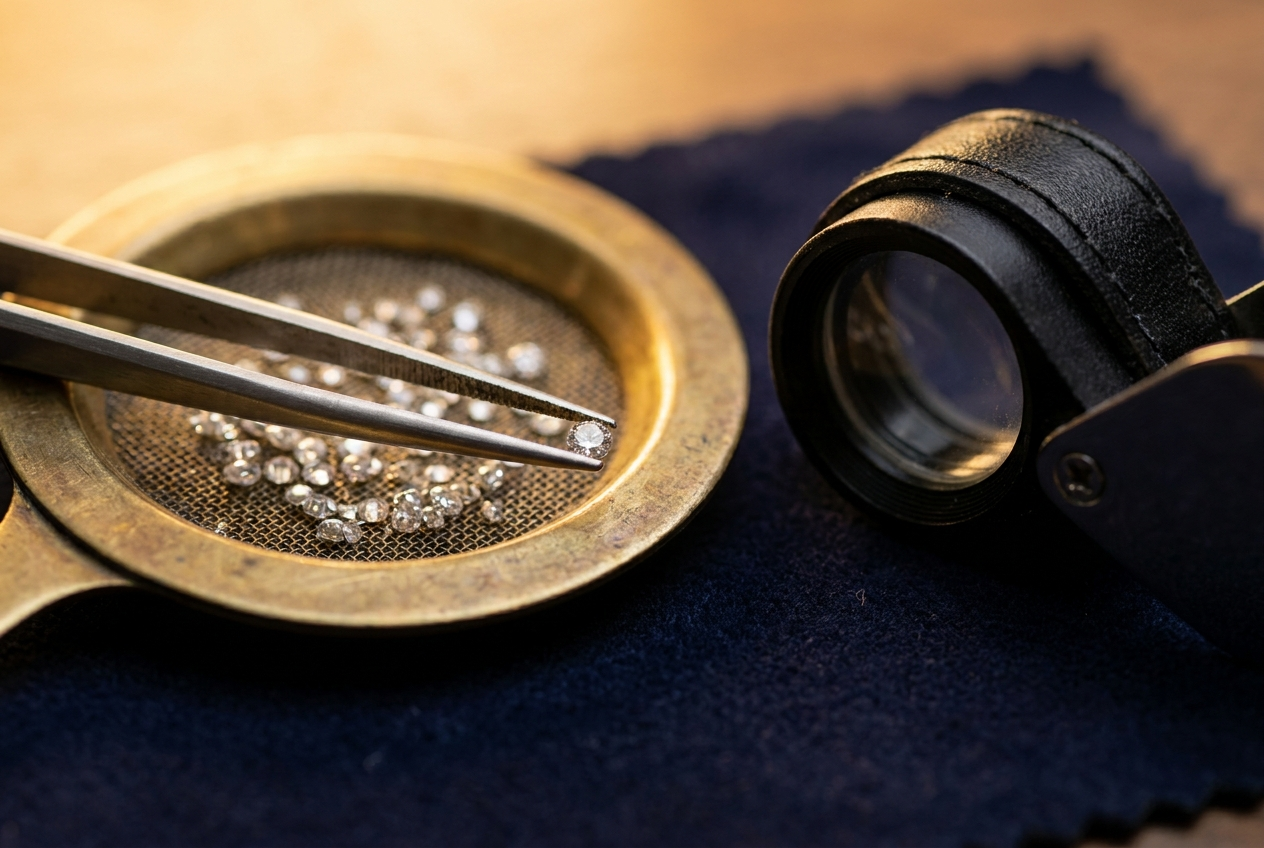
Because EF and GH are blended ranges rather than single grades, and because melee this small isn't individually graded, sorting happens comparatively — a parcel is screened against a master stone representing the middle of the target band. Two EF VS parcels quoted weeks apart at the same sieve size can look and price marginally differently even though both are correctly labeled EF VS, simply because the blended range has real width and where a given parcel sits inside it shifts with what's available to sort at the time.
One practical read of the rate card: at the smallest sieve sizes (up to Sieve 16/17, under 1.70mm), GH is the only column populated — there's no EF/GH choice to make yet, only a VS/SI one. From Sieve 17/18 up, both color tiers open, and the color decision starts to matter more the larger the sieve size gets, since larger stones sit more visibly in a finished piece.
Which Sieve Sizes Are Cheapest and Most Expensive on the 2026 Rate Card?
The single cheapest cell on the entire 2026 rate card is GH SI at Sieve 12/13–16/17 (1.20–1.70mm), at $370 per carat — not the very smallest sieve size, for the labor reasons covered above. The single most expensive cell is EF VS at Sieve ~36/38 (4.00mm), at $900 per carat, sitting at both the largest sieve size and the top quality tier the grid prices.
A few other reference points worth having on hand when you're scanning the card for a specific job:
- Cheapest EF tier available: EF SI at Sieve 17/18–20/22 (1.70–2.20mm), $420/ct — the smallest sieve size where EF is priced at all.
- Steepest single jump between adjacent rows: Sieve ~32/34 (3.50mm) to Sieve ~36/38 (4.00mm), where every quality tier gains at least $200–$255 per carat in one step — consistent with Sieve 36/38 sitting at the outer edge of what's currently sourced.
- Most stable stretch of the card: Sieve 17/18 through Sieve 24/26 (1.70–2.60mm), where per-carat rates move in smaller, more even increments across both color tiers — a useful working range if your design has flexibility on exact sieve size.
None of these reference points replace an actual quote — they're here so you can sanity-check a number you're given, or plan a design's sieve size around cost before you request one.
Why Is This a Rate Card, Not a Fixed Catalog Price?
Every number on this page is a snapshot, confirmed at the point of order, not a locked retail price. Natural melee is quoted per parcel against sieve bands — that's standard practice across the trade, and it's worth understanding why rather than treating it as a hedge. A price band like Sieve 17/18–20/22 blends stones across the full 1.70–2.20mm range; a parcel that skews toward the top of that band runs heavier, and typically costs more, than one skewing toward the bottom, even under the identical rate structure. The same logic applies to color and clarity — each is a blended range, and where a given parcel sits inside it can drift slightly from quote to quote even within a correctly labeled tier.
Broader rough diamond market movement is the slower-moving factor behind quote variance: natural melee cost tracks the wider natural rough market over time, the way any commodity input tied to a mined resource does. Order size and what's sorted and on hand at the moment you ask also play in — a large single order against a sieve size that happens to be in thin supply that week may quote differently than the same volume spread across two smaller requests.
None of that makes the rate card above unreliable. It means: use it as the right ballpark to plan a design and a budget against, and confirm the exact per-carat number on WhatsApp before committing a production run to it. Exact-to-the-cent pricing off a published table would be false precision in a trade that quotes parcel by parcel — the rate card's job is to get you within a few dollars of the real number before you ever request one.
What's the Rate Card Gap Above Sieve 36/38 / 4.0mm?
Sieve ~36/38, roughly 4.00mm, is the honest current ceiling of this rate card. Natural round melee above that size isn't priced or sourced on Guru Diam's program right now — that's a genuine open gap, not a conservative quote or a placeholder number. If your build calls for natural round stones larger than 4.0mm, that's outside today's rate card entirely; ask when you request a quote rather than assuming coverage, and don't plan a production timeline around when a size above 4.0mm might get added, since there's no confirmed date for that.
It's also worth being precise about scope on the other axis: this entire rate card, at every sieve size, covers round shapes only. Fancy natural melee shapes — oval, princess, pear, and similar — aren't yet priced or sourced on this program either. If a design calls for both a size above 4.0mm and a fancy shape, both are currently outside what this card, or Guru Diam's natural melee line generally, can quote.
How Do You Use This Rate Card to Budget a Real Order?
Once you know your sieve size and quality tier, budgeting is a straightforward multiplication: total cost is the per-carat rate from the card above, multiplied by the total carats your job needs. A few worked examples make the arithmetic concrete rather than abstract:
- A pavé halo using an estimated 0.60 total carats of GH VS melee at Sieve 17/18–20/22: 0.60 × $417.50 ≈ $250.50 for the melee.
- An eternity band using an estimated 1.20 total carats of EF VS melee at Sieve ~22/24–24/26: 1.20 × $510 ≈ $612 for the melee.
- A tennis bracelet using an estimated 3.50 total carats of GH SI melee at Sieve 28/30: 3.50 × $575 ≈ $2,012.50 for the melee.
These are illustrative examples built off the rate card, not fixed quotes — your actual carat requirement depends on your specific design and stone count, and your actual price is confirmed at quote. If you're starting from a stone count or a sieve size rather than a carat figure, convert to carats first (a mm-to-carat-to-sieve reference does that conversion), then run this same multiplication against the correct row on the rate card above. A design spanning multiple sieve sizes — graduated pavé stepping from Sieve 14/15 to Sieve 20/22, for instance — should be budgeted one row at a time rather than averaged into a single blended rate, since the per-carat number genuinely differs row to row.
How Does This Sieve-by-Sieve Rate Card Compare to Lab-Grown Melee Pricing?
Natural melee generally carries a higher per-carat rate than lab-grown melee at a comparable sieve size and quality tier, reflecting the difference between mined rough and manufactured material rather than any difference in how the two are sized or sold. The mechanics on this page — sieve-based sizing, blended color/clarity bands, per-carat parcel quoting confirmed at order — are shared conventions across both natural and lab-grown melee; what differs between the two lines is the rate itself, not the pricing logic. Guru Diam runs natural and lab-grown (CVD) melee as two completely separate product lines with their own size availability and their own pricing, and the two should never be treated as interchangeable numbers — a rate from this natural rate card doesn't translate to the lab-grown line, and vice versa.
If you're actively weighing natural against lab-grown for a specific build, see our size-by-size natural vs. lab-grown melee price comparison for the direct breakdown rather than assuming the figures on this page translate. For sieve sizing on the lab-grown side specifically, Guru Diam's lab-grown melee size chart covers that program's own size and grade bands, which run separately from the natural rate card above.
How Do You Get an Exact Quote Against a Specific Sieve Size?
A precise ask gets a precise quote back. When you reach out, have four things ready: the exact millimeter size or sieve size your setting calls for; the color/clarity tier (EF VS, EF SI, GH VS, or GH SI); the total carat weight you need, converted from stone count if that's how your design is specced; and your calibration tolerance if the setting is tight — standard trade tolerance runs about ±0.10mm dimension and ±0.10ct weight, with roughly a one-grade color/clarity match.
Round shapes only, for now, and nothing above Sieve ~36/38 (4.0mm) — plan production against the current rate card rather than the size or shape you'd ideally want. Reach out on WhatsApp at +1 347 812 2006, or via the contact page, and reference the sieve size and quality tier from the rate card above to get a fast, exact quote confirmed against current parcels.
Frequently Asked Questions
What is the natural melee diamond price per carat in 2026? Guru Diam's current sell price runs roughly $370 to $900 per carat, depending on sieve size (Sieve 8/9 through Sieve 36/38, about 0.8mm to 4.0mm) and color/clarity tier (EF VS, EF SI, GH VS, GH SI). Treat these as approximate, quote-confirmed figures rather than a fixed catalog price.
How do I find the price for a specific sieve size? Use the rate card above: find your sieve size (or millimeter size) in the left-hand columns, then read across to your color/clarity tier for the approximate per-carat rate. Confirm the exact number at quote before committing a production budget to it.
Why isn't the smallest sieve size the cheapest on the rate card? Sieve 8/9–11/12 (up to 1.20mm) actually prices higher than Sieve 12/13–16/17 (1.20–1.70mm) in the GH SI tier — $450 versus $370. That's a labor effect, not a rarity effect: star-size melee under 1.20mm can run 200+ stones to the carat, adding more cutting and sorting work per carat than the row just above it.
What's the largest sieve size Guru Diam currently prices? Sieve ~36/38, roughly 4.00mm. Natural round melee above that size is a genuine gap in what's currently priced and sourced — not a conservative quote. Fancy natural melee shapes aren't yet priced or sourced at any sieve size.
Why do sieve sizes on this rate card sometimes show an approximate ("~") label? Guru Diam's price grid is organized by its own millimeter quoting bands, which don't always land on a clean sieve-plate boundary, and sieve numbering conventions themselves vary slightly by supplier and region. Treat the sieve label as a reference point and confirm the exact plate size against your actual parcel at quote.
Does natural melee pricing by sieve size differ from lab-grown melee pricing? Yes, in rate but not in mechanics. Both lines are quoted per carat against sieve-style size bands with blended color/clarity ranges, but natural melee generally prices higher than lab-grown at a comparable sieve size and tier, reflecting mined rarity versus manufactured supply. The two lines are never quoted interchangeably.