
The Melee Diamond Size Chart MM to Carat to Sieve, with Calibration Tolerances

A melee diamond size chart mm to carat is the conversion reference every buyer needs before placing a parcel order: it maps a stone's millimeter diameter to its approximate carat weight and to the sieve plate that screens it. For round-brilliant melee, 1.0 mm runs about 0.005 ct, 2.0 mm about 0.03 ct, and 3.0 mm about 0.10 ct. Bookmark the table below.
If you set pavé, build halos, run tennis lines, or assemble eternity bands, you order melee by the parcel and you live or die by calibration. Get the millimeter wrong by a tenth and the goods seat high, rock in the bezel, or refuse to drop into a channel. This is the working reference our New York and Los Angeles desks hand to trade partners so a melee order ships right the first time. Use it operator-to-operator: spec the mm, confirm the weight expectation, and lock the tolerance before money moves.
What "Melee" Means, and Why Sizing Conventions Exist
In the trade, melee means the small accent diamonds that surround or accompany a center stone — pavé, halos, side rows, tennis links, eternity channels. The practical ceiling is roughly 0.18–0.20 ct, which corresponds to about 3.8–4.0 mm in a round brilliant. Above that you are into "pointer" goods talked about by individual weight rather than parcel; below it, you are buying by size and screening through sieves.
Melee is the highest-frequency SKU on most benches because almost every mounting consumes it. That also makes it the line item most exposed to sloppy spec. A parcel that grades beautifully but runs +0.10 mm oversize against your seats is a rework problem disguised as a good buy. The size chart exists to take that variable off the table.
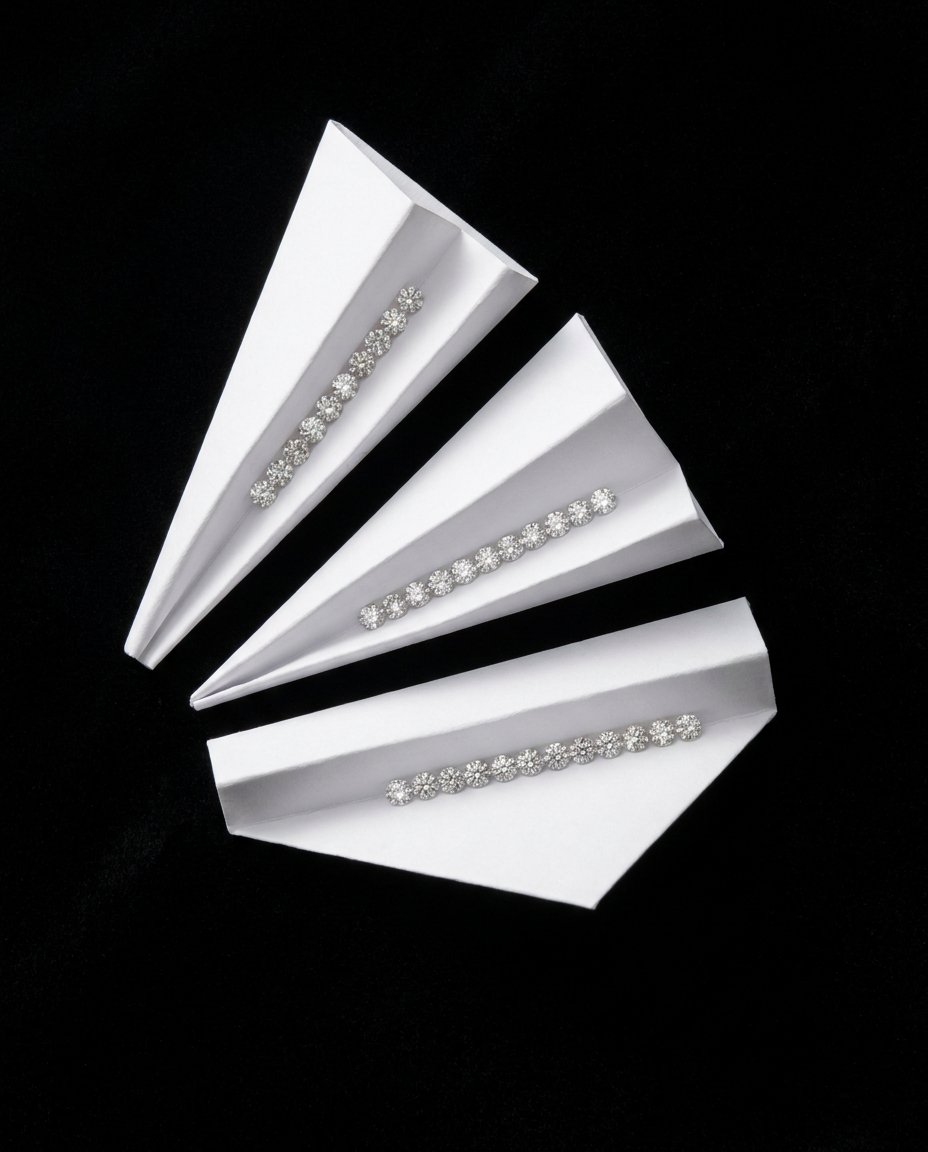
Sizing conventions exist because melee is never bought or sold one stone at a time. A center diamond gets inspected under a loupe, compared against a cert, and priced individually. Melee does not work that way — a parcel might carry anywhere from a few dozen to several thousand stones, and no bench has time to measure each one before it goes into a seat. The industry solved this by agreeing on a shared language: millimeter diameter as the physical spec, carat weight as the cost basis, and the sieve plate as the mechanical sorting standard that ties the two together. A cutter in one city and a setter in another can speak in the same mm number and both know exactly what will show up. Without that shared convention, every order would require a physical sample exchange before either side could trust the fit — which is exactly the friction the size chart eliminates.
Carat weight alone cannot do this job, because weight is a mass measurement and a seat is cut to a physical diameter. Two stones of identical carat weight can differ slightly in spread depending on cut proportions, so the trade defaults to millimeter as the primary spec and treats the carat figure as the expected-weight companion number, not the ordering unit.
How Sieve Sizing Works: The Physical Screening Process
Loose melee is sorted into size bands by sieve plates — flat discs or trays machined with a grid of round holes, each plate cut to a precise diameter. A full sieve set is stacked in descending hole size, largest opening on top, smallest at the bottom, with a solid catch pan underneath. Loose rough-sorted melee is poured onto the top plate and the stack is shaken, either by hand on a small bench set or mechanically on a vibratory sieve shaker for volume lots. Stones fall through every hole larger than their own diameter and are caught on the first plate whose openings are too small to pass them. A stone that measures 1.52 mm, for example, will fall through a 1.55 mm plate but sit on a 1.50 mm plate — that plate becomes its size band.
This is a purely physical, diameter-based sort. It says nothing about a stone's color, clarity, or cut quality — it only groups stones that share a common spread, because a sieve hole does not care what the stone looks like, only whether it fits through. That is precisely why sieving is the right tool for calibration and the wrong tool for grading: the two jobs happen separately, sieving for size and a trained sorter's eye (or automated color/clarity sorting equipment for higher-volume lots) for quality.
Once a batch is caught on its plate, a spot-check with a hand micrometer or a jeweler's leaf gauge confirms the plate did its job — sieve holes wear slightly with repeated use, and a worn plate can drift a few hundredths of a millimeter out of spec over time, which is one reason reputable suppliers recalibrate or replace plates on a set schedule rather than running them indefinitely. The stated tolerance on a parcel (see the table below) is the plate's real-world accuracy, not a marketing number — it is the actual band width the physical hole allows.
Sieving works cleanly for round brilliants because a circle only has one dimension: diameter. It gets more complicated for fancy melee shapes, which is covered further down — an emerald-cut or marquise melee stone has a length and a width, so a single round hole cannot sort it the same way. Fancy melee is typically screened on slotted or rectangular-aperture plates, or sorted by hand against a gauge, which is slower and part of why fancy melee commands a size-availability premium over round.
The Master Melee Size Chart: MM to Carat to Sieve
Here is the canonical round-brilliant reference, expanded with additional size points between the trade's standard sieve steps. These mm-to-carat figures are the working numbers our desks quote against — use them to convert a design's millimeter callout into the parcel weight you should expect, and to anticipate stone count per carat.
| Diameter (mm) | Approx. weight (ct) | Trade size class | Stones per carat (approx.) |
|---|---|---|---|
| 0.8 mm | 0.0025 ct | Star / fine melee | ~400 |
| 1.0 mm | 0.005 ct | Star | ~200 |
| 1.1 mm | 0.007 ct | Star | ~143 |
| 1.25 mm | 0.01 ct | Star / 1-pointer | ~100 |
| 1.4 mm | 0.013 ct | Star (large) | ~77 |
| 1.5 mm | 0.015 ct | Full | ~67 |
| 1.6 mm | 0.017 ct | Full | ~59 |
| 1.75 mm | 0.02 ct | Full / 2-pointer | ~50 |
| 1.9 mm | 0.027 ct | Full | ~37 |
| 2.0 mm | 0.03 ct | Full / 3-pointer | ~33 |
| 2.25 mm | 0.045 ct | Pointer | ~22 |
| 2.5 mm | 0.06 ct | Pointer | ~17 |
| 2.75 mm | 0.08 ct | Pointer | ~12.5 |
| 2.9 mm | 0.095 ct | Pointer (9-pt) | ~10.5 |
| 3.0 mm | 0.10 ct | Pointer (10-pt) | ~10 |
| 3.1 mm | 0.11 ct | Pointer (11-pt) | ~9.1 |
| 3.25 mm | 0.13 ct | Pointer (13-pt) | ~7.7 |
| 3.4 mm | 0.15 ct | Pointer (15-pt) | ~6.7 |
| 3.5 mm | 0.17 ct | Pointer (17-pt) | ~5.9 |
| 3.6 mm | 0.18 ct | Pointer (18-pt) | ~5.6 |
| 3.8 mm | 0.20 ct | Top of melee range | ~5 |
The stones-per-carat column is the one that saves you on costing. At 1.0 mm (0.005 ct), roughly 200 stones make one carat — so a 0.5-carat pavé build at that size is about 100 stones, and your per-stone setting labor, not the diamond cost, usually dominates. Read the chart in both directions: from a CAD millimeter callout to expected parcel weight, and from a target carat-weight-on-mounting back to stone count and setting time. Treat every figure as an approximation — actual weight varies slightly with a stone's exact crown height and girdle thickness, which is why suppliers quote weight per carat as "approx." rather than as a fixed conversion.
How Do Stars, Fulls, and Pointers Actually Divide Up?
These are parcel-floor terms, not lab grades, and usage varies slightly desk to desk — so confirm the mm with your supplier rather than trusting the word alone. As a working frame:
- Stars — the smallest melee, roughly under ~1.25 mm (under about a point each). Used for fine micro-pavé and fill work where stones read as sparkle, not individual diamonds.
- Fulls — the mid band, roughly 1.5–2.0 mm. The workhorse range for halos and shared-prong rows.
- Pointers — sold and discussed by their point weight: a "3-pointer" is ~0.03 ct (≈2.0 mm), a "10-pointer" is ~0.10 ct (≈3.0 mm), a "17-pointer" is ~0.17 ct (≈3.5 mm). Once a stone has a meaningful individual weight, the trade names it by points rather than lumping it as "full."
When you spec a job, lead with the millimeter because that is what the seat is cut for. Let the point/Star/Full label follow. Our round melee and pointers category is organized this way so you can shop the mm first.
Why Size Consistency Matters More for Melee Than for Single Stones
A center stone gets individual attention: the buyer looks at it, compares it to the report, and either accepts it or sends it back. Melee never gets that treatment. A halo of 40 stones or an eternity band of 60 is bought sight-unseen against a parcel spec, set on a bench, and only really inspected as a finished assembly — by which point a sizing problem is a rework problem, not a return.
The math works against you at scale. A single oversize stone in a hand-selected setting is a five-minute fix. The same 0.05 mm drift spread across an entire eternity line, where every seat was cut to the same CAD tolerance, shows up as a visible unevenness the length of the band — some stones sit proud, some sit low, and the channel line that was supposed to read as one continuous sparkle instead reads as uneven. In a shared-prong halo, an undersize stone rattles in its seat and can work loose over months of wear; an oversize stone forces the prong open and stresses the metal.
This is also why melee sizing is an upstream design problem, not just a purchasing one. A CAD file specifies seats to a fixed millimeter tolerance before a single stone is bought. If the parcel that arrives runs even slightly outside that tolerance, the mismatch is baked into every piece cast from that model until someone catches it and adjusts either the seat or the sourcing spec. Getting the size chart and the tolerance right before the mold is cut is far cheaper than reworking finished pieces after the fact.
Round melee tolerates this better than most fancy shapes simply because a round seat is forgiving in orientation — a slightly undersize round stone still centers itself under a bead or prong. Elongated fancy shapes (baguette, marquise, pear) do not have that luxury: an undersize or misaligned stone in a channel is visually obvious because the eye reads the long axis, not just the area.
How to Specify Melee Size Accurately When Ordering
Most sizing disputes trace back to an order that was specified incompletely, not to a supplier error. A complete melee spec covers five things, every time:
- Millimeter diameter, not just a point weight. "3-pointer" tells a supplier the target weight; it does not tell them your seat is cut for 2.00 mm rather than 1.95 mm. Lead with the mm.
- A stated tolerance. "1.5 mm" alone invites goods anywhere from roughly 1.45 to 1.60 mm. State ±0.05 mm for channel and micro-pavé work, ±0.10 mm for scattered independent accents.
- Total carat weight required, not a stone count. Quote and order melee by the carat — a request for "2 carats of 1.5 mm full-cut" gives a supplier a clean, checkable target; a request for a specific stone count assumes a conversion rate that varies slightly parcel to parcel.
- Shape and cut type. Round by default, but say so — and specify single-cut or full-cut (below) if the mounting calls for one over the other.
- Color and clarity range. Melee ships as an uncertified parcel against a stated quality baseline (commonly DEF+/VS+ for CVD lab-grown), not against individual reports — so the quality range has to be in the spec, not assumed.
Put those five items in writing on every purchase order, even for repeat suppliers. A verbal "same as last time" is how a tolerance or a shape detail quietly drifts across a dozen reorders.
Common Sizing Miscommunications and How to Avoid Them
A handful of mistakes account for most melee sizing disputes:
- Ordering by point weight alone. A "10-pointer" is a useful shorthand once both sides already agree it means 3.0 mm — but if your seat was actually modeled at 2.9 mm, you have a mismatch even though the weight label was technically correct. Always pair the point weight with the millimeter.
- Assuming stones-per-carat scales in a straight line. It does not — the relationship between diameter and weight is closer to cubic than linear, so a small size change near the top of the melee range (3.5 to 3.8 mm) moves the carat weight far more than the same size change near the bottom (1.0 to 1.3 mm). Always check the actual table rather than eyeballing a ratio.
- Leaving off the tolerance and assuming "calibrated" covers it. The word "calibrated" only means the parcel was sieved to a band — it does not tell you whether that band is ±0.05 mm or ±0.15 mm. State the number.
- Confusing a finished piece's total carat weight with a single stone's size. "0.50 ct total weight" on a halo describes the sum of every stone in the ring, not the size of any individual stone — the two numbers get mixed up constantly between sales staff and the bench.
- Treating a fancy melee callout as a single number. "3 mm marquise" is ambiguous on its own — a marquise has a length and a width, and two stones both loosely called "3 mm" can differ meaningfully in outline unless the length-to-width ratio is also specified.
- Assuming every supplier's sieve set is identical. Plates wear and get replaced on different schedules across different shops. If you are validating a new supplier, ask for a sample card against your own gauge before committing to a full parcel.
Most of these resolve with the same habit: write the millimeter, the tolerance, and the total carat weight on the order every time, and treat verbal shorthand as a starting point for the conversation, not the final spec.
Single-Cut vs Full-Cut Melee: Which Faceting Should You Order?
Two faceting standards live inside the melee range:
- Single-cut melee carries 17–18 facets. Historically common in the smallest sizes and in vintage repair, it shows broader, calmer flashes. It can be the right call when matching antique pieces or when a stone is so small that full faceting adds cost without visible return.
- Full-cut melee carries the standard 57–58 facets, the same architecture as a full-size round brilliant, and delivers the fine scintillation modern retail expects.
For most contemporary mountings, order full-cut. Reserve single-cut for restoration matching or deliberate vintage looks — and when you are working antique-cut centers, coordinate the accent stones the same way you would coordinate cuts in our antique-cut sourcing guide.
Size Availability Across Shapes: Round vs. Fancy Melee
Everything above the sieve-mechanics section describes round brilliant melee, and for good reason — round is the shape the entire size-chart convention was built around, because a circle has exactly one dimension to sort by. Fancy melee shapes work on a related but meaningfully different logic.
Round melee scales cleanly: one diameter number, one sieve plate, one weight. Fancy calibrated shapes — emerald, radiant, pear, and marquise are the standard calibrated fancy melee shapes in trade supply — have both a length and a width, so a single millimeter number is never a complete spec. A parcel of "3 mm marquise" could mean several different length-to-width ratios depending on the cutter's house standard; always confirm both dimensions, not just one.
This also affects how tightly a fancy melee parcel can be calibrated. A round stone drops through a round hole in one clean pass. A rectangular or pointed-oval outline has to be screened on a shaped aperture or sorted by hand against a two-dimensional gauge, which is slower and yields a slightly wider natural size spread than round goods at the same nominal size. If your design calls for calibrated fancy melee in a channel or a matched row, build in extra lead time for the sort and ask your supplier directly what tolerance they can hold on that specific shape — it is often wider than the round tolerance in the table above.
Availability follows the same logic: round melee is stocked deep across the entire 0.8–3.8 mm range because demand is constant and the sieve infrastructure is simple. Fancy calibrated melee is typically stocked in narrower, more common size bands rather than every fractional millimeter, because each additional size band requires its own gauge-sorted inventory. If a design calls for an unusual fancy melee size, confirm stock before finalizing the CAD rather than after.

Sourcing Considerations: Salting Risk and Lab-Grown CVD Melee
If you carry a natural melee line, the contamination risk to manage is "salting" — undisclosed lab-grown stones mixed into a parcel sold as natural. Because melee is screened by size, not individually certified, salting is hard to catch by eye and is an accurate-disclosure and trust problem before it is a cost problem. The defense is diamond-type detection instrumentation that screens parcels at scale.
This is a sourcing-discipline issue more than a chart issue, so we treat it in full in Melee Screening 101: how to avoid lab-grown salting. The short version: buy from suppliers who screen and disclose, and screen again on intake. For trade context on disclosure expectations, the Federal Trade Commission jewelry guidance and the grading framework published by GIA set the baseline both labs and buyers work from.
The mm-to-carat conversions above apply identically to lab-grown melee — a 1.0 mm stone is ~0.005 ct whether it grew via CVD or came out of the ground, because lab-grown shares the same physical, chemical, and optical properties as mined diamond. What changes is the certification posture and the cost structure.
For lab-grown melee, IGI is the practical trade default; IGI grades the large majority of lab-grown diamonds, and the International Gemological Institute report is what most parcels reference. Note that melee is generally bought against size and a stated quality range rather than individual stone certs — the cert conversation matters most as you move up into pointer and center goods. Where buyers do compare reports, hold to one rule: compare reports from the same lab, since a stone can grade up to about one color grade differently between labs.
Practical Melee Ordering Checklist
Before a melee purchase order goes out, run it against this list:
- Shape confirmed — round, or the specific fancy calibrated shape (emerald, radiant, pear, marquise)
- Millimeter diameter specified — not a point weight or a Star/Full/Pointer label alone
- Tolerance stated — ±0.05 mm for channel, eternity, and micro-pavé; ±0.10 mm for scattered accents
- Total carat weight required — quoted and confirmed in carats, never as a stone count
- Cut type confirmed — single-cut or full-cut
- Color and clarity range stated — the quality baseline the parcel is screened against
- Natural or lab-grown confirmed, with certification posture (parcel-level quality range vs. individual report) agreed up front
- For a new supplier relationship: a sample sieve card requested and checked against your own gauge before the full parcel ships
A parcel that satisfies every line on this list is one that drops into a precut seat without a bench conversation. Everything on it is a five-second confirmation if you already have the answer — the checklist earns its keep on the order where one of these was never actually decided.

Order Melee That Drops In Clean — All Under One Roof
Spec it once, ship it right. Guru Diam holds 11,000+ IGI and GIA certified stones across our New York and Los Angeles desks, with calibrated round melee and pointers, fancy color accents, and matched goods on real-time inventory — natural and lab-grown, All Under One Roof.
- Open a verified wholesale account at /signup
- Book a parcel review at our NY or LA desk at /book-appointment
Bookmark this chart, then send us the millimeter and tolerance — we will quote against these exact numbers. For fancy accents, see fancy color melee sourcing.
Frequently Asked Questions
How many melee diamonds make one carat? It depends entirely on size. At 1.0 mm (about 0.005 ct each), roughly 200 stones make one carat. At 2.0 mm (about 0.03 ct), it is roughly 33 stones, and at 3.0 mm (about 0.10 ct), about 10 stones. Always convert from the millimeter your mounting calls for, not from a generic average.
What is the largest size still considered melee? The practical ceiling is roughly 0.18–0.20 ct, which is about 3.8–4.0 mm in a round brilliant. Above that, stones are usually bought and discussed by individual weight as pointers rather than sorted by parcel.
What calibration tolerance should I ask for? Calibrated melee typically runs ±0.05 to 0.10 mm. For micro-pavé, channel, and eternity work, specify the tight end (±0.05 mm); scattered independent accents tolerate ±0.10 mm. Always state a tolerance with your millimeter — a size callout without one invites out-of-spec goods.
What is the difference between single-cut and full-cut melee? Single-cut melee has 17–18 facets and a calmer, broader flash, often used in the smallest sizes or for vintage matching. Full-cut melee has the standard 57–58 facets, matching a full round brilliant, and is what most modern retail mountings call for.
What do Stars, Fulls, and Pointers mean? They are trade parcel terms. Stars are the smallest melee (roughly under ~1.25 mm); Fulls are the mid band (roughly 1.5–2.0 mm); Pointers are larger melee named by point weight (a 10-pointer is ~0.10 ct, ~3.0 mm). Usage varies by desk, so always confirm the actual millimeter.
Should I order natural or lab-grown melee? Both convert on the same mm-to-carat chart. Lab-grown melee (CVD) typically lowers your accent-stone cost and references IGI grading. If you run a natural line, screen incoming parcels for salting with diamond-type detection. Many partners stock both tracks to fit the mounting and the price point.