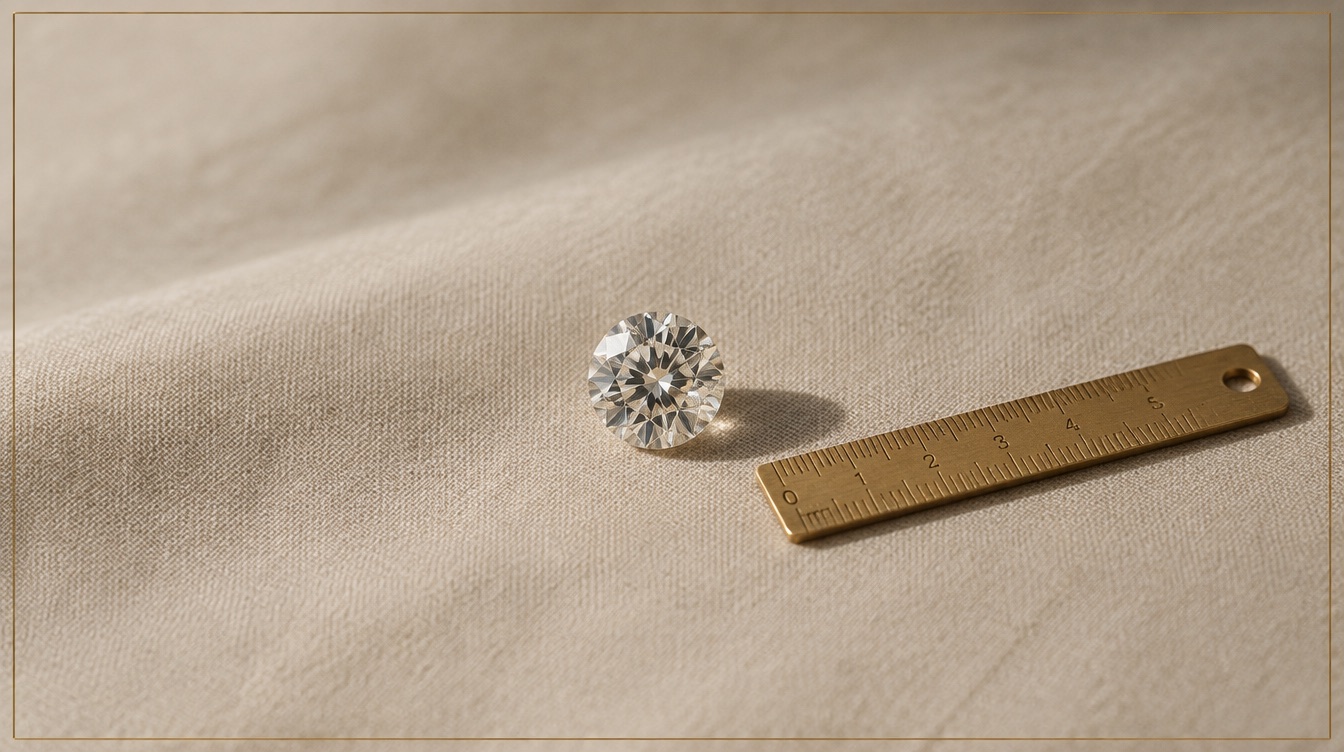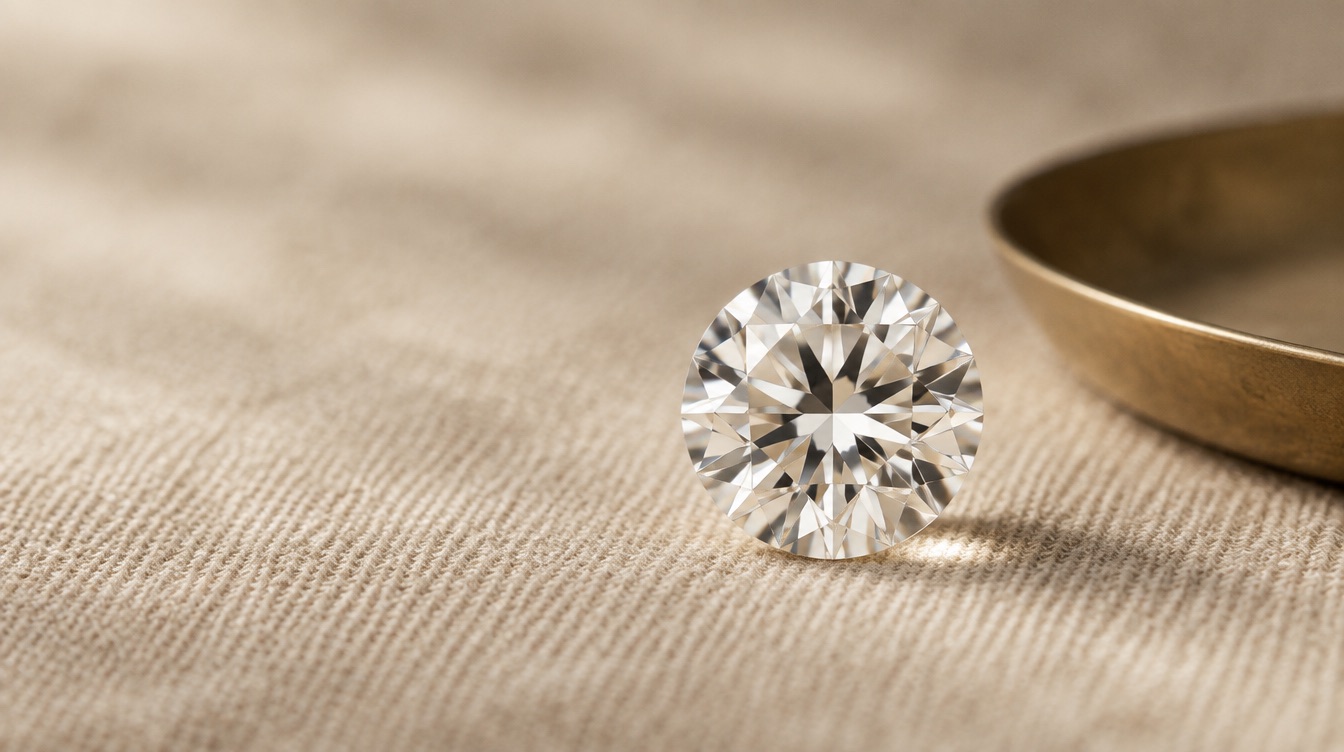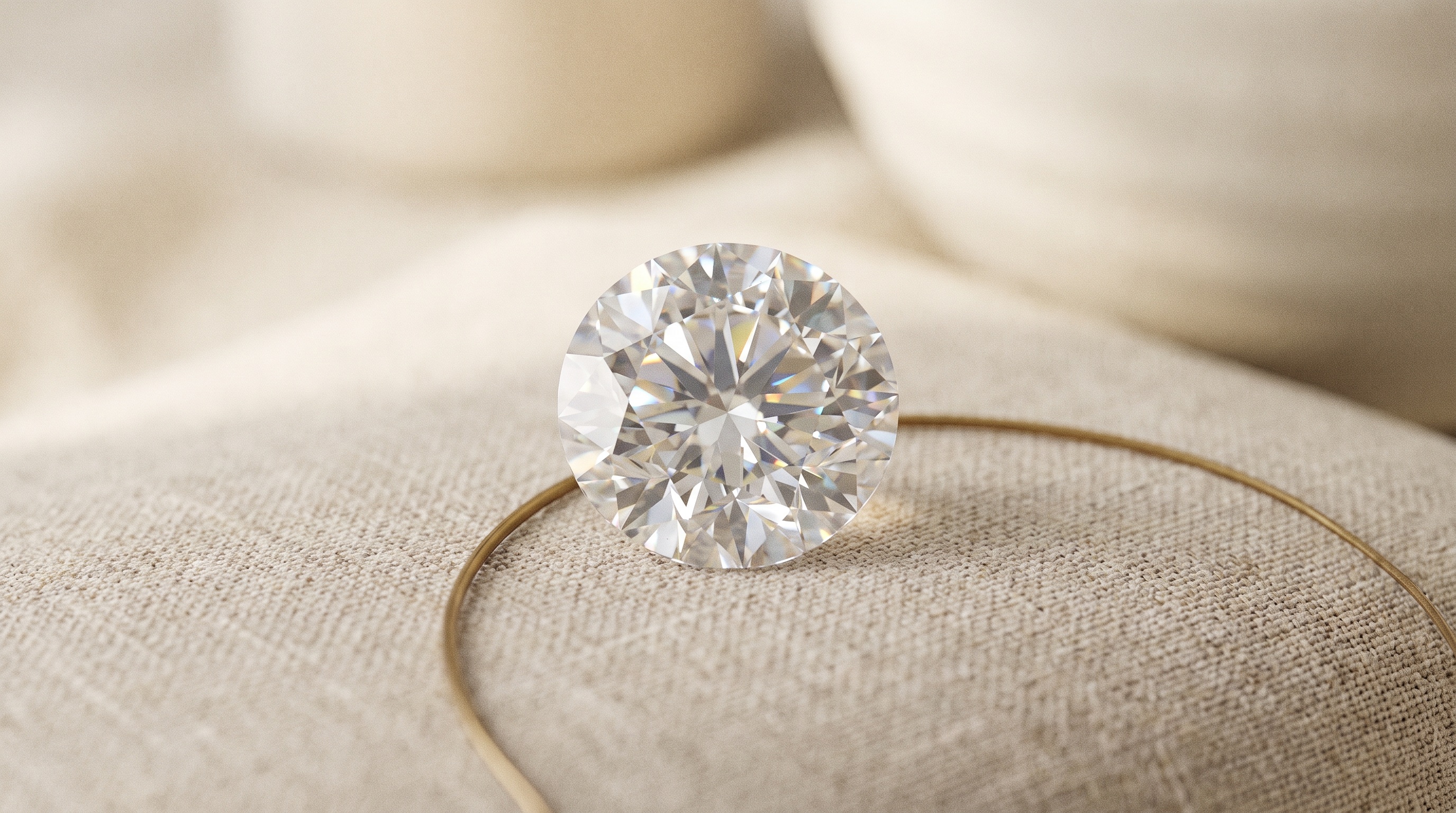
A natural melee diamond size chart converts millimeter diameter to carat weight to trade sieve size for loose round natural diamonds under 0.20ct. As a rule of thumb, a 1.0mm natural round runs about 0.005ct (roughly 200 stones per carat), a 2.0mm round runs about 0.03ct (roughly 32 stones per carat), and a 3.0mm round runs about 0.10ct (roughly 10 stones per carat). Guru Diam currently prices natural melee from 0.8mm to 4.0mm across the EF and GH color/VS and SI clarity grid — use the full chart below to convert any millimeter callout on a spec sheet into the carat weight and sieve size your parcel will actually ship against.
What Does "Sieve Size" Mean for Natural Melee Diamonds?
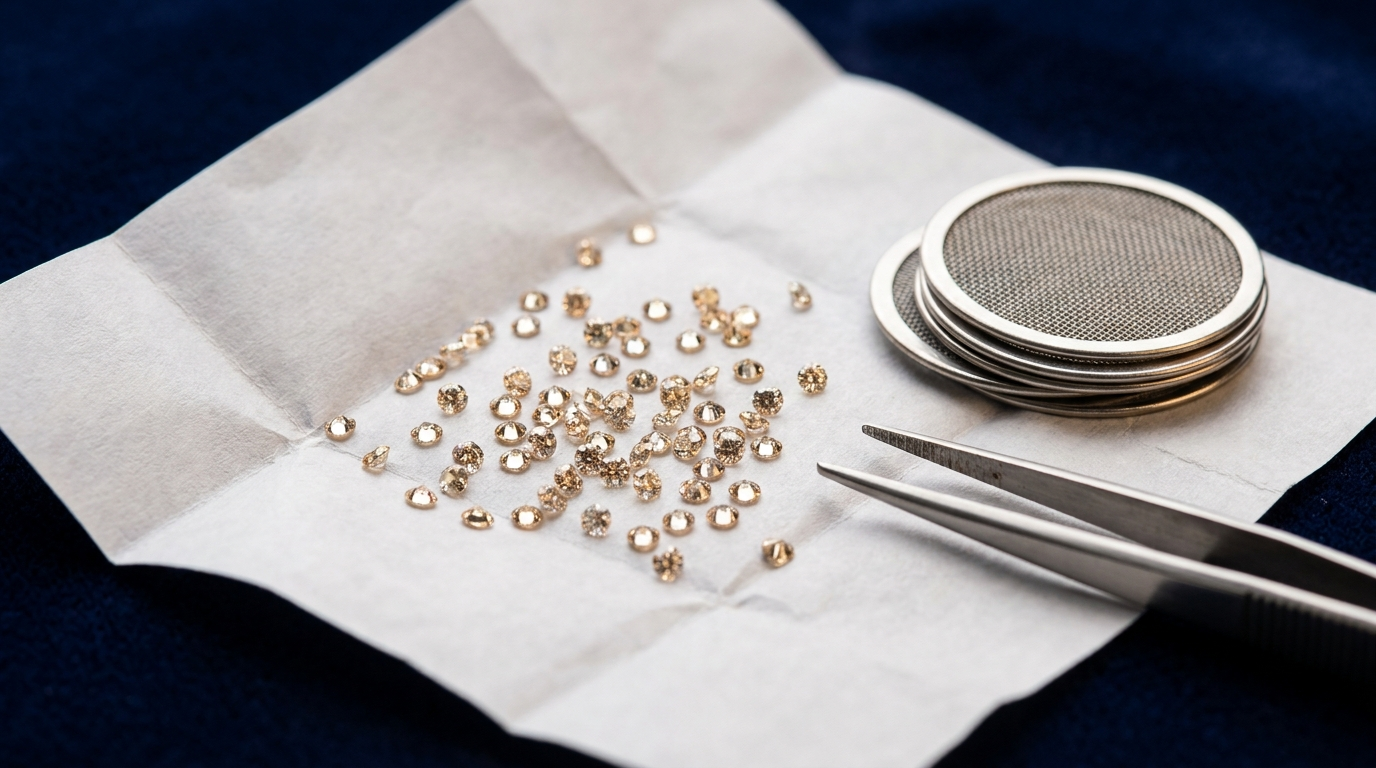
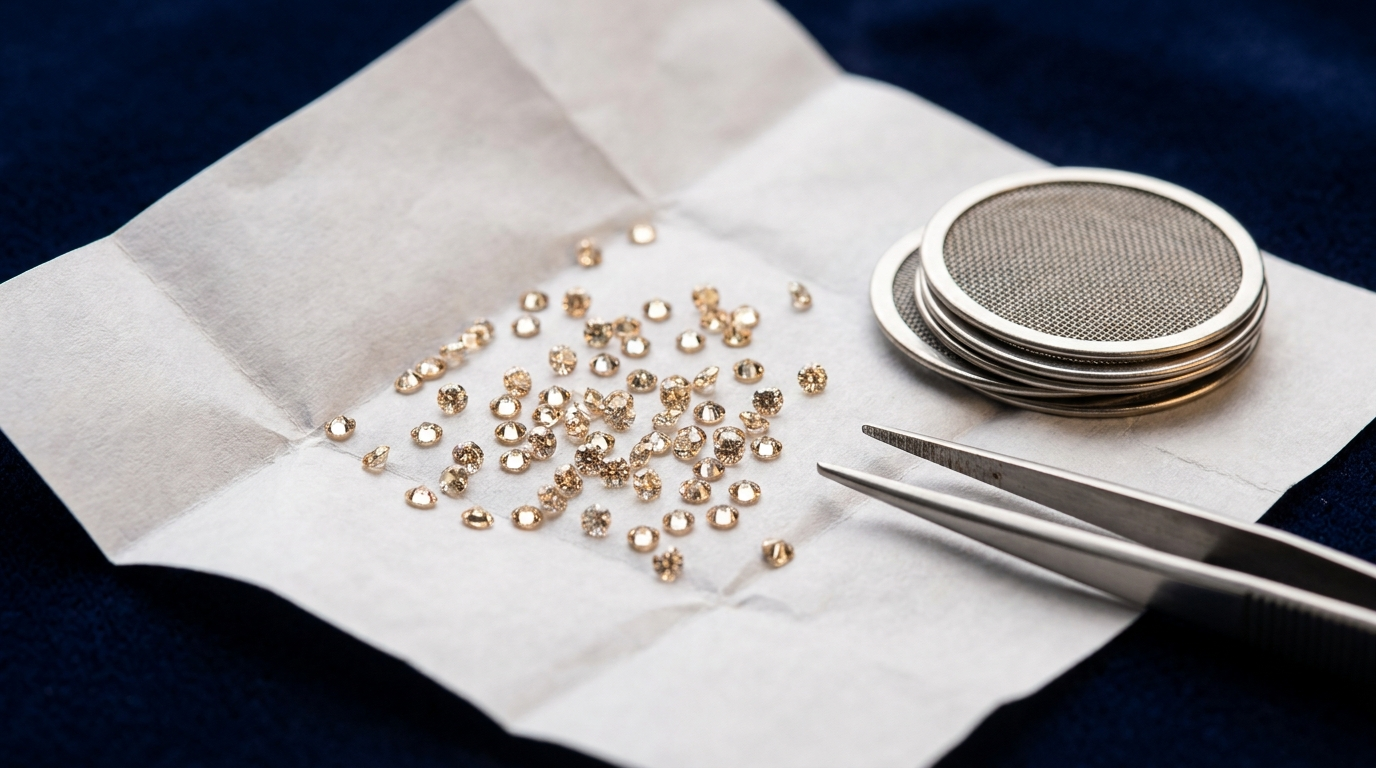
Sieve size is a physical sorting measurement, not a grading opinion. In the natural melee trade, loose round stones are shaken through a stack of metal plates, each drilled with a slightly larger row of holes than the one below it. A stone that falls through an 18-hole plate but sits on a 17-hole plate is sold as "17/18 sieve" — its diameter is bracketed between two known mesh openings, not measured stone by stone with a gauge. This is faster and more consistent than hand-measuring thousands of tiny rounds, and it's the reason natural melee parcels are quoted by sieve size first and carat weight second.
The convention matters for buyers because a sieve number is a size specification, not a quality grade. Two parcels at the same sieve size can carry different color and clarity — that's set separately on Guru Diam's EF/GH, VS/SI grid, covered further down. When you're speccing a repair job or a production run, "17/18 sieve, GH VS" is a complete, ordering-ready callout; "small diamonds, good quality" is not.
You'll also hear melee described by older trade shorthand — Stars for the smallest goods (roughly under 1.25mm), Fulls for the mid-size band (roughly 1.5mm–2.0mm), and Pointers for larger melee named by point weight, where a "10-pointer" means approximately 0.10ct, or about 3.0mm. These terms are still used verbally on the trading floor, but they're not precise enough for a purchase order on their own — usage shifts from desk to desk. Lead with sieve size or mm on paper, and treat Stars/Fulls/Pointers as the conversational shorthand behind it.
How Do You Convert MM to Carat for Natural Melee?
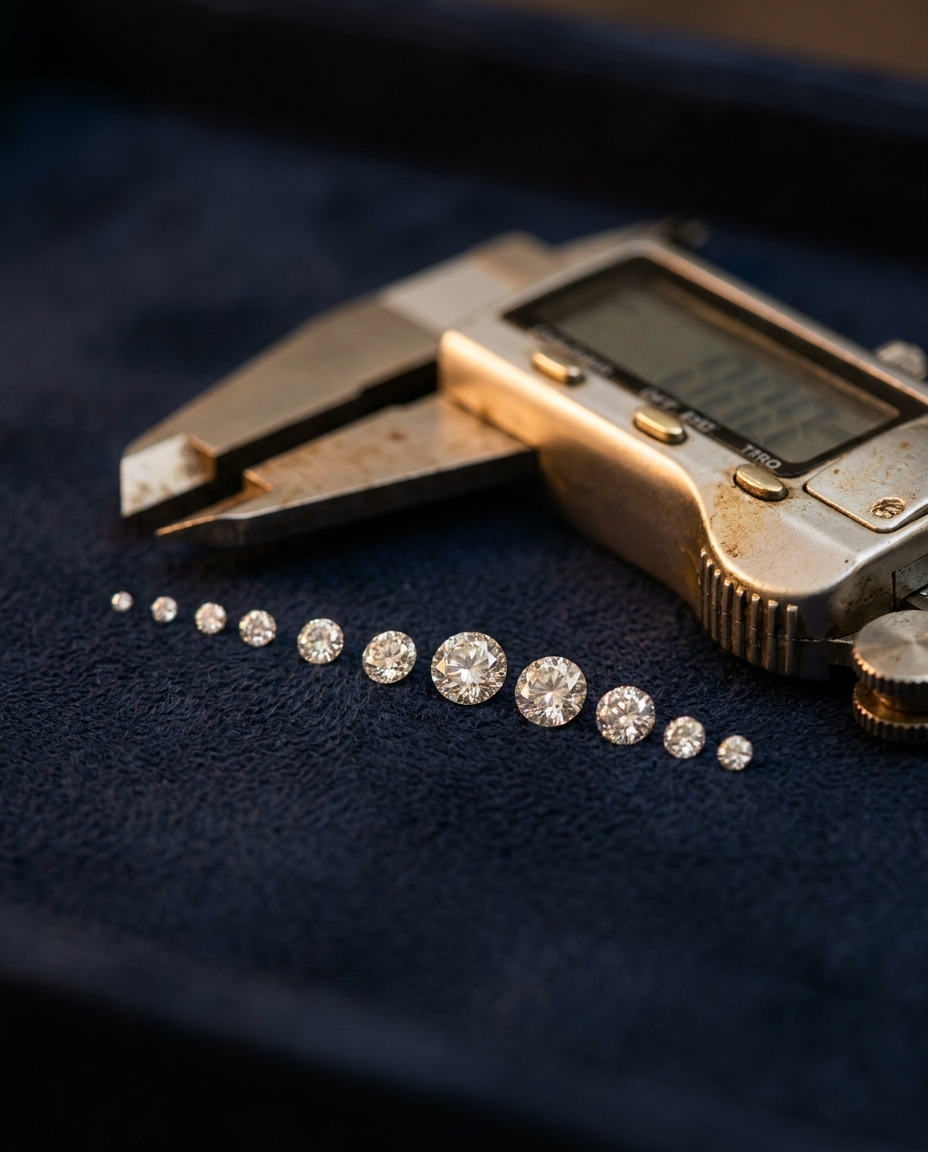
Round brilliant weight scales with the cube of the diameter — a stone that's twice as wide is roughly eight times heavier, not twice as heavy. That's why melee carat weight climbs slowly at the smallest sizes and then accelerates fast once you cross about 2.5mm. It's also why "just double the carat weight for double the size" is the single most common estimating mistake we see on incoming purchase orders.
The practical fix is to always convert from the chart rather than eyeballing it, and to convert in the direction your job actually needs. If your CAD file specifies a channel width, convert mm to carat to know how much weight to budget. If your budget is fixed in carats, convert carat back to mm to know what will physically fit the channel. The two conversions are not symmetric once tolerances are added, which is exactly why the full reference table below carries both directions side by side.
A quick worked example: a channel-set band with 40 stones at 1.4mm needs roughly 0.5ct of melee (40 × ~0.012–0.013ct). Bump that same channel to 1.6mm stones and the same 40-stone count now needs closer to 0.75ct — a 50% jump in weight for a size increase most eyes would barely register on the finished piece. That gap is easy to miss on a budget spreadsheet and easy to catch on a conversion chart, which is the whole case for keeping one on hand rather than estimating from memory.
Full Natural Melee Size Chart: MM to Carat to Sieve
The table below is a standard round-brilliant mm-to-carat-to-sieve reference, built on the trade's long-standing conversion physics — it applies to any well-cut round melee, natural or otherwise. Treat the carat and stones-per-carat columns as close approximations: actual weight varies slightly with cut proportions and depth, which is exactly why parcels are shipped and invoiced by sieve size and confirmed weight, not by a mm-to-ct formula alone.
| Diameter (mm) | Approx. Carat Weight | Trade Sieve Size | Approx. Stones per Carat |
|---|---|---|---|
| 0.80–0.90 | 0.003–0.004 ct | Sieve 8/9 | ~275 |
| 0.90–1.00 | 0.004–0.005 ct | Sieve 9/10 | ~215 |
| 1.00–1.10 | 0.005–0.006 ct | Sieve 10/11 | ~180 |
| 1.10–1.20 | 0.006–0.008 ct | Sieve 11/12 | ~150 |
| 1.20–1.30 | 0.008–0.010 ct | Sieve 12/13 | ~110 |
| 1.30–1.40 | 0.010–0.012 ct | Sieve 13/14 | ~90 |
| 1.40–1.50 | 0.012–0.015 ct | Sieve 14/15 | ~75 |
| 1.50–1.60 | 0.015–0.018 ct | Sieve 15/16 | ~62 |
| 1.60–1.70 | 0.018–0.021 ct | Sieve 16/17 | ~52 |
| 1.70–1.80 | 0.021–0.025 ct | Sieve 17/18 | ~44 |
| 1.80–1.90 | 0.025–0.029 ct | Sieve 18/19 | ~37 |
| 1.90–2.00 | 0.029–0.033 ct | Sieve 19/20 | ~32 |
| 2.00–2.20 | 0.033–0.042 ct | Sieve 20/22 | ~26 |
| 2.20–2.40 | 0.042–0.052 ct | Sieve 22/24 | ~21 |
| 2.40–2.60 | 0.052–0.065 ct | Sieve 24/26 | ~17 |
| 2.60–2.80 | 0.065–0.080 ct | Sieve 26/28 | ~13.5 |
| 2.80–3.00 | 0.080–0.100 ct | Sieve 28/30 | ~11 |
| 3.00–3.25 | 0.100–0.125 ct | Sieve 30/32 | ~9 |
| 3.25–3.50 | 0.125–0.150 ct | Sieve 32/34 | ~7.3 |
| 3.50–3.75 | 0.150–0.180 ct | Sieve 34/36 | ~6 |
| 3.75–4.00 | 0.180–0.200 ct | Sieve 36/38 | ~5.2 |
Two things worth flagging before you spec off this table. First, sieve numbering conventions vary slightly by supplier and by region, so always confirm the exact plate size against the parcel you're quoted, not just the mm you asked for. Second, this chart covers the standard melee range up to roughly 4.0mm / 0.20ct — above that, stones are typically bought and priced as individual pointers rather than sorted by sieve and parcel.
Why Does Sieve Sorting Still Matter for Natural Melee?
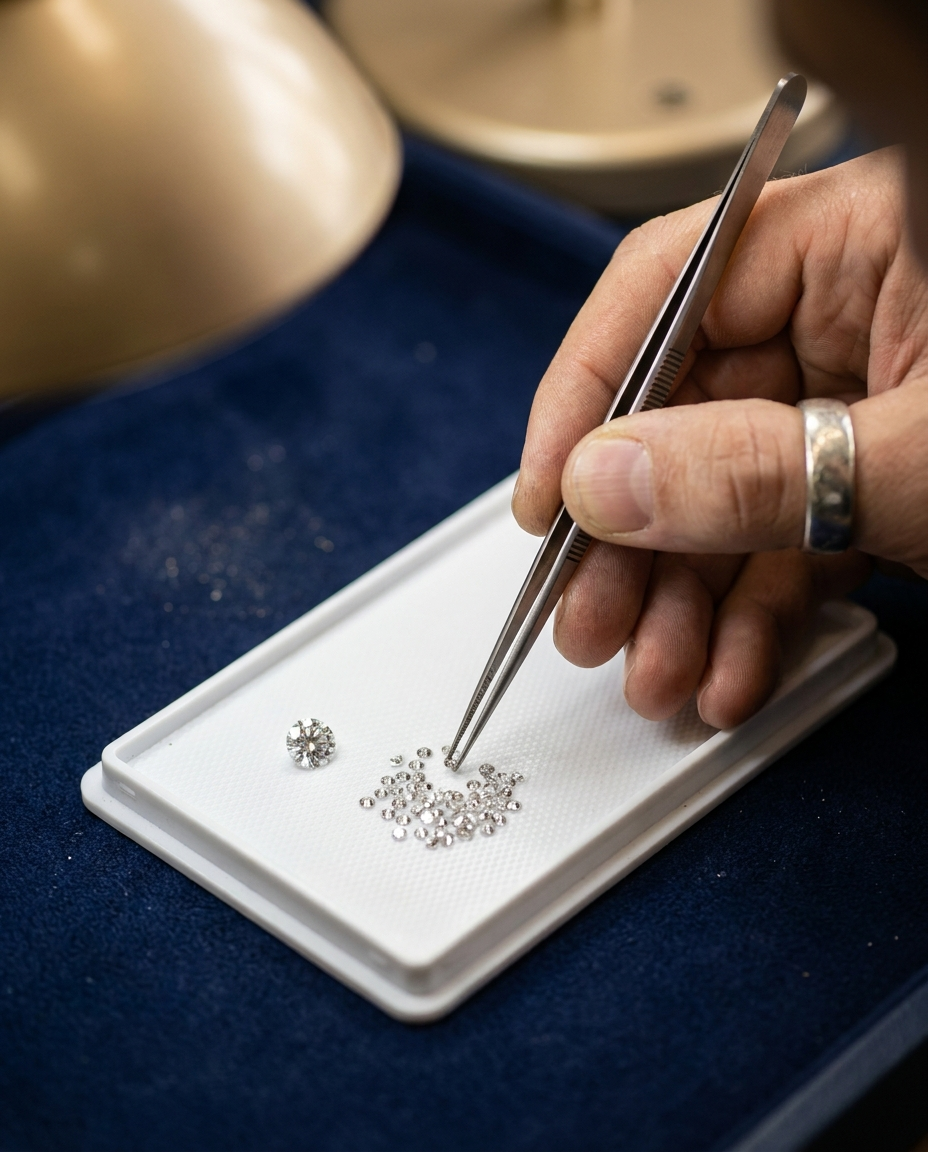
Individually certifying a 1.5mm natural diamond isn't economical — lab fees alone would exceed the stone's value, a limitation that applies to melee generally, natural or lab-grown, once you're under roughly 0.20ct. So the natural trade solved sizing and consistency a different way: physical sieve sorting plus comparison against a master stone for color and clarity. This isn't a shortcut or a lesser standard — it's the practice the entire natural melee market runs on, and it's what makes it possible to fill a 500-stone pavé order at a consistent size without paying for 500 lab reports.
What this means for you as a buyer is that "size" and "grade" arrive as two separate, parcel-level specifications rather than one per-stone certificate. A parcel described as "19/20 sieve, EF VS" has been sieve-sorted to size and visually matched to a master stone at that grade — every stone in the parcel is expected to fall within trade tolerance of both, not individually documented against them.
How Many Natural Melee Diamonds Make One Carat?
It depends entirely on the size you're ordering — there's no single answer, which is exactly why buyers keep a chart like this on hand instead of a rule of thumb. At 1.0mm, expect roughly 180–215 stones per carat. At 2.0mm, roughly 32 stones per carat. At 3.0mm, roughly 9–11 stones per carat. By 4.0mm, you're down to about 5 stones per carat.
This is the number that actually drives your purchase order math for pavé and micro-pavé work: if a design calls for 400 stones at 1.2mm, you're budgeting somewhere around 3.6–4.0ct of melee, not "a small amount." Piece-count and carat-weight both matter on a quote — always give a supplier both the sieve size and the piece count (or total mm coverage) you need, and let them convert to carats, rather than converting yourself and rounding.
What Size Range Does Guru Diam Currently Price?
Guru Diam's natural melee program is currently priced across roughly 0.8mm to 4.0mm, round shapes only — fancy natural melee shapes (oval, princess, pear, and similar) aren't yet sourced or priced on this line, so treat round as the current scope rather than assuming fancy cuts are available to quote. Within that 0.8mm–4.0mm window, every size on the chart above is available across the EF/GH color, VS/SI clarity grid described in the next section.
Pricing runs per carat and rises with both size and grade — smallest sizes in GH SI start in the $370–450/ct range and climb from there as size and color/clarity improve, with the largest priced size (4.0mm) running considerably higher. We're presenting that range directionally here rather than repeating the full rate card: for the complete size-by-grade pricing table, see our natural melee pricing guide, and for a full walkthrough of how to buy this line, start with our natural melee wholesale buying guide. All quotes are confirmed per parcel at the time of order — melee pricing in this trade is never exact-to-the-cent off a published table.
How Do EF and GH Color Grades Pair With Size on This Chart?
Guru Diam's natural melee grid runs two color bands — EF (E–F color) and GH (G–H color) — each available in VS and SI clarity, across the priced size range. These are blended-range grades, standard trade practice for melee: a parcel graded EF VS is sorted and matched to fall within that color and clarity band against a master stone, not certified stone by stone at an exact single grade.
| VS clarity | SI clarity | |
|---|---|---|
| EF color | Whitest, cleanest tier — priced from 1.70mm up | Whitest tier, light inclusions — priced from 1.70mm up |
| GH color | Near-colorless, clean — full 0.8mm–4.0mm range | Near-colorless, light inclusions — full 0.8mm–4.0mm range |
One gap worth stating plainly rather than glossing over: EF has no data below 1.70mm — no vendor in this size class has ever quoted a genuine E-color stone that small, so we don't fill that cell with a guess. If your design calls for the whitest possible melee under 1.70mm, GH is currently the floor, and it's a very good-looking floor at that size — color differences read far less at 1mm than they do at 3mm, which is the main reason most buyers spec GH for the smallest accent rows and reserve EF for larger, more visible stones.
Matching size to grade also matters for how the finished piece reads. Micro-pavé under 1.5mm generally doesn't need EF to look bright and white in a finished ring — GH VS or even GH SI at that size disappears into the metalwork and the eye simply doesn't resolve color at that scale. Larger accent stones from 2.5mm up, especially in halo or eternity work where each stone sits more visibly, are where upgrading to EF earns its price difference.
What Calibration Tolerance Should You Specify When Ordering by Size?
Melee is sold calibrated, meaning every stone in a parcel is held within a stated tolerance of the target size — standard trade convention runs about ±0.10mm on dimension, ±0.10ct on weight, and one grade of color/clarity match within the stated band. Specify your tolerance alongside your mm callout on every order; a size request without a stated tolerance invites a parcel that's technically "close" but inconsistent enough to show as an uneven row in a finished pavé line.
Tighter work — continuous micro-pavé, channel-set eternity bands, anywhere stones sit edge to edge — benefits from confirming the tight end of that tolerance on the order. Scattered or independently bezel-set accents tolerate the wider end without any visible difference. Either way, put the number in writing on the PO; "calibrated" alone isn't a spec, it's a category.
How Does Natural Melee Sizing Differ From Lab-Grown Melee Sizing?
Physically, it doesn't — a 2.0mm round diamond is a 2.0mm round diamond regardless of how it formed, and the mm-to-carat conversion table above applies equally to a natural or a lab-grown round brilliant of the same cut. Where the two lines genuinely diverge is grading and sourcing, not geometry. Natural melee is sieve-sorted and matched against a master stone specifically because natural rough doesn't arrive in uniform batches — every parcel is assembled from mined material, which is why size and color consistency is the thing you're paying a sorter to deliver.
Guru Diam runs natural and lab-grown melee as two separate, non-overlapping product lines with their own size availability, grading conventions, and pricing — the two are never quoted or specified interchangeably, and this post covers the natural line only. If you're evaluating lab-grown melee for a project, our lab-grown line has its own dedicated size reference — see the melee diamond size chart for the lab-grown CVD line for that program's specific size and grade bands rather than assuming this natural chart's grading columns carry over.
How Do You Match Sieve Size to Your Setting Type?
The right size band depends heavily on what you're building, and matching the two up front saves a re-order later:
- Micro-pavé and pavé: typically 0.8mm–1.7mm (Sieve 8/9 through 17/18) — the smallest, densest coverage, where GH grades most often make sense.
- Halo settings: typically 1.1mm–2.2mm around a center stone, sized to the halo's ring diameter — larger halos generally call for the upper half of that range.
- Eternity bands: typically 1.5mm–3.0mm depending on band width and whether it's a full or half-eternity layout — wider bands can carry the larger sizes in this range.
- Tennis bracelets: typically 2.5mm–4.0mm, at the upper end of Guru Diam's current priced range, where individual stones read clearly in a line.
- Repair and production fill work: whatever size the original setting calls for — this is the single most common reason buyers need an exact mm-to-carat conversion rather than an approximate one, since a replacement stone that's even 0.1mm off can visibly sit proud or loose in an existing channel.
For a deeper walkthrough of any one of these use cases — sizing math, ordering quantities, and setting-specific buying notes — see our dedicated guides on pavé, halo, eternity, and tennis-bracelet melee buying, linked from the pillar buying guide above.
Common Mistakes When Ordering Natural Melee by Size
A handful of size-related errors account for most of the re-quotes we see:
- Doubling carat weight for double the mm. Weight scales with the cube of diameter, not linearly — a 2.0mm stone isn't "twice" a 1.0mm stone, it's roughly six times the weight.
- Requesting a size with no stated tolerance. "2mm melee" without a ±mm tolerance leaves room for a parcel that's technically in spec but visually inconsistent once set.
- Confusing sieve size with grade. Sieve size is purely a dimension; color and clarity are a separate spec. Always give both.
- Assuming EF is available at every size. It isn't below 1.70mm — plan GH into small-stone budgets rather than discovering the gap mid-order.
- Speccing above the currently priced range. Above 4.0mm, this isn't a Guru Diam natural melee stone anymore — it's a loose diamond in a different buying category, and should be quoted as one.
Catching these before the PO goes out is faster than catching them after a parcel arrives that technically matches what was written down but not what was actually needed. As a general habit, write every melee line item as three fields, not one: sieve size (or mm with tolerance), color/clarity grade, and total carat weight or piece count. A spec missing any one of the three is the single most common cause of a re-quote on a repeat order.
How to Order Natural Melee Diamonds by Size at Guru Diam
Once you know your sieve size (or mm), color/clarity grade, and total carat weight or piece count, ordering is straightforward: send the spec over WhatsApp or through our contact form and we'll confirm exact pricing and availability against current parcels — melee is quoted per parcel at the time of order, not off a static list. Same-day fulfillment is available out of both our New York (36 West 47th Street, Suite 601A, NY 10036) and Los Angeles (607 S Hill Street, Suite 241, LA 90014) offices, with cutoffs of 6pm EST in NYC and 4pm PST in LA.
For the full buying process end to end — from first inquiry to reorder — see our natural melee wholesale buying guide. Ready to quote a specific size and grade combination now? Message us on WhatsApp or reach out through our contact page.
Frequently Asked Questions
How many natural melee diamonds make one carat?
It depends on size. At 1.0mm, roughly 180–215 stones make a carat. At 2.0mm, roughly 32 stones. At 3.0mm, roughly 9–11 stones. Always convert from the specific millimeter your project calls for using the full chart above, not a single rule of thumb.
What is a "sieve size" in natural melee diamonds?
Sieve size is a physical sorting measurement — loose stones are passed through stacked metal plates with progressively larger holes, and a stone's sieve size reflects which two plates it fell between (for example, "17/18 sieve"). It's a dimension specification, separate from color and clarity grade.
What size range does Guru Diam currently price in natural melee?
Roughly 0.8mm to 4.0mm, round shapes only. Fancy natural melee shapes aren't yet sourced or priced on this line, and sizes above 4.0mm fall outside our current natural melee range.
What's the difference between EF and GH melee at the same size?
EF (E–F color) is the whiter, cleaner tier and is priced from 1.70mm up — no vendor quotes true E color reliably below that size. GH (G–H color) covers the full 0.8mm–4.0mm range and is the standard choice for the smallest, densest pavé work, where color differences are least visible to the eye.
What calibration tolerance should I specify when ordering natural melee by size?
Standard trade tolerance runs about ±0.10mm on dimension and ±0.10ct on weight, with a one-grade color/clarity match window. State this on every purchase order — a size request without a tolerance invites a technically-in-spec but visually inconsistent parcel.
Does natural melee size differ from lab-grown melee size?
No — mm-to-carat conversion is pure geometry and applies the same way to both. What differs is grading and sourcing: natural melee is sieve-sorted and matched to a master stone because natural rough isn't uniform. Guru Diam's lab-grown melee line has its own separate size and grade bands; see our lab-grown melee size chart for that program specifically.