Natural Melee Diamond Pricing: What Drives Cost Per Carat
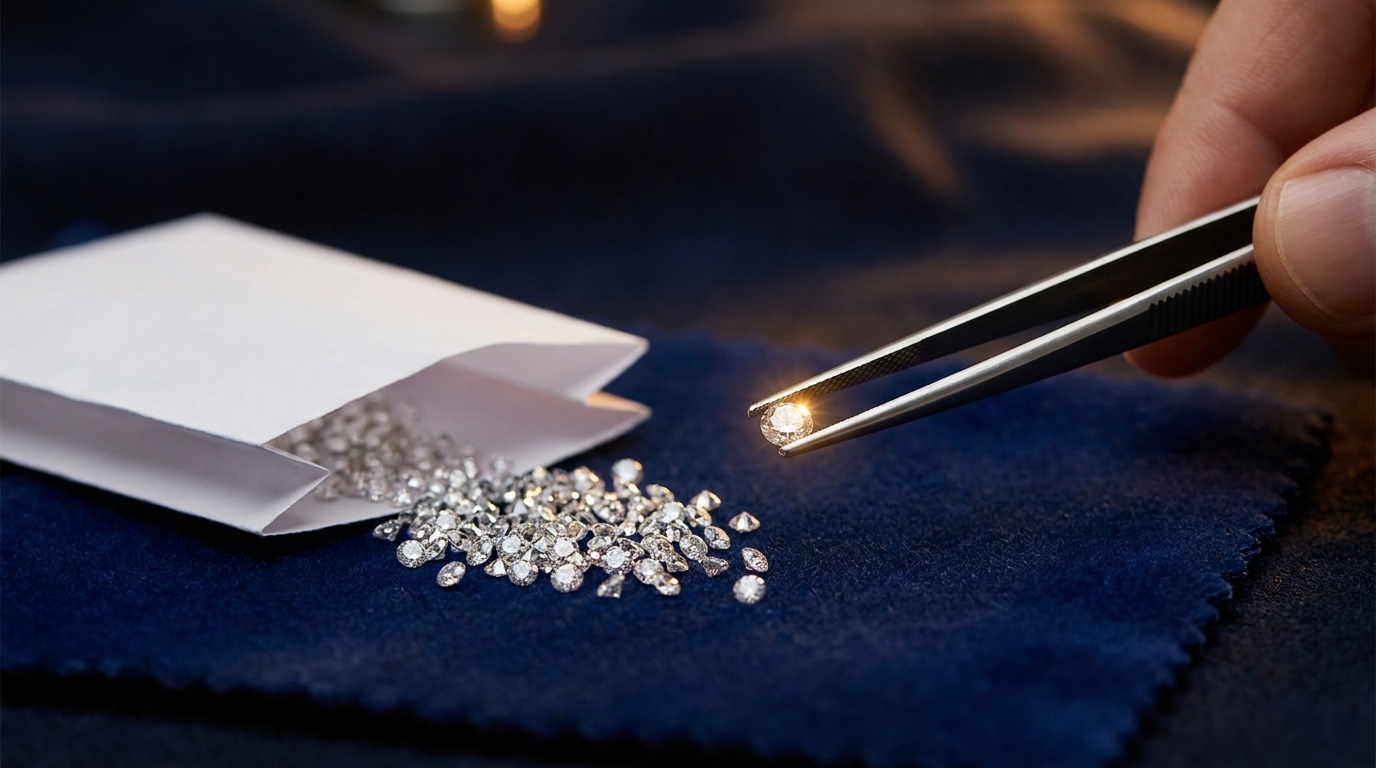
Natural melee diamond pricing at Guru Diam currently runs roughly $370 to $900 per carat, driven mainly by two variables: size and color/clarity grade. Price climbs as stones move up the 0.8mm–4.0mm size range, because larger melee is proportionally rarer to source even within this sub-carat category, and it climbs again for stones graded closer to colorless (E-F) and cleaner (VS) rather than warmer (G-H) and more included (SI). Every figure below is a starting point — melee is quoted per parcel, and the exact number is confirmed at the time of order.
What Is the Guru Diam Natural Melee Price List, and How Is It Read?
Natural melee is priced on a grid, not a single number, because two things move independently: the stone's size and its quality tier. Guru Diam prices natural round melee across eight size bands from 0.8mm to 4.0mm, each split into four quality columns — EF VS, EF SI, GH VS, and GH SI. "EF" and "GH" describe blended color ranges (E-F and G-H respectively), and "VS" and "GH" describe blended clarity ranges, not single exact grades — that is standard trade practice for parcel goods sorted comparatively against a master stone, not graded stone-by-stone.
Here is the current sell price per carat, as of August 2026:
| Size (mm) | EF VS | EF SI | GH VS | GH SI |
|---|---|---|---|---|
| up to 1.20 | — | — | $480 | $450 |
| 1.20–1.70 | — | — | $390 | $370 |
| 1.70–2.20 | $450 | $420 | $417.50 | $400 |
| 2.30–2.60 | $510 | $480 | $447.50 | $430 |
| 2.70–2.80 | $625 | $595 | $565 | $547.50 |
| 2.90–3.00 | $680 | $650 | $592.50 | $575 |
| 3.50 | $700 | $670 | $602.50 | $585 |
| 4.00 | $900 | $870 | $855 | $840 |
To read the grid: find the millimeter size your mounting or repair calls for down the left column, then move across to the color/clarity combination you need. That cell is your approximate per-carat rate. Treat every number here as a starting point for a live quote, not a locked price — melee is quoted per parcel against these sieve bands, and the exact figure is confirmed when you place an order. You'll also notice two blank cells: no EF (E-F color) pricing exists below 1.70mm. That's not an oversight — genuine E-F color melee isn't part of the confirmed supply at those smallest sizes, so rather than guess at a number for material that isn't actually being quoted, we leave it blank until it is.
One more reading note: this is the sell price for round natural melee specifically. Guru Diam also stocks a separate lab-grown (CVD) melee line with its own spec and its own pricing — the two are never interchangeable, and a rate from one line should never be assumed to apply to the other. Everything on this grid, and everywhere else in this guide, refers only to natural, mined melee.
Why Does Price Rise With Size, Even Within Melee?
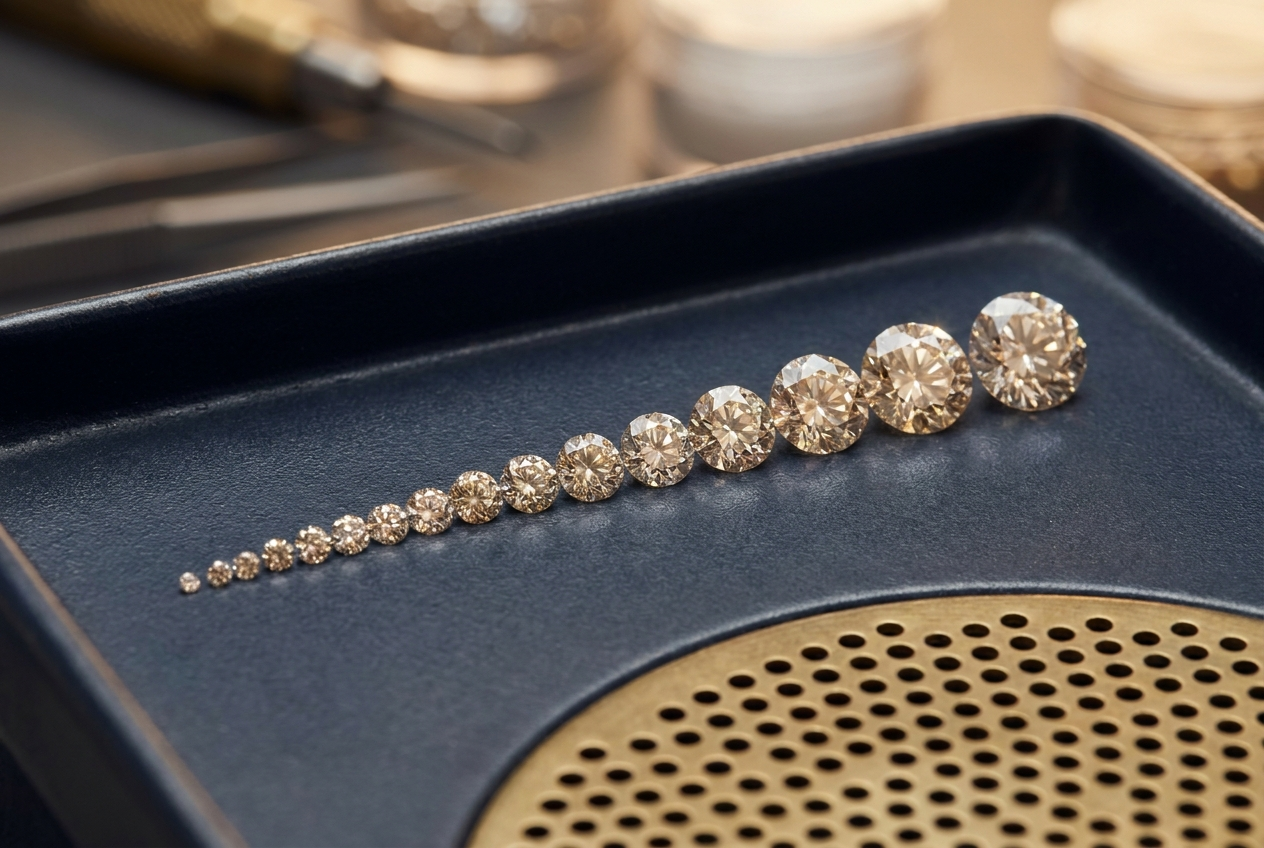
Every stone on this grid is sub-1ct, so it's easy to assume melee pricing should stay flat across the size range. It doesn't — the top of the grid runs roughly double the bottom. The reason is rarity, and it compounds two ways.
First, diamond weight scales with the cube of diameter, not the diameter itself. A 4.00mm round weighs meaningfully more than four times what a 2.00mm round weighs, not twice. That means a larger finished melee stone consumes a disproportionately larger, and harder-to-source, piece of rough than a smaller one does — even though both are still well under a carat. As you move up the size range, each additional 0.1mm of finished diameter draws from a narrower, more competitive slice of available rough.
Put a number on it: a diamond cut to 4.00mm holds roughly eight times the volume — and by extension, weight — of one cut to 2.00mm, because volume scales with the cube of diameter (2³ = 8), not with diameter itself. Doubling the millimeter size on this grid does far more than double the sourcing difficulty behind it, which is a big part of why the 4.00mm row prices roughly double the 1.70–2.20mm row sitting in the middle of the grid.
Second, look at the bottom two rows of the grid: GH SI actually runs slightly cheaper at 1.20–1.70mm ($370) than it does at up to 1.20mm ($450). That's the one place size and price don't move together, and it has a separate explanation — labor. Star-size melee under 1.20mm can run 200–400+ stones to the carat, which means proportionally more cutting and sieve-sorting work per carat of finished weight than at 1.20–1.70mm, where stone count per carat drops sharply. Below roughly 1.20mm, handling cost is the bigger factor; above it, size-driven rarity takes over and price climbs steadily from there through 4.00mm.
Why Does Color and Clarity Change the Per-Carat Price?
Within any single size row, EF always prices above GH, and VS always prices above SI. Both differences track the same underlying idea as the size effect: rarity in the rough. Rough diamond crystals close to colorless (E-F range) and cleaner internally (VS range) are a smaller share of what comes out of the ground than warmer-colored, more included material — that scarcity holds at melee scale the same way it does for larger stones, even though melee color and clarity differences are subtler to the eye at 2mm than at 0.5ct.
Because EF and GH are blended ranges rather than single grades, and because melee this small isn't individually graded, sorting happens comparatively — a parcel is screened against a master stone that represents the middle of the target band. That's why two EF VS parcels from two different quote dates can look and price slightly differently even though both are correctly labeled EF VS: the blended range has real width to it, and where a given parcel sits inside that width shifts with what's available to sort at the time.
How Does "Per Carat" Pricing Work for a Melee Parcel?
Melee is bought and sold by total carat weight, not by stone count. When you request a quote, you're asking for a per-carat rate against a size band and quality tier — the total cost of your order is that rate multiplied by the total carats you need, not a sum of individual stone prices. This is different from how loose stones 0.30ct and up are typically priced and sold, where each stone carries its own weight, grade, and certificate.
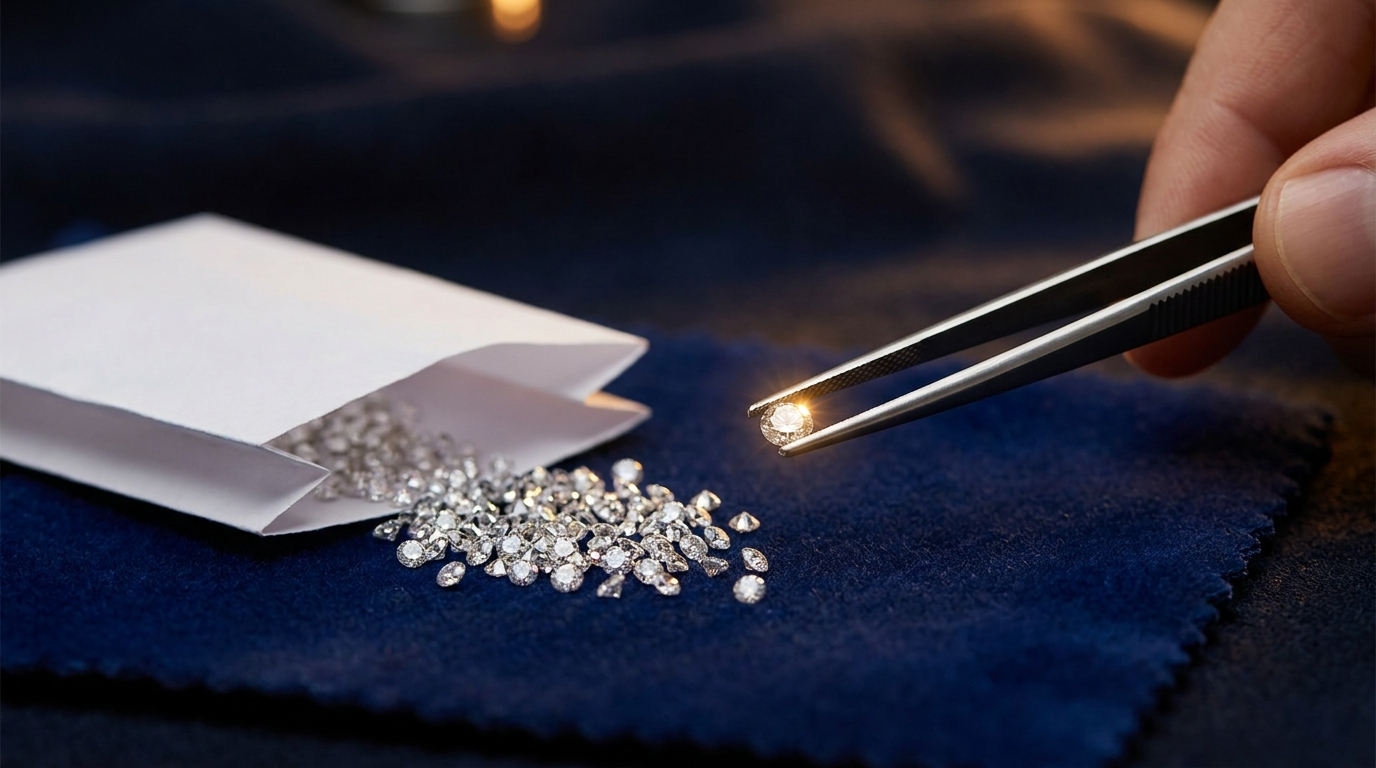
Because melee ships as sieve/size-graded parcel goods sorted comparatively against a master stone rather than certified stone-by-stone, the per-carat rate already reflects the average quality and size distribution the parcel is sorted to hold — you're not paying a premium for grading paperwork on stones too small for it to make economic sense (more on that below). If you need to convert a stone count into a carat estimate — say, you know a design calls for 140 stones at roughly 1.5mm — a mm-to-carat-to-sieve conversion chart gets you from stone count to approximate carat weight, which is what the per-carat rate actually prices against.
What Causes Quote-to-Quote Price Variance?
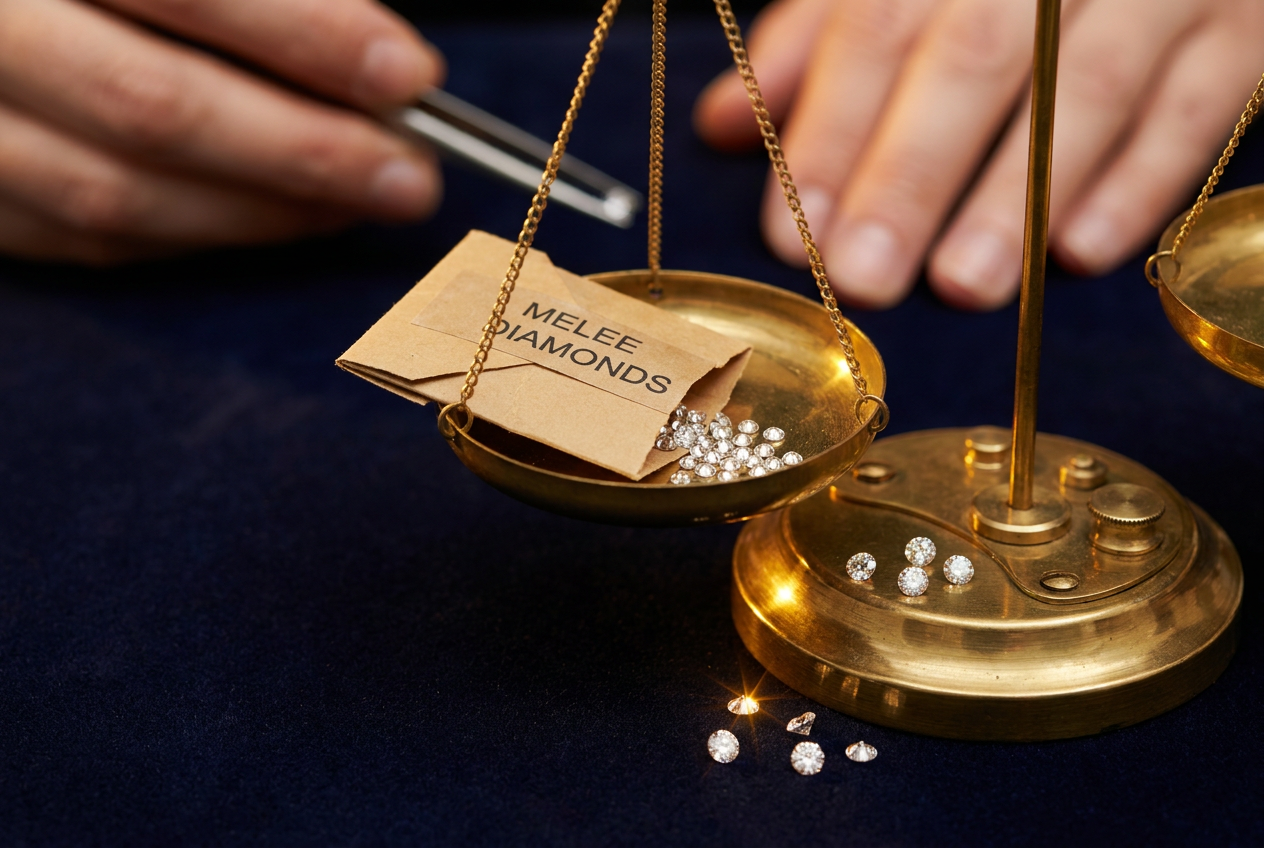
The numbers on the grid above are a snapshot, not a fixed catalog price, and buyers who order melee regularly should expect some movement from quote to quote. A few things drive it:
- Where a parcel sits inside its size band. A band like 1.70–2.20mm blends stones across that full range. A parcel that skews toward the top of the band runs heavier, and typically costs more, than one skewing toward the bottom — even at the same quoted rate structure. Two buyers asking for "1.70–2.20mm" in the same week can reasonably be quoted slightly different numbers if the parcels available to sort skew differently within that window.
- Where a parcel sits inside its quality band. The same logic applies to EF/GH and VS/SI — each is a blended range, and quality mix can drift slightly parcel to parcel even within a correctly labeled tier. A GH SI parcel sorted on a day when more of the available material sits toward the cleaner, whiter end of that band can price marginally differently than one sorted on a day when it doesn't.
- Broader rough diamond market movement. Natural melee cost tracks the wider natural rough market, which moves over time like any commodity input tied to a mined resource. That's a slower-moving factor than the two above, but it's the reason a rate you locked in months ago isn't guaranteed to hold indefinitely.
- Order size and parcel availability at the moment you ask. What's sorted and on hand when you request a quote affects what's quoted back. A large single order against a size and tier that happens to be in thin supply that week may quote differently than the same order spread across two smaller requests.
None of this means the price list above is unreliable — it means treat it as the right ballpark to plan against, and confirm the exact per-carat number on WhatsApp before you commit a production run to it.
How Does Pricing Change Across the Full 0.8mm–4.0mm Range?
Walking the GH SI column top to bottom shows the overall shape clearly: $450 at up to 1.20mm, dipping to $370 at 1.20–1.70mm, then climbing steadily — $400, $430, $547.50, $575, $585, and finally $840 at 4.00mm. That's roughly a 2.3x spread from the cheapest cell to the most expensive, inside a size range that never leaves melee territory. The steepest single jump on the grid is between 3.50mm and 4.00mm, where every quality tier gains at least $200–255 per carat in one step — consistent with 4.00mm sitting at the upper edge of what Guru Diam currently prices, where rarity in the rough is most acute.
It's worth repeating: 4.00mm is also the current ceiling. Natural melee above 4.0mm is a genuine gap in what's priced and sourced right now, not a range we're quoting conservatively. If your build calls for natural round stones larger than 4.0mm, that's outside today's program — ask when you request a quote rather than assuming coverage, and don't assume it will be added on any particular timeline.
The practical upshot for a buyer planning a mixed order is that size is doing at least as much work as quality in determining your final cost. A large jump from GH SI to EF VS at a fixed size moves the rate meaningfully, but stepping up two or three size bands at a fixed quality tier can move it by just as much or more — budget with both dimensions in mind, not just the color and clarity tier you'd default to first.
How Does Certification, or the Lack of It, Affect Melee Pricing?
Melee this small isn't individually or parcel-certified, and that's true across the trade for natural and lab-grown melee alike — not a Guru Diam shortcoming. The economics are straightforward: certification cost exceeds the stone's own value below roughly 0.20ct, which covers essentially this entire 0.8mm–4.0mm grid. Instead, natural melee ships as sieve/size-graded parcel goods, sorted comparatively against a master stone for size, color, and clarity.
That's a meaningful contrast with Guru Diam's loose stone program, where individual stones 0.30ct and up are IGI/GIA certified — a different product tier with different economics, where per-stone paperwork and grading make sense against the stone's value. Melee pricing on the grid above doesn't carry that grading premium, because it doesn't carry that grading step. If your project needs individually documented stones, that's the certified loose-stone tier, not melee.
For buyers used to shopping certified loose stones, this can initially read like less rigor, but it's the reverse: sieve/size grading against a master stone is the accuracy standard the entire melee trade runs on, precisely because per-stone certification isn't economically viable at this scale. The pricing on the grid above reflects that reality rather than working around it.
How Should You Budget for a Natural Melee Order?
Once you know your size band and quality tier, budgeting a natural melee order is a straightforward multiplication: total cost is the approximate per-carat rate multiplied by the total carats you need. The harder part for most buyers is the first step — converting a stone count or a design's accent-stone requirement into a carat figure to multiply against.
A few practical points when you're putting a number together:
- Work from the millimeter size your setting actually calls for, not a rounded average — a 1.9mm and a 2.3mm fall in different price bands on this grid.
- If you're planning a run across multiple sizes (say, graduated pavé that steps from 1.5mm to 2.5mm), budget each size band separately against its own rate rather than applying one blended number to the whole order.
- Build in a margin for quote-to-quote variance (see above) rather than treating the grid figure as a locked-in ceiling, particularly for larger production runs placed weeks or months apart.
- Get a live quote before finalizing a production budget — the table above is the planning reference, the WhatsApp quote is the number you actually commit against.
What Does the Math Actually Look Like on a Real Order?
The per-carat rate only becomes useful once you multiply it against a real carat total, so it helps to see the arithmetic worked through against a few common jobs. These are illustrative examples built off the grid above, not fixed quotes — your actual carat requirement depends on your specific design and stone count, and your actual price is confirmed at quote.
- A pavé halo using an estimated 0.60 total carats of GH VS melee at 1.70–2.20mm: 0.60 × $417.50 ≈ $250.50 for the melee.
- An eternity band using an estimated 1.20 total carats of EF VS melee at 2.30–2.60mm: 1.20 × $510 ≈ $612 for the melee.
- A tennis bracelet using an estimated 3.50 total carats of GH SI melee at 2.90–3.00mm: 3.50 × $575 ≈ $2,012.50 for the melee.
Notice that carat total, not stone count, is what the rate multiplies against — a design with more, smaller stones and a design with fewer, larger stones can land on a similar total carat weight and a similar melee cost, even though the finished pieces look very different. If you're working from a stone count instead of a carat figure, convert first (see the sieve size chart linked below), then run this same multiplication.
What Should You Ask For When Requesting a Quote?
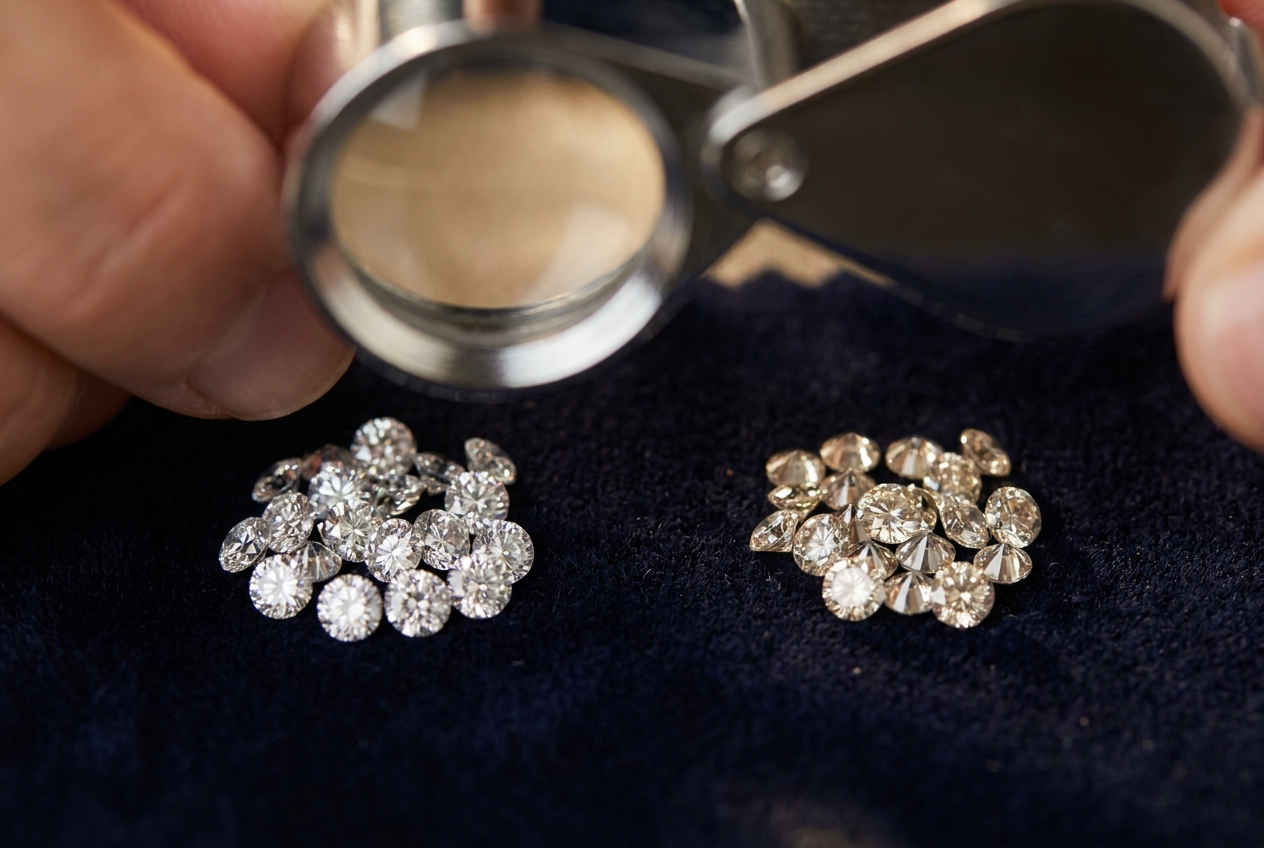
A precise ask gets a precise quote back. When you reach out, have these four things ready:
- Exact millimeter size (or size band) — not "small melee," but the mm figure your mounting or design calls for.
- Color/clarity tier — EF VS, EF SI, GH VS, or GH SI. If you're not sure which tier fits your price point and finished-piece quality target, say so and ask for guidance.
- Total carat weight needed — the figure your per-carat rate will multiply against.
- Calibration tolerance, if your setting is tight — standard trade tolerance runs about ±0.10mm dimension and ±0.10ct weight, with roughly a one-grade color/clarity match; flag if your build needs tighter than that.
Round shapes only, for now — fancy natural melee shapes like oval, princess, or pear aren't yet priced or sourced on this program, so plan production accordingly. Reach out on WhatsApp at +1 347 812 2006, or via the contact page, and reference the size and quality tier from the grid above to get a fast, exact quote.
How Does Natural Melee Pricing Compare to Lab-Grown Melee?
Natural melee generally carries a higher per-carat price than lab-grown melee at a comparable size and quality tier, reflecting rarity in mined rough versus manufactured material. The pricing mechanics covered in this guide — size bands, blended color/clarity ranges, per-carat parcel quoting — are natural melee specifics; Guru Diam's lab-grown (CVD) melee line runs its own separate spec and pricing, and the two should never be treated as interchangeable numbers. If you're actively weighing natural against lab-grown for a specific build, see our size-by-size natural vs. lab-grown melee price comparison for the direct breakdown, rather than assuming the figures above translate.
What doesn't change between the two lines is how the pricing mechanics work: both are quoted per carat against sieve-style size bands, both use blended color/clarity ranges rather than single grades, and both skip individual certification for the same value-versus-cost reason. The number that differs is the rate itself, driven by whether the rough is mined or grown — not the underlying logic of how melee gets priced.
Frequently Asked Questions
How much does natural melee diamond cost per carat? Roughly $370 to $900 per carat at Guru Diam as of August 2026, depending on size (0.8mm–4.0mm) and color/clarity tier (EF VS, EF SI, GH VS, GH SI). Treat these as approximate, quote-confirmed figures rather than a fixed catalog price.
Why does natural melee price rise with size if every stone is still under a carat? Because diamond weight scales with the cube of diameter, larger melee draws from a proportionally rarer slice of rough even within the sub-carat range. Below about 1.20mm, cutting and sieve-sorting labor per carat is also a factor, since that band can run 200–400+ stones to the carat.
What's the price difference between EF and GH natural melee? EF (E-F color) prices above GH (G-H color) at every size where both are available, reflecting the relative scarcity of near-colorless rough. EF has no confirmed pricing below 1.70mm — that size range isn't currently part of the sourced supply.
Why isn't natural melee individually certified? Certification cost exceeds the stone's value below roughly 0.20ct, which covers this entire size range. Natural melee ships as sieve/size-graded parcel goods sorted comparatively against a master stone instead — standard practice across the trade, not a shortcoming specific to any one supplier.
How do I calculate the total cost of a melee order? Multiply the approximate per-carat rate for your size and quality tier by the total carats you need. If you're starting from a stone count rather than a carat figure, convert stone count to carats first using a mm-to-carat conversion reference, then apply the rate.
Why did my quote come in different from the last time I ordered the same size and tier? Quote-to-quote variance is normal and comes from where a given parcel sits inside its size and quality bands, plus broader rough market movement and what's available to sort at the time you ask. Confirm current pricing at quote rather than reusing an older number for budgeting.