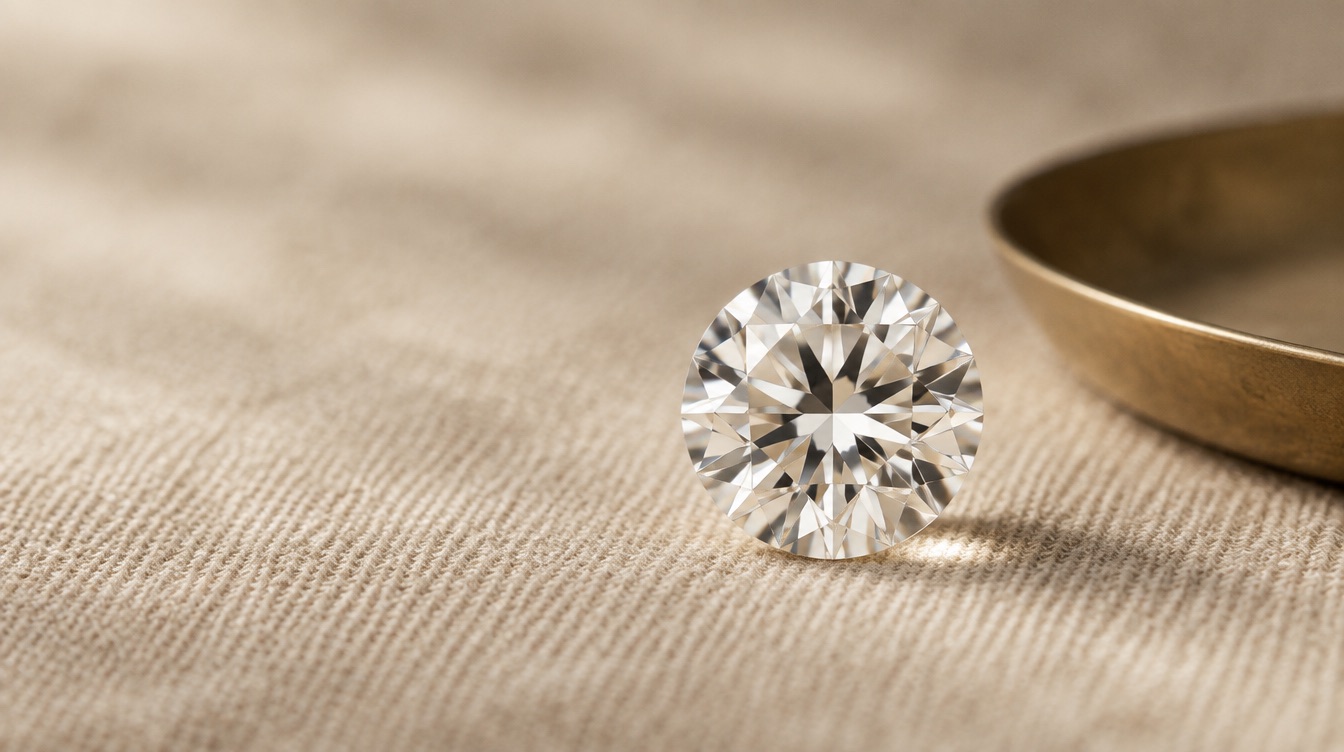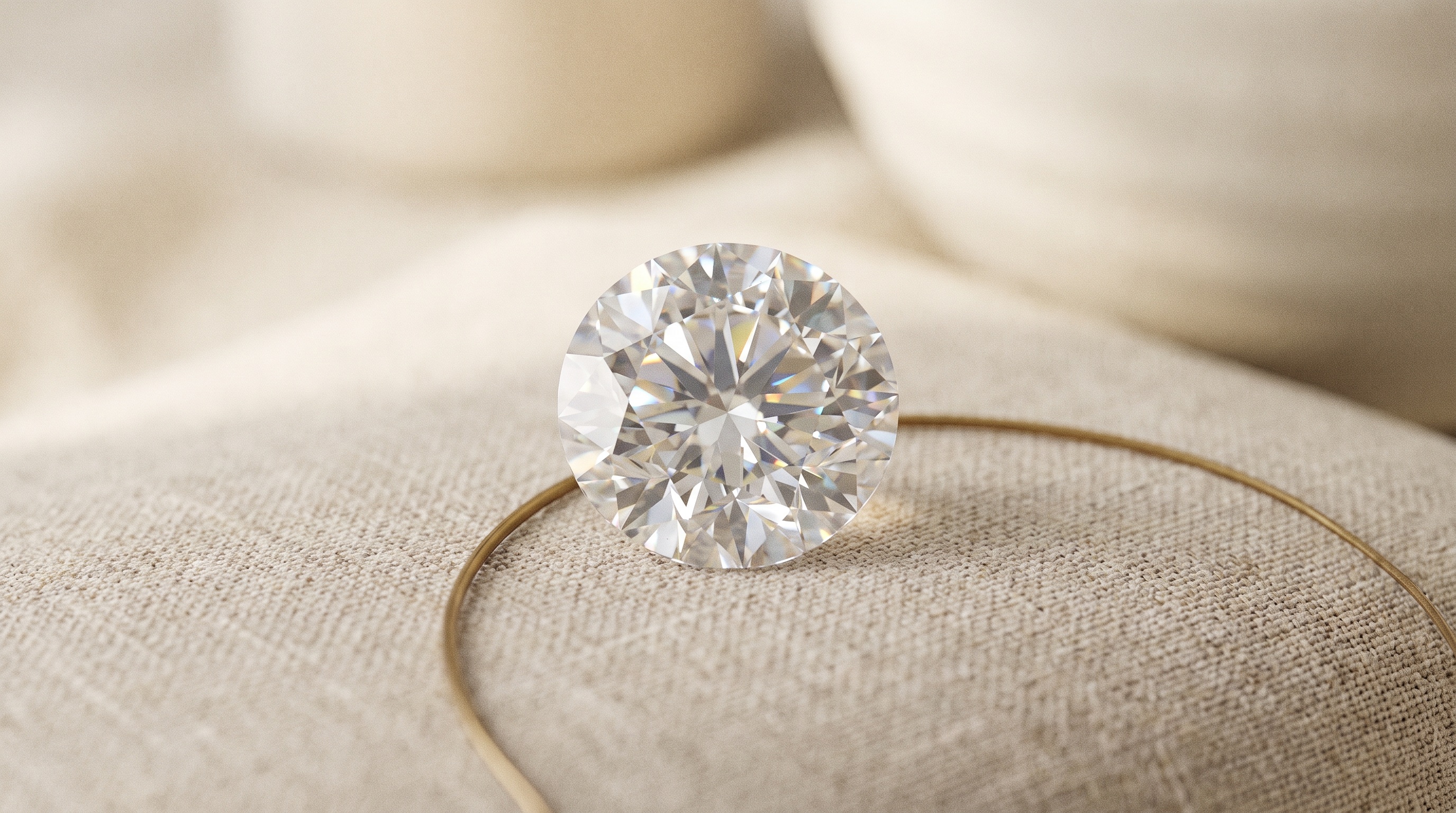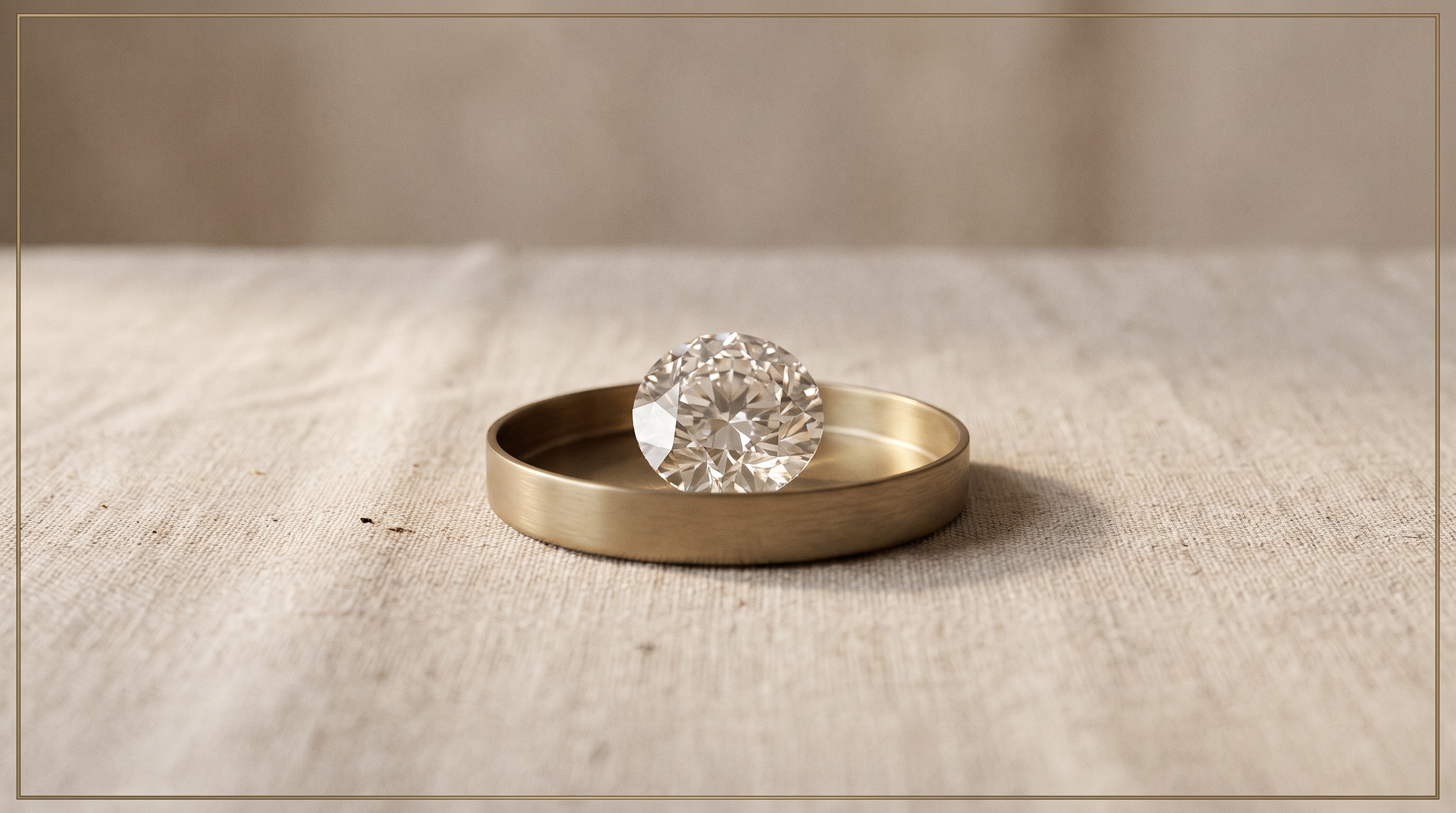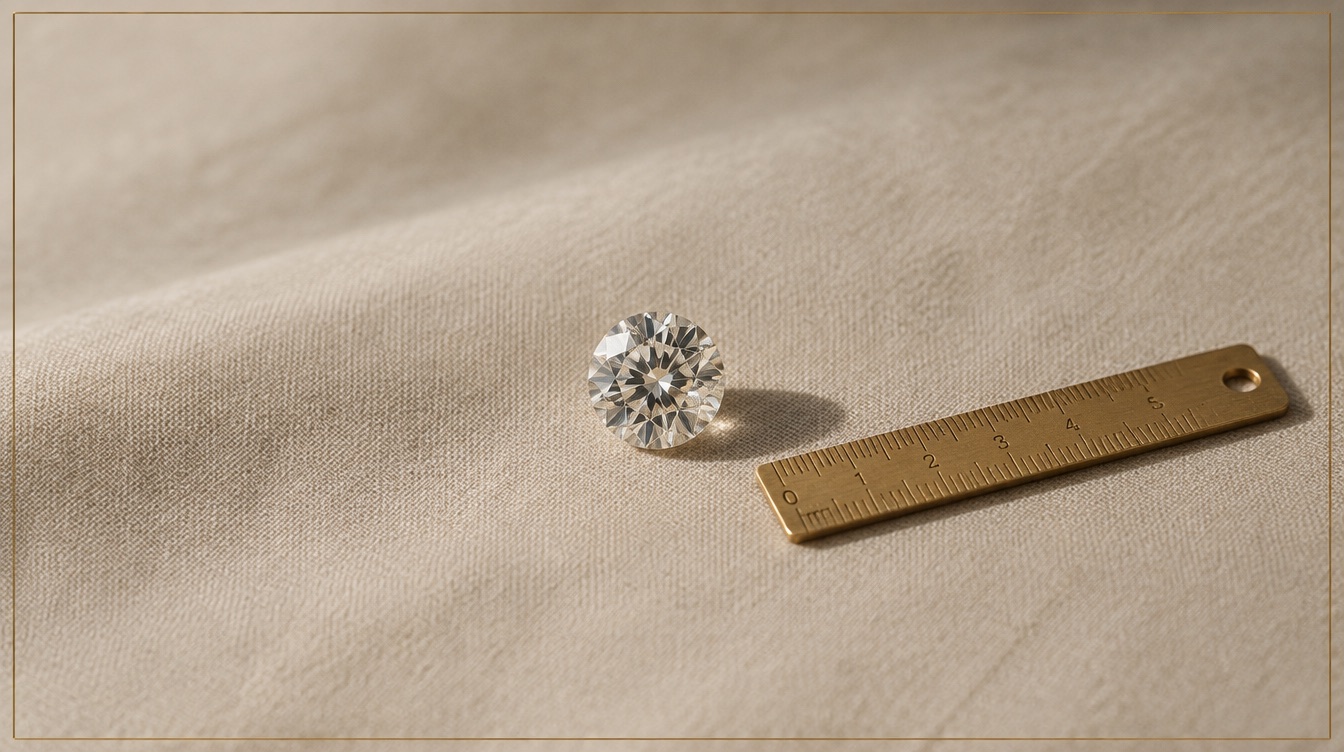
A 5mm round brilliant diamond weighs approximately 0.46 to 0.50 carat, with the exact figure shifting depending on how the stone is cut. That range puts a 5mm round right at the entry point of what most buyers think of as an actual center-stone size — roughly a half carat — rather than a melee accent, which makes getting the mm-to-carat relationship right at this size more consequential than it is for smaller diameters.
What a 5mm Round Brilliant Diamond Actually Weighs
Across trade references, grading charts, and supplier spec sheets, a 5.0mm round brilliant is consistently pegged at around 0.46 to 0.50 carat. Some sources round it to a flat "half carat," which is close enough for casual conversation but not precise enough for a quote, an appraisal, or a certificate — the real figure for a well-proportioned stone typically lands in the low-to-mid 0.40s through right around 0.50, with the exact number determined by how that particular stone was cut rather than by its diameter in isolation.
What makes 5mm worth a dedicated look, distinct from smaller round sizes, is where it sits in the market. At 3mm and 4mm, a round brilliant is almost always destined for melee use — a side stone, a pavé accent, a halo component. At 5mm, the stone crosses into genuine center-stone territory: a 0.46–0.50ct round is a completely normal, frequently requested size for a solitaire engagement ring, a pendant centerpiece, or stud earrings sold and worn as the main event rather than a supporting detail. That shift changes what buyers actually need from this size — individual grading and certification start to matter in a way they simply don't for a 3mm or 4mm accent stone.
None of that changes the underlying math, though. A 5mm diameter is still just a width measurement, and carat weight is still a mass measurement — the two track closely but aren't interchangeable, which is exactly why "5mm ≈ 0.48ct" is a planning reference, not a promise stamped on every stone that measures 5.0mm across the girdle.
It also helps to know how this figure gets used in practice. Buyers researching "5mm round diamond carat weight" are usually doing one of two things: sizing a mounting or CAD file that's already built around a specific millimeter seat, or trying to translate a diameter they've seen quoted somewhere into a carat figure they can compare against pricing. Both are legitimate uses of the reference range above, but they call for slightly different next steps — a fixed-seat buyer needs to confirm the mm tolerance a supplier can hold, while a shopping buyer needs to confirm the actual weight on a specific stone's certificate before treating 0.48ct as anything more than a starting estimate.
Diameter vs. Carat Weight: Why One mm Doesn't Fix the Other
Girdle diameter describes how wide a round brilliant reads from directly above — the dimension a setting is built around, the number a jeweler checks against a prong spread or a bezel opening. Carat weight describes total mass, and the bulk of that mass sits in the pavilion, the cone-shaped lower two-thirds of the stone that a face-up view doesn't show at all. Two diamonds can both measure 5.0mm at the girdle and still land on different points of the 0.46–0.50ct range — or slightly outside it — because of how their cutters distributed the material below that visible top-down outline.
Three proportions drive nearly all of that variance:
- Depth percentage. This is the stone's total depth, from table to culet, expressed as a percentage of its diameter. A round brilliant cut deeper for its width carries more volume — and more weight — under the same 5.0mm footprint than a shallower stone of identical diameter.
- Table percentage. The flat top facet's width relative to the diameter shifts how volume is distributed through the crown and pavilion. A wider table paired with a shallower crown tends to produce a "spready" stone — more visual size for less actual weight — while a narrower table with steeper angles tends to concentrate more weight for the same face-up diameter.
- Overall cut proportions. Crown angle, pavilion angle, girdle thickness, and culet size interact as a system. A cutter prioritizing light return and symmetry produces a stone close to the standard reference weight for 5.0mm; a cutter prioritizing weight retention from a piece of rough can produce a heavier "deep make" at the same diameter, and a cutter prioritizing visual spread can produce a lighter one.
The practical upshot: 0.46–0.50ct is a reliable planning figure for a 5.0mm round, but the certificate or the scale — never the millimeter spec alone — is the actual source of truth once a specific stone is on the table.
The 5mm Carat Range in Context: A Genuine Center-Stone Size
It's worth being direct about why this diameter gets treated differently from the smaller sizes covered elsewhere in mm-to-carat reference material. A 0.46–0.50ct round brilliant isn't a large stone by engagement-ring standards, but it's squarely within the range consumers and jewelers describe as "a half-carat diamond" — a size sold, quoted, insured, and certified as an individual stone rather than sorted into a parcel with hundreds of look-alikes. That distinction matters for sourcing: a buyer asking for "5mm round diamonds" could be furnishing melee for a dense pavé design, or shopping for loose center stones to set into solitaire mountings — and the sourcing path, paperwork, and pricing model differ substantially between those two use cases.
For context, half-carat round solitaires are one of the more commonly requested engagement-ring center-stone sizes below the one-carat mark, often chosen for a first ring, a secondary piece, or a budget-conscious build that still wants an individually graded, certificate-backed stone rather than an uncertified accent. A jeweler fielding a request for "a 5mm center stone" should generally expect the buyer wants exactly that: a graded, papered loose diamond meant to be the visual focal point of the piece, not a supporting stone.
Round Brilliant mm-to-Carat Reference Table
The table below lines up standard round brilliant diameters against their approximate carat weights, spanning the melee range through common center-stone sizes. These are trade-standard planning figures for well-proportioned stones — actual weight for any individual diamond should be confirmed against its certificate or a direct measurement, since depth, table, and overall cut proportions shift real stones within (and sometimes slightly outside) these ranges.
| Diameter (mm) | Approximate Carat Weight | Typical Use / Category |
|---|---|---|
| 3.0mm | ~0.10–0.11 ct | Melee — uncertified parcel goods |
| 3.5mm | ~0.14–0.16 ct | Melee — uncertified parcel goods |
| 4.0mm | ~0.23–0.25 ct | Melee-adjacent; near the certification threshold |
| 4.5mm | ~0.29–0.34 ct | Typically above the certification threshold |
| 5.0mm | ~0.46–0.50 ct | Common individually certified center-stone size |
| 5.5mm | ~0.61–0.66 ct | Certified center stone |
| 6.0mm | ~0.75–0.80 ct | Certified center stone |
| 6.5mm | ~0.88–0.98 ct | Certified center stone, approaching 1.0ct |
| 7.0mm | ~1.20–1.30 ct | Certified center stone |
Notice the jump between 4.5mm and 5.0mm is larger in absolute terms than the jump between 3.0mm and 3.5mm, even though both are half-millimeter steps. Carat weight scales with volume, and volume scales roughly with the cube of a linear measurement like diameter — so the same half-millimeter increment adds progressively more weight as the base diameter grows. That's also why buyers comparing a 5.0mm stone against a 5.5mm stone should expect a meaningfully bigger price step than the mm difference alone might suggest.
Melee vs. Center Stone: Where 5mm Falls
Melee, in trade terms, covers round brilliant and fancy calibrated diamonds from roughly 0.8mm up to about 9.0mm in diameter — so a 5.0mm stone technically sits inside that broader melee size band. In practice, though, 5mm is rarely sourced or sold as melee. Individually certified loose diamonds through labs like IGI, GIA, or GCAL generally start around 0.30 carat, and a 5.0mm stone at roughly 0.46–0.50ct sits comfortably above that threshold — well into the range where individual grading is the norm, not the exception, and where a buyer would reasonably expect a certificate rather than a lot-quality statement.
That said, 5mm calibrated melee does exist for specific design uses — a larger halo, a bold three-stone side stone, or a statement tennis line built at the upper end of typical melee sizing. When 5mm stones are sourced that way, they're still generally treated and priced closer to individual goods than true small-melee parcels, precisely because the per-stone value at this size is high enough that lot-quality sorting alone isn't the standard buyers expect. A supplier quoting 5mm stones should make clear upfront whether a given batch is being sold as individually certified loose stones or as calibrated accent goods, since the paperwork, pricing structure, and quality verification differ meaningfully between the two.
Sourcing 5mm Diamonds as Loose Center Stones
For a buyer shopping 5mm rounds specifically as center stones — for a solitaire engagement ring, a pendant, or stud earrings — the sourcing checklist looks like buying any other individually certified loose diamond, just at the smaller end of the size spectrum. The certificate is the definitive source for carat weight, color, clarity, and cut grade; the millimeter measurement on that certificate is descriptive information, not the basis for pricing or design decisions. A buyer should expect to see exact carat weight (which won't always be a clean 0.48 or 0.50, but something like 0.47 or 0.51), along with measured diameter and depth, listed explicitly on the report.
Cut quality deserves particular attention at this size because a half-carat stone is small enough that a poor cut is visually forgiving in a way a two- or three-carat stone's cut flaws wouldn't be — light performance issues can hide more easily at 5mm than they would at a larger diameter, which makes an actual cut grade on the certificate, rather than an assumption based on size alone, worth checking rather than skipping. Buyers assembling matched sets — a pair of 5mm rounds for stud earrings, for instance — should also confirm that both stones are graded to the same standard and genuinely matched for face-up appearance, not simply pulled from the same general size range.
Color and clarity choices also play out a little differently at 5mm than they do for a much larger center stone. Inclusions and slight color tint that would be obvious in a two-carat stone can be genuinely difficult to spot face-up in a well-cut half-carat diamond, which is part of why this size is often positioned as an accessible entry point into individually certified center stones — a buyer can reasonably choose a slightly more efficient color or clarity grade here than they might for a larger stone, without a meaningful visual tradeoff, and still walk away with full certification and documented provenance.
Sourcing 5mm Diamonds as Accent or Side Stones
The accent-stone use case for 5mm rounds hasn't disappeared just because the center-stone use case is more common at this size — it's simply the secondary application rather than the primary one. A 5mm round works well as a bold side stone in a three-stone ring paired with a larger center diamond, as the outer ring in a substantial double-halo design, or as a statement-size stone in a graduated tennis line where the design calls for individually noticeable stones rather than fine pavé texture.
When 5mm is being sourced for this purpose, the practical spec still starts with the millimeter measurement, since the stone has to physically fit a fixed prong or channel — carat weight becomes the secondary figure used for total-carat-weight disclosure and pricing once the diameter requirement is satisfied. The difference from smaller melee sizes is that, given the per-stone value at 5mm, it's worth asking a supplier for individual weight and quality documentation even in an accent-stone role, rather than accepting a lot-quality statement the way a buyer reasonably would for 2mm or 3mm pavé stones.
Fancy Shapes at an Equivalent Size
Everything above describes the round brilliant specifically, and the mm-to-carat relationship doesn't transfer to fancy shapes with anywhere near the same reliability. A fancy shape doesn't have a single diameter the way a round does — an oval, pear, or marquise is described by length and width, and the ratio between those two dimensions, along with depth and faceting style, changes how much weight a given footprint carries. An oval or marquise "5mm wide" can weigh noticeably more or less than a 5mm round depending on how elongated it's cut and how its length compares to its width.
This matters at the center-stone size range in particular, since fancy shapes are commonly requested as center stones in exactly this half-carat-to-one-carat window. A buyer moving from "I want a 5mm round" to "I want an oval or cushion of similar visual size" should ask a supplier for shape-specific length, width, and weight figures rather than assuming the round brilliant's 0.46–0.50ct reference applies — it generally doesn't, and elongated fancy shapes in particular can carry noticeably less weight than a round of comparable face-up length.
Why Verified Carat Weight Matters More at This Size Than at 3-4mm
For melee-sized stones, small weight variance across a lot gets absorbed into an overall parcel quality statement — nobody is pricing an individual 3mm accent stone to the hundredth of a carat. At 5mm, that changes. A half-carat center stone is priced, insured, and disclosed individually, so the gap between a stone that measures 0.46ct and one that measures 0.50ct is a real, checkable difference in value, not a rounding matter. This is exactly why a certificate matters more at this size than a millimeter spec sheet: the certificate states the actual measured weight for that specific stone, while the mm-to-carat table above is only ever a planning estimate for stones that haven't been individually measured yet.
This also affects how buyers should think about "upgrading" from a melee mindset to a center-stone mindset once a project crosses into the 5mm-and-up range. A jeweler used to ordering 3mm and 4mm accent goods by millimeter spec and DEF+/VS+ quality baseline needs a different sourcing conversation at 5mm — one centered on certificate-verified weight, individual color and clarity grades, and cut quality, rather than lot consistency across dozens of interchangeable stones.
Insurance and appraisal documentation reinforce the same point. A client insuring a 5mm center stone will have that policy written against the certificate's stated carat weight, not against an mm-derived estimate, so any mismatch between an assumed 0.48ct and an actual measured 0.44ct or 0.52ct becomes the client's problem the first time they file a claim or reappraise the piece. Getting the certificate-verified figure right at the point of sale avoids that gap entirely, which is one more reason this size rewards precision that a smaller melee accent simply doesn't require.
Sourcing 5mm Round Diamonds Through Guru Diam
Guru Diam is a trade-only, B2B wholesale diamond supplier, carrying individually IGI, GIA, and GCAL certified loose diamonds starting around 0.30 carat and up — a range that comfortably covers 5mm round brilliants at their standard 0.46–0.50ct weight — alongside round brilliant melee for buyers sourcing 5mm as an accent size instead. All of Guru Diam's lab-grown inventory is CVD-grown exclusively, with no HPHT stones anywhere in the catalog, and certification is available through any of the three major labs depending on a buyer's preference or a client's requirement.
For buyers assembling matched sets at this size — a pair of 5mm rounds for stud earrings or symmetrical side stones — Guru Diam's matched pairs category sources stones confirmed for consistent weight, color, and face-up appearance rather than pulled loosely from separate lots. Buyers exploring fancy-shape alternatives at an equivalent visual size can browse fancy color loose diamonds for colored options beyond the standard white round brilliant. Guru Diam operates out of two US locations — New York (headquarters) and Los Angeles — with same-day shipping on in-stock inventory ordered before 6pm EST from New York or 4pm PST from Los Angeles, which matters for a jeweler trying to get a certified center stone into a client's hands quickly. For projects that pair a 5mm loose center stone with a finished mounting, custom engagement rings are completed in 4-6 days once the design and stone are confirmed — a timeline specific to finished jewelry builds, not to loose-stone sourcing. Jewelers and designers evaluating a wholesale account for the first time can review terms through the trade partner program, and the full catalog spanning melee, certified loose stones, and finished jewelry is browsable through the wholesale hub. Buyers who need both the stone and a finished setting handled together can start directly through custom jewelry.
Frequently Asked Questions
How many carats is a 5mm round diamond?
A 5.0mm round brilliant diamond weighs approximately 0.46 to 0.50 carat, often described informally as "about a half carat." The exact weight for any individual stone depends on its depth percentage, table percentage, and overall cut proportions, so a specific 5mm stone's certificate may show a weight slightly above or below that range.
Is a 5mm diamond big enough to be a center stone?
Yes. Unlike 3mm and 4mm rounds, which are almost always sourced as melee or accent stones, a 5mm round at roughly 0.46–0.50ct is a genuinely common center-stone size for solitaire engagement rings, pendants, and stud earrings, and is typically sold as an individually certified loose diamond rather than parcel goods.
Why do two 5mm diamonds sometimes have different carat weights?
Millimeter diameter measures only the width across the girdle, while carat weight measures total mass, most of which sits in the pavilion below the girdle where it isn't visible from above. A deeper-cut stone carries more volume, and therefore more weight, than a shallower stone of the same diameter, which is why 5.0mm corresponds to a range rather than one exact carat figure.
Should a 5mm diamond be individually certified?
Generally, yes. Individually certified loose diamonds from labs like IGI, GIA, or GCAL are standard starting around 0.30 carat, and a 5mm stone at roughly 0.46–0.50ct sits well above that threshold. Buyers sourcing 5mm rounds as center stones should expect and request a certificate rather than accepting a lot-quality statement typical of smaller melee sizes.
Can a 5mm round diamond still be used as an accent stone?
Yes, though it's less common than using it as a center stone at this size. A 5mm round works as a bold side stone in a three-stone ring, an outer tier in a double-halo design, or a statement stone in a graduated tennis line, and given its higher per-stone value, it's worth requesting individual quality documentation even when it's being used as an accent rather than a focal stone.
Does the 5mm-to-carat conversion apply to oval, cushion, or other fancy shapes?
No. Round brilliants have a single diameter that scales predictably to carat weight, but fancy shapes are measured by length and width independently, and their weight depends heavily on their length-to-width ratio and cutting style. A fancy shape described as "5mm" in one dimension can weigh noticeably more or less than a 5mm round, so shape-specific dimensions and weight should always be confirmed separately.