Natural Melee for Eternity Bands: Sizing & Ordering Guide
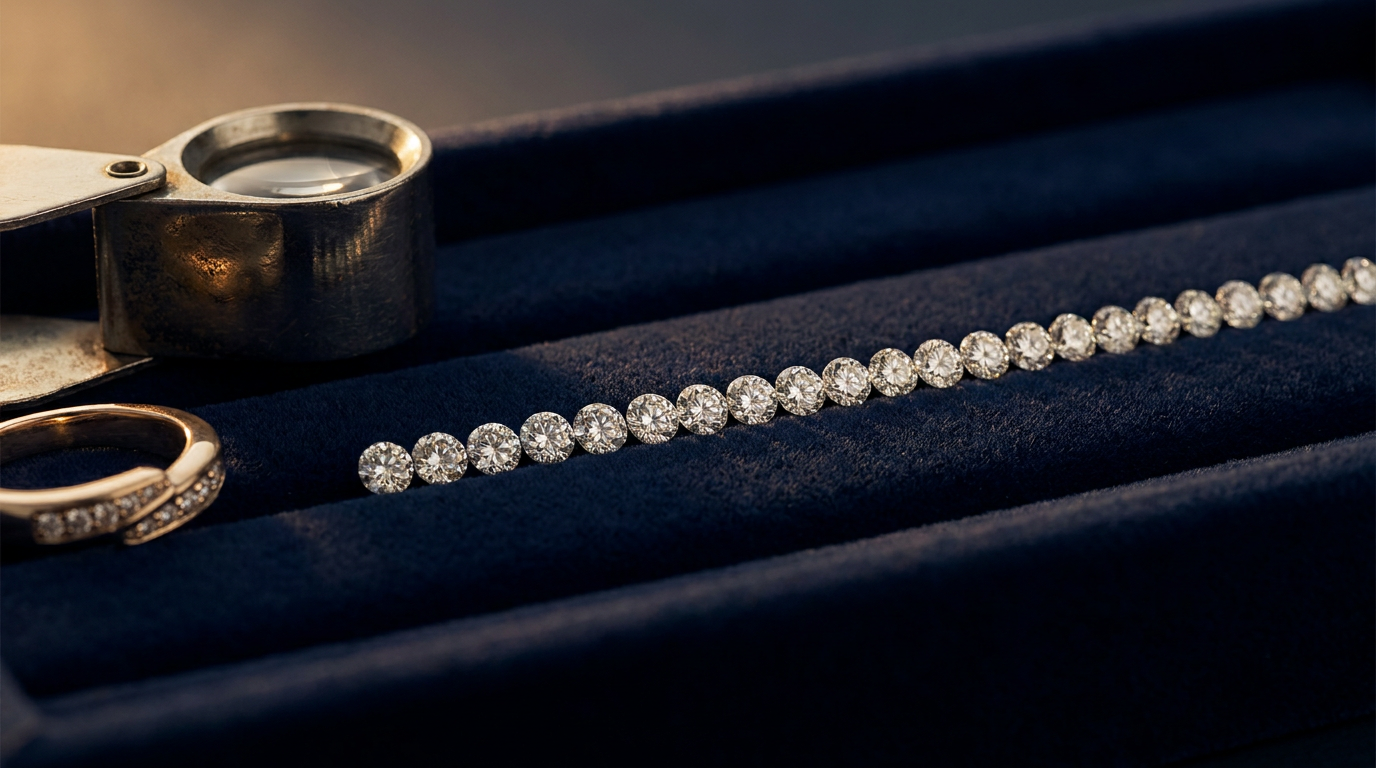
A full eternity band in 2.0mm natural melee runs roughly 22–25 stones and 0.65–0.75 carats for a size 6–8 ring; a half eternity is about half that. The exact count depends on ring size, stone diameter, and setting style, and it's the one melee job where every stone sits in a single visible line — so matching consistency, not just grade, is what makes or breaks the finished piece. This guide walks through the carat math, the ordering checklist, and the grade calls that matter for natural melee eternity work.
What Is a Natural Melee Eternity Band, Exactly?
An eternity band is a ring set with diamonds running some or all of the way around the shank, rather than a single center stone or a cluster. In natural melee terms, it's a production or custom order built from loose, sub-carat round diamonds sold by size and quality bucket — sorted for consistent diameter and matched color/clarity so the finished row reads as one continuous line rather than a scatter of visibly different stones.
One taxonomy note worth knowing if you're cross-referencing SKUs: on Guru Diam's own catalog, eternity bands are filed under Wedding Bands, not as a separate product category. That's a finished-jewelry classification detail — this guide is about the loose natural melee sourcing side of the job, not the catalog structure itself.
Everything in this guide is natural, mined melee — round shapes only, in the current 0.8mm–4.0mm size range, sold as sieve/size-graded parcel goods rather than individually certified (standard practice for stones this small across the trade, not a Guru Diam shortcoming). If you also stock a lab-grown line, treat it as a separate SKU set with its own spec — don't blend the two on one purchase order or one product page.
What's the Difference Between Full, Three-Quarter, and Half Eternity?
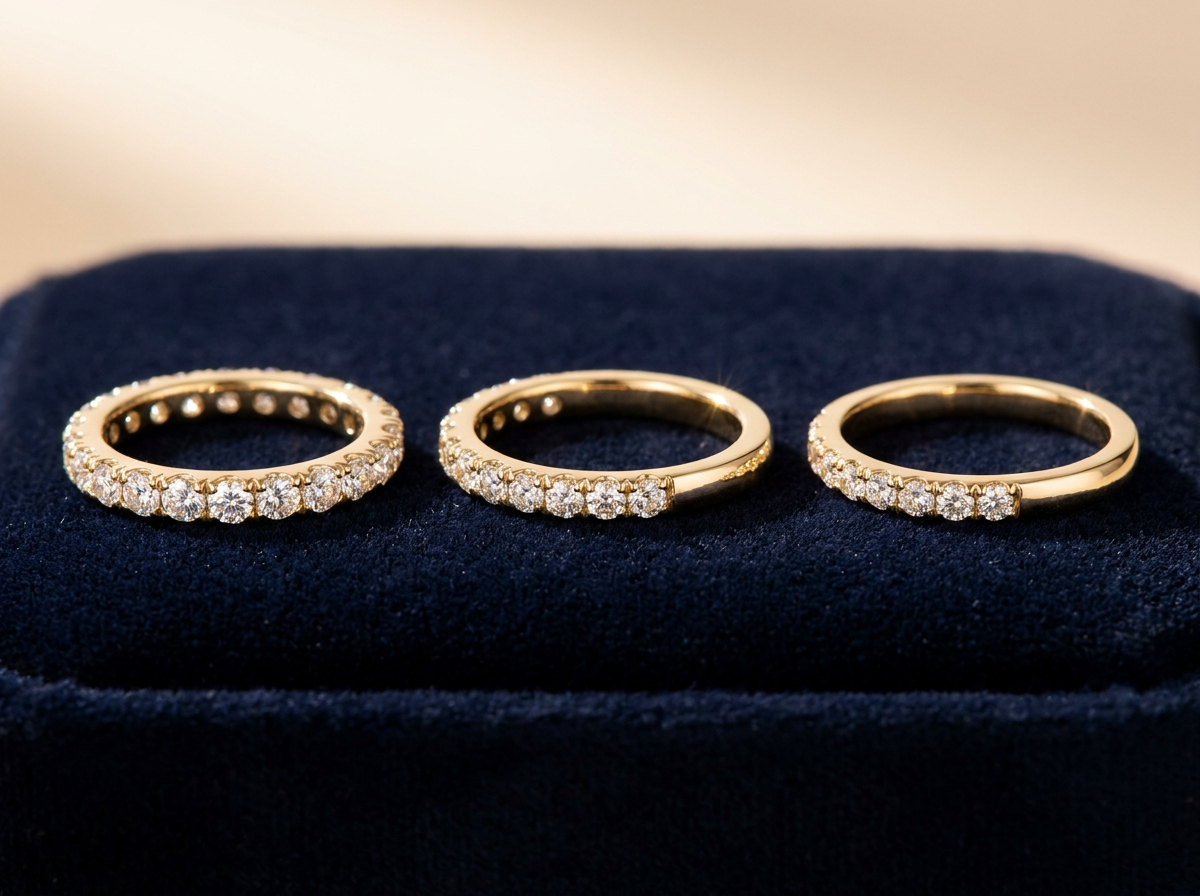
The three formats are defined by how much of the ring's circumference carries stones, and that coverage percentage is the first number you need before any carat math means anything:
- Full eternity — stones run 360° around the shank, all the way through the back. Maximum stone count and carat weight for a given ring size and mm. Because the back of the band is also set, a full eternity ring generally can't be resized without disturbing the stone line — sizing usually means cutting and re-fusing through set stones, which most shops avoid.
- Three-quarter eternity — stones cover roughly 270° (about 75% of the circumference), leaving a short plain-metal arc at the back, under the finger. This is a middle-ground order: most of the visual weight of a full band, meaningfully less carat weight, and a plain back that's marginally easier to work with at the bench than a fully set one.
- Half eternity — stones cover the front roughly 180° (about 50% of the circumference); the back half of the shank is plain metal. This is the most common configuration for both stacking/anniversary bands and for eternity rings that customers expect to resize later, since the plain back gives the jeweler room to cut and adjust without touching set stones.
None of this is a grade or quality decision — it's a coverage decision, and it's usually made before the stone order goes out, because it directly sets how many stones and how many carats you're buying.
How Many Carats of Melee Does a Full Eternity Band Need?
The working formula is simple and worth keeping on the bench:
Stone count ≈ inner circumference of the ring ÷ (stone diameter + prong/gap allowance)
Inner circumference comes from ring size — bigger finger, longer circumference, more stones needed to close the loop at the same mm. The gap allowance accounts for the sliver of metal between stones (shared prong, bead, or channel wall) and typically runs 0.15mm–0.3mm per stone depending on setting style, covered in more detail below.
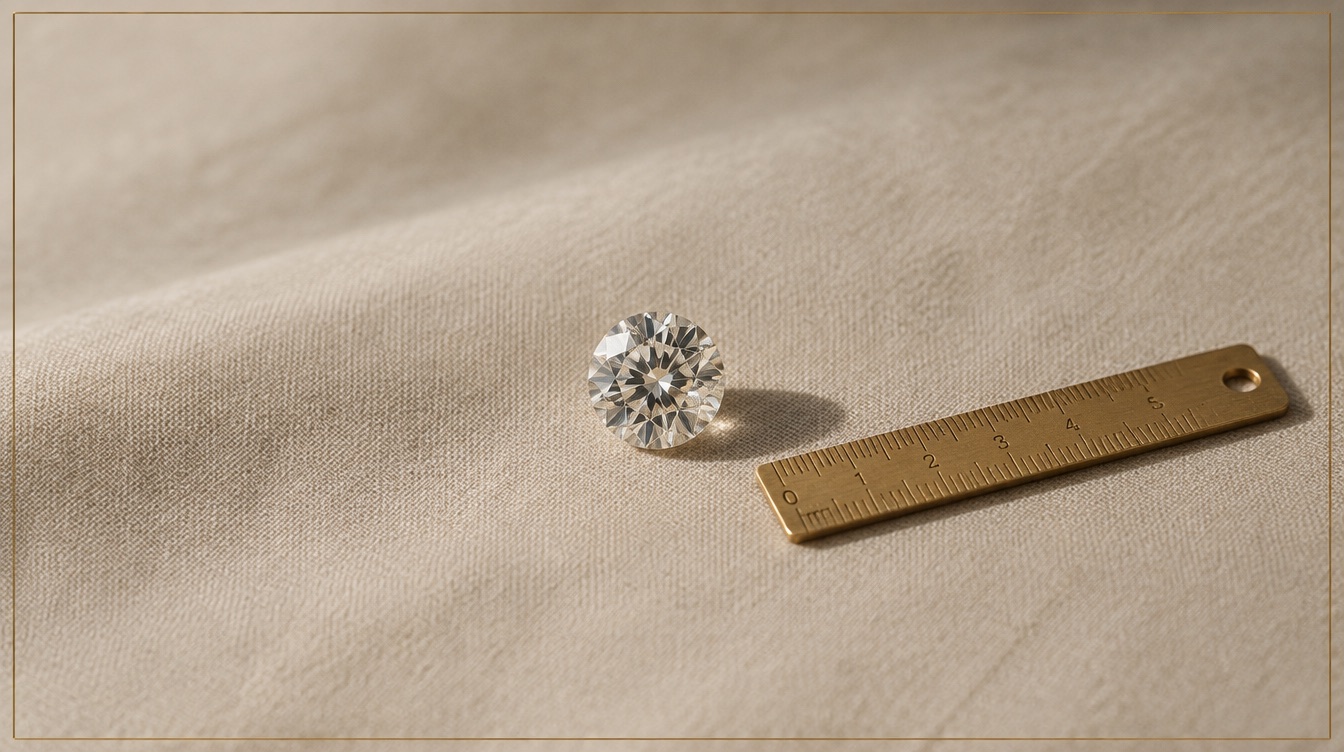
Once you have a stone count, multiply by the approximate per-stone weight for that millimeter to get total carats. Using standard trade mm-to-carat approximations: a 1.5mm round runs about 0.015ct, 2.0mm about 0.03ct, 2.5mm about 0.06ct, and 3.0mm about 0.10ct. For the full mm-to-carat-to-sieve reference table, see our companion size chart guide.
Worked example — size 7 ring, full eternity, 2.0mm GH-VS melee: circumference is roughly 54mm; at 2.0mm stones with a 0.3mm shared-prong allowance, that's about 24 stones. At ~0.03ct each, total weight comes to roughly 0.70–0.75ct. Move up to 2.5mm stones on the same ring and the count drops to around 19 stones but the total weight rises to roughly 1.10–1.15ct — fewer, heavier stones for the same coverage.
These are planning numbers, not a purchase order. The stone count that actually ships is confirmed against your setter's CAD or hand-fabrication count once the mounting is finalized — melee sorting always allows a small overage for breakage, rejects, and exact-fit adjustment at the bench.
How Does Ring Size Change the Stone Count?
Because the formula runs off circumference, stone count and carat weight scale with ring size in a fairly predictable way. Here's the approximate range for a full eternity band across common sizes, at two typical melee diameters:
| Ring size | Approx. inner circumference | Stone count @ 2.0mm | Total weight @ 2.0mm | Stone count @ 2.5mm | Total weight @ 2.5mm |
|---|---|---|---|---|---|
| 6 | ~52mm | ~23 | ~0.69ct | ~19 | ~1.14ct |
| 6.5 | ~53mm | ~23 | ~0.69ct | ~19 | ~1.14ct |
| 7 | ~54mm | ~24 | ~0.72ct | ~19 | ~1.14ct |
| 7.5 | ~56mm | ~24 | ~0.72ct | ~20 | ~1.20ct |
| 8 | ~57mm | ~25 | ~0.75ct | ~20 | ~1.20ct |
Two things worth flagging before you order off this table. First, band width changes the math if the design calls for a double row instead of a single row of stones — a wider band set with two rows of smaller melee roughly doubles both stone count and carat weight for the same ring size. Second, these figures assume the melee falls within Guru Diam's current 0.8mm–4.0mm sourced range; anything above 4.0mm is a genuine sourcing gap right now, not something we can quote for natural round melee.
How Much Do Three-Quarter and Half Eternity Save on Stone Count?
Once you have the full-eternity number for a given ring size and stone diameter, three-quarter and half are straightforward fractions of it — roughly 75% and 50% of both stone count and carat weight, respectively, since coverage is what's changing, not the stone spec.
Using the size 7, 2.0mm example above (24 stones, ~0.72ct full): a three-quarter version comes in around 18 stones and ~0.54ct, and a half eternity around 12 stones and ~0.36ct. That's a meaningful swing in carat weight — and therefore in cost — for what can be a fairly small visual difference from most viewing angles, which is exactly why the coverage decision is worth making deliberately rather than defaulting to full.
Here's the same comparison across the ring-size range, all at 2.0mm melee, so you can see how the three formats scale together:
| Ring size | Full — stones / total ct | Three-quarter — stones / total ct | Half — stones / total ct |
|---|---|---|---|
| 6 | ~23 / ~0.69ct | ~17 / ~0.52ct | ~12 / ~0.35ct |
| 6.5 | ~23 / ~0.69ct | ~17 / ~0.52ct | ~12 / ~0.35ct |
| 7 | ~24 / ~0.72ct | ~18 / ~0.54ct | ~12 / ~0.36ct |
| 7.5 | ~24 / ~0.72ct | ~18 / ~0.54ct | ~12 / ~0.36ct |
| 8 | ~25 / ~0.75ct | ~19 / ~0.56ct | ~13 / ~0.38ct |
The same 75%/50% ratio holds at other stone diameters too — for 2.5mm melee, just apply the same fractions to the full-eternity figures in the earlier table. This is why it's worth deciding coverage before locking stone size: the two variables multiply against each other, and getting either one wrong after the mounting is built is an expensive fix.
The trade-off isn't only cost. A plain back half (or the plain arc on a three-quarter) is also what makes a ring resizable later without cutting through set stones — worth raising with the customer or the account ordering the piece before you commit to full coverage, especially on a bridal SKU that's likely to need a size adjustment down the line.
Why Is Eternity the Hardest Melee Matching Job in the Shop?
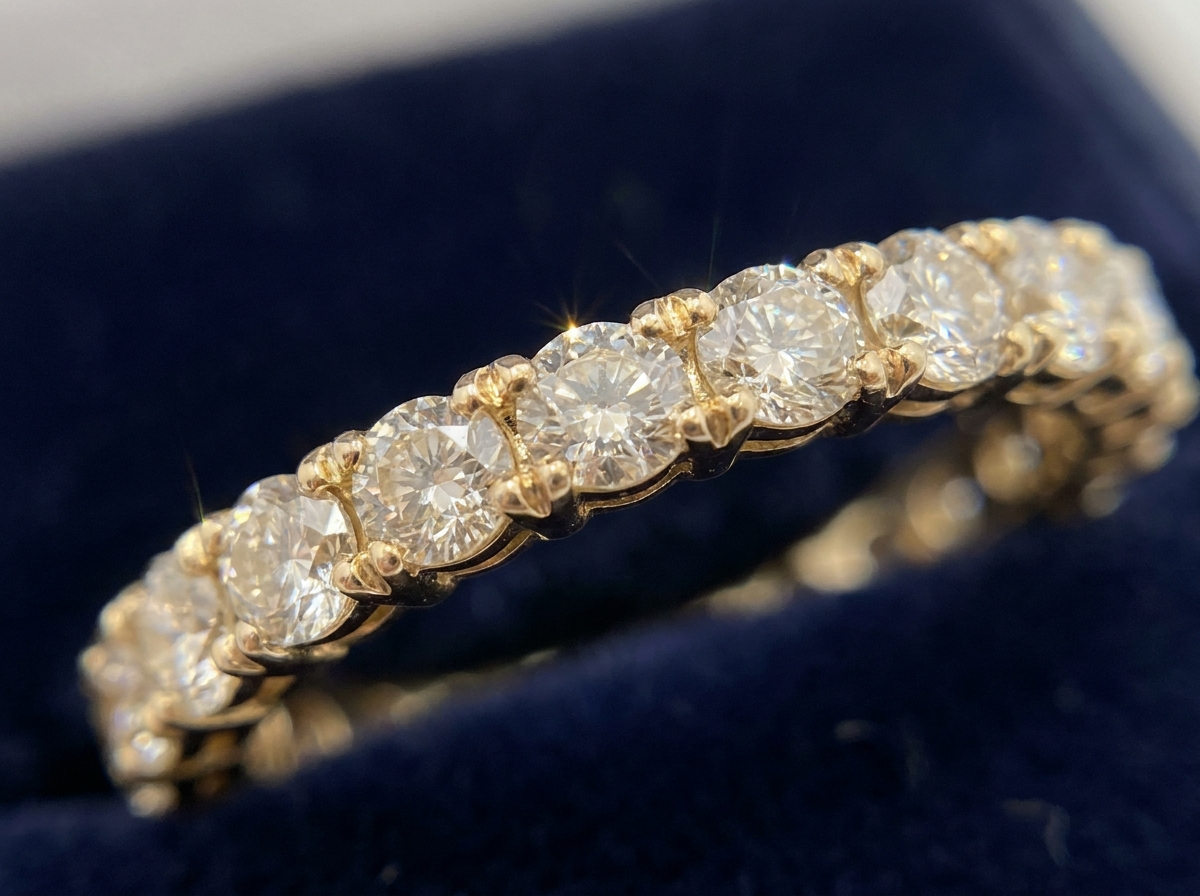
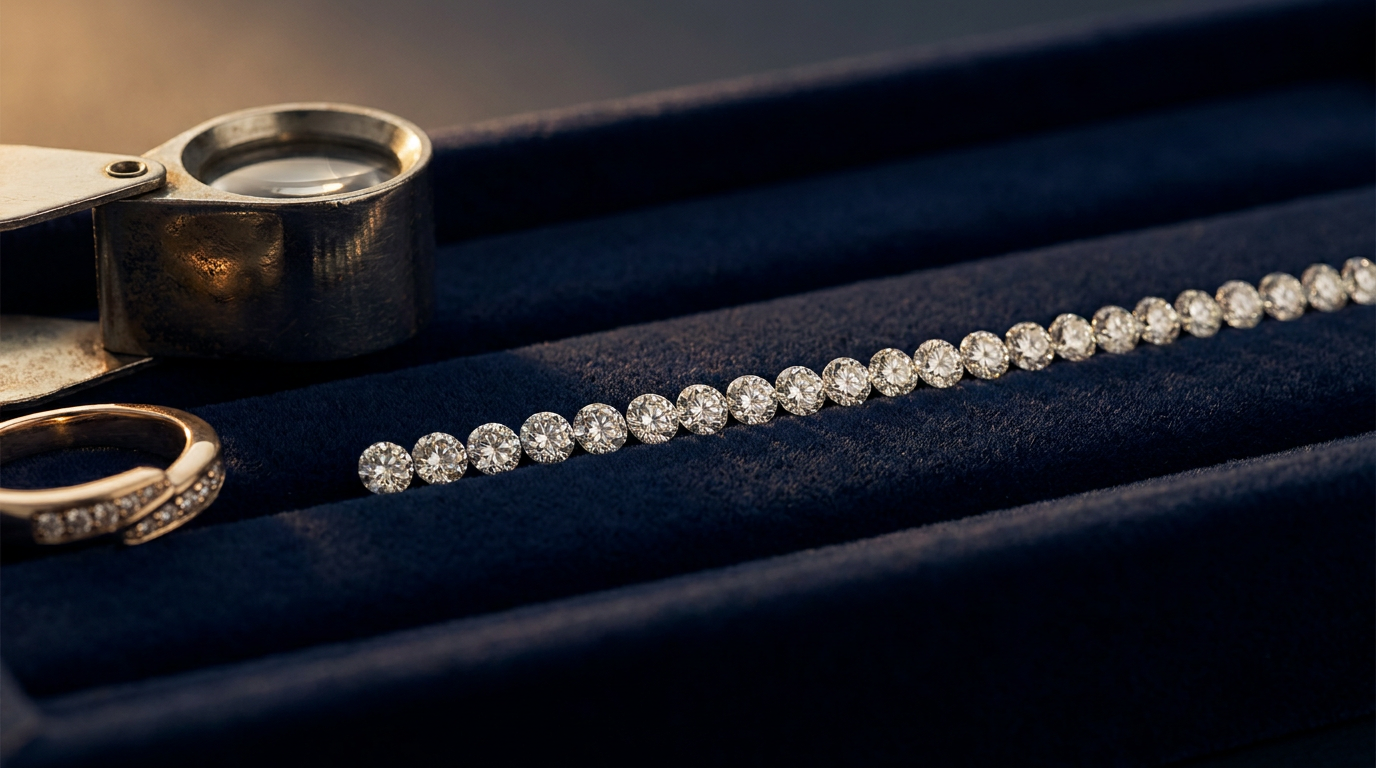
Halo work and pavé clusters have room to hide small variation — a slightly warmer stone or a marginally larger one gets absorbed visually into a field of many stones seen together. Eternity doesn't have that cover. Every stone in the row sits directly next to its neighbors in a single sightline, usually under close inspection since the customer is looking at their own hand. Any drift in size, color, or clarity between adjacent stones reads immediately as an uneven top line or a mismatched flash — there's nowhere for it to blend in.
That's what makes eternity the tightest matching job in natural melee, and it drives a few practical sourcing habits:
- Sort against a single master stone for the whole order, not a general size/grade bucket — the master stone is the reference every parcel stone gets compared to, which is how sieve-graded goods hold a consistent look across dozens of pieces.
- Draw from one continuous parcel where possible, rather than blending multiple purchase lots mid-order. Even within the same size/grade bucket, different lots can carry subtle differences in fluorescence or cut character that show up in a tight row.
- Confirm size consistency, not just average size. A parcel that averages 2.0mm but ranges from 1.9mm to 2.1mm will still throw an uneven top line in a full eternity setting, even though it technically matches the size call on paper.
None of this is unique to Guru Diam's grading process — it's the same discipline any serious melee desk applies to eternity and tennis work, because both put stones in a continuous visible row. The difference between a clean order and a rework request usually comes down to whether this step happened before the parcel shipped.
What Calibration Tolerance Should You Specify for Eternity Work?
Melee is generally sold to a calibration tolerance around the stated millimeter — the general trade convention is roughly ±0.10mm dimension and ±0.10ct weight, with about a one-grade allowance on color and clarity match within the parcel. For eternity, specify the tight end of that range: ±0.05mm rather than ±0.10mm.
The reason is the same as the matching point above — a continuous row makes size drift visible in a way a scattered pavé field doesn't. Stating a tighter tolerance up front, at the time of order, costs nothing and prevents a rework conversation later. A size callout without a stated tolerance is an invitation for out-of-spec goods; always pair your millimeter with a tolerance when you place the order.
What Grade Should You Order — EF or GH, VS or SI?
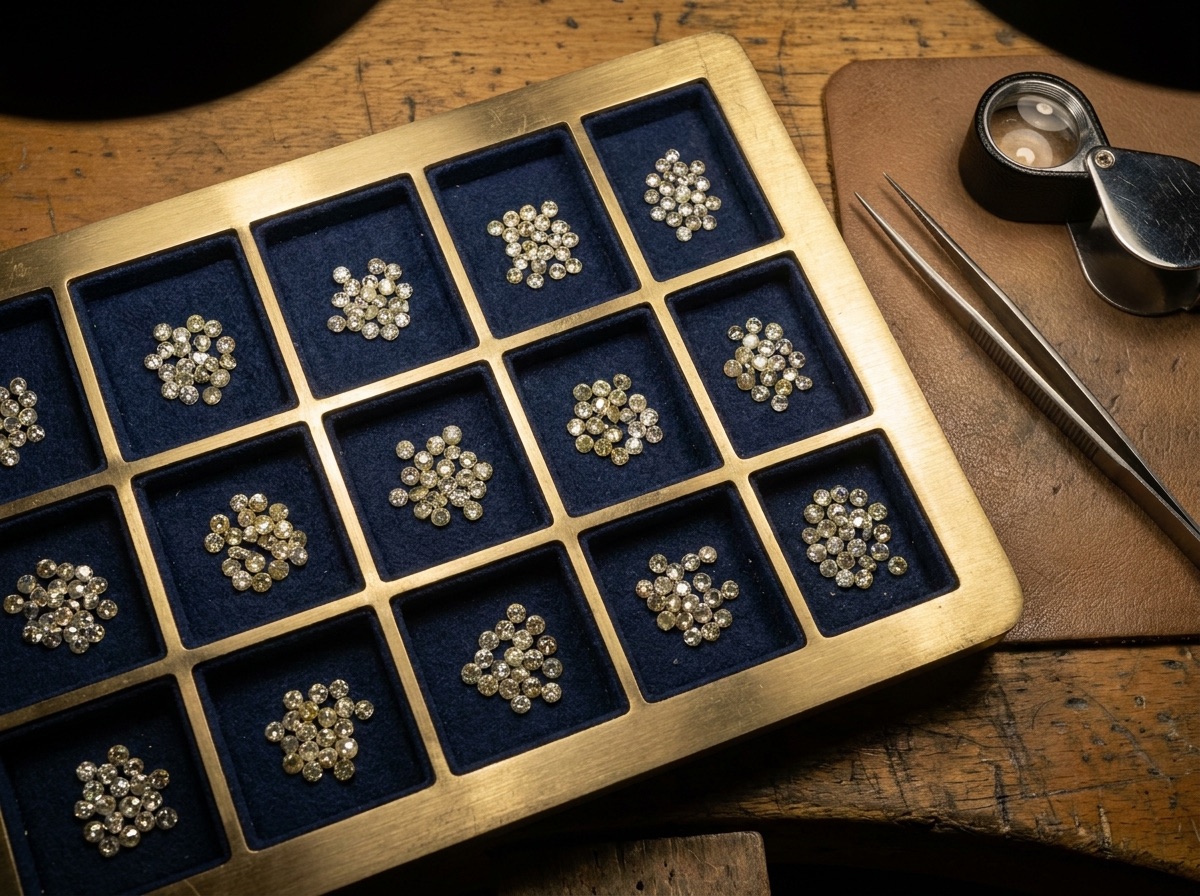
Guru Diam's natural melee grid runs two color bands (EF and GH) across two clarity bands (VS and SI) — blended trade ranges, not single exact grades. A few things matter specifically for eternity work when picking a cell in that grid:
- Size sets the color floor. EF color is only available from 1.70mm up — no vendor in this grid quotes a true E-F color melee smaller than that. If your eternity design tapers to stones under 1.70mm (common on the lower shank of a graduated band), GH is the color you'll be quoting at that size, full stop — there's no EF option to fall back on.
- Clarity matters more as stones get bigger. Under about 2.0mm, SI clarity is usually a safe, budget-friendly call — inclusions at that scale generally aren't visible face-up in a finished row. From roughly 2.5mm and up, bump to VS if the budget allows; a continuous line of larger stones puts every inclusion under more scrutiny than the same clarity would get in a scattered setting.
- Consistency across a stocking line matters more than the grade itself. If you're running eternity bands as a repeat SKU rather than a one-off custom order, locking one grade cell (say, GH-VS at 2.0mm) for every reorder keeps your finished pieces matching each other on the case, not just matching within a single band.
There's no single "right" grade — it's a budget and visibility call. What matters is making that call deliberately against the size the design actually needs, rather than defaulting to whatever's cheapest in the grid.
Does Setting Style Change the Stone Count or Order?
Yes, in two ways. First, the gap allowance in the stone-count formula shifts with setting method: shared-prong construction typically needs a slightly larger gap (around 0.25mm–0.3mm) to leave room for the shared prong tips between stones, while bead-set and channel work can run tighter (closer to 0.15mm–0.2mm), which nets a few more stones per ring at the same mm. Second, channel-set eternity bands sometimes call for a narrower calibration tolerance still, since the stones sit inside a fixed metal channel rather than being individually prong-secured — a stone even slightly oversized won't fit the channel, and one slightly undersized will sit loose.
Mention your setting style when you place a melee order, not just the mm and grade — it changes what "matched" and "in tolerance" actually mean for that specific job.
What Should You Give Your Supplier When Ordering Eternity Melee?
A clean eternity melee order gives the sorter everything needed to pull a matched parcel on the first pass, rather than going back and forth. At minimum:
- Ring size (or inner circumference, if you have it from a CAD file)
- Coverage: full, three-quarter, or half
- Stone diameter (mm) and calibration tolerance (specify ±0.05mm for eternity)
- Color/clarity grade cell (EF or GH, VS or SI)
- Setting style (shared-prong, bead-set, or channel)
- Whether this is a one-off custom piece or a repeat stocking SKU — repeat orders benefit from a locked grade cell and, where possible, sourcing continuity between runs
With those specifics in hand, we'll quote a stone count and total carat weight against your exact ring size and coverage — send them over WhatsApp or through our contact page and we'll turn a quote around against the real numbers, not a generic estimate.
If eternity bands are a recurring line for your shop rather than a one-off custom build, it's worth saying so up front. A repeat SKU benefits from locking the grade cell, mm, and tolerance once and reordering against that same spec every time, rather than re-specifying from scratch on each run — that consistency is what keeps a case of eternity bands looking like a matched line instead of several slightly different batches sitting next to each other.
What Does Natural Melee Cost for an Eternity Band?
Pricing starts around $370–450/ct in the smallest sizes and rises with stone size and grade — melee is quoted per parcel against sieve bands, not to the exact cent, so treat any number here as a planning range rather than a locked quote. For the full size-by-grade pricing breakdown, see our complete natural melee buying guide and our dedicated pricing guide. For an eternity-specific quote against your ring size, coverage, and grade, reach us on WhatsApp at +1 347 812 2006 or through our contact page — we'll confirm exact stone count and total cost against the real order, not a table estimate.
Frequently Asked Questions
How many diamonds are in a natural melee eternity band? It depends on ring size, stone diameter, and coverage. As a working range, a full eternity band in 2.0mm melee on a size 6–8 ring runs roughly 23–25 stones (about 0.70–0.75ct total); the same ring in 2.5mm stones runs about 19–20 stones (roughly 1.15–1.20ct). Three-quarter and half eternity scale down to roughly 75% and 50% of the full-eternity count.
What's the difference between full, three-quarter, and half eternity coverage? Full eternity sets stones 360° around the shank. Three-quarter covers about 270°, leaving a short plain arc at the back. Half eternity covers the front roughly 180°, leaving the back half plain — the most common choice for bands that may need resizing later, since the plain section gives the bench room to adjust without disturbing set stones.
What clarity and color grade should I order for an eternity band? For stones under about 2.0mm, SI clarity is generally fine since inclusions aren't visible face-up at that scale; from roughly 2.5mm up, VS is the safer call in a continuous visible row. On color, EF is only available from 1.70mm and up — for anything smaller, GH is the option in this grid, not a downgrade choice.
Why is eternity harder to match than halo or pavé work? Because every stone sits in a single visible line with no cluster to blend into, any variation in size, color, or clarity between neighboring stones is immediately visible. Halo and pavé settings scatter stones across a field where small differences get absorbed by the overall sparkle; eternity doesn't offer that cover, which is why sorting against one master stone and one continuous parcel matters more here than almost anywhere else in melee work.
What calibration tolerance should I request for eternity melee? Specify the tight end of standard trade tolerance — around ±0.05mm dimension — rather than the looser ±0.10mm that's fine for scattered accent work. A tighter tolerance costs nothing to request and prevents the uneven top line that shows up when stone diameters drift even slightly within a continuous row.
What does natural melee cost for an eternity band, and can I get an exact quote? Pricing runs roughly $370–450/ct in the smallest sizes and rises with size and grade, quoted per parcel rather than to the cent. For an exact quote against your ring size, coverage, and grade, message us on WhatsApp at +1 347 812 2006 or through our contact page — we'll confirm stone count and total cost against your real order.