
Calibrated Melee for Pave, Halo, Tennis & Eternity: Tolerances That Prevent Rework — Calibrated Diamonds for Tennis Bracelets and Eternity Bands

Calibrated diamonds for tennis bracelets and eternity bands are size-sorted melee parcels held to a tight diameter window — typically plus or minus 0.05 to 0.10mm — so every stone drops cleanly into a pre-cut seat or channel. Buying calibrated melee, not loose-sorted, is the highest-leverage way to cut bench rework and keep a continuous line uniform.
If you manufacture or order tennis bracelets, eternity bands, or micro-pavé, your finished-good quality is decided long before the setter sits down. It is decided at the parcel. A 0.02mm spread you can't see in a sieve becomes a visible step in a 7-inch tennis line, a rocking stone in a shared-prong eternity, or a seat that has to be re-cut by hand. This guide is about specifying melee so tightly that the line assembles itself — and about the trade demand that makes getting this right worth real money in 2026.
Why is calibrated melee suddenly a bigger deal in 2026?
Because the two products that consume the most calibrated round melee — tennis bracelets and eternity bands — are in the middle of a structural demand surge, not a fad. Tennis jewelry posted the largest unit-sales growth of any category in 2025, and search interest sits roughly 3x above 2021 levels, which reads as a permanent step-change rather than a spike, per Who What Wear's trend tracking. The "stacking" behavior — clients buying two and three bracelets to layer — multiplies the volume of identical, repeatable melee you need to source.
The cost side reinforces it. Lab-grown wholesale prices fell about 26% year over year in 2025, but the decline is decelerating — quarterly drops slowed to under 5%, the smallest since the category began, and small stones actually firmed up 10 to 20% after Chinese HPHT producers stopped cutting, according to Edahn Golan's wholesale price analysis. Translation for a manufacturer: melee is cheap enough to make repeatable tennis-and-eternity programs pencil out, and the floor under small-stone pricing means you can stock a calibrated range without watching it evaporate next quarter.
The opportunity is real. The trap is that cheap melee tempts buyers to source on price-per-carat alone — and uncalibrated melee that "looks fine" in the parcel paper is exactly what generates the rework that eats your labor margin.
What does "calibrated" actually guarantee — and what doesn't it?
GIA defines melee as small diamonds — single cut or full cut — weighing under 0.20ct, which corresponds to roughly 3.8mm and below for rounds, per GIA's melee primer. "Melee" alone tells you nothing about consistency. Calibrated melee adds the spec that matters at the bench: every stone is sorted to a target diameter within a stated tolerance.
Standard sieve-sorted melee is graded in size brackets — you pull a parcel between two sieve plates and accept everything that falls through one but not the next. That bracket can be 0.10 to 0.20mm wide. GIA itself notes that a size difference of as little as 0.20mm can be visible to a customer in finished jewelry — which is precisely why a sieve bracket is not good enough for a continuous line. Calibrated melee tightens the window:
| Spec | Sieve-sorted melee | Calibrated melee | Matched-pair / "matchable" |
|---|---|---|---|
| Diameter tolerance | +/- 0.10 to 0.20mm (bracket width) | +/- 0.05 to 0.10mm | +/- 0.02 to 0.05mm within the pair |
| Color spread in parcel | 2 to 3 grades typical | 1 to 2 grades | Within ~1 grade |
| Cut / symmetry control | Mixed | Held to a target | Symmetry paramount |
| Best use | Scattered accents, mixed-size halos | Tennis lines, eternity, straight-line pavé | Visible side stones, studs |
| Drop-in fit | Hand-fitting expected | Designed to seat with minimal adjustment | N/A (set as pairs) |
What calibration does not automatically guarantee: color and clarity uniformity, cut symmetry, or absence of undisclosed lab-grown stones mixed into a natural parcel (or vice versa). Tolerance is about diameter; you still have to spec color, clarity, and screening separately. For the mechanics of sorting and the underlying size-to-weight relationship, our melee size chart from mm to carat and sieve breaks down how the brackets map to weight, and our overview of calibrated round melee pointers shows the live stocked range.
How do tolerances actually prevent bench rework?
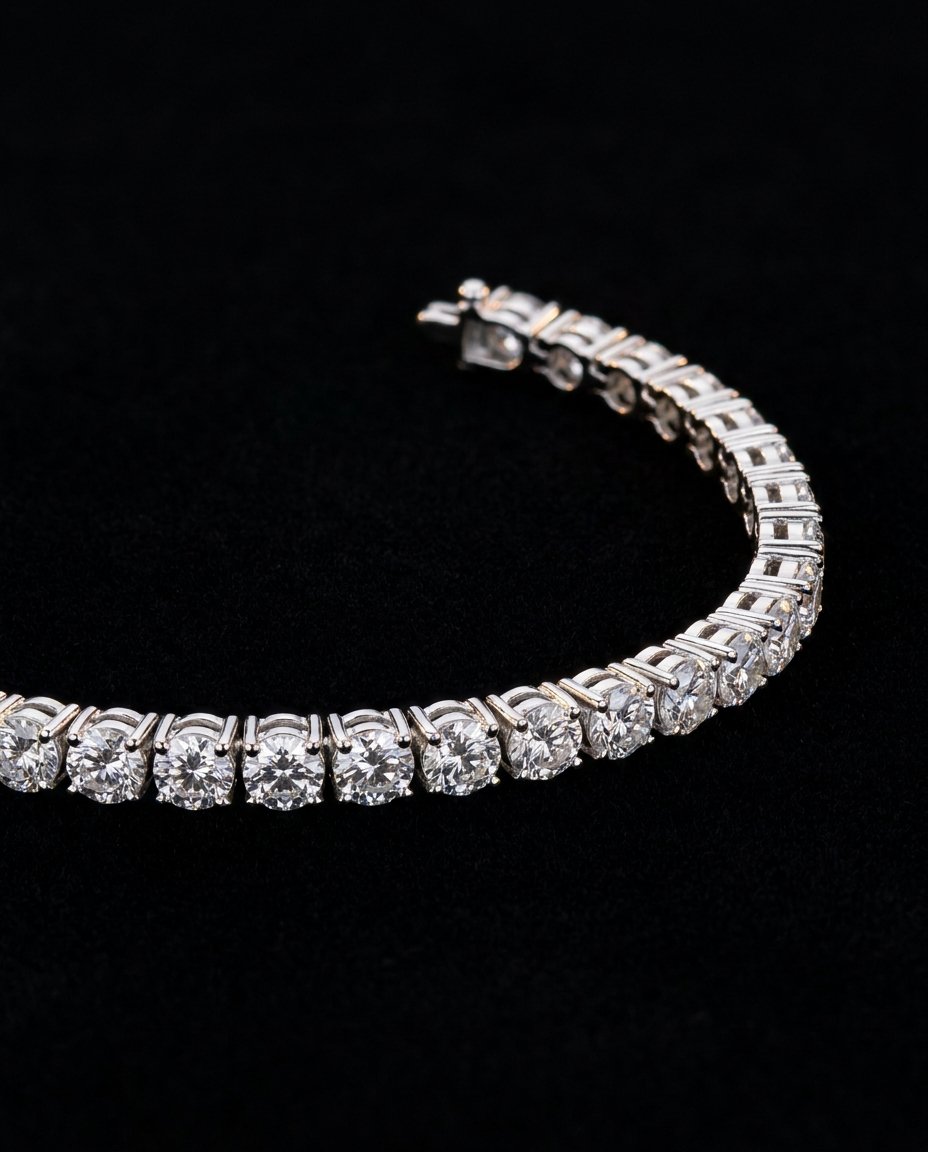
Rework happens when the stone and the seat disagree. In a tennis bracelet, every link carries one stone in a four-prong or channel seat, and the seats are produced to a fixed diameter — usually cast or stamped, then pre-cut. Feed that line a parcel with a 0.15mm internal spread and the setter is forced to make a choice on every stone: a stone 0.08mm under-size rocks and shows a gap; a stone 0.08mm over-size won't seat and the prong has to be opened or the seat re-cut by hand. Both are rework. Across a 30-stone bracelet, even a 10% misfit rate is three hand-corrections per piece — and at production volume that is the difference between a profitable program and a break-even one.
Eternity bands are less forgiving still, because stones sit shoulder to shoulder in shared prongs or a continuous channel. A diameter mismatch doesn't just affect one seat — it shifts the spacing of every stone downstream, producing the tell-tale "uneven river" look where gaps open and close around the band. There is no hiding it; the eye reads a continuous line the way it reads a typeface, and one off-step stone breaks the whole rhythm. Calibrated melee held to +/- 0.05mm keeps the seats and spacing regular enough that the band closes clean. Our stocked eternity and wedding band program is built around this — calibrated rounds in matched runs sized to common channel widths.
Micro-pavé is the third pressure point. Pavé surfaces use the smallest sizes (often 0.9 to 1.3mm) packed in beaded rows, and here uniformity of both diameter and table size determines whether the surface reads as a single sheet of light or a gritty, irregular field. A tight diameter tolerance lets the setter lay even bead rows; a wide one forces constant respacing. The labor math is brutal at this scale — a setter doing micro-pavé bills by the hour, and irregular melee can add meaningfully to set time. You pay for cheap melee in wages.
The talk track for your own bench or contractor
When you brief a setter or a contract house, specify three things, not one: target diameter, tolerance, and color/clarity window. "1.30mm rounds, plus or minus 0.05, F-G VS, full cut" is a spec a contractor can hold you to. "1.3mm melee, white, eye-clean" is an invitation to a rework invoice. The tighter the spec on paper, the less negotiation happens at the bench — and the less you eat in change orders.

Single cut or full cut: which do you order for tennis, eternity, and pavé?
This is the selection question most buyers skip, and it changes both the look and the price. A single cut (also called "8/8" or "huit-huit") has 17 to 18 facets — eight on the crown, eight on the pavilion, plus a table. A full cut has the standard 57 to 58 facets. The difference, well summarized by Victor Canera's breakdown, is the character of the sparkle: single cuts throw fewer, broader, softer flashes (a calmer, vintage, almost candlelit look), while full cuts produce finer, denser, more continuous scintillation.
For modern tennis bracelets, eternity bands, and bright micro-pavé where maximum, even sparkle is the selling point, full cut is the default — and conveniently, full-cut melee is now the more available and usually cheaper option because it dominates production. Reserve single cut for two cases: (1) period-correct restoration or vintage-styled pieces where the softer flash is the point, and (2) the very smallest accent sizes where a full cut's extra facets become invisible anyway and a single cut's broader facets actually read better. If you are building antique-styled goods, pair this thinking with our guide to lab-grown antique-cut diamonds for jewelers, where single-cut melee genuinely belongs.
A practical rule: match the melee cut to the center or the program. A bright modern eternity built on full-cut rounds should carry full-cut melee; an Old Mine or rose-cut center reads more honestly with single-cut accents.
Request a Wholesale Account → Verified trade buyers get live calibrated-melee pricing, sieve-level sorting specs, and same-day shipping from our New York and Los Angeles desks.
Can you order a full ring of melee that just drops in?
Yes — and for repeat tennis and eternity programs, this is the order you actually want to place. Instead of buying a loose carat-weight parcel and hoping it yields enough same-size stones, you order to the finished spec: "a continuous run of N stones at X.XXmm, +/- 0.05, F-G VS, full cut, for a 7-inch tennis bracelet" or "an eternity run for a 2.4mm channel, size 6.5." The supplier sorts the run to your target before it ships, so the setter receives a parcel that is already a matched line, not raw material to be re-sorted at your cost.
This is where matched-pair discipline and calibration overlap. The tightest tennis and eternity work treats the whole run like an extended matched set: held within a +/- 0.02 to 0.05mm internal spread and within roughly one color grade end to end, with cut symmetry policed throughout — the same logic we apply in how to source matched pairs of diamonds wholesale. The payoff is a bracelet whose stones step evenly from clasp to clasp and a band with no visible color drift around the finger.
Two ordering levers protect you:
- Order ~5 to 10% over count. Setting attrition is real — a stone chips, a seat opens wrong, one stone reads off. A small overage on a calibrated run means the setter never stops to wait for a replacement, which is its own form of rework (a stalled line).
- Lock the spec in writing with the parcel. A calibrated run should ship with its target diameter, tolerance, and color/clarity window documented, so a re-order six months later matches the first batch. This is what makes a tennis-bracelet SKU actually repeatable as a stocked program.
If you don't run an in-house bench at all, you can push the entire problem upstream: order the finished piece. Guru Diam completes custom diamond jewelry without an in-house bench in 4 to 6 days — versus the 9 to 19 days typical of competitors — using calibrated melee from the same stocked inventory, so the drop-in fit is handled before the piece ever leaves the workshop.
What about screening, certification, and tariffs on melee?
Three risk items belong in every melee order in 2026.
Screening. Melee is the easiest place in the supply chain for undisclosed lab-grown to be "salted" into natural parcels — the stones are too small to test individually by eye, and a single missed stone can taint a whole program. GIA has published guidance and offers melee screening for exactly this reason (GIA on identifying melee). If you run mixed natural and lab-grown inventory, insist on screened parcels or buy single-origin lots; our note on melee screening to avoid lab-grown salting covers the workflow.
Certification. Individual melee is generally not certed — it's too small to be economical — so you rely on the supplier's sorting and screening rather than a stone-by-stone report. That said, the broader cert landscape shifted in 2025: GIA stopped applying traditional 4Cs grades to lab-grown diamonds, moving to a "Premium/Standard" quality assessment, which has consolidated IGI's position as the de-facto leader in lab-grown reporting, per JCK's coverage of the change. For melee, the practical consequence is that supplier trust and parcel-level documentation matter more than ever.
Tariffs. The proposed 2026 US-India trade framework is still evolving, but as reported by JCK it would set roughly 0% on loose natural diamonds and gems and about 18% on finished jewelry and lab-grown diamonds. For a melee buyer, the structure matters: a calibrated parcel imported loose lands differently than a finished tennis bracelet built abroad. If you stock, watch the loose-vs-finished split — it can change whether you import melee and set domestically or buy finished. We track the moving pieces in our 2026 diamond tariff inventory hedge for jewelers.
Frequently Asked Questions
What tolerance should I require for calibrated melee in a tennis bracelet?
Specify a diameter tolerance of plus or minus 0.05 to 0.10mm for a standard tennis line, and tighten to plus or minus 0.02 to 0.05mm for premium or very fine work. Because GIA notes a 0.20mm difference can be visible to a customer, a wide sieve bracket is not enough — calibration to within 0.05mm is what keeps the line stepping evenly and prevents per-stone hand-fitting at the bench.
Should I use single-cut or full-cut melee for eternity bands?
Full cut is the default for modern eternity bands and tennis bracelets, because its 57 to 58 facets deliver the dense, continuous sparkle clients expect — and full cut is now more available and usually cheaper than single cut. Reserve single cut (17 to 18 facets) for vintage-styled or restoration pieces where a softer, broader flash is the design intent, or for the very smallest accent sizes.
Can I order a complete run of melee sized to drop into my settings?
Yes. Order to the finished spec rather than by loose carat weight: state stone count, target diameter, tolerance, color/clarity window, and cut, and request the run sorted to that target before shipment. Add a 5 to 10% overage to cover setting attrition. The parcel arrives as a matched line ready to set, which removes the re-sorting your bench would otherwise do at your cost.
How does calibrated melee actually reduce bench rework?
Pre-cut seats and channels are produced to a fixed diameter. When melee varies more than the seat allows, under-size stones rock and gap while over-size stones won't seat, forcing the setter to re-cut seats or open prongs by hand — that is rework. Holding the parcel to a tight diameter tolerance means stones seat on the first try, which is especially critical in eternity bands where one off-size stone shifts the spacing of every stone downstream.
Why are tennis bracelets and eternity bands driving melee demand in 2026?
Tennis jewelry posted the largest unit-sales growth of any category in 2025, with search interest roughly 3x above 2021 levels and strong "stacking" behavior where clients buy multiple bracelets to layer. Combined with lab-grown wholesale prices that fell about 26% in 2025 but are now stabilizing — with small stones firming up — repeatable tennis-and-eternity programs built on calibrated melee have become both high-demand and margin-viable.
Do I need to screen calibrated melee for undisclosed lab-grown stones?
Yes, if you run mixed natural and lab-grown inventory. Melee is the easiest point in the supply chain for undisclosed lab-grown to be salted into natural parcels because the stones are too small to assess individually by eye. Insist on screened parcels or buy single-origin lots, and rely on supplier sorting documentation, since individual melee is generally too small to be economically certified stone by stone.
Calibrated melee is where margin is won or lost on tennis, eternity, and pavé — the right diameter window means your line assembles itself and your labor bill stops absorbing the cost of sloppy sorting. Guru Diam stocks 11,000+ IGI and GIA certified stones plus calibrated and fancy-color melee across our New York and Los Angeles desks, with real-time inventory, same-day shipping, memo terms, and 4-to-6-day custom. Book an appointment with the trade desk → to spec a calibrated run for your next tennis or eternity program, or contact us for a sorted parcel quote.