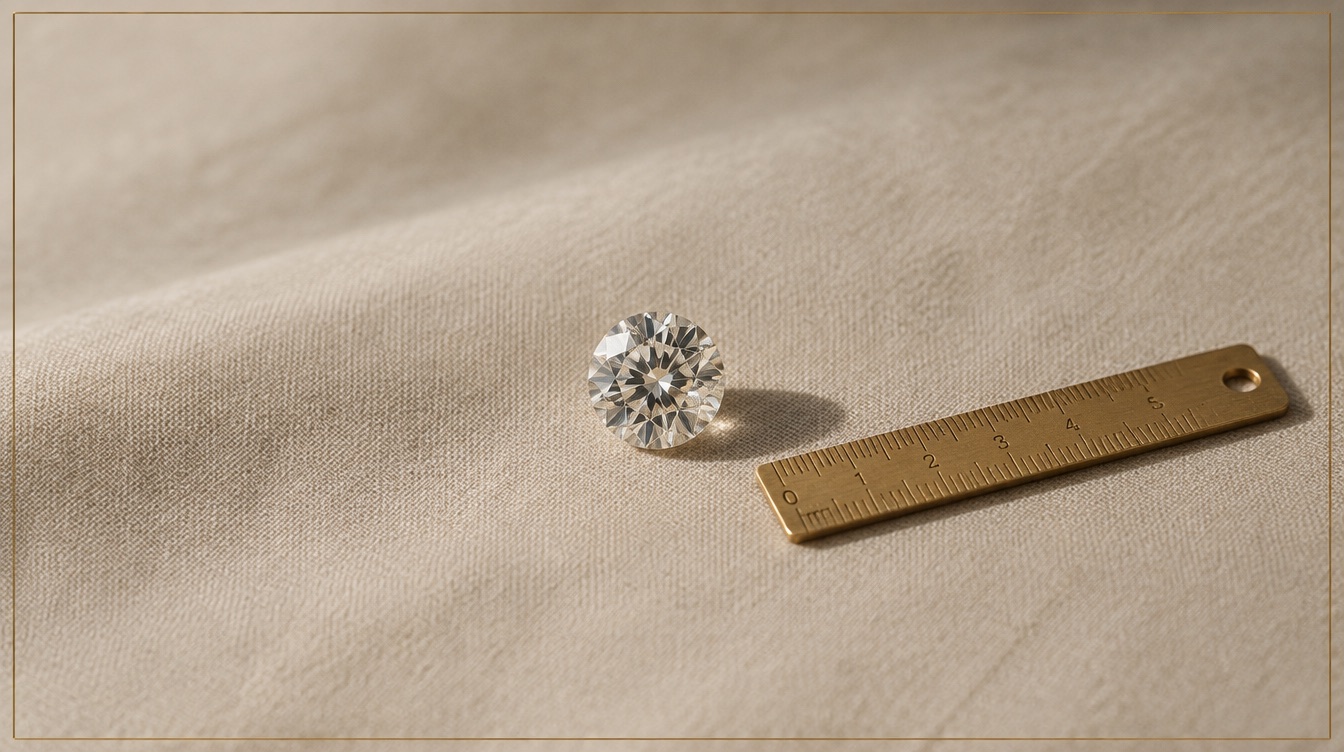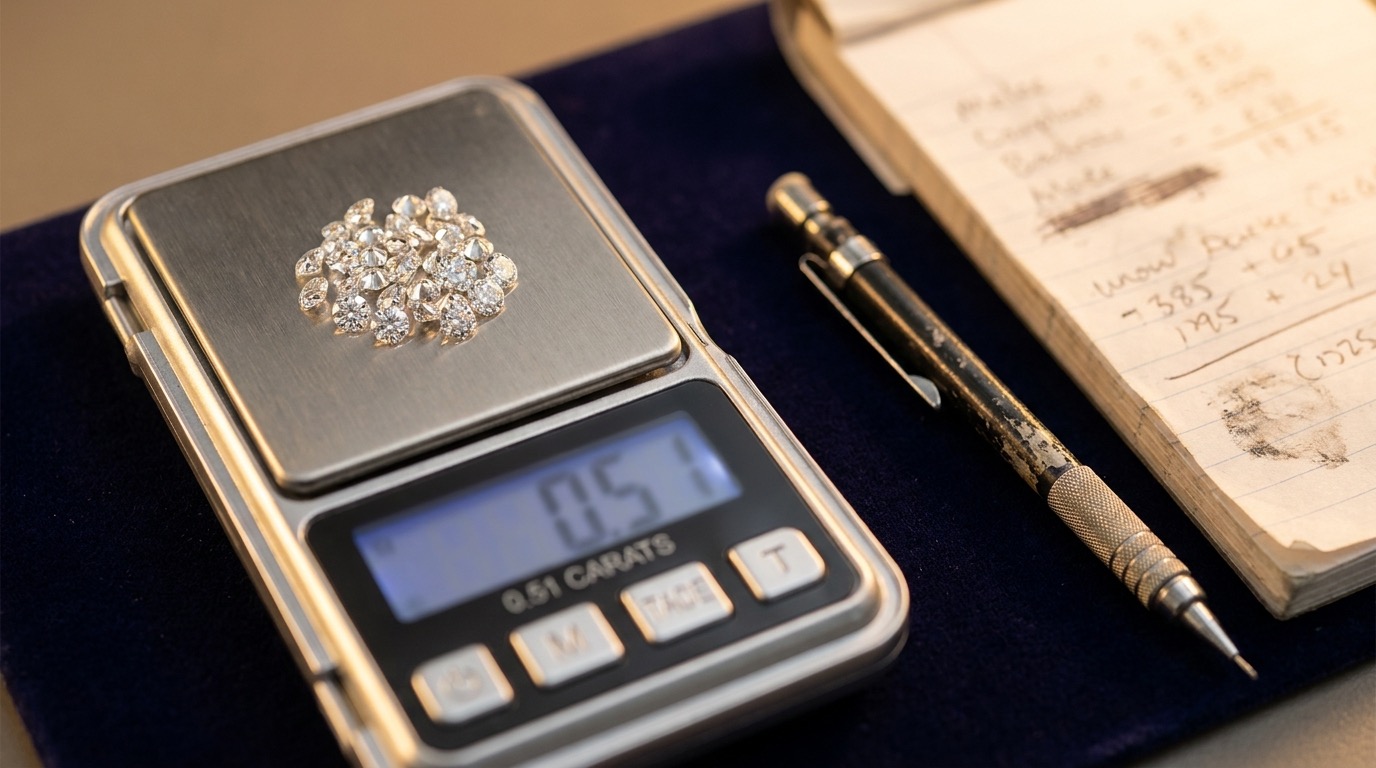
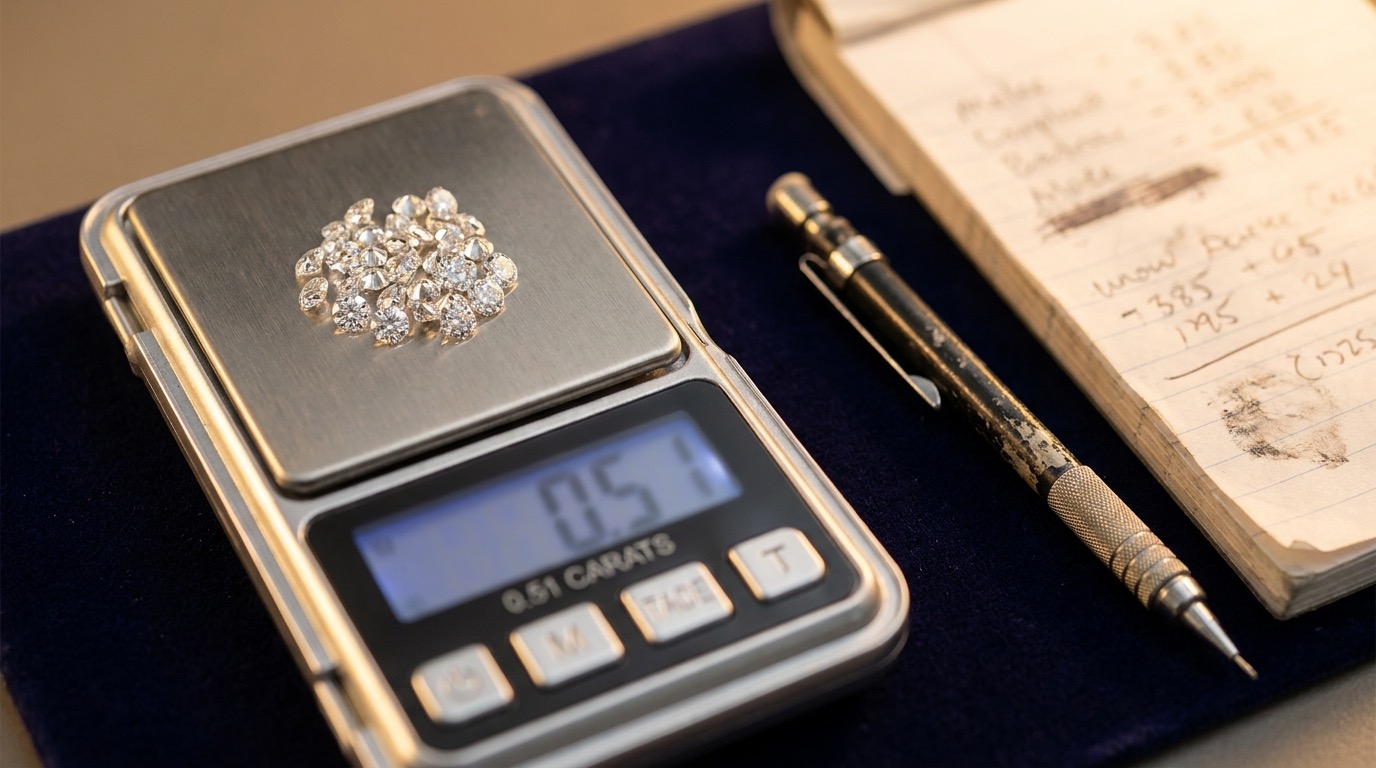
To calculate how many carats of melee you need, multiply your stone count by the approximate carat weight per stone at your millimeter size, then add a loss/matching allowance on top — typically 5% for simple pavé fill work up to 10-15% for tightly matched tennis bracelet or eternity work. The formula is: total carats = (stone count × carat weight per stone) × (1 + allowance%). For a 36-stone halo at 1.3mm, that's roughly 0.40ct raw, ordered as ~0.45ct with an 8% allowance. Below is the per-mm weight reference, the allowance rule of thumb, and worked math for a halo, a run of pavé, and a tennis bracelet segment.
What's the Basic Formula for Calculating Melee Carat Weight?
Every melee carat calculation runs on the same three inputs: how many stones the job needs, how much each stone weighs at its millimeter size, and how much extra to add on top for loss and matching. Written out:
Total carats to order = (number of stones × carat weight per stone at that mm size) × (1 + loss/matching allowance)
The first two inputs — stone count and per-stone weight — give you the raw carat weight the finished piece will actually carry once it's set. The third input, the allowance, is what you order on top of that so the parcel your bench receives has enough stones to match, enough to absorb a few losses during setting, and enough left over that a small size or color mismatch doesn't stall the job. Skip the allowance and you'll order exactly enough for a perfect world; melee work rarely delivers a perfect world.
Where jewelers usually go wrong is skipping straight to a rule of thumb — "melee runs about a carat for every 15-20 stones" — without checking it against the actual mm size on the job. That shortcut holds up in the 2.0-2.5mm range and falls apart badly outside it, because carat weight doesn't scale in a straight line with size (more on that below). The reliable path is always the three-input formula, not a size-agnostic average.
It helps to think of the calculation in two passes rather than one. The first pass — stone count times per-stone weight — is pure geometry, and it's the same number regardless of who's supplying the stones or what they charge per carat. The second pass, the allowance, is where trade judgment comes in, and it's worth getting a second opinion from whoever is actually setting the piece: a bench jeweler who's set a hundred halos has a feel for how many extra stones a given design realistically needs that no formula fully replaces.
How Do You Find Carat Weight Per Stone at a Given MM Size?
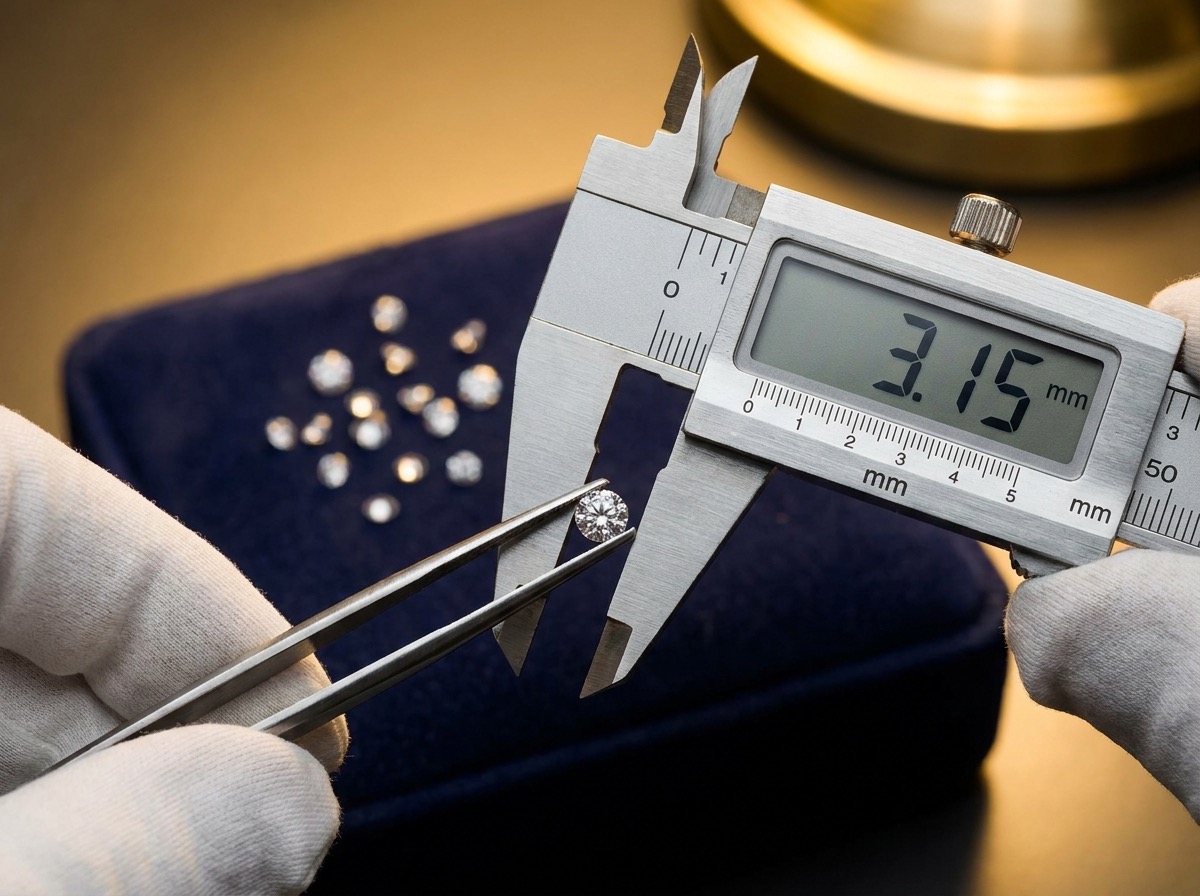
Round brilliant weight scales with the cube of the diameter, not the diameter itself — a stone twice as wide is roughly eight times heavier, not twice as heavy. That's why per-stone weight climbs slowly through the smallest sizes and then accelerates fast once you're past about 2.5mm, and it's why "just estimate from a similar size" produces bad math the moment the actual stone is more than a couple tenths of a millimeter off from the size you're picturing.
For quick reference, here's per-stone weight and stones-per-carat at the mm sizes that come up most often in pavé, halo, eternity, and tennis work:
| Diameter (mm) | Approx. Carat per Stone | Approx. Stones per Carat |
|---|---|---|
| 1.00–1.10 | 0.005–0.006 ct | ~180 |
| 1.20–1.30 | 0.008–0.010 ct | ~110 |
| 1.30–1.40 | 0.010–0.012 ct | ~90 |
| 1.50–1.60 | 0.015–0.018 ct | ~62 |
| 1.90–2.00 | 0.029–0.033 ct | ~32 |
| 2.40–2.60 | 0.052–0.065 ct | ~17 |
| 2.60–2.80 | 0.065–0.080 ct | ~13.5 |
| 2.80–3.00 | 0.080–0.100 ct | ~11 |
| 3.50 | ~0.145 ct | ~6.9 |
| 4.00 | ~0.195 ct | ~5.2 |
This is a working excerpt — for the full mm-to-carat-to-sieve reference covering every size from 0.8mm to 4.0mm, see our natural melee size chart. That post also covers sieve numbering, which is the sizing shorthand you'll hear quoted verbally on a trading desk even though the mm figure is what actually goes on a purchase order.
Treat every number in a carat-per-stone table as an approximation, not a guarantee. Actual weight varies slightly with cut proportions and depth, which is exactly why a finished parcel is weighed and invoiced on a scale at the time of shipment — the chart tells you what to budget, the scale tells you what you actually received.
How Much Extra Should You Add for Breakage and Loss?
The raw math (stone count × per-stone weight) tells you what the finished piece will weigh once it's set — it doesn't tell you what to order. Order exactly the raw number and you'll come up short, because a few things reliably eat into a melee parcel between quote and finished piece: a stone or two gets lost or chipped during setting, the setter needs a handful of extras to hand-match color and size across a long run, and any stone that falls slightly outside tolerance gets set aside rather than forced into a seat it doesn't fit.
How much to add depends on how visually demanding the job is — the more a stone's size and color have to match its neighbors, the more allowance to budget:
- Simple pavé / fill work (~5%): stones aren't in a single visible line, so minor variation is easy to hide.
- Halo settings (~5-8%): stones sit in a visible ring, so the setter wants a small surplus to keep the halo looking uniform.
- Eternity bands (~8-10%): continuous coverage around a band shows any inconsistency immediately, and full-eternity work uses more stones total, so the raw allowance count is larger too.
- Tennis bracelets (~10-15%): the tightest matching tolerance of any melee use case — every stone sits in a direct visual line next to its neighbors, so the setter needs real selection room to build a bracelet that reads as one continuous size and color.
These are planning ranges, not a guaranteed formula — a straightforward repair job might need less, and a graduated design with size-stepped rows might need more. Flag your setting type and finish quality when you request a quote, and confirm the allowance with your supplier rather than assuming a single percentage covers every job.
How Do You Calculate Carats for a Halo Setting?
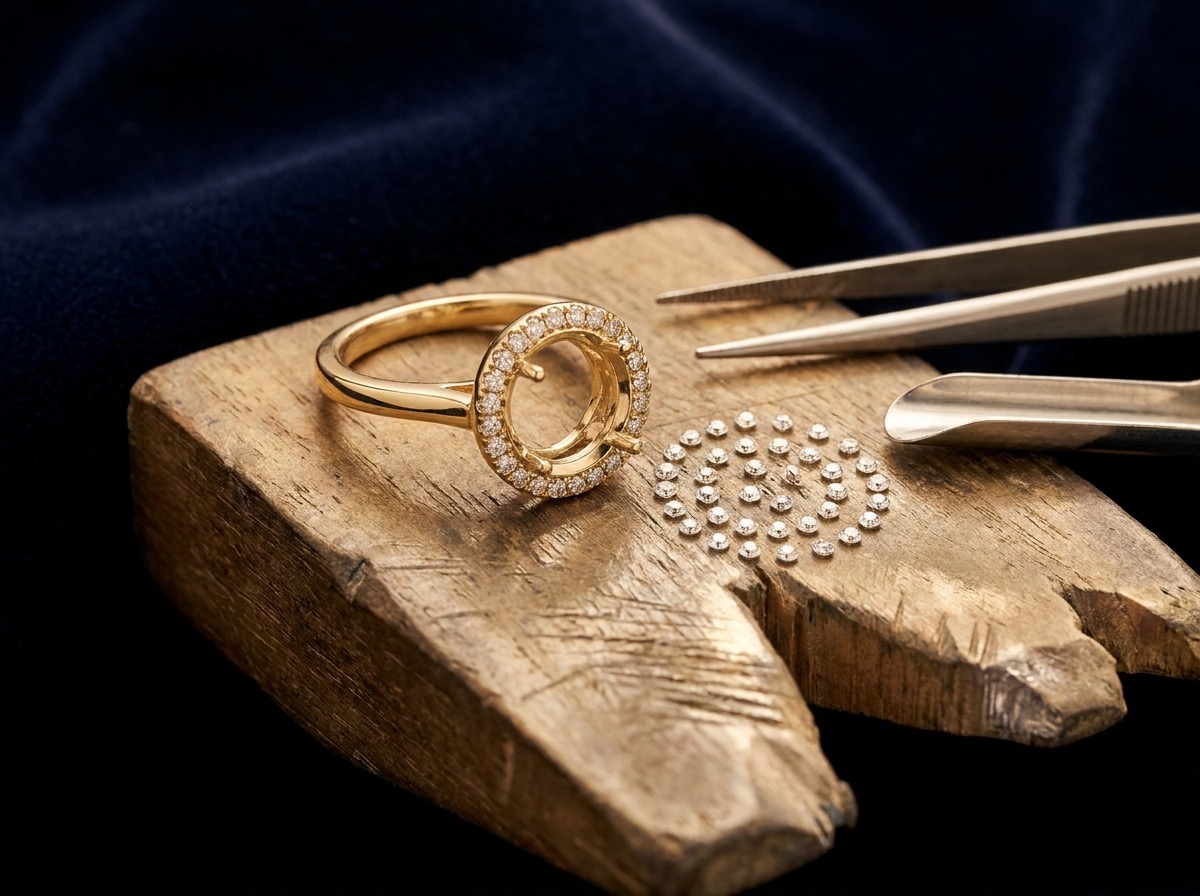
Worked example: a standard halo around a mid-size round center stone typically takes 30-40 stones of 1.2-1.5mm melee to fully ring the setting. Say your design calls for 36 stones at 1.3mm.
- Per-stone weight at 1.3mm: ~0.011ct (midpoint of the 1.30-1.40mm band)
- Raw weight: 36 × 0.011ct = 0.396ct
- Halo allowance (8%): 0.396 × 1.08 = ~0.43ct
- Order: ~0.45ct, rounding up to a figure your supplier can quote cleanly against a parcel
Notice the raw and final numbers aren't far apart in absolute terms — a few hundredths of a carat — but that gap is the difference between a halo that sets cleanly on the first pass and one where the bench runs short two stones from the end and has to stop and re-order mid-job.
How Do You Calculate Carats for a Few Inches of Pavé?
Worked example: 2 linear inches (about 50.8mm) of shared-prong pavé set with 1.2mm melee, spaced roughly 1.4mm center-to-center once you account for the prongs between stones — that works out to about 36 stones across the 2-inch run.
- Per-stone weight at 1.2mm: ~0.009ct (midpoint of the 1.20-1.30mm band)
- Raw weight: 36 × 0.009ct = 0.324ct
- Pavé allowance (5%): 0.324 × 1.05 = ~0.34ct
- Order: ~0.35ct for the 2-inch run
Spacing is the variable most likely to throw this off — a tighter-set micro-pavé row packs noticeably more stones per inch than a shared-prong row with visible metal between stones, so always count (or have your CAD file count) actual stones across the run rather than assuming a fixed stones-per-inch figure across different pavé styles.
How Do You Calculate Carats for a Tennis Bracelet Segment?
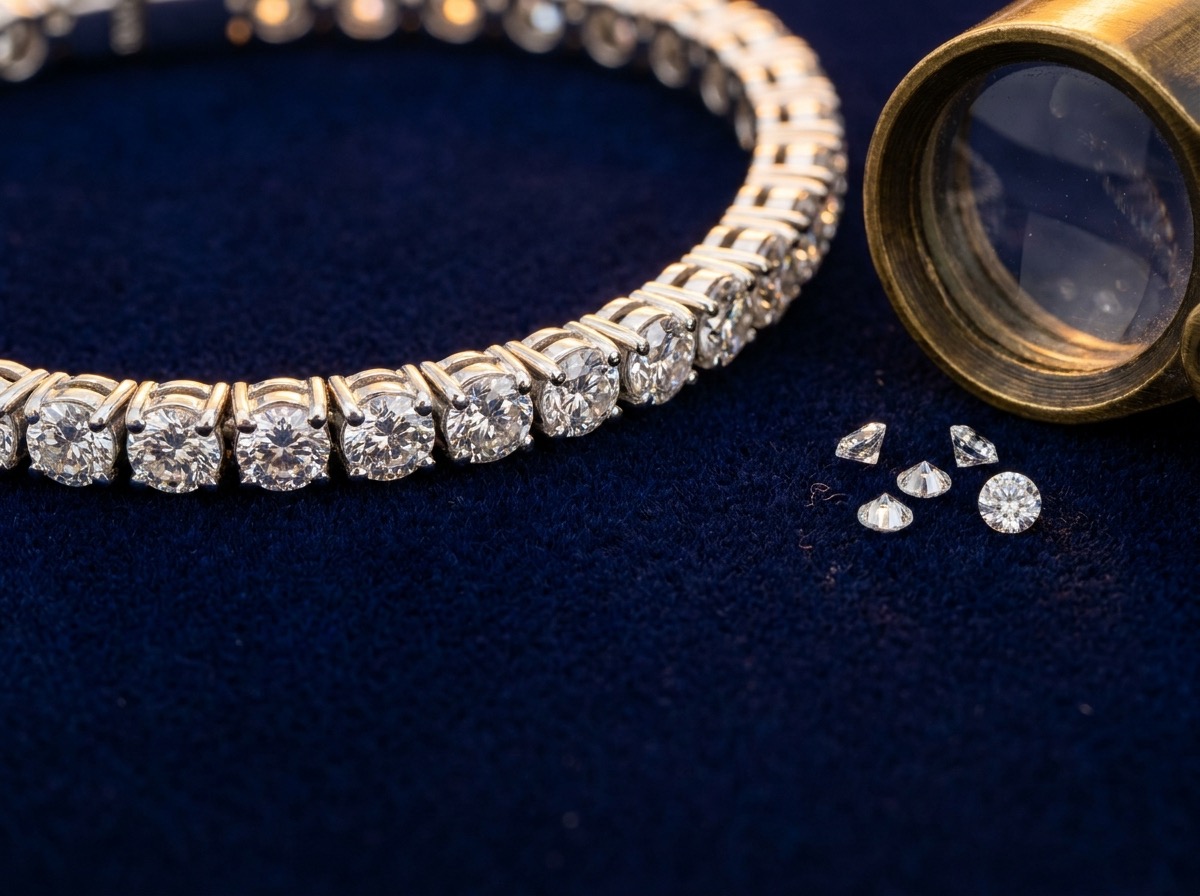
Worked example, 1-inch segment (a repair, extension, or size-matching job): 2.7mm melee at roughly 8 stones per inch, once prong/basket spacing is accounted for.
- Per-stone weight at 2.7mm: ~0.0725ct (midpoint of the 2.60-2.80mm band)
- Raw weight: 8 × 0.0725ct = 0.58ct
- Tennis matching allowance (12%): 0.58 × 1.12 = ~0.65ct
- Order: ~0.65ct for the 1-inch segment
Scaled to a full 7-inch bracelet at the same 2.7mm size: roughly 56 stones (8/inch × 7), raw weight of 56 × 0.0725ct = 4.06ct, plus a 12% matching allowance brings the order to ~4.5-4.6ct. That matching allowance matters more here than anywhere else in melee buying — a full bracelet needs every stone to read as one continuous size and color line, so the extra room to hand-select is what keeps the finished piece from showing a visible step where one batch ends and a reorder begins. For sizing math specific to tennis bracelet builds, see our natural melee for tennis bracelets buying guide.
Should You Order by Stone Count or by Total Carat Weight?
Give a supplier both, every time — not one or the other. Stone count tells them exactly how many pieces your setting requires; total carat weight tells them how much material to pull and confirms the math lines up. A quote built from only a stone count assumes a per-stone weight that may not match what actually ships; a quote built from only a carat figure with no stone count gives the supplier no way to confirm you'll receive enough individual pieces to finish the job, only that the pile weighs the right amount.
This matters more in melee than in almost any other category of diamond buying because melee is priced and shipped per carat but consumed per stone. A parcel that hits the carat target with fewer, slightly larger stones than expected can leave a pavé or tennis job short on piece count even though the invoice weight is correct. Stating both numbers up front is what catches that mismatch before the parcel ships, not after it arrives at the bench.
What Other Factors Affect How Much Melee You Actually Need?
The formula above covers the math; a few practical factors shift the real-world number beyond it:
Setting style. Bead-set and shared-prong pavé generally run tighter stone spacing (more stones per inch, but each one smaller) than bezel or channel work, which uses fewer, sometimes larger stones. Confirm your setting style before counting stones off a generic spacing assumption.
Graduated sizing. Halo and eternity designs sometimes step stone size up or down across the piece (larger stones near the center, smaller toward the shank). A graduated design needs the formula run separately for each size band, then summed — not one average size applied across the whole count.
Repair vs. new production. Repair work replacing lost pavé stones needs an exact mm match to the existing setting, not a size close enough to "look right" — a replacement even 0.1mm off can sit proud of or loose in a channel cut for the original stone.
Color/clarity consistency across a large order. The larger the stone count, the more a sorter needs to pull from to guarantee a consistent match — this is part of why matching allowances run higher on big continuous runs (full eternity, full tennis bracelets) than on scattered accent work.
Order timing. Calculating the full carat weight up front — rather than ordering in small batches as a production run progresses — makes it easier for a supplier to pull matched stones from a single parcel. Splitting one job across multiple small reorders increases the odds that a later batch is sorted against a slightly different master stone, which is the kind of subtle inconsistency that's much easier to prevent at the order stage than to fix after a piece is already set.
How Do You Convert a CAD File's Stone Count into a Carat Order?
Most CAD renders for pavé, halo, and eternity work already output an exact stone count and the mm size specified for each seat — that's the fastest, most accurate starting point for a carat calculation, since it removes the guesswork of counting stones off a photo or sketch. Pull the stone count and mm size directly from the CAD file's stone schedule (most CAD software generates one), run it through the formula above, and you have an order-ready carat figure without hand-counting anything.
Two things to double check before converting: that the CAD stone schedule is grouped by actual mm size rather than a single "small/medium/large" label, and that the count reflects finished stone placements rather than a placeholder count from an early design pass. A CAD schedule that hasn't been updated since a design revision is a common source of over- or under-ordering that has nothing to do with the math itself.
What Mistakes Lead to Ordering Too Much or Too Little Melee?
A handful of errors account for most melee carat miscalculations we see on incoming orders:
- Using a flat "stones per carat" average across different sizes. A rule of thumb calibrated for 2.0mm stones badly overstates or understates carat weight once applied to 1.2mm or 3.0mm work — always convert from the actual mm size, not a blended average.
- Skipping the loss/matching allowance entirely. Ordering exactly the raw calculated weight leaves no room for a lost stone, a mismatch, or a stone that falls outside tolerance — the job stalls mid-setting waiting on a reorder.
- Assuming carat weight doubles when mm size doubles. It doesn't — weight scales with the cube of diameter, so a 2.0mm stone is roughly six to eight times the weight of a 1.0mm stone, not twice.
- Ordering carats without stating stone count. A carat figure alone doesn't guarantee the piece count your setting needs, since the same total weight can arrive as fewer larger stones or more smaller ones.
- Not accounting for graduated sizing. Running one average mm size across a design that actually steps sizes up or down produces a total that's off in both directions at once — too much at one end, too little at the other.
Most of these are caught by the same habit: write every melee order as three explicit fields — mm size (or a size-graduated breakdown), stone count, and total carat weight with the allowance already applied — rather than handing a supplier just one of the three and letting them infer the rest.
How Much Does Extra Melee Carat Weight Cost?
Once you have a target carat weight, cost follows from Guru Diam's per-carat pricing at your chosen size and grade — pricing starts around $370-450/ct in the smallest sizes and rises with size and color/clarity grade from there. Because price per carat climbs faster at larger sizes, the cost impact of an allowance is smaller in absolute terms on small-stone pavé work than it is on larger tennis or eternity stones, which is worth factoring in if you're weighing a tighter allowance against budget.
We're intentionally not repeating the full size-by-grade rate table here — see our natural melee wholesale buying guide for the complete pricing grid, or message us on WhatsApp with your calculated carat weight, size, and grade for a confirmed quote. All melee pricing is approximate until confirmed at quote — it's sold per parcel against sieve bands, not off a fixed list.
How Do You Place a Melee Order Once You've Calculated Your Carat Weight?
Once you've run the math, send your supplier all three numbers together: millimeter size (or size-graduated breakdown), stone count, and total carat weight with your allowance already built in. That's a complete, quote-ready spec — a supplier working from those three fields can confirm availability and exact pricing against real current parcels, rather than guessing at what you actually need.
Reach Guru Diam over WhatsApp or through Contact with your calculated spec, and you'll get a confirmed price per carat for the parcel that matches your job. Same-day shipping is available out of both our New York (36 West 47th Street, Suite 601A, NY 10036) and Los Angeles (607 S Hill Street, Suite 241, LA 90014) trade desks — before 6pm EST in New York, before 4pm PST in Los Angeles — subject to the parcel being in stock at your size and grade.
Frequently Asked Questions
What's the formula for calculating how many carats of melee I need?
Total carats to order = (stone count × carat weight per stone at your mm size) × (1 + loss/matching allowance). The allowance typically runs 5% for simple pavé up to 10-15% for tennis bracelet work, where stone-to-stone matching is tightest.
How much extra melee should I order for breakage and loss?
It depends on the job: roughly 5% for simple pavé or fill work, 5-8% for halo settings, 8-10% for eternity bands, and 10-15% for tennis bracelets, which need the most matching room. These are planning ranges — confirm with your supplier for jobs with unusual finish requirements.
Why doesn't carat weight double when the millimeter size doubles?
Round brilliant weight scales with the cube of the diameter, not the diameter itself. A 2.0mm stone is roughly six to eight times the weight of a 1.0mm stone, not twice — which is why estimating carat weight by eye or by a flat ratio consistently produces bad numbers.
Should I tell my supplier a stone count, a carat weight, or both?
Both, every time. Carat weight confirms the material pulled matches your budget; stone count confirms the parcel will actually contain enough individual pieces to finish your setting. A quote built from only one of the two can technically hit its number while still leaving your bench short.
How many carats of melee does a typical halo setting need?
It depends on the center stone's ring diameter and the mm size chosen, but a common range is 30-40 stones at 1.2-1.5mm, which works out to roughly 0.35-0.55ct raw before a matching allowance. See the worked example above for the exact math at 36 stones and 1.3mm.
Where can I get an exact price once I've calculated my carat weight?
Send your calculated mm size, stone count, and total carat weight to Guru Diam over WhatsApp or through Contact — pricing is confirmed per parcel at the time of quote, not off a static table.
Related Articles
- How to Buy Natural Melee Diamonds Wholesale (Step by Step)
- Natural Melee for Eternity Bands: Sizing & Ordering Guide
- Natural Melee for Tennis Bracelets: Buying by the Carat
- Natural Melee Diamond Size Chart: MM to Carat & Sieve Guide
- Melee Diamond Size Chart: MM to Carat to Sieve (Lab-Grown CVD Line)