
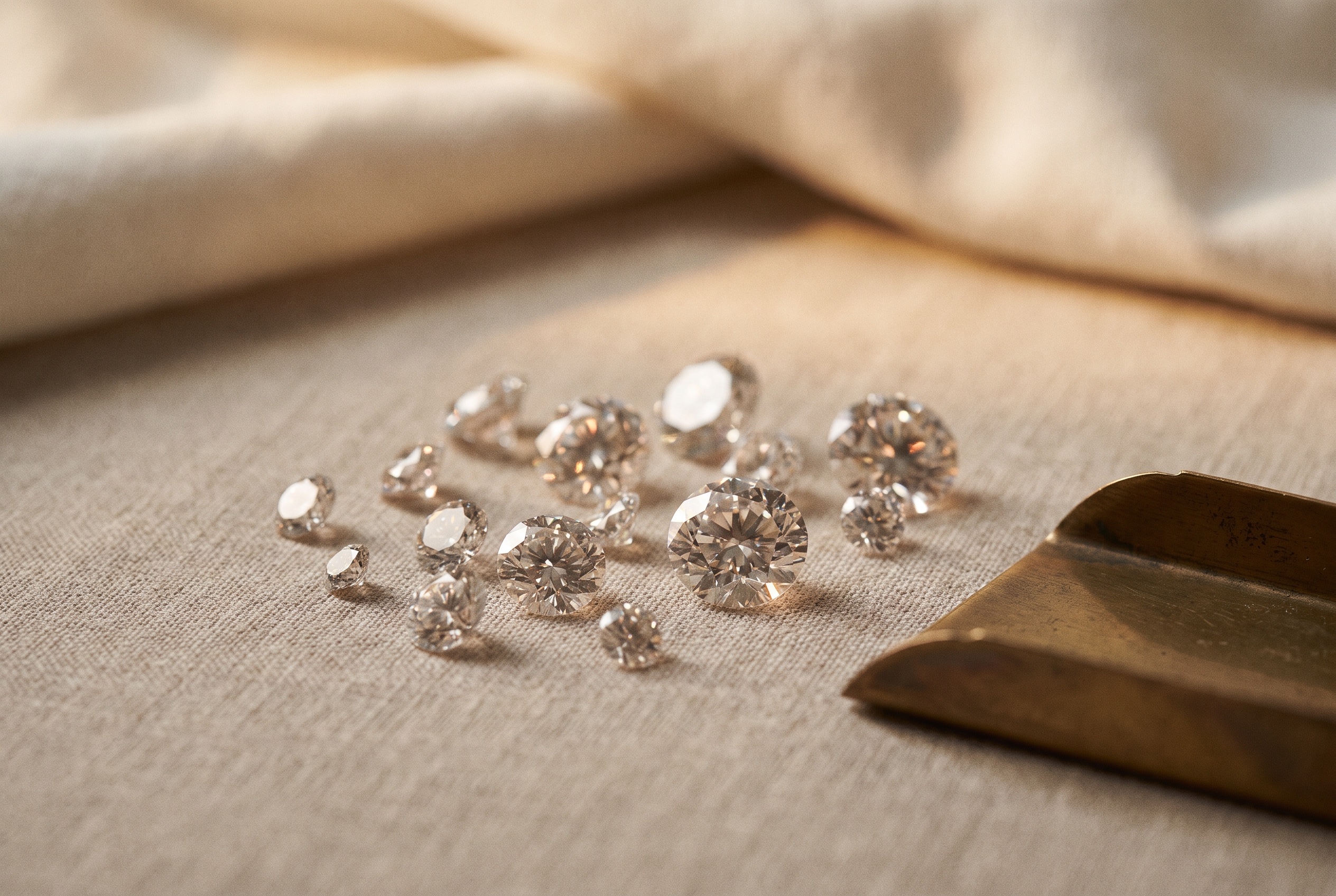
Natural loose diamonds are unmounted stones formed geologically over hundreds of millions to billions of years and mined from the earth, sold individually rather than set into jewelry — distinct from lab-grown (CVD) diamonds, which are chemically identical but produced in a controlled growth chamber over weeks. For wholesale buyers, natural loose diamonds remain the category driven most by rarity, provenance, and certification confidence rather than production cost, and sourcing them well means understanding a different set of tradeoffs than lab-grown sourcing requires. This guide covers how natural loose diamonds are graded, priced, and verified, and what a trade buyer should check before building a natural-stone program alongside an existing lab-grown line.
Even as lab-grown diamond has become the fastest-growing share of the wholesale trade, natural loose diamonds remain a distinct and durable category with buyers who specifically want a naturally formed stone — for its rarity, its resale and investment characteristics, or simply because a segment of the customer base still associates "diamond" with the natural product specifically, and expects a jeweler's case to reflect that even alongside a growing lab-grown selection. This guide is a practical resource for a jeweler or designer sourcing natural loose diamonds: how natural stones are graded and certified, what drives price at different carat and quality tiers, how to think about provenance and conflict-free sourcing, how natural pricing compares to lab-grown at equivalent specs, and what separates a trustworthy natural-stone supplier from a risky one.
What Makes a Diamond "Natural"
A natural diamond forms through geological processes — carbon subjected to extreme heat and pressure deep in the earth's mantle, over a timescale ranging from roughly 1 billion to 3.5 billion years, before being brought to the surface through volcanic activity and eventually mined. This is the defining distinction from lab-grown (CVD) diamonds, which are chemically and crystallographically identical carbon but grown in a matter of weeks inside a controlled chamber. The physical and optical properties of a natural diamond and a lab-grown diamond of equivalent grade are indistinguishable to the naked eye and require specialized lab equipment to differentiate — but origin itself (natural formation versus lab growth) is a permanent, non-negotiable fact about a given stone that certification exists specifically to document and disclose.
Natural Loose Diamonds: Certification and Grading
Natural loose diamonds at 0.30ct and above are typically individually certified by GIA, IGI, or GCAL, with the certificate documenting the standard 4Cs (carat, cut, color, clarity) along with a clarity plot mapping the stone's specific inclusions and, for natural stones specifically, an explicit origin statement confirming the diamond is natural rather than lab-grown or treated. GIA in particular carries the deepest trade recognition specifically for natural diamond grading, built over decades as the standard-setting lab for the natural stone market, though IGI and GCAL are both widely accepted and used across natural inventory as well. A natural diamond's certificate should also disclose any treatments (clarity enhancement, color treatment via irradiation or HPHT processing) — undisclosed treatment is one of the more serious integrity issues a buyer needs to guard against in natural sourcing specifically, since treated stones carry meaningfully lower value than untreated stones of the same visible grade.
Natural vs. Lab-Grown Loose Diamonds: Comparison
| Factor | Natural Loose Diamonds | Lab-Grown (CVD) Loose Diamonds |
|---|---|---|
| Formation | Geological, over roughly 1-3.5 billion years | Grown in a controlled chamber, typically weeks |
| Physical/chemical properties | Identical to lab-grown at equivalent grade | Identical to natural at equivalent grade |
| Price at equivalent specs | Significantly higher, driven by natural rarity | Significantly lower, reflecting production cost |
| Supply predictability | Finite, mining-dependent, subject to geological scarcity | Scalable production, less supply-constrained |
| Resale/investment positioning | Stronger secondary-market and investment narrative | Developing secondary market, less established |
| Certification | GIA, IGI, GCAL with explicit natural-origin statement | GIA, IGI, GCAL with explicit lab-grown disclosure |
What Drives Natural Diamond Pricing
Natural diamond pricing follows the same 4C framework as any diamond, but the underlying scarcity dynamics behind each factor are different from lab-grown, where production can (within limits) be steered toward whatever specs the market wants most. In natural stones, supply of any given combination of carat weight, color, and clarity is fixed by what the earth actually produced and what got mined — which is why exceptional natural combinations (a large, high-color, high-clarity natural stone) carry a size-and-rarity premium that compounds faster than the equivalent lab-grown combination does, since lab-grown supply can, in principle, be produced to meet demand at a given spec far more readily than nature can be persuaded to produce more of a rare natural combination. This is the core reason natural and lab-grown pricing, once close to comparable per-carat at the same grade years ago, have diverged so significantly as lab-grown production has scaled while natural supply has stayed structurally fixed — a gap that shows no sign of narrowing back given how differently the two supply chains actually behave.
Provenance and Conflict-Free Sourcing
Provenance — where and how a natural diamond was mined — matters to a growing share of both trade buyers and end consumers, driven by conflict-diamond concerns and broader interest in supply chain transparency. The Kimberley Process Certification Scheme is the baseline industry mechanism preventing conflict diamonds (stones mined to fund armed conflict) from entering the legitimate supply chain, and any natural diamond moving through legitimate wholesale channels should carry Kimberley Process compliance as a baseline, not an optional extra. Beyond that baseline, some buyers and suppliers pursue additional traceability (documented mine-of-origin, chain-of-custody tracking) as a further differentiator, though this remains less standardized industry-wide than Kimberley Process compliance itself. See our conflict-free diamonds guide and ethically sourced diamonds guide for the fuller picture on sourcing standards.
Carat Tiers and Availability in the Natural Loose Market
Natural loose diamond availability thins out meaningfully as carat weight climbs, in a way lab-grown availability doesn't to nearly the same degree:
- Under 1 carat — the deepest, most liquid tier of the natural market, with broad availability across every shape and quality grade.
- 1-2 carats — still a well-stocked, standard trade tier, covering the bulk of natural center-stone demand for engagement and statement pieces.
- 3-5 carats — meaningfully less available; natural stones in this range are more often sourced to order than pulled from open stock, and price per carat rises faster than the linear jump in size would suggest.
- 5+ carats — specialty tier, typically requiring direct sourcing relationships and longer lead times, with individual stone value driven heavily by the specific combination of size, color, and clarity rather than a standard per-carat rate.
Fancy Color Natural Diamonds
Natural fancy color diamonds (yellow, pink, blue, green, and other hues occurring from trace elements or structural anomalies during formation) represent an even more constrained supply than natural white diamonds, since color-causing formation conditions are themselves rare on top of the base rarity of natural diamond formation generally. Fancy color natural stones carry their own grading scale (intensity from Faint through Fancy Vivid) alongside the standard clarity and cut assessment, and pricing for a natural fancy color stone can exceed a comparably sized colorless natural diamond by a substantial multiple at the top intensity grades. This is a distinct sourcing category from fancy color melee or lab-grown fancy color stones, and a buyer specifically seeking natural fancy color inventory should expect longer sourcing timelines and more individualized pricing than standard white diamond sourcing.
How to Evaluate a Natural Loose Diamond Supplier
- Certification transparency. Every natural stone above 0.30ct should carry a verifiable GIA, IGI, or GCAL report with report numbers a buyer can independently check through the issuing lab.
- Explicit treatment disclosure. Any color or clarity treatment should be stated plainly on the certificate — a supplier vague about treatment history on natural inventory is a real risk.
- Kimberley Process compliance as a baseline. This should be a given, not a selling point requiring extra verification, for any legitimate natural diamond supplier.
- Clear natural-vs-lab-grown separation in inventory and paperwork. A supplier carrying both categories should never blur the two — mislabeling or inconsistent disclosure between natural and lab-grown stock is a serious integrity issue, not a minor administrative one.
- Realistic lead times at larger carat weights. A supplier promising in-stock availability across every carat tier in natural stones, including 5ct+, without qualification, is either overstating their inventory or blurring the natural/lab-grown line somewhere in the catalog.
Shape Availability in Natural Loose Diamonds
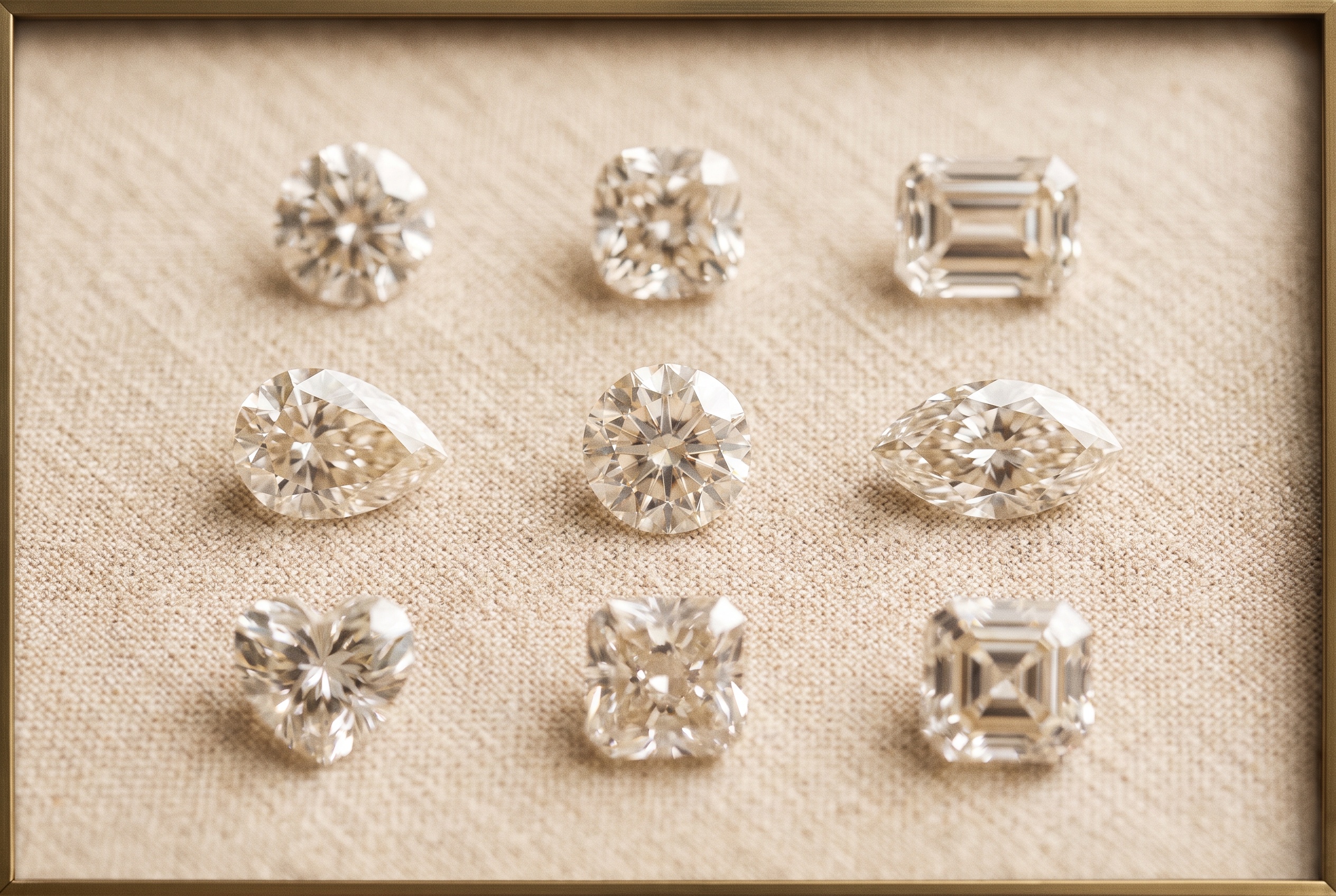
Natural rough doesn't form in a shape that maps cleanly to any particular finished cut, so which shapes a cutter can efficiently produce from a given piece of rough — and therefore which shapes are more or less available in the natural market — is itself a function of natural supply rather than pure market demand. Round brilliant remains the most common finished shape across both natural and lab-grown inventory, since it's the most light-performance-efficient cut for a wide range of rough shapes and carries the deepest buyer familiarity. Beyond round, natural supply of the popular fancy shapes (oval, cushion, pear, emerald, princess) tracks reasonably closely with lab-grown availability at the mid carat tiers for a buyer sourcing standard inventory rather than something unusual, but antique and exotic cuts — Old Mine, Old European, Kite, Hexagonal, and similar historic styles — are where natural sourcing gets genuinely more specialized, since these cuts are less commonly re-created from modern rough at volume and more often either recut from period stones or custom-cut to order by a cutter with the specific expertise those styles require. See our Old Mine cut guide and Old European cut guide for more on sourcing this end of the natural market specifically.
Natural Diamonds and Resale/Investment Positioning
A meaningful share of natural diamond demand, particularly at larger carat weights and higher quality tiers, is driven by buyers thinking about the stone's long-term value retention and resale potential rather than purely its appearance in a finished piece. Natural diamonds have an established secondary market — auction houses, estate sales, and trade buyback channels — built over more than a century of natural diamond commerce, giving natural stones a resale infrastructure that the lab-grown category, still comparatively young as a mainstream product, hasn't yet developed to the same depth. This is a genuine, defensible differentiator for natural stones specifically and one that's fair to communicate to a customer weighing the two categories, separate from any claim about physical quality or beauty, where the two are equivalent at matching grades. It's worth being precise with customers that "better resale infrastructure" is not the same claim as "guaranteed appreciation" — natural diamond resale value depends heavily on the specific stone's grade, size, and market conditions at time of resale, same as any other collectible or luxury asset category.
Common Mistakes When Sourcing Natural Loose Diamonds Wholesale
- Assuming certification alone guarantees no treatment. Always read the certificate's treatment disclosure line specifically rather than assuming a graded report means untreated — treated stones are legitimately certified too, just with the treatment noted.
- Skipping independent report verification on a new supplier. A report number that doesn't check out against the issuing lab's own database is a serious red flag, and it takes only a couple of minutes to verify.
- Not asking about Kimberley Process compliance directly. It should be standard, but a buyer working with a new or smaller supplier should confirm it explicitly rather than assume.
- Expecting natural pricing to track lab-grown pricing declines. Natural diamond pricing moves on a different set of supply dynamics than lab-grown, and a buyer expecting natural prices to fall the way lab-grown prices have over the past several years will be consistently surprised by natural market behavior.
- Blurring natural and lab-grown inventory in customer-facing descriptions. Even when a supplier's own paperwork is clean, a retailer needs to carry that same clarity through to their own product listings and sales conversations — origin confusion at the point of sale is a trust problem that falls on the retailer, not just the original supplier.
Building a Mixed Natural and Lab-Grown Program
Most jewelers today stock both natural and lab-grown loose diamonds side by side, positioning them as genuinely different products for different customer priorities rather than treating lab-grown as a discount substitute for natural. A customer choosing natural is typically prioritizing rarity, resale narrative, or an emotional connection to the stone's geological origin; a customer choosing lab-grown is typically prioritizing value-per-carat or sustainability positioning. Sourcing both categories from a single supplier — with consistent certification standards and clear labeling across the whole catalog — keeps that distinction clean for the retailer's own customers, which matters more in natural-vs-lab-grown specifically than in almost any other diamond sourcing decision, given how much of the natural category's value proposition rests on buyer confidence in origin claims.
Melee and Accent Stones: Natural vs. Lab-Grown
Below the individually certified threshold, natural melee (small accent stones, typically under 0.30ct) is sold as quality-controlled parcel goods against a color/clarity baseline, similar in structure to how lab-grown melee is sold — but natural melee sourcing carries its own scarcity dynamics, since natural melee-sized rough is itself a byproduct of the broader natural mining supply chain rather than something that can be produced to meet demand the way lab-grown melee can. A program mixing natural center stones with lab-grown melee, or vice versa, is common practice and not a quality or integrity issue on its own, provided the distinction is disclosed accurately in the finished piece's description — buyers should never assume melee accompanying a natural center stone is automatically also natural without confirming it directly.
Documentation to Request Before a Natural Loose Diamond Purchase
Beyond the grading certificate itself, a thorough wholesale buyer sourcing natural loose diamonds — particularly at larger carat weights or for a first order with a new supplier — should expect to request and receive a clear paper trail covering the certificate with a verifiable report number, an explicit statement of Kimberley Process compliance, disclosure of any treatment history, and, where relevant to the buyer's own positioning, any additional provenance documentation the supplier can provide about the stone's mining origin. None of this should require unusual effort from a legitimate supplier — the paperwork already exists as part of how a properly sourced natural stone moves through the trade, and a supplier who treats a documentation request as burdensome or unusual is signaling something worth taking seriously before committing to the purchase, particularly on a larger or repeat order where the cost of an integrity problem surfacing later far outweighs the small friction of asking upfront.
Sourcing Natural Loose Diamonds Through Guru Diam
Guru Diam carries natural diamonds alongside its CVD lab-grown catalog — never positioned narrowly as a lab-grown-only manufacturer — with certified loose stones available in IGI, GIA, and GCAL, and clear separation maintained between natural and lab-grown inventory throughout the catalog and paperwork, so buyers always know exactly which category a given stone belongs to. Trade buyers get one supplier across both categories, plus finished jewelry and custom builds, rather than sourcing natural stones from one dealer and lab-grown from another. Same-day shipping applies to in-stock inventory out of the New York (before 6pm EST) and Los Angeles (before 4pm PST) offices — one vendor, one shipment, one relationship across both natural and lab-grown sourcing. Browse certified diamonds and fancy color loose diamonds for natural inventory, review trade terms at the trade partner page, or explore the full wholesale hub.
Frequently Asked Questions
What is the difference between natural and lab-grown loose diamonds?
Natural diamonds form geologically over roughly 1-3.5 billion years and are mined from the earth; lab-grown (CVD) diamonds are chemically and physically identical carbon but grown in a controlled chamber over a matter of weeks. Both require specialized lab equipment to distinguish, since neither is visually different to the naked eye.
Why are natural loose diamonds more expensive than lab-grown at the same specs?
Natural supply at any given carat, color, and clarity combination is fixed by what mining actually produces, while lab-grown production can be steered toward the specs the market wants most. That structural scarcity difference is the core driver of the price gap between the two categories at equivalent grades.
How do I verify a natural diamond's certification is legitimate?
Every GIA, IGI, or GCAL report includes a report number that can be checked directly through the issuing lab's own online verification tool — always confirm this independently, especially with a new supplier.
What is the Kimberley Process and why does it matter for natural diamonds?
The Kimberley Process Certification Scheme is the industry mechanism preventing conflict diamonds from entering the legitimate trade. Kimberley Process compliance should be a baseline expectation for any legitimate natural diamond supplier, not an optional extra to ask about.
Are natural loose diamonds available in every carat weight?
Availability thins significantly above roughly 3 carats — natural stones in that range and above are more often sourced to order than pulled from open stock, with individual pricing rather than a standard per-carat rate at the top of the range.
Can I source both natural and lab-grown loose diamonds from the same wholesale supplier?
Yes, and it's common practice — but the supplier should maintain clear, consistent labeling and certification separation between the two categories throughout the catalog, since buyer confidence in origin claims matters more in natural sourcing than almost anywhere else in the trade.
Do natural diamonds hold their value better than lab-grown diamonds?
Natural diamonds have a more established secondary and resale market built over a much longer commercial history, which gives them stronger resale infrastructure than lab-grown stones today. That's a real difference in market maturity, not a guarantee of appreciation — actual resale value still depends on the specific stone's grade and market conditions at time of sale.
What antique or exotic cuts are available in natural loose diamonds?
Old Mine, Old European, Kite, Hexagonal, and other historic cutting styles are more available in natural stones than in most lab-grown catalogs, since they're often recut from period rough or custom-cut to order by cutters with specific expertise in those styles, rather than produced at standard commercial volume.