
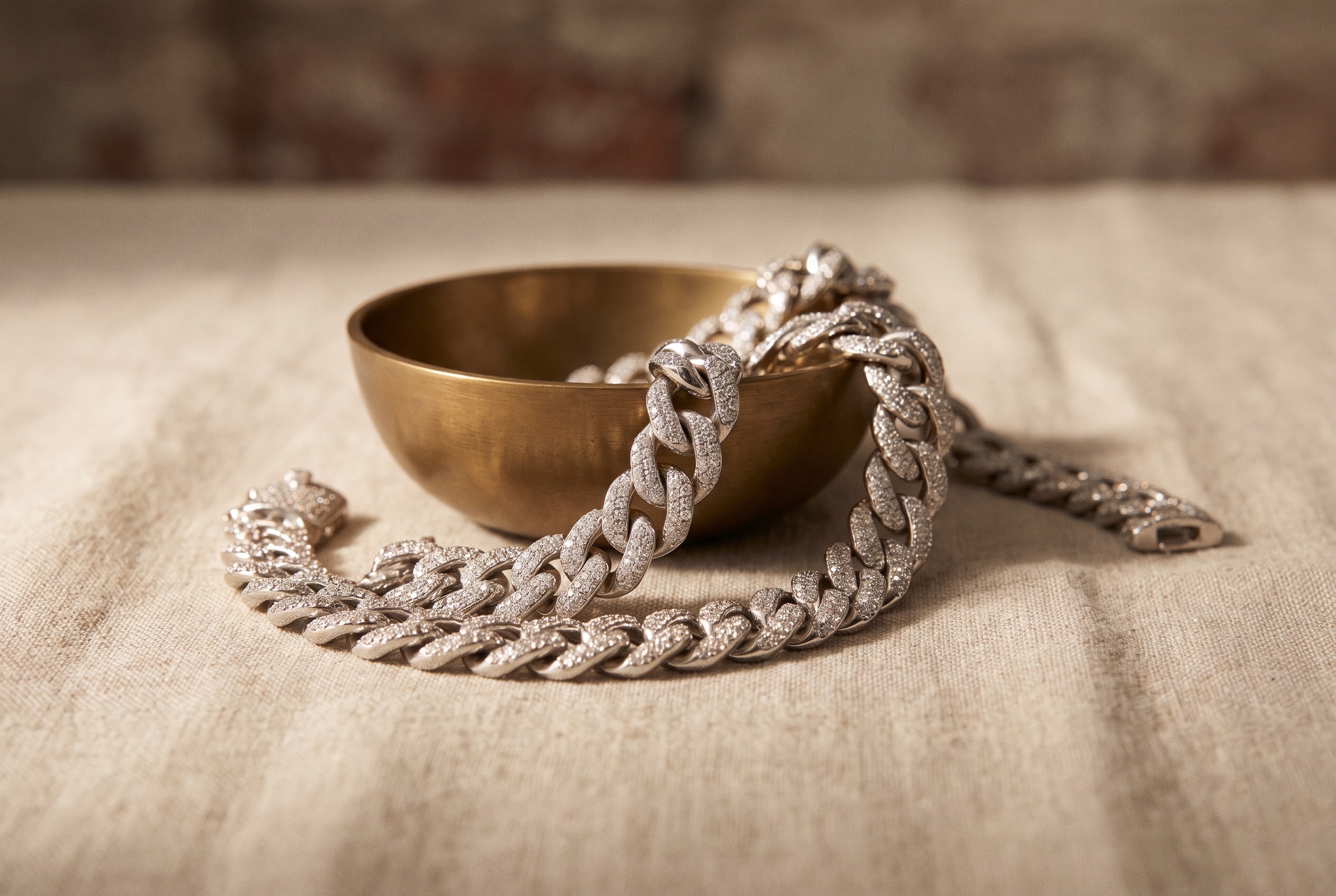
A men's diamond chain is a neck chain — Cuban link, rope, figaro, box, or another traditional link style — set with diamonds along part or all of its length, ranging from a subtle diamond-accented clasp to a fully iced-out chain paved with melee end to end. For a jeweler, the category sits at the intersection of two established product lines: traditional men's chain jewelry (sold historically with little or no diamond content) and diamond-set jewelry more broadly, and sourcing it well means understanding both the chain-construction side and the stone-setting side of the piece.
This guide is written for the trade — retailers, designers, and manufacturers sourcing loose diamonds and melee to build or expand a men's diamond chain line — not a consumer shopping guide. It covers common link styles and how they take diamond setting differently, typical carat and stone-count ranges by construction, and what to look for in a wholesale diamond supplier for this category.
What Defines a Men's Diamond Chain
A men's diamond chain is defined by its base link construction — the same traditional chain styles worn by men for decades — with diamonds added either as a full-coverage pavé treatment or as targeted accents on select links, a clasp, or a pendant element. Unlike women's diamond necklaces, which more often build the diamond setting into the core design from the start, men's chains frequently start from an established plain-chain silhouette and add diamond content as a variant or upgrade tier, which shapes how retailers typically merchandise the category — as a diamond-set option within an existing chain line, not always a standalone diamond jewelry category.
Common Link Styles and How They Take Diamond Setting
Cuban Link (Diamond-Paved or Diamond-Accented)
The dominant men's chain style in current demand, characterized by flat, interlocking oval links. Fully diamond-paved Cuban chains — often called "iced-out" Cuban chains in trade and consumer language alike — set melee into the flat face of each link across the chain's full length, representing the highest carat-weight, highest-cost construction in the category. A lighter-touch alternative sets diamonds only on select links or in an alternating pattern, offering a lower entry price point within the same link style.
Rope Chain
A twisted, spiral link construction that takes diamond setting less commonly than Cuban link, since the twisted profile makes continuous full-coverage pavé more structurally complex. When diamonds are added to a rope chain, it's typically as accent stones at intervals along the twist rather than full coverage.
Figaro Chain
An alternating pattern of oval and elongated links, traditionally worn plain or with minimal diamond content historically, but increasingly offered with diamond accents on the elongated links as a distinctive design variation within the category.
Box Chain
Square, uniform links forming a rigid, structured chain — a less common base for full diamond paving than Cuban link, but a clean, geometric option for diamond accents on select links or at a diamond-set pendant connection point.
| Link Style | Typical Diamond Treatment | Relative Cost |
|---|---|---|
| Cuban link | Full pavé or select-link accents | Highest for full pavé, moderate for accents |
| Rope chain | Interval accent stones | Moderate |
| Figaro chain | Accents on elongated links | Moderate |
| Box chain | Select-link accents or pendant connection | Lower to moderate |
Typical Stone Sizes and Total Carat Weight by Construction
Fully diamond-paved Cuban chains represent one of the largest total-carat-weight commitments in men's diamond jewelry, since a full-length chain paving every link can carry anywhere from 10ct to well over 30ct of combined melee weight depending on chain length and link size — a materially larger sourcing commitment than most other diamond jewelry categories, men's or women's. Individual stones in a fully paved chain typically run 0.02ct to 0.06ct each, small enough to sit flush within a link's flat face without disrupting the chain's flexibility. Select-link accent constructions use far less total weight, often 1ct to 4ct combined depending on how many links carry stones, offering a meaningfully lower entry price point within the same base chain style.
Color and Clarity Standards for Men's Chain Melee
Because a fully paved chain presents diamonds across a large, continuous, closely viewed surface, parcel consistency matters enormously — an inconsistent parcel with visible color or clarity variation between links reads immediately at normal viewing distance across a surface this large, more so than on a smaller diamond jewelry piece. A DEF+/VS+ commercial melee standard, sorted and shipped in genuinely calibrated, size- and quality-matched parcels, is the baseline this construction requires. Select-link accent constructions have somewhat more tolerance for minor stone-to-stone variation, since fewer stones sit in isolation rather than in an unbroken field.
Lab-Grown vs. Natural Diamonds for Men's Chains
Given the substantial total carat weight a fully paved chain can carry, CVD lab-grown material is close to a commercial necessity for this specific construction — sourcing 15ct to 30ct of natural melee for a single chain would push the finished piece's cost into a range that puts it out of reach for all but a narrow luxury segment of the market. Lab-grown material makes a fully iced-out men's chain commercially viable at a meaningfully broader range of price points, which has been a significant factor in the category's growth. Select-link accent chains, carrying far less total weight, work reasonably in either lab-grown or natural material, giving retailers more flexibility to offer a natural-stone version at that lighter-touch construction level.
Chain Length and Diamond Coverage Considerations
Men's chains are commonly sold in longer lengths than women's necklaces — 20 to 24 inches is a typical range, compared to 16 to 18 inches for a standard women's necklace — which directly affects total stone count and carat weight for any given per-link diamond treatment. Retailers should account for this length difference explicitly when planning inventory and pricing tiers, since a diamond treatment that reads as a moderate carat commitment at women's necklace length becomes a substantially larger one at typical men's chain length, purely as a function of the additional inches of chain being covered.
Clasp and Closure Construction for Diamond Chains
A fully paved men's chain carries meaningful weight from its total metal and stone content, which makes clasp strength and durability a more important engineering consideration than on a lighter women's necklace. Box clasps and lobster clasps reinforced for higher load-bearing capacity are standard on heavier fully paved chains, and retailers sourcing this category should confirm a manufacturing partner's clasp specification is rated appropriately for the finished piece's actual weight rather than assuming a standard clasp used on lighter jewelry will hold up under daily wear on a substantially heavier chain.
Building a Men's Diamond Chain Program: Inventory Planning
- Stock melee sized for flush link-face setting (0.02ct–0.06ct) as the primary standing inventory for full-pavé construction.
- Source large, genuinely calibrated parcels specifically for full-pavé chains, where consistency across 10ct-plus of combined weight is essential to a clean finished look.
- Weight material sourcing heavily toward CVD lab-grown for full-pavé construction to keep the category commercially accessible at scale.
- Offer both link-style and coverage-level tiers (Cuban vs. rope vs. figaro; full pavé vs. select-link accents) to cover a wide price range within one category.
- Confirm clasp load rating matches the finished piece's actual weight before committing to volume production.
Pricing a Men's Diamond Chain: What Drives the Final Cost
Total carat weight is the dominant cost driver in this category by a wide margin, given how much combined weight a full-length, fully paved chain can carry relative to most other diamond jewelry pieces. Link style and chain length are secondary but still meaningful factors — a longer chain in the same link style and coverage level simply requires more total stones and metal. Setting labor also factors meaningfully into cost for full-pavé construction, since setting continuous melee across dozens or hundreds of individual links is considerably more labor-intensive than setting a smaller number of accent stones at intervals.
The Iced-Out Trend and What's Driving Demand
Fully diamond-paved men's chains have grown substantially as a category alongside broader "iced-out" jewelry trends in men's fashion and hip-hop-adjacent style culture, where visible, substantial diamond coverage functions as a status and style statement in its own right, distinct from the more understated diamond accents traditionally associated with men's jewelry. Retailers entering or expanding this category should recognize that the customer base driving fully paved chain demand often wants maximum visible coverage and presence at a given budget rather than prioritizing the highest individual stone grade — which has direct sourcing implications, favoring well-calibrated, consistently graded commercial melee at scale over smaller quantities of higher-grade stones.
Photographing and Marketing Men's Diamond Chains
Because diamond coverage across a full chain length is central to how a fully paved piece reads, flat-lay photography of a coiled or laid-out chain often understates the finished look compared to on-model photography showing the chain actually worn at typical neck length, where the light play across dozens of continuous stones is much more visible in motion and under natural lighting. Retailers marketing this category, particularly online, benefit from investing in on-model shots and short video showing the chain catching light as it would in real wear, since static flat photography tends to undersell the visual impact that's a core part of what drives demand in the fully paved segment of the category specifically.
Common Sourcing Mistakes in Men's Chain Programs
A frequent mistake retailers make entering this category is underestimating the sheer total carat weight a full-length, fully paved chain requires relative to other jewelry categories, leading to under-ordering melee for a planned production run. A second common mistake is sourcing inconsistent parcels for full-pavé work, not accounting for how visible color and clarity variation becomes across dozens of closely spaced, continuously viewed links. A third is underspecifying clasp strength relative to the finished piece's actual weight, leading to durability complaints and returns after the piece is in customer hands and under daily wear.
Durability and Repair Considerations for Daily-Wear Chains
Diamond-set men's chains worn daily are exposed to more physical stress — friction against clothing, incidental impacts, regular flexing at each link — than most occasion-only jewelry, which has direct implications for setting method and long-term durability. Melee set into a link's flat face needs a setting style secure enough to withstand this level of daily contact without stones loosening or falling out over time, and retailers should confirm with a manufacturing partner that the setting method used for full-pavé chain work has actually been tested for this kind of sustained daily-wear stress, not just adapted from a setting technique designed for lower-contact jewelry. Retailers should also plan for a straightforward prong-check and re-tightening service as part of their standard care offering for this category, since daily-wear diamond chains benefit from periodic inspection more than most other diamond jewelry a customer might wear only occasionally.
Diamond Shape Choices for Men's Chain Construction
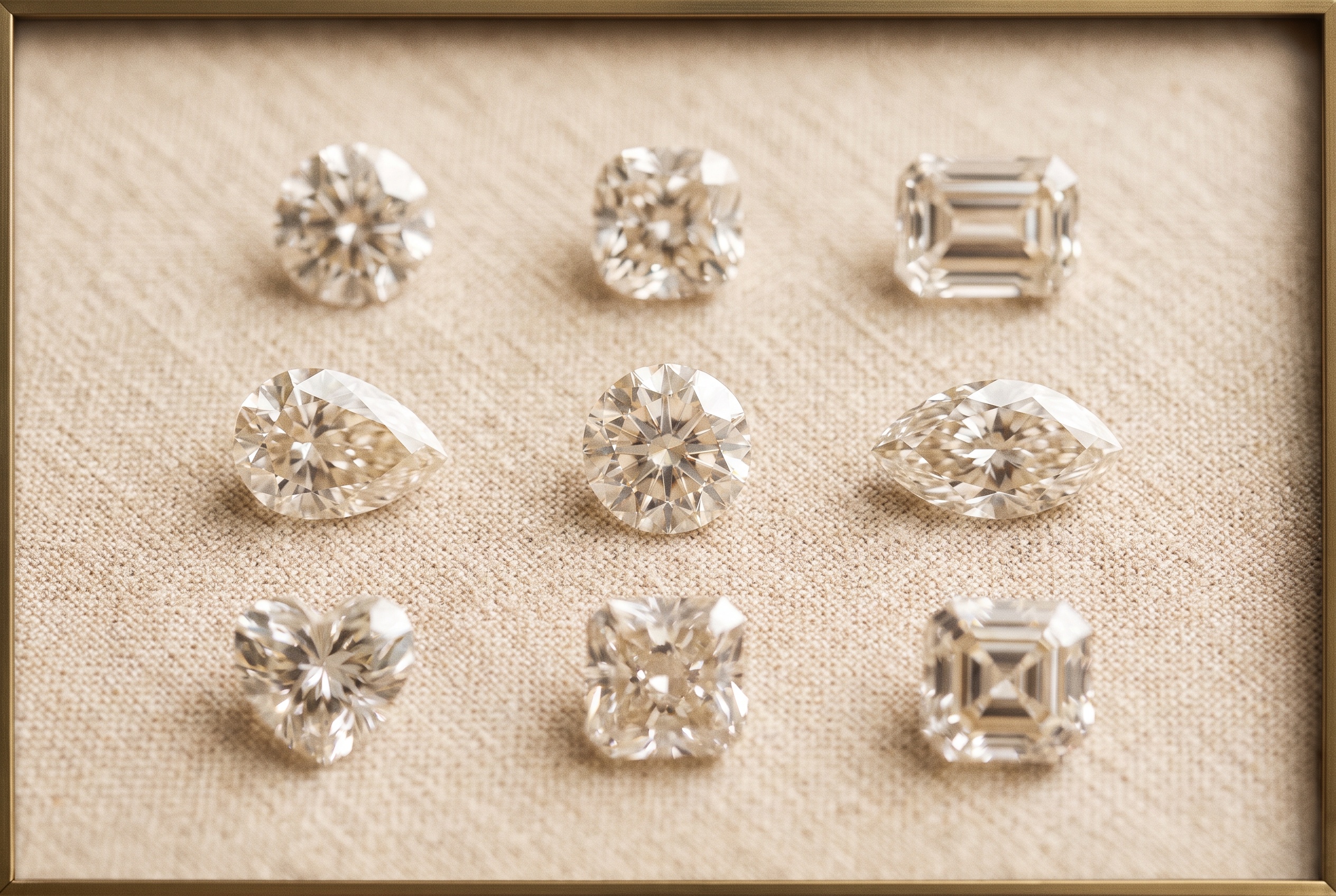
Round brilliant dominates men's diamond chain construction for the same reasons it dominates other continuous-coverage diamond jewelry: consistent brilliance and an efficient, symmetrical outline that packs cleanly across a link's flat face with minimal visible gap. Baguette-cut stones appear occasionally in more architectural, geometric chain designs, set in a channel along select links rather than the full round-melee approach, offering a distinctive visual alternative for retailers looking to differentiate a chain line from the standard fully round-set look.
Manufacturing Timelines for Men's Diamond Chains
Full-pavé men's chains generally require longer manufacturing lead times than lighter select-link accent chains, purely as a function of the setting labor involved in mounting melee continuously across a full chain length — meaningfully more bench time than accenting a fraction of the links. Retailers offering custom men's chain commissions, whether a custom length adjustment or a bespoke coverage pattern, should set clear lead-time expectations upfront and work with a manufacturing partner experienced specifically in continuous chain-link setting, since that skill set doesn't fully overlap with general ring or pendant-setting experience. Guru Diam finishes custom pieces, including men's diamond chains, in 4-6 days.
Merchandising Men's Diamond Chains Alongside Existing Men's Jewelry
Retailers already carrying plain men's chains, men's rings, and other men's jewelry categories are well positioned to introduce diamond chains as a natural upsell within an existing men's jewelry section, rather than building an entirely separate category from scratch. Cross-merchandising a diamond chain alongside a retailer's men's diamond ring line, for instance, gives sales staff a coordinated upsell path for a customer already shopping the men's diamond jewelry category, rather than treating chains as an isolated product line disconnected from the rest of the men's assortment.
Layering and Stacking: How Men's Chains Are Worn Today
Men's chain purchasing has shifted meaningfully toward layering multiple chains at once — a plain heavier chain, a lighter diamond-set chain, and a pendant chain worn together at different lengths — rather than a single chain worn in isolation, mirroring a broader layering trend that has also driven growth in women's stackable rings. This has real merchandising implications: retailers who present diamond chains only as a single standalone purchase decision are missing the more common way customers are actually buying into the category now, which is incrementally, chain by chain, building a personal layered stack over multiple purchases. Retailers who instead present a diamond chain explicitly as part of a layering system — recommending complementary lengths and styles to pair with a customer's existing chains, or merchandising a starter multi-chain set — tend to see stronger average order value and repeat purchase behavior than those selling chains as isolated, one-off items.
Weight and Comfort Considerations for Daily Wear
Because men's chains, diamond-set or otherwise, are frequently worn daily rather than reserved for occasion wear, total finished weight is a practical consideration retailers should discuss with customers beyond the diamond content itself. A fully paved chain carries substantial metal weight in addition to its stone weight, and a customer unaccustomed to wearing heavier jewelry daily may find an extremely substantial fully paved chain less comfortable for constant wear than a lighter select-link accent chain, even if both fall within the same overall budget range. Retailers benefit from stocking or being able to produce chains across a genuine weight range — not just a price range — so a customer prioritizing all-day comfort has a real option distinct from one prioritizing maximum visible diamond coverage.
Combining Diamond Chains With Pendants
A diamond chain frequently serves double duty as the base for a separately sourced pendant — a religious symbol, an initial, a custom design element — rather than being worn as a standalone piece. Retailers building out a men's diamond chain program should consider pendant compatibility as part of chain design from the outset: a chain link style and clasp mechanism should accommodate a range of common pendant bail sizes without requiring a customer to have a chain custom-modified after the fact just to add a pendant they already own or plan to source separately. This is a small design consideration with outsized impact on customer satisfaction, since a chain that doesn't comfortably accept a customer's intended pendant creates friction well after the original sale is complete.
Sourcing Diamonds for a Men's Diamond Chain Line Wholesale
Guru Diam supplies CVD lab-grown melee in the calibrated sizes and volumes full-pavé men's chain construction requires, sorted to a consistent DEF+/VS+ quality baseline, alongside select-link and accent-scale melee for lighter constructions. Trade buyers can review current melee inventory through matching pairs and certified diamonds, and work with Guru Diam's custom jewelry team on chain construction and setting through custom jewelry. In-stock inventory ships same-day from Guru Diam's New York and Los Angeles locations. New trade accounts can apply through trade partner, with current terms available at the wholesale hub. For related men's jewelry sourcing guides, see our men's diamond ring guide and men's diamond earrings guide.
A Note on Chain Weight Units and Buying by the Gram
Unlike most diamond jewelry, where price is discussed primarily in terms of stone carat weight and grade, men's chains are traditionally also priced and discussed partly in terms of metal weight — grams or pennyweight — a holdover from the category's origins as primarily a metal-value piece rather than a diamond-centric one. Retailers and buyers newer to diamond chains specifically should understand that a fully paved chain's total price reflects both components together: metal weight and construction at the traditional chain-jewelry per-gram basis, plus diamond content priced the way any other diamond jewelry is priced, by total carat weight and quality grade. Quoting or comparing chains using only one of these two components, without accounting for the other, is a common source of confused price comparisons between suppliers for buyers unfamiliar with how the category's pricing conventions differ from single-stone diamond jewelry.
Frequently Asked Questions
How many carats are in a fully diamond-paved men's chain?
A fully paved Cuban-link chain commonly carries anywhere from 10ct to over 30ct of combined melee weight, depending on chain length and link size — one of the largest total-carat commitments in men's diamond jewelry.
Should a men's diamond chain be lab-grown or natural?
For fully paved chains carrying substantial total weight, CVD lab-grown material offers a major cost advantage, making the piece commercially accessible at a broader range of price points. Lighter, select-link accent chains work well in either material.
What chain style is most common for diamond setting?
Cuban link is the dominant men's chain style for diamond setting, taking both full pavé and select-link accent treatments. Rope, figaro, and box chains take diamond setting less commonly, usually as interval or select-link accents.
What diamond shape is used in men's diamond chains?
Round brilliant dominates, packing efficiently across a link's flat face with minimal visible gap. Baguette-cut stones appear occasionally in more architectural chain designs, set in a channel along select links.
How long does a custom men's diamond chain take to produce?
Guru Diam finishes custom pieces, including men's diamond chains, in 4-6 days. Full-pavé constructions generally take longer bench time than lighter accent chains due to the additional setting labor.
What quality standard should men's chain melee meet?
A DEF+/VS+ commercial melee standard, sorted and shipped as genuinely calibrated, size- and quality-matched parcels, is the right baseline for full-pavé construction, where consistency across a large continuous surface matters most.
Guru Diam is a trade-only wholesale diamond supplier with locations in New York and Los Angeles, supplying calibrated CVD lab-grown melee and custom jewelry production for retailers building men's diamond chains and other men's diamond jewelry lines. Browse current melee inventory in matching pairs or apply for a trade account through trade partner.